Element of differential geometry                           Riemannian geometry    No Riemannian geometry


           Element of differential geometry and applications
                     to probability and statistics

                                          J´rˆme Lapuyade-Lahorgue
                                           eo


J´rˆme Lapuyade-Lahorgue
 eo                                                                                             1/ 49
Element of differential geometry and applications to probability and statistics
Element of differential geometry                           Riemannian geometry    No Riemannian geometry


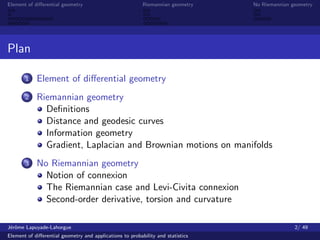
Plan

       1    Element of differential geometry
       2    Riemannian geometry
              Definitions
              Distance and geodesic curves
              Information geometry
              Gradient, Laplacian and Brownian motions on manifolds
       3    No Riemannian geometry
              Notion of connexion
              The Riemannian case and Levi-Civita connexion
              Second-order derivative, torsion and curvature

J´rˆme Lapuyade-Lahorgue
 eo                                                                                             2/ 49
Element of differential geometry and applications to probability and statistics
Element of differential geometry                           Riemannian geometry    No Riemannian geometry


Main definitions


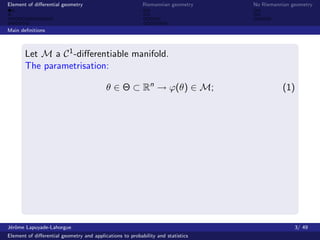
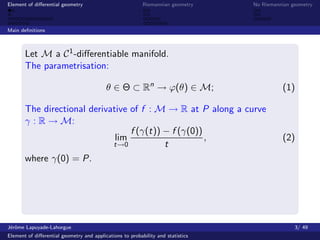
       Let M a C 1 -differentiable manifold.
       The parametrisation:

                                          θ ∈ Θ ⊂ Rn → ϕ(θ) ∈ M;                           (1)


J´rˆme Lapuyade-Lahorgue
 eo                                                                                             3/ 49
Element of differential geometry and applications to probability and statistics
Element of differential geometry                           Riemannian geometry    No Riemannian geometry


Main definitions


       Let M a C 1 -differentiable manifold.
       The parametrisation:

                                          θ ∈ Θ ⊂ Rn → ϕ(θ) ∈ M;                           (1)

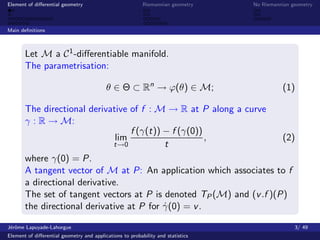
       The directional derivative of f : M → R at P along a curve
       γ : R → M:
                                  f (γ(t)) − f (γ(0))
                              lim                     ,                                    (2)
                             t→0           t
       where γ(0) = P.


J´rˆme Lapuyade-Lahorgue
 eo                                                                                             3/ 49
Element of differential geometry and applications to probability and statistics
Element of differential geometry                           Riemannian geometry    No Riemannian geometry


Main definitions


       Let M a C 1 -differentiable manifold.
       The parametrisation:

                                          θ ∈ Θ ⊂ Rn → ϕ(θ) ∈ M;                           (1)

       The directional derivative of f : M → R at P along a curve
       γ : R → M:
                                   f (γ(t)) − f (γ(0))
                               lim                     ,              (2)
                              t→0           t
       where γ(0) = P.
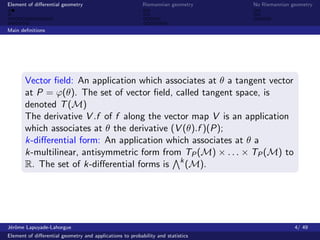
       A tangent vector of M at P: An application which associates to f
       a directional derivative.
       The set of tangent vectors at P is denoted TP (M) and (v .f )(P)
       the directional derivative at P for γ(0) = v .
                                            ˙

J´rˆme Lapuyade-Lahorgue
 eo                                                                                             3/ 49
Element of differential geometry and applications to probability and statistics
Element of differential geometry                           Riemannian geometry    No Riemannian geometry


Main definitions


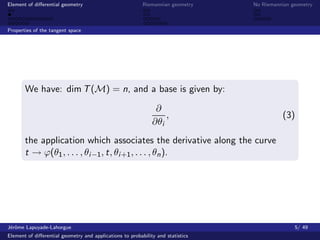
       Vector field: An application which associates at θ a tangent vector
       at P = ϕ(θ). The set of vector field, called tangent space, is
       denoted T (M)
       The derivative V .f of f along the vector map V is an application
       which associates at θ the derivative (V (θ).f )(P);
       k-differential form: An application which associates at θ a
       k-multilinear, antisymmetric form from TP (M) × . . . × TP (M) to
       R. The set of k-differential forms is k (M).


J´rˆme Lapuyade-Lahorgue
 eo                                                                                             4/ 49
Element of differential geometry and applications to probability and statistics
Element of differential geometry                           Riemannian geometry    No Riemannian geometry


Properties of the tangent space


       We have: dim T (M) = n, and a base is given by:

                                                               ∂
                                                                  ,                        (3)
                                                              ∂θi
       the application which associates the derivative along the curve
       t → ϕ(θ1 , . . . , θi −1 , t, θi +1 , . . . , θn ).


J´rˆme Lapuyade-Lahorgue
 eo                                                                                             5/ 49
Element of differential geometry and applications to probability and statistics
Element of differential geometry                           Riemannian geometry                       No Riemannian geometry


Operations on differential forms


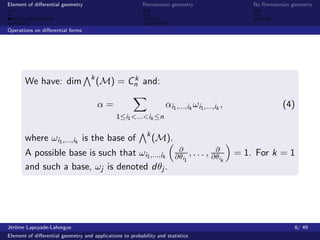
                                    k          k
       We have: dim                     (M) = Cn and:

                                        α=                          αi1 ,...,ik ωi1 ,...,ik ,                 (4)
                                               1≤i1 <...<ik ≤n

                                                            k
       where ωi1 ,...,ik is the base of                         (M).
                                                                         ∂              ∂
       A possible base is such that ωi1 ,...,ik                         ∂θi1 , . . . , ∂θik     = 1. For k = 1
       and such a base, ωj is denoted dθj .


J´rˆme Lapuyade-Lahorgue
 eo                                                                                                                6/ 49
Element of differential geometry and applications to probability and statistics
Element of differential geometry                                Riemannian geometry         No Riemannian geometry


Operations on differential forms


Exterior product


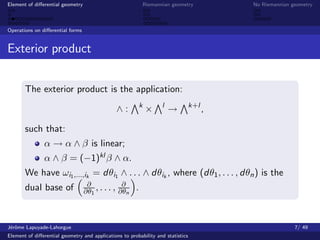
       The exterior product is the application:
                                                           k          l          k+l
                                               ∧:              ×          →            ,

       such that:
               α → α ∧ β is linear;
               α ∧ β = (−1)kl β ∧ α.
       We have ωi1 ,...,ik = dθi1 ∧ . . . ∧ dθik , where (dθ1 , . . . , dθn ) is the
                                   ∂             ∂
       dual base of               ∂θ1 , . . . , ∂θn    .


J´rˆme Lapuyade-Lahorgue
 eo                                                                                                       7/ 49
Element of differential geometry and applications to probability and statistics
Element of differential geometry                           Riemannian geometry             No Riemannian geometry


Operations on differential forms


Integral of differential form


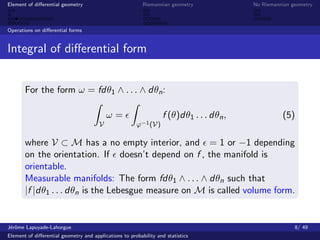
       For the form ω = fdθ1 ∧ . . . ∧ dθn :

                                           ω=                      f (θ)dθ1 . . . dθn ,             (5)
                                       V               ϕ−1 (V)

       where V ⊂ M has a no empty interior, and = 1 or −1 depending
       on the orientation. If doesn’t depend on f , the manifold is
       orientable.
       Measurable manifolds: The form fdθ1 ∧ . . . ∧ dθn such that
       |f |dθ1 . . . dθn is the Lebesgue measure on M is called volume form.


J´rˆme Lapuyade-Lahorgue
 eo                                                                                                      8/ 49
Element of differential geometry and applications to probability and statistics
Element of differential geometry                           Riemannian geometry                       No Riemannian geometry


Operations on differential forms


Restriction of differential form

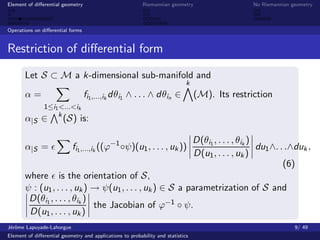
       Let S ⊂ M a k-dimensional sub-manifold and
                                                                             k
       α=                         fi1 ,...,ik dθi1 ∧ . . . ∧ dθin ∈              (M). Its restriction
               1≤i1 <...<ik
                   k
       α|S ∈           (S) is:

                                                                                 D(θi1 , . . . , θik )
       α|S =               fi1 ,...,ik ((ϕ−1 ◦ψ)(u1 , . . . , uk ))                                    du1 ∧. . .∧duk ,
                                                                                 D(u1 , . . . , uk )
                                                                                                               (6)
       where is the orientation of S,
       ψ : (u1 , . . . , uk ) → ψ(u1 , . . . , uk ) ∈ S a parametrization of S and
        D(θi1 , . . . , θik )
                              the Jacobian of ϕ−1 ◦ ψ.
        D(u1 , . . . , uk )
J´rˆme Lapuyade-Lahorgue
 eo                                                                                                                9/ 49
Element of differential geometry and applications to probability and statistics
Element of differential geometry                            Riemannian geometry   No Riemannian geometry


Operations on differential forms


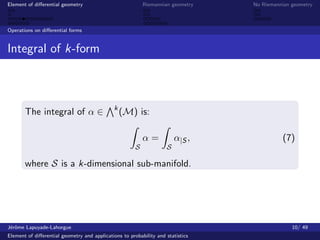
Integral of k-form


                                              k
       The integral of α ∈                        (M) is:

                                                           α=           α|S ,              (7)
                                                       S            S

       where S is a k-dimensional sub-manifold.


J´rˆme Lapuyade-Lahorgue
 eo                                                                                            10/ 49
Element of differential geometry and applications to probability and statistics
Element of differential geometry                           Riemannian geometry    No Riemannian geometry


Operations on differential forms


Border of a manifold and exterior derivative

       Definition
       Let f and g two functions from E to F , f and g are k-homotopic
       if there exists an application:

                            H : [0, 1]k × E → F , with [0, 1]0 = {0, 1} .                  (8)

       such (u1 , . . . , uk ) → H(u1 , . . . , uk , x) continuous,
       H(0, . . . , 0, x) = f (x) and H(1, . . . , 1, x) = g (x).

       Two topological spaces E and F has the same k-homotopy if there
       exists two functions f : E → F and g : F → E such g ◦ f and f ◦ g
       are k-homotopic to the respective identity functions.
J´rˆme Lapuyade-Lahorgue
 eo                                                                                            11/ 49
Element of differential geometry and applications to probability and statistics
Element of differential geometry                           Riemannian geometry    No Riemannian geometry


Operations on differential forms


Border of a manifold and exterior derivative


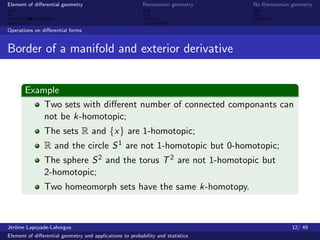
       Example
           Two sets with different number of connected componants can
           not be k-homotopic;
               The sets R and {x} are 1-homotopic;
               R and the circle S 1 are not 1-homotopic but 0-homotopic;
               The sphere S 2 and the torus T 2 are not 1-homotopic but
               2-homotopic;
               Two homeomorph sets have the same k-homotopy.


J´rˆme Lapuyade-Lahorgue
 eo                                                                                            12/ 49
Element of differential geometry and applications to probability and statistics
Element of differential geometry                           Riemannian geometry    No Riemannian geometry


Operations on differential forms


Border of a manifold and exterior derivative

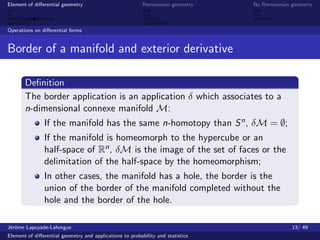
       Definition
       The border application is an application δ which associates to a
       n-dimensional connexe manifold M:
               If the manifold has the same n-homotopy than S n , δM = ∅;
               If the manifold is homeomorph to the hypercube or an
               half-space of Rn , δM is the image of the set of faces or the
               delimitation of the half-space by the homeomorphism;
               In other cases, the manifold has a hole, the border is the
               union of the border of the manifold completed without the
               hole and the border of the hole.

J´rˆme Lapuyade-Lahorgue
 eo                                                                                            13/ 49
Element of differential geometry and applications to probability and statistics
Element of differential geometry                           Riemannian geometry    No Riemannian geometry


Operations on differential forms


Border of a manifold and exterior derivative


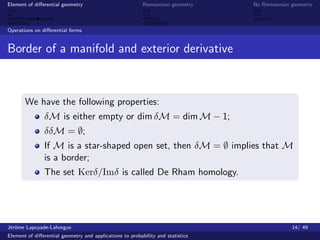
       We have the following properties:
               δM is either empty or dim δM = dim M − 1;
               δδM = ∅;
               If M is a star-shaped open set, then δM = ∅ implies that M
               is a border;
               The set Kerδ/Imδ is called De Rham homology.


J´rˆme Lapuyade-Lahorgue
 eo                                                                                            14/ 49
Element of differential geometry and applications to probability and statistics
Element of differential geometry                           Riemannian geometry           No Riemannian geometry


Operations on differential forms


Border of a manifold and exterior derivative

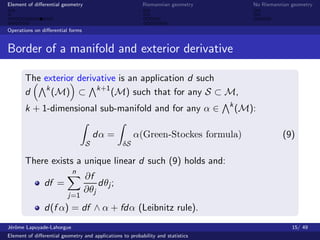
       The exterior derivative is an application d such
            k
       d      (M) ⊂ k+1 (M) such that for any S ⊂ M,
                                                                                 k
       k + 1-dimensional sub-manifold and for any α ∈                                (M):

                                      dα =            α(Green-Stockes formula)                    (9)
                                  S              δS

       There exists a unique linear d such (9) holds and:
                           n
                                  ∂f
               df =                   dθj ;
                                  ∂θj
                          j=1
               d(f α) = df ∧ α + fdα (Leibnitz rule).
J´rˆme Lapuyade-Lahorgue
 eo                                                                                                   15/ 49
Element of differential geometry and applications to probability and statistics
Element of differential geometry                           Riemannian geometry        No Riemannian geometry


Operations on differential forms


Orientation of the border
       Let V = ϕ([0, 1]n ) a n-dimensional sub-manifold such δV = ∅ and
       consider:
                     α = fdθ1 ∧ . . . ∧ θj−1 ∧ θj+1 ∧ . . . ∧ θn     (10)
       We have:

              α =            j               [f (θj = 1) − f (θj = 0)] dθ1 . . . dθj−1 dθj+1 . . . dθn
         δV                       [0,1]n−1
                                           ∂f
                    =        j                 dθ1 . . . dθn
                                  [0,1]n   ∂θj

                    =        j    (−1)j−1            dα.                                            (11)
                                                 V

       So      j   = (−1)j−1 .
J´rˆme Lapuyade-Lahorgue
 eo                                                                                                16/ 49
Element of differential geometry and applications to probability and statistics
Element of differential geometry                           Riemannian geometry    No Riemannian geometry


Operations on differential forms


Properties of the exterior derivative


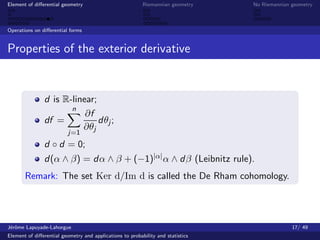
               d is R-linear;
                      n
                          ∂f
               df =           dθj ;
                         ∂θj
                          j=1
               d ◦ d = 0;
               d(α ∧ β) = dα ∧ β + (−1)|α| α ∧ dβ (Leibnitz rule).
       Remark: The set Ker d/Im d is called the De Rham cohomology.


J´rˆme Lapuyade-Lahorgue
 eo                                                                                            17/ 49
Element of differential geometry and applications to probability and statistics
Element of differential geometry                           Riemannian geometry    No Riemannian geometry


Operations on differential forms


Interior derivative


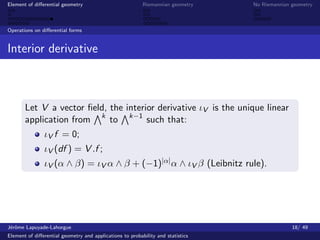
       Let V a vector field, the interior derivative ιV is the unique linear
       application from k to k−1 such that:
               ιV f = 0;
               ιV (df ) = V .f ;
               ιV (α ∧ β) = ιV α ∧ β + (−1)|α| α ∧ ιV β (Leibnitz rule).


J´rˆme Lapuyade-Lahorgue
 eo                                                                                            18/ 49
Element of differential geometry and applications to probability and statistics
Element of differential geometry                           Riemannian geometry    No Riemannian geometry


Lie derivative


Integral curves and flows

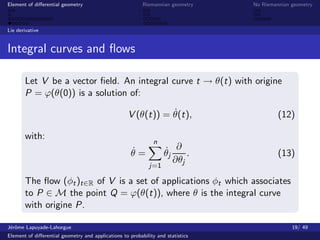
       Let V be a vector field. An integral curve t → θ(t) with origine
       P = ϕ(θ(0)) is a solution of:

                                                               ˙
                                                    V (θ(t)) = θ(t),                      (12)

       with:
                                                              n
                                                     ˙
                                                     θ=            ˙ ∂ .
                                                                   θj                     (13)
                                                                      ∂θj
                                                             j=1

       The flow (φt )t∈R of V is a set of applications φt which associates
       to P ∈ M the point Q = ϕ(θ(t)), where θ is the integral curve
       with origine P.

J´rˆme Lapuyade-Lahorgue
 eo                                                                                            19/ 49
Element of differential geometry and applications to probability and statistics
Element of differential geometry                           Riemannian geometry    No Riemannian geometry


Lie derivative


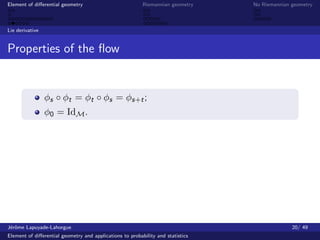
Properties of the flow


                 φs ◦ φt = φt ◦ φs = φs+t ;
                 φ0 = IdM .


J´rˆme Lapuyade-Lahorgue
 eo                                                                                            20/ 49
Element of differential geometry and applications to probability and statistics
Element of differential geometry                           Riemannian geometry    No Riemannian geometry


Lie derivative


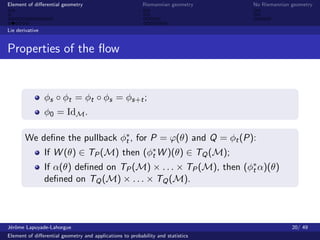
Properties of the flow


                 φs ◦ φt = φt ◦ φs = φs+t ;
                 φ0 = IdM .

       We define the pullback φ∗ , for P = ϕ(θ) and Q = φt (P):
                              t
                 If W (θ) ∈ TP (M) then (φ∗ W )(θ) ∈ TQ (M);
                                          t
                 If α(θ) defined on TP (M) × . . . × TP (M), then (φ∗ α)(θ)
                                                                   t
                 defined on TQ (M) × . . . × TQ (M).


J´rˆme Lapuyade-Lahorgue
 eo                                                                                            20/ 49
Element of differential geometry and applications to probability and statistics
Element of differential geometry                           Riemannian geometry    No Riemannian geometry


Lie derivative


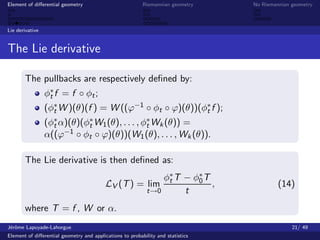
The Lie derivative

       The pullbacks are respectively defined by:
                 φ∗ f = f ◦ φt ;
                  t
                 (φ∗ W )(θ)(f ) = W ((ϕ−1 ◦ φt ◦ ϕ)(θ))(φ∗ f );
                   t                                     t
                 (φ∗ α)(θ)(φ∗ W1 (θ), . . . , φ∗ Wk (θ)) =
                   t        t                  t
                 α((ϕ−1 ◦ φt ◦ ϕ)(θ))(W1 (θ), . . . , Wk (θ)).

       The Lie derivative is then defined as:
                                                                φ∗ T − φ0 T
                                                                 t
                                                                        ∗
                                          LV (T ) = lim                     ,             (14)
                                                            t→0      t
       where T = f , W or α.
J´rˆme Lapuyade-Lahorgue
 eo                                                                                            21/ 49
Element of differential geometry and applications to probability and statistics
Element of differential geometry                           Riemannian geometry    No Riemannian geometry


Lie derivative


Properties of the Lie derivative


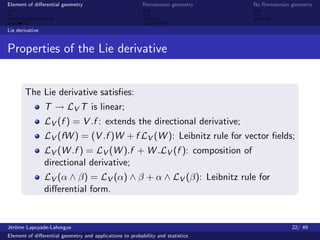
       The Lie derivative satisfies:
                 T → LV T is linear;
                 LV (f ) = V .f : extends the directional derivative;
                 LV (fW ) = (V .f )W + f LV (W ): Leibnitz rule for vector fields;
                 LV (W .f ) = LV (W ).f + W .LV (f ): composition of
                 directional derivative;
                 LV (α ∧ β) = LV (α) ∧ β + α ∧ LV (β): Leibnitz rule for
                 differential form.


J´rˆme Lapuyade-Lahorgue
 eo                                                                                            22/ 49
Element of differential geometry and applications to probability and statistics
Element of differential geometry                           Riemannian geometry    No Riemannian geometry


Lie derivative


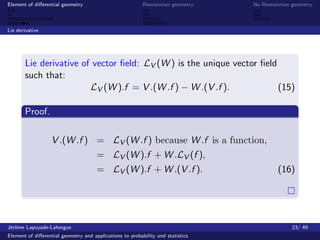
       Lie derivative of vector field: LV (W ) is the unique vector field
       such that:
                        LV (W ).f = V .(W .f ) − W .(V .f ).            (15)

       Proof.

                  V .(W .f ) = LV (W .f ) because W .f is a function,
                                      = LV (W ).f + W .LV (f ),
                                      = LV (W ).f + W .(V .f ).                           (16)


J´rˆme Lapuyade-Lahorgue
 eo                                                                                            23/ 49
Element of differential geometry and applications to probability and statistics
Element of differential geometry                           Riemannian geometry        No Riemannian geometry


Lie derivative


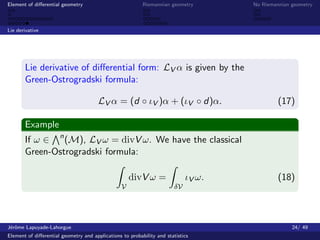
       Lie derivative of differential form: LV α is given by the
       Green-Ostrogradski formula:

                                       LV α = (d ◦ ιV )α + (ιV ◦ d)α.                         (17)

       Example
       If ω ∈ n (M), LV ω = divV ω. We have the classical
       Green-Ostrogradski formula:

                                                     divV ω =                ιV ω.            (18)
                                                 V                      δV


J´rˆme Lapuyade-Lahorgue
 eo                                                                                                24/ 49
Element of differential geometry and applications to probability and statistics
Element of differential geometry                           Riemannian geometry    No Riemannian geometry


Definitions


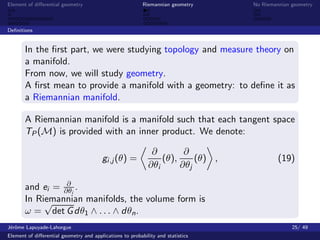
       In the first part, we were studying topology and measure theory on
       a manifold.
       From now, we will study geometry.
       A first mean to provide a manifold with a geometry: to define it as
       a Riemannian manifold.

       A Riemannian manifold is a manifold such that each tangent space
       TP (M) is provided with an inner product. We denote:

                                                             ∂        ∂
                                        gi ,j (θ) =             (θ),     (θ) ,            (19)
                                                            ∂θi      ∂θj
                 ∂
       and ei = ∂θi .
       In Riemannian manifolds, the volume form is
            √
       ω = det G dθ1 ∧ . . . ∧ dθn .
J´rˆme Lapuyade-Lahorgue
 eo                                                                                            25/ 49
Element of differential geometry and applications to probability and statistics
Element of differential geometry                           Riemannian geometry        No Riemannian geometry


Definitions


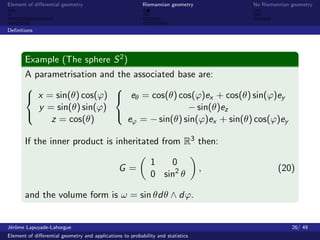
       Example (The sphere S 2 )
       A parametrisation and the associated base are:
                           
        x = sin(θ) cos(ϕ)  eθ = cos(θ) cos(ϕ)ex + cos(θ) sin(ϕ)ey
          y = sin(θ) sin(ϕ)                   − sin(θ)ez
             z = cos(θ)        eϕ = − sin(θ) sin(ϕ)ex + sin(θ) cos(ϕ)ey
                           

       If the inner product is inheritated from R3 then:

                                                             1   0
                                                G=                               ,            (20)
                                                             0 sin2 θ

       and the volume form is ω = sin θdθ ∧ dϕ.


J´rˆme Lapuyade-Lahorgue
 eo                                                                                                26/ 49
Element of differential geometry and applications to probability and statistics
Element of differential geometry                            Riemannian geometry                  No Riemannian geometry


Distance and geodesic curves


Riemannian geometry and geodesic curves

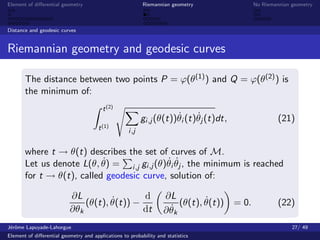
       The distance between two points P = ϕ(θ (1) ) and Q = ϕ(θ (2) ) is
       the minimum of:
                                         t (2)
                                                                       ˙     ˙
                                                           gi ,j (θ(t))θi (t)θj (t)dt,                   (21)
                                       t (1)        i ,j


       where t → θ(t) describes the set of curves of M.
                           ˙                 ˙ ˙
       Let us denote L(θ, θ) = i ,j gi ,j (θ)θi θj , the minimum is reached
       for t → θ(t), called geodesic curve, solution of:

                          ∂L         ˙       d                     ∂L          ˙
                              (θ(t), θ(t)) −                            (θ(t), θ(t))     = 0.            (22)
                          ∂θk                dt                      ˙
                                                                   ∂ θk
J´rˆme Lapuyade-Lahorgue
 eo                                                                                                           27/ 49
Element of differential geometry and applications to probability and statistics
Element of differential geometry                           Riemannian geometry       No Riemannian geometry


Distance and geodesic curves


Riemannian geometry and geodesic curves


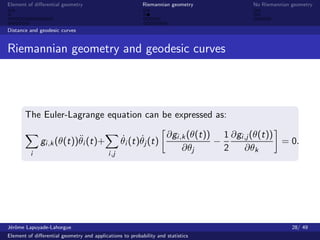
       The Euler-Lagrange equation can be expressed as:

                          ¨                       ˙     ˙      ∂gi ,k (θ(t)) 1 ∂gi ,j (θ(t))
              gi ,k (θ(t))θi (t)+                 θi (t)θj (t)              −                = 0.
                                                                    ∂θj       2    ∂θk
          i                                i ,j


J´rˆme Lapuyade-Lahorgue
 eo                                                                                               28/ 49
Element of differential geometry and applications to probability and statistics
Element of differential geometry                           Riemannian geometry                      No Riemannian geometry


Information geometry


Geometry of the set of probability densities


       We study parameterized set of probability distribution.
       At each θ ∈ Θ ⊂ Rk , we associate a probability density
       y → p(y ; θ):
                                                                                     b
                    p(y ; θ)dy = 1 and Pθ (Y ∈ [a, b]) =                                 p(y ; θ)dy ;
                                                                                 a
               For each fixed y , θ → p(y ; θ) is differentiable.
       The Riemannian metric is chosen in order to the volume form is
       the prior distribution such that an infinite sample of p(y ; θ)
       provides the maximum of information.


J´rˆme Lapuyade-Lahorgue
 eo                                                                                                              29/ 49
Element of differential geometry and applications to probability and statistics
Element of differential geometry                           Riemannian geometry             No Riemannian geometry


Information geometry


Geometry of the set of probability densities


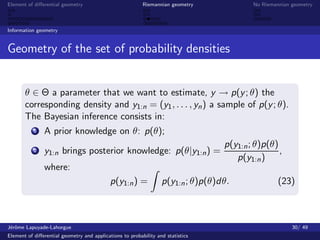
       θ ∈ Θ a parameter that we want to estimate, y → p(y ; θ) the
       corresponding density and y1:n = (y1 , . . . , yn ) a sample of p(y ; θ).
       The Bayesian inference consists in:
           1   A prior knowledge on θ: p(θ);
                                                                                  p(y1:n ; θ)p(θ)
           2   y1:n brings posterior knowledge: p(θ|y1:n ) =                                      ,
                                                                                     p(y1:n )
               where:
                                            p(y1:n ) =            p(y1:n ; θ)p(θ)dθ.               (23)


J´rˆme Lapuyade-Lahorgue
 eo                                                                                                     30/ 49
Element of differential geometry and applications to probability and statistics
Element of differential geometry                           Riemannian geometry               No Riemannian geometry


Information geometry


Geometry of the set of probability densities

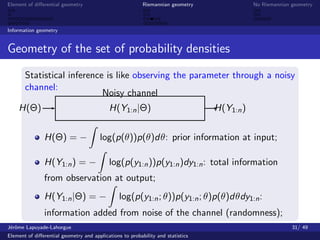
       Statistical inference is like observing the parameter through a noisy
       channel:
                            Noisy channel
    H(Θ)                                   H(Y1:n |Θ)                            H(Y1:n )


               H(Θ) = −                log(p(θ))p(θ)dθ: prior information at input;

               H(Y1:n ) = −                log(p(y1:n ))p(y1:n )dy1:n : total information
               from observation at output;
               H(Y1:n |Θ) = −                   log(p(y1:n ; θ))p(y1:n ; θ)p(θ)dθdy1:n :
               information added from noise of the channel (randomness);
J´rˆme Lapuyade-Lahorgue
 eo                                                                                                       31/ 49
Element of differential geometry and applications to probability and statistics
Element of differential geometry                           Riemannian geometry           No Riemannian geometry


Information geometry


Jeffreys’ priors and Fisher metric

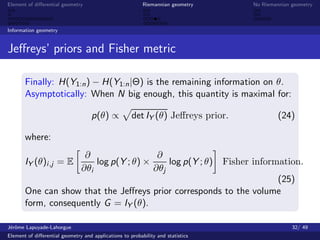
       Finally: H(Y1:n ) − H(Y1:n |Θ) is the remaining information on θ.
       Asymptotically: When N big enough, this quantity is maximal for:

                                    p(θ) ∝           det IY (θ) Jeffreys prior.                   (24)

       where:
                                ∂                  ∂
       IY (θ)i ,j = E              log p(Y ; θ) ×     log p(Y ; θ)               Fisher information.
                               ∂θi                ∂θj
                                                                   (25)
       One can show that the Jeffreys prior corresponds to the volume
       form, consequently G = IY (θ).

J´rˆme Lapuyade-Lahorgue
 eo                                                                                                   32/ 49
Element of differential geometry and applications to probability and statistics
Element of differential geometry                           Riemannian geometry                       No Riemannian geometry


Information geometry


Distance between probability distributions


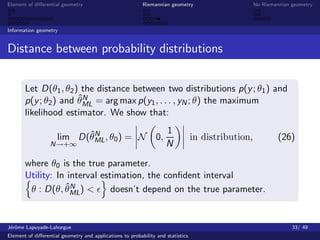
       Let D(θ1 , θ2 ) the distance between two distributions p(y ; θ1 ) and
                      ˆN
       p(y ; θ2 ) and θML = arg max p(y1 , . . . , yN ; θ) the maximum
       likelihood estimator. We show that:

                           ˆN                                        1
                     lim D(θML , θ0 ) = N                       0,               in distribution,            (26)
                  N→+∞                                               N

       where θ0 is the true parameter.
       Utility: In interval estimation, the confident interval
                  ˆN
        θ : D(θ, θML) <        doesn’t depend on the true parameter.


J´rˆme Lapuyade-Lahorgue
 eo                                                                                                               33/ 49
Element of differential geometry and applications to probability and statistics
Element of differential geometry                           Riemannian geometry    No Riemannian geometry


Gradient, Laplacian and Brownian motions on manifolds


The gradient and Laplace-Beltrami operator


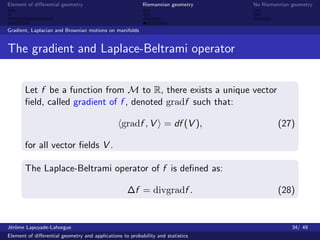
       Let f be a function from M to R, there exists a unique vector
       field, called gradient of f , denoted gradf such that:

                                                 gradf , V = df (V ),                     (27)

       for all vector fields V .

       The Laplace-Beltrami operator of f is defined as:

                                                   ∆f = divgradf .                        (28)


J´rˆme Lapuyade-Lahorgue
 eo                                                                                            34/ 49
Element of differential geometry and applications to probability and statistics
Element of differential geometry                           Riemannian geometry              No Riemannian geometry


Gradient, Laplacian and Brownian motions on manifolds


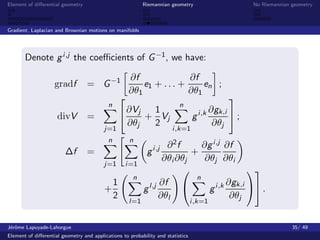
       Denote g i ,j the coefficients of G −1 , we have:

                                           ∂f              ∂f
                    gradf         = G −1      e1 + . . . +       en ;
                                          ∂θ1              ∂θ1
                                                                        
                                     n                   n
                                          ∂Vj    1                 ∂gk,i 
                     divV         =          + Vj          g i ,k         ;
                                          ∂θj    2                  ∂θj
                                         j=1                           i ,k=1
                                           n        n
                                                                  ∂2f       ∂g i ,j ∂f
                        ∆f        =                         g i ,j       +
                                                                 ∂θi ∂θj     ∂θj ∂θi
                                         j=1      i =1
                                                                                          
                                                      n                   n
                                           1                    ∂f                  ∂gk,i 
                                         +                g l,j               g i ,k          .
                                           2                    ∂θl                   ∂θj
                                                    l=1                          i ,k=1


J´rˆme Lapuyade-Lahorgue
 eo                                                                                                      35/ 49
Element of differential geometry and applications to probability and statistics
Element of differential geometry                           Riemannian geometry    No Riemannian geometry


Gradient, Laplacian and Brownian motions on manifolds


Martingals, local martingals and semi-martingals

       Let (Ω, A, P) a probability space.
               A continuous time process (Mt ) is a martingal if
               E [Mt |σ((Mu )u≤s )] = Ms for any s ≤ t;
               A continuous time process (Mt ) is a local martingal if there
               exists an increasing sequence of stopping times (Tn ) such that
               the processes (Mt∧Tn ) are martingals;
               A predictible process (At ) is a process such that for any
               ω ∈ Ω, there exists a Radon measure µ(ω) such that
               At (ω) − As (ω) = µ(ω) (]s, t]);
               A semi-martingal is the sum of a local martingal and a
               predictible process.
J´rˆme Lapuyade-Lahorgue
 eo                                                                                            36/ 49
Element of differential geometry and applications to probability and statistics
Element of differential geometry                           Riemannian geometry                  No Riemannian geometry


Gradient, Laplacian and Brownian motions on manifolds


Stochastic integral and differential forms


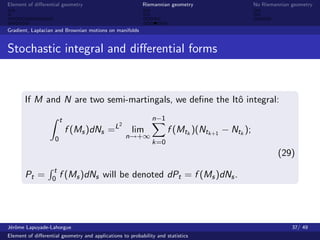
       If M and N are two semi-martingals, we define the Itˆ integral:
                                                          o

                        t                                     n−1
                                                2
                            f (Ms )dNs =L            lim             f (Mtk )(Ntk+1 − Ntk );
                    0                               n→+∞
                                                              k=0
                                                                                                        (29)
                   t
       Pt =        0    f (Ms )dNs will be denoted dPt = f (Ms )dNs .


J´rˆme Lapuyade-Lahorgue
 eo                                                                                                          37/ 49
Element of differential geometry and applications to probability and statistics
Element of differential geometry                           Riemannian geometry                 No Riemannian geometry


Gradient, Laplacian and Brownian motions on manifolds


Itˆ formula
  o

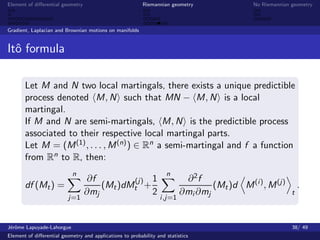
       Let M and N two local martingals, there exists a unique predictible
       process denoted M, N such that MN − M, N is a local
       martingal.
       If M and N are semi-martingals, M, N is the predictible process
       associated to their respective local martingal parts.
       Let M = (M (1) , . . . , M (n) ) ∈ Rn a semi-martingal and f a function
       from Rn to R, then:
                           n                                        n
                                   ∂f        (j) 1                         ∂2f
       df (Mt ) =                     (Mt )dMt +                                  (Mt )d M (i ) , M (j)         .
                                  ∂mj            2                        ∂mi ∂mj                           t
                          j=1                                    i ,j=1


J´rˆme Lapuyade-Lahorgue
 eo                                                                                                         38/ 49
Element of differential geometry and applications to probability and statistics
Element of differential geometry                           Riemannian geometry    No Riemannian geometry


Gradient, Laplacian and Brownian motions on manifolds


Brownian motion in a manifold

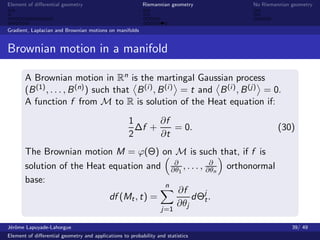
       A Brownian motion in Rn is the martingal Gaussian process
       (B (1) , . . . , B (n) ) such that B (i ) , B (i ) = t and B (i ) , B (j) = 0.
       A function f from M to R is solution of the Heat equation if:
                                                    1      ∂f
                                                      ∆f +    = 0.                        (30)
                                                    2      ∂t
       The Brownian motion M = ϕ(Θ) on M is such that, if f is
                                            ∂            ∂
       solution of the Heat equation and ∂θ1 , . . . , ∂θn orthonormal
       base:
                                          n
                                             ∂f
                            df (Mt , t) =        dΘj . t
                                             ∂θj
                                                                  j=1

J´rˆme Lapuyade-Lahorgue
 eo                                                                                            39/ 49
Element of differential geometry and applications to probability and statistics
Element of differential geometry                             Riemannian geometry           No Riemannian geometry


Gradient, Laplacian and Brownian motions on manifolds


Expression of the Brownian motion
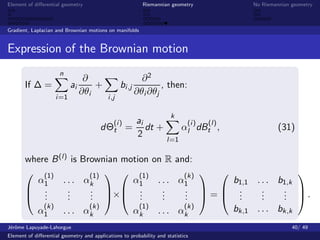
                      n
                                 ∂                          ∂2
       If ∆ =              ai       +             bi ,j           , then:
                                ∂θi                       ∂θi ∂θj
                    i =1                   i ,j

                                                                      k
                                              (i )        ai                 (i )   (l)
                                        dΘt =                dt +          αl dBt ,                (31)
                                                          2
                                                                     l=1

       where B (l) is Brownian motion on R and:
        (1)            (1)   (1)           (k)                   
         α1      . . . αk        α1    . . . α1       b1,1 . . . b1,k
        .         .    . × .          .    . = .        .    . .
        . .       .
                   .    .   .
                        .          .     .
                                         .    .   .
                                              .        .     .
                                                             .    . 
                                                                  .
           (k)          (k)        (1)        (k)     bk,1 . . . bk,k
         α1      . . . αk        αk    . . . αk
J´rˆme Lapuyade-Lahorgue
 eo                                                                                                     40/ 49
Element of differential geometry and applications to probability and statistics
Element of differential geometry                           Riemannian geometry                No Riemannian geometry


Notion of connexion


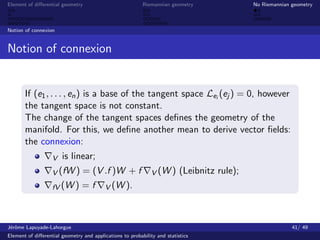
Notion of connexion


       If (e1 , . . . , en ) is a base of the tangent space Lei (ej ) = 0, however
       the tangent space is not constant.
       The change of the tangent spaces defines the geometry of the
       manifold. For this, we define another mean to derive vector fields:
       the connexion:
                   V   is linear;
                   V (fW )      = (V .f )W + f                V (W )      (Leibnitz rule);
                   fV (W )      =f        V (W ).


J´rˆme Lapuyade-Lahorgue
 eo                                                                                                        41/ 49
Element of differential geometry and applications to probability and statistics
Element of differential geometry                            Riemannian geometry                     No Riemannian geometry


Notion of connexion


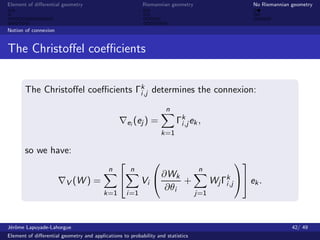
The Christoffel coefficients


       The Christoffel coefficients Γk,j determines the connexion:
                                  i

                                                                    n
                                                    ei (ej ) =           Γik,j ek ,
                                                                  k=1

       so we have:
                                                                                            
                                           n         n                            n
                                                                  ∂Wk
                         V (W )      =                    Vi         +               Wj Γk,j  ek .
                                                                                           i
                                                                   ∂θi
                                         k=1        i =1                         j=1


J´rˆme Lapuyade-Lahorgue
 eo                                                                                                              42/ 49
Element of differential geometry and applications to probability and statistics
Element of differential geometry                           Riemannian geometry       No Riemannian geometry


The Riemannian case and Levi-Civita connexion


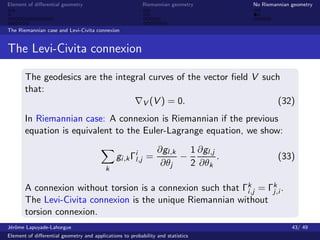
The Levi-Civita connexion

       The geodesics are the integral curves of the vector field V such
       that:
                                    V (V ) = 0.                       (32)
       In Riemannian case: A connexion is Riemannian if the previous
       equation is equivalent to the Euler-Lagrange equation, we show:
                                                                ∂gl,k   1 ∂gl,j
                                               gi ,k Γil,j =          −         .            (33)
                                                                 ∂θj    2 ∂θk
                                          k

       A connexion without torsion is a connexion such that Γk,j = Γk .
                                                             i      j,i
       The Levi-Civita connexion is the unique Riemannian without
       torsion connexion.
J´rˆme Lapuyade-Lahorgue
 eo                                                                                               43/ 49
Element of differential geometry and applications to probability and statistics
Element of differential geometry                           Riemannian geometry                  No Riemannian geometry


The Riemannian case and Levi-Civita connexion


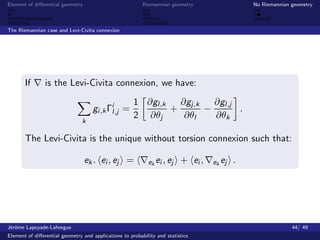
       If       is the Levi-Civita connexion, we have:

                                           i          1 ∂gl,k   ∂gj,k   ∂gl,j
                                    gi ,k Γl,j =              +       −       .
                                                      2 ∂θj      ∂θl    ∂θk
                                k

       The Levi-Civita is the unique without torsion connexion such that:

                                  ek . ei , ej =            ek ei , ej    + ei ,   ek ej   .


J´rˆme Lapuyade-Lahorgue
 eo                                                                                                          44/ 49
Element of differential geometry and applications to probability and statistics
Element of differential geometry                           Riemannian geometry    No Riemannian geometry


Second-order derivative, torsion and curvature


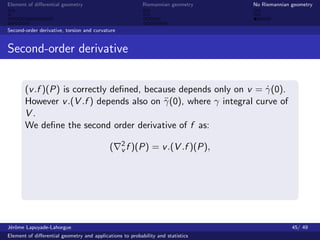
Second-order derivative


       (v .f )(P) is correctly defined, because depends only on v = γ(0).
                                                                    ˙
       However v .(V .f ) depends also on γ (0), where γ integral curve of
                                           ¨
       V.
       We define the second order derivative of f as:
                                                 2
                                            (    v f )(P)     = v .(V .f )(P),


J´rˆme Lapuyade-Lahorgue
 eo                                                                                            45/ 49
Element of differential geometry and applications to probability and statistics
Element of differential geometry                           Riemannian geometry    No Riemannian geometry


Second-order derivative, torsion and curvature


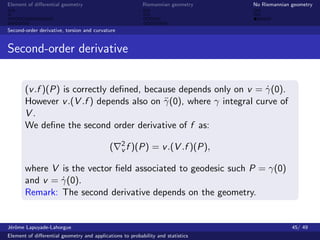
Second-order derivative


       (v .f )(P) is correctly defined, because depends only on v = γ(0).
                                                                    ˙
       However v .(V .f ) depends also on γ (0), where γ integral curve of
                                           ¨
       V.
       We define the second order derivative of f as:
                                                 2
                                            (    v f )(P)     = v .(V .f )(P),

       where V is the vector field associated to geodesic such P = γ(0)
       and v = γ(0).
               ˙
       Remark: The second derivative depends on the geometry.


J´rˆme Lapuyade-Lahorgue
 eo                                                                                            45/ 49
Element of differential geometry and applications to probability and statistics
Element of differential geometry                           Riemannian geometry              No Riemannian geometry


Second-order derivative, torsion and curvature


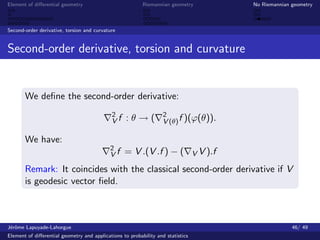
Second-order derivative, torsion and curvature


       We define the second-order derivative:
                                             2                     2
                                             Vf    :θ→(            V (θ) f )(ϕ(θ)).

       We have:
                                            2
                                            Vf    = V .(V .f ) − (               V V ).f

       Remark: It coincides with the classical second-order derivative if V
       is geodesic vector field.


J´rˆme Lapuyade-Lahorgue
 eo                                                                                                      46/ 49
Element of differential geometry and applications to probability and statistics
Element of differential geometry                           Riemannian geometry                 No Riemannian geometry


Second-order derivative, torsion and curvature


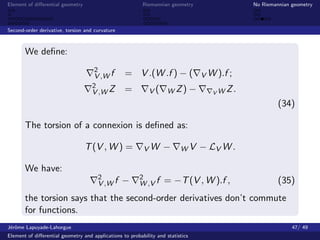
       We define:
                                     2
                                     V ,W f       = V .(W .f ) − (               V W ).f ;
                                    2
                                    V ,W Z        =          V(      W Z) −         VW
                                                                                         Z.
                                                                                                       (34)

       The torsion of a connexion is defined as:

                                  T (V , W ) =            VW       −      WV     − LV W .

       We have:
                                       2                 2
                                       V ,W f    −       W ,V f    = −T (V , W ).f ,                   (35)
       the torsion says that the second-order derivatives don’t commute
       for functions.
J´rˆme Lapuyade-Lahorgue
 eo                                                                                                         47/ 49
Element of differential geometry and applications to probability and statistics
Element of differential geometry                           Riemannian geometry                 No Riemannian geometry


Second-order derivative, torsion and curvature


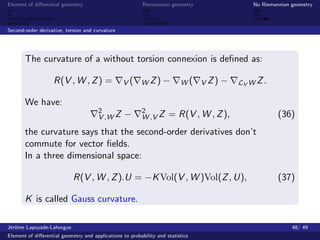
       The curvature of a without torsion connexion is defined as:

                   R(V , W , Z ) =               V(      W Z) −           W(     V Z) −   LV W Z .

       We have:
                                       2                  2
                                       V ,W Z     −       W ,V Z     = R(V , W , Z ),                  (36)
       the curvature says that the second-order derivatives don’t
       commute for vector fields.
       In a three dimensional space:

                            R(V , W , Z ).U = −K Vol(V , W )Vol(Z , U),                                (37)

       K is called Gauss curvature.

J´rˆme Lapuyade-Lahorgue
 eo                                                                                                         48/ 49
Element of differential geometry and applications to probability and statistics
Element of differential geometry                           Riemannian geometry    No Riemannian geometry


Second-order derivative, torsion and curvature


No riemannian set of probability distributions


       The study of no Riemannian or information geometry with torsion
       has been by S. I. Amari and H. Nagaoka in Methods of Information
       Geometry


J´rˆme Lapuyade-Lahorgue
 eo                                                                                            49/ 49
Element of differential geometry and applications to probability and statistics

Differential Geometry

  • 1.
    Element of differentialgeometry Riemannian geometry No Riemannian geometry Element of differential geometry and applications to probability and statistics J´rˆme Lapuyade-Lahorgue eo J´rˆme Lapuyade-Lahorgue eo 1/ 49 Element of differential geometry and applications to probability and statistics
  • 2.
    Element of differentialgeometry Riemannian geometry No Riemannian geometry Plan 1 Element of differential geometry 2 Riemannian geometry Definitions Distance and geodesic curves Information geometry Gradient, Laplacian and Brownian motions on manifolds 3 No Riemannian geometry Notion of connexion The Riemannian case and Levi-Civita connexion Second-order derivative, torsion and curvature J´rˆme Lapuyade-Lahorgue eo 2/ 49 Element of differential geometry and applications to probability and statistics
  • 3.
    Element of differentialgeometry Riemannian geometry No Riemannian geometry Main definitions Let M a C 1 -differentiable manifold. The parametrisation: θ ∈ Θ ⊂ Rn → ϕ(θ) ∈ M; (1) J´rˆme Lapuyade-Lahorgue eo 3/ 49 Element of differential geometry and applications to probability and statistics
  • 4.
    Element of differentialgeometry Riemannian geometry No Riemannian geometry Main definitions Let M a C 1 -differentiable manifold. The parametrisation: θ ∈ Θ ⊂ Rn → ϕ(θ) ∈ M; (1) The directional derivative of f : M → R at P along a curve γ : R → M: f (γ(t)) − f (γ(0)) lim , (2) t→0 t where γ(0) = P. J´rˆme Lapuyade-Lahorgue eo 3/ 49 Element of differential geometry and applications to probability and statistics
  • 5.
    Element of differentialgeometry Riemannian geometry No Riemannian geometry Main definitions Let M a C 1 -differentiable manifold. The parametrisation: θ ∈ Θ ⊂ Rn → ϕ(θ) ∈ M; (1) The directional derivative of f : M → R at P along a curve γ : R → M: f (γ(t)) − f (γ(0)) lim , (2) t→0 t where γ(0) = P. A tangent vector of M at P: An application which associates to f a directional derivative. The set of tangent vectors at P is denoted TP (M) and (v .f )(P) the directional derivative at P for γ(0) = v . ˙ J´rˆme Lapuyade-Lahorgue eo 3/ 49 Element of differential geometry and applications to probability and statistics
  • 6.
    Element of differentialgeometry Riemannian geometry No Riemannian geometry Main definitions Vector field: An application which associates at θ a tangent vector at P = ϕ(θ). The set of vector field, called tangent space, is denoted T (M) The derivative V .f of f along the vector map V is an application which associates at θ the derivative (V (θ).f )(P); k-differential form: An application which associates at θ a k-multilinear, antisymmetric form from TP (M) × . . . × TP (M) to R. The set of k-differential forms is k (M). J´rˆme Lapuyade-Lahorgue eo 4/ 49 Element of differential geometry and applications to probability and statistics
  • 7.
    Element of differentialgeometry Riemannian geometry No Riemannian geometry Properties of the tangent space We have: dim T (M) = n, and a base is given by: ∂ , (3) ∂θi the application which associates the derivative along the curve t → ϕ(θ1 , . . . , θi −1 , t, θi +1 , . . . , θn ). J´rˆme Lapuyade-Lahorgue eo 5/ 49 Element of differential geometry and applications to probability and statistics
  • 8.
    Element of differentialgeometry Riemannian geometry No Riemannian geometry Operations on differential forms k k We have: dim (M) = Cn and: α= αi1 ,...,ik ωi1 ,...,ik , (4) 1≤i1 <...<ik ≤n k where ωi1 ,...,ik is the base of (M). ∂ ∂ A possible base is such that ωi1 ,...,ik ∂θi1 , . . . , ∂θik = 1. For k = 1 and such a base, ωj is denoted dθj . J´rˆme Lapuyade-Lahorgue eo 6/ 49 Element of differential geometry and applications to probability and statistics
  • 9.
    Element of differentialgeometry Riemannian geometry No Riemannian geometry Operations on differential forms Exterior product The exterior product is the application: k l k+l ∧: × → , such that: α → α ∧ β is linear; α ∧ β = (−1)kl β ∧ α. We have ωi1 ,...,ik = dθi1 ∧ . . . ∧ dθik , where (dθ1 , . . . , dθn ) is the ∂ ∂ dual base of ∂θ1 , . . . , ∂θn . J´rˆme Lapuyade-Lahorgue eo 7/ 49 Element of differential geometry and applications to probability and statistics
  • 10.
    Element of differentialgeometry Riemannian geometry No Riemannian geometry Operations on differential forms Integral of differential form For the form ω = fdθ1 ∧ . . . ∧ dθn : ω= f (θ)dθ1 . . . dθn , (5) V ϕ−1 (V) where V ⊂ M has a no empty interior, and = 1 or −1 depending on the orientation. If doesn’t depend on f , the manifold is orientable. Measurable manifolds: The form fdθ1 ∧ . . . ∧ dθn such that |f |dθ1 . . . dθn is the Lebesgue measure on M is called volume form. J´rˆme Lapuyade-Lahorgue eo 8/ 49 Element of differential geometry and applications to probability and statistics
  • 11.
    Element of differentialgeometry Riemannian geometry No Riemannian geometry Operations on differential forms Restriction of differential form Let S ⊂ M a k-dimensional sub-manifold and k α= fi1 ,...,ik dθi1 ∧ . . . ∧ dθin ∈ (M). Its restriction 1≤i1 <...<ik k α|S ∈ (S) is: D(θi1 , . . . , θik ) α|S = fi1 ,...,ik ((ϕ−1 ◦ψ)(u1 , . . . , uk )) du1 ∧. . .∧duk , D(u1 , . . . , uk ) (6) where is the orientation of S, ψ : (u1 , . . . , uk ) → ψ(u1 , . . . , uk ) ∈ S a parametrization of S and D(θi1 , . . . , θik ) the Jacobian of ϕ−1 ◦ ψ. D(u1 , . . . , uk ) J´rˆme Lapuyade-Lahorgue eo 9/ 49 Element of differential geometry and applications to probability and statistics
  • 12.
    Element of differentialgeometry Riemannian geometry No Riemannian geometry Operations on differential forms Integral of k-form k The integral of α ∈ (M) is: α= α|S , (7) S S where S is a k-dimensional sub-manifold. J´rˆme Lapuyade-Lahorgue eo 10/ 49 Element of differential geometry and applications to probability and statistics
  • 13.
    Element of differentialgeometry Riemannian geometry No Riemannian geometry Operations on differential forms Border of a manifold and exterior derivative Definition Let f and g two functions from E to F , f and g are k-homotopic if there exists an application: H : [0, 1]k × E → F , with [0, 1]0 = {0, 1} . (8) such (u1 , . . . , uk ) → H(u1 , . . . , uk , x) continuous, H(0, . . . , 0, x) = f (x) and H(1, . . . , 1, x) = g (x). Two topological spaces E and F has the same k-homotopy if there exists two functions f : E → F and g : F → E such g ◦ f and f ◦ g are k-homotopic to the respective identity functions. J´rˆme Lapuyade-Lahorgue eo 11/ 49 Element of differential geometry and applications to probability and statistics
  • 14.
    Element of differentialgeometry Riemannian geometry No Riemannian geometry Operations on differential forms Border of a manifold and exterior derivative Example Two sets with different number of connected componants can not be k-homotopic; The sets R and {x} are 1-homotopic; R and the circle S 1 are not 1-homotopic but 0-homotopic; The sphere S 2 and the torus T 2 are not 1-homotopic but 2-homotopic; Two homeomorph sets have the same k-homotopy. J´rˆme Lapuyade-Lahorgue eo 12/ 49 Element of differential geometry and applications to probability and statistics
  • 15.
    Element of differentialgeometry Riemannian geometry No Riemannian geometry Operations on differential forms Border of a manifold and exterior derivative Definition The border application is an application δ which associates to a n-dimensional connexe manifold M: If the manifold has the same n-homotopy than S n , δM = ∅; If the manifold is homeomorph to the hypercube or an half-space of Rn , δM is the image of the set of faces or the delimitation of the half-space by the homeomorphism; In other cases, the manifold has a hole, the border is the union of the border of the manifold completed without the hole and the border of the hole. J´rˆme Lapuyade-Lahorgue eo 13/ 49 Element of differential geometry and applications to probability and statistics
  • 16.
    Element of differentialgeometry Riemannian geometry No Riemannian geometry Operations on differential forms Border of a manifold and exterior derivative We have the following properties: δM is either empty or dim δM = dim M − 1; δδM = ∅; If M is a star-shaped open set, then δM = ∅ implies that M is a border; The set Kerδ/Imδ is called De Rham homology. J´rˆme Lapuyade-Lahorgue eo 14/ 49 Element of differential geometry and applications to probability and statistics
  • 17.
    Element of differentialgeometry Riemannian geometry No Riemannian geometry Operations on differential forms Border of a manifold and exterior derivative The exterior derivative is an application d such k d (M) ⊂ k+1 (M) such that for any S ⊂ M, k k + 1-dimensional sub-manifold and for any α ∈ (M): dα = α(Green-Stockes formula) (9) S δS There exists a unique linear d such (9) holds and: n ∂f df = dθj ; ∂θj j=1 d(f α) = df ∧ α + fdα (Leibnitz rule). J´rˆme Lapuyade-Lahorgue eo 15/ 49 Element of differential geometry and applications to probability and statistics
  • 18.
    Element of differentialgeometry Riemannian geometry No Riemannian geometry Operations on differential forms Orientation of the border Let V = ϕ([0, 1]n ) a n-dimensional sub-manifold such δV = ∅ and consider: α = fdθ1 ∧ . . . ∧ θj−1 ∧ θj+1 ∧ . . . ∧ θn (10) We have: α = j [f (θj = 1) − f (θj = 0)] dθ1 . . . dθj−1 dθj+1 . . . dθn δV [0,1]n−1 ∂f = j dθ1 . . . dθn [0,1]n ∂θj = j (−1)j−1 dα. (11) V So j = (−1)j−1 . J´rˆme Lapuyade-Lahorgue eo 16/ 49 Element of differential geometry and applications to probability and statistics
  • 19.
    Element of differentialgeometry Riemannian geometry No Riemannian geometry Operations on differential forms Properties of the exterior derivative d is R-linear; n ∂f df = dθj ; ∂θj j=1 d ◦ d = 0; d(α ∧ β) = dα ∧ β + (−1)|α| α ∧ dβ (Leibnitz rule). Remark: The set Ker d/Im d is called the De Rham cohomology. J´rˆme Lapuyade-Lahorgue eo 17/ 49 Element of differential geometry and applications to probability and statistics
  • 20.
    Element of differentialgeometry Riemannian geometry No Riemannian geometry Operations on differential forms Interior derivative Let V a vector field, the interior derivative ιV is the unique linear application from k to k−1 such that: ιV f = 0; ιV (df ) = V .f ; ιV (α ∧ β) = ιV α ∧ β + (−1)|α| α ∧ ιV β (Leibnitz rule). J´rˆme Lapuyade-Lahorgue eo 18/ 49 Element of differential geometry and applications to probability and statistics
  • 21.
    Element of differentialgeometry Riemannian geometry No Riemannian geometry Lie derivative Integral curves and flows Let V be a vector field. An integral curve t → θ(t) with origine P = ϕ(θ(0)) is a solution of: ˙ V (θ(t)) = θ(t), (12) with: n ˙ θ= ˙ ∂ . θj (13) ∂θj j=1 The flow (φt )t∈R of V is a set of applications φt which associates to P ∈ M the point Q = ϕ(θ(t)), where θ is the integral curve with origine P. J´rˆme Lapuyade-Lahorgue eo 19/ 49 Element of differential geometry and applications to probability and statistics
  • 22.
    Element of differentialgeometry Riemannian geometry No Riemannian geometry Lie derivative Properties of the flow φs ◦ φt = φt ◦ φs = φs+t ; φ0 = IdM . J´rˆme Lapuyade-Lahorgue eo 20/ 49 Element of differential geometry and applications to probability and statistics
  • 23.
    Element of differentialgeometry Riemannian geometry No Riemannian geometry Lie derivative Properties of the flow φs ◦ φt = φt ◦ φs = φs+t ; φ0 = IdM . We define the pullback φ∗ , for P = ϕ(θ) and Q = φt (P): t If W (θ) ∈ TP (M) then (φ∗ W )(θ) ∈ TQ (M); t If α(θ) defined on TP (M) × . . . × TP (M), then (φ∗ α)(θ) t defined on TQ (M) × . . . × TQ (M). J´rˆme Lapuyade-Lahorgue eo 20/ 49 Element of differential geometry and applications to probability and statistics
  • 24.
    Element of differentialgeometry Riemannian geometry No Riemannian geometry Lie derivative The Lie derivative The pullbacks are respectively defined by: φ∗ f = f ◦ φt ; t (φ∗ W )(θ)(f ) = W ((ϕ−1 ◦ φt ◦ ϕ)(θ))(φ∗ f ); t t (φ∗ α)(θ)(φ∗ W1 (θ), . . . , φ∗ Wk (θ)) = t t t α((ϕ−1 ◦ φt ◦ ϕ)(θ))(W1 (θ), . . . , Wk (θ)). The Lie derivative is then defined as: φ∗ T − φ0 T t ∗ LV (T ) = lim , (14) t→0 t where T = f , W or α. J´rˆme Lapuyade-Lahorgue eo 21/ 49 Element of differential geometry and applications to probability and statistics
  • 25.
    Element of differentialgeometry Riemannian geometry No Riemannian geometry Lie derivative Properties of the Lie derivative The Lie derivative satisfies: T → LV T is linear; LV (f ) = V .f : extends the directional derivative; LV (fW ) = (V .f )W + f LV (W ): Leibnitz rule for vector fields; LV (W .f ) = LV (W ).f + W .LV (f ): composition of directional derivative; LV (α ∧ β) = LV (α) ∧ β + α ∧ LV (β): Leibnitz rule for differential form. J´rˆme Lapuyade-Lahorgue eo 22/ 49 Element of differential geometry and applications to probability and statistics
  • 26.
    Element of differentialgeometry Riemannian geometry No Riemannian geometry Lie derivative Lie derivative of vector field: LV (W ) is the unique vector field such that: LV (W ).f = V .(W .f ) − W .(V .f ). (15) Proof. V .(W .f ) = LV (W .f ) because W .f is a function, = LV (W ).f + W .LV (f ), = LV (W ).f + W .(V .f ). (16) J´rˆme Lapuyade-Lahorgue eo 23/ 49 Element of differential geometry and applications to probability and statistics
  • 27.
    Element of differentialgeometry Riemannian geometry No Riemannian geometry Lie derivative Lie derivative of differential form: LV α is given by the Green-Ostrogradski formula: LV α = (d ◦ ιV )α + (ιV ◦ d)α. (17) Example If ω ∈ n (M), LV ω = divV ω. We have the classical Green-Ostrogradski formula: divV ω = ιV ω. (18) V δV J´rˆme Lapuyade-Lahorgue eo 24/ 49 Element of differential geometry and applications to probability and statistics
  • 28.
    Element of differentialgeometry Riemannian geometry No Riemannian geometry Definitions In the first part, we were studying topology and measure theory on a manifold. From now, we will study geometry. A first mean to provide a manifold with a geometry: to define it as a Riemannian manifold. A Riemannian manifold is a manifold such that each tangent space TP (M) is provided with an inner product. We denote: ∂ ∂ gi ,j (θ) = (θ), (θ) , (19) ∂θi ∂θj ∂ and ei = ∂θi . In Riemannian manifolds, the volume form is √ ω = det G dθ1 ∧ . . . ∧ dθn . J´rˆme Lapuyade-Lahorgue eo 25/ 49 Element of differential geometry and applications to probability and statistics
  • 29.
    Element of differentialgeometry Riemannian geometry No Riemannian geometry Definitions Example (The sphere S 2 ) A parametrisation and the associated base are:    x = sin(θ) cos(ϕ)  eθ = cos(θ) cos(ϕ)ex + cos(θ) sin(ϕ)ey y = sin(θ) sin(ϕ) − sin(θ)ez z = cos(θ) eϕ = − sin(θ) sin(ϕ)ex + sin(θ) cos(ϕ)ey   If the inner product is inheritated from R3 then: 1 0 G= , (20) 0 sin2 θ and the volume form is ω = sin θdθ ∧ dϕ. J´rˆme Lapuyade-Lahorgue eo 26/ 49 Element of differential geometry and applications to probability and statistics
  • 30.
    Element of differentialgeometry Riemannian geometry No Riemannian geometry Distance and geodesic curves Riemannian geometry and geodesic curves The distance between two points P = ϕ(θ (1) ) and Q = ϕ(θ (2) ) is the minimum of: t (2) ˙ ˙ gi ,j (θ(t))θi (t)θj (t)dt, (21) t (1) i ,j where t → θ(t) describes the set of curves of M. ˙ ˙ ˙ Let us denote L(θ, θ) = i ,j gi ,j (θ)θi θj , the minimum is reached for t → θ(t), called geodesic curve, solution of: ∂L ˙ d ∂L ˙ (θ(t), θ(t)) − (θ(t), θ(t)) = 0. (22) ∂θk dt ˙ ∂ θk J´rˆme Lapuyade-Lahorgue eo 27/ 49 Element of differential geometry and applications to probability and statistics
  • 31.
    Element of differentialgeometry Riemannian geometry No Riemannian geometry Distance and geodesic curves Riemannian geometry and geodesic curves The Euler-Lagrange equation can be expressed as: ¨ ˙ ˙ ∂gi ,k (θ(t)) 1 ∂gi ,j (θ(t)) gi ,k (θ(t))θi (t)+ θi (t)θj (t) − = 0. ∂θj 2 ∂θk i i ,j J´rˆme Lapuyade-Lahorgue eo 28/ 49 Element of differential geometry and applications to probability and statistics
  • 32.
    Element of differentialgeometry Riemannian geometry No Riemannian geometry Information geometry Geometry of the set of probability densities We study parameterized set of probability distribution. At each θ ∈ Θ ⊂ Rk , we associate a probability density y → p(y ; θ): b p(y ; θ)dy = 1 and Pθ (Y ∈ [a, b]) = p(y ; θ)dy ; a For each fixed y , θ → p(y ; θ) is differentiable. The Riemannian metric is chosen in order to the volume form is the prior distribution such that an infinite sample of p(y ; θ) provides the maximum of information. J´rˆme Lapuyade-Lahorgue eo 29/ 49 Element of differential geometry and applications to probability and statistics
  • 33.
    Element of differentialgeometry Riemannian geometry No Riemannian geometry Information geometry Geometry of the set of probability densities θ ∈ Θ a parameter that we want to estimate, y → p(y ; θ) the corresponding density and y1:n = (y1 , . . . , yn ) a sample of p(y ; θ). The Bayesian inference consists in: 1 A prior knowledge on θ: p(θ); p(y1:n ; θ)p(θ) 2 y1:n brings posterior knowledge: p(θ|y1:n ) = , p(y1:n ) where: p(y1:n ) = p(y1:n ; θ)p(θ)dθ. (23) J´rˆme Lapuyade-Lahorgue eo 30/ 49 Element of differential geometry and applications to probability and statistics
  • 34.
    Element of differentialgeometry Riemannian geometry No Riemannian geometry Information geometry Geometry of the set of probability densities Statistical inference is like observing the parameter through a noisy channel: Noisy channel H(Θ) H(Y1:n |Θ) H(Y1:n ) H(Θ) = − log(p(θ))p(θ)dθ: prior information at input; H(Y1:n ) = − log(p(y1:n ))p(y1:n )dy1:n : total information from observation at output; H(Y1:n |Θ) = − log(p(y1:n ; θ))p(y1:n ; θ)p(θ)dθdy1:n : information added from noise of the channel (randomness); J´rˆme Lapuyade-Lahorgue eo 31/ 49 Element of differential geometry and applications to probability and statistics
  • 35.
    Element of differentialgeometry Riemannian geometry No Riemannian geometry Information geometry Jeffreys’ priors and Fisher metric Finally: H(Y1:n ) − H(Y1:n |Θ) is the remaining information on θ. Asymptotically: When N big enough, this quantity is maximal for: p(θ) ∝ det IY (θ) Jeffreys prior. (24) where: ∂ ∂ IY (θ)i ,j = E log p(Y ; θ) × log p(Y ; θ) Fisher information. ∂θi ∂θj (25) One can show that the Jeffreys prior corresponds to the volume form, consequently G = IY (θ). J´rˆme Lapuyade-Lahorgue eo 32/ 49 Element of differential geometry and applications to probability and statistics
  • 36.
    Element of differentialgeometry Riemannian geometry No Riemannian geometry Information geometry Distance between probability distributions Let D(θ1 , θ2 ) the distance between two distributions p(y ; θ1 ) and ˆN p(y ; θ2 ) and θML = arg max p(y1 , . . . , yN ; θ) the maximum likelihood estimator. We show that: ˆN 1 lim D(θML , θ0 ) = N 0, in distribution, (26) N→+∞ N where θ0 is the true parameter. Utility: In interval estimation, the confident interval ˆN θ : D(θ, θML) < doesn’t depend on the true parameter. J´rˆme Lapuyade-Lahorgue eo 33/ 49 Element of differential geometry and applications to probability and statistics
  • 37.
    Element of differentialgeometry Riemannian geometry No Riemannian geometry Gradient, Laplacian and Brownian motions on manifolds The gradient and Laplace-Beltrami operator Let f be a function from M to R, there exists a unique vector field, called gradient of f , denoted gradf such that: gradf , V = df (V ), (27) for all vector fields V . The Laplace-Beltrami operator of f is defined as: ∆f = divgradf . (28) J´rˆme Lapuyade-Lahorgue eo 34/ 49 Element of differential geometry and applications to probability and statistics
  • 38.
    Element of differentialgeometry Riemannian geometry No Riemannian geometry Gradient, Laplacian and Brownian motions on manifolds Denote g i ,j the coefficients of G −1 , we have: ∂f ∂f gradf = G −1 e1 + . . . + en ; ∂θ1 ∂θ1   n n ∂Vj 1 ∂gk,i  divV =  + Vj g i ,k ; ∂θj 2 ∂θj j=1 i ,k=1 n n ∂2f ∂g i ,j ∂f ∆f = g i ,j + ∂θi ∂θj ∂θj ∂θi j=1 i =1   n n 1 ∂f  ∂gk,i  + g l,j g i ,k . 2 ∂θl ∂θj l=1 i ,k=1 J´rˆme Lapuyade-Lahorgue eo 35/ 49 Element of differential geometry and applications to probability and statistics
  • 39.
    Element of differentialgeometry Riemannian geometry No Riemannian geometry Gradient, Laplacian and Brownian motions on manifolds Martingals, local martingals and semi-martingals Let (Ω, A, P) a probability space. A continuous time process (Mt ) is a martingal if E [Mt |σ((Mu )u≤s )] = Ms for any s ≤ t; A continuous time process (Mt ) is a local martingal if there exists an increasing sequence of stopping times (Tn ) such that the processes (Mt∧Tn ) are martingals; A predictible process (At ) is a process such that for any ω ∈ Ω, there exists a Radon measure µ(ω) such that At (ω) − As (ω) = µ(ω) (]s, t]); A semi-martingal is the sum of a local martingal and a predictible process. J´rˆme Lapuyade-Lahorgue eo 36/ 49 Element of differential geometry and applications to probability and statistics
  • 40.
    Element of differentialgeometry Riemannian geometry No Riemannian geometry Gradient, Laplacian and Brownian motions on manifolds Stochastic integral and differential forms If M and N are two semi-martingals, we define the Itˆ integral: o t n−1 2 f (Ms )dNs =L lim f (Mtk )(Ntk+1 − Ntk ); 0 n→+∞ k=0 (29) t Pt = 0 f (Ms )dNs will be denoted dPt = f (Ms )dNs . J´rˆme Lapuyade-Lahorgue eo 37/ 49 Element of differential geometry and applications to probability and statistics
  • 41.
    Element of differentialgeometry Riemannian geometry No Riemannian geometry Gradient, Laplacian and Brownian motions on manifolds Itˆ formula o Let M and N two local martingals, there exists a unique predictible process denoted M, N such that MN − M, N is a local martingal. If M and N are semi-martingals, M, N is the predictible process associated to their respective local martingal parts. Let M = (M (1) , . . . , M (n) ) ∈ Rn a semi-martingal and f a function from Rn to R, then: n n ∂f (j) 1 ∂2f df (Mt ) = (Mt )dMt + (Mt )d M (i ) , M (j) . ∂mj 2 ∂mi ∂mj t j=1 i ,j=1 J´rˆme Lapuyade-Lahorgue eo 38/ 49 Element of differential geometry and applications to probability and statistics
  • 42.
    Element of differentialgeometry Riemannian geometry No Riemannian geometry Gradient, Laplacian and Brownian motions on manifolds Brownian motion in a manifold A Brownian motion in Rn is the martingal Gaussian process (B (1) , . . . , B (n) ) such that B (i ) , B (i ) = t and B (i ) , B (j) = 0. A function f from M to R is solution of the Heat equation if: 1 ∂f ∆f + = 0. (30) 2 ∂t The Brownian motion M = ϕ(Θ) on M is such that, if f is ∂ ∂ solution of the Heat equation and ∂θ1 , . . . , ∂θn orthonormal base: n ∂f df (Mt , t) = dΘj . t ∂θj j=1 J´rˆme Lapuyade-Lahorgue eo 39/ 49 Element of differential geometry and applications to probability and statistics
  • 43.
    Element of differentialgeometry Riemannian geometry No Riemannian geometry Gradient, Laplacian and Brownian motions on manifolds Expression of the Brownian motion n ∂ ∂2 If ∆ = ai + bi ,j , then: ∂θi ∂θi ∂θj i =1 i ,j k (i ) ai (i ) (l) dΘt = dt + αl dBt , (31) 2 l=1 where B (l) is Brownian motion on R and:  (1) (1)   (1) (k)    α1 . . . αk α1 . . . α1 b1,1 . . . b1,k  . . . × . . . = . . . .  . . . . .   . . . . . .   . . . . . .  . (k) (k) (1) (k) bk,1 . . . bk,k α1 . . . αk αk . . . αk J´rˆme Lapuyade-Lahorgue eo 40/ 49 Element of differential geometry and applications to probability and statistics
  • 44.
    Element of differentialgeometry Riemannian geometry No Riemannian geometry Notion of connexion Notion of connexion If (e1 , . . . , en ) is a base of the tangent space Lei (ej ) = 0, however the tangent space is not constant. The change of the tangent spaces defines the geometry of the manifold. For this, we define another mean to derive vector fields: the connexion: V is linear; V (fW ) = (V .f )W + f V (W ) (Leibnitz rule); fV (W ) =f V (W ). J´rˆme Lapuyade-Lahorgue eo 41/ 49 Element of differential geometry and applications to probability and statistics
  • 45.
    Element of differentialgeometry Riemannian geometry No Riemannian geometry Notion of connexion The Christoffel coefficients The Christoffel coefficients Γk,j determines the connexion: i n ei (ej ) = Γik,j ek , k=1 so we have:    n n n ∂Wk V (W ) =  Vi  + Wj Γk,j  ek . i ∂θi k=1 i =1 j=1 J´rˆme Lapuyade-Lahorgue eo 42/ 49 Element of differential geometry and applications to probability and statistics
  • 46.
    Element of differentialgeometry Riemannian geometry No Riemannian geometry The Riemannian case and Levi-Civita connexion The Levi-Civita connexion The geodesics are the integral curves of the vector field V such that: V (V ) = 0. (32) In Riemannian case: A connexion is Riemannian if the previous equation is equivalent to the Euler-Lagrange equation, we show: ∂gl,k 1 ∂gl,j gi ,k Γil,j = − . (33) ∂θj 2 ∂θk k A connexion without torsion is a connexion such that Γk,j = Γk . i j,i The Levi-Civita connexion is the unique Riemannian without torsion connexion. J´rˆme Lapuyade-Lahorgue eo 43/ 49 Element of differential geometry and applications to probability and statistics
  • 47.
    Element of differentialgeometry Riemannian geometry No Riemannian geometry The Riemannian case and Levi-Civita connexion If is the Levi-Civita connexion, we have: i 1 ∂gl,k ∂gj,k ∂gl,j gi ,k Γl,j = + − . 2 ∂θj ∂θl ∂θk k The Levi-Civita is the unique without torsion connexion such that: ek . ei , ej = ek ei , ej + ei , ek ej . J´rˆme Lapuyade-Lahorgue eo 44/ 49 Element of differential geometry and applications to probability and statistics
  • 48.
    Element of differentialgeometry Riemannian geometry No Riemannian geometry Second-order derivative, torsion and curvature Second-order derivative (v .f )(P) is correctly defined, because depends only on v = γ(0). ˙ However v .(V .f ) depends also on γ (0), where γ integral curve of ¨ V. We define the second order derivative of f as: 2 ( v f )(P) = v .(V .f )(P), J´rˆme Lapuyade-Lahorgue eo 45/ 49 Element of differential geometry and applications to probability and statistics
  • 49.
    Element of differentialgeometry Riemannian geometry No Riemannian geometry Second-order derivative, torsion and curvature Second-order derivative (v .f )(P) is correctly defined, because depends only on v = γ(0). ˙ However v .(V .f ) depends also on γ (0), where γ integral curve of ¨ V. We define the second order derivative of f as: 2 ( v f )(P) = v .(V .f )(P), where V is the vector field associated to geodesic such P = γ(0) and v = γ(0). ˙ Remark: The second derivative depends on the geometry. J´rˆme Lapuyade-Lahorgue eo 45/ 49 Element of differential geometry and applications to probability and statistics
  • 50.
    Element of differentialgeometry Riemannian geometry No Riemannian geometry Second-order derivative, torsion and curvature Second-order derivative, torsion and curvature We define the second-order derivative: 2 2 Vf :θ→( V (θ) f )(ϕ(θ)). We have: 2 Vf = V .(V .f ) − ( V V ).f Remark: It coincides with the classical second-order derivative if V is geodesic vector field. J´rˆme Lapuyade-Lahorgue eo 46/ 49 Element of differential geometry and applications to probability and statistics
  • 51.
    Element of differentialgeometry Riemannian geometry No Riemannian geometry Second-order derivative, torsion and curvature We define: 2 V ,W f = V .(W .f ) − ( V W ).f ; 2 V ,W Z = V( W Z) − VW Z. (34) The torsion of a connexion is defined as: T (V , W ) = VW − WV − LV W . We have: 2 2 V ,W f − W ,V f = −T (V , W ).f , (35) the torsion says that the second-order derivatives don’t commute for functions. J´rˆme Lapuyade-Lahorgue eo 47/ 49 Element of differential geometry and applications to probability and statistics
  • 52.
    Element of differentialgeometry Riemannian geometry No Riemannian geometry Second-order derivative, torsion and curvature The curvature of a without torsion connexion is defined as: R(V , W , Z ) = V( W Z) − W( V Z) − LV W Z . We have: 2 2 V ,W Z − W ,V Z = R(V , W , Z ), (36) the curvature says that the second-order derivatives don’t commute for vector fields. In a three dimensional space: R(V , W , Z ).U = −K Vol(V , W )Vol(Z , U), (37) K is called Gauss curvature. J´rˆme Lapuyade-Lahorgue eo 48/ 49 Element of differential geometry and applications to probability and statistics
  • 53.
    Element of differentialgeometry Riemannian geometry No Riemannian geometry Second-order derivative, torsion and curvature No riemannian set of probability distributions The study of no Riemannian or information geometry with torsion has been by S. I. Amari and H. Nagaoka in Methods of Information Geometry J´rˆme Lapuyade-Lahorgue eo 49/ 49 Element of differential geometry and applications to probability and statistics