Nickel
Things You Should Know
History
 Name
    Nickel: German
      -means “Old Nick” (which also
      means Devil).
      -Derived from Kupfernickel, meaning
      Devil’s Copper
History
 Discovery
    It was found in niccolite in 1751.
    Discovered by Swedish Chemist and
     Mineralogist, Axel Fredrick Cronstedt, who
     first believed it was copper.
Properties
 State at Room Temperature: Solid
 Color: Silvery-white
 Melting Point: 1455 degrees Celsius
 Boiling Point: 2913 degrees Celsius
 Density: 8.912g per cubic centimeter
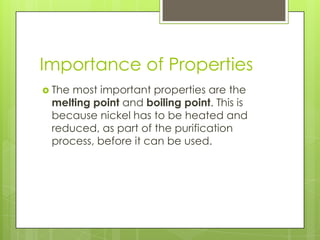
Importance of Properties
 Themost important properties are the
 melting point and boiling point. This is
 because nickel has to be heated and
 reduced, as part of the purification
 process, before it can be used.
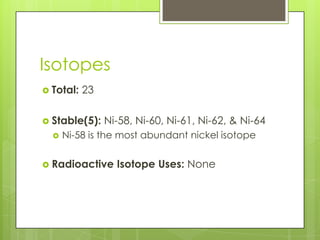
Isotopes
 Total:   23

 Stable(5):    Ni-58, Ni-60, Ni-61, Ni-62, & Ni-64
     Ni-58 is the most abundant nickel isotope

 Radioactive     Isotope Uses: None
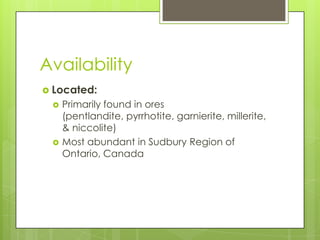
Availability
 Located:
    Primarily found in ores
     (pentlandite, pyrrhotite, garnierite, millerite,
     & niccolite)
    Most abundant in Sudbury Region of
     Ontario, Canada
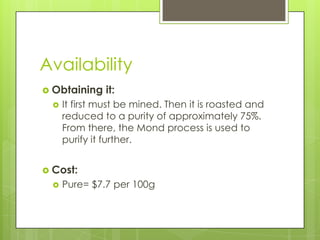
Availability
 Obtaining    it:
     It first must be mined. Then it is roasted and
      reduced to a purity of approximately 75%.
      From there, the Mond process is used to
      purify it further.


 Cost:
     Pure= $7.7 per 100g
Uses
 Primary:
     Catalyst for hydrogenation of vegetable
      oils, heat regulation, nuclear reactors, solar
      engineering, corrosion resistant alloys.
 Major    Compounds:
     NiCd(rechargeable batteries), Alnico
      Magnets, stainless steel, electric guitar
      strings.
Other
 Ferromagnetic
 Considered   carcinogenic
 Breathing in large amounts of nickel
  compounds can lead to chronic
  bronchitis and lung & nasal cancers
 Magnetic at room temperature, but
  becomes less so as the temperature is
  increased.
Works Cited
   "Nickel." Chemicool Periodic Table. Chemicool.com. 24
          Feb. 2011. Web. 10/31/2011
          <http://www.chemicool.com/elements/nickel.html>.
   Thomas Jefferson National Accelerator Facility - Office of
          Science EducationLast, . "It's Elemental-The Element
          Nickel." Jefferson Lab. Jefferson Lab, 31 Oct 2011. Web.
          31 Oct 2011. <http://education.jlab.org/faq/index.html>.
   McPartland, Josh. "Everything About Nickel: History, Invention,
          Some Critical Applications, Characteristics &
          Significance." How To Stop Sweating So Much. How To
          Stop Sweating So Much, 2011. Web. 31 Oct 2011.
          <http://howtostopsweatingsomuch.com/articlearchive/?
          everything-about-nickel-history-invention-some-critical-
          applications-characteristics-significance-1448>.

Nickel (Aimee Ellis)

  • 1.
  • 2.
    History  Name  Nickel: German -means “Old Nick” (which also means Devil). -Derived from Kupfernickel, meaning Devil’s Copper
  • 3.
    History  Discovery  It was found in niccolite in 1751.  Discovered by Swedish Chemist and Mineralogist, Axel Fredrick Cronstedt, who first believed it was copper.
  • 4.
    Properties  State atRoom Temperature: Solid  Color: Silvery-white  Melting Point: 1455 degrees Celsius  Boiling Point: 2913 degrees Celsius  Density: 8.912g per cubic centimeter
  • 5.
    Importance of Properties Themost important properties are the melting point and boiling point. This is because nickel has to be heated and reduced, as part of the purification process, before it can be used.
  • 6.
    Isotopes  Total: 23  Stable(5): Ni-58, Ni-60, Ni-61, Ni-62, & Ni-64  Ni-58 is the most abundant nickel isotope  Radioactive Isotope Uses: None
  • 7.
    Availability  Located:  Primarily found in ores (pentlandite, pyrrhotite, garnierite, millerite, & niccolite)  Most abundant in Sudbury Region of Ontario, Canada
  • 8.
    Availability  Obtaining it:  It first must be mined. Then it is roasted and reduced to a purity of approximately 75%. From there, the Mond process is used to purify it further.  Cost:  Pure= $7.7 per 100g
  • 9.
    Uses  Primary:  Catalyst for hydrogenation of vegetable oils, heat regulation, nuclear reactors, solar engineering, corrosion resistant alloys.  Major Compounds:  NiCd(rechargeable batteries), Alnico Magnets, stainless steel, electric guitar strings.
  • 10.
    Other  Ferromagnetic  Considered carcinogenic  Breathing in large amounts of nickel compounds can lead to chronic bronchitis and lung & nasal cancers  Magnetic at room temperature, but becomes less so as the temperature is increased.
  • 11.
    Works Cited  "Nickel." Chemicool Periodic Table. Chemicool.com. 24 Feb. 2011. Web. 10/31/2011 <http://www.chemicool.com/elements/nickel.html>.  Thomas Jefferson National Accelerator Facility - Office of Science EducationLast, . "It's Elemental-The Element Nickel." Jefferson Lab. Jefferson Lab, 31 Oct 2011. Web. 31 Oct 2011. <http://education.jlab.org/faq/index.html>.  McPartland, Josh. "Everything About Nickel: History, Invention, Some Critical Applications, Characteristics & Significance." How To Stop Sweating So Much. How To Stop Sweating So Much, 2011. Web. 31 Oct 2011. <http://howtostopsweatingsomuch.com/articlearchive/? everything-about-nickel-history-invention-some-critical- applications-characteristics-significance-1448>.