Presented By-
1). Harpreet Khanna. (18)
2). Prince Goel (32)
3). Roopashree Panda (33)
4). Shiv Verdhan Singh (49)
Content
Introduction to Nickel
Extraction of nickel
Properties of Nickel
Advantages
Disadvantages.
Classification of Nickel alloys
1. INTRODUCTION TO NICKEL
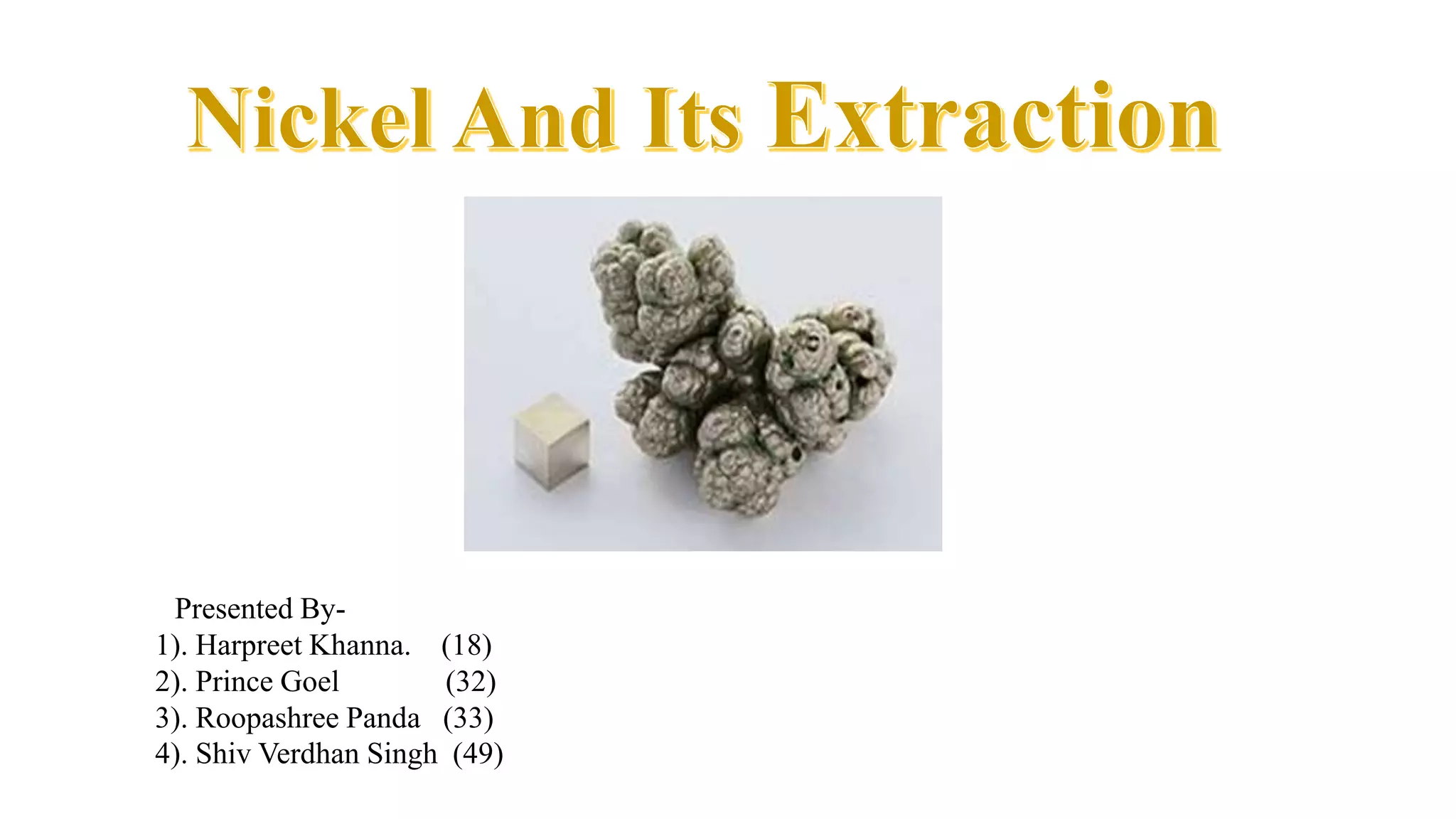
• Nickel is a chemical element with symbol Ni and atomic number 28
• It is a silvery-white lustrous metal with a slight golden tinge
• Nickel belongs to the transition metals and is hard and ductile
• Pure native nickel is found in Earth's crust only in tiny amounts, usually
in ultramafic rocks, and in the interiors of larger nickel–iron meteorites that were
not exposed to oxygen when outside Earth's atmosphere
1.1 OCCURRENCE
• Nickel is the earth's 22nd most abundant element and the 7th most abundant
transition metal
• It is a silver white crystalline metal that occurs in meteors or combined with other
elements in ores
• Two important groups of ores are:
 Laterites: Oxide or silicate ores such as garnierite, (Ni, Mg)6 Si4O10 OH)8 which are
predominantly found in tropical areas such as New Caledonia, Cuba and Queensland.
Sulphides:These are ores such as pentlandite, which contain about 1.5%, nickel
associated with copper, cobalt and other metals. They are predominant in more
temperate regions such as Canada, Russia and South Africa.
Canada is the world's leading nickel producer and the Sudbury Basin of Ontario
contains one of the largest nickel deposits in the world.
2.EXTRACTION OF NICKEL
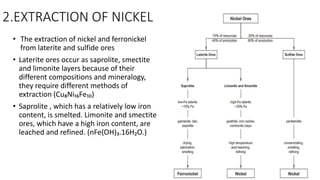
• The extraction of nickel and ferronickel
from laterite and sulfide ores
• Laterite ores occur as saprolite, smectite
and limonite layers because of their
different compositions and mineralogy,
they require different methods of
extraction (Cu₈Ni₁₆Fe₁₀)
• Saprolite , which has a relatively low iron
content, is smelted. Limonite and smectite
ores, which have a high iron content, are
leached and refined. (nFe(OH)₃.16H₂O.)
FOR SULFIDES ORES
[(FeNi)₉S₈](Pentlandite)
• Concentration, Smelting and
Converting to Matte
• The sulphide ores are
concentrated, smelted and
converted to metal-rich matte
• The processing steps are as
follows:
(a)The valuable minerals in an ore
are concentrated by froth
flotation
(b) This concentrate is smelted and
converted into an even richer,
low-iron sulphide matte
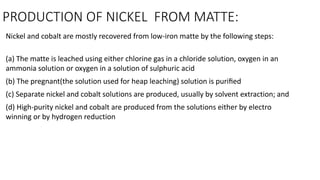
PRODUCTION OF NICKEL FROM MATTE:
Nickel and cobalt are mostly recovered from low-iron matte by the following steps:
(a) The matte is leached using either chlorine gas in a chloride solution, oxygen in an
ammonia solution or oxygen in a solution of sulphuric acid
(b) The pregnant(the solution used for heap leaching) solution is purified
(c) Separate nickel and cobalt solutions are produced, usually by solvent extraction; and
(d) High-purity nickel and cobalt are produced from the solutions either by electro
winning or by hydrogen reduction
HYDROMETALLURGICAL APPROACHES: (Cu₈Ni₁₆Fe₁₀)→Limonite
(FeO(OH).nH₂O)
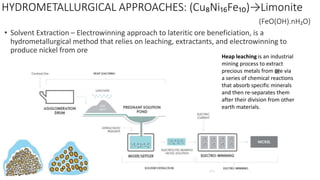
• Solvent Extraction – Electrowinning approach to lateritic ore beneficiation, is a
hydrometallurgical method that relies on leaching, extractants, and electrowinning to
produce nickel from ore
Heap leaching is an industrial
mining process to extract
precious metals from ore via
a series of chemical reactions
that absorb specific minerals
and then re-separates them
after their division from other
earth materials.
PYROMETALLURGICAL APPROACHES
LATERITE (Cu₈Ni₁₆Fe₁₀ ) SAPROLITE [nFe(OH)₃.nH₂O]
Rotary Kiln Electric Furnace method, is a pyro metallurgical approach to
produce ferronickel. As a pyro metallurgical technique, this method is best
suited for ores that are predominantly saprolite.
• STEPS INVOLVED :
Drying
• Nickel laterites contain a significant amount of water, making drying an
important aspect of processing. A rotary dryer is typically used to
remove free moisture.
Preliminary Reduction
• Once ore has been dried, it is processed in a large-scale rotary kiln to
remove chemically bound moisture, as well as the oxide component of
the ore. This step is often referred to as pre-reduction.
Reduction & Smelting
• Nickel is further reduced and smelted in an electric furnace. A cooling
step may be implemented after the smelting step, typically through the
employment of a rotary cooler
REFINING:
1.MOND PROCESS
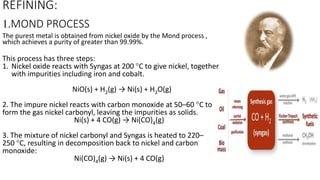
The purest metal is obtained from nickel oxide by the Mond process ,
which achieves a purity of greater than 99.99%.
This process has three steps:
1. Nickel oxide reacts with Syngas at 200 °C to give nickel, together
with impurities including iron and cobalt.
NiO(s) + H2(g) → Ni(s) + H2O(g)
2. The impure nickel reacts with carbon monoxide at 50–60 °C to
form the gas nickel carbonyl, leaving the impurities as solids.
Ni(s) + 4 CO(g) → Ni(CO)4(g)
3. The mixture of nickel carbonyl and Syngas is heated to 220–
250 °C, resulting in decomposition back to nickel and carbon
monoxide:
Ni(CO)4(g) → Ni(s) + 4 CO(g)
2.ELECTROREFINING
• Nickel is refined electrolytically from metallic nickel or nickel sulphide anodes, containing
impurities iron,copper,silver,platinum,palladium etc.
• The electrolyte principally contain nickel sulphate in a nearly neutral solution
• Extraordinary precautions must be taken to ensure that the electrolyte at the cathode is
free of copper, iron, and other impurities.
• Each cathode is suspended in an individual porous walled compartment to which pure
electrolyte is fed at a predetermined rate. The impure electrolyte leaving the anodes is
removed from the cell and is purified by removal of iron ,copper etc. before being
returned to the cathode compartments for precipitation of pure nickel on the cathode.
PROPERTIES OF NICKEL
PHYSICAL PROPERTIES
• Color- Silvery-White Metal
• Phase- Solid
• Conductivity- Fairly good conductor of heat and electricity
• Ductility- It can be beaten into extremely thin sheets
• Malleability- It’s capable of being shaped or bent
• Luster- Exhibits a shine or glow
• Hardness- Harder than iron
• Ferromagnetic- Nickel is easily magnetized
CHEMICAL PROPERTIES
• Corrosion- Highly resistant to rusting and corrosion
• Reactivity with Oxygen- Nickel metal does not react with air under
ambient conditions.
• Compounds- Used for electroplating and to make nickel alloys
ADVANTAGES
• Nickel belongs to transition metals. It is hard , ductile , and considered
corrosion resistant because of its slow rate of oxidation at room
temperature
• High melting point and is magnetic at room temperature.
• Low expansion
DISADVANTAGES
• Handling nickel can result in symptoms of dermatitis among
sensitized individuals.
• High nickel concentration in air causes health issues.
• High nickel concentration in soil as well as in surface water destroys
plant growth and algae growth respectively
CLASSIFICATIONS OF NICKEL ALLOYS :
• There are different types of nickel alloys:
Nickel-copper alloys (Monels)
Nickel-chromium alloys
Nickel-base superalloys
1.NICKEL COPPER ALLOYS (MONELS)
 Ni and Cu form complete solid solution.
 Ni-Cu alloy contains 67%Ni and 33%Cu, called Monels.
o Two types of Monels are found :-
1. MONEL METAL (METAL TREATED) :
• It consists of (67% Ni + 30% Cu + small amounts of Fe, Mn, Si & C.)
PROPERTIES:
High strength and toughness over a range of temperature.
Good weldability.
Excellent corrosion resistance.
Resistant to Sea Water, Chlorine
APPLICATIONS:
High temperature valves.
Centrifugal pump impellors & water meter parts.
Steam turbine blades.
2.K-MONEL (AGE HARDENED) :
It consists of 66% Ni + 29% Cu + 2.57% Al + Mn + C.
PROPERTIES
Wholly Non-magnetic
Al increases strength & hardness above that of monel.
APPLICATIONS
Pump shafts, springs & valve stems, etc
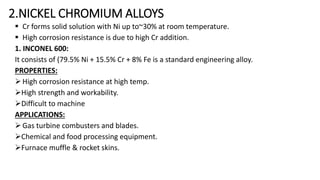
2.NICKEL CHROMIUM ALLOYS
 Cr forms solid solution with Ni up to~30% at room temperature.
 High corrosion resistance is due to high Cr addition.
1. INCONEL 600:
It consists of (79.5% Ni + 15.5% Cr + 8% Fe is a standard engineering alloy.
PROPERTIES:
High corrosion resistance at high temp.
High strength and workability.
Difficult to machine
APPLICATIONS:
Gas turbine combusters and blades.
Chemical and food processing equipment.
Furnace muffle & rocket skins.
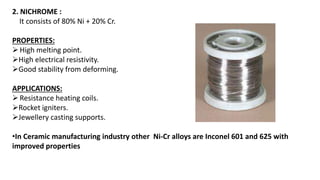
2. NICHROME :
It consists of 80% Ni + 20% Cr.
PROPERTIES:
High melting point.
High electrical resistivity.
Good stability from deforming.
APPLICATIONS:
Resistance heating coils.
Rocket igniters.
Jewellery casting supports.
•In Ceramic manufacturing industry other Ni-Cr alloys are Inconel 601 and 625 with
improved properties
3.NICKEL BASE SUPERALLOYS
 High temperature heat-resistance alloys, which can retain high strengths at
elevated temperatures.
There are three types of Ni-base superalloys:-
•Ni base.
•Ni- iron base.
•Cobalt base.
 The alloys contain high Cr with Ti, Al to from precipitates
and additions of Mo, Co, Nb, Zr, B, Fe.
 Microstructures are complex.
PROPERTIES:
Heat resistant and high strength at high temperature (760-980°C).
Good corrosion & oxidation resistance.
APPLICATIONS
Aircrafts, space vehicles, rocket engines
Industrial gas turbines, high temp applications.
Nuclear reactors, submarines.
Steam power plants, petrochemical equipment
4.SOME OTHER NICKEL ALLOYS
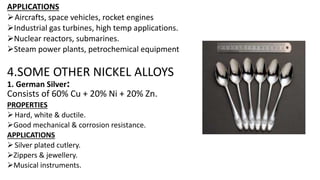
1. German Silver:
Consists of 60% Cu + 20% Ni + 20% Zn.
PROPERTIES
Hard, white & ductile.
Good mechanical & corrosion resistance.
APPLICATIONS
Silver plated cutlery.
Zippers & jewellery.
Musical instruments.
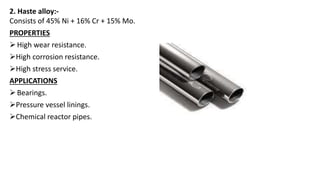
2. Haste alloy:-
Consists of 45% Ni + 16% Cr + 15% Mo.
PROPERTIES
High wear resistance.
High corrosion resistance.
High stress service.
APPLICATIONS
Bearings.
Pressure vessel linings.
Chemical reactor pipes.

Nickel and its extraction

  • 1.
    Presented By- 1). HarpreetKhanna. (18) 2). Prince Goel (32) 3). Roopashree Panda (33) 4). Shiv Verdhan Singh (49)
  • 2.
    Content Introduction to Nickel Extractionof nickel Properties of Nickel Advantages Disadvantages. Classification of Nickel alloys
  • 3.
    1. INTRODUCTION TONICKEL • Nickel is a chemical element with symbol Ni and atomic number 28 • It is a silvery-white lustrous metal with a slight golden tinge • Nickel belongs to the transition metals and is hard and ductile • Pure native nickel is found in Earth's crust only in tiny amounts, usually in ultramafic rocks, and in the interiors of larger nickel–iron meteorites that were not exposed to oxygen when outside Earth's atmosphere
  • 4.
    1.1 OCCURRENCE • Nickelis the earth's 22nd most abundant element and the 7th most abundant transition metal • It is a silver white crystalline metal that occurs in meteors or combined with other elements in ores • Two important groups of ores are:  Laterites: Oxide or silicate ores such as garnierite, (Ni, Mg)6 Si4O10 OH)8 which are predominantly found in tropical areas such as New Caledonia, Cuba and Queensland. Sulphides:These are ores such as pentlandite, which contain about 1.5%, nickel associated with copper, cobalt and other metals. They are predominant in more temperate regions such as Canada, Russia and South Africa. Canada is the world's leading nickel producer and the Sudbury Basin of Ontario contains one of the largest nickel deposits in the world.
  • 5.
    2.EXTRACTION OF NICKEL •The extraction of nickel and ferronickel from laterite and sulfide ores • Laterite ores occur as saprolite, smectite and limonite layers because of their different compositions and mineralogy, they require different methods of extraction (Cu₈Ni₁₆Fe₁₀) • Saprolite , which has a relatively low iron content, is smelted. Limonite and smectite ores, which have a high iron content, are leached and refined. (nFe(OH)₃.16H₂O.)
  • 6.
    FOR SULFIDES ORES [(FeNi)₉S₈](Pentlandite) •Concentration, Smelting and Converting to Matte • The sulphide ores are concentrated, smelted and converted to metal-rich matte • The processing steps are as follows: (a)The valuable minerals in an ore are concentrated by froth flotation (b) This concentrate is smelted and converted into an even richer, low-iron sulphide matte
  • 7.
    PRODUCTION OF NICKELFROM MATTE: Nickel and cobalt are mostly recovered from low-iron matte by the following steps: (a) The matte is leached using either chlorine gas in a chloride solution, oxygen in an ammonia solution or oxygen in a solution of sulphuric acid (b) The pregnant(the solution used for heap leaching) solution is purified (c) Separate nickel and cobalt solutions are produced, usually by solvent extraction; and (d) High-purity nickel and cobalt are produced from the solutions either by electro winning or by hydrogen reduction
  • 8.
    HYDROMETALLURGICAL APPROACHES: (Cu₈Ni₁₆Fe₁₀)→Limonite (FeO(OH).nH₂O) •Solvent Extraction – Electrowinning approach to lateritic ore beneficiation, is a hydrometallurgical method that relies on leaching, extractants, and electrowinning to produce nickel from ore Heap leaching is an industrial mining process to extract precious metals from ore via a series of chemical reactions that absorb specific minerals and then re-separates them after their division from other earth materials.
  • 9.
    PYROMETALLURGICAL APPROACHES LATERITE (Cu₈Ni₁₆Fe₁₀) SAPROLITE [nFe(OH)₃.nH₂O] Rotary Kiln Electric Furnace method, is a pyro metallurgical approach to produce ferronickel. As a pyro metallurgical technique, this method is best suited for ores that are predominantly saprolite. • STEPS INVOLVED : Drying • Nickel laterites contain a significant amount of water, making drying an important aspect of processing. A rotary dryer is typically used to remove free moisture. Preliminary Reduction • Once ore has been dried, it is processed in a large-scale rotary kiln to remove chemically bound moisture, as well as the oxide component of the ore. This step is often referred to as pre-reduction. Reduction & Smelting • Nickel is further reduced and smelted in an electric furnace. A cooling step may be implemented after the smelting step, typically through the employment of a rotary cooler
  • 10.
    REFINING: 1.MOND PROCESS The purestmetal is obtained from nickel oxide by the Mond process , which achieves a purity of greater than 99.99%. This process has three steps: 1. Nickel oxide reacts with Syngas at 200 °C to give nickel, together with impurities including iron and cobalt. NiO(s) + H2(g) → Ni(s) + H2O(g) 2. The impure nickel reacts with carbon monoxide at 50–60 °C to form the gas nickel carbonyl, leaving the impurities as solids. Ni(s) + 4 CO(g) → Ni(CO)4(g) 3. The mixture of nickel carbonyl and Syngas is heated to 220– 250 °C, resulting in decomposition back to nickel and carbon monoxide: Ni(CO)4(g) → Ni(s) + 4 CO(g)
  • 11.
    2.ELECTROREFINING • Nickel isrefined electrolytically from metallic nickel or nickel sulphide anodes, containing impurities iron,copper,silver,platinum,palladium etc. • The electrolyte principally contain nickel sulphate in a nearly neutral solution • Extraordinary precautions must be taken to ensure that the electrolyte at the cathode is free of copper, iron, and other impurities. • Each cathode is suspended in an individual porous walled compartment to which pure electrolyte is fed at a predetermined rate. The impure electrolyte leaving the anodes is removed from the cell and is purified by removal of iron ,copper etc. before being returned to the cathode compartments for precipitation of pure nickel on the cathode.
  • 12.
    PROPERTIES OF NICKEL PHYSICALPROPERTIES • Color- Silvery-White Metal • Phase- Solid • Conductivity- Fairly good conductor of heat and electricity • Ductility- It can be beaten into extremely thin sheets • Malleability- It’s capable of being shaped or bent • Luster- Exhibits a shine or glow • Hardness- Harder than iron • Ferromagnetic- Nickel is easily magnetized
  • 13.
    CHEMICAL PROPERTIES • Corrosion-Highly resistant to rusting and corrosion • Reactivity with Oxygen- Nickel metal does not react with air under ambient conditions. • Compounds- Used for electroplating and to make nickel alloys
  • 14.
    ADVANTAGES • Nickel belongsto transition metals. It is hard , ductile , and considered corrosion resistant because of its slow rate of oxidation at room temperature • High melting point and is magnetic at room temperature. • Low expansion
  • 15.
    DISADVANTAGES • Handling nickelcan result in symptoms of dermatitis among sensitized individuals. • High nickel concentration in air causes health issues. • High nickel concentration in soil as well as in surface water destroys plant growth and algae growth respectively
  • 16.
    CLASSIFICATIONS OF NICKELALLOYS : • There are different types of nickel alloys: Nickel-copper alloys (Monels) Nickel-chromium alloys Nickel-base superalloys
  • 17.
    1.NICKEL COPPER ALLOYS(MONELS)  Ni and Cu form complete solid solution.  Ni-Cu alloy contains 67%Ni and 33%Cu, called Monels. o Two types of Monels are found :- 1. MONEL METAL (METAL TREATED) : • It consists of (67% Ni + 30% Cu + small amounts of Fe, Mn, Si & C.) PROPERTIES: High strength and toughness over a range of temperature. Good weldability. Excellent corrosion resistance. Resistant to Sea Water, Chlorine
  • 18.
    APPLICATIONS: High temperature valves. Centrifugalpump impellors & water meter parts. Steam turbine blades. 2.K-MONEL (AGE HARDENED) : It consists of 66% Ni + 29% Cu + 2.57% Al + Mn + C. PROPERTIES Wholly Non-magnetic Al increases strength & hardness above that of monel. APPLICATIONS Pump shafts, springs & valve stems, etc
  • 19.
    2.NICKEL CHROMIUM ALLOYS Cr forms solid solution with Ni up to~30% at room temperature.  High corrosion resistance is due to high Cr addition. 1. INCONEL 600: It consists of (79.5% Ni + 15.5% Cr + 8% Fe is a standard engineering alloy. PROPERTIES: High corrosion resistance at high temp. High strength and workability. Difficult to machine APPLICATIONS: Gas turbine combusters and blades. Chemical and food processing equipment. Furnace muffle & rocket skins.
  • 20.
    2. NICHROME : Itconsists of 80% Ni + 20% Cr. PROPERTIES: High melting point. High electrical resistivity. Good stability from deforming. APPLICATIONS: Resistance heating coils. Rocket igniters. Jewellery casting supports. •In Ceramic manufacturing industry other Ni-Cr alloys are Inconel 601 and 625 with improved properties
  • 21.
    3.NICKEL BASE SUPERALLOYS High temperature heat-resistance alloys, which can retain high strengths at elevated temperatures. There are three types of Ni-base superalloys:- •Ni base. •Ni- iron base. •Cobalt base.  The alloys contain high Cr with Ti, Al to from precipitates and additions of Mo, Co, Nb, Zr, B, Fe.  Microstructures are complex. PROPERTIES: Heat resistant and high strength at high temperature (760-980°C). Good corrosion & oxidation resistance.
  • 22.
    APPLICATIONS Aircrafts, space vehicles,rocket engines Industrial gas turbines, high temp applications. Nuclear reactors, submarines. Steam power plants, petrochemical equipment 4.SOME OTHER NICKEL ALLOYS 1. German Silver: Consists of 60% Cu + 20% Ni + 20% Zn. PROPERTIES Hard, white & ductile. Good mechanical & corrosion resistance. APPLICATIONS Silver plated cutlery. Zippers & jewellery. Musical instruments.
  • 23.
    2. Haste alloy:- Consistsof 45% Ni + 16% Cr + 15% Mo. PROPERTIES High wear resistance. High corrosion resistance. High stress service. APPLICATIONS Bearings. Pressure vessel linings. Chemical reactor pipes.