Chlorine
By Chelsie Dedman
History!
The name “chlorine”
derives from the Greek
word chloros, meaning
“pale green”
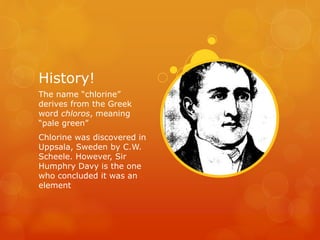
Chlorine was discovered in
Uppsala, Sweden by C.W.
Scheele. However, Sir
Humphry Davy is the one
who concluded it was an
element
Properties!
 At room temperature, Chlorine is a gas
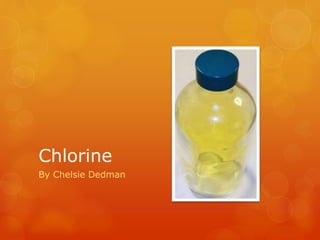
 Chlorine is of a pale greenish-yellow color
 The melting point is -101° C
 The boiling point is -34° C
 The density of Chlorine is 3.214 g/cm³
 Major isotopes: 35C, 36C, 37C. 36C is used in research as a
tracer.
Availability!
 Chlorine is not found by itself in nature. Instead, it is
found in many compounds. In nature, it can be found in
salt of the ocean water, carnallite, and sylvite.
 To get the element, one must contact a chemical
company like Sigma-Aldrich.
 Chlorine usually costs around $0.15 for every 100 g
Uses!
 By itself, chlorine is not
used very much, but it is
used to create many
compounds for many
purposes. It can be
found in bleach, and it is
also used in water
purification. It can also
be used in making
insecticides in the form
of chlorinated
hydrocarbons.
 Major compounds
include:
1. CaOCl: Calcium
hypochlorite- bleaching
and swimming pool
disinfectant
2. KClO3: Potassium
chlorate- fireworks
3. NaCl: Sodium chloride-
salt
4. Ethylene dichloride: used
to make polyvinyl
chloride- PVC
Fun Facts!
 Chlorine is among the top 10 most produced chemicals
in the U.S.
Resources!
 http://www.chemicool.com/elements/chlorine.html
 http://www.rsc.org/chemsoc/visualelements/pages/data/chl
orine_data.html
 http://www.periodic-table.org.uk/element-chlorine.htm
 http://science.jrank.org/pages/1440/Chlorine.html
 http://science.jrank.org/pages/1438/Chlorine-Properties-
uses-chlorine.html
 http://science.jrank.org/pages/1439/Chlorine-Compounds-
chlorine.html
 http://www.chemistryexplained.com/elements/A-
C/Chlorine.html
 http://chemistry.about.com/od/periodictableelements/ig/Ele
ments-in-the-Human-Body/Chlorine.--WP.htm

Chlorine (Chelsie Dedman)

  • 1.
  • 2.
    History! The name “chlorine” derivesfrom the Greek word chloros, meaning “pale green” Chlorine was discovered in Uppsala, Sweden by C.W. Scheele. However, Sir Humphry Davy is the one who concluded it was an element
  • 3.
    Properties!  At roomtemperature, Chlorine is a gas  Chlorine is of a pale greenish-yellow color  The melting point is -101° C  The boiling point is -34° C  The density of Chlorine is 3.214 g/cm³  Major isotopes: 35C, 36C, 37C. 36C is used in research as a tracer.
  • 4.
    Availability!  Chlorine isnot found by itself in nature. Instead, it is found in many compounds. In nature, it can be found in salt of the ocean water, carnallite, and sylvite.  To get the element, one must contact a chemical company like Sigma-Aldrich.  Chlorine usually costs around $0.15 for every 100 g
  • 5.
    Uses!  By itself,chlorine is not used very much, but it is used to create many compounds for many purposes. It can be found in bleach, and it is also used in water purification. It can also be used in making insecticides in the form of chlorinated hydrocarbons.  Major compounds include: 1. CaOCl: Calcium hypochlorite- bleaching and swimming pool disinfectant 2. KClO3: Potassium chlorate- fireworks 3. NaCl: Sodium chloride- salt 4. Ethylene dichloride: used to make polyvinyl chloride- PVC
  • 6.
    Fun Facts!  Chlorineis among the top 10 most produced chemicals in the U.S.
  • 7.
    Resources!  http://www.chemicool.com/elements/chlorine.html  http://www.rsc.org/chemsoc/visualelements/pages/data/chl orine_data.html http://www.periodic-table.org.uk/element-chlorine.htm  http://science.jrank.org/pages/1440/Chlorine.html  http://science.jrank.org/pages/1438/Chlorine-Properties- uses-chlorine.html  http://science.jrank.org/pages/1439/Chlorine-Compounds- chlorine.html  http://www.chemistryexplained.com/elements/A- C/Chlorine.html  http://chemistry.about.com/od/periodictableelements/ig/Ele ments-in-the-Human-Body/Chlorine.--WP.htm