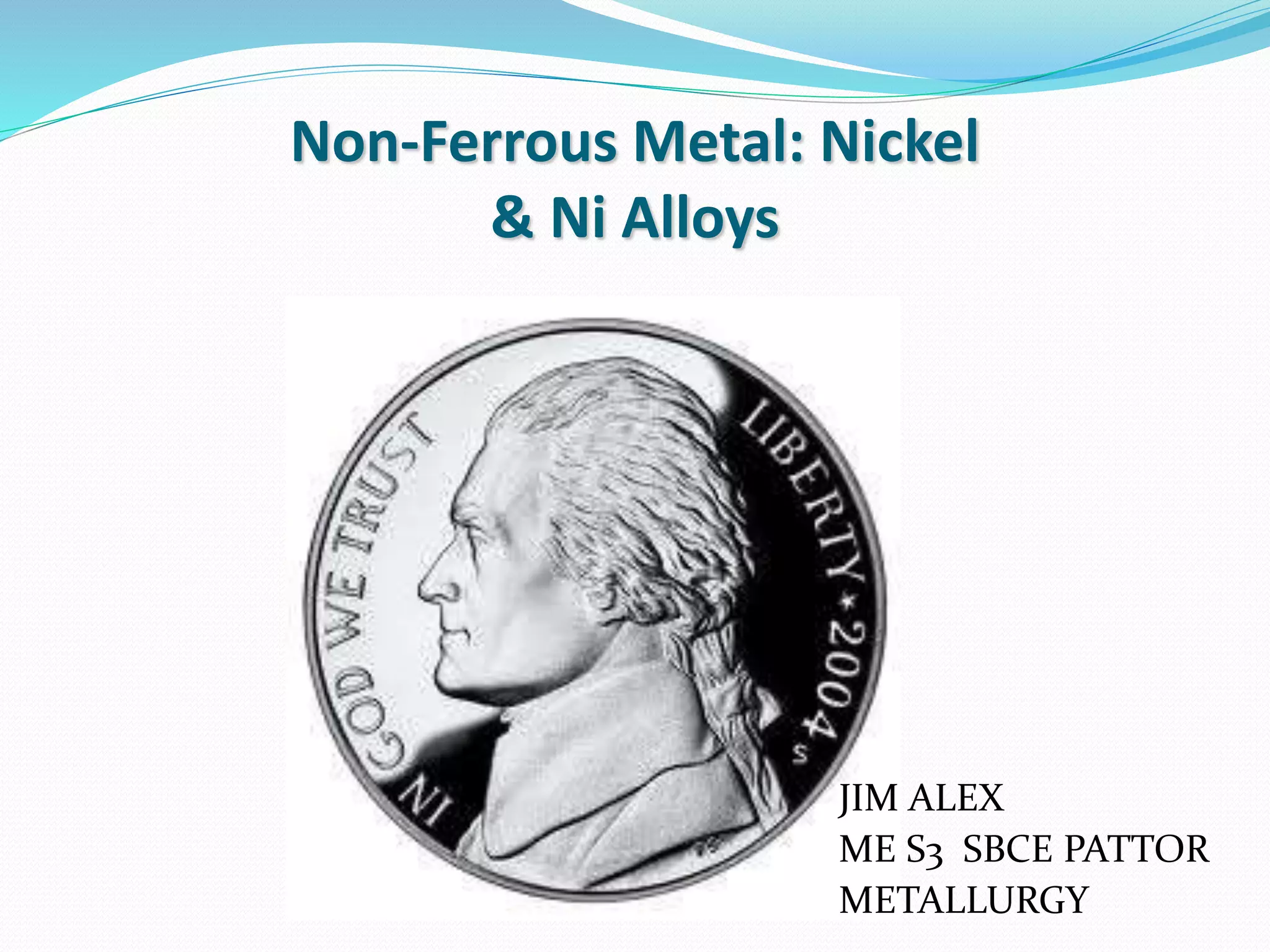
Non-Ferrous Metal: Nickel
& Ni Alloys
JIM ALEX
ME S3 SBCE PATTOR
METALLURGY
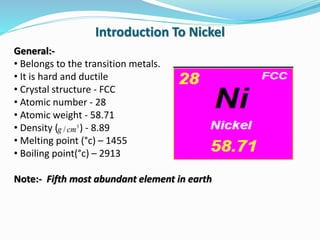
General:-
• Belongs to the transition metals.
• It is hard and ductile
• Crystal structure - FCC
• Atomic number - 28
• Atomic weight - 58.71
• Density ( ) - 8.89
• Melting point (°c) – 1455
• Boiling point(°c) – 2913
Note:- Fifth most abundant element in earth
Introduction To Nickel
3
/ cmg
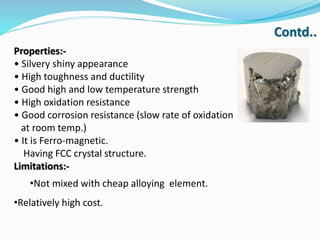
Properties:-
• Silvery shiny appearance
• High toughness and ductility
• Good high and low temperature strength
• High oxidation resistance
• Good corrosion resistance (slow rate of oxidation
at room temp.)
• It is Ferro-magnetic.
Having FCC crystal structure.
Limitations:-
•Not mixed with cheap alloying element.
•Relatively high cost.
Contd..
Applications
 85% of metallic nickel used in combination with other
metals alloys
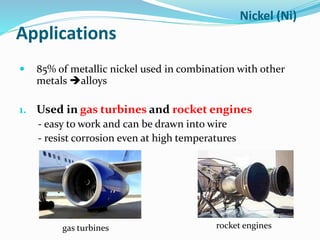
1. Used in gas turbines and rocket engines
- easy to work and can be drawn into wire
- resist corrosion even at high temperatures
Nickel (Ni)
gas turbines rocket engines
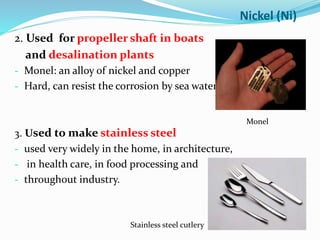
2. Used for propeller shaft in boats
and desalination plants
- Monel: an alloy of nickel and copper
- Hard, can resist the corrosion by sea water
3. Used to make stainless steel
- used very widely in the home, in architecture,
- in health care, in food processing and
- throughout industry.
Nickel (Ni)
Monel
Stainless steel cutlery
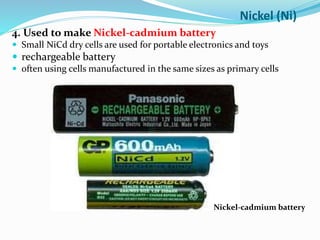
4. Used to make Nickel-cadmium battery
 Small NiCd dry cells are used for portable electronics and toys
 rechargeable battery
 often using cells manufactured in the same sizes as primary cells
Nickel-cadmium battery
Nickel (Ni)
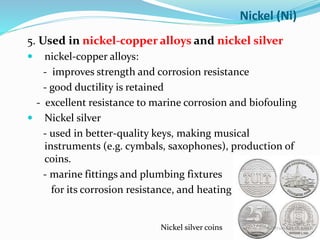
5. Used in nickel-copper alloys and nickel silver
 nickel-copper alloys:
- improves strength and corrosion resistance
- good ductility is retained
- excellent resistance to marine corrosion and biofouling
 Nickel silver
- used in better-quality keys, making musical
instruments (e.g. cymbals, saxophones), production of
coins.
- marine fittings and plumbing fixtures
for its corrosion resistance, and heating
Nickel (Ni)
Nickel silver coins
There are different types of nickel and nickel alloys;
 Commercially pure nickel
 Nickel-copper alloys (Monels)
 Nickel-chromium alloys
 Nickel-base superalloys
 Nickel-iron superalloys
Classification of Ni & Ni-Alloys
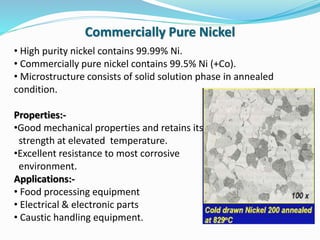
• High purity nickel contains 99.99% Ni.
• Commercially pure nickel contains 99.5% Ni (+Co).
• Microstructure consists of solid solution phase in annealed
condition.
Properties:-
•Good mechanical properties and retains its
strength at elevated temperature.
•Excellent resistance to most corrosive
environment.
Applications:-
• Food processing equipment
• Electrical & electronic parts
• Caustic handling equipment.
Commercially Pure Nickel
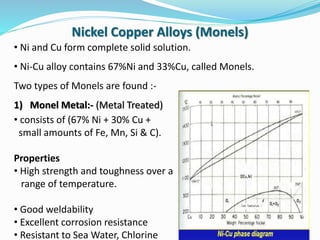
• Ni and Cu form complete solid solution.
• Ni-Cu alloy contains 67%Ni and 33%Cu, called Monels.
Two types of Monels are found :-
1) Monel Metal:- (Metal Treated)
• consists of (67% Ni + 30% Cu +
small amounts of Fe, Mn, Si & C).
Properties
• High strength and toughness over a
range of temperature.
• Good weldability
• Excellent corrosion resistance
• Resistant to Sea Water, Chlorine
Nickel Copper Alloys (Monels)
Applications
• Steam turbine blades (UTS-525 Mpa & Yield Strength-230 Mpa)
• High temperature valves
• Centrifugal pump impellors & water meter parts.
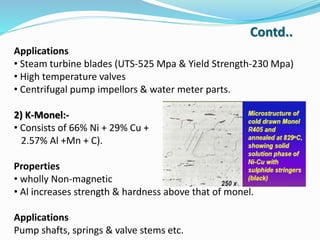
2) K-Monel:-
• Consists of 66% Ni + 29% Cu +
2.57% Al +Mn + C).
Properties
• wholly Non-magnetic
• Al increases strength & hardness above that of monel.
Applications
Pump shafts, springs & valve stems etc.
Contd..
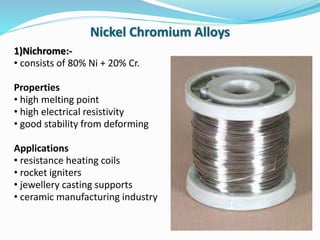
1)Nichrome:-
• consists of 80% Ni + 20% Cr.
Properties
• high melting point
• high electrical resistivity
• good stability from deforming
Applications
• resistance heating coils
• rocket igniters
• jewellery casting supports
• ceramic manufacturing industry
Nickel Chromium Alloys
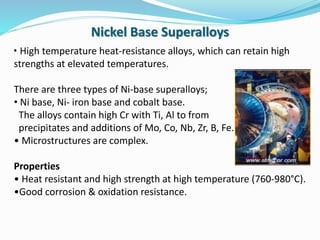
• High temperature heat-resistance alloys, which can retain high
strengths at elevated temperatures.
There are three types of Ni-base superalloys;
• Ni base, Ni- iron base and cobalt base.
The alloys contain high Cr with Ti, Al to from
precipitates and additions of Mo, Co, Nb, Zr, B, Fe.
• Microstructures are complex.
Properties
• Heat resistant and high strength at high temperature (760-980°C).
•Good corrosion & oxidation resistance.
Nickel Base Superalloys
Applications
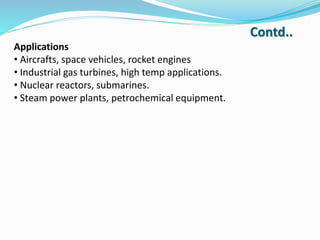
• Aircrafts, space vehicles, rocket engines
• Industrial gas turbines, high temp applications.
• Nuclear reactors, submarines.
• Steam power plants, petrochemical equipment.
Contd..
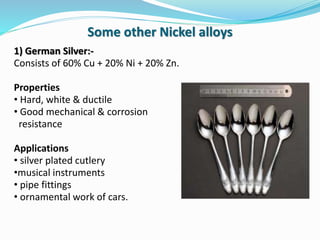
1) German Silver:-
Consists of 60% Cu + 20% Ni + 20% Zn.
Properties
• Hard, white & ductile
• Good mechanical & corrosion
resistance
Applications
• silver plated cutlery
•musical instruments
• pipe fittings
• ornamental work of cars.
Some other Nickel alloys
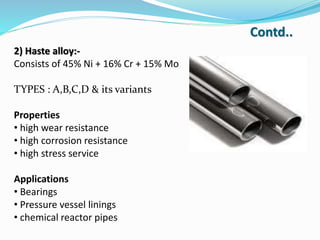
2) Haste alloy:-
Consists of 45% Ni + 16% Cr + 15% Mo
TYPES : A,B,C,D & its variants
Properties
• high wear resistance
• high corrosion resistance
• high stress service
Applications
• Bearings
• Pressure vessel linings
• chemical reactor pipes
Contd..

Nickal and its alloys

  • 1.
    Non-Ferrous Metal: Nickel &Ni Alloys JIM ALEX ME S3 SBCE PATTOR METALLURGY
  • 2.
    General:- • Belongs tothe transition metals. • It is hard and ductile • Crystal structure - FCC • Atomic number - 28 • Atomic weight - 58.71 • Density ( ) - 8.89 • Melting point (°c) – 1455 • Boiling point(°c) – 2913 Note:- Fifth most abundant element in earth Introduction To Nickel 3 / cmg
  • 3.
    Properties:- • Silvery shinyappearance • High toughness and ductility • Good high and low temperature strength • High oxidation resistance • Good corrosion resistance (slow rate of oxidation at room temp.) • It is Ferro-magnetic. Having FCC crystal structure. Limitations:- •Not mixed with cheap alloying element. •Relatively high cost. Contd..
  • 4.
    Applications  85% ofmetallic nickel used in combination with other metals alloys 1. Used in gas turbines and rocket engines - easy to work and can be drawn into wire - resist corrosion even at high temperatures Nickel (Ni) gas turbines rocket engines
  • 5.
    2. Used forpropeller shaft in boats and desalination plants - Monel: an alloy of nickel and copper - Hard, can resist the corrosion by sea water 3. Used to make stainless steel - used very widely in the home, in architecture, - in health care, in food processing and - throughout industry. Nickel (Ni) Monel Stainless steel cutlery
  • 6.
    4. Used tomake Nickel-cadmium battery  Small NiCd dry cells are used for portable electronics and toys  rechargeable battery  often using cells manufactured in the same sizes as primary cells Nickel-cadmium battery Nickel (Ni)
  • 7.
    5. Used innickel-copper alloys and nickel silver  nickel-copper alloys: - improves strength and corrosion resistance - good ductility is retained - excellent resistance to marine corrosion and biofouling  Nickel silver - used in better-quality keys, making musical instruments (e.g. cymbals, saxophones), production of coins. - marine fittings and plumbing fixtures for its corrosion resistance, and heating Nickel (Ni) Nickel silver coins
  • 8.
    There are differenttypes of nickel and nickel alloys;  Commercially pure nickel  Nickel-copper alloys (Monels)  Nickel-chromium alloys  Nickel-base superalloys  Nickel-iron superalloys Classification of Ni & Ni-Alloys
  • 9.
    • High puritynickel contains 99.99% Ni. • Commercially pure nickel contains 99.5% Ni (+Co). • Microstructure consists of solid solution phase in annealed condition. Properties:- •Good mechanical properties and retains its strength at elevated temperature. •Excellent resistance to most corrosive environment. Applications:- • Food processing equipment • Electrical & electronic parts • Caustic handling equipment. Commercially Pure Nickel
  • 10.
    • Ni andCu form complete solid solution. • Ni-Cu alloy contains 67%Ni and 33%Cu, called Monels. Two types of Monels are found :- 1) Monel Metal:- (Metal Treated) • consists of (67% Ni + 30% Cu + small amounts of Fe, Mn, Si & C). Properties • High strength and toughness over a range of temperature. • Good weldability • Excellent corrosion resistance • Resistant to Sea Water, Chlorine Nickel Copper Alloys (Monels)
  • 11.
    Applications • Steam turbineblades (UTS-525 Mpa & Yield Strength-230 Mpa) • High temperature valves • Centrifugal pump impellors & water meter parts. 2) K-Monel:- • Consists of 66% Ni + 29% Cu + 2.57% Al +Mn + C). Properties • wholly Non-magnetic • Al increases strength & hardness above that of monel. Applications Pump shafts, springs & valve stems etc. Contd..
  • 12.
    1)Nichrome:- • consists of80% Ni + 20% Cr. Properties • high melting point • high electrical resistivity • good stability from deforming Applications • resistance heating coils • rocket igniters • jewellery casting supports • ceramic manufacturing industry Nickel Chromium Alloys
  • 13.
    • High temperatureheat-resistance alloys, which can retain high strengths at elevated temperatures. There are three types of Ni-base superalloys; • Ni base, Ni- iron base and cobalt base. The alloys contain high Cr with Ti, Al to from precipitates and additions of Mo, Co, Nb, Zr, B, Fe. • Microstructures are complex. Properties • Heat resistant and high strength at high temperature (760-980°C). •Good corrosion & oxidation resistance. Nickel Base Superalloys
  • 14.
    Applications • Aircrafts, spacevehicles, rocket engines • Industrial gas turbines, high temp applications. • Nuclear reactors, submarines. • Steam power plants, petrochemical equipment. Contd..
  • 15.
    1) German Silver:- Consistsof 60% Cu + 20% Ni + 20% Zn. Properties • Hard, white & ductile • Good mechanical & corrosion resistance Applications • silver plated cutlery •musical instruments • pipe fittings • ornamental work of cars. Some other Nickel alloys
  • 17.
    2) Haste alloy:- Consistsof 45% Ni + 16% Cr + 15% Mo TYPES : A,B,C,D & its variants Properties • high wear resistance • high corrosion resistance • high stress service Applications • Bearings • Pressure vessel linings • chemical reactor pipes Contd..

Editor's Notes

  • #3 The difference being that in forging, the main body of metal is product & flash is cut away & discarded; in extrusion, the flash (metal flowing out of die) is product and slug remianing in die isn’t used.
  • #4 The difference being that in forging, the main body of metal is product & flash is cut away & discarded; in extrusion, the flash (metal flowing out of die) is product and slug remianing in die isn’t used.
  • #9 The difference being that in forging, the main body of metal is product & flash is cut away & discarded; in extrusion, the flash (metal flowing out of die) is product and slug remianing in die isn’t used.
  • #10 The difference being that in forging, the main body of metal is product & flash is cut away & discarded; in extrusion, the flash (metal flowing out of die) is product and slug remianing in die isn’t used.
  • #11 The difference being that in forging, the main body of metal is product & flash is cut away & discarded; in extrusion, the flash (metal flowing out of die) is product and slug remianing in die isn’t used.
  • #12 The difference being that in forging, the main body of metal is product & flash is cut away & discarded; in extrusion, the flash (metal flowing out of die) is product and slug remianing in die isn’t used.
  • #13 The difference being that in forging, the main body of metal is product & flash is cut away & discarded; in extrusion, the flash (metal flowing out of die) is product and slug remianing in die isn’t used.
  • #14 The difference being that in forging, the main body of metal is product & flash is cut away & discarded; in extrusion, the flash (metal flowing out of die) is product and slug remianing in die isn’t used.
  • #15 The difference being that in forging, the main body of metal is product & flash is cut away & discarded; in extrusion, the flash (metal flowing out of die) is product and slug remianing in die isn’t used.
  • #16 The difference being that in forging, the main body of metal is product & flash is cut away & discarded; in extrusion, the flash (metal flowing out of die) is product and slug remianing in die isn’t used.
  • #18 The difference being that in forging, the main body of metal is product & flash is cut away & discarded; in extrusion, the flash (metal flowing out of die) is product and slug remianing in die isn’t used.