 Named after the mineral zircon, which
originates from the Persian word for gold-like,
zagun.
 Pronounced as zer-KO-ni-em.
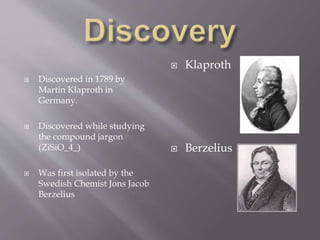
 Discovered in 1789 by
Martin Klaproth in
Germany.
 Discovered while studying
the compound jargon
(ZiSiO_4_)
 Was first isolated by the
Swedish Chemist Jons Jacob
Berzelius
 Klaproth
 Berzelius
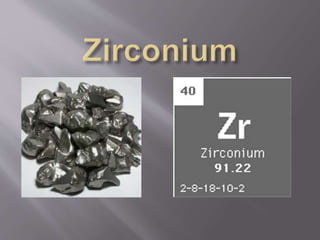
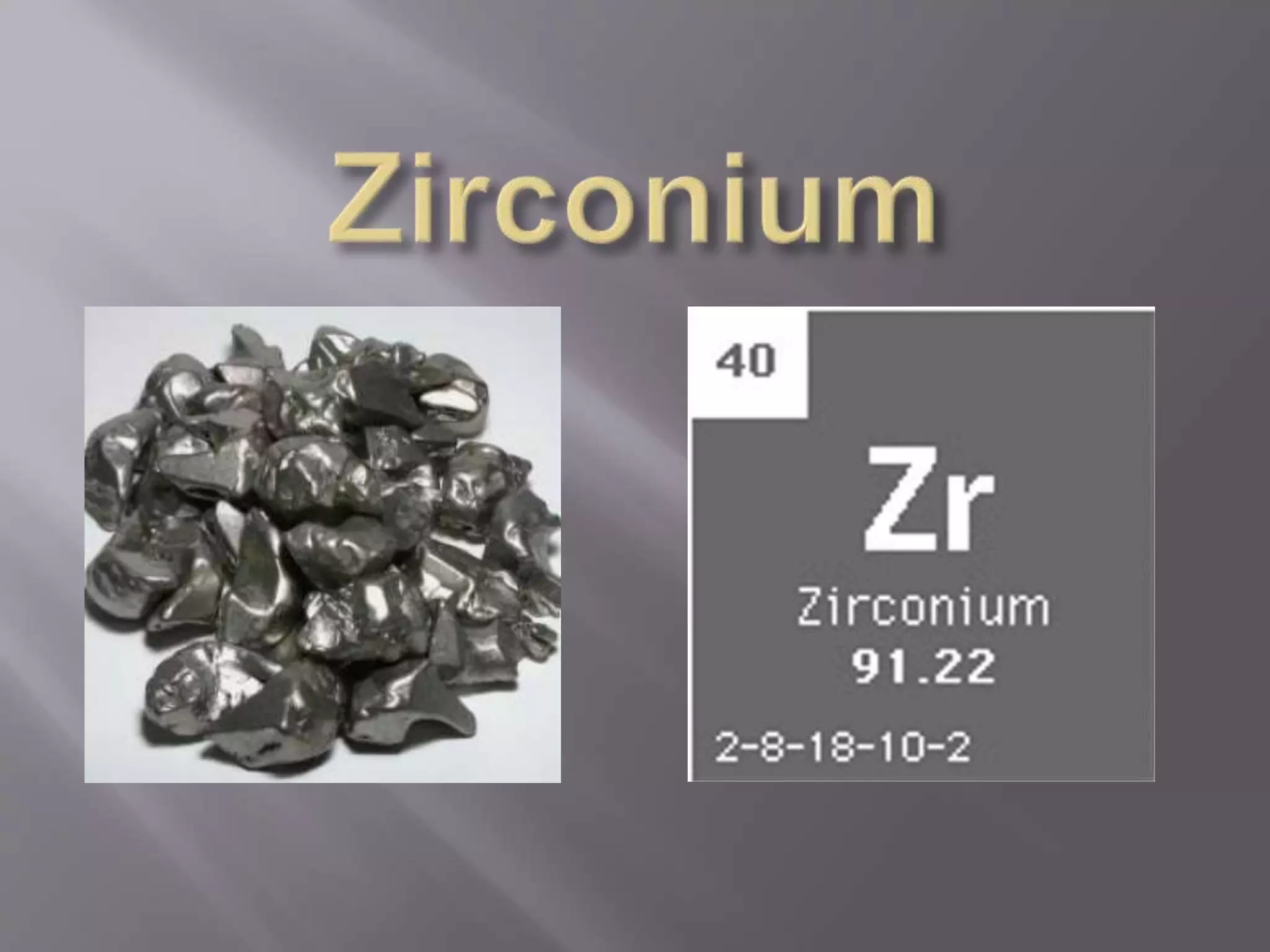
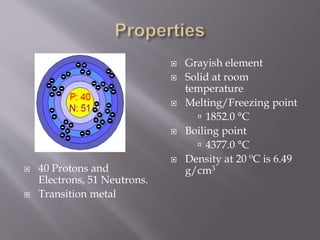
 40 Protons and
Electrons, 51 Neutrons.
 Transition metal
 Grayish element
 Solid at room
temperature
 Melting/Freezing point
 1852.0 °C
 Boiling point
 4377.0 °C
 Density at 20 ºC is 6.49
g/cm3
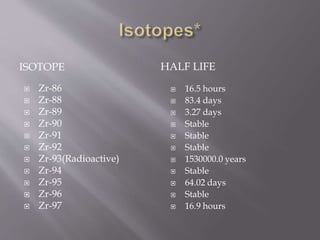
ISOTOPE HALF LIFE
 Zr-86
 Zr-88
 Zr-89
 Zr-90
 Zr-91
 Zr-92
 Zr-93(Radioactive)
 Zr-94
 Zr-95
 Zr-96
 Zr-97
 16.5 hours
 83.4 days
 3.27 days
 Stable
 Stable
 Stable
 1530000.0 years
 Stable
 64.02 days
 Stable
 16.9 hours
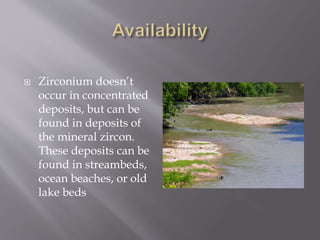
 Zirconium doesn’t
occur in concentrated
deposits, but can be
found in deposits of
the mineral zircon.
These deposits can be
found in streambeds,
ocean beaches, or old
lake beds
 Zirconium is obtained through a process
known as the Kroll Process.
 Essentially is the reduction of chloride with
magnesium.
 This is the way most of the Zirconium in the
world is produced.
PRIMARY USES SECONDARY USES
 Used in research due to its
resistance to corrosion.
 This property also allows
it to be used in high
performance pumps and
valves.
 It is also used as an
alloying agent in steel
 Photoflash bulbs
 Explosive primers
 Vacuum Tubes
 Lamp filaments
 As a carbonate
(Zirconium Carbonate),
its used to treat poison
ivy.
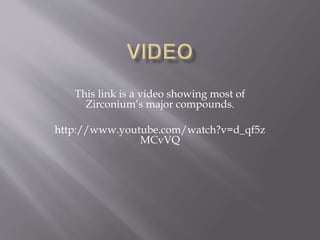
 The most popular form
of Zirconium is
Zircon(ZrSiO_4_). A
form of this is a clear,
transparent gemstone
,that can be cut to look
like diamond and is
frequently used in
jewelry.
This link is a video showing most of
Zirconium’s major compounds.
http://www.youtube.com/watch?v=d_qf5z
MCvVQ

Zirconium (Jesse Wynne)

  • 2.
     Named afterthe mineral zircon, which originates from the Persian word for gold-like, zagun.  Pronounced as zer-KO-ni-em.
  • 3.
     Discovered in1789 by Martin Klaproth in Germany.  Discovered while studying the compound jargon (ZiSiO_4_)  Was first isolated by the Swedish Chemist Jons Jacob Berzelius  Klaproth  Berzelius
  • 4.
     40 Protonsand Electrons, 51 Neutrons.  Transition metal  Grayish element  Solid at room temperature  Melting/Freezing point  1852.0 °C  Boiling point  4377.0 °C  Density at 20 ºC is 6.49 g/cm3
  • 5.
    ISOTOPE HALF LIFE Zr-86  Zr-88  Zr-89  Zr-90  Zr-91  Zr-92  Zr-93(Radioactive)  Zr-94  Zr-95  Zr-96  Zr-97  16.5 hours  83.4 days  3.27 days  Stable  Stable  Stable  1530000.0 years  Stable  64.02 days  Stable  16.9 hours
  • 6.
     Zirconium doesn’t occurin concentrated deposits, but can be found in deposits of the mineral zircon. These deposits can be found in streambeds, ocean beaches, or old lake beds
  • 7.
     Zirconium isobtained through a process known as the Kroll Process.  Essentially is the reduction of chloride with magnesium.  This is the way most of the Zirconium in the world is produced.
  • 8.
    PRIMARY USES SECONDARYUSES  Used in research due to its resistance to corrosion.  This property also allows it to be used in high performance pumps and valves.  It is also used as an alloying agent in steel  Photoflash bulbs  Explosive primers  Vacuum Tubes  Lamp filaments
  • 9.
     As acarbonate (Zirconium Carbonate), its used to treat poison ivy.  The most popular form of Zirconium is Zircon(ZrSiO_4_). A form of this is a clear, transparent gemstone ,that can be cut to look like diamond and is frequently used in jewelry.
  • 10.
    This link isa video showing most of Zirconium’s major compounds. http://www.youtube.com/watch?v=d_qf5z MCvVQ

Editor's Notes

  • #6 *data found on a chemicalelements.com website.