Non-Ferrous Metal: Nickel
& Ni Alloys
Presented By:-
Deepam Goyal
Department of Mechanical Engineering
NITTTR , CHANDIGARH
 Non-Ferrous Metals
 Introduction to Nickel
 Production of Nickel
 Extraction of Nickel
 Classification of Nickel Alloys
 References
CONTENTS
• In metallurgy, a non-ferrous metal is any metal, including alloys, that
does not contain iron in appreciable amounts.
• They are generally suffer from hot-shortness, possess lower strength
at lower temperatures.
Properties:-
• Low density
• Higher thermal & electrical conductivities, magnetic properties
• Attractive colours
• Softness & facility of cold working
• Good formability
• Corrosion resistance
• Fusibility & ease of casting and fabrication.
Non-Ferrous Metals
Contd..
Non-Ferrous Metals Ferrous Metals
• Don’t Contain iron as base
• Lower Melting Points
• More expensive
• More Shrinkage
• Contain iron as base
• Higher Melting Points
• Less expensive
• Less shrinkage
General:-
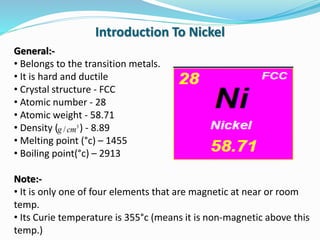
• Belongs to the transition metals.
• It is hard and ductile
• Crystal structure - FCC
• Atomic number - 28
• Atomic weight - 58.71
• Density ( ) - 8.89
• Melting point (°c) – 1455
• Boiling point(°c) – 2913
Note:-
• It is only one of four elements that are magnetic at near or room
temp.
• Its Curie temperature is 355°c (means it is non-magnetic above this
temp.)
Introduction To Nickel
3
/cmg
Properties:-
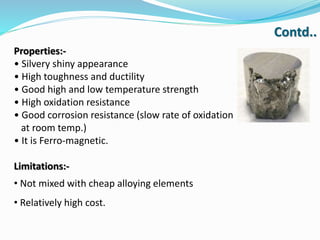
• Silvery shiny appearance
• High toughness and ductility
• Good high and low temperature strength
• High oxidation resistance
• Good corrosion resistance (slow rate of oxidation
at room temp.)
• It is Ferro-magnetic.
Limitations:-
• Not mixed with cheap alloying elements
• Relatively high cost.
Contd..
Applications:-
• Ni and its alloys are used in making coins.
• Nickel is used in rechargeable batteries such as Ni-Cd & in magnets.
• Its alloys are also used for armour plate and burglar proof vaults.
• Chemical plant, heat exchanger, reaction furnace, rotary kiln,
turbine blades.
• Used as alloying elements in stainless steels etc.
• Ni and its alloys are frequently used as catalysts for hydrogenation
reactions (Raney nickel)
• Ni is used as a binder in the cemented tungsten carbide or hard
metal industry.
Contd..
First discovery of nickel mineral by the German was mistakenly
misunderstood to be rich-copper mineral.
There are three major types of Nickel deposits (sources):
1) Nickel-copper sulphide
2) Nickel silicates
3) Nickel laterites and serpentines
Ni-laterite Deposits
Production of Nickel
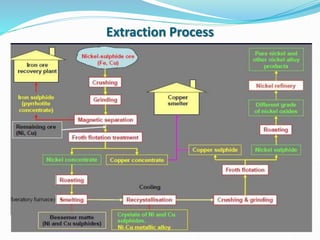
Extraction Process
There are different types of nickel and nickel alloys;
 Commercially pure nickel
 Nickel-copper alloys (Monels)
 Nickel-chromium alloys
 Nickel-base superalloys
 Nickel-iron superalloys
Classification of Ni & Ni-Alloys
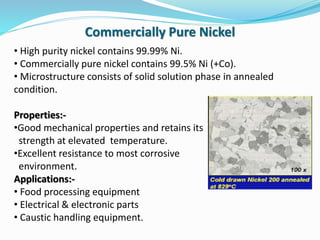
• High purity nickel contains 99.99% Ni.
• Commercially pure nickel contains 99.5% Ni (+Co).
• Microstructure consists of solid solution phase in annealed
condition.
Properties:-
•Good mechanical properties and retains its
strength at elevated temperature.
•Excellent resistance to most corrosive
environment.
Applications:-
• Food processing equipment
• Electrical & electronic parts
• Caustic handling equipment.
Commercially Pure Nickel
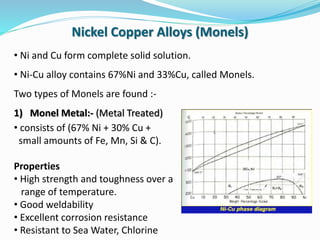
• Ni and Cu form complete solid solution.
• Ni-Cu alloy contains 67%Ni and 33%Cu, called Monels.
Two types of Monels are found :-
1) Monel Metal:- (Metal Treated)
• consists of (67% Ni + 30% Cu +
small amounts of Fe, Mn, Si & C).
Properties
• High strength and toughness over a
range of temperature.
• Good weldability
• Excellent corrosion resistance
• Resistant to Sea Water, Chlorine
Nickel Copper Alloys (Monels)
Applications
• Steam turbine blades (UTS-525 Mpa & Yield Strength-230 Mpa)
• High temperature valves
• Centrifugal pump impellors & water meter parts.
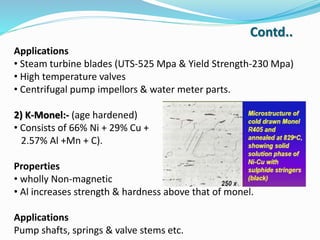
2) K-Monel:- (age hardened)
• Consists of 66% Ni + 29% Cu +
2.57% Al +Mn + C).
Properties
• wholly Non-magnetic
• Al increases strength & hardness above that of monel.
Applications
Pump shafts, springs & valve stems etc.
Contd..
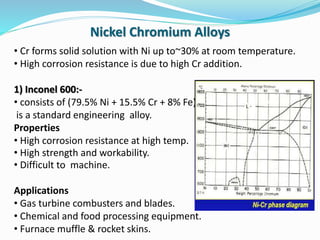
• Cr forms solid solution with Ni up to~30% at room temperature.
• High corrosion resistance is due to high Cr addition.
1) Inconel 600:-
• consists of (79.5% Ni + 15.5% Cr + 8% Fe)
is a standard engineering alloy.
Properties
• High corrosion resistance at high temp.
• High strength and workability.
• Difficult to machine.
Applications
• Gas turbine combusters and blades.
• Chemical and food processing equipment.
• Furnace muffle & rocket skins.
Nickel Chromium Alloys
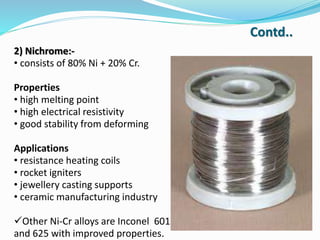
2) Nichrome:-
• consists of 80% Ni + 20% Cr.
Properties
• high melting point
• high electrical resistivity
• good stability from deforming
Applications
• resistance heating coils
• rocket igniters
• jewellery casting supports
• ceramic manufacturing industry
Other Ni-Cr alloys are Inconel 601
and 625 with improved properties.
Contd..
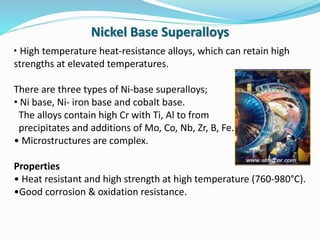
• High temperature heat-resistance alloys, which can retain high
strengths at elevated temperatures.
There are three types of Ni-base superalloys;
• Ni base, Ni- iron base and cobalt base.
The alloys contain high Cr with Ti, Al to from
precipitates and additions of Mo, Co, Nb, Zr, B, Fe.
• Microstructures are complex.
Properties
• Heat resistant and high strength at high temperature (760-980°C).
•Good corrosion & oxidation resistance.
Nickel Base Superalloys
The major phases present in the nickel-base superalloys:
1) γ (gamma) phase –the continuous matrix of FCC austenite.
2) γ’(gamma prime) phase –the major precipitate phase (more cubic
shape).
3) Carbides –various types, mainly and MC. (M – metal).
Applications
• Aircrafts, space vehicles, rocket engines
• Industrial gas turbines, high temp applications.
• Nuclear reactors, submarines.
• Steam power plants, petrochemical equipment.
Contd..
623CM
• Fe is added to replace some of Ni as it has lower cost.
- lowering the properties as compared with nickel base
super alloy, therefore it is used at lower temperatures.
• Ni-Fe superalloys contains 25-45% Ni + 15-60% Fe.
• Higher Ni content increases operating temp (upto815oC), due to
improved stability but more costly.
•Microstructure consists of austenitic FCC matrix and can be
strengthened by solid solution strengthening(Mo, Cr), and
precipitation hardening(Ti, Nb, Al) by forming intermetallic phases.
Examples: Inconel707, 718, 901.
Nickel Iron Superalloys
1) German Silver:-
Consists of 60% Cu + 20% Ni + 20% Zn.
Properties
• Hard, white & ductile
• Good mechanical & corrosion
resistance
Applications
• silver plated cutlery
• zippers & jewellery
• musical instruments
• pipe fittings
• ornamental work of cars
Some other Nickel alloys
2) Haste alloy:-
Consists of 45% Ni + 16% Cr + 15% Mo
TYPES : A,B,C,D & its variants
Properties
• high wear resistance
• high corrosion resistance
• high stress service
Applications
• Bearings
• Pressure vessel linings
• chemical reactor pipes
Contd..
REFERENCES
 Kalpakjian Seope, Schmid Steven R.: “Manufacturing Engineering &
Technology” Pearson Education India, 2009, pp 183-185.
 Sharma, P.C. ”A textbook of production Technology”. 7. New Delhi:
S.Chand & Company Ltd, 2011, 60-62. Print.
 Smith, W.F. “Structure and properties of engineering alloys”, second
edition, 1993, McGraw-Hill, ISB 0-07-59172-5.
 Davis, Joseph R. ”Nickel, Cobalt & their alloys”. United States of
America: ASM International, 2000. 5-192. Print.
Email ID :- bkdeepamgoyal@gmail.com

Nickel & Its Alloys

  • 1.
    Non-Ferrous Metal: Nickel &Ni Alloys Presented By:- Deepam Goyal Department of Mechanical Engineering NITTTR , CHANDIGARH
  • 2.
     Non-Ferrous Metals Introduction to Nickel  Production of Nickel  Extraction of Nickel  Classification of Nickel Alloys  References CONTENTS
  • 3.
    • In metallurgy,a non-ferrous metal is any metal, including alloys, that does not contain iron in appreciable amounts. • They are generally suffer from hot-shortness, possess lower strength at lower temperatures. Properties:- • Low density • Higher thermal & electrical conductivities, magnetic properties • Attractive colours • Softness & facility of cold working • Good formability • Corrosion resistance • Fusibility & ease of casting and fabrication. Non-Ferrous Metals
  • 4.
    Contd.. Non-Ferrous Metals FerrousMetals • Don’t Contain iron as base • Lower Melting Points • More expensive • More Shrinkage • Contain iron as base • Higher Melting Points • Less expensive • Less shrinkage
  • 5.
    General:- • Belongs tothe transition metals. • It is hard and ductile • Crystal structure - FCC • Atomic number - 28 • Atomic weight - 58.71 • Density ( ) - 8.89 • Melting point (°c) – 1455 • Boiling point(°c) – 2913 Note:- • It is only one of four elements that are magnetic at near or room temp. • Its Curie temperature is 355°c (means it is non-magnetic above this temp.) Introduction To Nickel 3 /cmg
  • 6.
    Properties:- • Silvery shinyappearance • High toughness and ductility • Good high and low temperature strength • High oxidation resistance • Good corrosion resistance (slow rate of oxidation at room temp.) • It is Ferro-magnetic. Limitations:- • Not mixed with cheap alloying elements • Relatively high cost. Contd..
  • 7.
    Applications:- • Ni andits alloys are used in making coins. • Nickel is used in rechargeable batteries such as Ni-Cd & in magnets. • Its alloys are also used for armour plate and burglar proof vaults. • Chemical plant, heat exchanger, reaction furnace, rotary kiln, turbine blades. • Used as alloying elements in stainless steels etc. • Ni and its alloys are frequently used as catalysts for hydrogenation reactions (Raney nickel) • Ni is used as a binder in the cemented tungsten carbide or hard metal industry. Contd..
  • 8.
    First discovery ofnickel mineral by the German was mistakenly misunderstood to be rich-copper mineral. There are three major types of Nickel deposits (sources): 1) Nickel-copper sulphide 2) Nickel silicates 3) Nickel laterites and serpentines Ni-laterite Deposits Production of Nickel
  • 9.
  • 10.
    There are differenttypes of nickel and nickel alloys;  Commercially pure nickel  Nickel-copper alloys (Monels)  Nickel-chromium alloys  Nickel-base superalloys  Nickel-iron superalloys Classification of Ni & Ni-Alloys
  • 11.
    • High puritynickel contains 99.99% Ni. • Commercially pure nickel contains 99.5% Ni (+Co). • Microstructure consists of solid solution phase in annealed condition. Properties:- •Good mechanical properties and retains its strength at elevated temperature. •Excellent resistance to most corrosive environment. Applications:- • Food processing equipment • Electrical & electronic parts • Caustic handling equipment. Commercially Pure Nickel
  • 12.
    • Ni andCu form complete solid solution. • Ni-Cu alloy contains 67%Ni and 33%Cu, called Monels. Two types of Monels are found :- 1) Monel Metal:- (Metal Treated) • consists of (67% Ni + 30% Cu + small amounts of Fe, Mn, Si & C). Properties • High strength and toughness over a range of temperature. • Good weldability • Excellent corrosion resistance • Resistant to Sea Water, Chlorine Nickel Copper Alloys (Monels)
  • 13.
    Applications • Steam turbineblades (UTS-525 Mpa & Yield Strength-230 Mpa) • High temperature valves • Centrifugal pump impellors & water meter parts. 2) K-Monel:- (age hardened) • Consists of 66% Ni + 29% Cu + 2.57% Al +Mn + C). Properties • wholly Non-magnetic • Al increases strength & hardness above that of monel. Applications Pump shafts, springs & valve stems etc. Contd..
  • 14.
    • Cr formssolid solution with Ni up to~30% at room temperature. • High corrosion resistance is due to high Cr addition. 1) Inconel 600:- • consists of (79.5% Ni + 15.5% Cr + 8% Fe) is a standard engineering alloy. Properties • High corrosion resistance at high temp. • High strength and workability. • Difficult to machine. Applications • Gas turbine combusters and blades. • Chemical and food processing equipment. • Furnace muffle & rocket skins. Nickel Chromium Alloys
  • 15.
    2) Nichrome:- • consistsof 80% Ni + 20% Cr. Properties • high melting point • high electrical resistivity • good stability from deforming Applications • resistance heating coils • rocket igniters • jewellery casting supports • ceramic manufacturing industry Other Ni-Cr alloys are Inconel 601 and 625 with improved properties. Contd..
  • 16.
    • High temperatureheat-resistance alloys, which can retain high strengths at elevated temperatures. There are three types of Ni-base superalloys; • Ni base, Ni- iron base and cobalt base. The alloys contain high Cr with Ti, Al to from precipitates and additions of Mo, Co, Nb, Zr, B, Fe. • Microstructures are complex. Properties • Heat resistant and high strength at high temperature (760-980°C). •Good corrosion & oxidation resistance. Nickel Base Superalloys
  • 17.
    The major phasespresent in the nickel-base superalloys: 1) γ (gamma) phase –the continuous matrix of FCC austenite. 2) γ’(gamma prime) phase –the major precipitate phase (more cubic shape). 3) Carbides –various types, mainly and MC. (M – metal). Applications • Aircrafts, space vehicles, rocket engines • Industrial gas turbines, high temp applications. • Nuclear reactors, submarines. • Steam power plants, petrochemical equipment. Contd.. 623CM
  • 18.
    • Fe isadded to replace some of Ni as it has lower cost. - lowering the properties as compared with nickel base super alloy, therefore it is used at lower temperatures. • Ni-Fe superalloys contains 25-45% Ni + 15-60% Fe. • Higher Ni content increases operating temp (upto815oC), due to improved stability but more costly. •Microstructure consists of austenitic FCC matrix and can be strengthened by solid solution strengthening(Mo, Cr), and precipitation hardening(Ti, Nb, Al) by forming intermetallic phases. Examples: Inconel707, 718, 901. Nickel Iron Superalloys
  • 19.
    1) German Silver:- Consistsof 60% Cu + 20% Ni + 20% Zn. Properties • Hard, white & ductile • Good mechanical & corrosion resistance Applications • silver plated cutlery • zippers & jewellery • musical instruments • pipe fittings • ornamental work of cars Some other Nickel alloys
  • 20.
    2) Haste alloy:- Consistsof 45% Ni + 16% Cr + 15% Mo TYPES : A,B,C,D & its variants Properties • high wear resistance • high corrosion resistance • high stress service Applications • Bearings • Pressure vessel linings • chemical reactor pipes Contd..
  • 21.
    REFERENCES  Kalpakjian Seope,Schmid Steven R.: “Manufacturing Engineering & Technology” Pearson Education India, 2009, pp 183-185.  Sharma, P.C. ”A textbook of production Technology”. 7. New Delhi: S.Chand & Company Ltd, 2011, 60-62. Print.  Smith, W.F. “Structure and properties of engineering alloys”, second edition, 1993, McGraw-Hill, ISB 0-07-59172-5.  Davis, Joseph R. ”Nickel, Cobalt & their alloys”. United States of America: ASM International, 2000. 5-192. Print.
  • 22.
    Email ID :-bkdeepamgoyal@gmail.com

Editor's Notes

  • #4 The difference being that in forging, the main body of metal is product & flash is cut away & discarded; in extrusion, the flash (metal flowing out of die) is product and slug remianing in die isn’t used.
  • #5 The difference being that in forging, the main body of metal is product & flash is cut away & discarded; in extrusion, the flash (metal flowing out of die) is product and slug remianing in die isn’t used.
  • #6 The difference being that in forging, the main body of metal is product & flash is cut away & discarded; in extrusion, the flash (metal flowing out of die) is product and slug remianing in die isn’t used.
  • #7 The difference being that in forging, the main body of metal is product & flash is cut away & discarded; in extrusion, the flash (metal flowing out of die) is product and slug remianing in die isn’t used.
  • #8 The difference being that in forging, the main body of metal is product & flash is cut away & discarded; in extrusion, the flash (metal flowing out of die) is product and slug remianing in die isn’t used.
  • #9 The difference being that in forging, the main body of metal is product & flash is cut away & discarded; in extrusion, the flash (metal flowing out of die) is product and slug remianing in die isn’t used.
  • #10 The difference being that in forging, the main body of metal is product & flash is cut away & discarded; in extrusion, the flash (metal flowing out of die) is product and slug remianing in die isn’t used.
  • #11 The difference being that in forging, the main body of metal is product & flash is cut away & discarded; in extrusion, the flash (metal flowing out of die) is product and slug remianing in die isn’t used.
  • #12 The difference being that in forging, the main body of metal is product & flash is cut away & discarded; in extrusion, the flash (metal flowing out of die) is product and slug remianing in die isn’t used.
  • #13 The difference being that in forging, the main body of metal is product & flash is cut away & discarded; in extrusion, the flash (metal flowing out of die) is product and slug remianing in die isn’t used.
  • #14 The difference being that in forging, the main body of metal is product & flash is cut away & discarded; in extrusion, the flash (metal flowing out of die) is product and slug remianing in die isn’t used.
  • #15 The difference being that in forging, the main body of metal is product & flash is cut away & discarded; in extrusion, the flash (metal flowing out of die) is product and slug remianing in die isn’t used.
  • #16 The difference being that in forging, the main body of metal is product & flash is cut away & discarded; in extrusion, the flash (metal flowing out of die) is product and slug remianing in die isn’t used.
  • #17 The difference being that in forging, the main body of metal is product & flash is cut away & discarded; in extrusion, the flash (metal flowing out of die) is product and slug remianing in die isn’t used.
  • #18 The difference being that in forging, the main body of metal is product & flash is cut away & discarded; in extrusion, the flash (metal flowing out of die) is product and slug remianing in die isn’t used.
  • #19 The difference being that in forging, the main body of metal is product & flash is cut away & discarded; in extrusion, the flash (metal flowing out of die) is product and slug remianing in die isn’t used.
  • #20 The difference being that in forging, the main body of metal is product & flash is cut away & discarded; in extrusion, the flash (metal flowing out of die) is product and slug remianing in die isn’t used.
  • #21 The difference being that in forging, the main body of metal is product & flash is cut away & discarded; in extrusion, the flash (metal flowing out of die) is product and slug remianing in die isn’t used.