Group no.2
• FATIMA GUL
• ABIDA PARVEEN
• SITARA AYAZ
• MARYAM TARIQ
People all over the world
irrespective of the
differences of class,
region, society, gender and
mode of speech exchange
information with one
another.
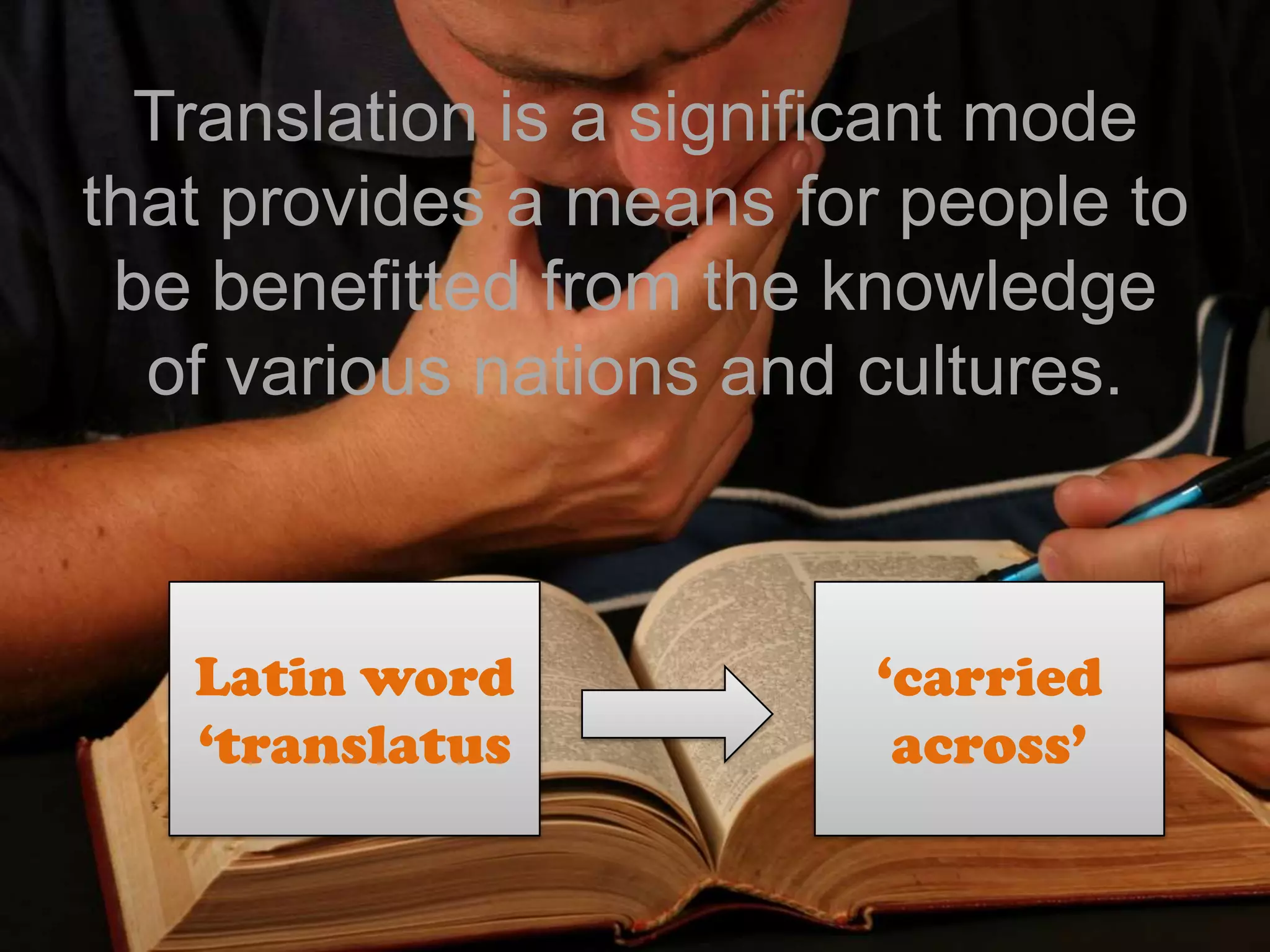
Translation is a significant mode
that provides a means for people to
be benefitted from the knowledge
of various nations and cultures.
Latin word
‘translatus
‘carried
across’
It refers to the act or process of
translation that takes place in order
to convert the source or actual text
written in a source language into a
target text with target language.
as ‘translation studies’ after the publication of Holmes’ paper entitled
The Name and the Nature of translation studies
The investigation of the aim of target
text, its communicative, semantic and
thematic value, the place and the time
in which it is written, its participants
and its tenor and mode of delivering
the information are some of the issues
that translator has to deal with.
dominant approaches
TRANSLATION IS
EQUIVALENCE AND
EQUIVALENCE EFFECT.
Latin word
equivalence
‘be of
equal
worth’
• he
gender.
LEVEL OF ASPECT.
TRANSLATION SHIFT APPROACH.
It deals with the question that
how the message and the
meaning of the source text is
shifted into target language and
how the translator shifts form one
technique or procedure of
translation to some other strategy
according to his requirement
while handling the process of
translation.
VINAY AND DARBELNET
TRANSLATION IS DIVIDED INTO TWO
STRATEGIES THAT COVER SEVEN MAIN
PROCEDURES. DIRECT TRANSLATION IS
THE FIRST TECHNIQUE THAT THE
TRANSLATOR IS ADVISED TO USE. THIS
DIRECT TRANSLATION INCLUDES THREE
PROCEDURES
borrowing.
• It is a special kind of borrowing in which the Words
of the source language are translated into target
language by adding a flavor. In this regard the main
word remains the same but usually connectors are
literally translated.
SUB DIVIDED INTO FOUR
PROCEDURES.
Transposition
It corresponds to the alteration
of parts of speech. In source text
one lexeme belongs to one part
of speech; but when it is
translated, it changes its place
according to the usage of target
language.
MODULATION
It refers to the semantic change between source
language and target language. If in language,
certain expressions are abstract they show part
whole relationship, they are active sentences,
their symbols are fixed; then these expressions
in another language will have a different
semantic relationship like that of concrete
expressions, they will be passive sentence,
their relationship is part to part relationship,
there symbols are not fined and vice versa.
SEVEN PROCEDURES OF DIRECT
AND OBLIQUE TRANSLATION
WORK.
LEXEMES
SYNTAX OR
GRAMMATICAL
STRUCTURES
MESSAGE
THEME
CONNECTORS
SUCH AS
DEXIS
DEMONSTRATE
D PRONOUNS
ORDER OF THE
TEXT OR
SEMANTIC
LEVEL
WORDS
servitude
Servitude deals with those
changes carried out by
translators that are necessary for
the transference of message of
source text.
OPTIONAL CORRESPONDS
To those alterations that the translator
decides to make by choosing an
appropriate option from several available
situations
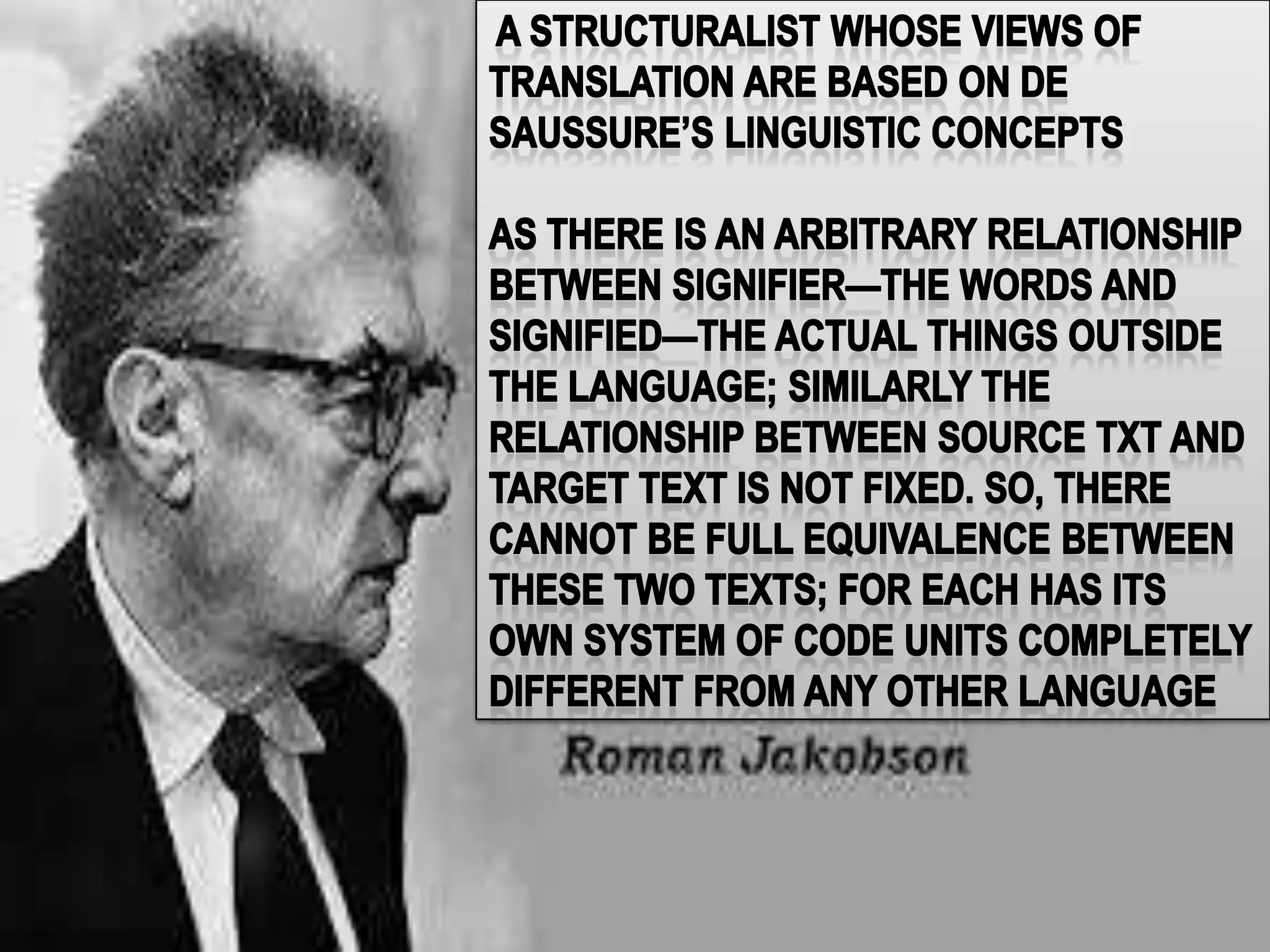
Influenced by Fithian and Hallidayan linguistic models
.
FORMAL CORRESPONDENCE
• It gives value to the categories of
TL according to its system. It
focuses that the aspects of TL
should occupy the same place as
the features of SL have a specific
place in ST
TWO TYPES OF SHIFTS
• The first one is the shift of . It refers
to the shift in which grammatical aspects
of SL become lexical features in TL or vice
versa
• The other aspect of shift is that of
THIS SHIFT OF CATEGORY IS
SUB DIVIDED INTO FOUR
MAIN AREAS
is the major
type of shift. It takes into
account the transference of
grammatical patterns between
two modes of speech
IS ANOTHER BRANCH OF
CATEGORY SHIFT. THE
ALTERATION OF PARTS
OF SPEECH OCCURS IN
THIS SHIFT
Unit or
a valuable shift under the domain
of category shift. This shift occurs
as two languages have their own
hierarchal structures and the
construction of linguistic
expressions sharply distinctive
from one another.
last type of shift that falls under
the category shift. It throws light
on the point that although all of
the languages of the world have a
similar system; all the languages
have parts of speech and
grammatical rules.
In translated text of Animal Farm, Syed
Irfan Alihas played a significant part. He
is a mediator who has tried his level best
to bring reconciliation between English
and Urdu language.
There are a number
by George Orwell. Its
content and languageis simple that can easily
be interpreted. It has been chosen on account
of the shortage of time; for it has a small
length; so that this project can fulfill the
required criteria by closely analyzing the text.
According to Jacobson aspect is another
important factor due to which one language
seems different from the other. This can be
feature examined in the texts of animal farm.
Orwell comments upon the character of
Benjamin after the rebellion in these words, ‘Old
Benjamin, the donkey seemed quite unchanged
since the Rebellion’. While in translation it is “
. In English it is
conveyed that Benjamin appears unchanged
while in Urdu the sense of the verb ‘seemed’ is
missing.
Then, when Old Major decides to
deliver his message of freedom to all
other animals; in the beginning while
discussing about his life he says, “I have
had a long life, I have had much time for
thought”. While in Urdu, it is conveyed
as
Here the word „time‟ in English is
neutral; while the word of Urdu
language has masculine status that is
apparent from the expression of
.
Major advices animals that, “all
men are enemies. All animals are
comrades”. It has been translated
as “
”. Here, there is a semantic
difference between “comrades”
and “ ”; belongs to
the semantic field of kinship; while
“comrade” is a term used for
friends.
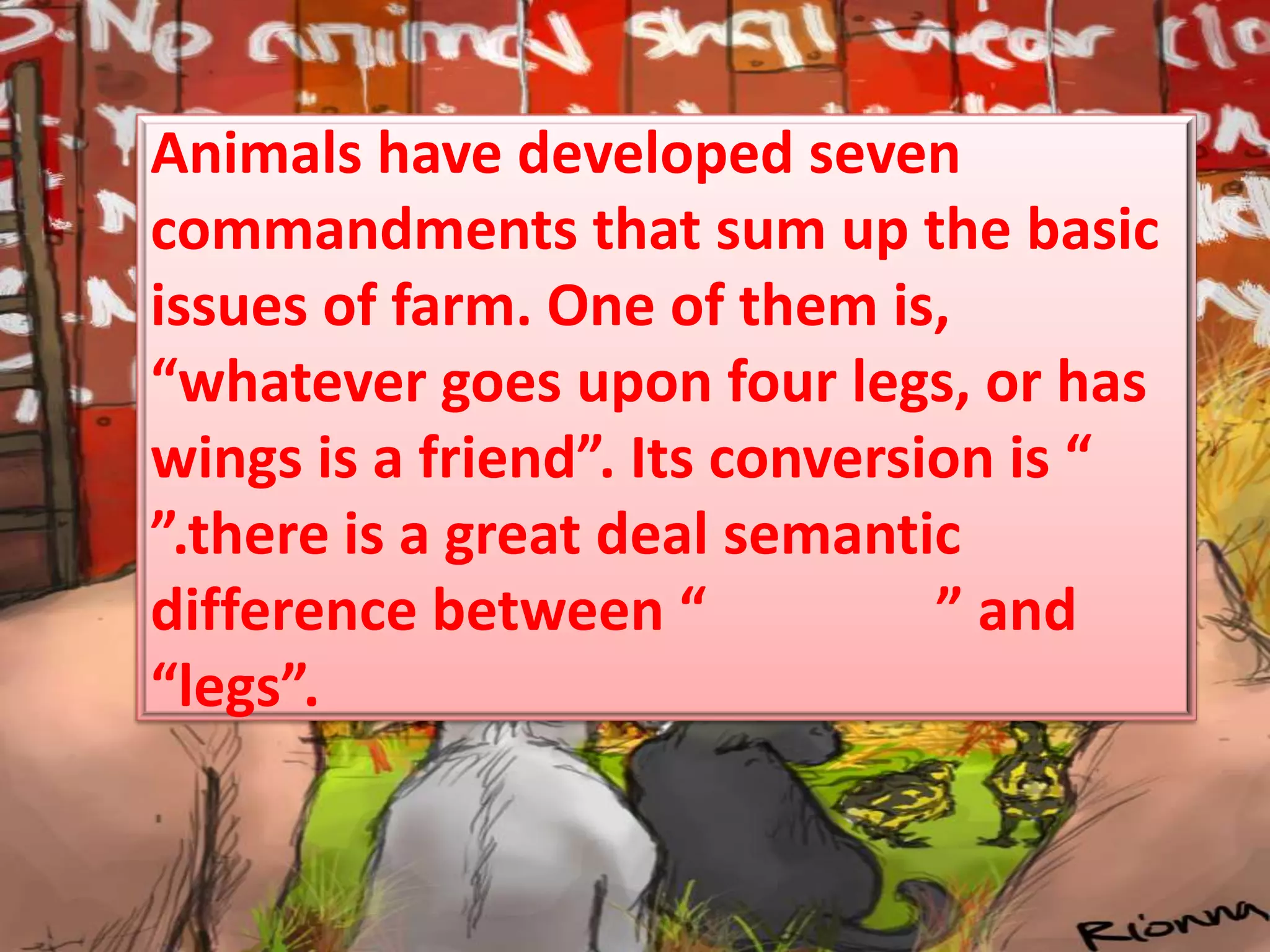
Animals have developed seven
commandments that sum up the basic
issues of farm. One of them is,
“whatever goes upon four legs, or has
wings is a friend”. Its conversion is “
”.there is a great deal semantic
difference between “ ” and
“legs”.
• .
• Here the word “snoring” in the English is used
as verb’s it has been shown that she “was
snoring” but in Urdu version “ ”.
Under the category of noun; for it is apparent
from the expression of “
”. The character of “Old Major he was always
called, though the name under which he had
been exhibited was wellington beauty”. In
Urdu text is appeared as wellington beauty
On the whole translation is like a
road that has many paths to move
forward. The more the time passes,
the more the path and avenues come
into existence. Many critics and
scholars of translation are moving
forward to find their destination.
Many models and theories have their
own directions. However, all have
same destination, same end, same
purpose, but from different angles.
The class shift has also some role in
translation. But it is similar to that
of the concept of transposition under
line by Vinay and Darbelnet.
Another kind of shift that has a
definite effect to differentiate the
Animal Farm of English from Animal
Farm of Urdu language is the shift of
unit or rank. English and Urdu have
their own hierarchical structures.
animal farm
animal farm
animal farm
animal farm

animal farm

  • 1.
    Group no.2 • FATIMAGUL • ABIDA PARVEEN • SITARA AYAZ • MARYAM TARIQ
  • 3.
    People all overthe world irrespective of the differences of class, region, society, gender and mode of speech exchange information with one another.
  • 5.
    Translation is asignificant mode that provides a means for people to be benefitted from the knowledge of various nations and cultures. Latin word ‘translatus ‘carried across’
  • 6.
    It refers tothe act or process of translation that takes place in order to convert the source or actual text written in a source language into a target text with target language.
  • 7.
    as ‘translation studies’after the publication of Holmes’ paper entitled The Name and the Nature of translation studies
  • 10.
    The investigation ofthe aim of target text, its communicative, semantic and thematic value, the place and the time in which it is written, its participants and its tenor and mode of delivering the information are some of the issues that translator has to deal with.
  • 16.
  • 17.
  • 19.
  • 21.
  • 22.
  • 24.
    TRANSLATION SHIFT APPROACH. Itdeals with the question that how the message and the meaning of the source text is shifted into target language and how the translator shifts form one technique or procedure of translation to some other strategy according to his requirement while handling the process of translation.
  • 25.
    VINAY AND DARBELNET TRANSLATIONIS DIVIDED INTO TWO STRATEGIES THAT COVER SEVEN MAIN PROCEDURES. DIRECT TRANSLATION IS THE FIRST TECHNIQUE THAT THE TRANSLATOR IS ADVISED TO USE. THIS DIRECT TRANSLATION INCLUDES THREE PROCEDURES
  • 26.
  • 27.
    • It isa special kind of borrowing in which the Words of the source language are translated into target language by adding a flavor. In this regard the main word remains the same but usually connectors are literally translated.
  • 29.
    SUB DIVIDED INTOFOUR PROCEDURES.
  • 30.
    Transposition It corresponds tothe alteration of parts of speech. In source text one lexeme belongs to one part of speech; but when it is translated, it changes its place according to the usage of target language.
  • 31.
    MODULATION It refers tothe semantic change between source language and target language. If in language, certain expressions are abstract they show part whole relationship, they are active sentences, their symbols are fixed; then these expressions in another language will have a different semantic relationship like that of concrete expressions, they will be passive sentence, their relationship is part to part relationship, there symbols are not fined and vice versa.
  • 34.
    SEVEN PROCEDURES OFDIRECT AND OBLIQUE TRANSLATION WORK. LEXEMES SYNTAX OR GRAMMATICAL STRUCTURES MESSAGE THEME CONNECTORS SUCH AS DEXIS DEMONSTRATE D PRONOUNS ORDER OF THE TEXT OR SEMANTIC LEVEL WORDS
  • 35.
    servitude Servitude deals withthose changes carried out by translators that are necessary for the transference of message of source text.
  • 36.
    OPTIONAL CORRESPONDS To thosealterations that the translator decides to make by choosing an appropriate option from several available situations
  • 38.
    Influenced by Fithianand Hallidayan linguistic models .
  • 41.
    FORMAL CORRESPONDENCE • Itgives value to the categories of TL according to its system. It focuses that the aspects of TL should occupy the same place as the features of SL have a specific place in ST
  • 43.
    TWO TYPES OFSHIFTS • The first one is the shift of . It refers to the shift in which grammatical aspects of SL become lexical features in TL or vice versa • The other aspect of shift is that of
  • 44.
    THIS SHIFT OFCATEGORY IS SUB DIVIDED INTO FOUR MAIN AREAS is the major type of shift. It takes into account the transference of grammatical patterns between two modes of speech
  • 45.
    IS ANOTHER BRANCHOF CATEGORY SHIFT. THE ALTERATION OF PARTS OF SPEECH OCCURS IN THIS SHIFT
  • 46.
    Unit or a valuableshift under the domain of category shift. This shift occurs as two languages have their own hierarchal structures and the construction of linguistic expressions sharply distinctive from one another.
  • 47.
    last type ofshift that falls under the category shift. It throws light on the point that although all of the languages of the world have a similar system; all the languages have parts of speech and grammatical rules.
  • 49.
    In translated textof Animal Farm, Syed Irfan Alihas played a significant part. He is a mediator who has tried his level best to bring reconciliation between English and Urdu language.
  • 50.
    There are anumber by George Orwell. Its content and languageis simple that can easily be interpreted. It has been chosen on account of the shortage of time; for it has a small length; so that this project can fulfill the required criteria by closely analyzing the text.
  • 52.
    According to Jacobsonaspect is another important factor due to which one language seems different from the other. This can be feature examined in the texts of animal farm. Orwell comments upon the character of Benjamin after the rebellion in these words, ‘Old Benjamin, the donkey seemed quite unchanged since the Rebellion’. While in translation it is “ . In English it is conveyed that Benjamin appears unchanged while in Urdu the sense of the verb ‘seemed’ is missing.
  • 54.
    Then, when OldMajor decides to deliver his message of freedom to all other animals; in the beginning while discussing about his life he says, “I have had a long life, I have had much time for thought”. While in Urdu, it is conveyed as Here the word „time‟ in English is neutral; while the word of Urdu language has masculine status that is apparent from the expression of .
  • 57.
    Major advices animalsthat, “all men are enemies. All animals are comrades”. It has been translated as “ ”. Here, there is a semantic difference between “comrades” and “ ”; belongs to the semantic field of kinship; while “comrade” is a term used for friends.
  • 58.
    Animals have developedseven commandments that sum up the basic issues of farm. One of them is, “whatever goes upon four legs, or has wings is a friend”. Its conversion is “ ”.there is a great deal semantic difference between “ ” and “legs”.
  • 61.
  • 66.
    • Here theword “snoring” in the English is used as verb’s it has been shown that she “was snoring” but in Urdu version “ ”. Under the category of noun; for it is apparent from the expression of “ ”. The character of “Old Major he was always called, though the name under which he had been exhibited was wellington beauty”. In Urdu text is appeared as wellington beauty
  • 70.
    On the wholetranslation is like a road that has many paths to move forward. The more the time passes, the more the path and avenues come into existence. Many critics and scholars of translation are moving forward to find their destination. Many models and theories have their own directions. However, all have same destination, same end, same purpose, but from different angles.
  • 78.
    The class shifthas also some role in translation. But it is similar to that of the concept of transposition under line by Vinay and Darbelnet. Another kind of shift that has a definite effect to differentiate the Animal Farm of English from Animal Farm of Urdu language is the shift of unit or rank. English and Urdu have their own hierarchical structures.