TRANSFORMATIONAL
GRAMMAR
An introduction
Dr. Abha Pandey
Professor & Head
Department of English
Govt. Mahakoshal Arts & Commerce
College, Jabalpur
T G Grammar
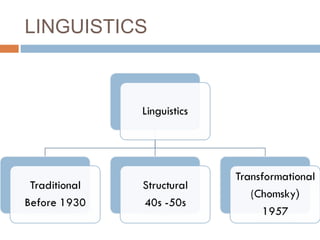
LINGUISTICS
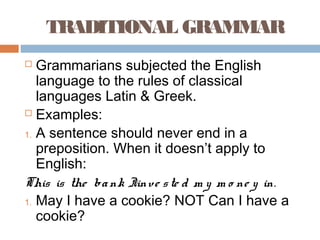
TRADITIONAL GRAMMAR
 Grammarians subjected the English
language to the rules of classical
languages Latin & Greek.
 Examples:
1. A sentence should never end in a
preposition. When it doesn’t apply to
English:
This is the bank Iinve ste d m y m o ne y in.
1. May I have a cookie? NOT Can I have a
cookie?
TRANSFORMATIONAL
GENERATIVE LINGUISTICS
 Sentences are generated by a
(subconscious) set of procedures.
 It is part of the mind ability.
 The goal is ….. To figure out what we
(subconsciously) know……. A theory
of the linguistic intuitio n (unconscious
knowledge) of a native speaker.
How do they analyze language?
1. Observe data
2. Generalize rules.
3. Develop hypotheses.
4. Test sentences on native speakers.
5. If their judgments agree with the
grammaticality rules then the
hypothesis is supported.
(grammaticality judgments)
Which sentences do not sound
right?
 The boy found the ball
 The boy found quickly
 The boy found in the house
 The boy found the ball in the house
 Grammaticality judgments are determined by
rules that are shared by the speakers of a
language. They do not depend on whether the
sentence has meaning or not:
 Colourless green ideas sleep furiously.
 It doesn’t mean anything but it sounds like an
GENERATIVE GRAMMARRULES
 Older schools of grammar:
 PERSCRIPTIVE RULES: perscribe how
people ‘should’ produce language.
 The ‘rules’ in TG do not tell us how to
produce language> They tell us the
‘ORDER’ in which to put words and
phrases.
 DESCRIPTIVE RULES: Describes how
GENERATIVE?
Because they allow us to
generate an infinite number
of sentences.
TRANSFORMATIONAL
GRAMMARMODEL OF
LANGUAGE
Phrase structure
Lexical component
Deep structure
Transformations
Surface structure
Morphophonemic rules
Sentence
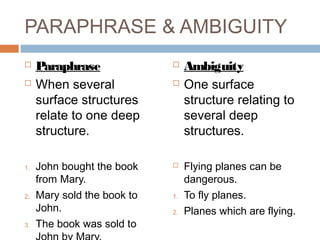
PARAPHRASE & AMBIGUITY
 Paraphrase
 When several
surface structures
relate to one deep
structure.
1. John bought the book
from Mary.
2. Mary sold the book to
John.
3. The book was sold to
 Ambiguity
 One surface
structure relating to
several deep
structures.
 Flying planes can be
dangerous.
1. To fly planes.
2. Planes which are flying.

T g grammar

  • 1.
  • 2.
    Dr. Abha Pandey Professor& Head Department of English Govt. Mahakoshal Arts & Commerce College, Jabalpur T G Grammar
  • 3.
  • 4.
    TRADITIONAL GRAMMAR  Grammarianssubjected the English language to the rules of classical languages Latin & Greek.  Examples: 1. A sentence should never end in a preposition. When it doesn’t apply to English: This is the bank Iinve ste d m y m o ne y in. 1. May I have a cookie? NOT Can I have a cookie?
  • 5.
    TRANSFORMATIONAL GENERATIVE LINGUISTICS  Sentencesare generated by a (subconscious) set of procedures.  It is part of the mind ability.  The goal is ….. To figure out what we (subconsciously) know……. A theory of the linguistic intuitio n (unconscious knowledge) of a native speaker.
  • 6.
    How do theyanalyze language? 1. Observe data 2. Generalize rules. 3. Develop hypotheses. 4. Test sentences on native speakers. 5. If their judgments agree with the grammaticality rules then the hypothesis is supported. (grammaticality judgments)
  • 7.
    Which sentences donot sound right?  The boy found the ball  The boy found quickly  The boy found in the house  The boy found the ball in the house  Grammaticality judgments are determined by rules that are shared by the speakers of a language. They do not depend on whether the sentence has meaning or not:  Colourless green ideas sleep furiously.  It doesn’t mean anything but it sounds like an
  • 8.
    GENERATIVE GRAMMARRULES  Olderschools of grammar:  PERSCRIPTIVE RULES: perscribe how people ‘should’ produce language.  The ‘rules’ in TG do not tell us how to produce language> They tell us the ‘ORDER’ in which to put words and phrases.  DESCRIPTIVE RULES: Describes how
  • 9.
    GENERATIVE? Because they allowus to generate an infinite number of sentences.
  • 10.
    TRANSFORMATIONAL GRAMMARMODEL OF LANGUAGE Phrase structure Lexicalcomponent Deep structure Transformations Surface structure Morphophonemic rules Sentence
  • 11.
    PARAPHRASE & AMBIGUITY Paraphrase  When several surface structures relate to one deep structure. 1. John bought the book from Mary. 2. Mary sold the book to John. 3. The book was sold to  Ambiguity  One surface structure relating to several deep structures.  Flying planes can be dangerous. 1. To fly planes. 2. Planes which are flying.