Transformational Generative
Grammar
by
Noam Chomsky
Presented by Ali Imran
Introduction
Transformational grammar is a set of rules that
indicates the structure and interpretation of
sentences which native speakers of a language
accept as belonging to the language.
It involves the use of defined operations called
transformations to produce new sentences from
existing ones.
Definition of Sentence &
Language
According to Chomsky,
A sentence is defined as being “ well formed” if the
native speakers of that particular language feel that
it is correct or grammatical .
He defines language as;
“ I will consider a language to be a set (finite or
infinite) of sentences.”
It means that any language is made up of a number
of well formed sentences.
Two Aspects of Grammar
1- Transformational:
It is called Transformational since a sentence can be
transformed into number of sentences with either the same
meaning or with different meaning, e.g
“ I read the book”
“ The book is read by me”
“ Do I read the book”?
“ I do not read the book.
Cont.…
2- Generative:
It is Generative since it can create an infinite number of
sentences.
It means , we can produce as many sentences as possible of the
language following the rules of the grammar.
Hence, with a finite number of rules the infinite sets of sentences
can be generated and this infinity is known as “ Recursion”
Thus Grammar transforms and generates sentences. Therefore, it is
called transformational generative grammar, or TG for short.
Properties
It has the following properties.
1- It can generate only the well formed or grammatically
correct sentences of a language which native speakers
consider correct or well formed.
2- Recursivity:
This grammar has recursive rules to be applied again and
again in order to generate infinite number of well formed
sentences of a language,e.g,
This is the boy who rode the horse that chased the fox, that
chased the jackal.
Such kind of structure is called Embedding.
Deep and Surface Structure
A sentence has a deep and a surface structure.
1- Deep structure is a basic, or a kernel sentence. It is
simple, assertive, declarative and active in form. e.g,
Ali reads a novel.
It is the abstract structure that allows the native speaker to
know what the sentence means. Hence, it expresses the
semantic content of the sentence.
Cont.…
2- Surface structure is a transformed form of deep structure
which shows how the speaker actually uses it in
communication. It expresses the phonetic content of the
sentence. Consider the following examples,
1. Ali reads a novel.
2. Does Ali read a novel?
3. Ali does not read a novel.
4. A novel is read by Ali .
Sentence 1 is a kernel sentence and shows deep structure
while 2,3 and 4 are examples of surface structure.
Cont.…
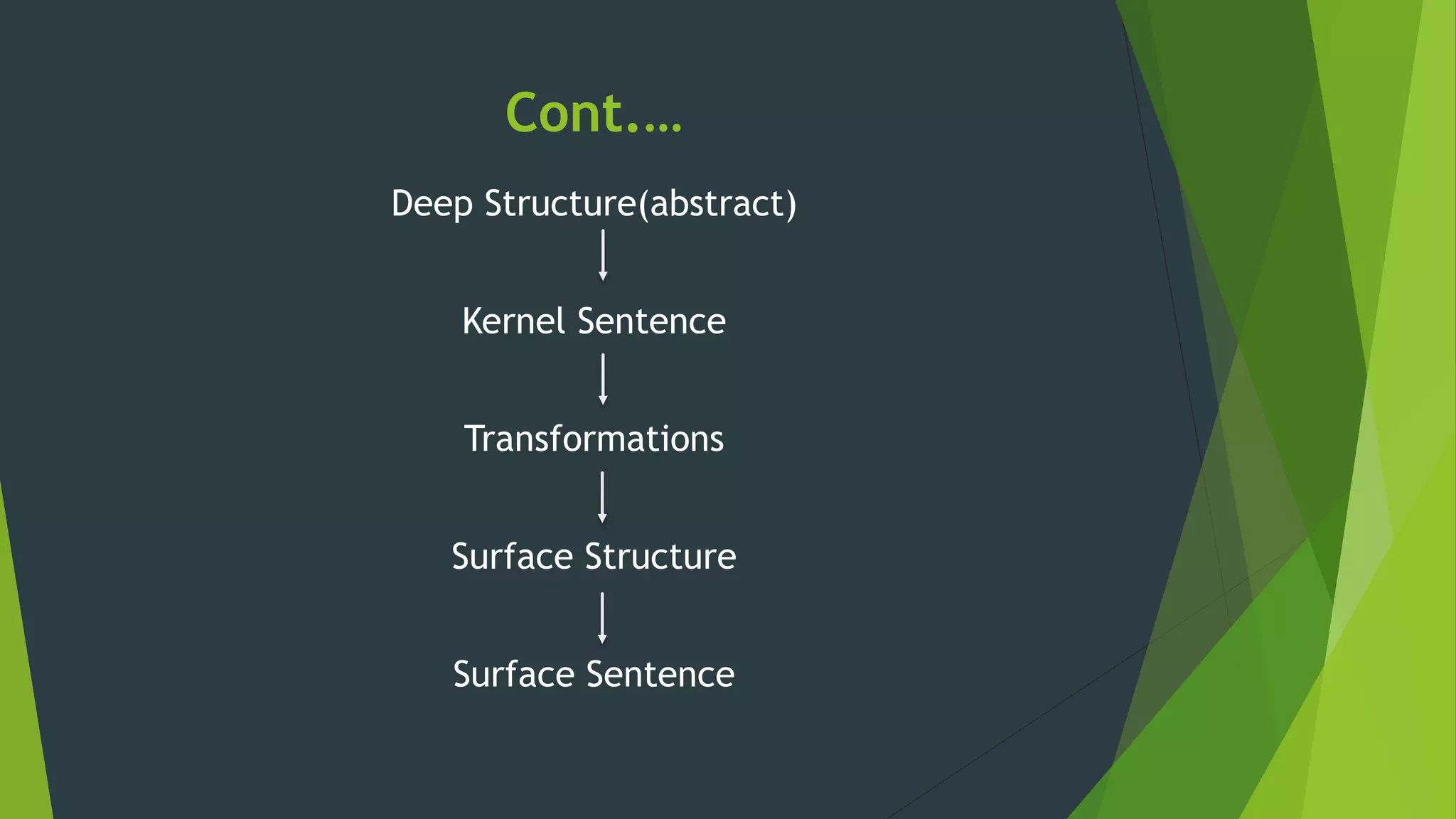
Deep Structure(abstract)
Kernel Sentence
Transformations
Surface Structure
Surface Sentence
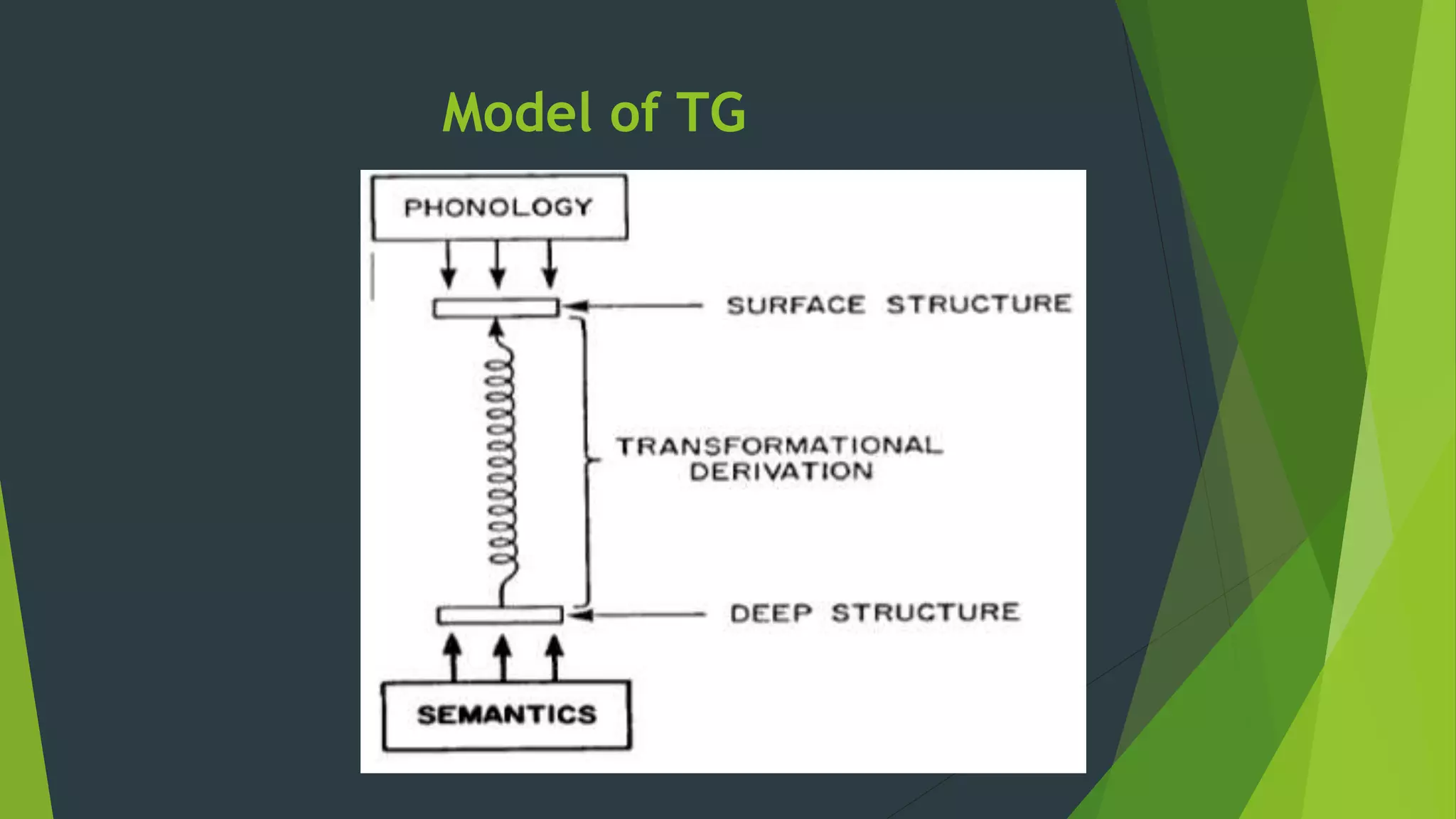
Model of TG
Transformational Rules
Transformational grammar can be best summarized by
Inserting, Deleting, Moving and substituting of
words. These changes take place through specific rules
which are called transformational rules. We shall discuss
them one by one with examples.
1- Insertion Transformation:
Example:
He knew she was here.
He knew that she was here.
Cont.…
2- Deletion Transformation:
1-Imperative:
You come here.
Come here.
2-Verb Phrase:
If he says he will study for the test, he will study
for the test.
If he says he will study for the test, he will.
Cont.…
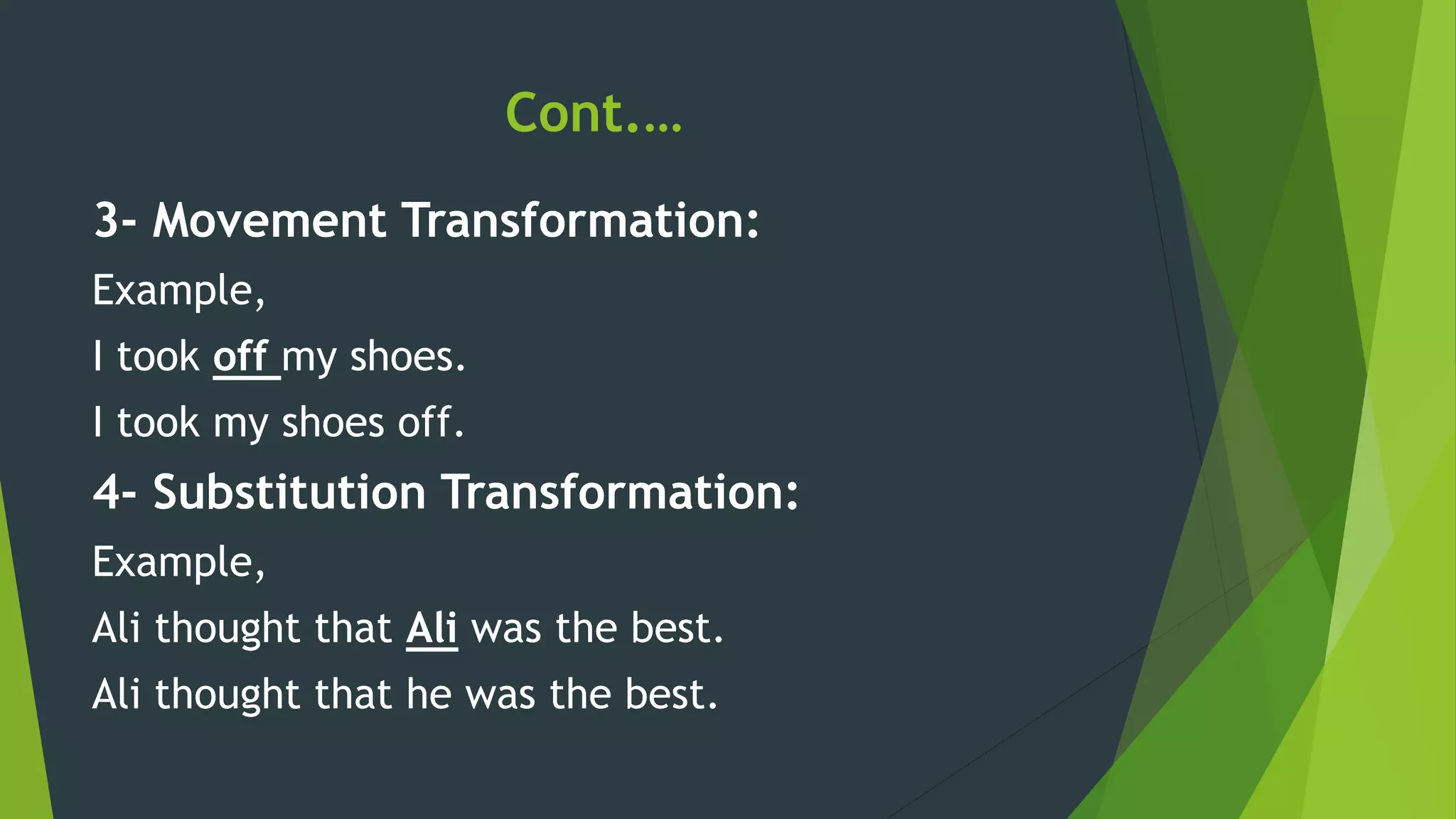
3- Movement Transformation:
Example,
I took off my shoes.
I took my shoes off.
4- Substitution Transformation:
Example,
Ali thought that Ali was the best.
Ali thought that he was the best.
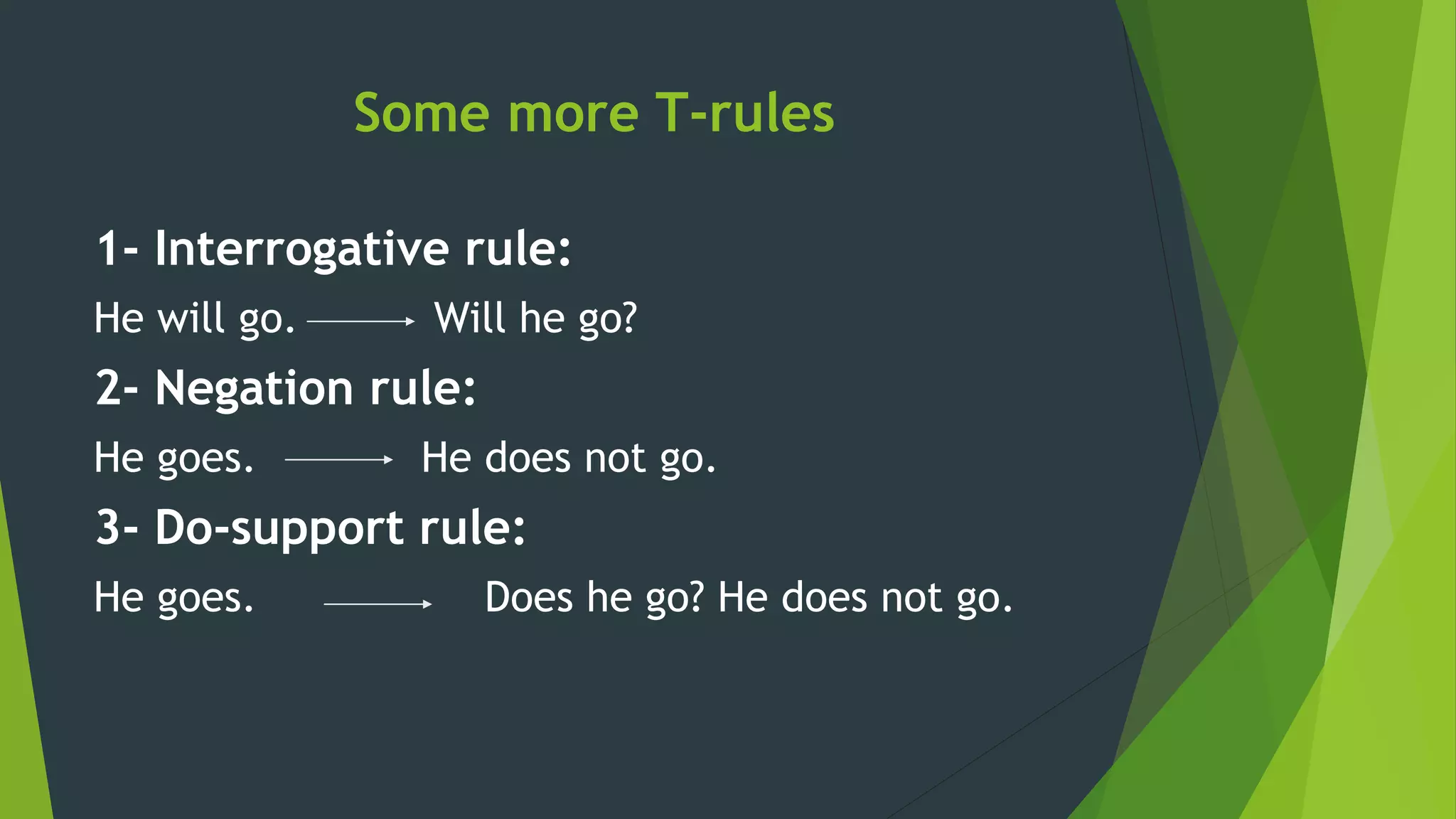
Some more T-rules
1- Interrogative rule:
He will go. Will he go?
2- Negation rule:
He goes. He does not go.
3- Do-support rule:
He goes. Does he go? He does not go.
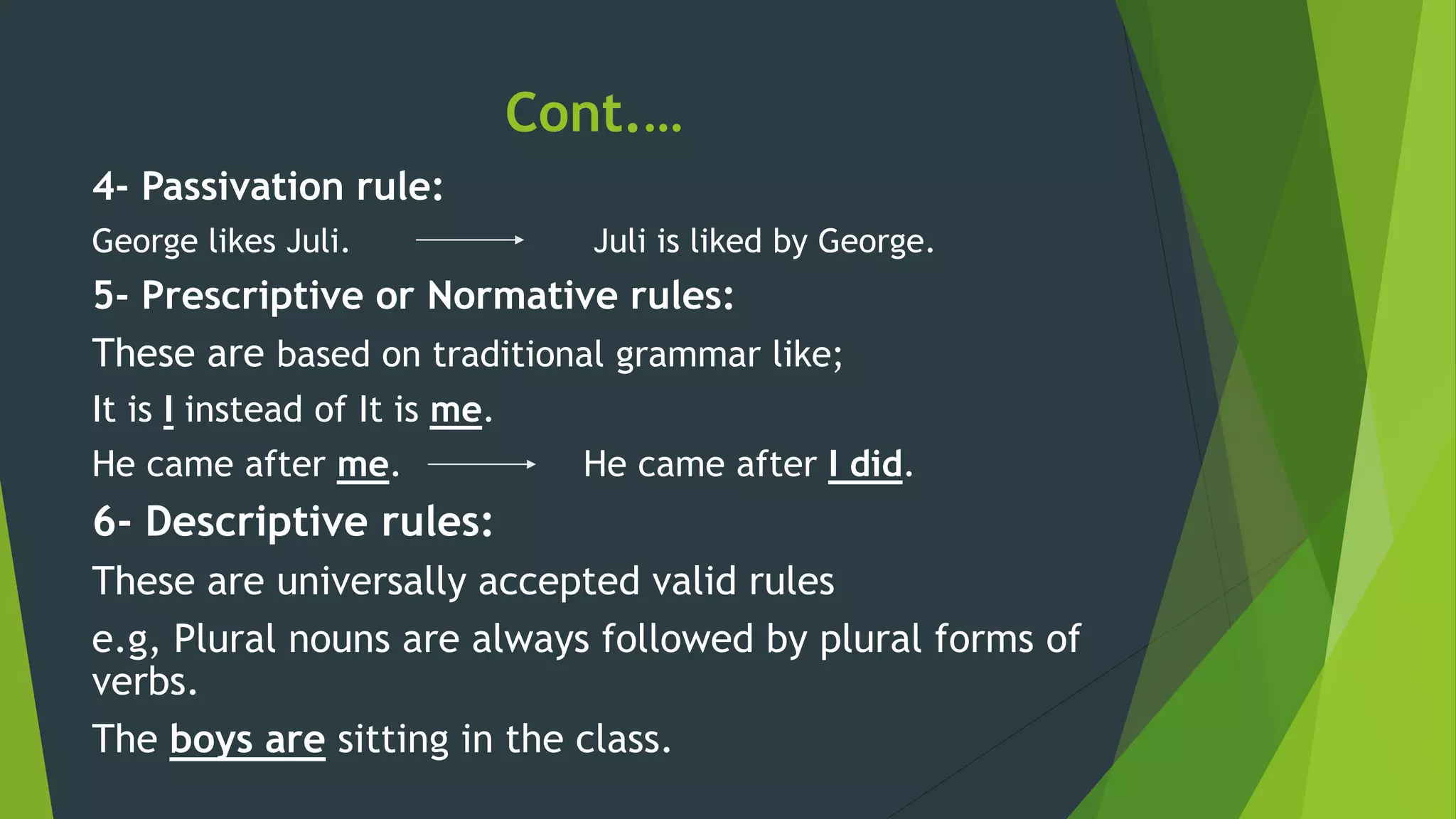
Cont.…
4- Passivation rule:
George likes Juli. Juli is liked by George.
5- Prescriptive or Normative rules:
These are based on traditional grammar like;
It is I instead of It is me.
He came after me. He came after I did.
6- Descriptive rules:
These are universally accepted valid rules
e.g, Plural nouns are always followed by plural forms of
verbs.
The boys are sitting in the class.
Cont.…
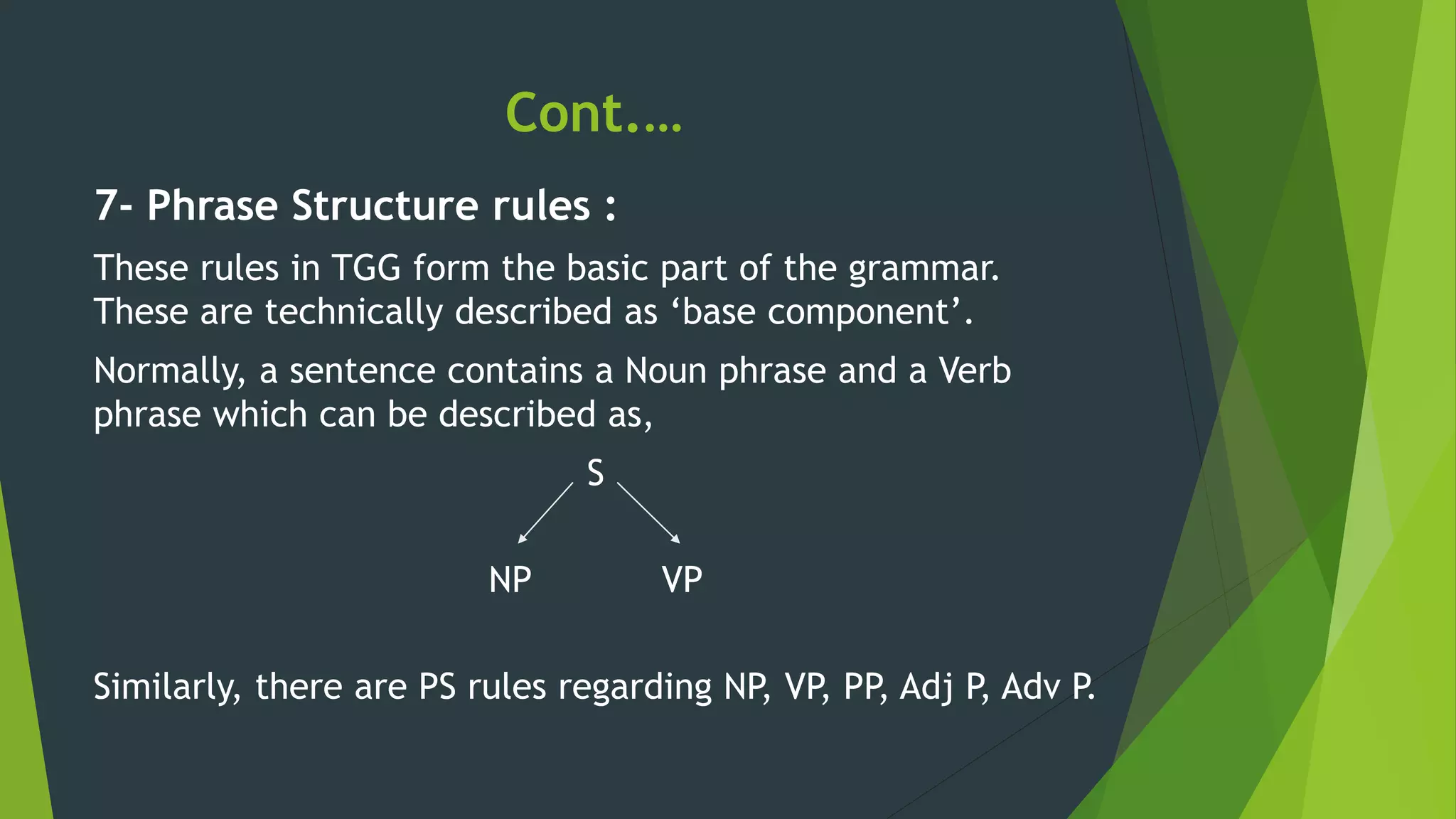
7- Phrase Structure rules :
These rules in TGG form the basic part of the grammar.
These are technically described as ‘base component’.
Normally, a sentence contains a Noun phrase and a Verb
phrase which can be described as,
S
NP VP
Similarly, there are PS rules regarding NP, VP, PP, Adj P, Adv P.

Transformational generative grammar

  • 1.
  • 2.
    Introduction Transformational grammar isa set of rules that indicates the structure and interpretation of sentences which native speakers of a language accept as belonging to the language. It involves the use of defined operations called transformations to produce new sentences from existing ones.
  • 3.
    Definition of Sentence& Language According to Chomsky, A sentence is defined as being “ well formed” if the native speakers of that particular language feel that it is correct or grammatical . He defines language as; “ I will consider a language to be a set (finite or infinite) of sentences.” It means that any language is made up of a number of well formed sentences.
  • 4.
    Two Aspects ofGrammar 1- Transformational: It is called Transformational since a sentence can be transformed into number of sentences with either the same meaning or with different meaning, e.g “ I read the book” “ The book is read by me” “ Do I read the book”? “ I do not read the book.
  • 5.
    Cont.… 2- Generative: It isGenerative since it can create an infinite number of sentences. It means , we can produce as many sentences as possible of the language following the rules of the grammar. Hence, with a finite number of rules the infinite sets of sentences can be generated and this infinity is known as “ Recursion” Thus Grammar transforms and generates sentences. Therefore, it is called transformational generative grammar, or TG for short.
  • 6.
    Properties It has thefollowing properties. 1- It can generate only the well formed or grammatically correct sentences of a language which native speakers consider correct or well formed. 2- Recursivity: This grammar has recursive rules to be applied again and again in order to generate infinite number of well formed sentences of a language,e.g, This is the boy who rode the horse that chased the fox, that chased the jackal. Such kind of structure is called Embedding.
  • 7.
    Deep and SurfaceStructure A sentence has a deep and a surface structure. 1- Deep structure is a basic, or a kernel sentence. It is simple, assertive, declarative and active in form. e.g, Ali reads a novel. It is the abstract structure that allows the native speaker to know what the sentence means. Hence, it expresses the semantic content of the sentence.
  • 8.
    Cont.… 2- Surface structureis a transformed form of deep structure which shows how the speaker actually uses it in communication. It expresses the phonetic content of the sentence. Consider the following examples, 1. Ali reads a novel. 2. Does Ali read a novel? 3. Ali does not read a novel. 4. A novel is read by Ali . Sentence 1 is a kernel sentence and shows deep structure while 2,3 and 4 are examples of surface structure.
  • 9.
  • 10.
  • 11.
    Transformational Rules Transformational grammarcan be best summarized by Inserting, Deleting, Moving and substituting of words. These changes take place through specific rules which are called transformational rules. We shall discuss them one by one with examples. 1- Insertion Transformation: Example: He knew she was here. He knew that she was here.
  • 12.
    Cont.… 2- Deletion Transformation: 1-Imperative: Youcome here. Come here. 2-Verb Phrase: If he says he will study for the test, he will study for the test. If he says he will study for the test, he will.
  • 13.
    Cont.… 3- Movement Transformation: Example, Itook off my shoes. I took my shoes off. 4- Substitution Transformation: Example, Ali thought that Ali was the best. Ali thought that he was the best.
  • 14.
    Some more T-rules 1-Interrogative rule: He will go. Will he go? 2- Negation rule: He goes. He does not go. 3- Do-support rule: He goes. Does he go? He does not go.
  • 15.
    Cont.… 4- Passivation rule: Georgelikes Juli. Juli is liked by George. 5- Prescriptive or Normative rules: These are based on traditional grammar like; It is I instead of It is me. He came after me. He came after I did. 6- Descriptive rules: These are universally accepted valid rules e.g, Plural nouns are always followed by plural forms of verbs. The boys are sitting in the class.
  • 16.
    Cont.… 7- Phrase Structurerules : These rules in TGG form the basic part of the grammar. These are technically described as ‘base component’. Normally, a sentence contains a Noun phrase and a Verb phrase which can be described as, S NP VP Similarly, there are PS rules regarding NP, VP, PP, Adj P, Adv P.