
Network Security
CS:9-10(CH17-18-19-20)
By: Prof. Ganesh Ingle
Session 9-10 objective
CS-9 Revision Previous Session revision
CS-9-10 – Review of SSL protocol
CS – 9-10 Review of SSL
protocol
CS -9-10 Review of IPSec
CS-9-10 PGP
SUMMARY
3
There are two main schemes which are
especially designed to provide confidentiality
and authentication for electronic mail
systems. These are:
PGP
(Pretty Good Privacy)
S/MIME
(Secure/Multipurpose Internet Mail Extension)
PGP
4
S/MIME
S/MIME uses public key certificates conforming to standard X.509 and
signed by a certification agency. In other respects, S/MIME is quite
similar to PGP.
S/MIME is not studied in any detail on this course and is not
examinable.
PGP
5
 Developed by Phil Zimmerman in 1995.
 Documentation and source code is freely available.
 The package is independent of operating system and processor.
 PGP does not rely on the “establishment” and it’s popularity and
use have grown extensively since 1995.
PGP
6
What does PGP do?
PGP offers 5 services:
1. Authentication
2. Confidentiality
3. Compression
4. E-mail compatibility
5. Segmentation
PGP
7
PGP Authentication
This is a digital signature scheme with hashing.
1. Alice has (private/public) key pair (Ad/Ae) and she wants to
send a digitally signed message m to Bob.
2. Alice hashes the message using SHA-1 to obtain SHA(m).
PGP
8
PGP Authenticaton and Confidentiality
(at the same time)
The schemes for authentication and confidentiality can be
combined so that Alice can sign a confidential message which
is encrypted before transmission. The steps required are as
follows:
1. Alice generates a signature c for her message m as in the
Authentication scheme
c=pk.encryptAd(SHA(m))
PGP
9
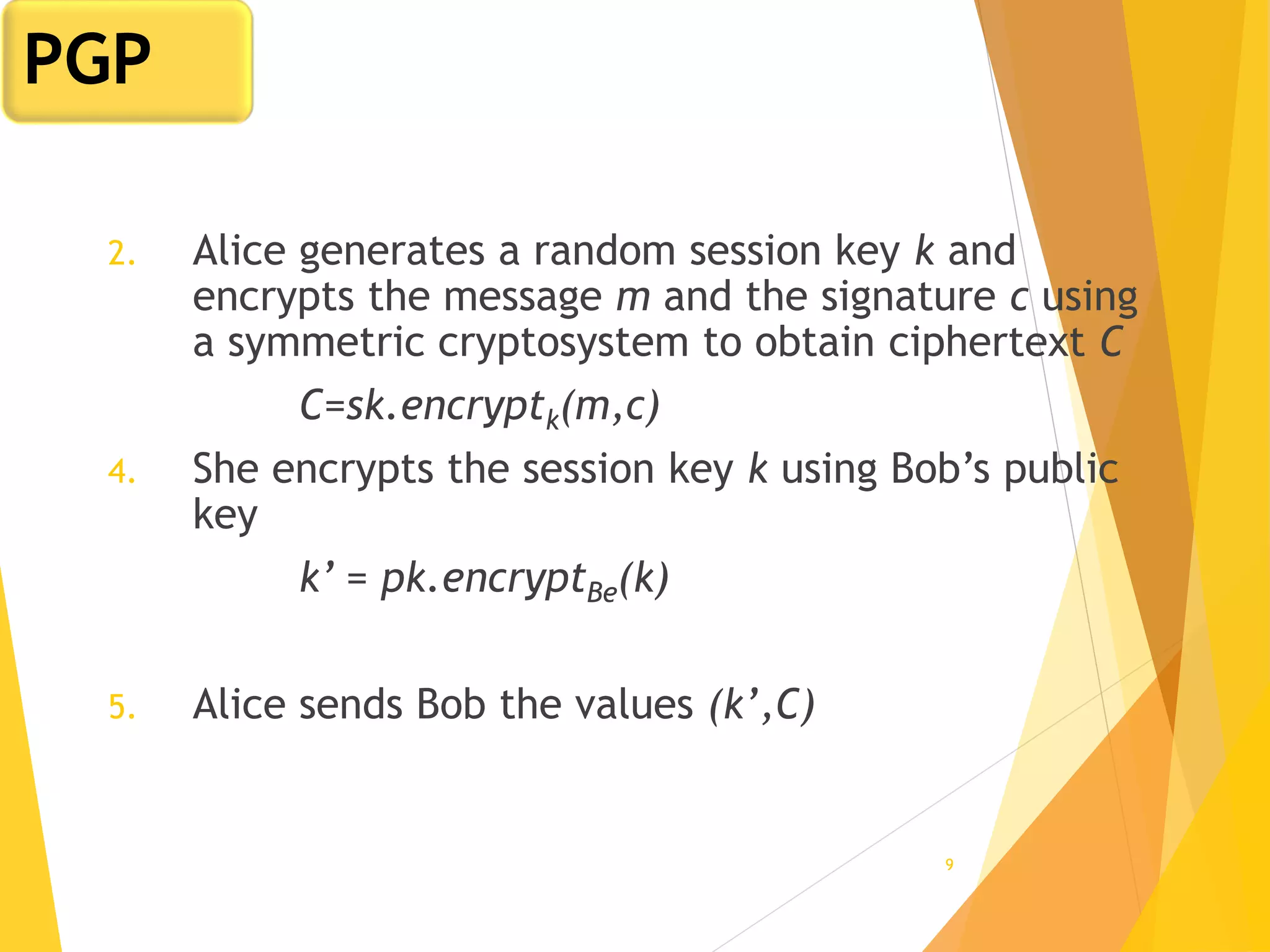
2. Alice generates a random session key k and
encrypts the message m and the signature c using
a symmetric cryptosystem to obtain ciphertext C
C=sk.encryptk(m,c)
4. She encrypts the session key k using Bob’s public
key
k’ = pk.encryptBe(k)
5. Alice sends Bob the values (k’,C)
PGP
10
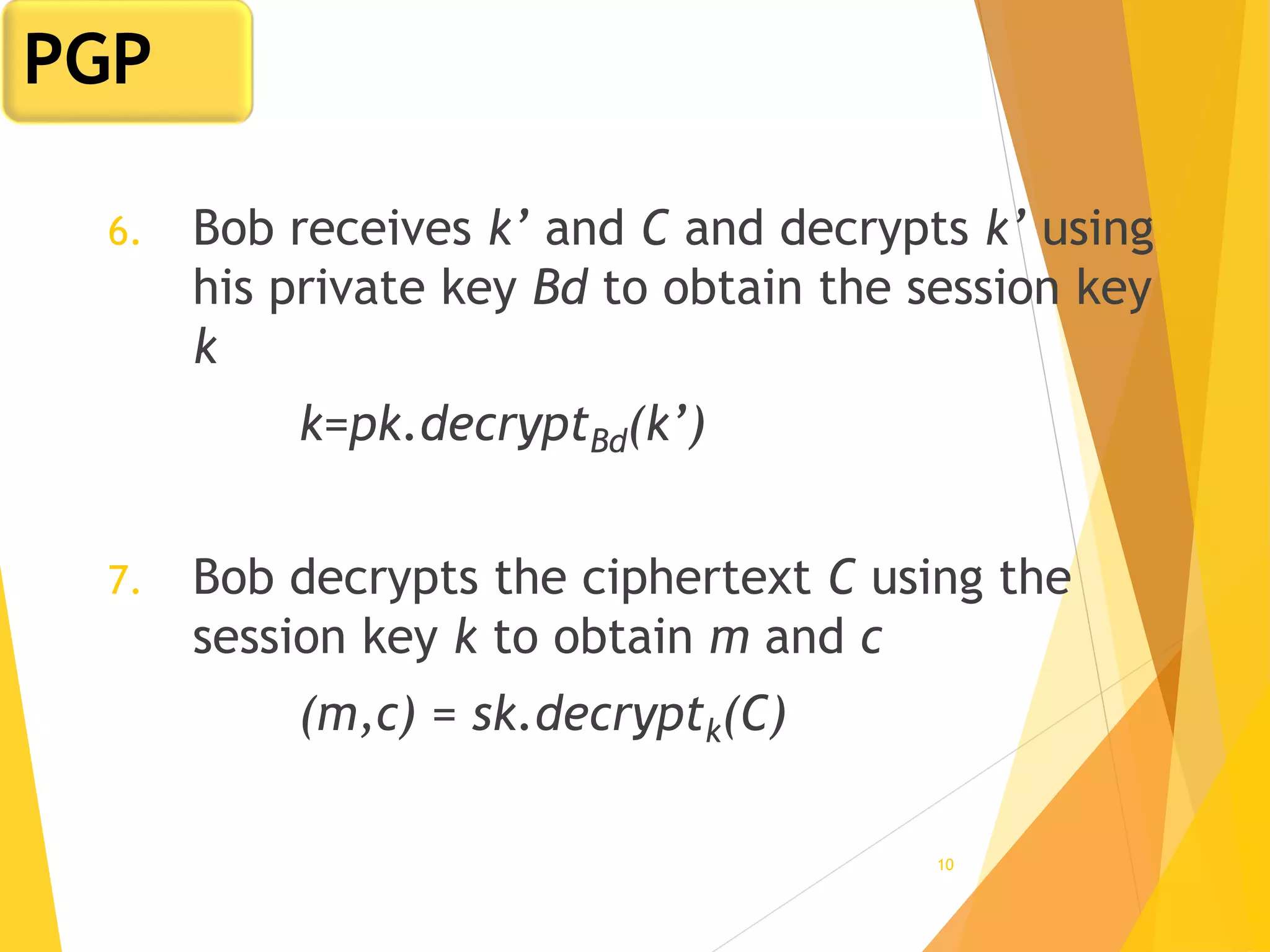
6. Bob receives k’ and C and decrypts k’ using
his private key Bd to obtain the session key
k
k=pk.decryptBd(k’)
7. Bob decrypts the ciphertext C using the
session key k to obtain m and c
(m,c) = sk.decryptk(C)
PGP
11
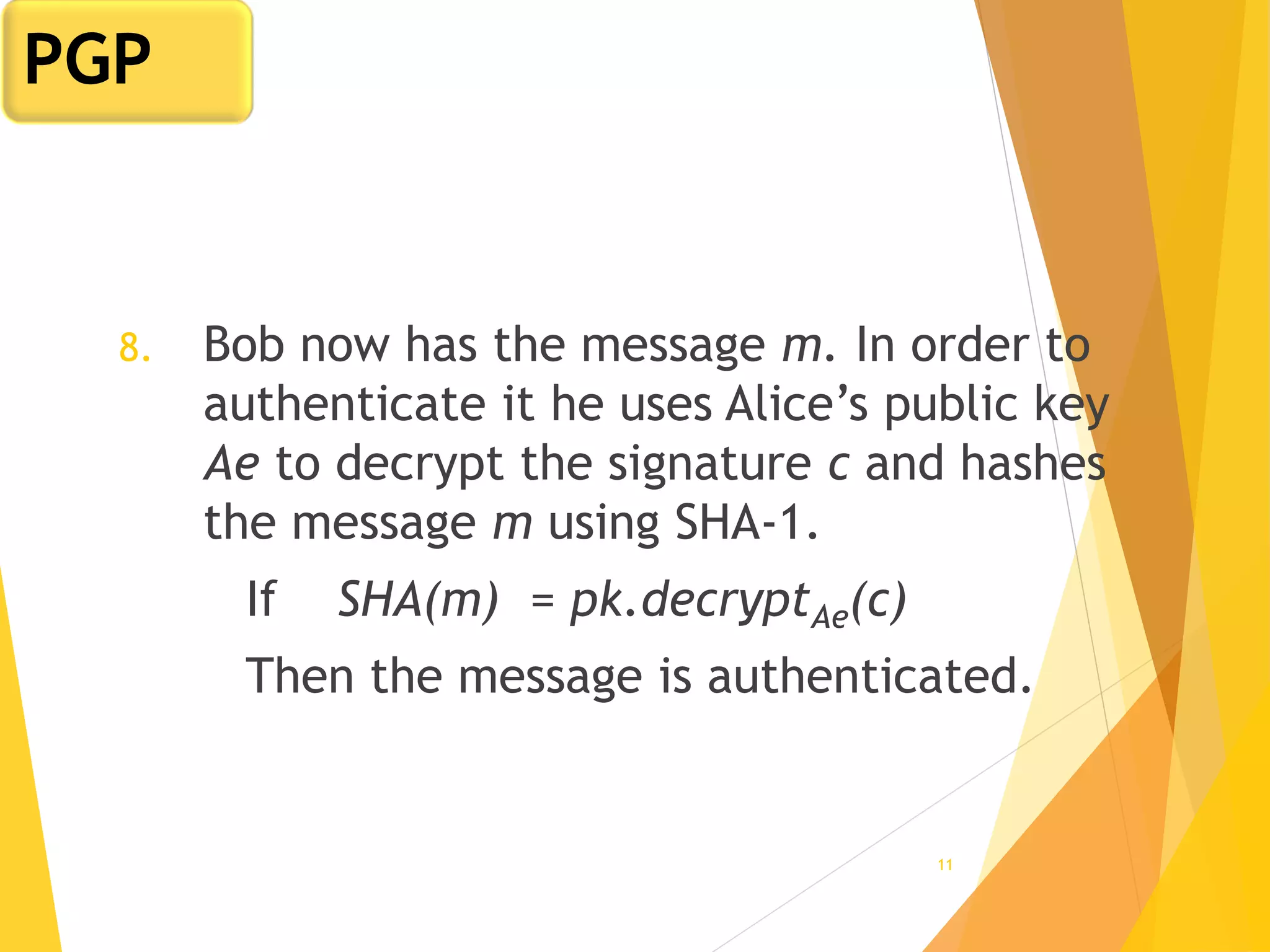
8. Bob now has the message m. In order to
authenticate it he uses Alice’s public key
Ae to decrypt the signature c and hashes
the message m using SHA-1.
If SHA(m) = pk.decryptAe(c)
Then the message is authenticated.
PGP
12
PGP E-Mail Compatibility
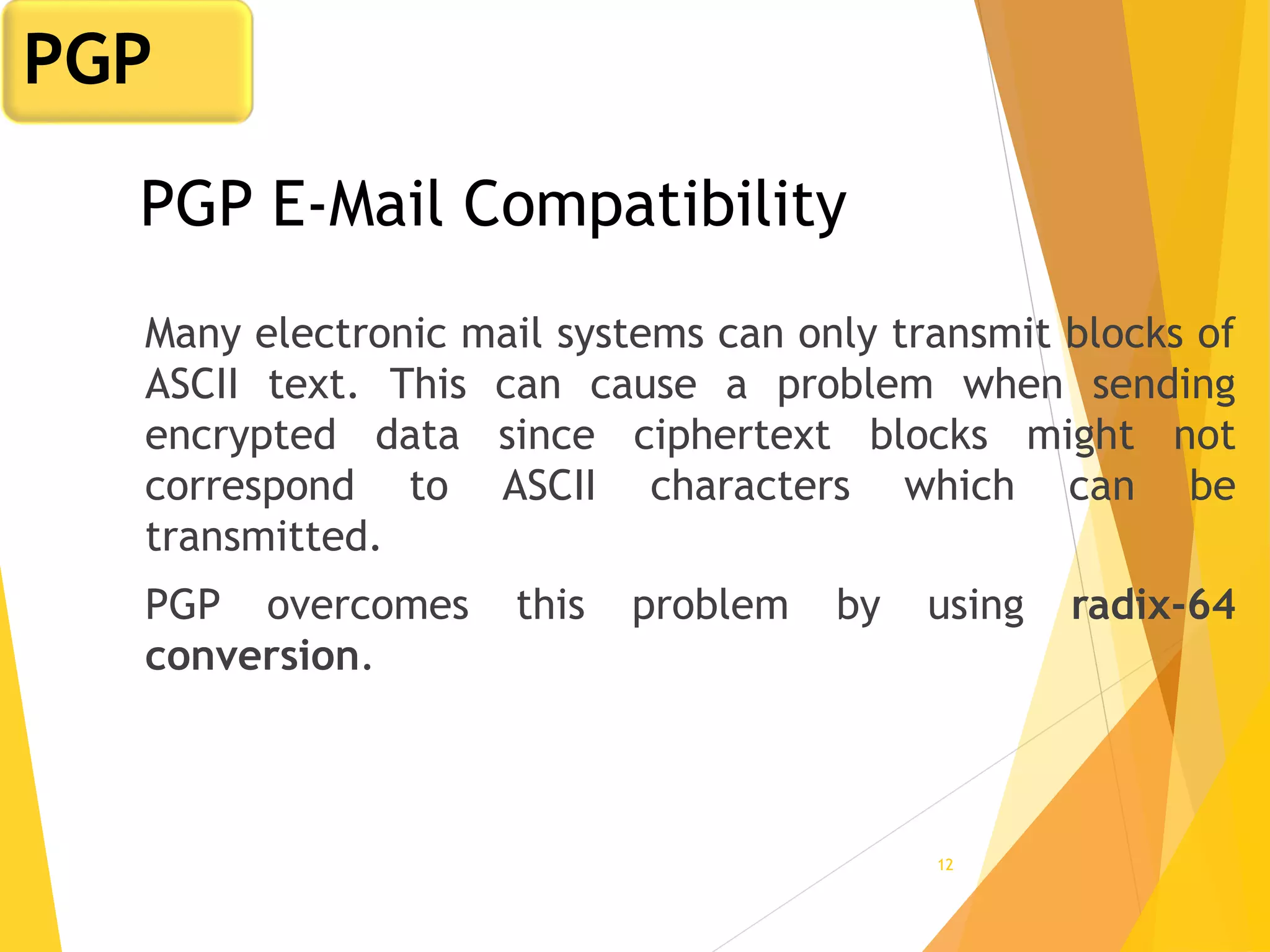
Many electronic mail systems can only transmit blocks of
ASCII text. This can cause a problem when sending
encrypted data since ciphertext blocks might not
correspond to ASCII characters which can be
transmitted.
PGP overcomes this problem by using radix-64
conversion.
PGP
13
Radix-64 conversion
Suppose the text to be encrypted has been converted
into binary using ASCII coding and encrypted to give a
ciphertext stream of binary.
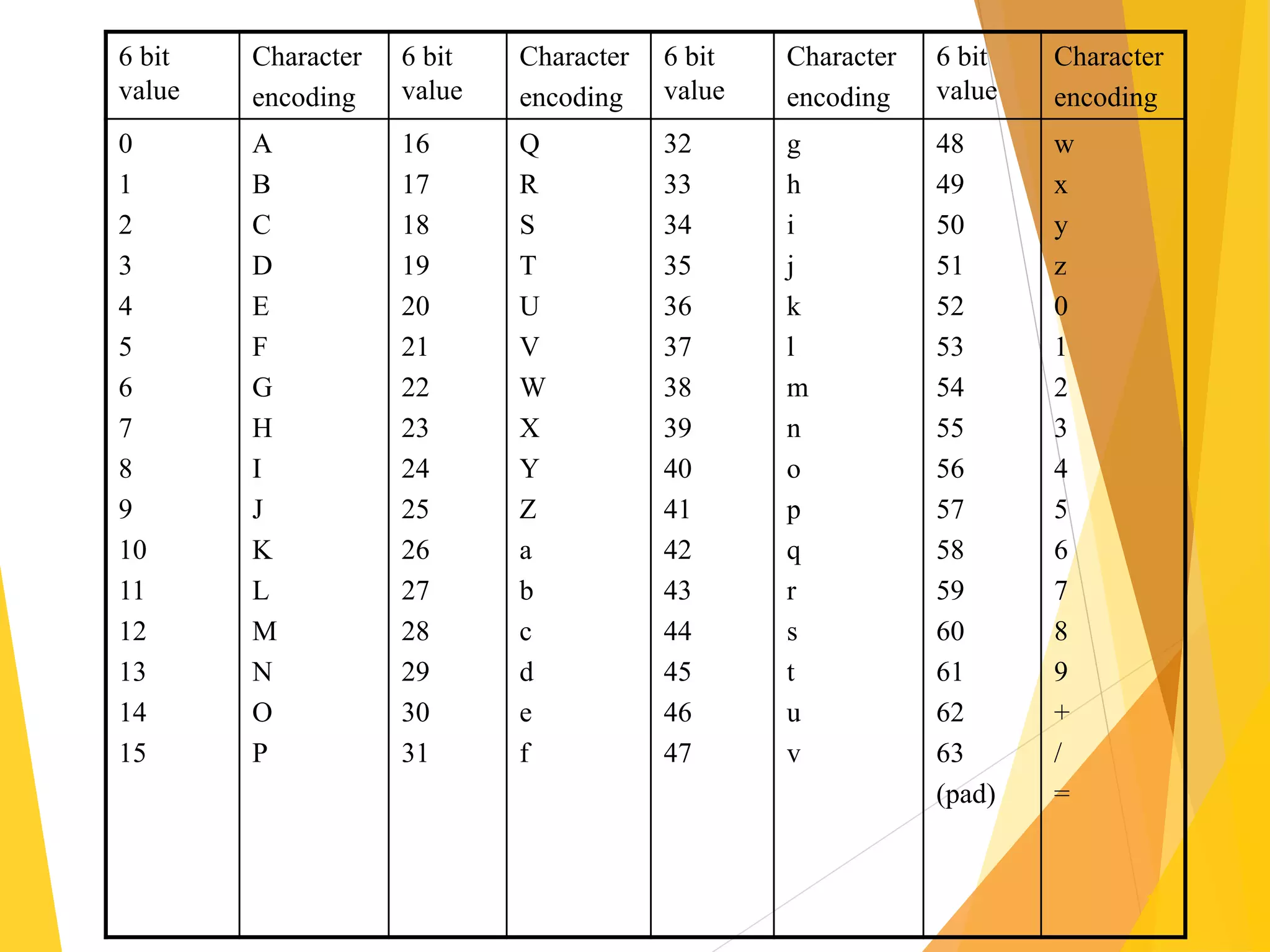
Radix-64 conversion maps arbitrary binary into printable
characters as follows:
PGP
14
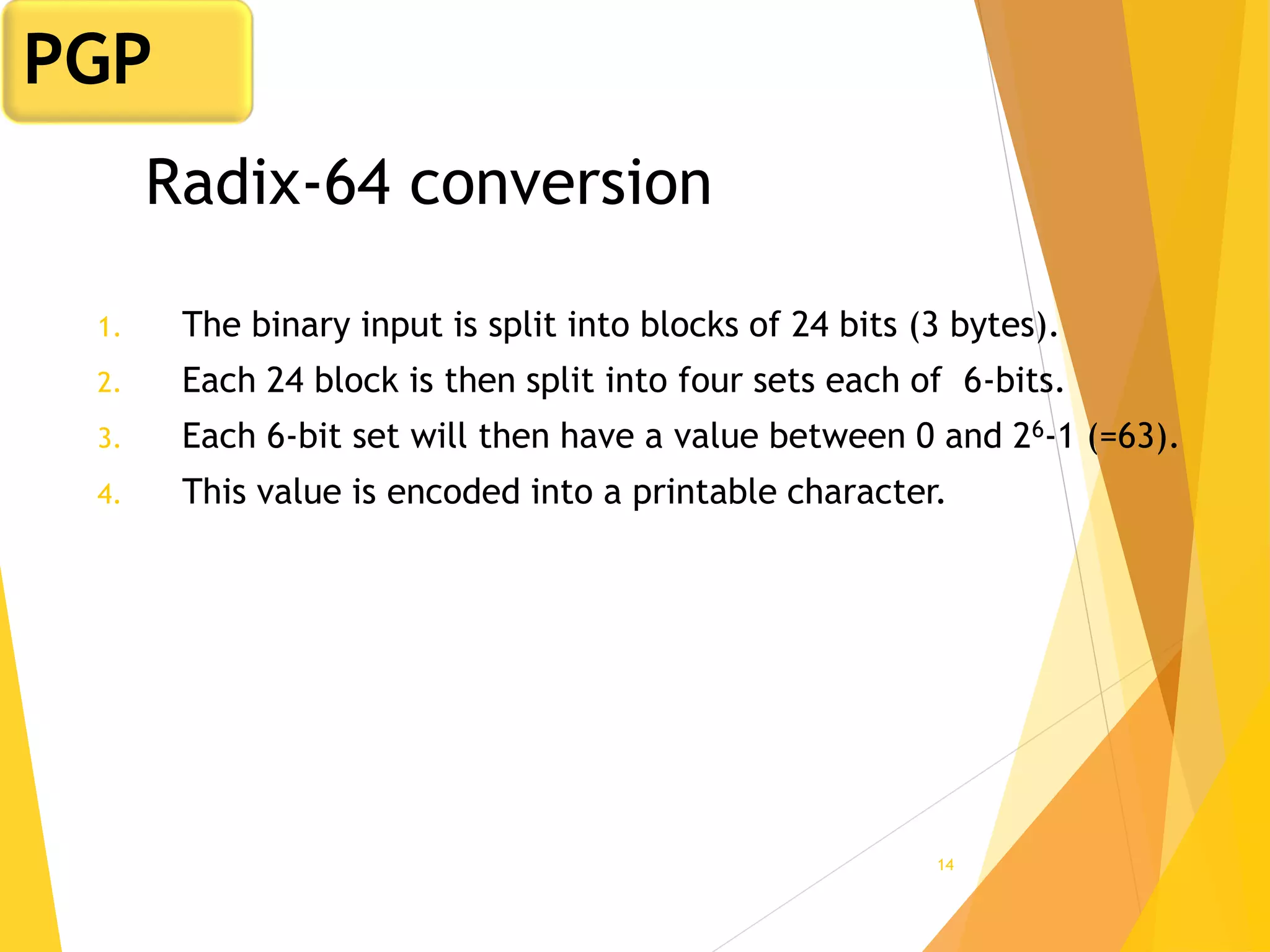
Radix-64 conversion
1. The binary input is split into blocks of 24 bits (3 bytes).
2. Each 24 block is then split into four sets each of 6-bits.
3. Each 6-bit set will then have a value between 0 and 26-1 (=63).
4. This value is encoded into a printable character.
PGP
15
6 bit
value
Character
encoding
6 bit
value
Character
encoding
6 bit
value
Character
encoding
6 bit
value
Character
encoding
0
1
2
3
4
5
6
7
8
9
10
11
12
13
14
15
A
B
C
D
E
F
G
H
I
J
K
L
M
N
O
P
16
17
18
19
20
21
22
23
24
25
26
27
28
29
30
31
Q
R
S
T
U
V
W
X
Y
Z
a
b
c
d
e
f
32
33
34
35
36
37
38
39
40
41
42
43
44
45
46
47
g
h
i
j
k
l
m
n
o
p
q
r
s
t
u
v
48
49
50
51
52
53
54
55
56
57
58
59
60
61
62
63
(pad)
w
x
y
z
0
1
2
3
4
5
6
7
8
9
+
/
=
16
PGP Segmentation
Another constraint of e-mail is that there is usually a
maximum message length.
PGP automatically blocks an encrypted message into
segments of an appropriate length.
On receipt, the segments must be re-assembled before
the decryption process.
PGP
17
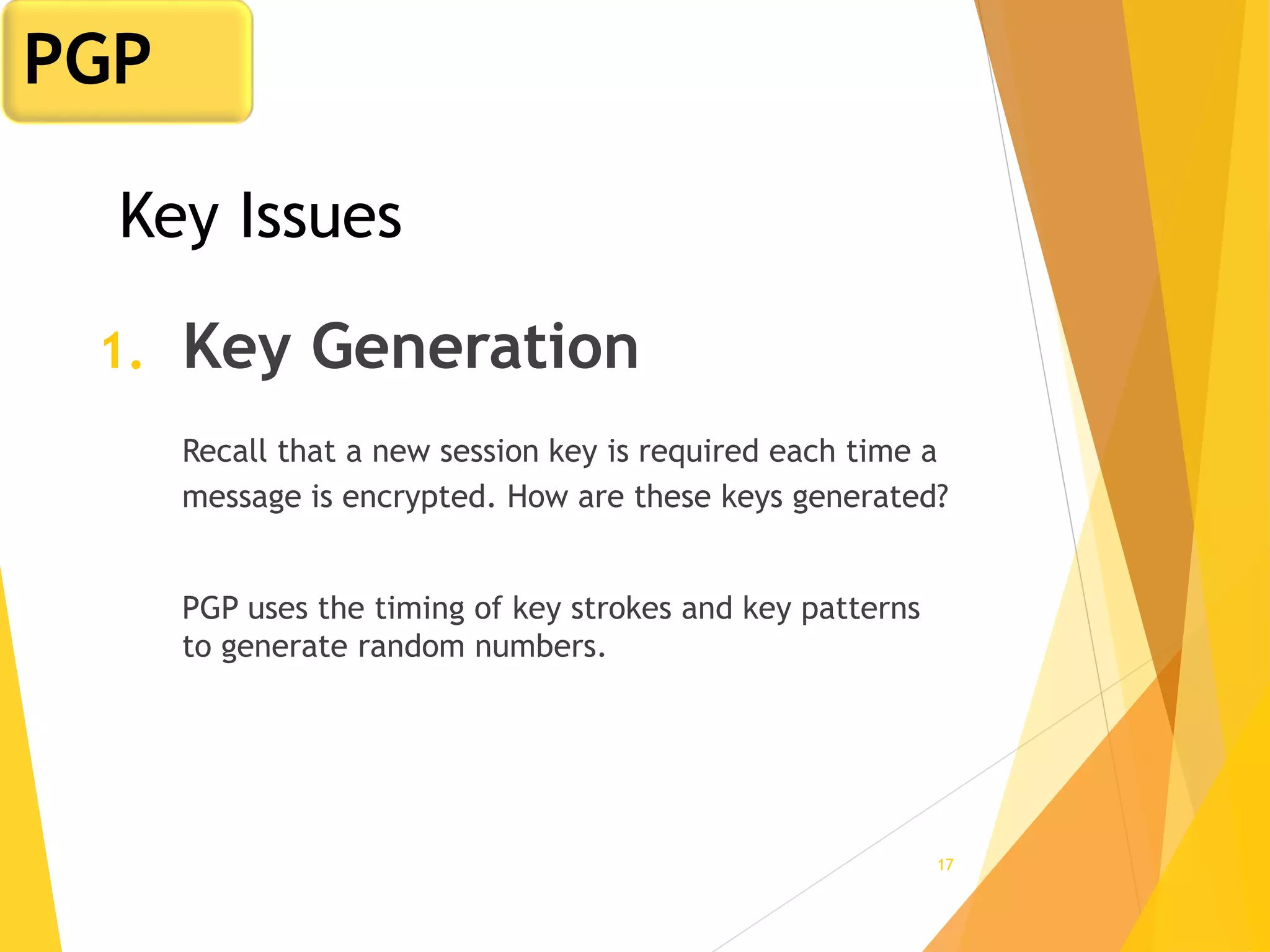
Key Issues
1. Key Generation
Recall that a new session key is required each time a
message is encrypted. How are these keys generated?
PGP uses the timing of key strokes and key patterns
to generate random numbers.
PGP
18
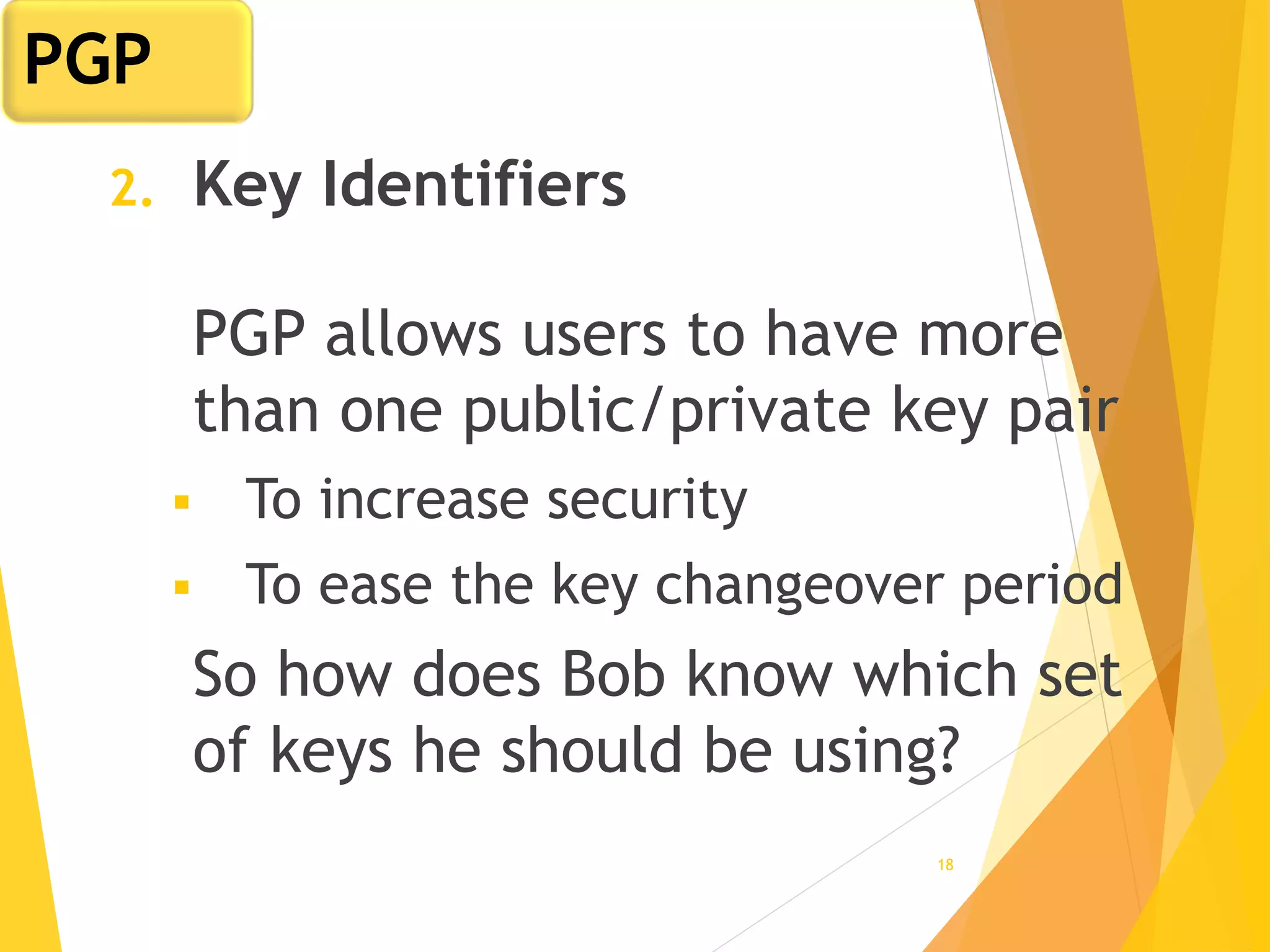
2. Key Identifiers
PGP allows users to have more
than one public/private key pair
 To increase security
 To ease the key changeover period
So how does Bob know which set
of keys he should be using?
PGP
19
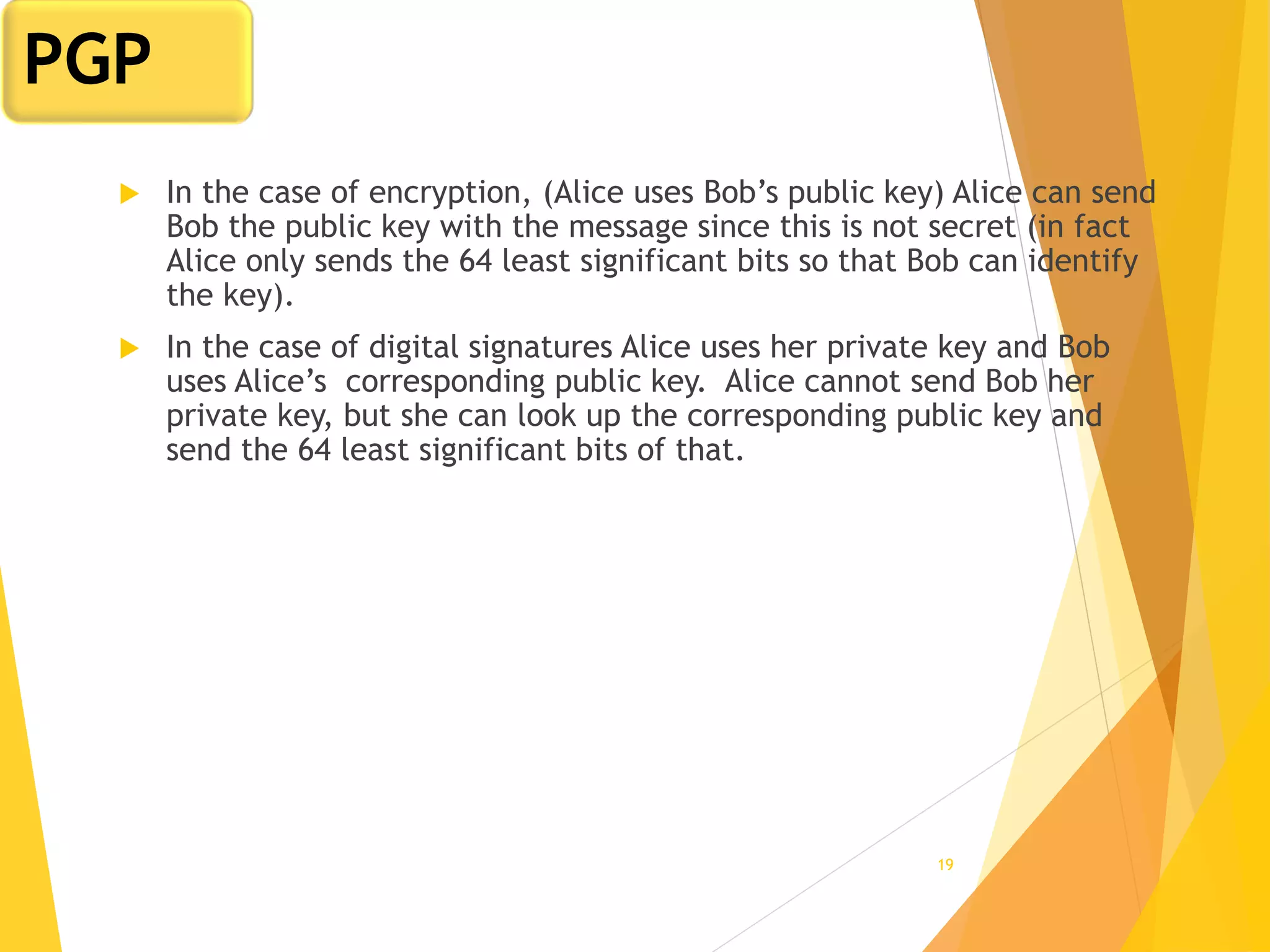
 In the case of encryption, (Alice uses Bob’s public key) Alice can send
Bob the public key with the message since this is not secret (in fact
Alice only sends the 64 least significant bits so that Bob can identify
the key).
 In the case of digital signatures Alice uses her private key and Bob
uses Alice’s corresponding public key. Alice cannot send Bob her
private key, but she can look up the corresponding public key and
send the 64 least significant bits of that.
PGP
20
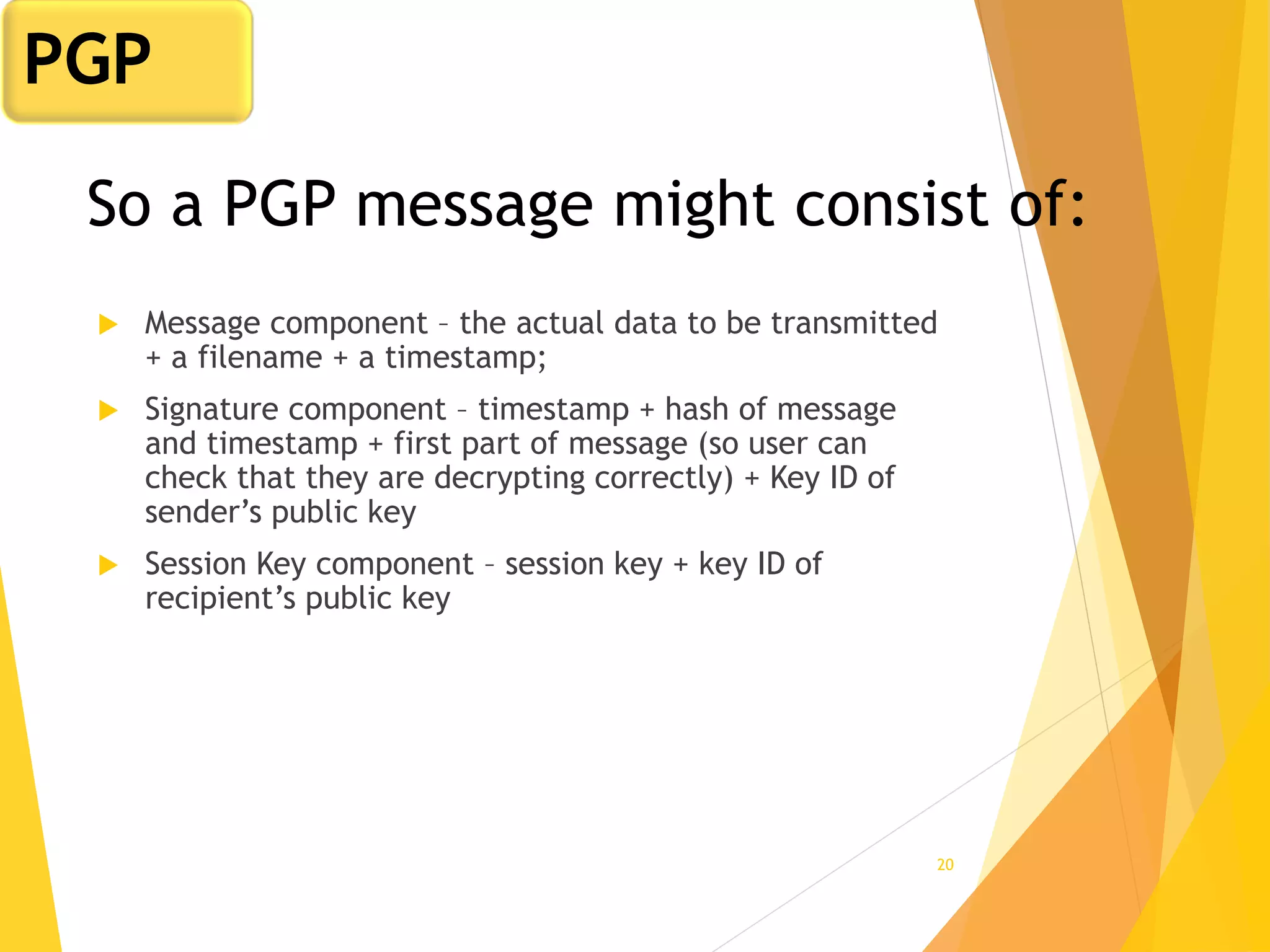
So a PGP message might consist of:
 Message component – the actual data to be transmitted
+ a filename + a timestamp;
 Signature component – timestamp + hash of message
and timestamp + first part of message (so user can
check that they are decrypting correctly) + Key ID of
sender’s public key
 Session Key component – session key + key ID of
recipient’s public key
PGP
21
• SSL was first developed by Netscape in 1994 and
became an internet standard in 1996 ( RFC 2246
– TLS V1.0)
• SSL is a cryptographic protocol to secure network
across a connection-oriented layer
• Any program using TCP can be modified to use
SSL connection
Encryption and its types SSL Facts
22
• SSL connection uses a dedicated TCP/IP
socket(e.g. port 443 for https)
• SSL is flexible in choice of which symmetric
encryption, message digest, and authentication
can be used
• SSL provides built in data compression
SSL Facts
23
• Authenticate the server to the client
• Allow the client and server to select cryptographic
algorithms, or ciphers, that they both support
• Optionally authenticate the client to the server
• Use public key encryption techniques to generate
shared secret
• Establish an encrypted SSL connection
SSL Usage
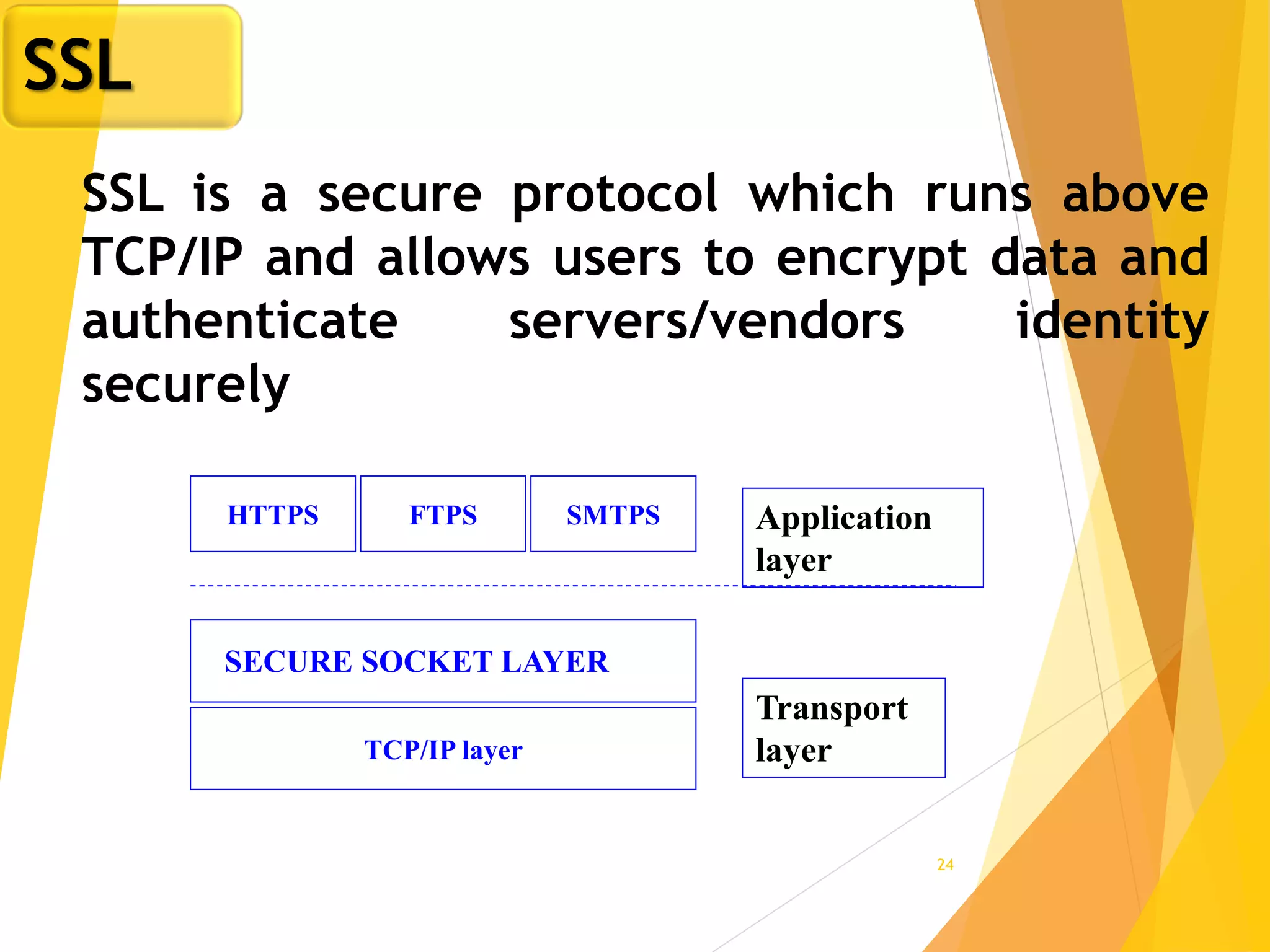
24
SSL is a secure protocol which runs above
TCP/IP and allows users to encrypt data and
authenticate servers/vendors identity
securely
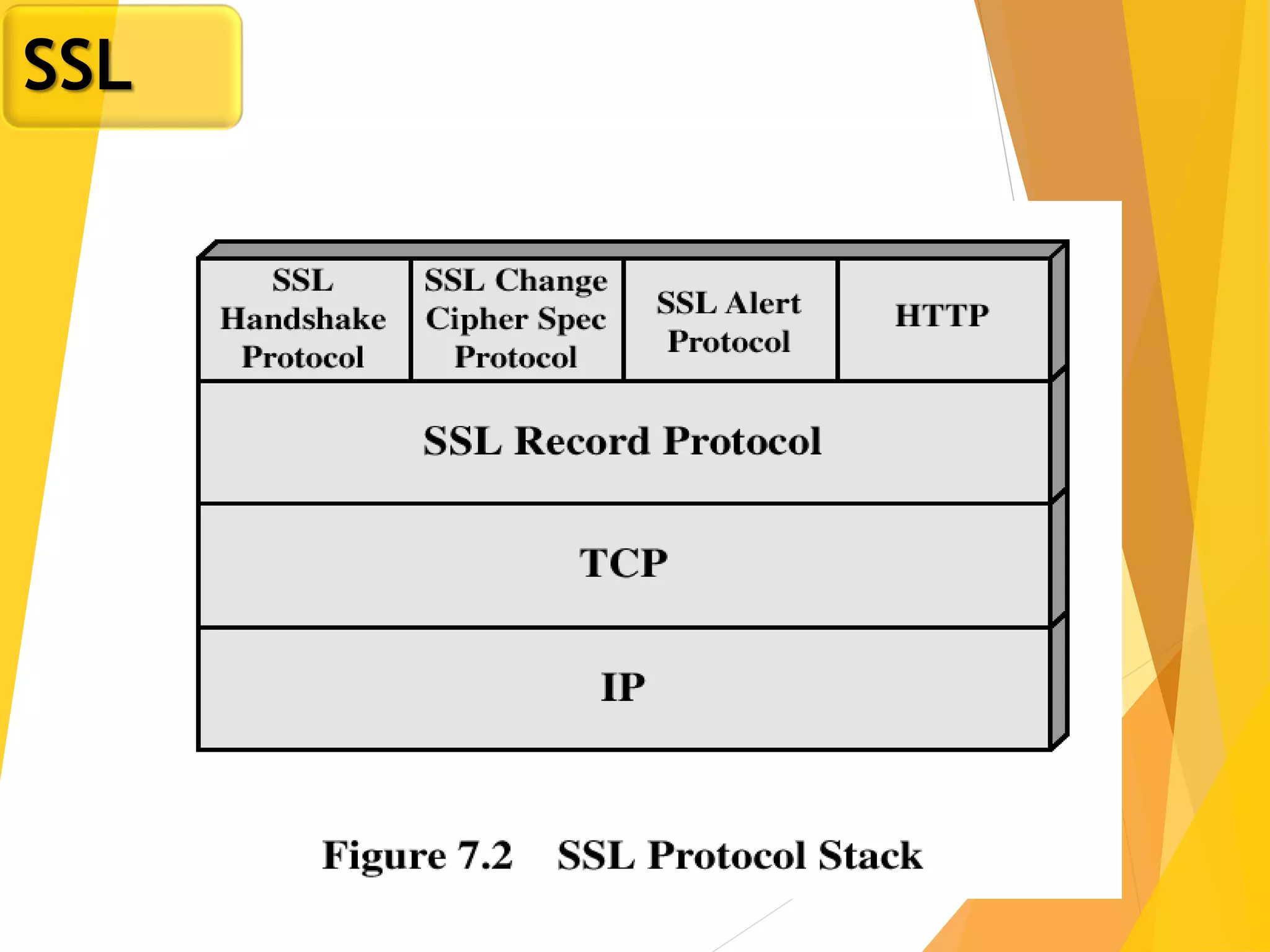
Application
layer
Transport
layerTCP/IP layer
SMTPSFTPSHTTPS
SECURE SOCKET LAYER
SSL
25
SSL
26
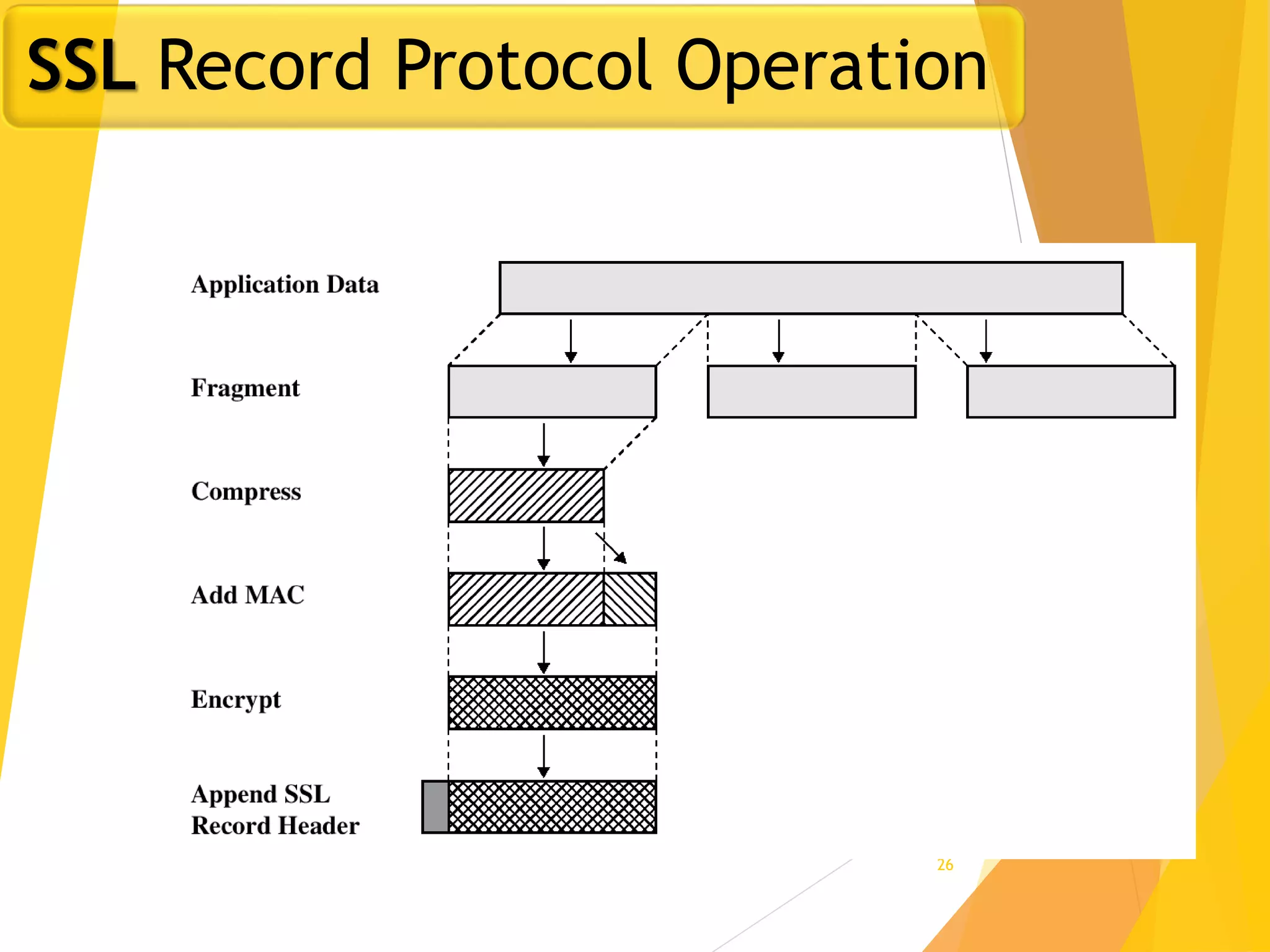
SSL Record Protocol Operation
27
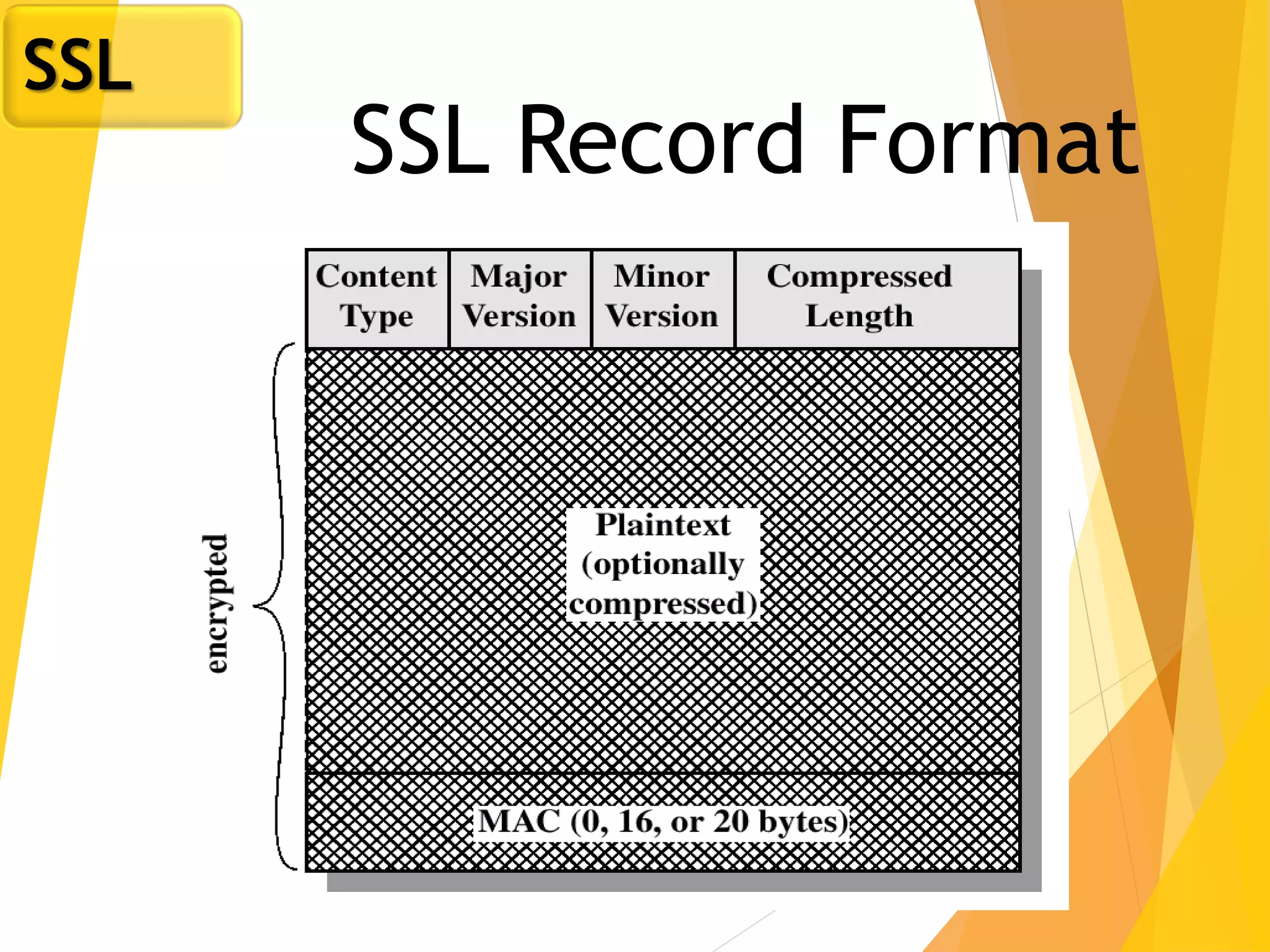
SSL Record Format
SSL
28
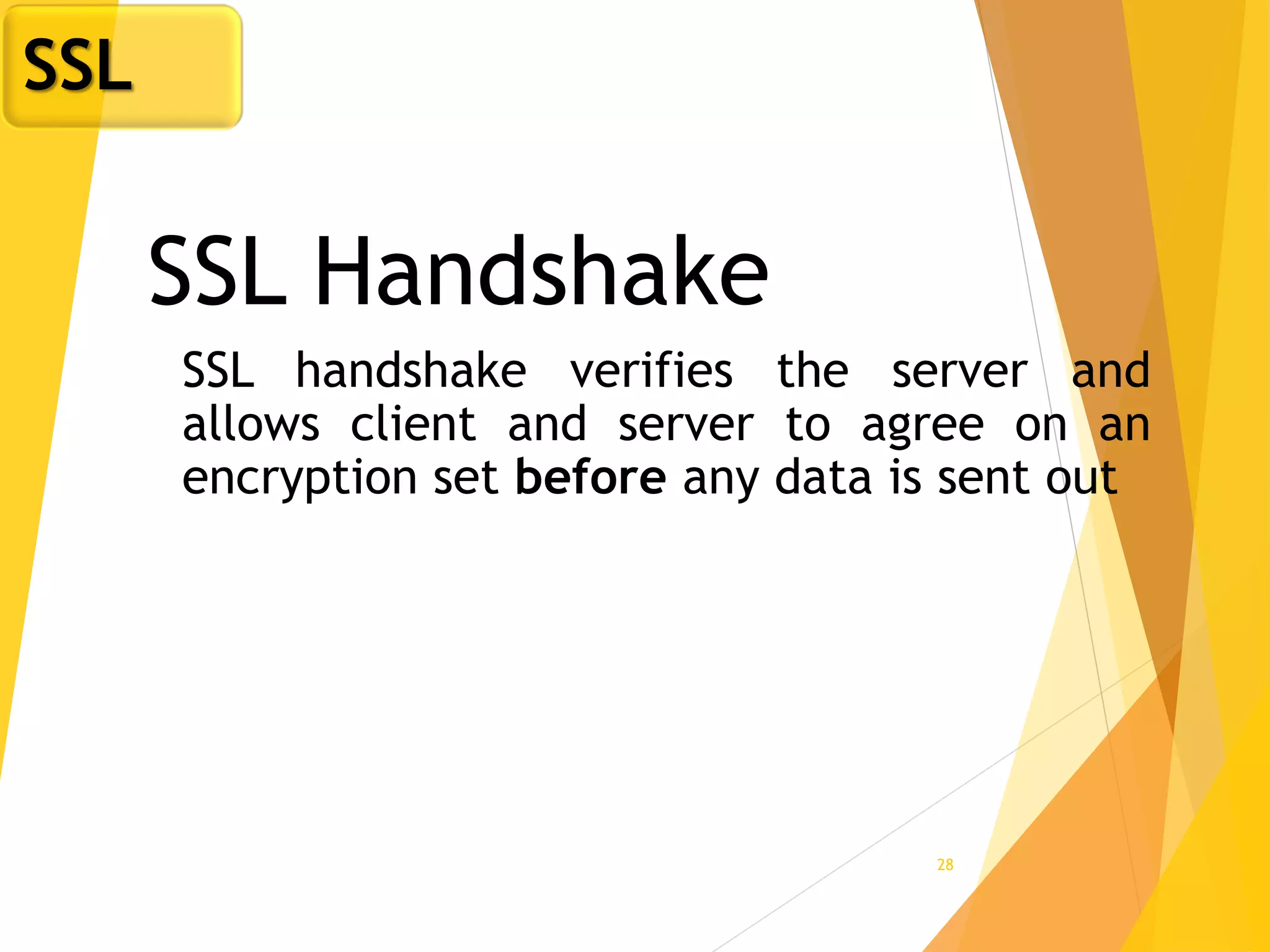
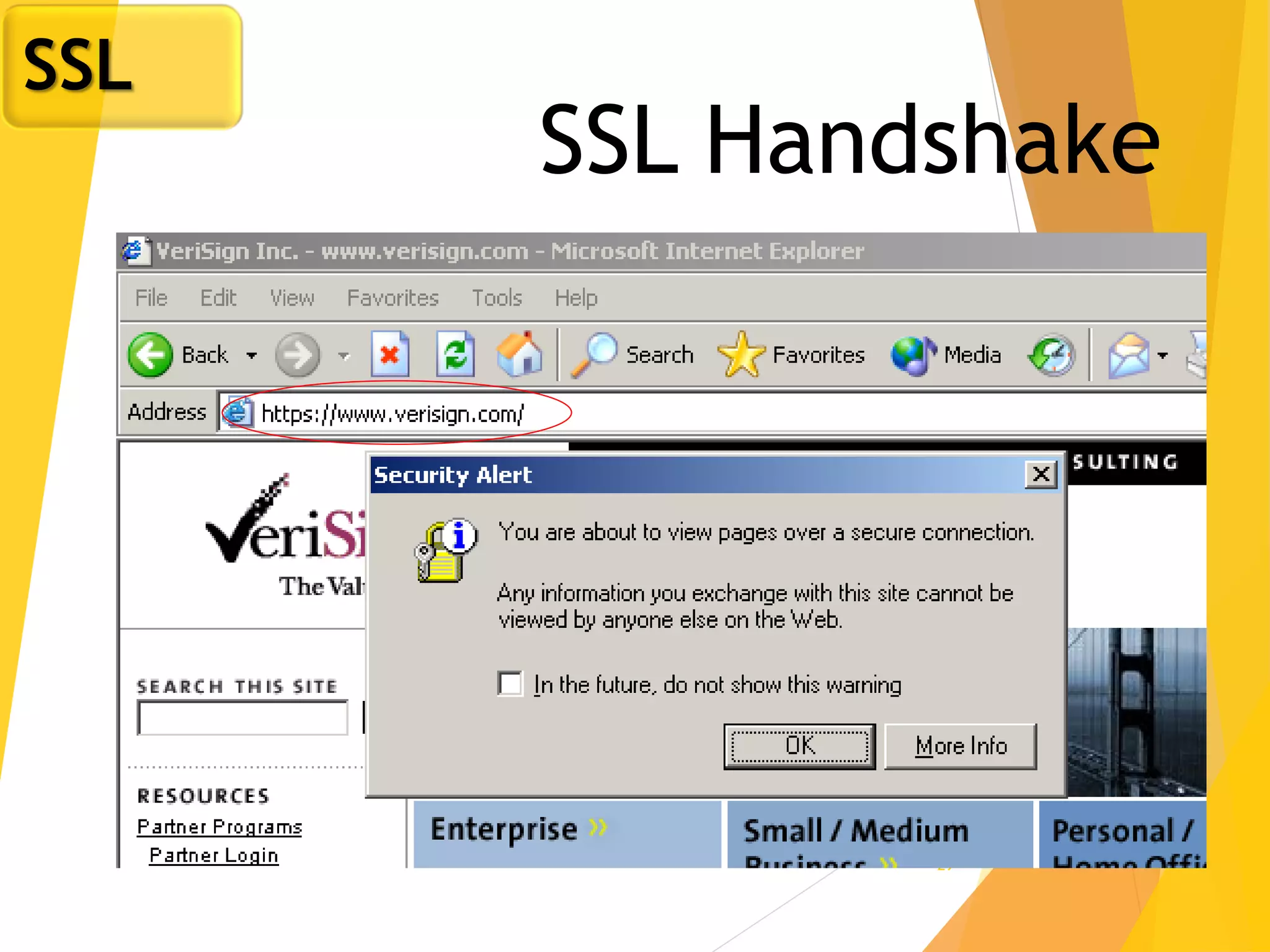
SSL Handshake
SSL handshake verifies the server and
allows client and server to agree on an
encryption set before any data is sent out
SSL
29
SSL Handshake
SSL
30
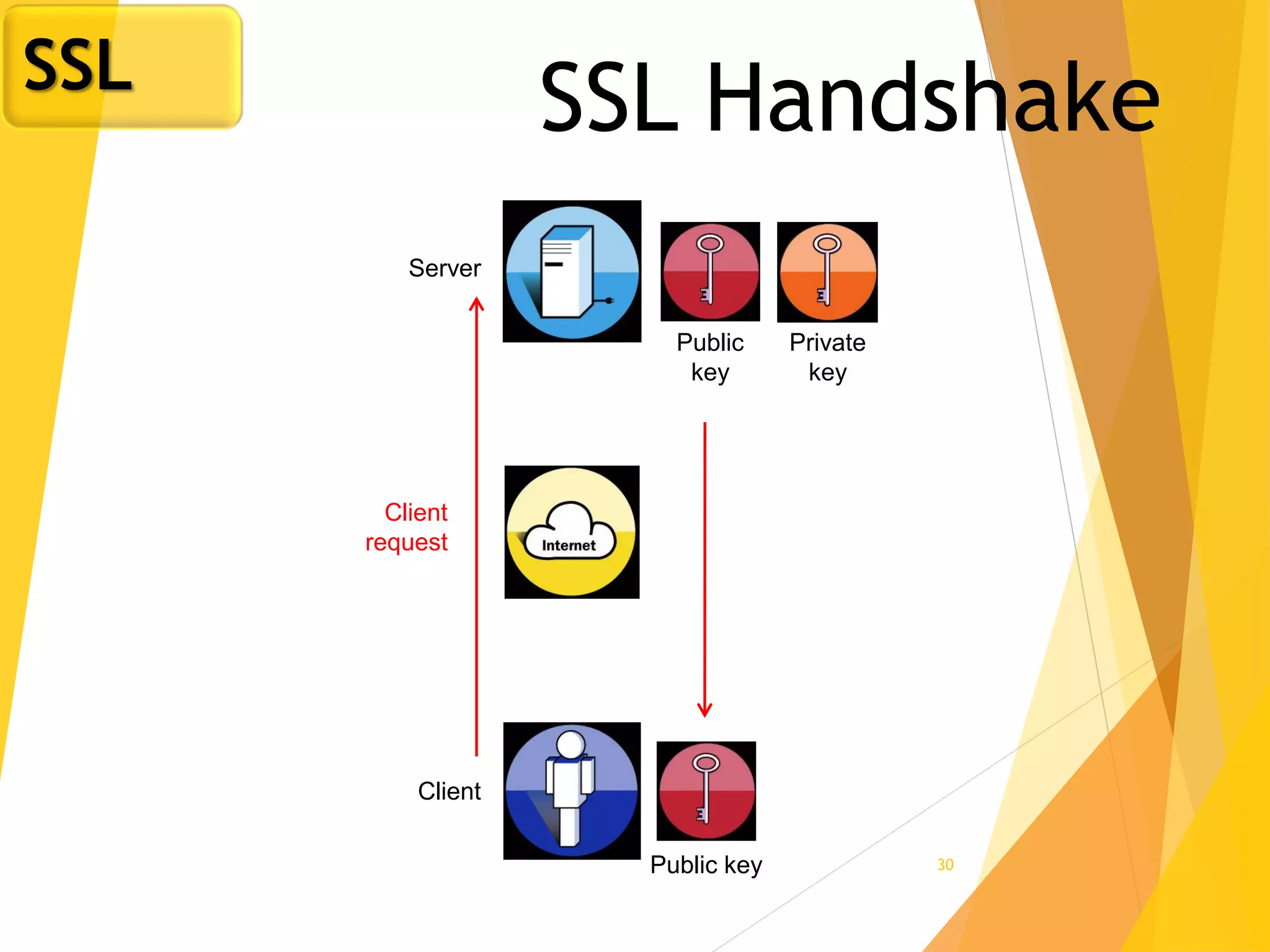
SSL Handshake
Server
Client
Public
key
Private
key
Client
request
Public key
SSL
31
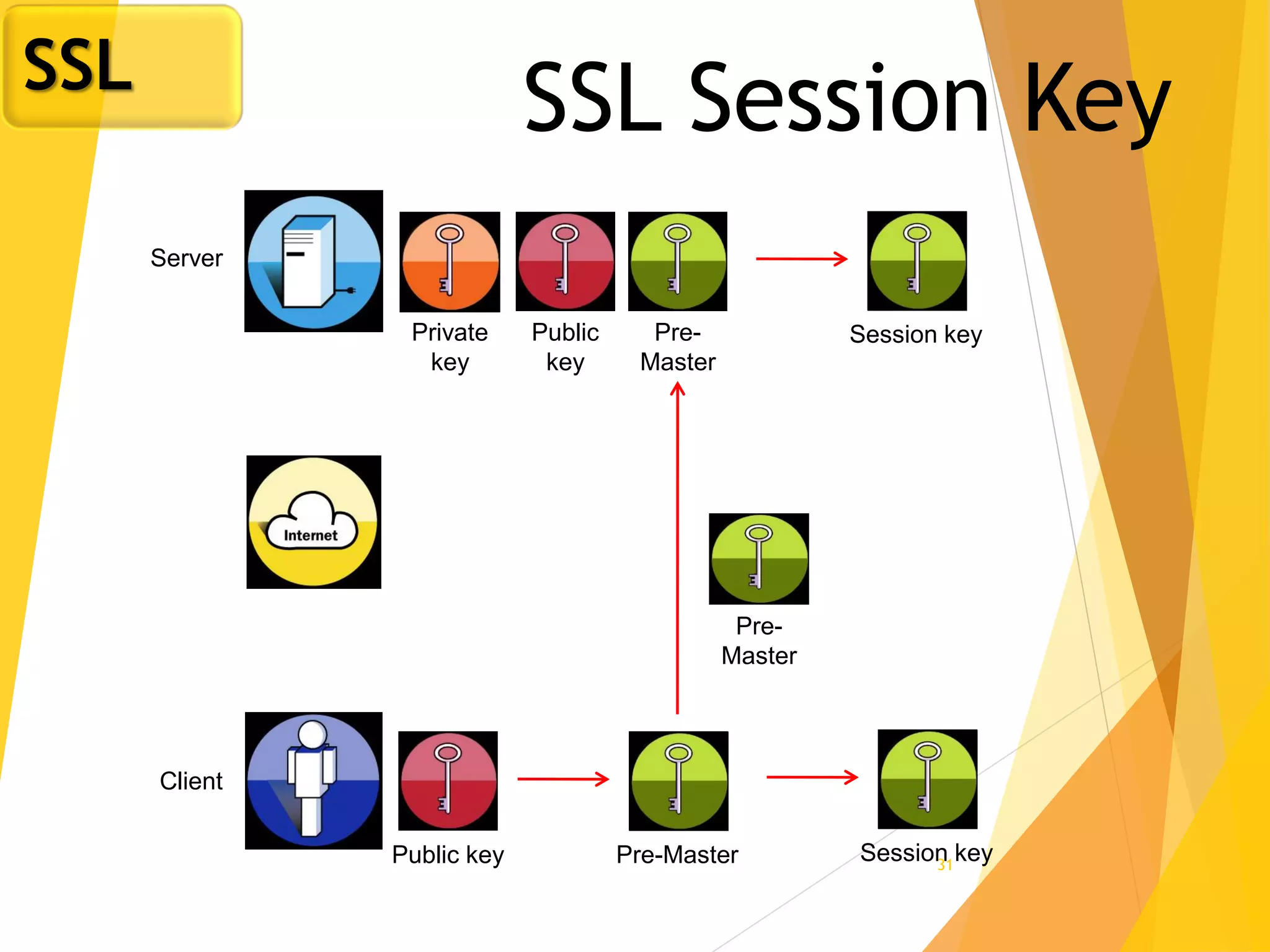
SSL Session Key
Server
Client
Public
key
Private
key
Public key Pre-Master
Pre-
Master
Pre-
Master
Session key
Session key
SSL
32
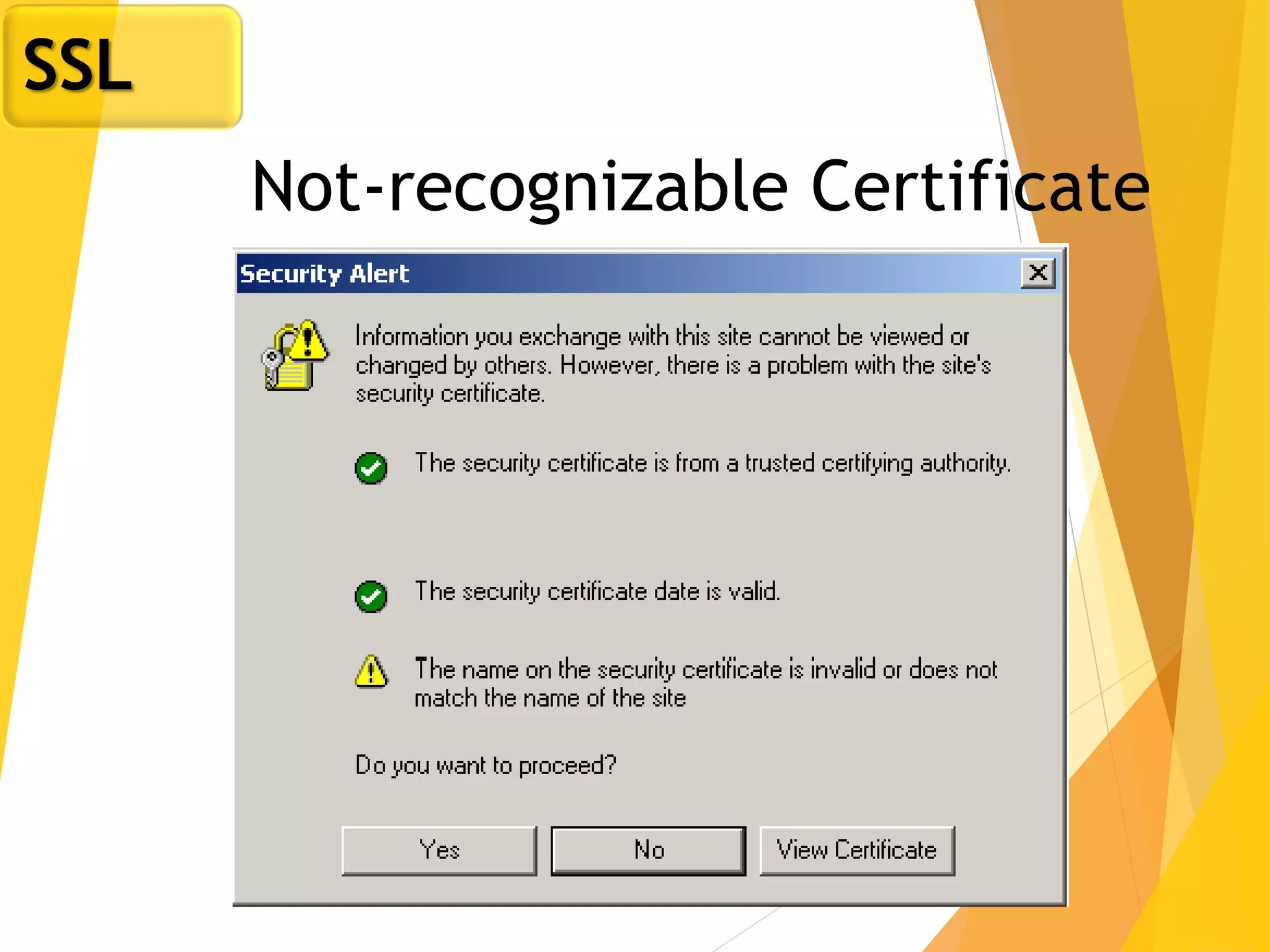
Not-recognizable Certificate
SSL
33
Review the Certificate In IE
34
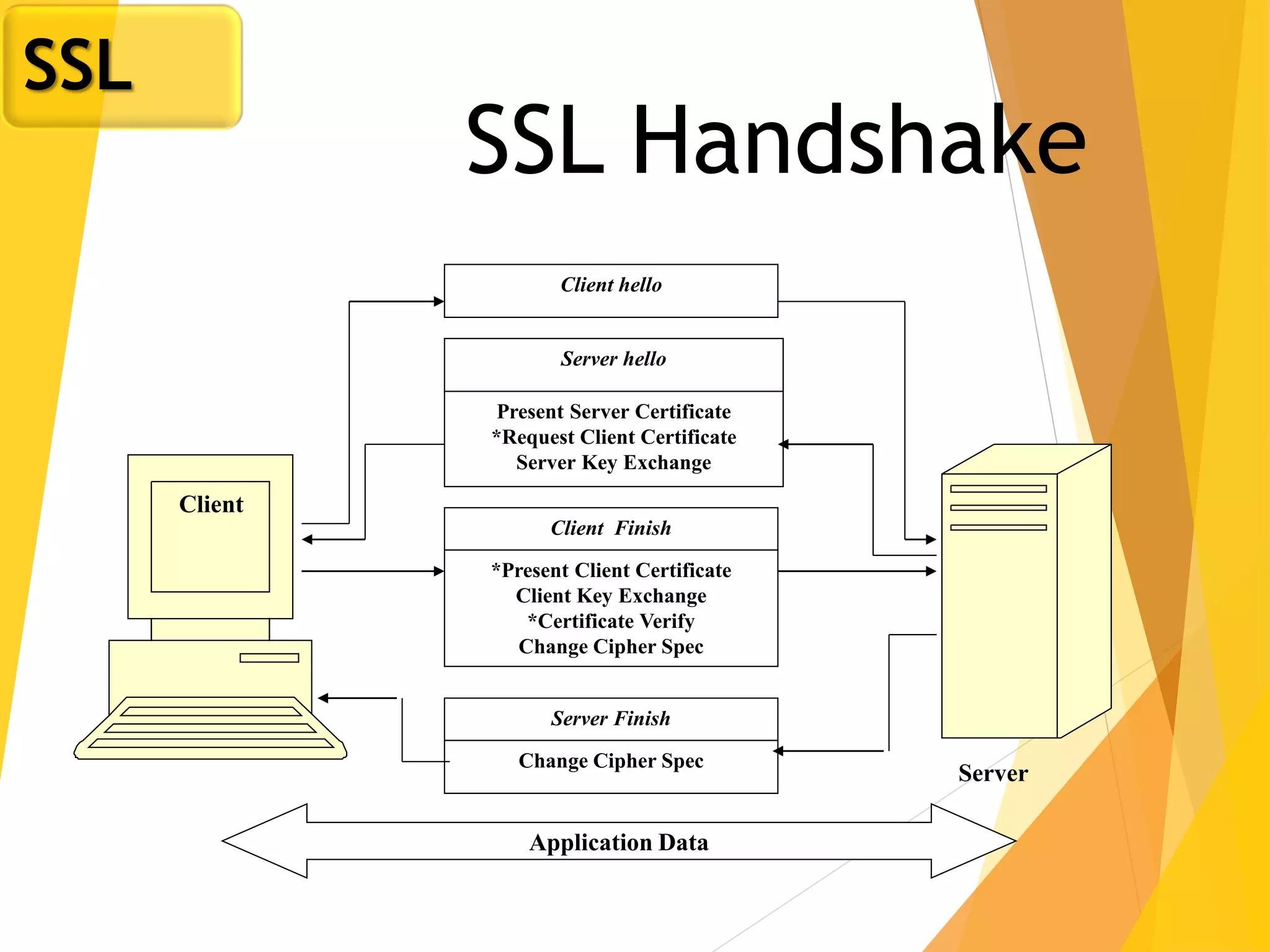
SSL Handshake
Client hello
Server hello
Present Server Certificate
*Request Client Certificate
Server Key Exchange
Client Finish
*Present Client Certificate
Client Key Exchange
*Certificate Verify
Change Cipher Spec
Server Finish
Change Cipher Spec
Client
Server
Application Data
SSL
35
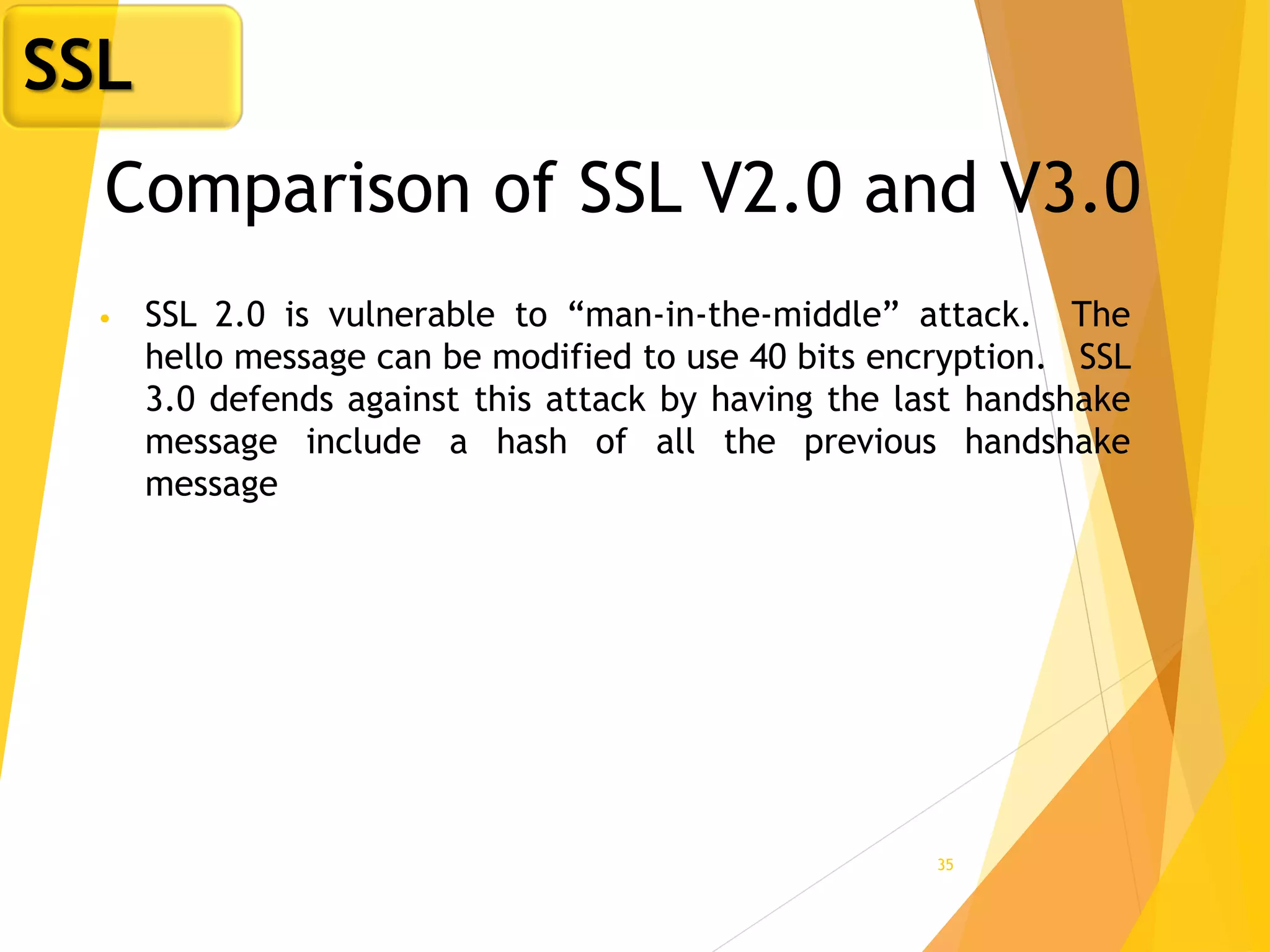
Comparison of SSL V2.0 and V3.0
• SSL 2.0 is vulnerable to “man-in-the-middle” attack. The
hello message can be modified to use 40 bits encryption. SSL
3.0 defends against this attack by having the last handshake
message include a hash of all the previous handshake
message
SSL
36
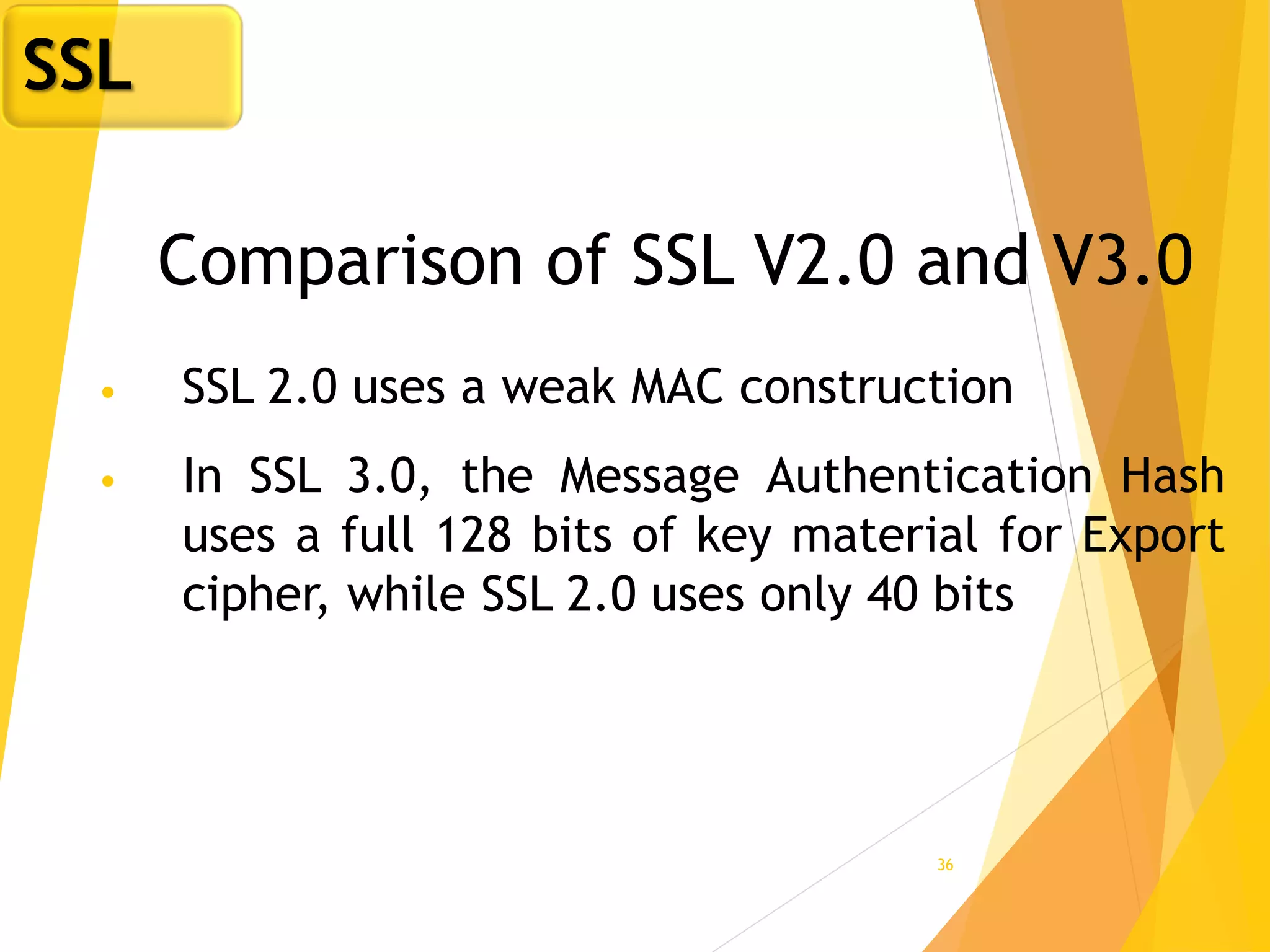
Comparison of SSL V2.0 and V3.0
• SSL 2.0 uses a weak MAC construction
• In SSL 3.0, the Message Authentication Hash
uses a full 128 bits of key material for Export
cipher, while SSL 2.0 uses only 40 bits
SSL
37
Comparison of SSL V2.0 and V3.0
• SSL 2.0 only allows a handshake at the
beginning of the connection. In 3.0, the
client can initiate a handshake routine any
time
• SSL 3.0 allows server and client to send
chains of certificate
• SSL 3.0 has a generalized key exchange
protocol. It allows Diffie-Hellman and
Fortezza key exchange
• SSL 3.0 allows for record compression and
decompression
SSL
 One of the primary goals of the ARPANET
was remote access
 Several different connections allowed
rlogin
rcp
rsh
 All data was unencrypted
This was a different world than exists today.
SSH
GBI 39
 SSH is a UNIX-based command interface and protocol for
securely accessing a remote computer
 Suite of four utilities—slogin, ssh, sftp, and scp
 Can protect against:
 IP spoofing
 DNS spoofing
 Intercepting information
SSH
 Protect data sent over the network
 Negotiate an encryption algorithm between sender and
receiver
 Use that algorithm and a session key to encrypt / decrypt data
sent
 Provide site authentication
 Use public key / fingerprint to ensure identity of remote host.
 Relies on locally generated keys, so no certifying authority is
generally available.
SSH
GBI 41
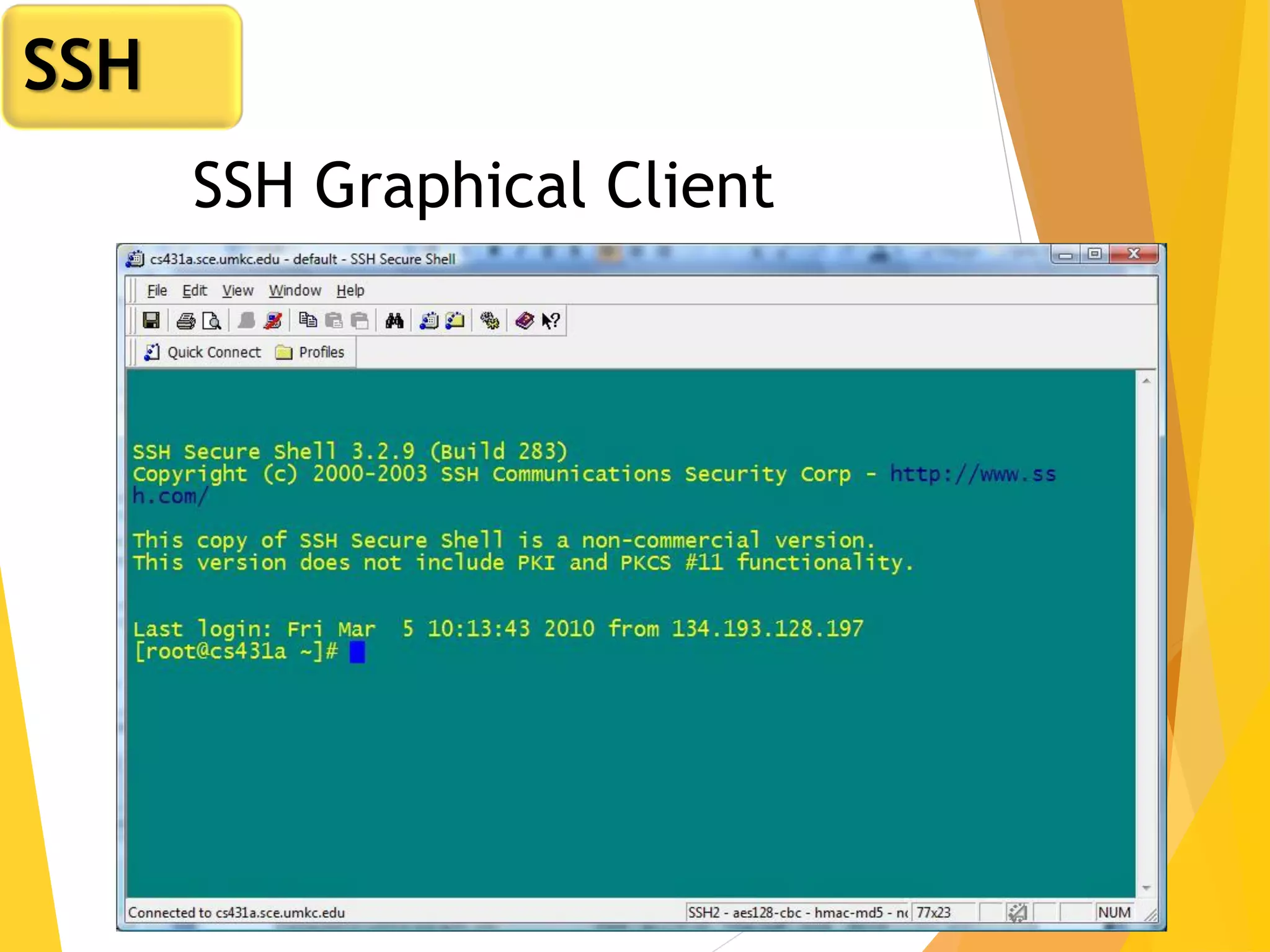
SSH Graphical Client
SSH
GBI 42
SSH
GBI 43
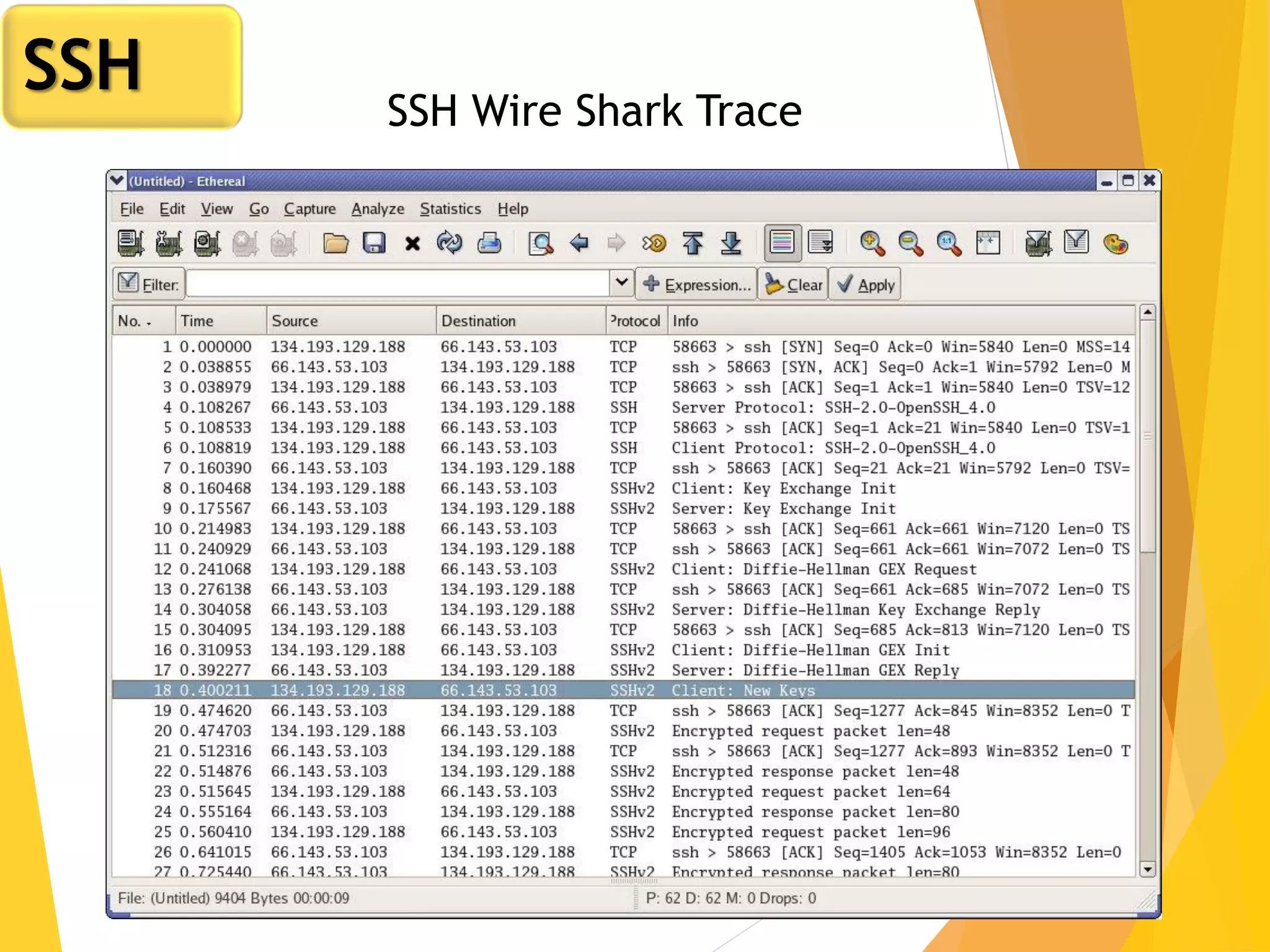
SSH Wire Shark Trace
SSH
GBI 44
sFTP in Linux
SSH
GBI 45
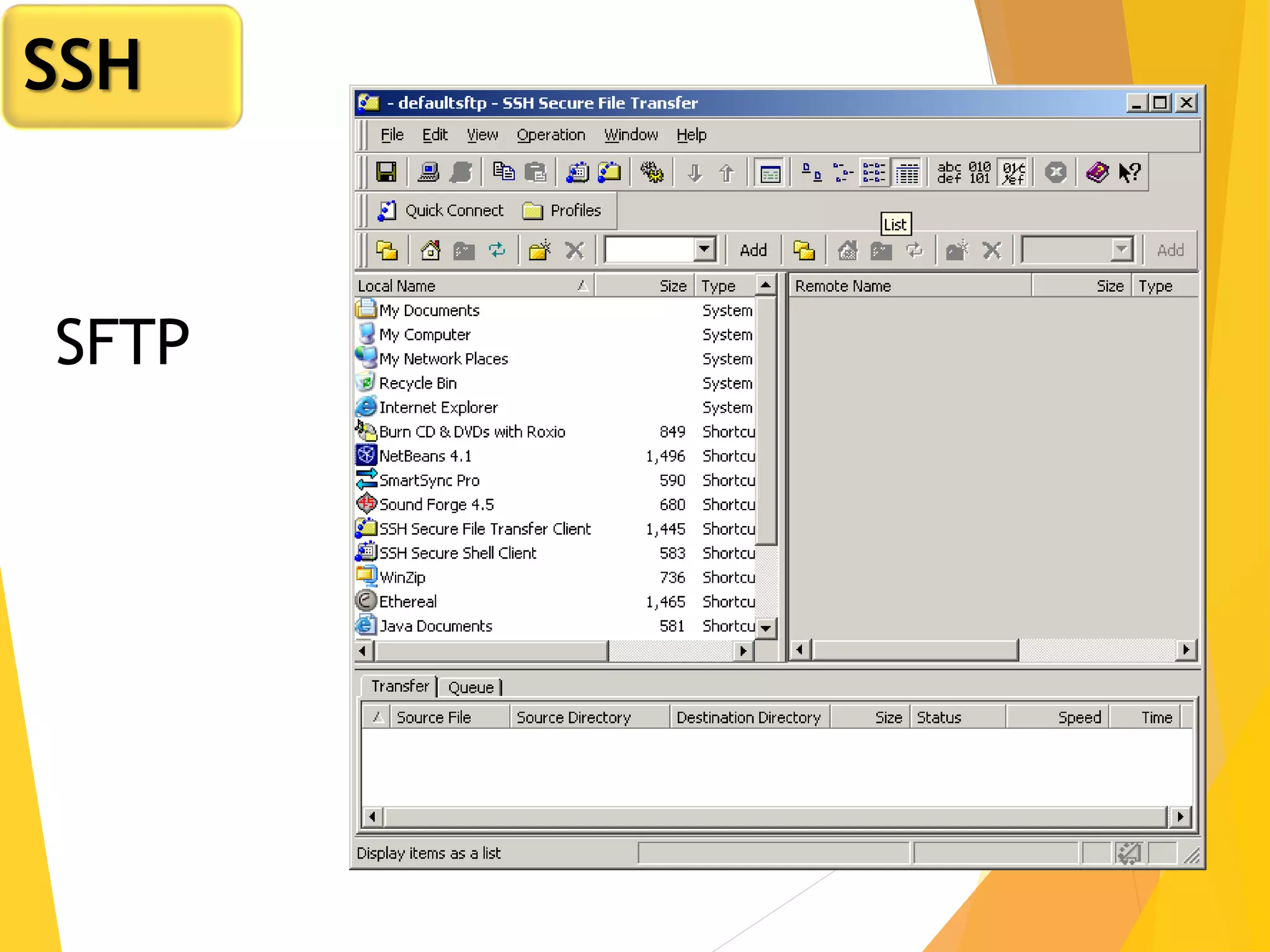
SFTP
SSH
GBI 46
SSH Tunneling
 Use SSH to create an encrypted channel between remote host and server
 Use that encrypted channel to carry other traffic.
SSH
Tunn
www
acce
ss
Web Server
192.168.1.10
Local port
12345
Internet
LAN
SSH
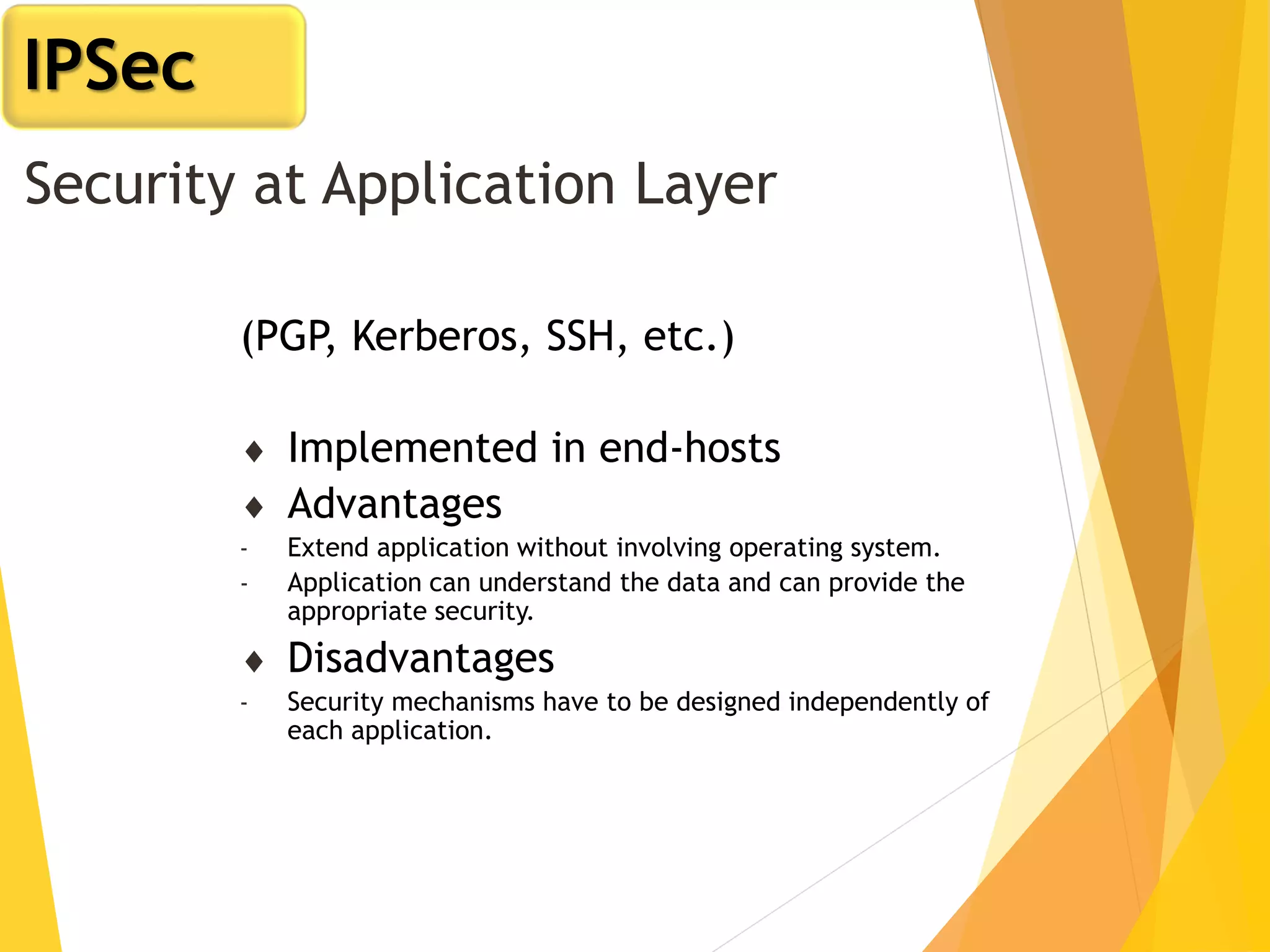
Security at Application Layer
(PGP, Kerberos, SSH, etc.)
 Implemented in end-hosts
 Advantages
- Extend application without involving operating system.
- Application can understand the data and can provide the
appropriate security.
 Disadvantages
- Security mechanisms have to be designed independently of
each application.
IPSec
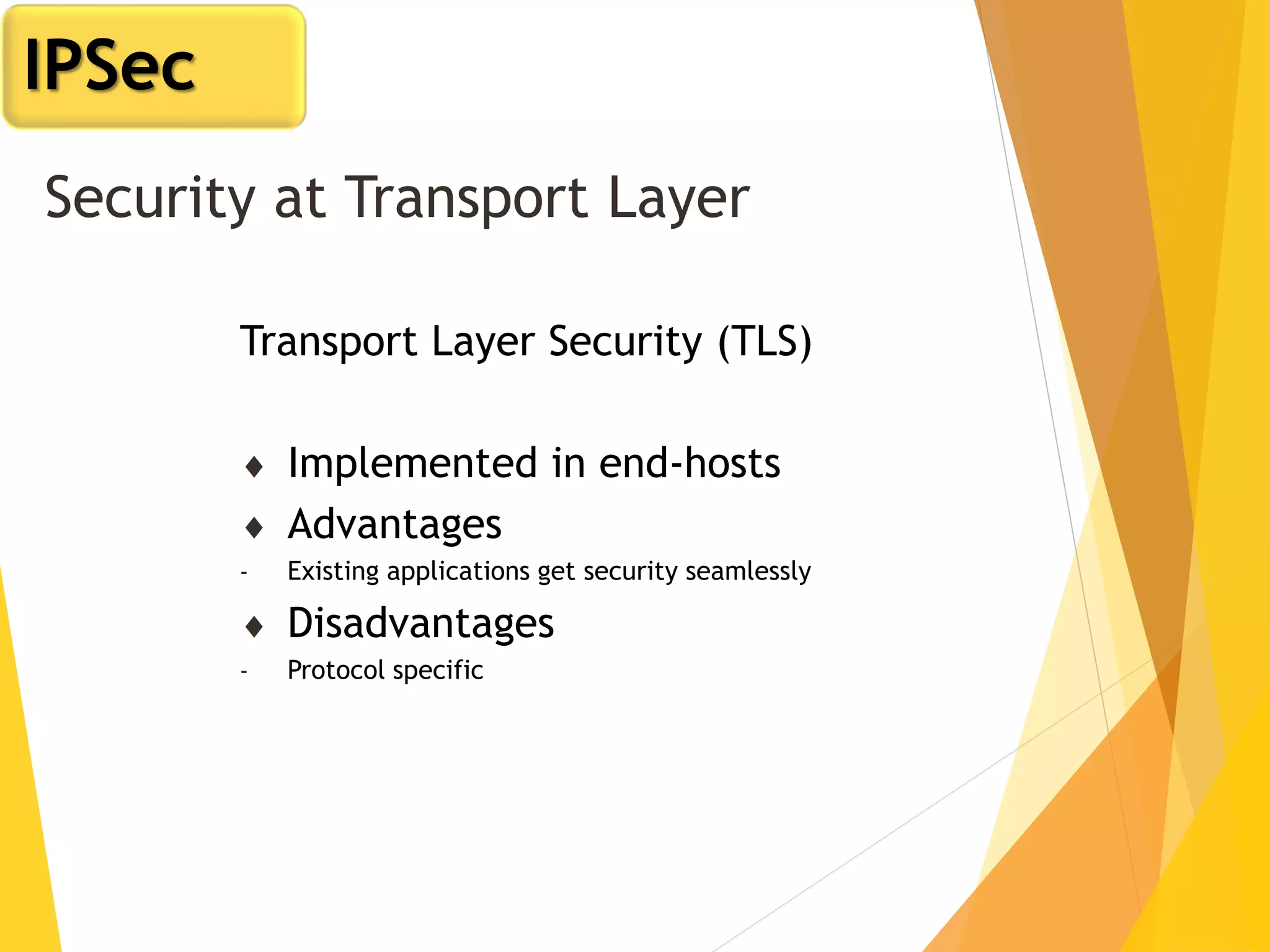
Security at Transport Layer
Transport Layer Security (TLS)
 Implemented in end-hosts
 Advantages
- Existing applications get security seamlessly
 Disadvantages
- Protocol specific
IPSec
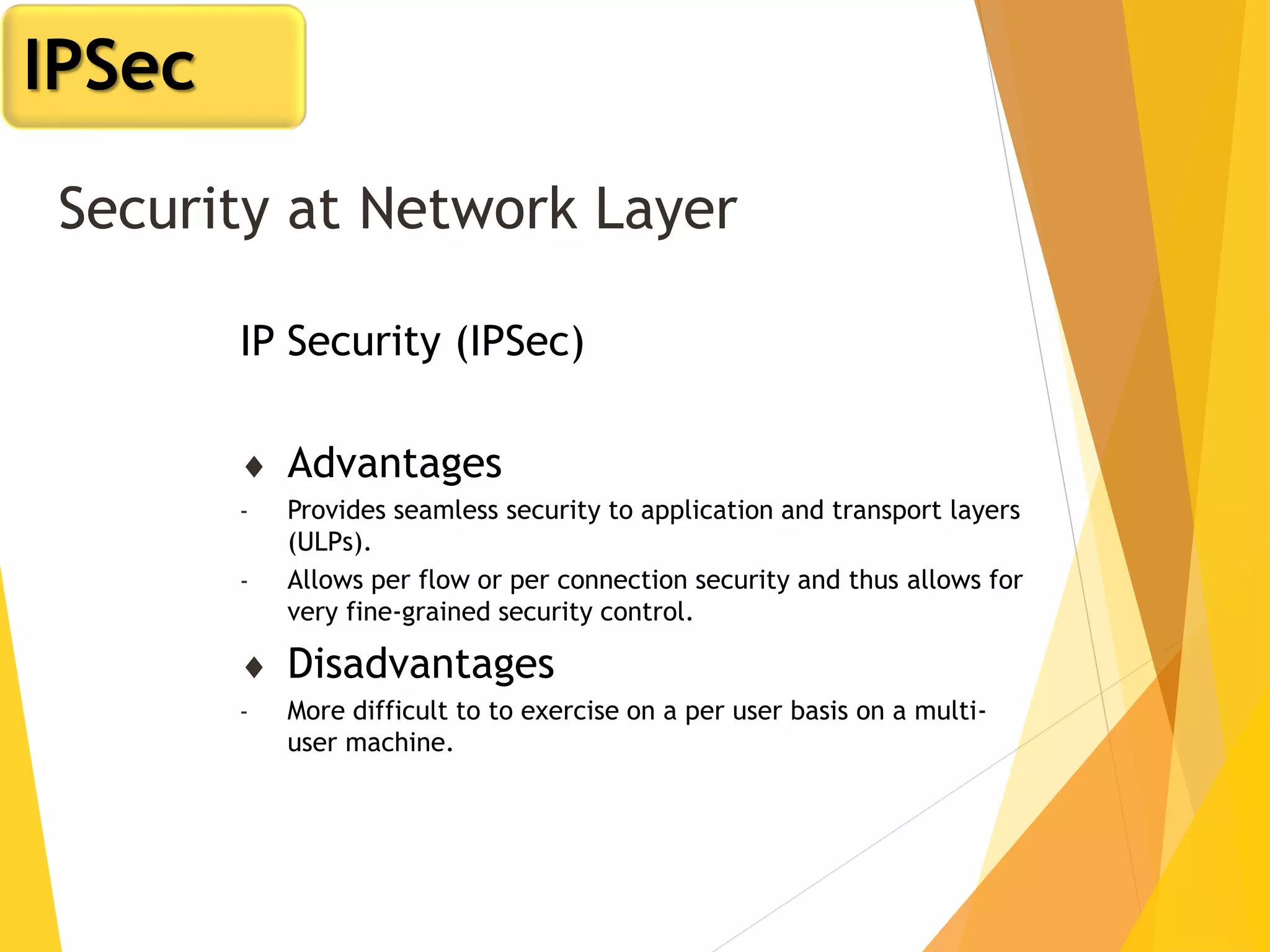
Security at Network Layer
IP Security (IPSec)
 Advantages
- Provides seamless security to application and transport layers
(ULPs).
- Allows per flow or per connection security and thus allows for
very fine-grained security control.
 Disadvantages
- More difficult to to exercise on a per user basis on a multi-
user machine.
IPSec
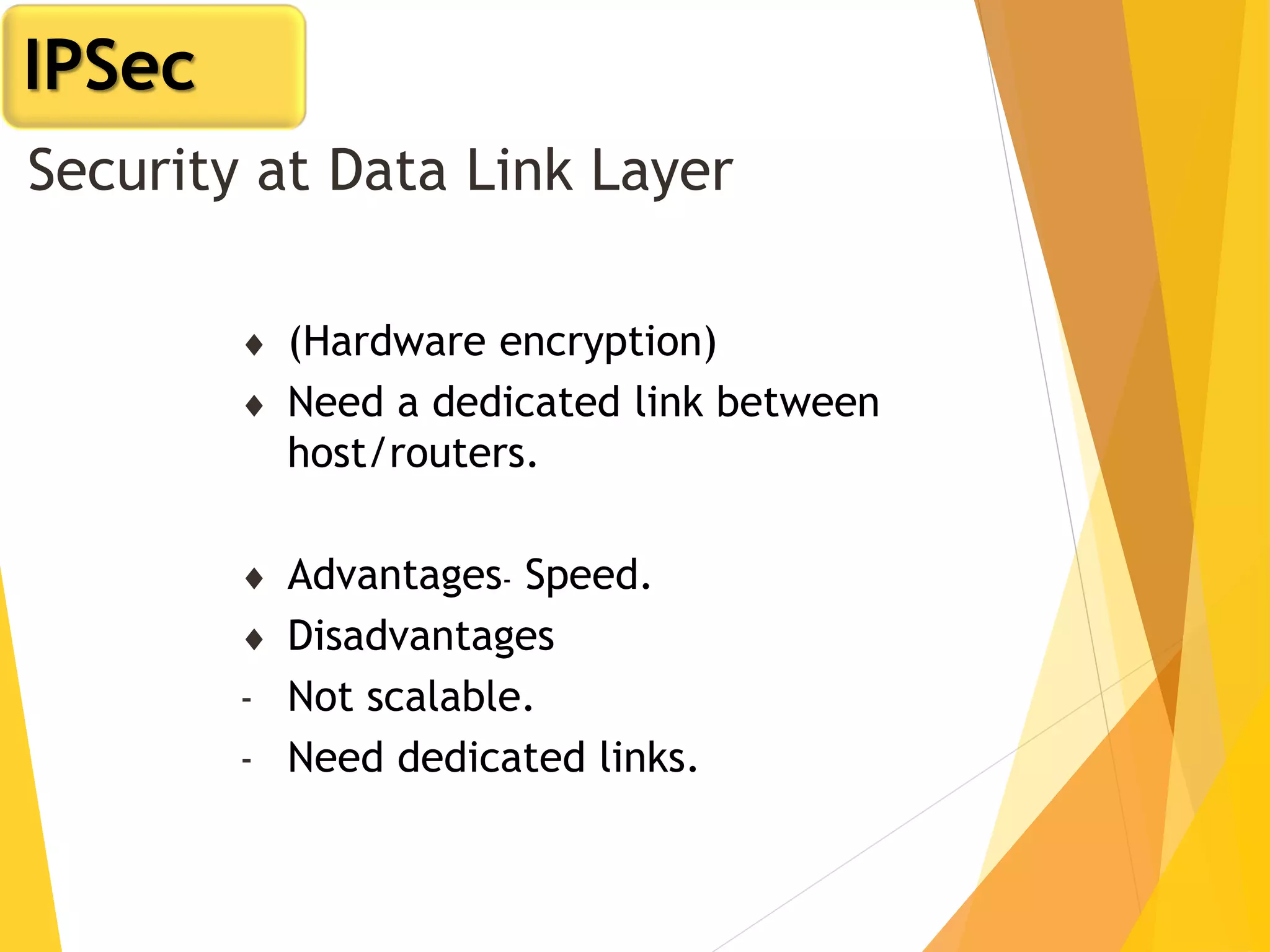
Security at Data Link Layer
 (Hardware encryption)
 Need a dedicated link between
host/routers.
 Advantages- Speed.
 Disadvantages
- Not scalable.
- Need dedicated links.
IPSec
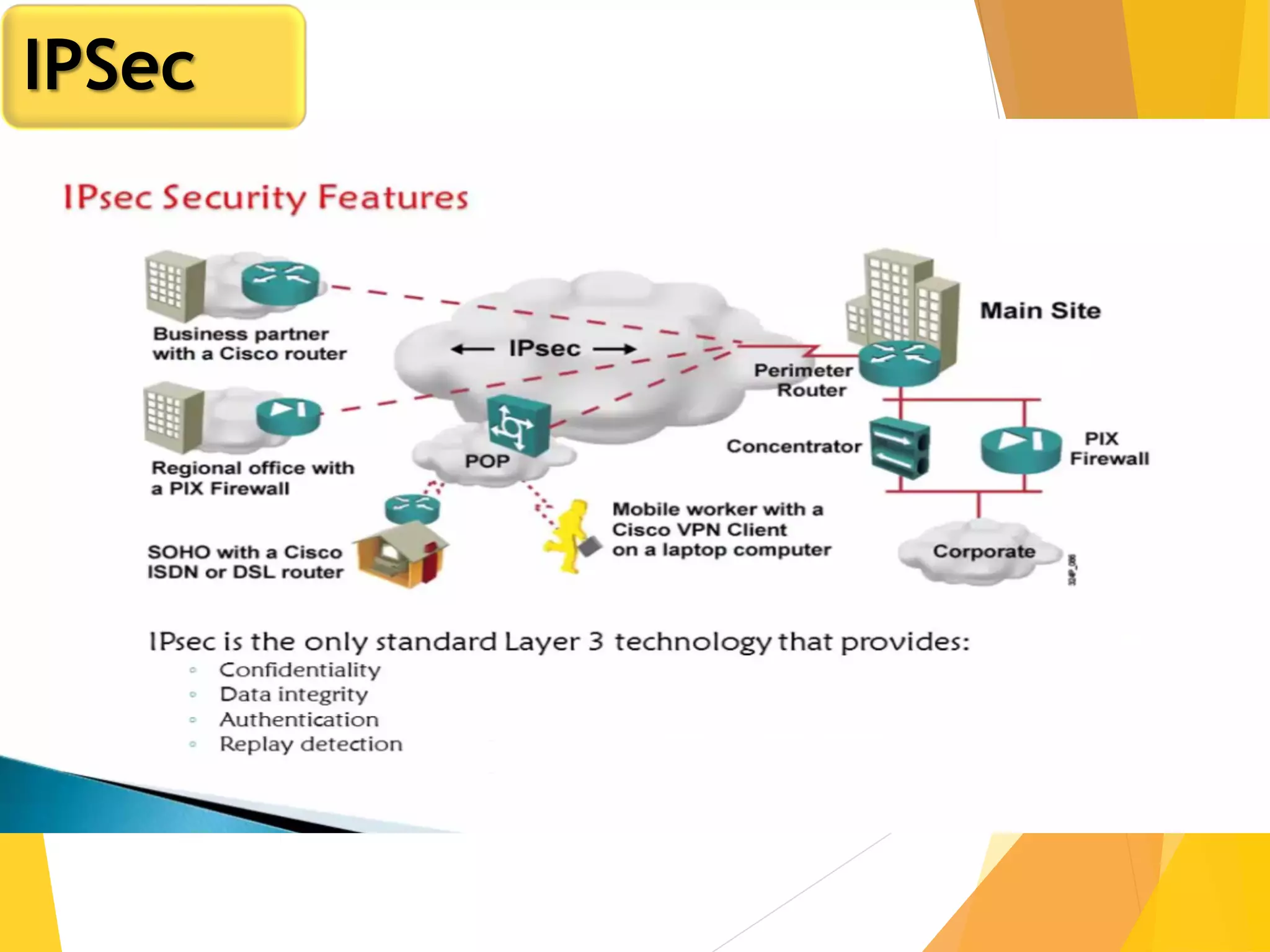
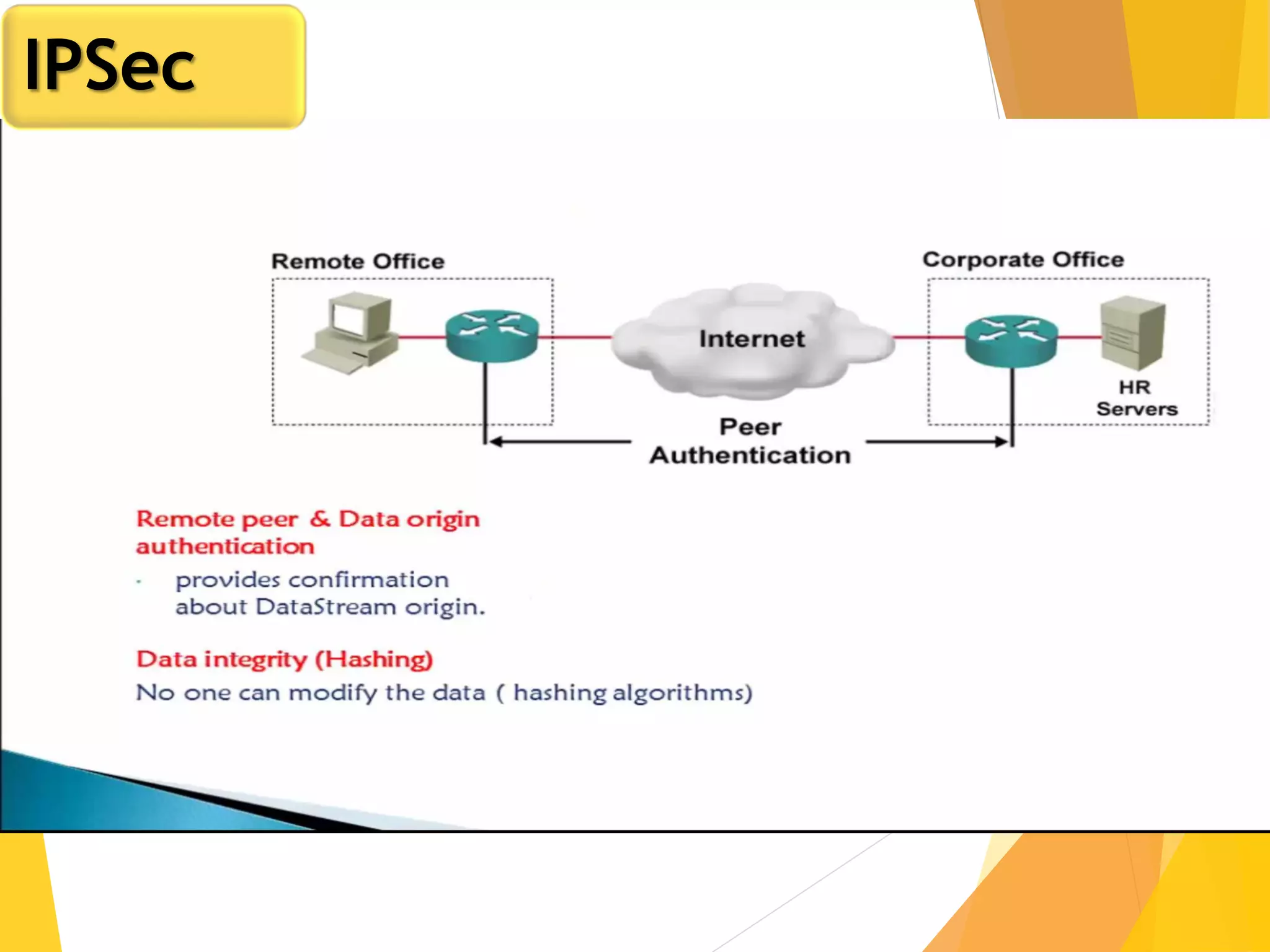
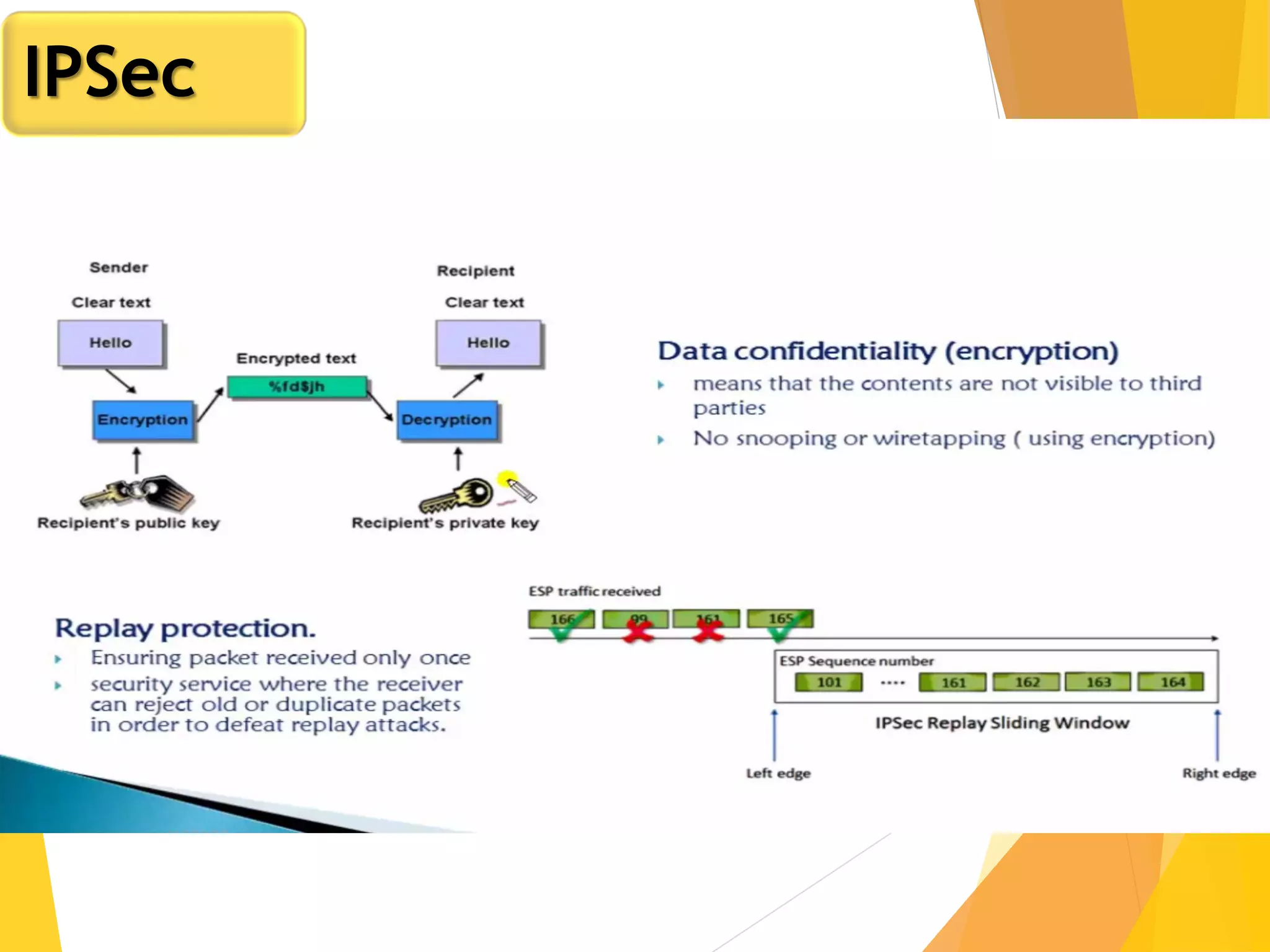
IP Security (IPSec)
 IPSec is a framework of open
standards developed by the Internet
Engineering Task Force (IETF).
Creates secure, authenticated,
reliable communications over IP
networks
IPSec
IPSec
IPSec
IPSec
IPSec
IPSec
IPSec
IPSec
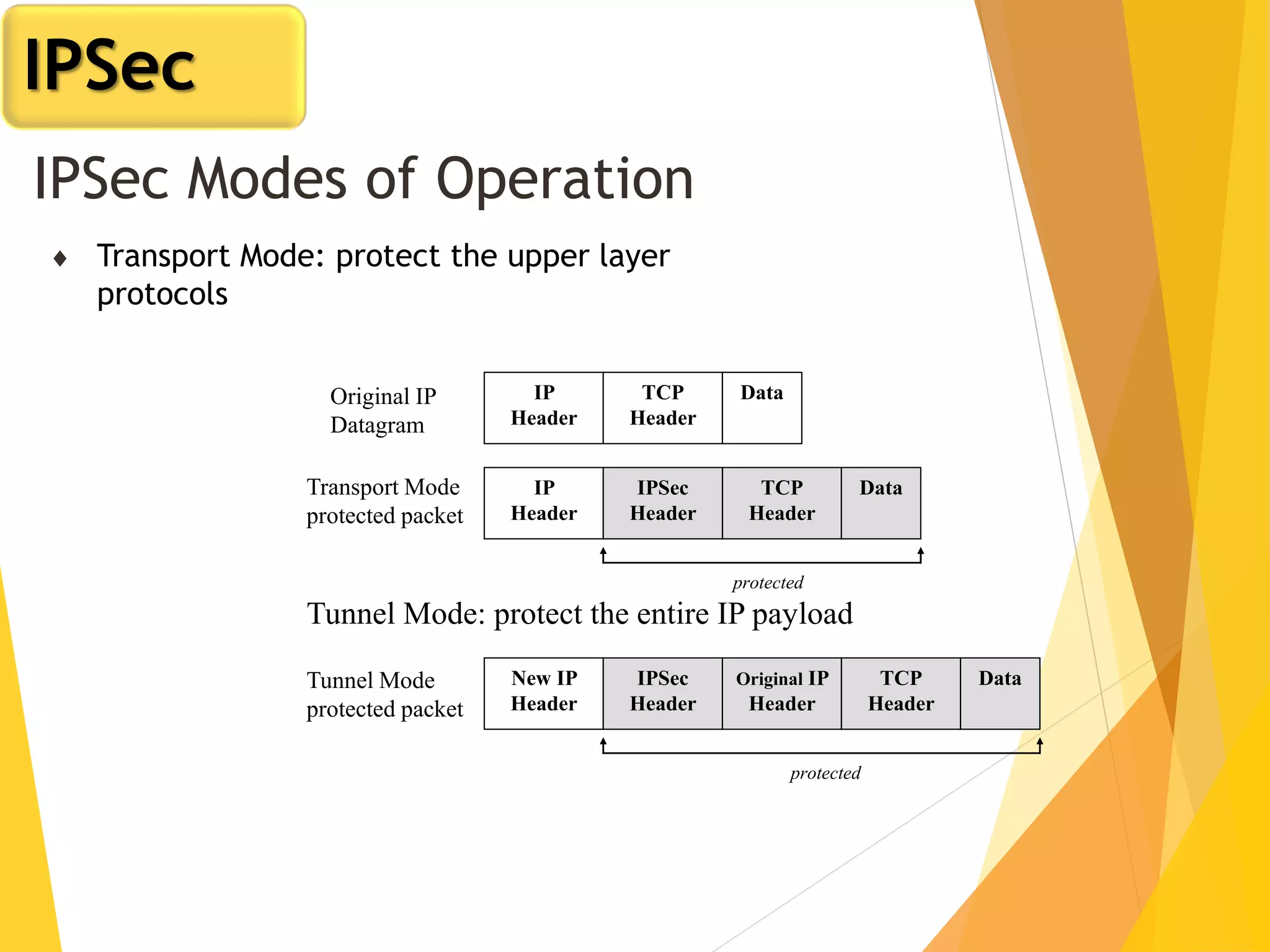
IPSec Modes of Operation
 Transport Mode: protect the upper layer
protocols
IP
Header
TCP
Header
DataOriginal IP
Datagram
IP
Header
TCP
Header
IPSec
Header
DataTransport Mode
protected packet
Tunnel Mode: protect the entire IP payload
Tunnel Mode
protected packet
New IP
Header
TCP
Header
IPSec
Header
DataOriginal IP
Header
protected
protected
IPSec
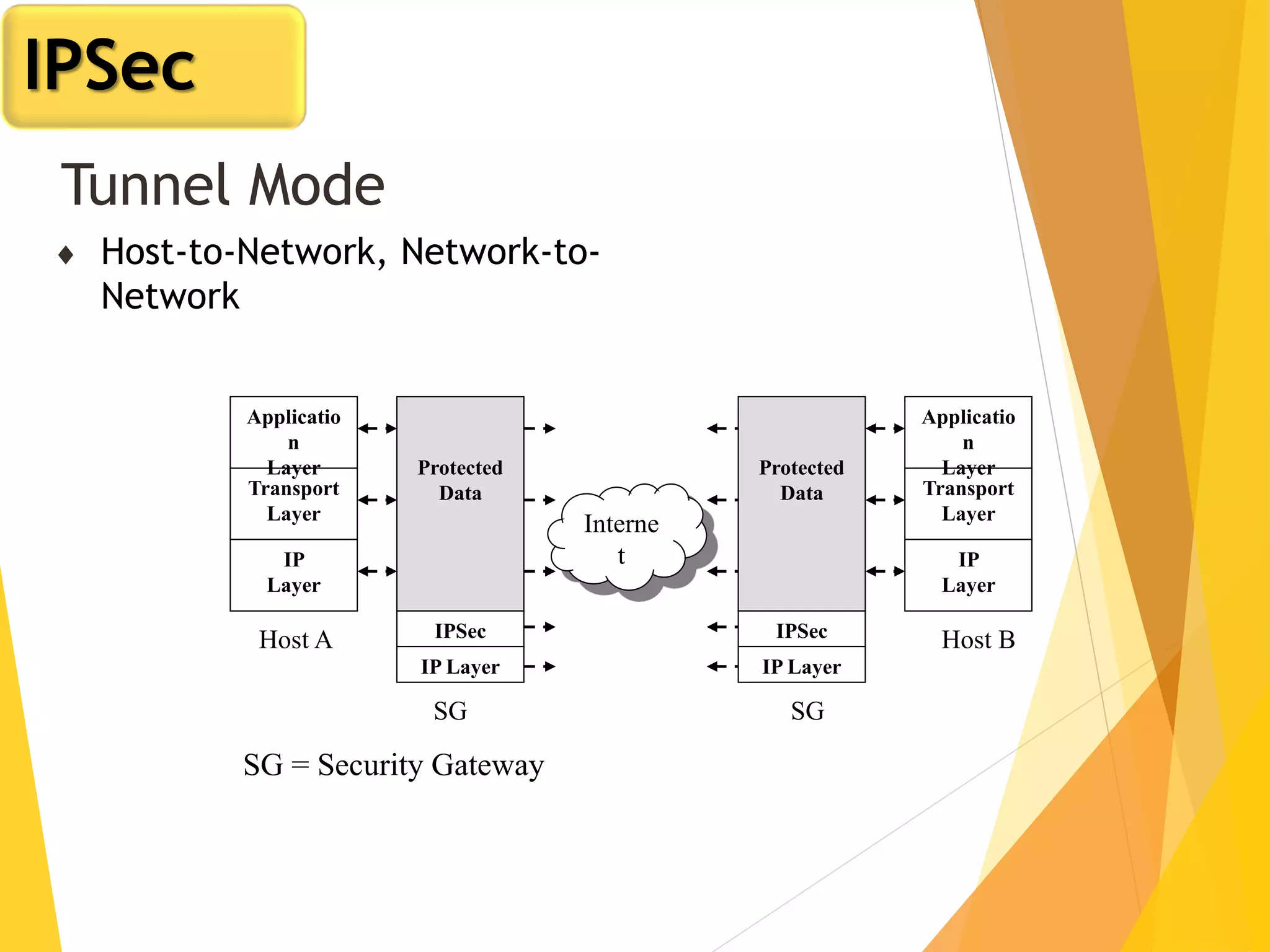
Tunnel Mode
 Host-to-Network, Network-to-
Network
Protected
Data
IPSec
IP Layer
SG
Interne
t
Transport
Layer
Applicatio
n
Layer
IP
Layer
Host B
Protected
Data
IPSec
IP Layer
SG
Transport
Layer
Applicatio
n
Layer
IP
Layer
Host A
SG = Security Gateway
IPSec
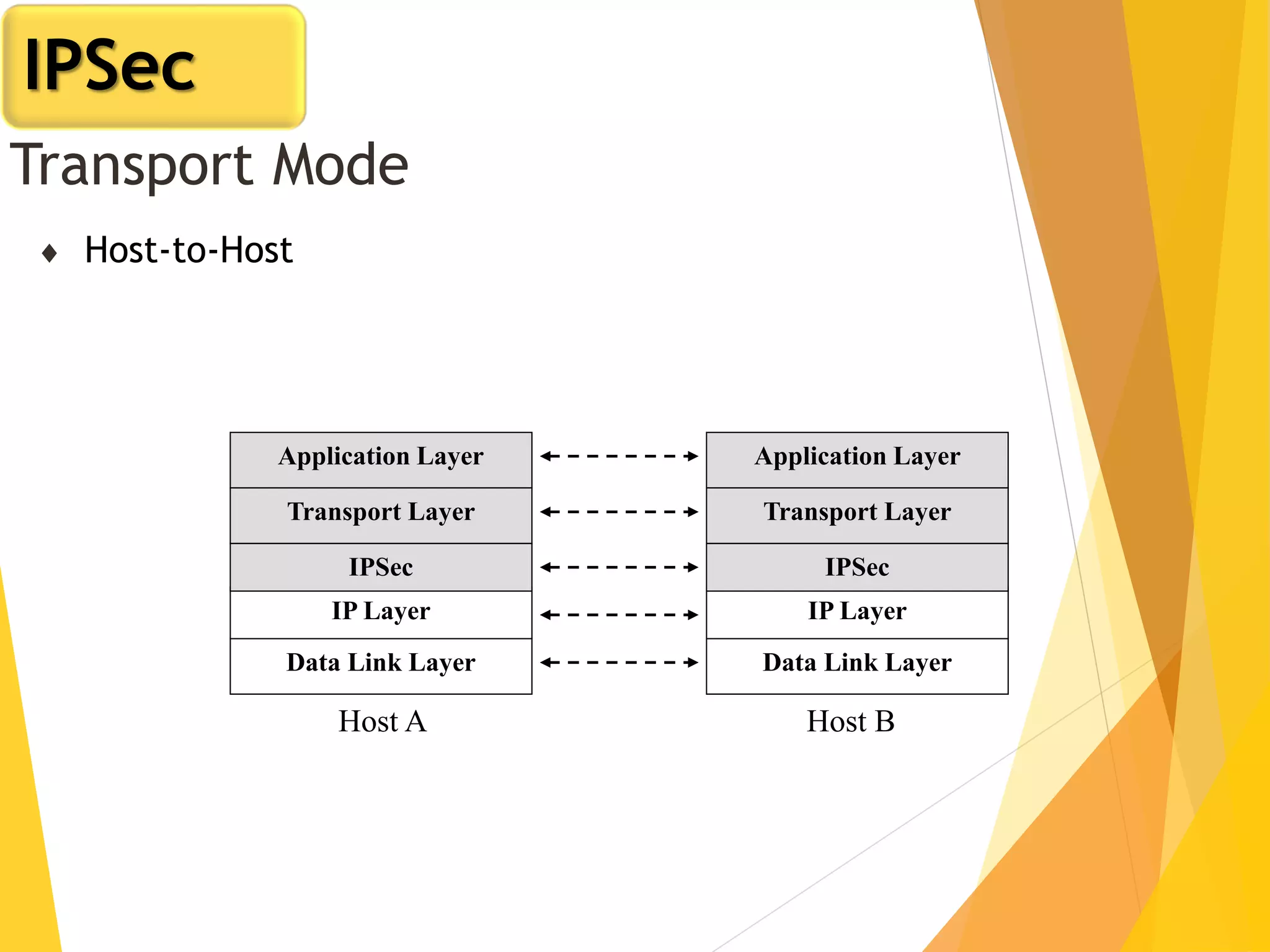
Transport Mode
Transport Layer
Application Layer
 Host-to-Host
Transport Layer
Application Layer
IP Layer
Data Link Layer
IPSec
Host B
IP Layer
Data Link Layer
IPSec
Host A
IPSec
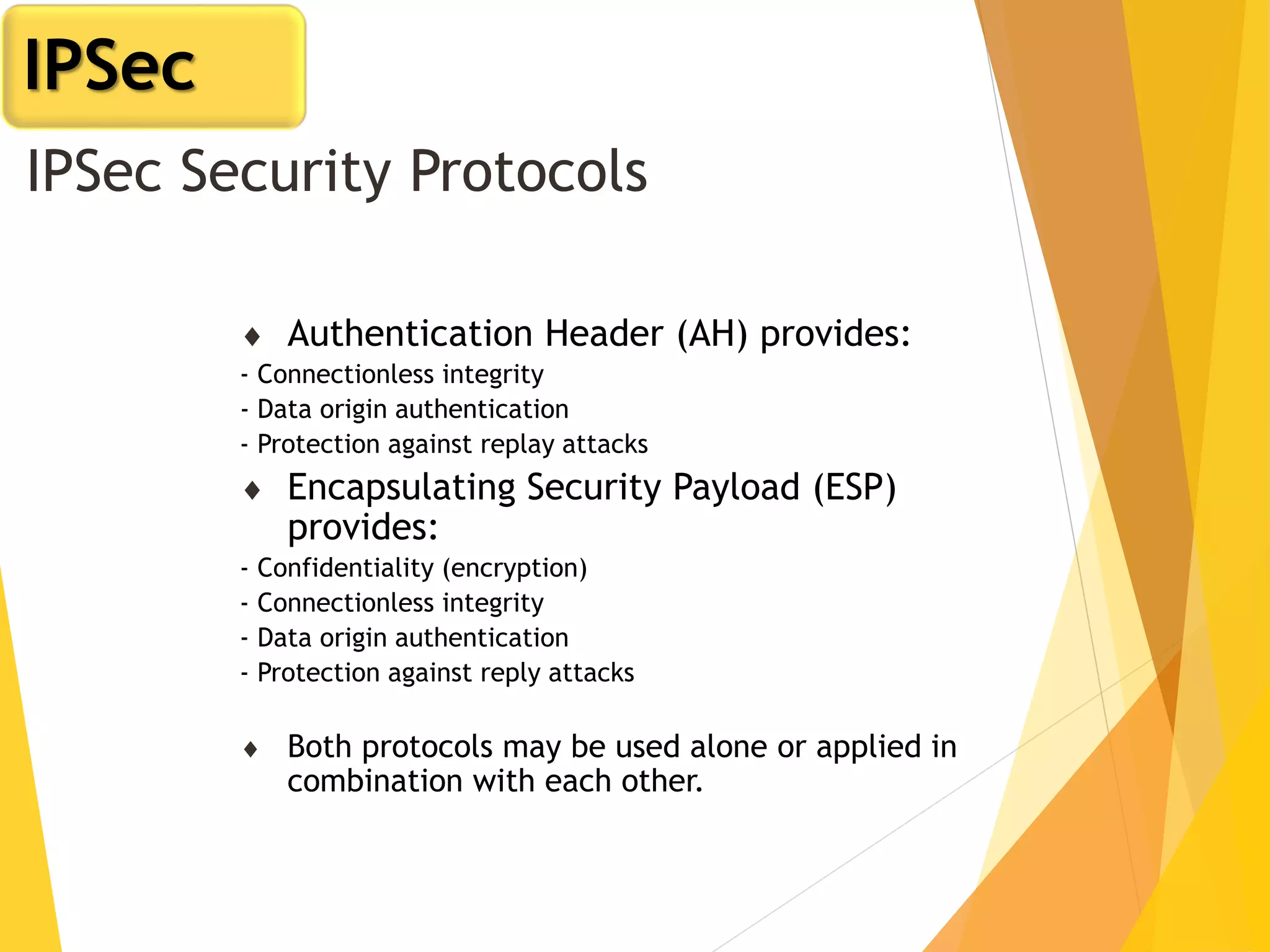
IPSec Security Protocols
 Authentication Header (AH) provides:
- Connectionless integrity
- Data origin authentication
- Protection against replay attacks
 Encapsulating Security Payload (ESP)
provides:
- Confidentiality (encryption)
- Connectionless integrity
- Data origin authentication
- Protection against reply attacks
 Both protocols may be used alone or applied in
combination with each other.
IPSec
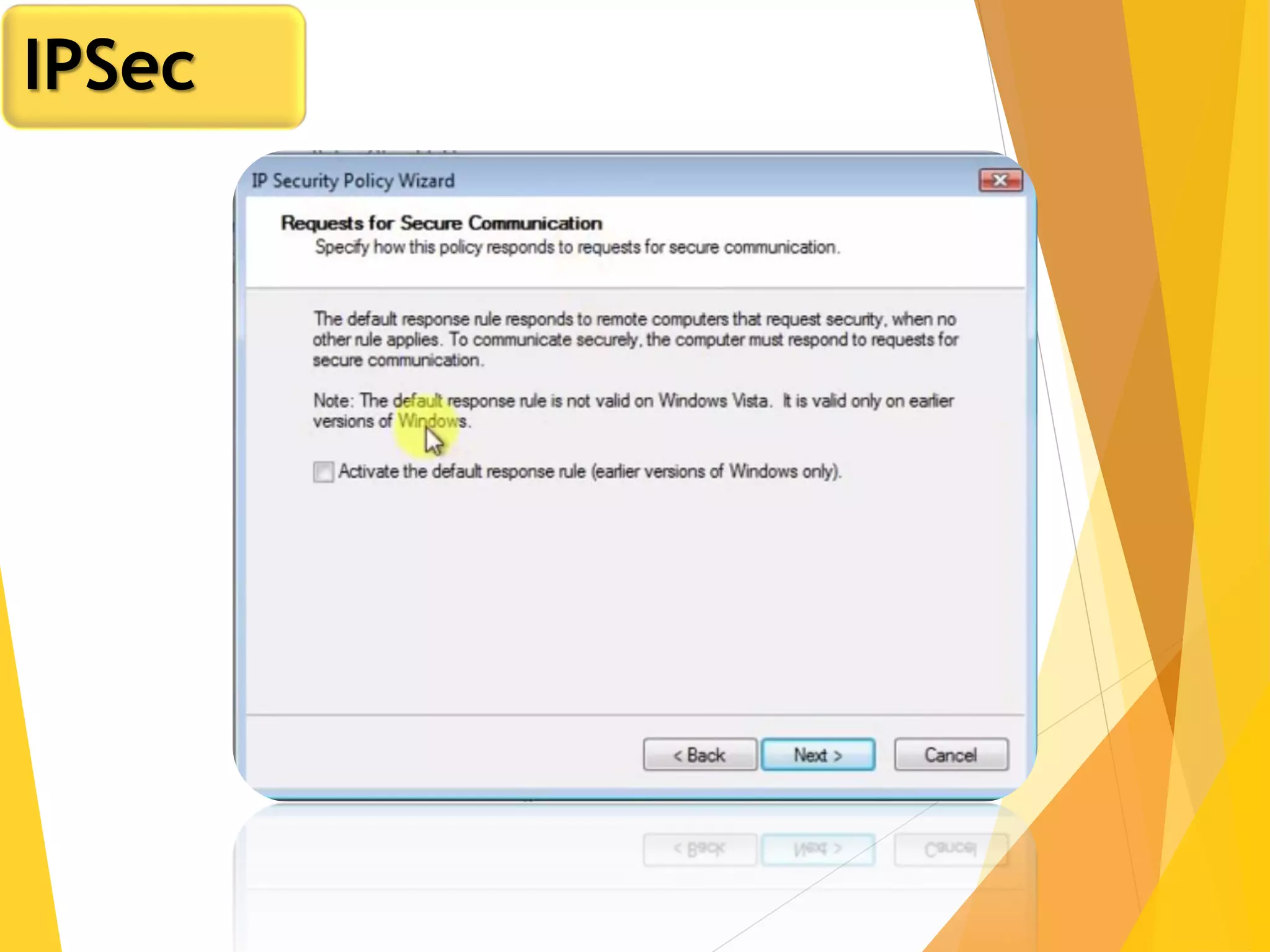
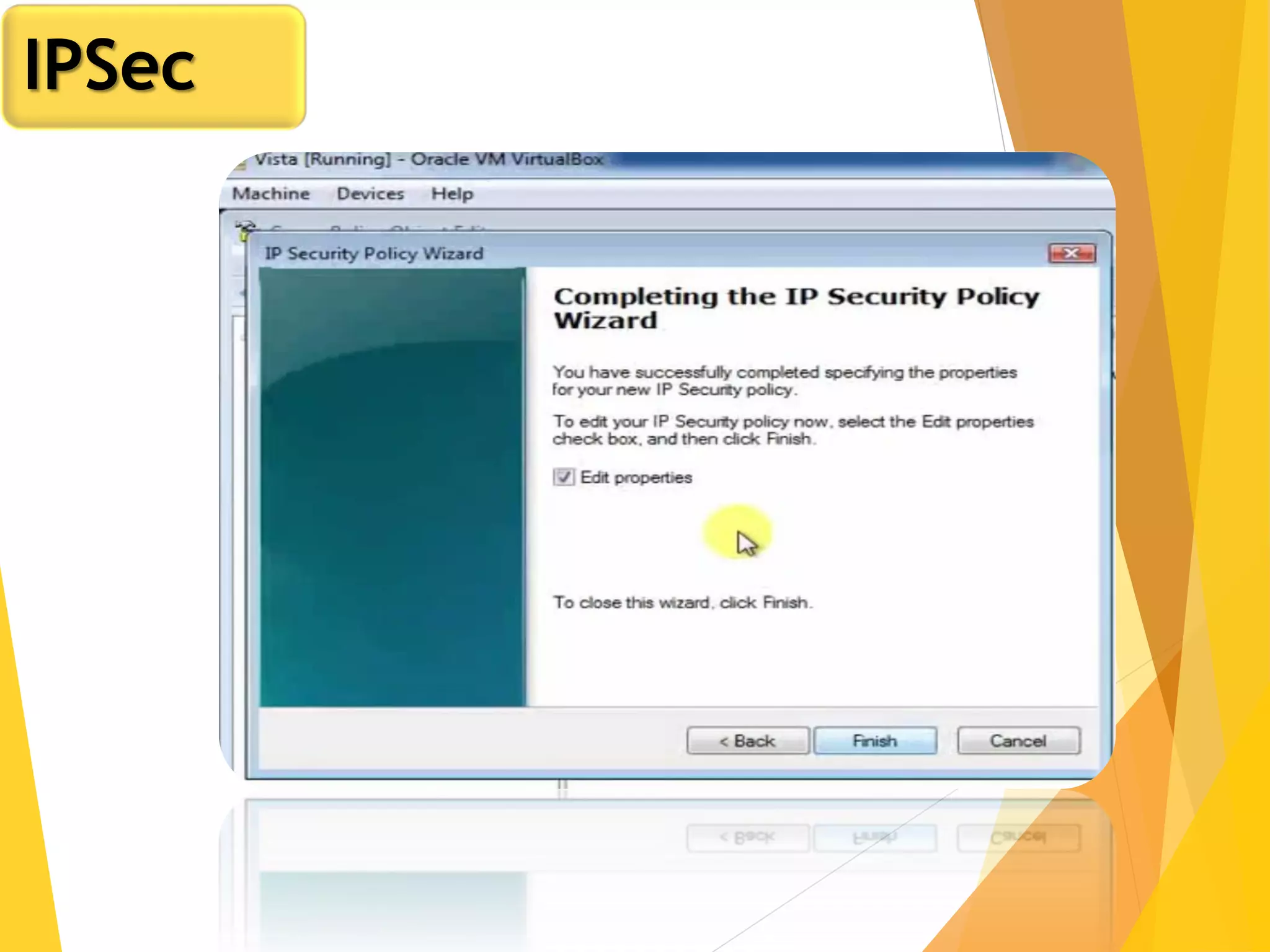
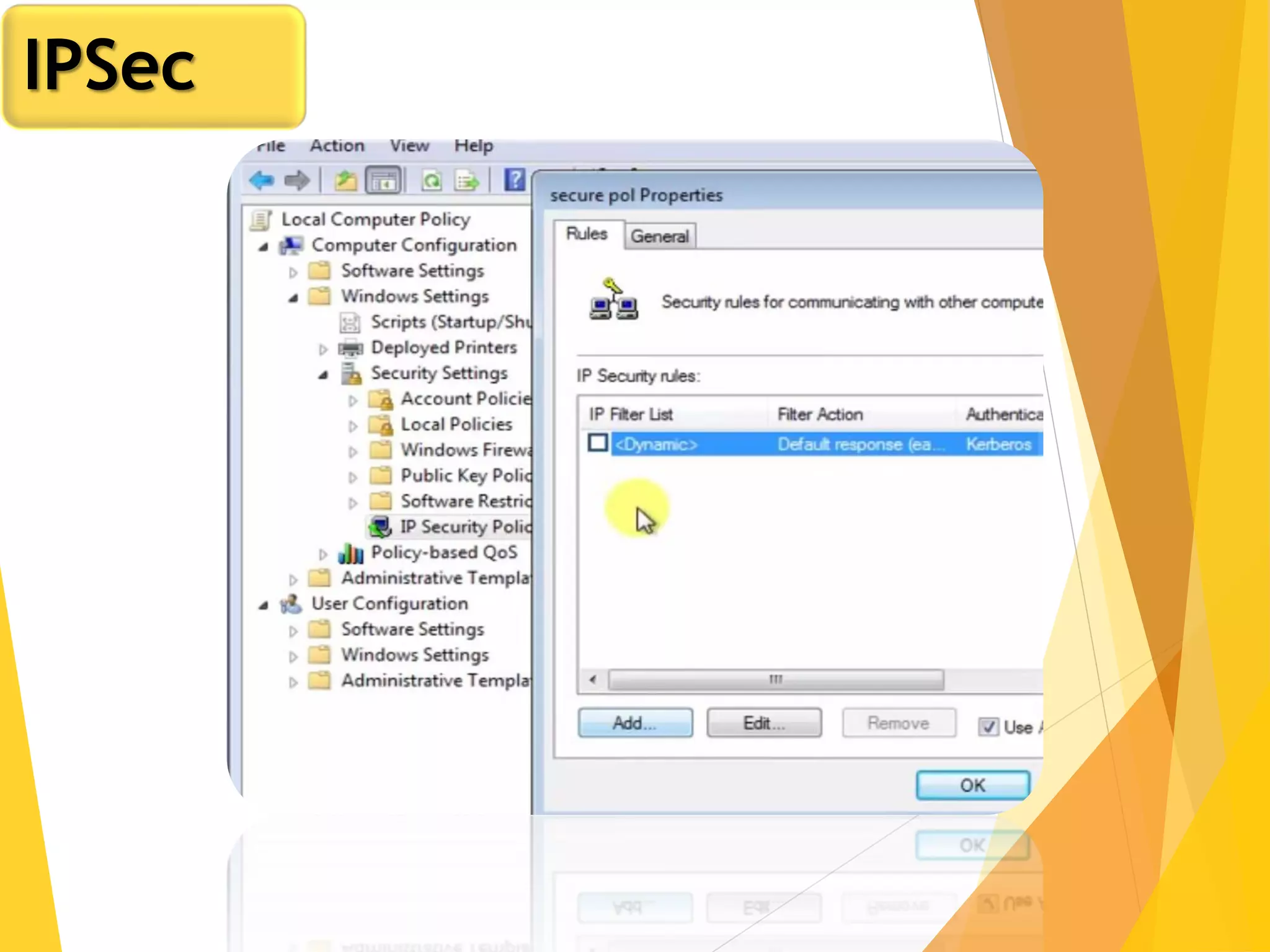
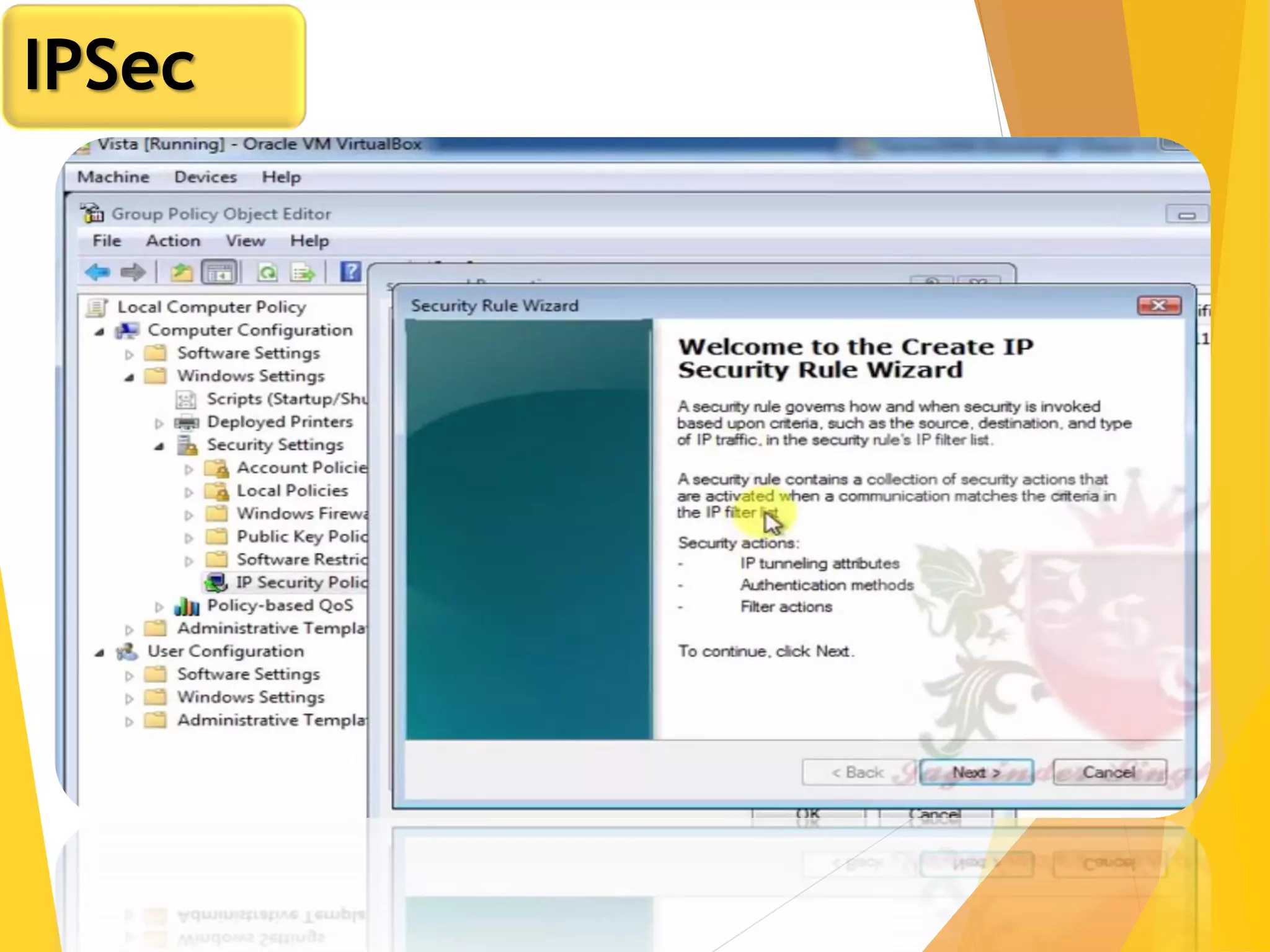
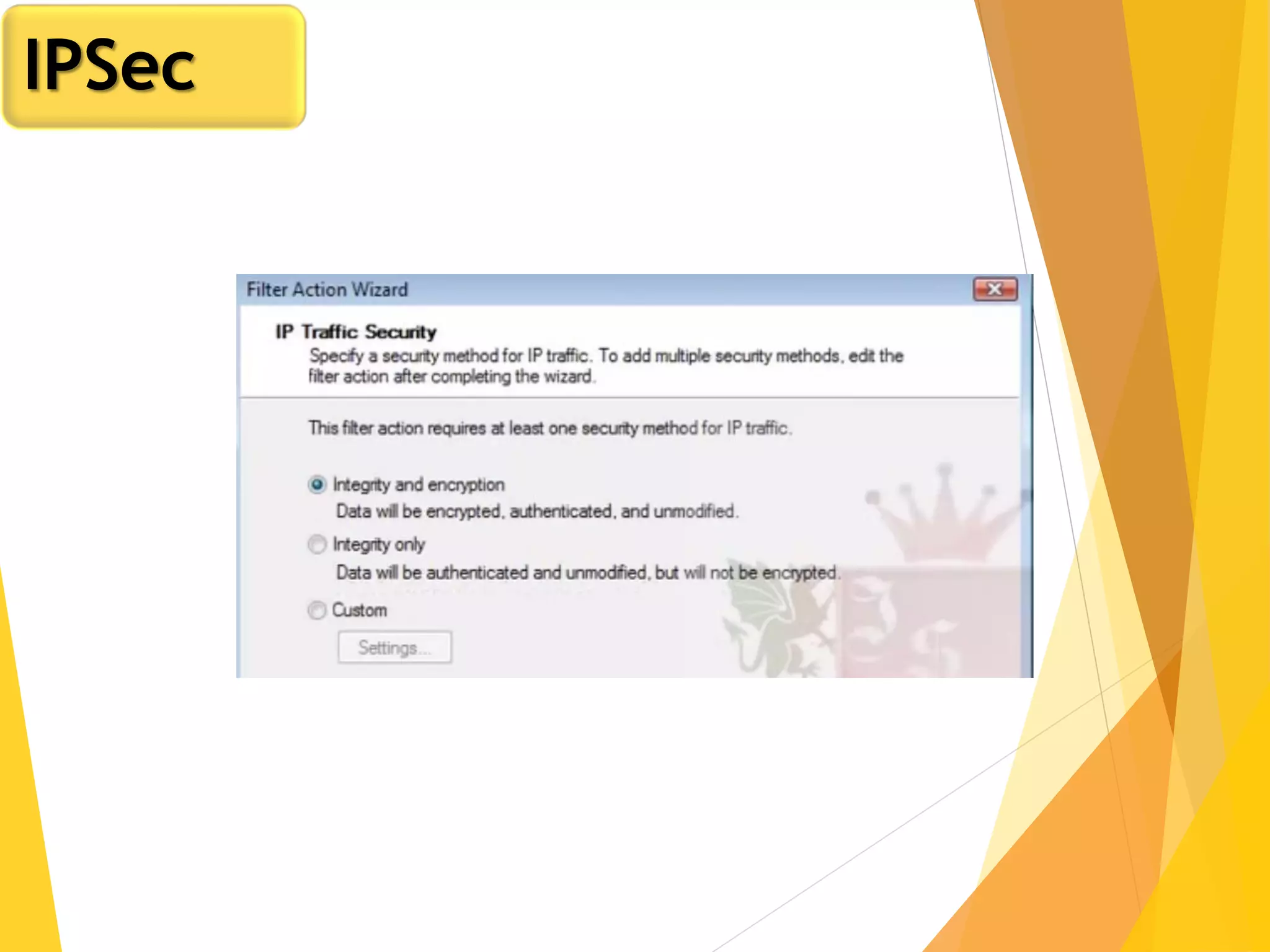
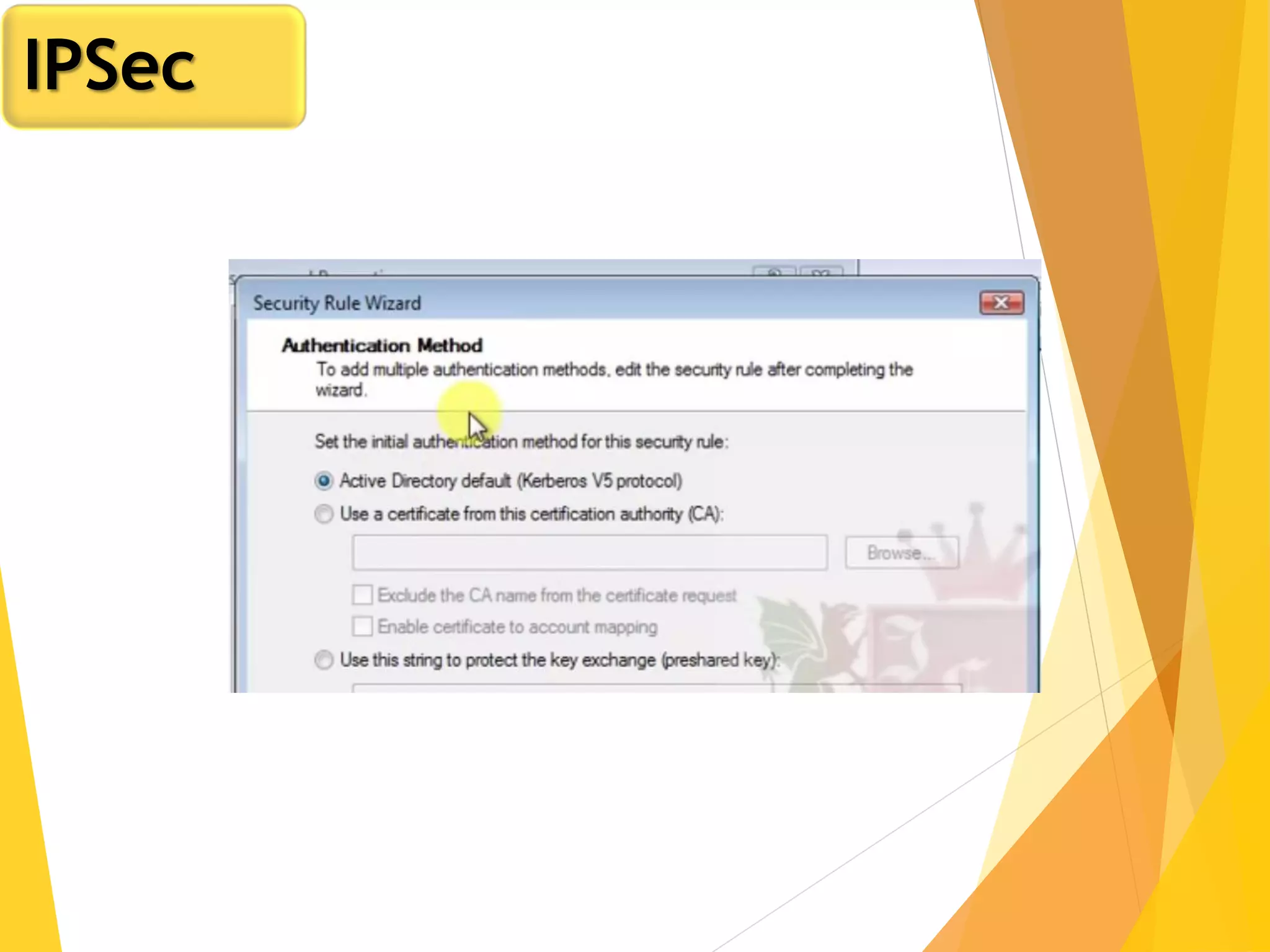
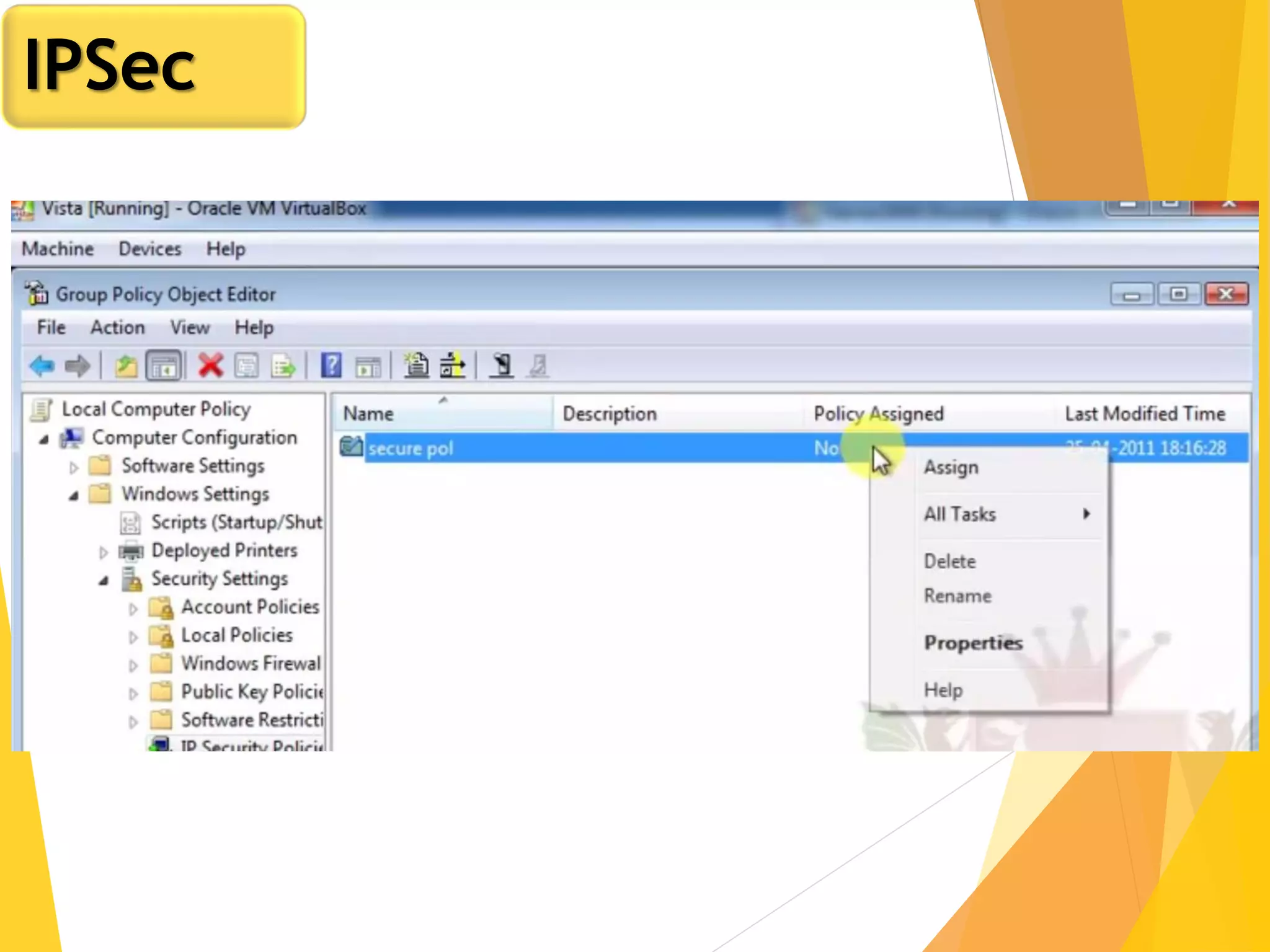
Implementation of IPSEC
IPSec
IPSec
IPSec
IPSec
IPSec
IPSec
IPSec
IPSec
IPSec
IPSec
IPSec
IPSec
IPSec
IPSec
IPSec
IPSec
IPSec
IPSec
IPSec
IPSec
IPSec
IPSec
IPSec
IPSec
IPSec
IPSec
IPSec
IPSec
Thank you
Image Source
searchenterpriseai.techtarget.com
wikipedia

Network security cs9 10

  • 1.
  • 2.
    Session 9-10 objective CS-9Revision Previous Session revision CS-9-10 – Review of SSL protocol CS – 9-10 Review of SSL protocol CS -9-10 Review of IPSec CS-9-10 PGP SUMMARY
  • 3.
    3 There are twomain schemes which are especially designed to provide confidentiality and authentication for electronic mail systems. These are: PGP (Pretty Good Privacy) S/MIME (Secure/Multipurpose Internet Mail Extension) PGP
  • 4.
    4 S/MIME S/MIME uses publickey certificates conforming to standard X.509 and signed by a certification agency. In other respects, S/MIME is quite similar to PGP. S/MIME is not studied in any detail on this course and is not examinable. PGP
  • 5.
    5  Developed byPhil Zimmerman in 1995.  Documentation and source code is freely available.  The package is independent of operating system and processor.  PGP does not rely on the “establishment” and it’s popularity and use have grown extensively since 1995. PGP
  • 6.
    6 What does PGPdo? PGP offers 5 services: 1. Authentication 2. Confidentiality 3. Compression 4. E-mail compatibility 5. Segmentation PGP
  • 7.
    7 PGP Authentication This isa digital signature scheme with hashing. 1. Alice has (private/public) key pair (Ad/Ae) and she wants to send a digitally signed message m to Bob. 2. Alice hashes the message using SHA-1 to obtain SHA(m). PGP
  • 8.
    8 PGP Authenticaton andConfidentiality (at the same time) The schemes for authentication and confidentiality can be combined so that Alice can sign a confidential message which is encrypted before transmission. The steps required are as follows: 1. Alice generates a signature c for her message m as in the Authentication scheme c=pk.encryptAd(SHA(m)) PGP
  • 9.
    9 2. Alice generatesa random session key k and encrypts the message m and the signature c using a symmetric cryptosystem to obtain ciphertext C C=sk.encryptk(m,c) 4. She encrypts the session key k using Bob’s public key k’ = pk.encryptBe(k) 5. Alice sends Bob the values (k’,C) PGP
  • 10.
    10 6. Bob receivesk’ and C and decrypts k’ using his private key Bd to obtain the session key k k=pk.decryptBd(k’) 7. Bob decrypts the ciphertext C using the session key k to obtain m and c (m,c) = sk.decryptk(C) PGP
  • 11.
    11 8. Bob nowhas the message m. In order to authenticate it he uses Alice’s public key Ae to decrypt the signature c and hashes the message m using SHA-1. If SHA(m) = pk.decryptAe(c) Then the message is authenticated. PGP
  • 12.
    12 PGP E-Mail Compatibility Manyelectronic mail systems can only transmit blocks of ASCII text. This can cause a problem when sending encrypted data since ciphertext blocks might not correspond to ASCII characters which can be transmitted. PGP overcomes this problem by using radix-64 conversion. PGP
  • 13.
    13 Radix-64 conversion Suppose thetext to be encrypted has been converted into binary using ASCII coding and encrypted to give a ciphertext stream of binary. Radix-64 conversion maps arbitrary binary into printable characters as follows: PGP
  • 14.
    14 Radix-64 conversion 1. Thebinary input is split into blocks of 24 bits (3 bytes). 2. Each 24 block is then split into four sets each of 6-bits. 3. Each 6-bit set will then have a value between 0 and 26-1 (=63). 4. This value is encoded into a printable character. PGP
  • 15.
    15 6 bit value Character encoding 6 bit value Character encoding 6bit value Character encoding 6 bit value Character encoding 0 1 2 3 4 5 6 7 8 9 10 11 12 13 14 15 A B C D E F G H I J K L M N O P 16 17 18 19 20 21 22 23 24 25 26 27 28 29 30 31 Q R S T U V W X Y Z a b c d e f 32 33 34 35 36 37 38 39 40 41 42 43 44 45 46 47 g h i j k l m n o p q r s t u v 48 49 50 51 52 53 54 55 56 57 58 59 60 61 62 63 (pad) w x y z 0 1 2 3 4 5 6 7 8 9 + / =
  • 16.
    16 PGP Segmentation Another constraintof e-mail is that there is usually a maximum message length. PGP automatically blocks an encrypted message into segments of an appropriate length. On receipt, the segments must be re-assembled before the decryption process. PGP
  • 17.
    17 Key Issues 1. KeyGeneration Recall that a new session key is required each time a message is encrypted. How are these keys generated? PGP uses the timing of key strokes and key patterns to generate random numbers. PGP
  • 18.
    18 2. Key Identifiers PGPallows users to have more than one public/private key pair  To increase security  To ease the key changeover period So how does Bob know which set of keys he should be using? PGP
  • 19.
    19  In thecase of encryption, (Alice uses Bob’s public key) Alice can send Bob the public key with the message since this is not secret (in fact Alice only sends the 64 least significant bits so that Bob can identify the key).  In the case of digital signatures Alice uses her private key and Bob uses Alice’s corresponding public key. Alice cannot send Bob her private key, but she can look up the corresponding public key and send the 64 least significant bits of that. PGP
  • 20.
    20 So a PGPmessage might consist of:  Message component – the actual data to be transmitted + a filename + a timestamp;  Signature component – timestamp + hash of message and timestamp + first part of message (so user can check that they are decrypting correctly) + Key ID of sender’s public key  Session Key component – session key + key ID of recipient’s public key PGP
  • 21.
    21 • SSL wasfirst developed by Netscape in 1994 and became an internet standard in 1996 ( RFC 2246 – TLS V1.0) • SSL is a cryptographic protocol to secure network across a connection-oriented layer • Any program using TCP can be modified to use SSL connection Encryption and its types SSL Facts
  • 22.
    22 • SSL connectionuses a dedicated TCP/IP socket(e.g. port 443 for https) • SSL is flexible in choice of which symmetric encryption, message digest, and authentication can be used • SSL provides built in data compression SSL Facts
  • 23.
    23 • Authenticate theserver to the client • Allow the client and server to select cryptographic algorithms, or ciphers, that they both support • Optionally authenticate the client to the server • Use public key encryption techniques to generate shared secret • Establish an encrypted SSL connection SSL Usage
  • 24.
    24 SSL is asecure protocol which runs above TCP/IP and allows users to encrypt data and authenticate servers/vendors identity securely Application layer Transport layerTCP/IP layer SMTPSFTPSHTTPS SECURE SOCKET LAYER SSL
  • 25.
  • 26.
  • 27.
  • 28.
    28 SSL Handshake SSL handshakeverifies the server and allows client and server to agree on an encryption set before any data is sent out SSL
  • 29.
  • 30.
  • 31.
    31 SSL Session Key Server Client Public key Private key Publickey Pre-Master Pre- Master Pre- Master Session key Session key SSL
  • 32.
  • 33.
  • 34.
    34 SSL Handshake Client hello Serverhello Present Server Certificate *Request Client Certificate Server Key Exchange Client Finish *Present Client Certificate Client Key Exchange *Certificate Verify Change Cipher Spec Server Finish Change Cipher Spec Client Server Application Data SSL
  • 35.
    35 Comparison of SSLV2.0 and V3.0 • SSL 2.0 is vulnerable to “man-in-the-middle” attack. The hello message can be modified to use 40 bits encryption. SSL 3.0 defends against this attack by having the last handshake message include a hash of all the previous handshake message SSL
  • 36.
    36 Comparison of SSLV2.0 and V3.0 • SSL 2.0 uses a weak MAC construction • In SSL 3.0, the Message Authentication Hash uses a full 128 bits of key material for Export cipher, while SSL 2.0 uses only 40 bits SSL
  • 37.
    37 Comparison of SSLV2.0 and V3.0 • SSL 2.0 only allows a handshake at the beginning of the connection. In 3.0, the client can initiate a handshake routine any time • SSL 3.0 allows server and client to send chains of certificate • SSL 3.0 has a generalized key exchange protocol. It allows Diffie-Hellman and Fortezza key exchange • SSL 3.0 allows for record compression and decompression SSL
  • 38.
     One ofthe primary goals of the ARPANET was remote access  Several different connections allowed rlogin rcp rsh  All data was unencrypted This was a different world than exists today. SSH
  • 39.
    GBI 39  SSHis a UNIX-based command interface and protocol for securely accessing a remote computer  Suite of four utilities—slogin, ssh, sftp, and scp  Can protect against:  IP spoofing  DNS spoofing  Intercepting information SSH
  • 40.
     Protect datasent over the network  Negotiate an encryption algorithm between sender and receiver  Use that algorithm and a session key to encrypt / decrypt data sent  Provide site authentication  Use public key / fingerprint to ensure identity of remote host.  Relies on locally generated keys, so no certifying authority is generally available. SSH
  • 41.
  • 42.
  • 43.
    GBI 43 SSH WireShark Trace SSH
  • 44.
    GBI 44 sFTP inLinux SSH
  • 45.
  • 46.
    GBI 46 SSH Tunneling Use SSH to create an encrypted channel between remote host and server  Use that encrypted channel to carry other traffic. SSH Tunn www acce ss Web Server 192.168.1.10 Local port 12345 Internet LAN SSH
  • 47.
    Security at ApplicationLayer (PGP, Kerberos, SSH, etc.)  Implemented in end-hosts  Advantages - Extend application without involving operating system. - Application can understand the data and can provide the appropriate security.  Disadvantages - Security mechanisms have to be designed independently of each application. IPSec
  • 48.
    Security at TransportLayer Transport Layer Security (TLS)  Implemented in end-hosts  Advantages - Existing applications get security seamlessly  Disadvantages - Protocol specific IPSec
  • 49.
    Security at NetworkLayer IP Security (IPSec)  Advantages - Provides seamless security to application and transport layers (ULPs). - Allows per flow or per connection security and thus allows for very fine-grained security control.  Disadvantages - More difficult to to exercise on a per user basis on a multi- user machine. IPSec
  • 50.
    Security at DataLink Layer  (Hardware encryption)  Need a dedicated link between host/routers.  Advantages- Speed.  Disadvantages - Not scalable. - Need dedicated links. IPSec
  • 51.
    IP Security (IPSec) IPSec is a framework of open standards developed by the Internet Engineering Task Force (IETF). Creates secure, authenticated, reliable communications over IP networks IPSec
  • 52.
  • 53.
  • 54.
  • 55.
  • 56.
  • 57.
  • 58.
  • 59.
    IPSec Modes ofOperation  Transport Mode: protect the upper layer protocols IP Header TCP Header DataOriginal IP Datagram IP Header TCP Header IPSec Header DataTransport Mode protected packet Tunnel Mode: protect the entire IP payload Tunnel Mode protected packet New IP Header TCP Header IPSec Header DataOriginal IP Header protected protected IPSec
  • 60.
    Tunnel Mode  Host-to-Network,Network-to- Network Protected Data IPSec IP Layer SG Interne t Transport Layer Applicatio n Layer IP Layer Host B Protected Data IPSec IP Layer SG Transport Layer Applicatio n Layer IP Layer Host A SG = Security Gateway IPSec
  • 61.
    Transport Mode Transport Layer ApplicationLayer  Host-to-Host Transport Layer Application Layer IP Layer Data Link Layer IPSec Host B IP Layer Data Link Layer IPSec Host A IPSec
  • 62.
    IPSec Security Protocols Authentication Header (AH) provides: - Connectionless integrity - Data origin authentication - Protection against replay attacks  Encapsulating Security Payload (ESP) provides: - Confidentiality (encryption) - Connectionless integrity - Data origin authentication - Protection against reply attacks  Both protocols may be used alone or applied in combination with each other. IPSec
  • 63.
  • 64.
  • 65.
  • 66.
  • 67.
  • 68.
  • 69.
  • 70.
  • 71.
  • 72.
  • 73.
  • 74.
  • 75.
  • 76.
  • 77.
  • 78.
  • 79.
  • 80.
  • 81.
  • 82.
  • 83.
  • 84.
  • 85.
  • 86.
  • 87.
  • 88.
  • 89.
  • 90.
  • 91.
  • 92.