Pg.no.1
Module 2 – E-Mail Security
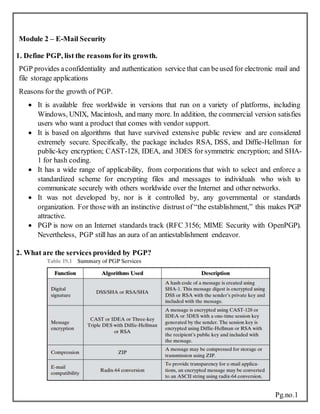
1. Define PGP, list the reasons for its growth.
PGP provides aconfidentiality and authentication service that can beused for electronic mail and
file storage applications
Reasons for the growth of PGP.
 It is available free worldwide in versions that run on a variety of platforms, including
Windows, UNIX, Macintosh, and many more. In addition, the commercial version satisfies
users who want a product that comes with vendor support.
 It is based on algorithms that have survived extensive public review and are considered
extremely secure. Specifically, the package includes RSA, DSS, and Diffie-Hellman for
public-key encryption; CAST-128, IDEA, and 3DES for symmetric encryption; and SHA-
1 for hash coding.
 It has a wide range of applicability, from corporations that wish to select and enforce a
standardized scheme for encrypting files and messages to individuals who wish to
communicate securely with others worldwide over the Internet and other networks.
 It was not developed by, nor is it controlled by, any governmental or standards
organization. For those with an instinctive distrust of “the establishment,” this makes PGP
attractive.
 PGP is now on an Internet standards track (RFC 3156; MIME Security with OpenPGP).
Nevertheless, PGP still has an aura of an antiestablishment endeavor.
2. What are the services provided by PGP?
Pg.no.2
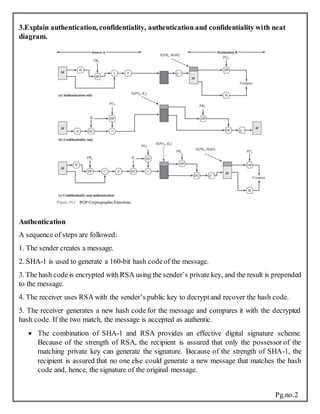
3.Explain authentication, confidentiality, authentication and confidentiality with neat
diagram.
Authentication
A sequence of steps are followed:
1. The sender creates a message.
2. SHA-1 is used to generate a 160-bit hash codeof the message.
3. The hash codeis encrypted with RSA using the sender’s private key, and the result is prepended
to the message.
4. The receiver uses RSA with the sender’s public key to decryptand recover the hash code.
5. The receiver generates a new hash code for the message and compares it with the decrypted
hash code. If the two match, the message is accepted as authentic.
 The combination of SHA-1 and RSA provides an effective digital signature scheme.
Because of the strength of RSA, the recipient is assured that only the possessor of the
matching private key can generate the signature. Because of the strength of SHA-1, the
recipient is assured that no one else could generate a new message that matches the hash
code and, hence, the signature of the original message.
Pg.no.3
 As an alternative, signatures can be generated using DSS/SHA-1. Although signatures
normally are found attached to the message or file that they sign, this is not always the
case: Detached signatures are supported. A detached signature may be stored and
transmitted separately from the message it signs.
 This is useful in several contexts. A user may wish to maintain a separate signature log of
all messages sent or received. A detached signature of an executable program can detect
subsequent virus infection. Finally, detached signatures can be used when more than one
party must sign a document, such as a legal contract.
 Each person’s signature is independent and therefore is applied only to the document.
Otherwise, signatures would have to be nested, with the second signer signing both the
document and the first signature, and so on.
Confidentiality
Another basic service provided by PGP is confidentiality, which is provided by encrypting
messages to be transmitted or to be stored locally as files. In both cases, the symmetric
encryption algorithm CAST-128 may be used. The 64-bit cipher feedback (CFB) mode is
used. As always, one must address the problem of key distribution. In PGP, each symmetric
key is used only once. That is, a new key is generated as a random 128-bit number for each
message. Thus, although this is referred to in the documentation as a sessionkey, it is in reality
a one-time key. Because it is to be used only once, the session key is bound to the message
and transmitted with it. To protect the key, it is encrypted with the receiver’s public key.
The following is the sequence of steps
1. The sender generates a message and a random 128-bit number to be used as a session key
for this message only.
2. The message is encrypted using CAST-128 (or IDEA or 3DES) with the session key.
3. The sessionkey is encrypted with RSAusing the recipient’s public key and is prepended to
the message.
4. The receiver uses RSA with its private key to decrypt and recover the session key.
5. The sessionkey is used to decrypt the message.
Confidentiality and Authentication
Both services may be used for the same message.
• First, a signature is generated for the plaintext message and prepended to the message.
• Then the plaintext message plus signature is encrypted using CAST-128 (orIDEA or3DES),
and the session key is encrypted using RSA (or ElGamal).
Pg.no.4
• This sequence is preferable to the opposite: encrypting the message and then generating a
signature for the encrypted message. It is generally more convenient to store a signature with
a plaintext version of a message.
• Furthermore, for purposes of third-party verification, if the signature is performed first, a
third party need not be concerned with the symmetric key when verifying the signature.
4. Explain Compression and Email compatibility in PGP
Compression
PGP compresses the message after applying the signature but before encryption.
• This has the benefit of saving space both for email transmission and for file storage.
• The placement of the compression algorithm, indicated by Z for compression and Z-1 for
decompression .
1. The signature is generated before compression for two reasons:
• a) It is preferable to sign an uncompressed messageso that one can store only the uncompressed
message together with the signature for future verification.
• If one signed a compressed document, then it would be necessary either to store a compressed
version of the message for later verification or to recompress the message when verification is
required
b). Even if one were willing to generate dynamically a recompressed message for verification,
PGP’s compression algorithm presents a difficulty. The algorithm is not deterministic(not same
output);
2. Message encryption is applied after compressionto strengthen cryptographic security. Because
the compressed message has less redundancy than the original plaintext, cryptanalysis is more
difficult. The compression algorithm used is ZIP.
E-mail Compatibility
When PGP is used, at least part of the block to be transmitted is encrypted.
• If only the signature service is used, then the message digest is encrypted (with the sender’s
private key).
• If the confidentiality service is used, the message plus signature (if present) are encrypted (with
a one-time symmetric key).
Pg.no.5
• PGP provides the service of converting the raw 8-bit binary stream to a stream of printable
ASCII characters.
• The scheme used for this purpose is radix-64 conversion. Each group of three octets of binary
data is mapped into four ASCII characters.
• This format also appends a CRC to detect transmission errors.
• The use of radix 64 expands a message by 33%.
• The sessionkey and signature portions of the message are relatively compact, and the plaintext
message has been compressed.
• In fact, the compressionshould bemore than enough to compensatefor the radix-64 expansion.
• the radix-64 algorithm is that it blindly converts the input streamto radix-64 format regardless
of content, even if the input happens to be ASCII text.
• Thus, if a message is signed but not encrypted and the conversion is applied to the entire block,
the output will be unreadable to the casual observer, which provides a certain level of
confidentiality.
5. Explain transmissionand receptionof PGP messagewith flow diagram.
Pg.no.6
On transmission,
a signature is generated using a hash codeofthe uncompressed plaintext. Then the plaintext (plus
signature if present) is compressed. Next, if confidentiality is required, the block (compressed
plaintext or compressed signature plus plaintext) is encrypted and prepended with the public key-
encrypted symmetric encryption key. Finally, the entire block is converted to radix-64format.
On reception,
the incoming block is first converted back from radix-64 format to binary. Then, if the message
is encrypted, the recipient recovers the sessionkey and decrypts the message. The resulting block
is then decompressed. If the message is signed, the recipient recovers the transmitted hash code
and compares it to its own calculation of the hash code.
6. What is RFC 5322? listthe limitations of SMTP/5322
RFC 5322 defines a format for text messages that are sent using electronic mail.
• It has been the standard for Internet-based text mail messages.
• The overall structure of a message that conforms to RFC 5322 is very simple.
• A message consists of some number of header lines (the header)
• Followed by unrestricted text (the body).
• The header is separated from the bodyby a blank line.
• A message is ASCII text.
• A header line usually consists of a keyword, followed by a colon, followed by the
keyword’s arguments;
• The format allows a long line to bebroken up into several lines. The most frequently
used keywords are From, To, Subject, and Date.
 Limitations
1. SMTP cannot transmit executable files or other binary objects. A number of schemes are
in use for converting binary files into a text form that can be used by SMTP mail systems,
including the popular UNIX UUencode/ UUdecode scheme. However, none of these is a
standard or even a de facto standard.
2. SMTP cannot transmit text data that includes national language characters, because these
are represented by 8-bit codes with values of 128 decimal or higher, and SMTP is limited
to 7-bit ASCII.
3. SMTP servers may reject mail message over a certain size.
Pg.no.7
4. SMTP gateways that translate between ASCII and the character codeEBCDIC do not use
a consistent set of mappings, resulting in translation problems.
5. SMTP gateways to X.400 electronic mail networks cannot handle nontextual data included
in X.400 messages.
6. Some SMTP implementations do not adhere completely to the SMTP standards defined in
RFC 821.
7. What is R64 conversion? Why is R64 conversionuseful for an e-mail application?
Both PGP and S/MIME make use of an encoding technique referred to as radix-64 conversion.
This technique maps arbitrary binary input into printable character output. The form of
encoding has the following relevant characteristics:
1. The range of the function is a character set that is universally representable at all sites, not a
specific binary encoding of that character set. Thus, the characters themselves can be encoded
into whatever form is needed by a specific system. Forexample, the character “E”is
represented in an ASCII based system as hexadecimal 45 and in an EBCDIC-based system as
hexadecimal C5.
2. The character set consists of 65 printable characters, oneof which is used for padding. With
26 = 64 available characters, each character can be used to represent 6 bits of input.
3. No control characters are included in the set. Thus, a message encoded in radix 64 can
traverse mail-handling systems that scan the data stream for controlcharacters.
4. The hyphen character “-” is not used. This character has significance in the RFC 5322 format
and should therefore be avoided.
R64 conversion is useful for an e-mail application as
 To provide transparency for e-mail applications, an encrypted message may be converted
to an ASCII string using radix-64 conversion.
 The use of radix 64 expands a message by 33%.
 One noteworthy aspect of the radix-64 algorithm is that it blindly converts the input stream
to radix-64 format regardless of content, even if the input happens to be ASCII text.
 PGP can be configured to convert to radix-64 format only the signature portion of signed
plaintext messages. This enables the human recipient to read the message without using
PGP.
Pg.no.8
8. What is MIME?
MIME is an Internet standard that extends the format of email to support.
9. Explain MIME specification:a)headerfields b)content types c)Transfer encoding
Specification includes the following elements.
1. Five new message header fields are defined, which may be included in an RFC 5322 header.
These fields provide information about the bodyof the message.
2. A number of content formats are defined, thus standardizing representations that support
multimedia electronic mail.
3. Transfer encodings are defined that enable the conversion of any content format into a form
that is protected from alteration by the mail system.
Header files
Five header fields defined in MIME are
 MIME-Version: Must have the parameter value 1.0. This field indicates that the message
conforms to RFCs 2045 and 2046.
 Content-Type: Describes the data contained in the body with sufficient detail that the
receiving user agent can pick an appropriate agent or mechanism to represent the data to
the user or otherwise deal with the data in an appropriate manner.
 Content-Transfer-Encoding: Indicates the type of transformation that has been used to
represent the body of the message in a way that is acceptable for mail transport.
 Content-ID: Used to identify MIME entities uniquely in multiple contexts.
 Content-Description: A text description of the object with the body;this is useful when the
object is not readable (e.g., audio data). Any or all of these fields may appear in a normal
RFC 5322 header. A compliant implementation must support the MIME-Version, Content-
Type, and Content-Transfer-Encoding fields; the Content-ID and Content-Description
fields are optional and may be ignored by the recipient implementation.
Content types
 The bulk of the MIME specification is concerned with the definition of a variety ofcontent
types. This reflects the need to provide standardized ways of dealing with a wide variety
of information representations in a multimedia environment.
 In general, a content type declares the general type of data, and the subtype specifies a
particular format for that type of data.
Pg.no.9
 Forthe text type of body, no special software is required to get the full meaning of the text
aside from supportof the indicated character set. The primary subtype is plain text, which
is simply a string ofASCII characters or ISO 8859 characters. The enriched subtypeallows
greater formatting flexibility.
 The multipart type indicates that the body contains multiple, independent parts. The
Content-Type header field includes a parameter (called a boundary) that defines the
delimiter between body parts.
 This boundary should not appear in any parts of the message. Each boundary starts on a
new line and consists oftwo hyphens followed by the boundary value. The final boundary,
which indicates the end ofthe last part, also has a suffix of two hyphens. Within each part,
there may be an optional ordinary MIME header
MIME Transfer Encodings
Theother major component ofthe MIME specification, in addition to content typespecification,is
transfer encodings for message bodies.
• The objective is to provide reliable delivery across the largest range of environments.
• The MIME standard defines two methods of encoding data. – ContentTransfer-
Encoding field can actually take on six values.
• However, three of these values (7bit, 8bit, and binary) indicate that no encoding has
been done but provide some information about the nature of the data.
• ForSMTP transfer, it is safe to use the 7bit form. The 8bit and binary forms may be
usable in other mail transport contexts.
• Another Content-Transfer-Encoding value is xtoken,. This could be a vendor-
specific or application-specific scheme. a named nonstandard encoding. • The two
actual encoding schemes defined are
• 1) quoted-printable and
• 2) base64.
 Two schemes are defined to provide a choice between a transfer technique that is
essentially human readable and one that is safe for all types of data in a way that is
reasonably compact.
• Quoted-Printable, or QP encoding, is a binaryto-text encoding system using
printable ASCII characters (alphanumeric and the equals sign =) to transmit 8-bit
data over a 7-bit data.
• It is defined as a MIME content transfer encoding for use in e-mail.
• QP works by using the equals sign = as an escape character.
• It also limits line length to 76.
• The base64 transfer encoding, also known as radix-64 encoding, is a common one
for encoding arbitrary binary data in such a way as to be invulnerable to the
processing by mail-transport programs. It is also used in PGP
Pg.no.10
• The encoding mechanisms defined here explicitly encode all data in ASCII. Thus,
for example, suppose an entity has header fields such as:
• Content-Type: text/plain; charset=ISO-8859-1 Content-transfer-encoding: base64
• This should beinterpreted to mean that the bodyis a base64 ASCII encoding ofdata
that was originally in ISO-8859-1, and will be in that character set again after
decoding.
10. What is S/MIME?
• S/MIME is very similar to PGP. Both offer the ability to sign and/or encrypt
messages. Functions - S/MIME provides the following functions.
• Enveloped data: This consistsofencrypted content and encrypted content encryption
keys for one or more recipients.
• Signed data:A digital signature is formed by taking the message digest ofthe content
to be signed and then encrypting that with the private key of the signer.
• The content plus signature are then encoded using base64 encoding. A signed data
message can only be viewed by a recipient with S/MIME capability.
• Clear-signed data: a digital signature of the content is formed. In this case, only the
digital signature is encoded using base64.
• As a result, recipients without S/MIME capability can view the message content,
although they cannot verify the signature.
• Signed and enveloped data: Signed-only and encrypted-only entities may be nested,
so that encrypted data may be signed and signed data or clear-signed data may be
encrypted.
• S/MIME incorporates three public-key algorithms.
• The Digital Signature Standard is the preferred algorithm for digital signature.
• S/MIME lists Diffie-Hellman as the preferred algorithm for encrypting session keys
• As an alternative, RSA, can be used for both signatures and session key encryption.
These are the same algorithms used in PGP and provide a high level of security.
• For the hash function used to create the digital signature, the specification requires
the 160-bit SHA-1 but recommends receiver support for the 128-bit MD5 for
backward compatibility
• The S/MIME specification includes a discussionofthe procedurefordeciding which
content encryption algorithm to use.
• a sending agent has two decisions to make.
• First, the sending agent must determine if the receiving agent is capable of
decrypting using a given encryption algorithm.
• Second, ifthe receiving agent is only capableof accepting weakly encrypted content,
the sending agent must decide if it is acceptable to send using weak encryption.
Pg.no.11
• To support this decision process, a sending agent may announce its decrypting
capabilities in order of preference for any message that it sends out. A receiving
agent may store that information for future use.
11.What are the function provided by S/MIME? Explain./ Cryptographic algorithms of
MIME.
12. Explain S/MIME certificate Processing.
User Agent Role - An S/MIME user has several key-management functions to perform
• Key generation: The user of some related administrative utility (e.g., one associated with LAN
management) MUST be capable of generating separate Diffie-Hellman and DSS key pairs and
SHOULD be capable of generating RSA key pairs.
• Each key pair MUST be generated from a good source of nondeterministic random input and
be protected in a secure fashion.
• A user agent SHOULD generate RSA key pairs with a length in the range of 768 to 1024 bits
and MUST NOT generate a length of less than 512 bits.
• Registration: A user’s public key must be registered with a certification authority in order to
receive an X.509 public-key certificate.
Pg.no.12
• Certificate storage and retrieval: A user requires access to a local list of certificates in orderto
verify incoming signatures and to encrypt outgoing messages.
• Such a list could be maintained by the user or by some local administrative entity on behalf of
a number of users.
• VeriSign Certificates - There are several companies that provide certification authority (CA)
services.
• For example, Nortel has designed an enterprise CA solution and can provide S/MIME support
within an organization.
• There are a number of Internet-based CAs, including VeriSign, GTE, and the U.S. Postal
Service.
• the most widely used is the VeriSign CA service.
• VeriSign provides a CA service that is compatible with S/MIME and a variety of other
applications. • VeriSign issues X.509 certificates with the productname VeriSign Digital ID.
• As of early 1998, over 35,000 commercial Web sites were using VeriSign Server Digital IDs,
• over a million consumer Digital IDs had been issued to users of Netscape and Microsoft
browsers.
• The information contained in a Digital ID depends on the type of Digital ID and its use. Ata
minimum. each Digital ID contains
• Owner’s public key • Owner’s name or alias • Expiration date of the Digital ID •Serial
number of the Digital ID • Name of the certification authority that issued the Digital ID
• Digital signature of the certification authority that issued the Digital ID Digital IDs canalso
contain other user-supplied information, including
• Address • E-mail address • Basic registration information (country, zip code, age, and gender).
13.Explain three classesofsecurity for public key certificates.
VeriSign provides three levels, or classes, of security for public-key certificates
• Class 1 Digital IDs, VeriSign confirms the user’s e-mail address by sending a PIN and Digital
ID pick-up information to the e-mail address provided in the application.
• Class 2 Digital IDs, VeriSign verifies the information in the application through an automated
comparison with a consumer database in addition to performing all of the checking associated
with a Class 1 Digital ID. Finally, confirmation is sent to the specified postaladdress alerting
the user that a Digital ID has been issued in his or her name.
• For Class 3 Digital IDs, VeriSign requires a higher level of identity assurance. Anindividual
must prove his or her identity by providing notarized credentials or applying in person.
Pg.no.13

network and cyber security

  • 1.
    Pg.no.1 Module 2 –E-Mail Security 1. Define PGP, list the reasons for its growth. PGP provides aconfidentiality and authentication service that can beused for electronic mail and file storage applications Reasons for the growth of PGP.  It is available free worldwide in versions that run on a variety of platforms, including Windows, UNIX, Macintosh, and many more. In addition, the commercial version satisfies users who want a product that comes with vendor support.  It is based on algorithms that have survived extensive public review and are considered extremely secure. Specifically, the package includes RSA, DSS, and Diffie-Hellman for public-key encryption; CAST-128, IDEA, and 3DES for symmetric encryption; and SHA- 1 for hash coding.  It has a wide range of applicability, from corporations that wish to select and enforce a standardized scheme for encrypting files and messages to individuals who wish to communicate securely with others worldwide over the Internet and other networks.  It was not developed by, nor is it controlled by, any governmental or standards organization. For those with an instinctive distrust of “the establishment,” this makes PGP attractive.  PGP is now on an Internet standards track (RFC 3156; MIME Security with OpenPGP). Nevertheless, PGP still has an aura of an antiestablishment endeavor. 2. What are the services provided by PGP?
  • 2.
    Pg.no.2 3.Explain authentication, confidentiality,authentication and confidentiality with neat diagram. Authentication A sequence of steps are followed: 1. The sender creates a message. 2. SHA-1 is used to generate a 160-bit hash codeof the message. 3. The hash codeis encrypted with RSA using the sender’s private key, and the result is prepended to the message. 4. The receiver uses RSA with the sender’s public key to decryptand recover the hash code. 5. The receiver generates a new hash code for the message and compares it with the decrypted hash code. If the two match, the message is accepted as authentic.  The combination of SHA-1 and RSA provides an effective digital signature scheme. Because of the strength of RSA, the recipient is assured that only the possessor of the matching private key can generate the signature. Because of the strength of SHA-1, the recipient is assured that no one else could generate a new message that matches the hash code and, hence, the signature of the original message.
  • 3.
    Pg.no.3  As analternative, signatures can be generated using DSS/SHA-1. Although signatures normally are found attached to the message or file that they sign, this is not always the case: Detached signatures are supported. A detached signature may be stored and transmitted separately from the message it signs.  This is useful in several contexts. A user may wish to maintain a separate signature log of all messages sent or received. A detached signature of an executable program can detect subsequent virus infection. Finally, detached signatures can be used when more than one party must sign a document, such as a legal contract.  Each person’s signature is independent and therefore is applied only to the document. Otherwise, signatures would have to be nested, with the second signer signing both the document and the first signature, and so on. Confidentiality Another basic service provided by PGP is confidentiality, which is provided by encrypting messages to be transmitted or to be stored locally as files. In both cases, the symmetric encryption algorithm CAST-128 may be used. The 64-bit cipher feedback (CFB) mode is used. As always, one must address the problem of key distribution. In PGP, each symmetric key is used only once. That is, a new key is generated as a random 128-bit number for each message. Thus, although this is referred to in the documentation as a sessionkey, it is in reality a one-time key. Because it is to be used only once, the session key is bound to the message and transmitted with it. To protect the key, it is encrypted with the receiver’s public key. The following is the sequence of steps 1. The sender generates a message and a random 128-bit number to be used as a session key for this message only. 2. The message is encrypted using CAST-128 (or IDEA or 3DES) with the session key. 3. The sessionkey is encrypted with RSAusing the recipient’s public key and is prepended to the message. 4. The receiver uses RSA with its private key to decrypt and recover the session key. 5. The sessionkey is used to decrypt the message. Confidentiality and Authentication Both services may be used for the same message. • First, a signature is generated for the plaintext message and prepended to the message. • Then the plaintext message plus signature is encrypted using CAST-128 (orIDEA or3DES), and the session key is encrypted using RSA (or ElGamal).
  • 4.
    Pg.no.4 • This sequenceis preferable to the opposite: encrypting the message and then generating a signature for the encrypted message. It is generally more convenient to store a signature with a plaintext version of a message. • Furthermore, for purposes of third-party verification, if the signature is performed first, a third party need not be concerned with the symmetric key when verifying the signature. 4. Explain Compression and Email compatibility in PGP Compression PGP compresses the message after applying the signature but before encryption. • This has the benefit of saving space both for email transmission and for file storage. • The placement of the compression algorithm, indicated by Z for compression and Z-1 for decompression . 1. The signature is generated before compression for two reasons: • a) It is preferable to sign an uncompressed messageso that one can store only the uncompressed message together with the signature for future verification. • If one signed a compressed document, then it would be necessary either to store a compressed version of the message for later verification or to recompress the message when verification is required b). Even if one were willing to generate dynamically a recompressed message for verification, PGP’s compression algorithm presents a difficulty. The algorithm is not deterministic(not same output); 2. Message encryption is applied after compressionto strengthen cryptographic security. Because the compressed message has less redundancy than the original plaintext, cryptanalysis is more difficult. The compression algorithm used is ZIP. E-mail Compatibility When PGP is used, at least part of the block to be transmitted is encrypted. • If only the signature service is used, then the message digest is encrypted (with the sender’s private key). • If the confidentiality service is used, the message plus signature (if present) are encrypted (with a one-time symmetric key).
  • 5.
    Pg.no.5 • PGP providesthe service of converting the raw 8-bit binary stream to a stream of printable ASCII characters. • The scheme used for this purpose is radix-64 conversion. Each group of three octets of binary data is mapped into four ASCII characters. • This format also appends a CRC to detect transmission errors. • The use of radix 64 expands a message by 33%. • The sessionkey and signature portions of the message are relatively compact, and the plaintext message has been compressed. • In fact, the compressionshould bemore than enough to compensatefor the radix-64 expansion. • the radix-64 algorithm is that it blindly converts the input streamto radix-64 format regardless of content, even if the input happens to be ASCII text. • Thus, if a message is signed but not encrypted and the conversion is applied to the entire block, the output will be unreadable to the casual observer, which provides a certain level of confidentiality. 5. Explain transmissionand receptionof PGP messagewith flow diagram.
  • 6.
    Pg.no.6 On transmission, a signatureis generated using a hash codeofthe uncompressed plaintext. Then the plaintext (plus signature if present) is compressed. Next, if confidentiality is required, the block (compressed plaintext or compressed signature plus plaintext) is encrypted and prepended with the public key- encrypted symmetric encryption key. Finally, the entire block is converted to radix-64format. On reception, the incoming block is first converted back from radix-64 format to binary. Then, if the message is encrypted, the recipient recovers the sessionkey and decrypts the message. The resulting block is then decompressed. If the message is signed, the recipient recovers the transmitted hash code and compares it to its own calculation of the hash code. 6. What is RFC 5322? listthe limitations of SMTP/5322 RFC 5322 defines a format for text messages that are sent using electronic mail. • It has been the standard for Internet-based text mail messages. • The overall structure of a message that conforms to RFC 5322 is very simple. • A message consists of some number of header lines (the header) • Followed by unrestricted text (the body). • The header is separated from the bodyby a blank line. • A message is ASCII text. • A header line usually consists of a keyword, followed by a colon, followed by the keyword’s arguments; • The format allows a long line to bebroken up into several lines. The most frequently used keywords are From, To, Subject, and Date.  Limitations 1. SMTP cannot transmit executable files or other binary objects. A number of schemes are in use for converting binary files into a text form that can be used by SMTP mail systems, including the popular UNIX UUencode/ UUdecode scheme. However, none of these is a standard or even a de facto standard. 2. SMTP cannot transmit text data that includes national language characters, because these are represented by 8-bit codes with values of 128 decimal or higher, and SMTP is limited to 7-bit ASCII. 3. SMTP servers may reject mail message over a certain size.
  • 7.
    Pg.no.7 4. SMTP gatewaysthat translate between ASCII and the character codeEBCDIC do not use a consistent set of mappings, resulting in translation problems. 5. SMTP gateways to X.400 electronic mail networks cannot handle nontextual data included in X.400 messages. 6. Some SMTP implementations do not adhere completely to the SMTP standards defined in RFC 821. 7. What is R64 conversion? Why is R64 conversionuseful for an e-mail application? Both PGP and S/MIME make use of an encoding technique referred to as radix-64 conversion. This technique maps arbitrary binary input into printable character output. The form of encoding has the following relevant characteristics: 1. The range of the function is a character set that is universally representable at all sites, not a specific binary encoding of that character set. Thus, the characters themselves can be encoded into whatever form is needed by a specific system. Forexample, the character “E”is represented in an ASCII based system as hexadecimal 45 and in an EBCDIC-based system as hexadecimal C5. 2. The character set consists of 65 printable characters, oneof which is used for padding. With 26 = 64 available characters, each character can be used to represent 6 bits of input. 3. No control characters are included in the set. Thus, a message encoded in radix 64 can traverse mail-handling systems that scan the data stream for controlcharacters. 4. The hyphen character “-” is not used. This character has significance in the RFC 5322 format and should therefore be avoided. R64 conversion is useful for an e-mail application as  To provide transparency for e-mail applications, an encrypted message may be converted to an ASCII string using radix-64 conversion.  The use of radix 64 expands a message by 33%.  One noteworthy aspect of the radix-64 algorithm is that it blindly converts the input stream to radix-64 format regardless of content, even if the input happens to be ASCII text.  PGP can be configured to convert to radix-64 format only the signature portion of signed plaintext messages. This enables the human recipient to read the message without using PGP.
  • 8.
    Pg.no.8 8. What isMIME? MIME is an Internet standard that extends the format of email to support. 9. Explain MIME specification:a)headerfields b)content types c)Transfer encoding Specification includes the following elements. 1. Five new message header fields are defined, which may be included in an RFC 5322 header. These fields provide information about the bodyof the message. 2. A number of content formats are defined, thus standardizing representations that support multimedia electronic mail. 3. Transfer encodings are defined that enable the conversion of any content format into a form that is protected from alteration by the mail system. Header files Five header fields defined in MIME are  MIME-Version: Must have the parameter value 1.0. This field indicates that the message conforms to RFCs 2045 and 2046.  Content-Type: Describes the data contained in the body with sufficient detail that the receiving user agent can pick an appropriate agent or mechanism to represent the data to the user or otherwise deal with the data in an appropriate manner.  Content-Transfer-Encoding: Indicates the type of transformation that has been used to represent the body of the message in a way that is acceptable for mail transport.  Content-ID: Used to identify MIME entities uniquely in multiple contexts.  Content-Description: A text description of the object with the body;this is useful when the object is not readable (e.g., audio data). Any or all of these fields may appear in a normal RFC 5322 header. A compliant implementation must support the MIME-Version, Content- Type, and Content-Transfer-Encoding fields; the Content-ID and Content-Description fields are optional and may be ignored by the recipient implementation. Content types  The bulk of the MIME specification is concerned with the definition of a variety ofcontent types. This reflects the need to provide standardized ways of dealing with a wide variety of information representations in a multimedia environment.  In general, a content type declares the general type of data, and the subtype specifies a particular format for that type of data.
  • 9.
    Pg.no.9  Forthe texttype of body, no special software is required to get the full meaning of the text aside from supportof the indicated character set. The primary subtype is plain text, which is simply a string ofASCII characters or ISO 8859 characters. The enriched subtypeallows greater formatting flexibility.  The multipart type indicates that the body contains multiple, independent parts. The Content-Type header field includes a parameter (called a boundary) that defines the delimiter between body parts.  This boundary should not appear in any parts of the message. Each boundary starts on a new line and consists oftwo hyphens followed by the boundary value. The final boundary, which indicates the end ofthe last part, also has a suffix of two hyphens. Within each part, there may be an optional ordinary MIME header MIME Transfer Encodings Theother major component ofthe MIME specification, in addition to content typespecification,is transfer encodings for message bodies. • The objective is to provide reliable delivery across the largest range of environments. • The MIME standard defines two methods of encoding data. – ContentTransfer- Encoding field can actually take on six values. • However, three of these values (7bit, 8bit, and binary) indicate that no encoding has been done but provide some information about the nature of the data. • ForSMTP transfer, it is safe to use the 7bit form. The 8bit and binary forms may be usable in other mail transport contexts. • Another Content-Transfer-Encoding value is xtoken,. This could be a vendor- specific or application-specific scheme. a named nonstandard encoding. • The two actual encoding schemes defined are • 1) quoted-printable and • 2) base64.  Two schemes are defined to provide a choice between a transfer technique that is essentially human readable and one that is safe for all types of data in a way that is reasonably compact. • Quoted-Printable, or QP encoding, is a binaryto-text encoding system using printable ASCII characters (alphanumeric and the equals sign =) to transmit 8-bit data over a 7-bit data. • It is defined as a MIME content transfer encoding for use in e-mail. • QP works by using the equals sign = as an escape character. • It also limits line length to 76. • The base64 transfer encoding, also known as radix-64 encoding, is a common one for encoding arbitrary binary data in such a way as to be invulnerable to the processing by mail-transport programs. It is also used in PGP
  • 10.
    Pg.no.10 • The encodingmechanisms defined here explicitly encode all data in ASCII. Thus, for example, suppose an entity has header fields such as: • Content-Type: text/plain; charset=ISO-8859-1 Content-transfer-encoding: base64 • This should beinterpreted to mean that the bodyis a base64 ASCII encoding ofdata that was originally in ISO-8859-1, and will be in that character set again after decoding. 10. What is S/MIME? • S/MIME is very similar to PGP. Both offer the ability to sign and/or encrypt messages. Functions - S/MIME provides the following functions. • Enveloped data: This consistsofencrypted content and encrypted content encryption keys for one or more recipients. • Signed data:A digital signature is formed by taking the message digest ofthe content to be signed and then encrypting that with the private key of the signer. • The content plus signature are then encoded using base64 encoding. A signed data message can only be viewed by a recipient with S/MIME capability. • Clear-signed data: a digital signature of the content is formed. In this case, only the digital signature is encoded using base64. • As a result, recipients without S/MIME capability can view the message content, although they cannot verify the signature. • Signed and enveloped data: Signed-only and encrypted-only entities may be nested, so that encrypted data may be signed and signed data or clear-signed data may be encrypted. • S/MIME incorporates three public-key algorithms. • The Digital Signature Standard is the preferred algorithm for digital signature. • S/MIME lists Diffie-Hellman as the preferred algorithm for encrypting session keys • As an alternative, RSA, can be used for both signatures and session key encryption. These are the same algorithms used in PGP and provide a high level of security. • For the hash function used to create the digital signature, the specification requires the 160-bit SHA-1 but recommends receiver support for the 128-bit MD5 for backward compatibility • The S/MIME specification includes a discussionofthe procedurefordeciding which content encryption algorithm to use. • a sending agent has two decisions to make. • First, the sending agent must determine if the receiving agent is capable of decrypting using a given encryption algorithm. • Second, ifthe receiving agent is only capableof accepting weakly encrypted content, the sending agent must decide if it is acceptable to send using weak encryption.
  • 11.
    Pg.no.11 • To supportthis decision process, a sending agent may announce its decrypting capabilities in order of preference for any message that it sends out. A receiving agent may store that information for future use. 11.What are the function provided by S/MIME? Explain./ Cryptographic algorithms of MIME. 12. Explain S/MIME certificate Processing. User Agent Role - An S/MIME user has several key-management functions to perform • Key generation: The user of some related administrative utility (e.g., one associated with LAN management) MUST be capable of generating separate Diffie-Hellman and DSS key pairs and SHOULD be capable of generating RSA key pairs. • Each key pair MUST be generated from a good source of nondeterministic random input and be protected in a secure fashion. • A user agent SHOULD generate RSA key pairs with a length in the range of 768 to 1024 bits and MUST NOT generate a length of less than 512 bits. • Registration: A user’s public key must be registered with a certification authority in order to receive an X.509 public-key certificate.
  • 12.
    Pg.no.12 • Certificate storageand retrieval: A user requires access to a local list of certificates in orderto verify incoming signatures and to encrypt outgoing messages. • Such a list could be maintained by the user or by some local administrative entity on behalf of a number of users. • VeriSign Certificates - There are several companies that provide certification authority (CA) services. • For example, Nortel has designed an enterprise CA solution and can provide S/MIME support within an organization. • There are a number of Internet-based CAs, including VeriSign, GTE, and the U.S. Postal Service. • the most widely used is the VeriSign CA service. • VeriSign provides a CA service that is compatible with S/MIME and a variety of other applications. • VeriSign issues X.509 certificates with the productname VeriSign Digital ID. • As of early 1998, over 35,000 commercial Web sites were using VeriSign Server Digital IDs, • over a million consumer Digital IDs had been issued to users of Netscape and Microsoft browsers. • The information contained in a Digital ID depends on the type of Digital ID and its use. Ata minimum. each Digital ID contains • Owner’s public key • Owner’s name or alias • Expiration date of the Digital ID •Serial number of the Digital ID • Name of the certification authority that issued the Digital ID • Digital signature of the certification authority that issued the Digital ID Digital IDs canalso contain other user-supplied information, including • Address • E-mail address • Basic registration information (country, zip code, age, and gender). 13.Explain three classesofsecurity for public key certificates. VeriSign provides three levels, or classes, of security for public-key certificates • Class 1 Digital IDs, VeriSign confirms the user’s e-mail address by sending a PIN and Digital ID pick-up information to the e-mail address provided in the application. • Class 2 Digital IDs, VeriSign verifies the information in the application through an automated comparison with a consumer database in addition to performing all of the checking associated with a Class 1 Digital ID. Finally, confirmation is sent to the specified postaladdress alerting the user that a Digital ID has been issued in his or her name. • For Class 3 Digital IDs, VeriSign requires a higher level of identity assurance. Anindividual must prove his or her identity by providing notarized credentials or applying in person.
  • 13.