

Session Objectives
Introduction
Hadoop: Introduction
Hadoop: Architecture
Hadoop:Map-reduce
DFS and HDFS
Summary
Introduction
Big Data:?
Challenges of BIG DATA
Big Data Sources
Use cases of Big
Big data characteristics :
• Volume : Extremely large amount of data
• Velocity: Rate at which the data is generated
• Variety: Structured, semi-structured, unstructured data,
Big data Technologies:
Hadoop : Introduction
Hadoop. It allows the distributed processing on large
clusters and datasets
It’s a data management technology or a framework
Why Hadoop?
• Scalable.
• Cost effective.
• Fast,
• Resilient to failure.
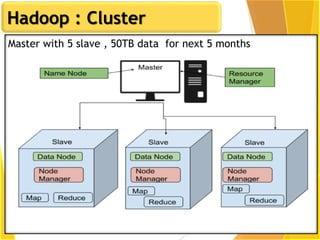
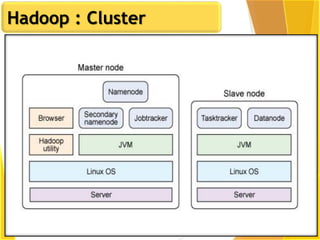
Hadoop : Cluster
Master with 5 slave , 50TB data for next 5 months
Hadoop : Cluster
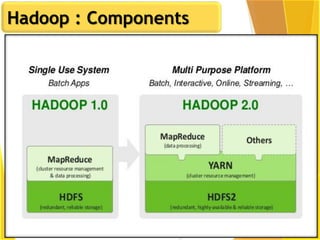
Hadoop : Components
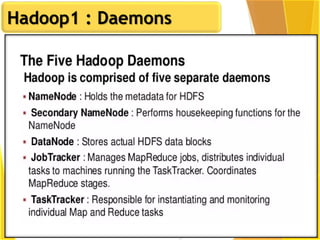
Hadoop1 : Daemons
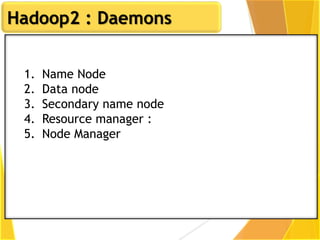
Hadoop2 : Daemons
1. Name Node
2. Data node
3. Secondary name node
4. Resource manager :
5. Node Manager
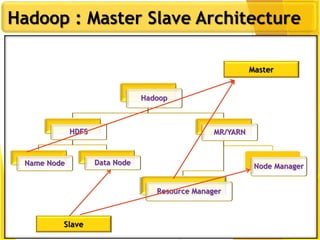
Hadoop : Master Slave Architecture
Hadoop
HDFS
Name Node Data Node
MR/YARN
Resource Manager
Node Manager
Master
Slave
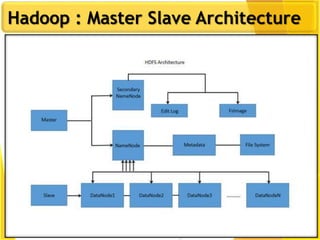
Hadoop : Master Slave Architecture
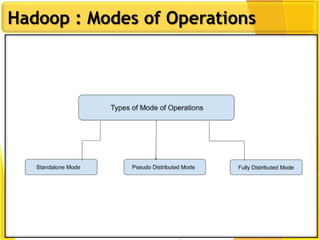
Hadoop : Modes of Operations
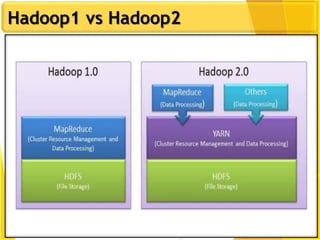
Hadoop1 vs Hadoop2
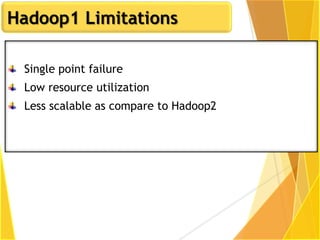
Hadoop1 Limitations
Single point failure
Low resource utilization
Less scalable as compare to Hadoop2
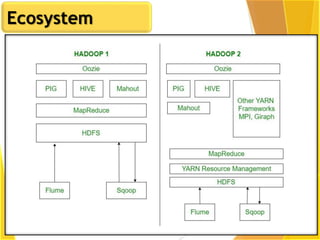
Ecosystem
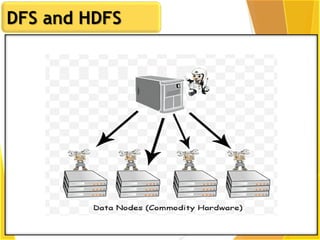
DFS and HDFS
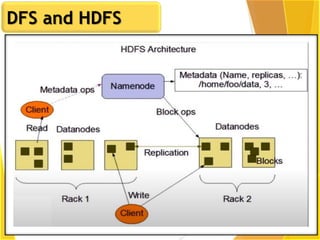
DFS and HDFS
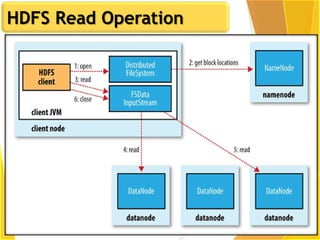
HDFS Read Operation
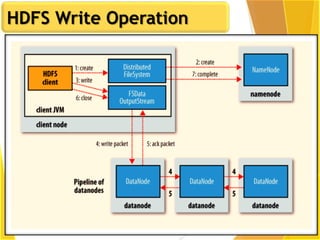
HDFS Write Operation
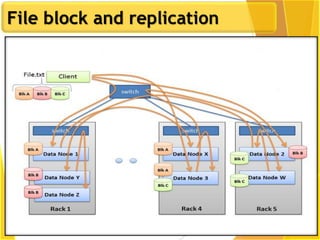
File block and replication
Thank You

BIG DATA Session 6