PRETTY GOOD PRIVACY
from CNS
Presented by,
Punnya sureshbabu
PGP
• PGP was invented by Phil Zimmermann.
• Used to provide Email with privacy.
• It is an open source.
• ƒBased on strong cryptographic algorithms (IDEA, RSA, SHA-1).
Scenarios
• Plaintext
• Message integrity
• Compression
• Confidentiality with one-time session key
• Code conversion
• Segmentation
Plaintext
• Simplest scenario.
• There is no message integrity.
• Sender compose the message and send it to the receiver.
• The message stored in receivers mailbox, until it is received by
him.
Message integrity
• Sender create a message and ends with her private
key.
• When receiver receives the message, he get the
message by using senders public key.
Compression
• Compress the message.
• No security benefits.
• Easy to send.
Confidentiality with one-time session key
• First sender create session key.
• Using this session key , sender encrypt the message.
• Then send the message with the key to the receiver.
• Receiver receive the package.
• He encrypt the session key using his private key.
• Receiver use the session key to encrypt the message.
• After decrypt the message, receiver create a digest of the
message and check.
• If both are equal, then the message is authentic.
Code conversion
• Most email message consist of ASCII characters.
• To translate the characters PGP uses Radix-64
conversion.
Segmentation
• Maximum message length restrictions in email.
• PGP automatically subdivides a large message into
segments small enough to mail separately.
Services provide by PGP
• Authentication
• Confidentiality
• Compression
• E-mail compatibility
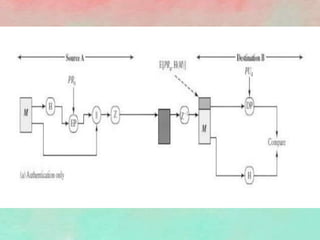
Authentication
• The sender creates a message.
• SHA-1 is used to generate a 160-bit hash code of the message.
• The hash code is encrypted with RSA using the sender’s
private key, and the result is pretended to the message.
• The receiver uses RSA with the sender’s public key to decrypt
and recover the hash code.
• The receiver generates a new hash code for the message and
compares it with the decrypted hash code. If the two match,
the message is accepted as authentic.
Confidentiality
• PGP another service is confidentiality, which is encrypting
messages for transmitting or to store files locally.
• In both cases, the symmetric encryption algorithm CAST-128
may be used. Alternatively, IDEA or 3DES may be used. And
the 64-bit cipher feedback (CFB) mode is used.
• In PGP, each symmetric key is used only once. The session
key is bound to the message. To protect the key, it is encrypted
with the receiver’s public key.
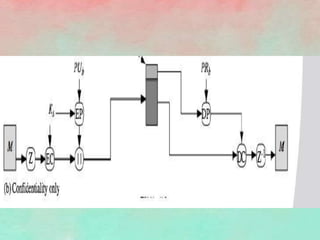
• The sender generates a message and a random 128-bit number
to be used as a session key for this message only.
• The message is encrypted using CAST-128 (or IDEA or
3DES) with the session key.
• The session key is encrypted with RSA using the recipient’s
public key and is prepended to the message.
• The receiver uses RSA with its private key to decrypt and
recover the session key. 5. The session key is used to decrypt
the message.
Notations
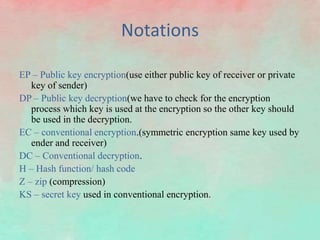
EP – Public key encryption(use either public key of receiver or private
key of sender)
DP – Public key decryption(we have to check for the encryption
process which key is used at the encryption so the other key should
be used in the decryption.
EC – conventional encryption.(symmetric encryption same key used by
ender and receiver)
DC – Conventional decryption.
H – Hash function/ hash code
Z – zip (compression)
KS – secret key used in conventional encryption.
Combine Authentication &
Confidentiality
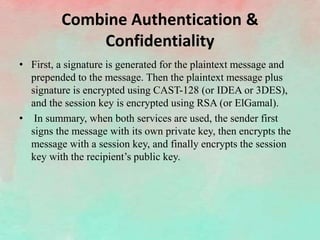
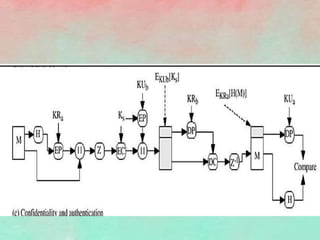
• First, a signature is generated for the plaintext message and
prepended to the message. Then the plaintext message plus
signature is encrypted using CAST-128 (or IDEA or 3DES),
and the session key is encrypted using RSA (or ElGamal).
• In summary, when both services are used, the sender first
signs the message with its own private key, then encrypts the
message with a session key, and finally encrypts the session
key with the recipient’s public key.
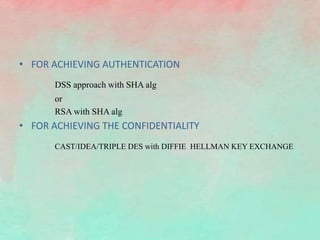
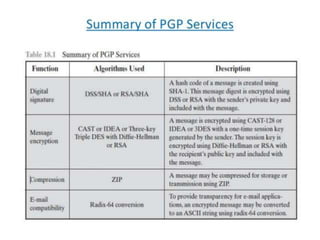
• FOR ACHIEVING AUTHENTICATION
DSS approach with SHA alg
or
RSA with SHA alg
• FOR ACHIEVING THE CONFIDENTIALITY
CAST/IDEA/TRIPLE DES with DIFFIE HELLMAN KEY EXCHANGE
Compression
• PGP compresses the message after applying the signature but before
encryption. This has the benefit of saving space both for e-mail
transmission and for file storage.
• Z for compression and Z–1 for decompression The signature is generated
before compression for two reasons:
• It is preferable to sign an uncompressed message so that one can store only
the uncompressed message together with the signature for future
verification.
• If you generate signature after compression then there is a need
recompression for message verification, PGP’s compression algorithm
presents a difficulty.
• Message encryption is applied after compression to strengthen
cryptographic security. Therefore cryptanalysis is more difficult.
• The compression algorithm used here is ZIP Algorithm
E-mail compatibility
• The resulting message block consists of a stream of arbitrary 8-bit octets.
• However, many electronic mail systems only permit the use of blocks
consisting of ASCII text.
• To accommodate this restriction, PGP provides the service of converting
the raw 8-bit binary stream to a stream of printable ASCII characters.
• The scheme used for this purpose is radix-64 conversion. Each group of
three octets of binary data is mapped into four ASCII characters. This
format also appends a CRC to detect transmission errors.
• The use of radix 64 expands a message by 33%. Fortunately, the session
key and signature portions of the message are relatively compact, and the
plaintext message has been compressed.
• In fact, the compression should be more than enough to compensate for the
radix-64 expansion.
ADVANTAGES OF PGP
• Your valuable information is always protected, others cannot
view it, and it cannot be stolen over the Internet .
• No compatibility problems - works with any email application
that you or your recipients are using .
• Verification of the sender of information ensures you are not
being spoofed by a third party.
• Absolute assurity that the information you send or receive has
not been modified in transit.
• Your secure mail and text cannot be infiltrated by hackers or
infected and mis-used by email attacks
DISADVANTAGES OF PGP
• Administering conflicting versions.
• Compatibility issues.
• Complexity.
• No recovery.
Thankyou

Pretty good privacy

  • 1.
    PRETTY GOOD PRIVACY fromCNS Presented by, Punnya sureshbabu
  • 2.
    PGP • PGP wasinvented by Phil Zimmermann. • Used to provide Email with privacy. • It is an open source. • ƒBased on strong cryptographic algorithms (IDEA, RSA, SHA-1).
  • 3.
    Scenarios • Plaintext • Messageintegrity • Compression • Confidentiality with one-time session key • Code conversion • Segmentation
  • 4.
    Plaintext • Simplest scenario. •There is no message integrity. • Sender compose the message and send it to the receiver. • The message stored in receivers mailbox, until it is received by him.
  • 5.
    Message integrity • Sendercreate a message and ends with her private key. • When receiver receives the message, he get the message by using senders public key. Compression • Compress the message. • No security benefits. • Easy to send.
  • 6.
    Confidentiality with one-timesession key • First sender create session key. • Using this session key , sender encrypt the message. • Then send the message with the key to the receiver. • Receiver receive the package. • He encrypt the session key using his private key. • Receiver use the session key to encrypt the message. • After decrypt the message, receiver create a digest of the message and check. • If both are equal, then the message is authentic.
  • 7.
    Code conversion • Mostemail message consist of ASCII characters. • To translate the characters PGP uses Radix-64 conversion. Segmentation • Maximum message length restrictions in email. • PGP automatically subdivides a large message into segments small enough to mail separately.
  • 8.
    Services provide byPGP • Authentication • Confidentiality • Compression • E-mail compatibility
  • 9.
    Authentication • The sendercreates a message. • SHA-1 is used to generate a 160-bit hash code of the message. • The hash code is encrypted with RSA using the sender’s private key, and the result is pretended to the message. • The receiver uses RSA with the sender’s public key to decrypt and recover the hash code. • The receiver generates a new hash code for the message and compares it with the decrypted hash code. If the two match, the message is accepted as authentic.
  • 11.
    Confidentiality • PGP anotherservice is confidentiality, which is encrypting messages for transmitting or to store files locally. • In both cases, the symmetric encryption algorithm CAST-128 may be used. Alternatively, IDEA or 3DES may be used. And the 64-bit cipher feedback (CFB) mode is used. • In PGP, each symmetric key is used only once. The session key is bound to the message. To protect the key, it is encrypted with the receiver’s public key.
  • 12.
    • The sendergenerates a message and a random 128-bit number to be used as a session key for this message only. • The message is encrypted using CAST-128 (or IDEA or 3DES) with the session key. • The session key is encrypted with RSA using the recipient’s public key and is prepended to the message. • The receiver uses RSA with its private key to decrypt and recover the session key. 5. The session key is used to decrypt the message.
  • 14.
    Notations EP – Publickey encryption(use either public key of receiver or private key of sender) DP – Public key decryption(we have to check for the encryption process which key is used at the encryption so the other key should be used in the decryption. EC – conventional encryption.(symmetric encryption same key used by ender and receiver) DC – Conventional decryption. H – Hash function/ hash code Z – zip (compression) KS – secret key used in conventional encryption.
  • 15.
    Combine Authentication & Confidentiality •First, a signature is generated for the plaintext message and prepended to the message. Then the plaintext message plus signature is encrypted using CAST-128 (or IDEA or 3DES), and the session key is encrypted using RSA (or ElGamal). • In summary, when both services are used, the sender first signs the message with its own private key, then encrypts the message with a session key, and finally encrypts the session key with the recipient’s public key.
  • 17.
    • FOR ACHIEVINGAUTHENTICATION DSS approach with SHA alg or RSA with SHA alg • FOR ACHIEVING THE CONFIDENTIALITY CAST/IDEA/TRIPLE DES with DIFFIE HELLMAN KEY EXCHANGE
  • 18.
    Compression • PGP compressesthe message after applying the signature but before encryption. This has the benefit of saving space both for e-mail transmission and for file storage. • Z for compression and Z–1 for decompression The signature is generated before compression for two reasons: • It is preferable to sign an uncompressed message so that one can store only the uncompressed message together with the signature for future verification. • If you generate signature after compression then there is a need recompression for message verification, PGP’s compression algorithm presents a difficulty. • Message encryption is applied after compression to strengthen cryptographic security. Therefore cryptanalysis is more difficult. • The compression algorithm used here is ZIP Algorithm
  • 19.
    E-mail compatibility • Theresulting message block consists of a stream of arbitrary 8-bit octets. • However, many electronic mail systems only permit the use of blocks consisting of ASCII text. • To accommodate this restriction, PGP provides the service of converting the raw 8-bit binary stream to a stream of printable ASCII characters. • The scheme used for this purpose is radix-64 conversion. Each group of three octets of binary data is mapped into four ASCII characters. This format also appends a CRC to detect transmission errors. • The use of radix 64 expands a message by 33%. Fortunately, the session key and signature portions of the message are relatively compact, and the plaintext message has been compressed. • In fact, the compression should be more than enough to compensate for the radix-64 expansion.
  • 21.
    ADVANTAGES OF PGP •Your valuable information is always protected, others cannot view it, and it cannot be stolen over the Internet . • No compatibility problems - works with any email application that you or your recipients are using . • Verification of the sender of information ensures you are not being spoofed by a third party. • Absolute assurity that the information you send or receive has not been modified in transit. • Your secure mail and text cannot be infiltrated by hackers or infected and mis-used by email attacks
  • 22.
    DISADVANTAGES OF PGP •Administering conflicting versions. • Compatibility issues. • Complexity. • No recovery.
  • 23.