TLS/SSL protocol design


        Nate Lawson
      nate@rootlabs.com

      Presented at Cal Poly
          June 3, 2010
Overview

• Introduction to SSL/TLS
   – Focus on HTTP+SSL
• Design goals and result
• Cryptography primer
   – Desired properties
   – Primitives for implementing them
• Protocol walkthrough in detail
• Attacks and mitigation
My background

• Root Labs founder
   – Design and analyze security systems
   – Emphasis on embedded, kernel, and crypto
• Previously, Cryptography Research
   – Paul Kocher’s company (author of SSL 3.0)
   – Co-designed Blu-ray disc security layer, aka BD+
• Crypto engineer at Infogard Labs
Security is hard but rewarding

• Protocols and crypto are susceptible to very minor
  mistakes
• Example: SSL timing attacks over the Internet

• Hard = fun and $
   – Breaking and building things is exciting
   – Security is a desired skill for any resumé
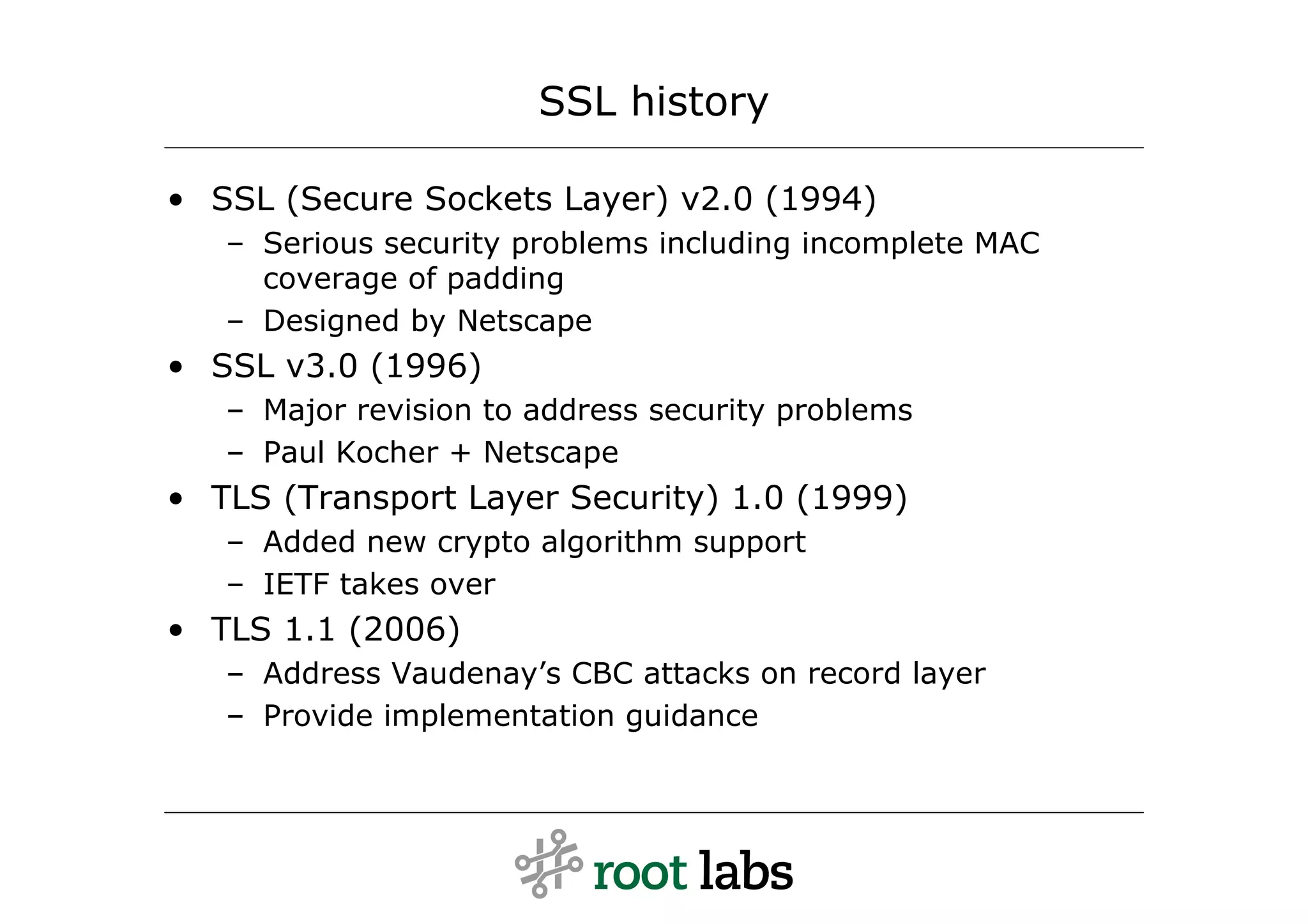
SSL history

• SSL (Secure Sockets Layer) v2.0 (1994)
   – Serious security problems including incomplete MAC
     coverage of padding
   – Designed by Netscape
• SSL v3.0 (1996)
   – Major revision to address security problems
   – Paul Kocher + Netscape
• TLS (Transport Layer Security) 1.0 (1999)
   – Added new crypto algorithm support
   – IETF takes over
• TLS 1.1 (2006)
   – Address Vaudenay’s CBC attacks on record layer
   – Provide implementation guidance
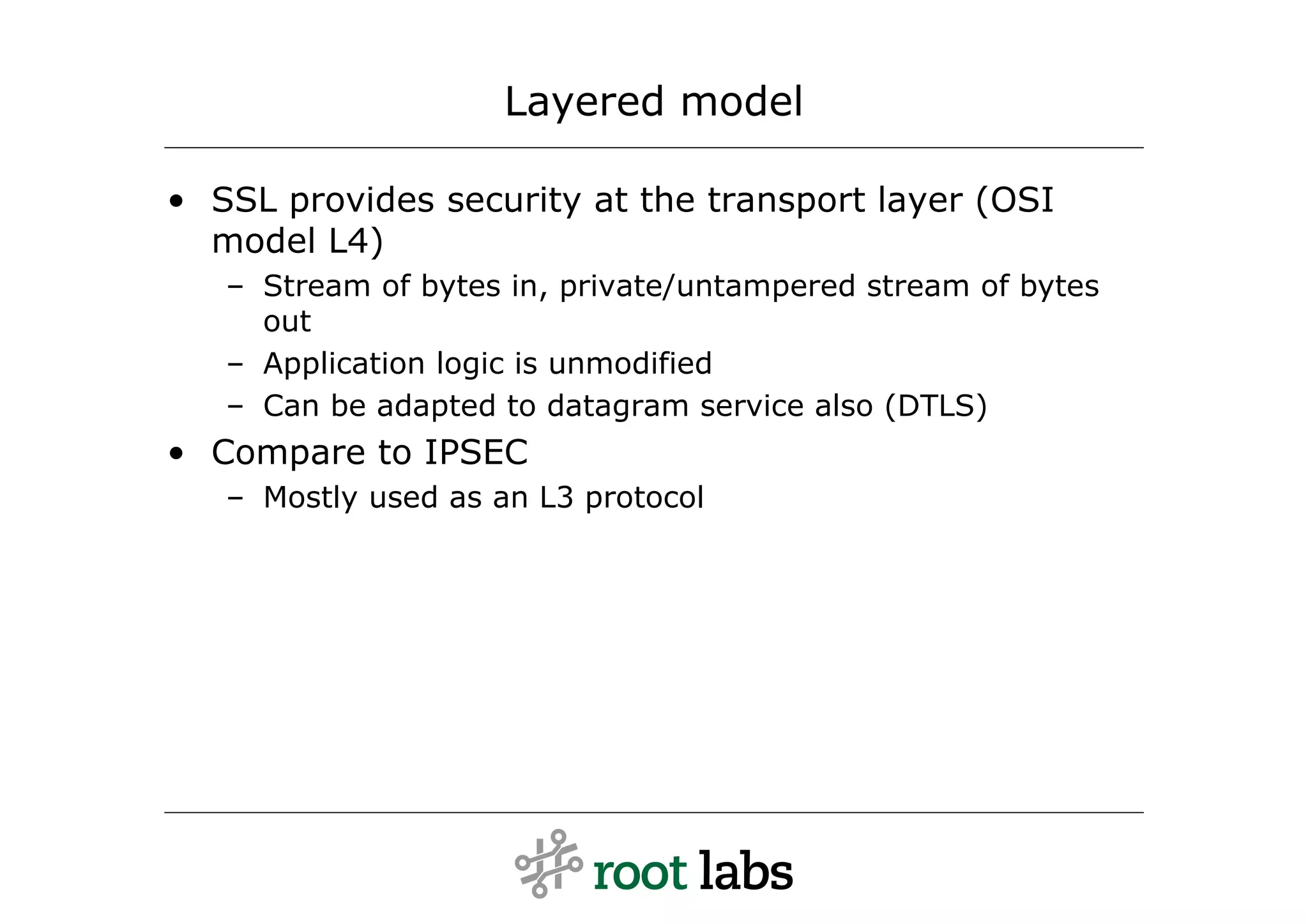
Layered model

• SSL provides security at the transport layer (OSI
  model L4)
   – Stream of bytes in, private/untampered stream of bytes
     out
   – Application logic is unmodified
   – Can be adapted to datagram service also (DTLS)
• Compare to IPSEC
   – Mostly used as an L3 protocol
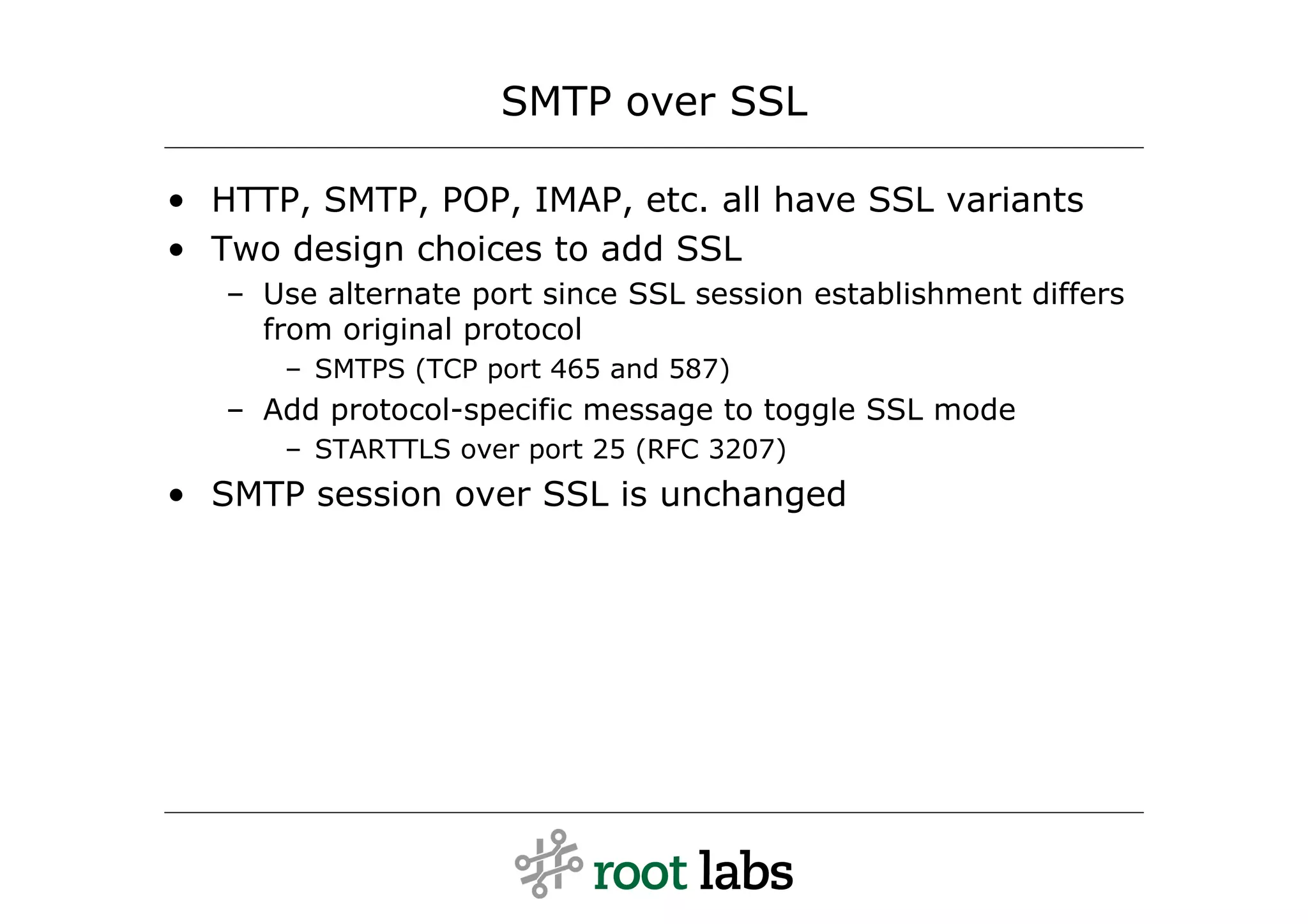
SMTP over SSL

• HTTP, SMTP, POP, IMAP, etc. all have SSL variants
• Two design choices to add SSL
   – Use alternate port since SSL session establishment differs
     from original protocol
      – SMTPS (TCP port 465 and 587)
   – Add protocol-specific message to toggle SSL mode
      – STARTTLS over port 25 (RFC 3207)
• SMTP session over SSL is unchanged
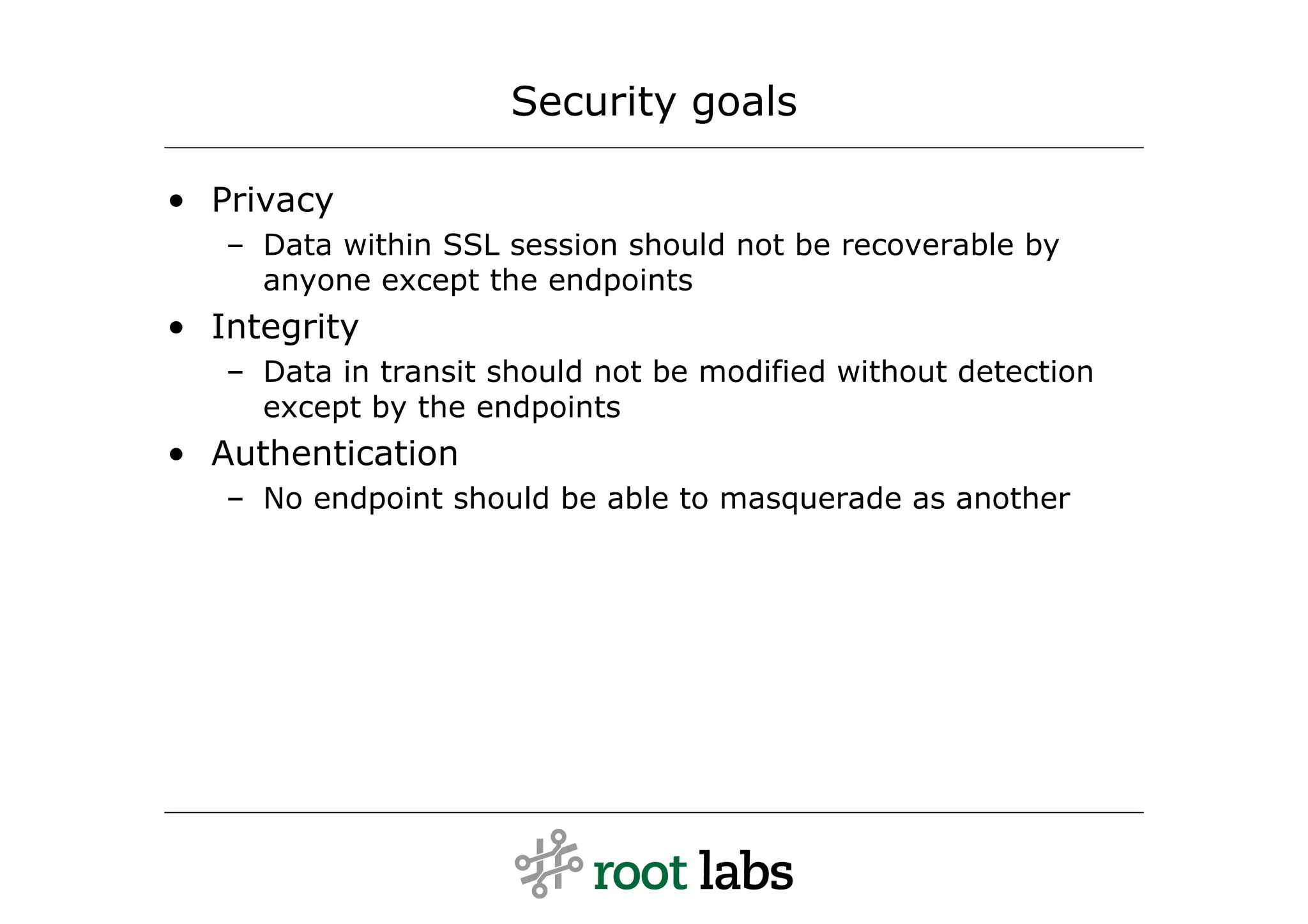
Security goals

• Privacy
   – Data within SSL session should not be recoverable by
     anyone except the endpoints
• Integrity
   – Data in transit should not be modified without detection
     except by the endpoints
• Authentication
   – No endpoint should be able to masquerade as another
Attacker capabilities

• Sorted by increasing power
• Normal participant
   – Can talk to server that is also talking to other parties
• Passive eavesdropping
   – Observe any or all messages sent by other parties
• Active (Man in the Middle)
   – Insert or replay old messages
   – Modify
   – Delete or reorder
• Secure protocols must address all these threats
Crypto property: privacy

• No one other than the intended recipient of a
  message can determine its contents
• Caveats
   – Adversary could have powers of knowing or choosing
     plaintext
   – Traffic analysis
      – Length, latency, unencrypted data like IP or Ethernet
        addresses
      – Side channel attacks: power consumption, EM, timing of
        operations
Crypto property: integrity

• Any change made to a message after it has been
  sent will be detected by the recipient
   – Corollary: reordering, replay, insertion, or deletion of
     messages will also be detected
• Caveats
   – Privacy is not integrity protection
   – Error recovery
       – You can’t always terminate the session
   – Root of trust (shared system?)
Crypto property: authentication

• Messages can be associated with a given identity with
  high level of confidence
• Caveats
   – Managing identification
      – Lost keys, forgotten passwords, laptop walks away
      – Revocation of old keys and refreshing to new ones
   – Bootstrapping: what is your root of trust?
Security goal implementation

• Privacy
   – Data is encrypted with block cipher (e.g., AES)
   – Cipher key is exchanged via public key crypto (e.g., RSA)
• Integrity
   – Data is protected by a MAC (e.g., SHA1-HMAC)
• Authentication
   – Server and/or client identity is verified via certificates
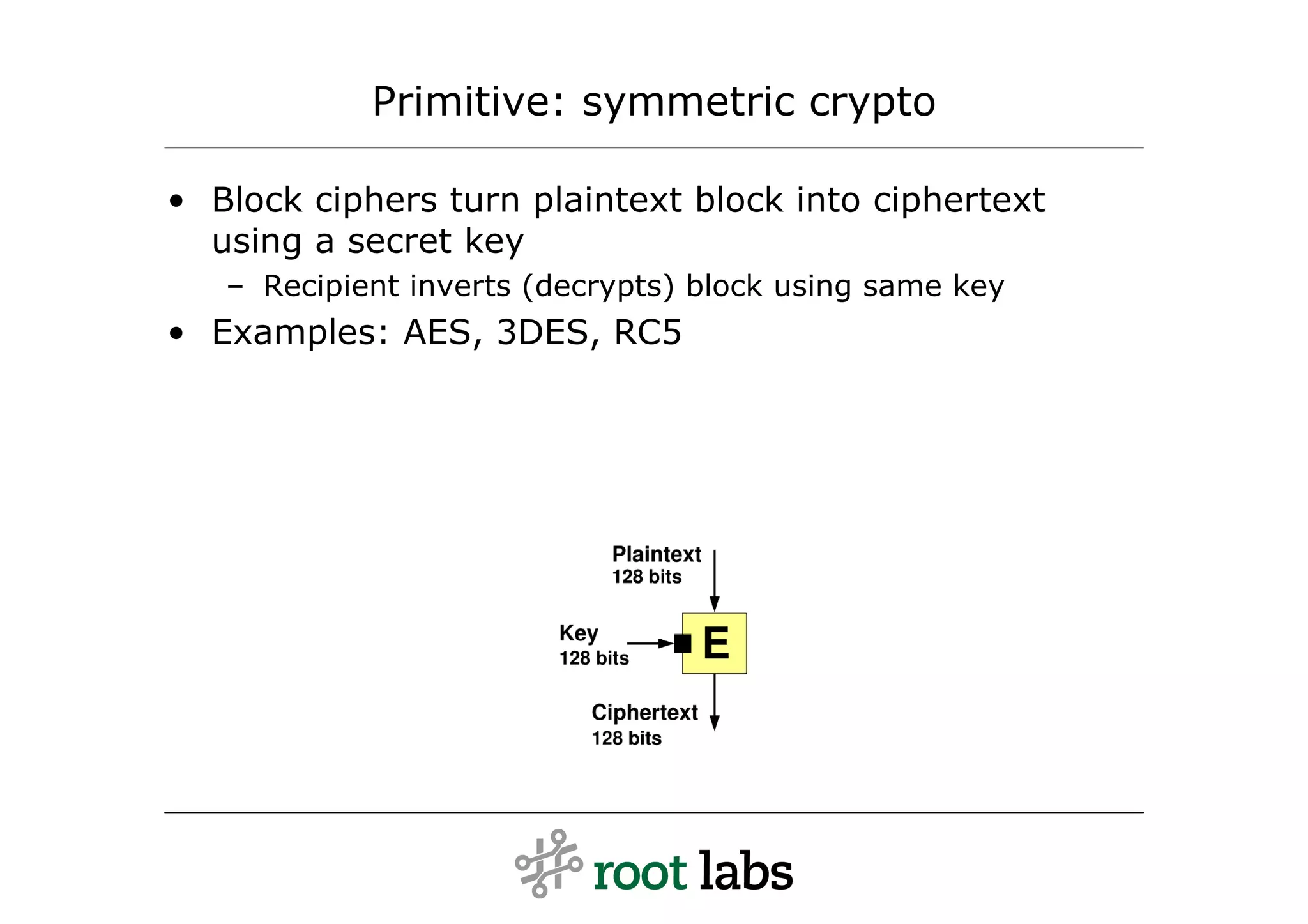
Primitive: symmetric crypto

• Block ciphers turn plaintext block into ciphertext
  using a secret key
   – Recipient inverts (decrypts) block using same key
• Examples: AES, 3DES, RC5
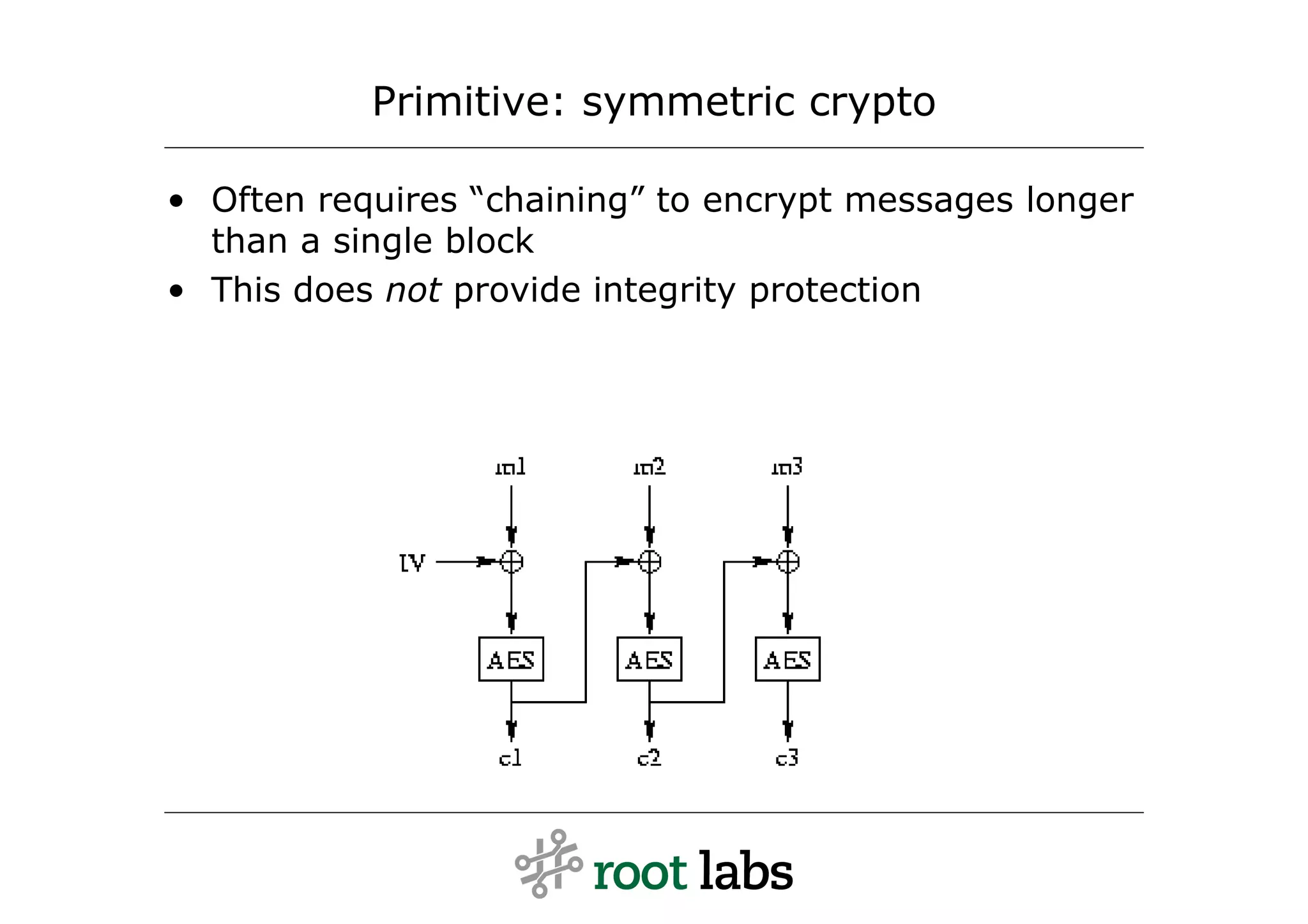
Primitive: symmetric crypto

• Often requires “chaining” to encrypt messages longer
  than a single block
• This does not provide integrity protection
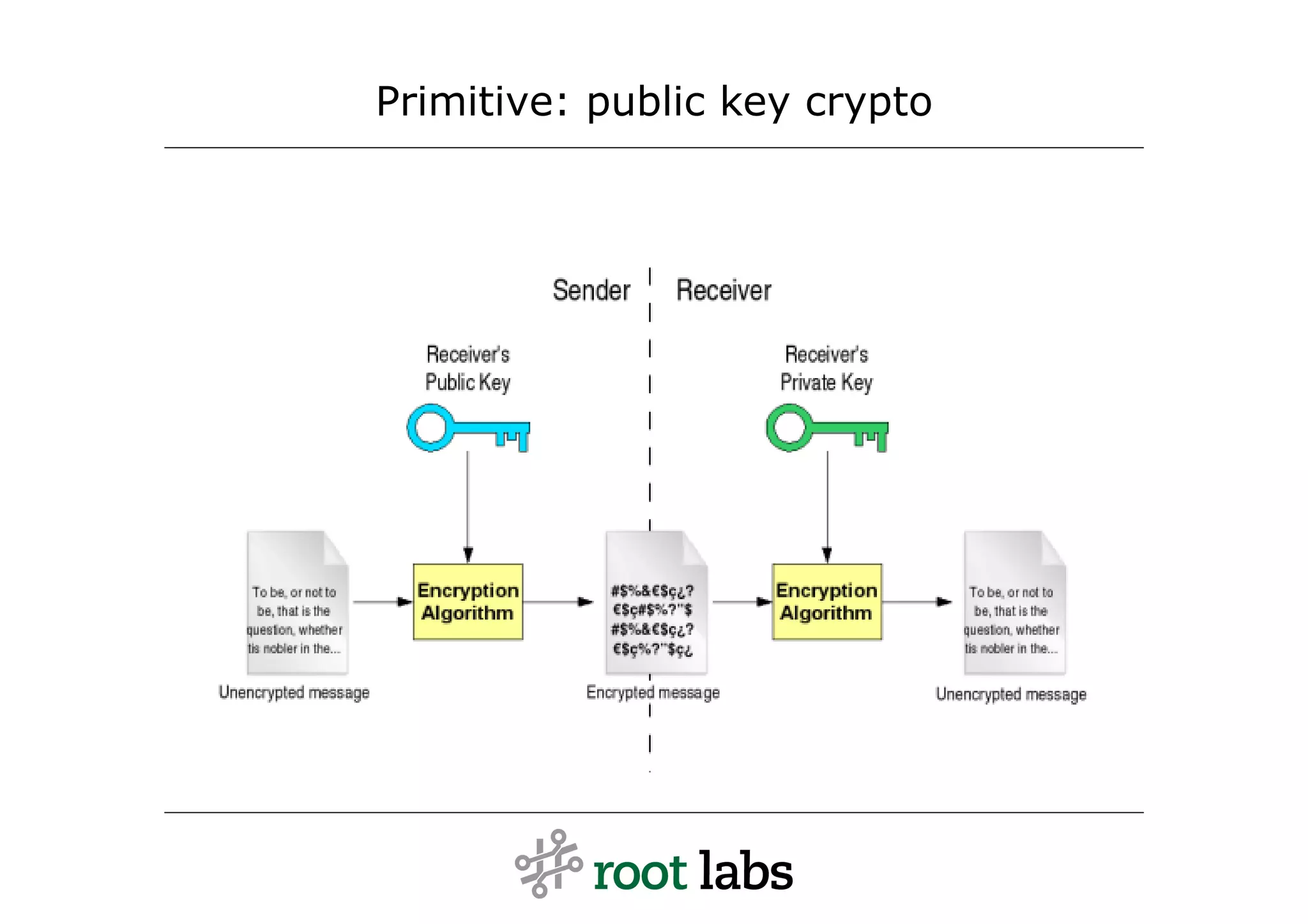
Primitive: public key crypto

• Data transformed with one key can only be inverted
  with the other key (asymmetric)
• Examples: RSA, Diffie-Hellman, DSA
   – And elliptic curve variants
• Can encrypt data to a recipient without also being
  able to decrypt it afterward
• Can sign data by encrypting it with one key and
  publishing the other
Primitive: public key crypto
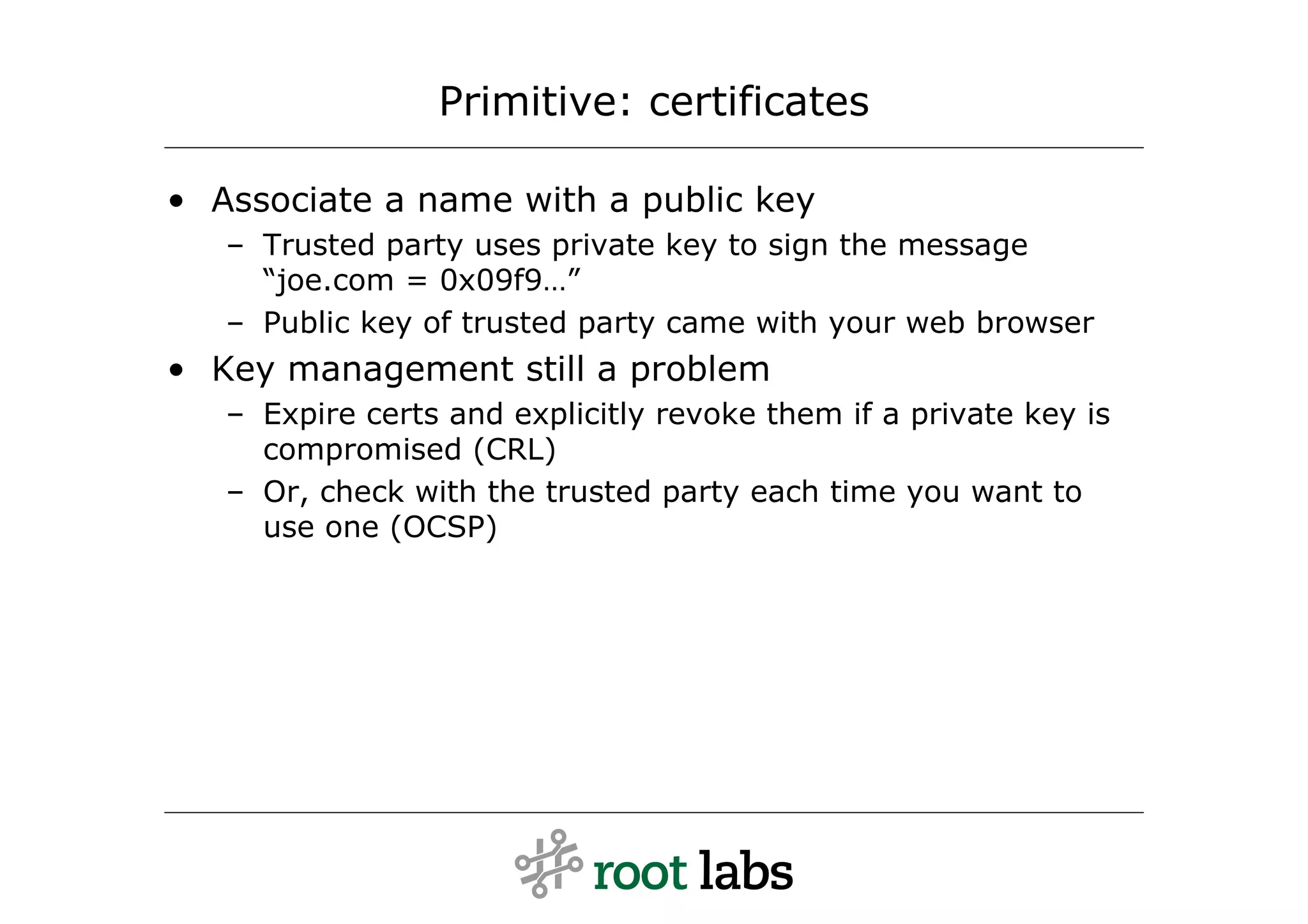
Primitive: certificates

• Associate a name with a public key
   – Trusted party uses private key to sign the message
     “joe.com = 0x09f9…”
   – Public key of trusted party came with your web browser
• Key management still a problem
   – Expire certs and explicitly revoke them if a private key is
     compromised (CRL)
   – Or, check with the trusted party each time you want to
     use one (OCSP)
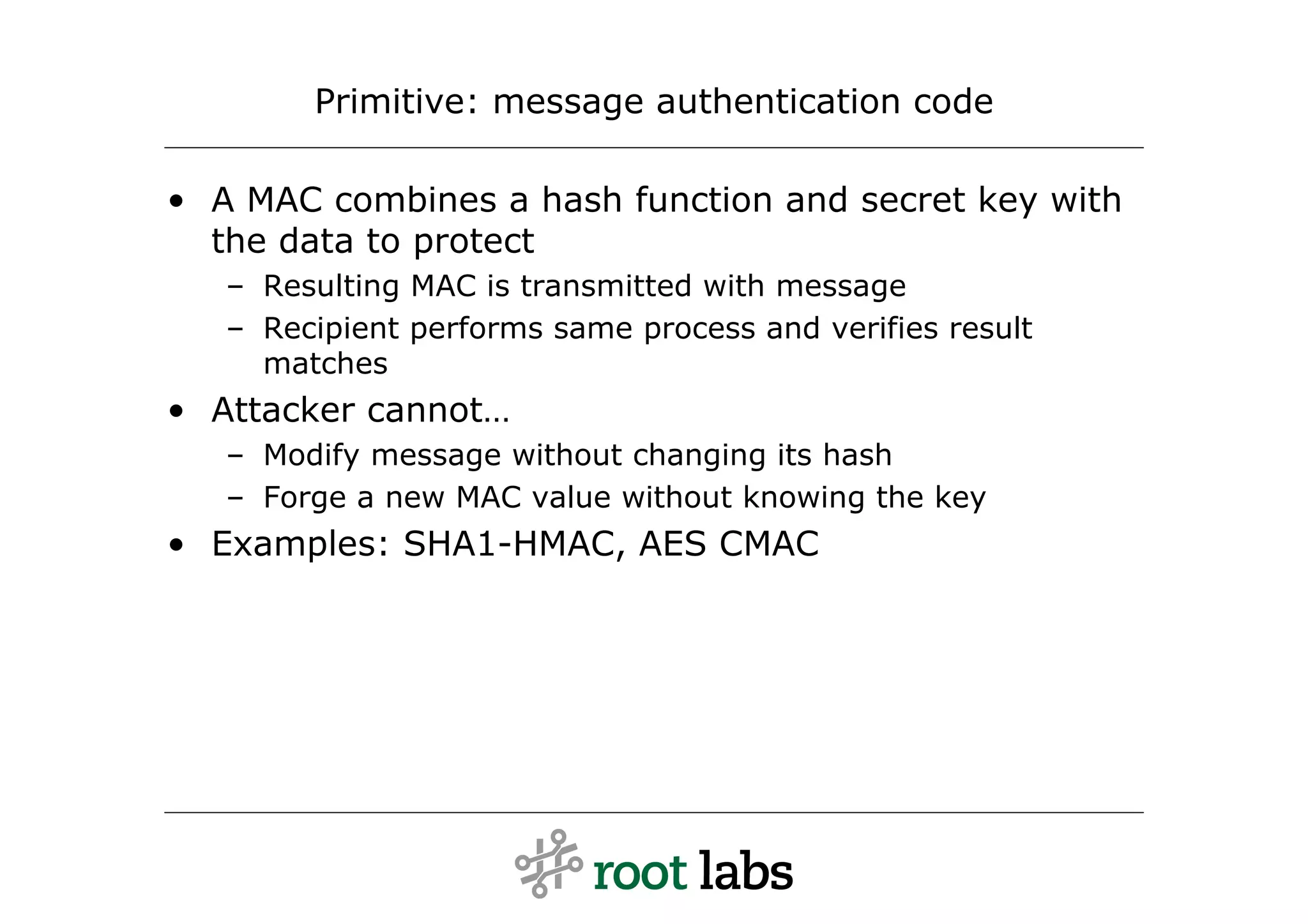
Primitive: message authentication code

• A MAC combines a hash function and secret key with
  the data to protect
   – Resulting MAC is transmitted with message
   – Recipient performs same process and verifies result
     matches
• Attacker cannot…
   – Modify message without changing its hash
   – Forge a new MAC value without knowing the key
• Examples: SHA1-HMAC, AES CMAC
Primitive: secure PRNG

• Outputs a cryptographically-strong, pseudo-random
  stream of data based on initial seed
   – Initial seed needs to have enough entropy
   – PRNGs used many places (key generation, IVs, nonces)
• Examples: /dev/random, Yarrow
   – Often based on a hash function like SHA-1
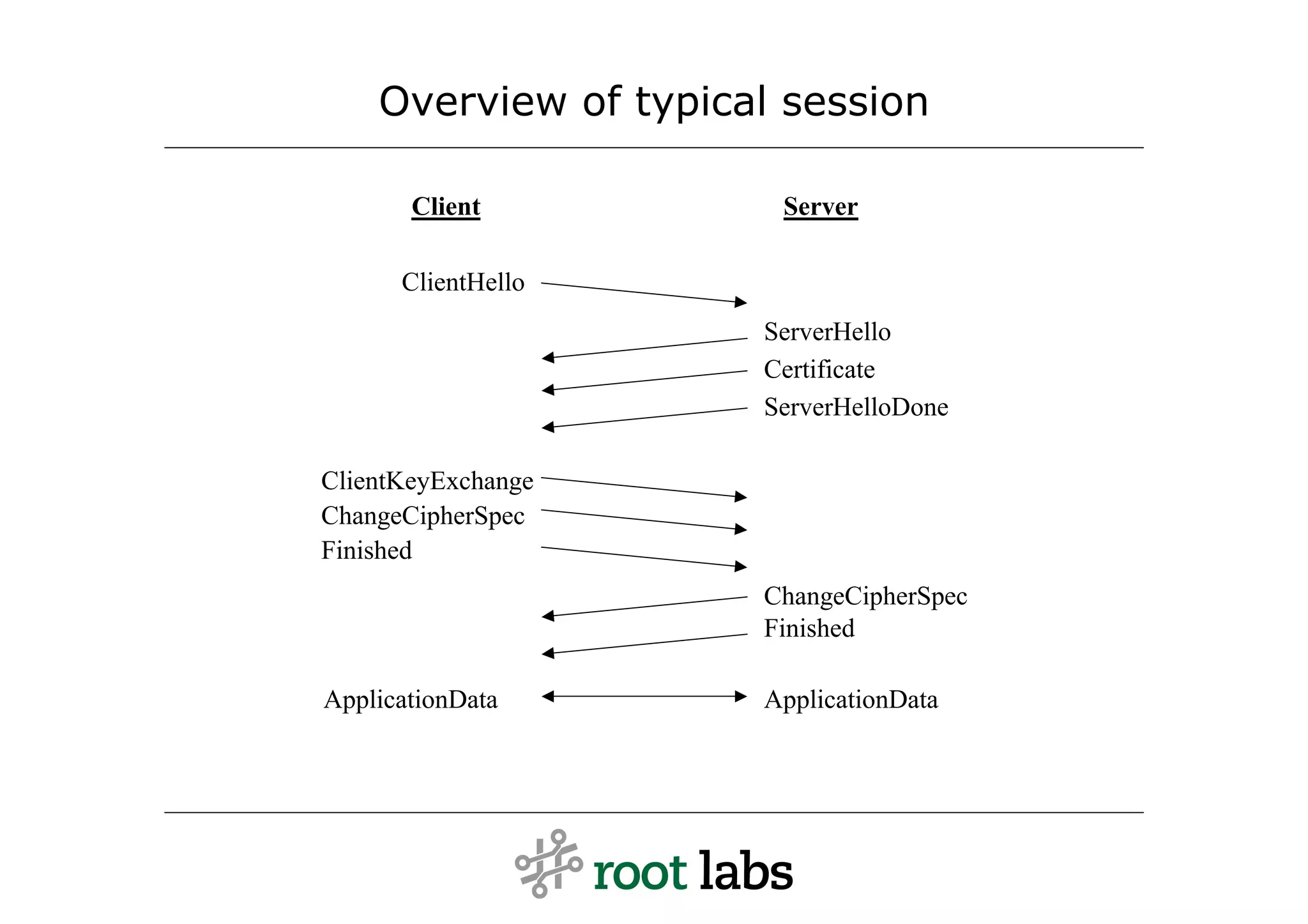
Overview of typical session

       Client          Server

      ClientHello
                      ServerHello
                      Certificate
                      ServerHelloDone

ClientKeyExchange
ChangeCipherSpec
Finished
                      ChangeCipherSpec
                      Finished

ApplicationData       ApplicationData
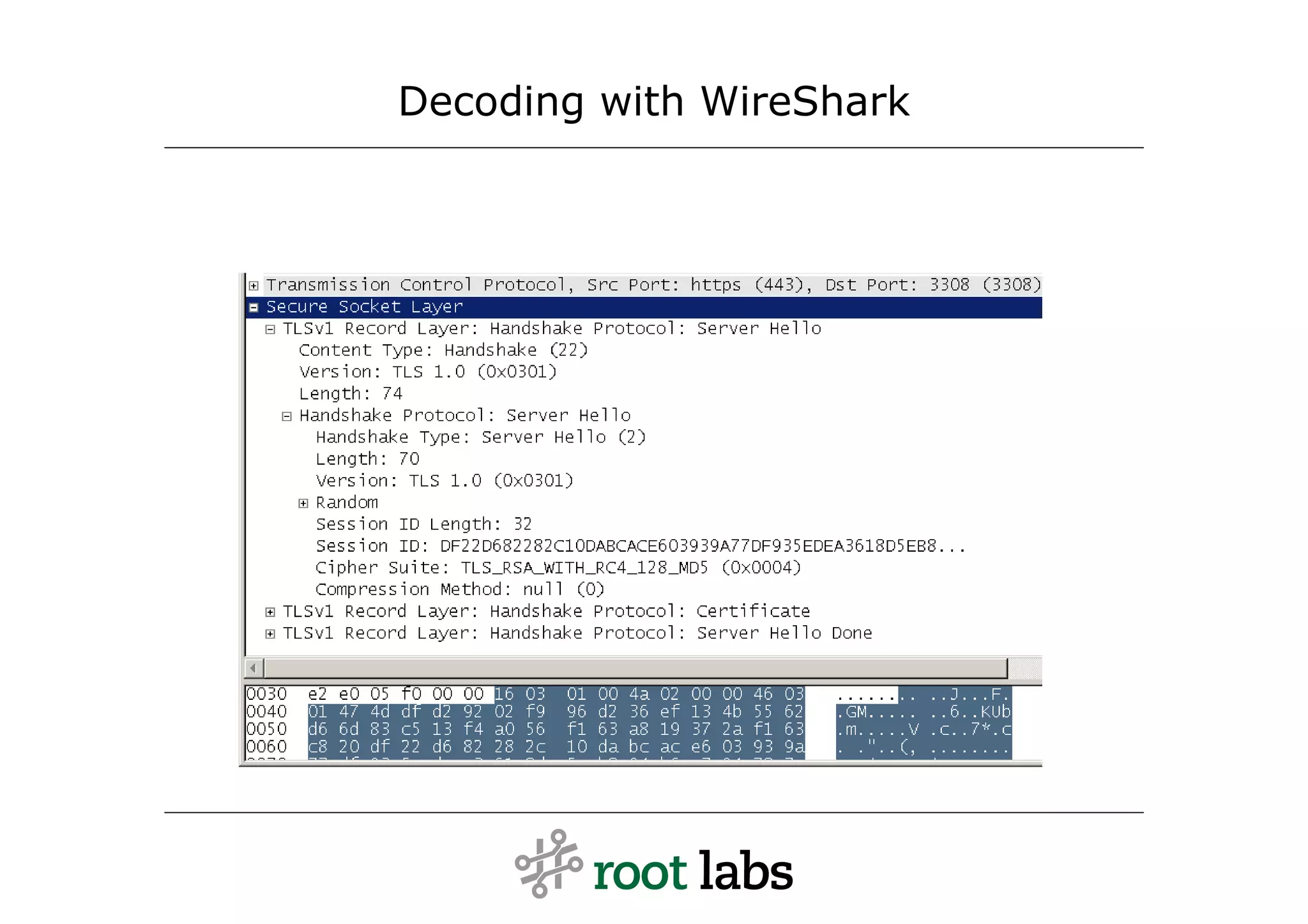
Decoding with WireShark
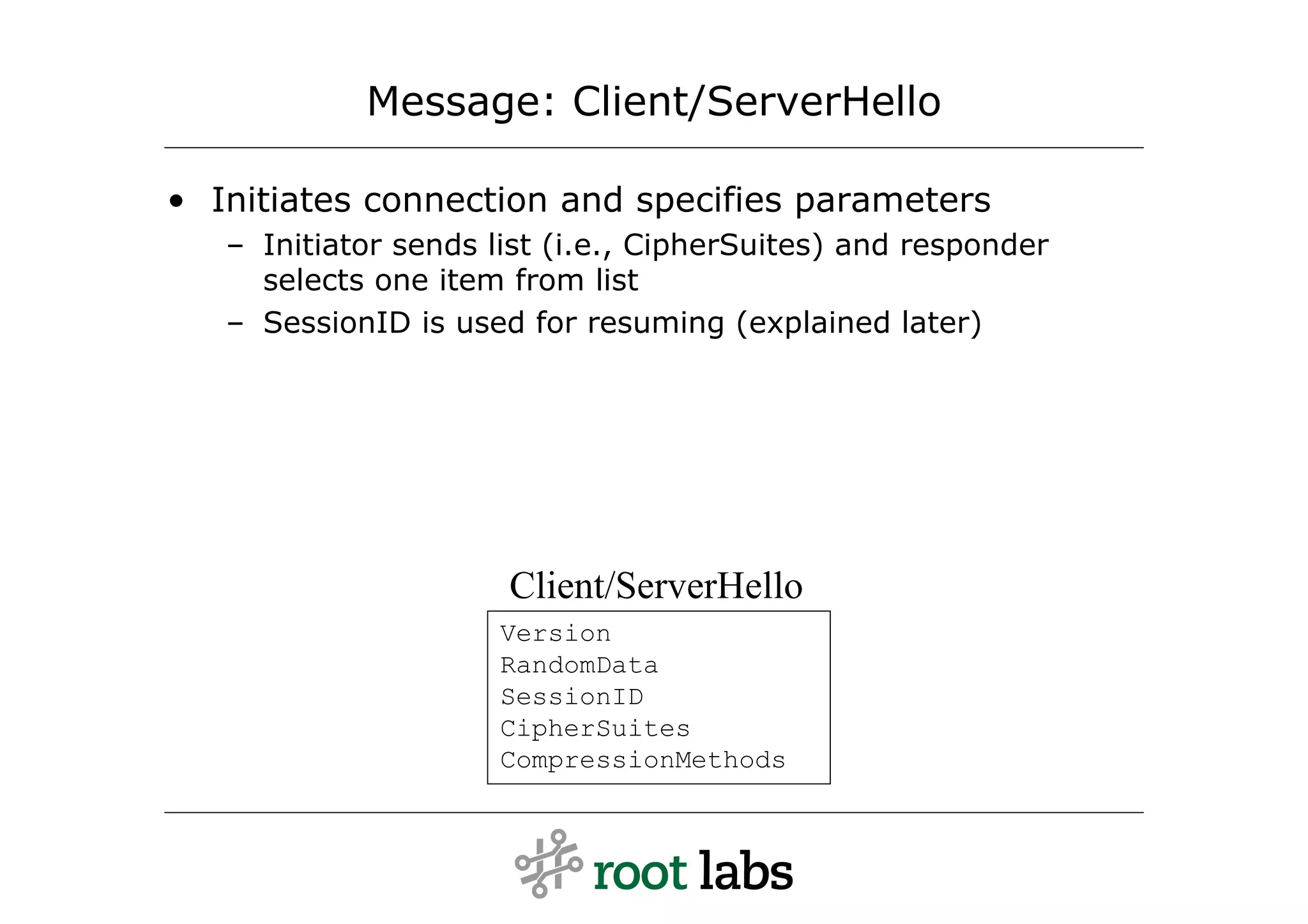
Message: Client/ServerHello

• Initiates connection and specifies parameters
   – Initiator sends list (i.e., CipherSuites) and responder
     selects one item from list
   – SessionID is used for resuming (explained later)


                      Client/ServerHello
                     Version
                     RandomData
                     SessionID
                     CipherSuites
                     CompressionMethods
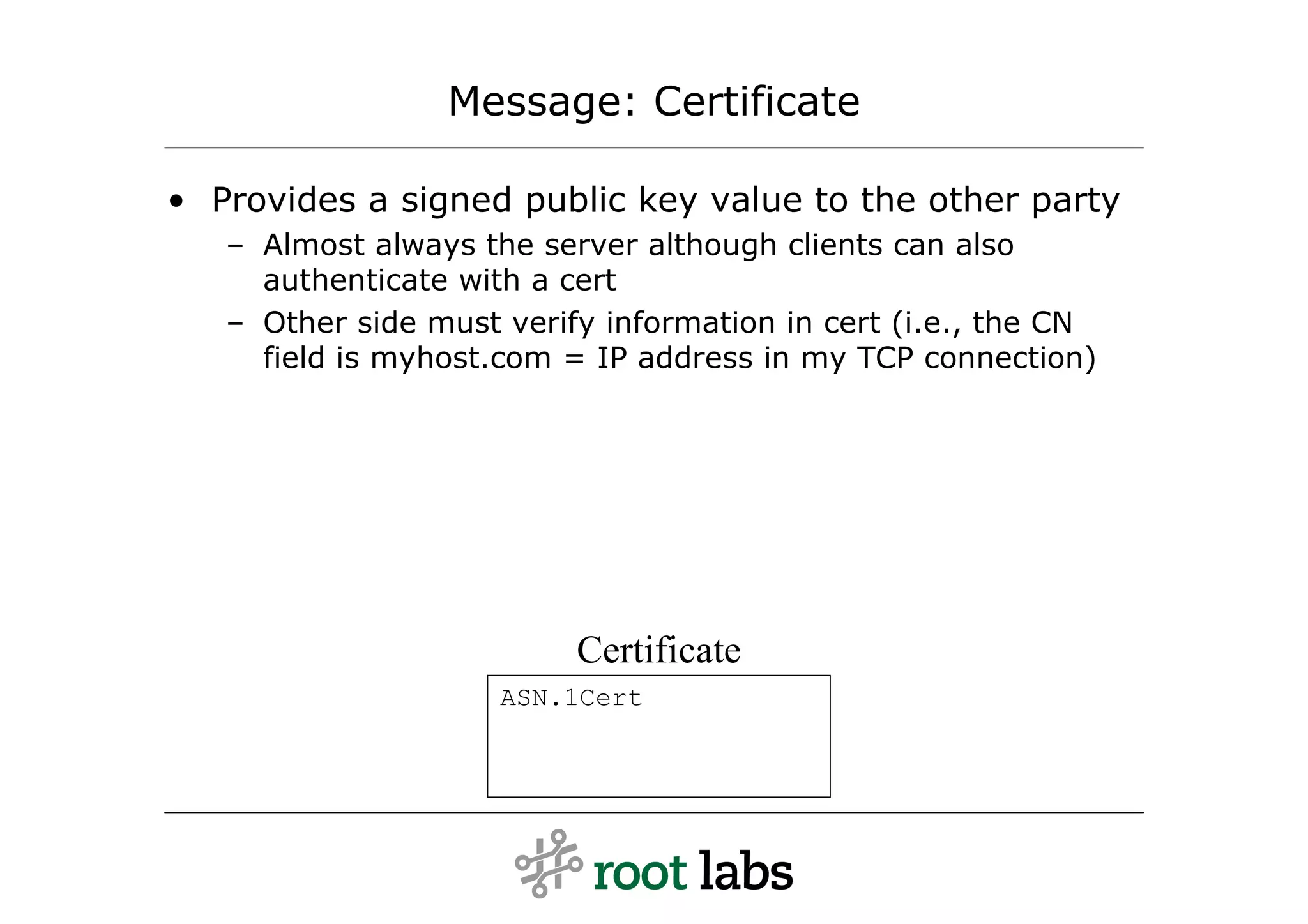
Message: Certificate

• Provides a signed public key value to the other party
   – Almost always the server although clients can also
     authenticate with a cert
   – Other side must verify information in cert (i.e., the CN
     field is myhost.com = IP address in my TCP connection)


                          Certificate
                     ASN.1Cert
Message: ServerHelloDone

• Signifies end of server auth process
   – Allows multi-pass authentication handshake
   – Otherwise unimportant
• Cert-based auth is single-pass
Message: ClientKeyExchange

• Client sends encrypted premaster secret to server
   – Assumes RSA public key crypto (most common)
   – Server checks ClientVersion matches highest advertised
     version


                    ClientKeyExchange
                   RSA-PubKey-Encrypt(
                       ClientVersion
                       PreMasterSecret[48]
                   )
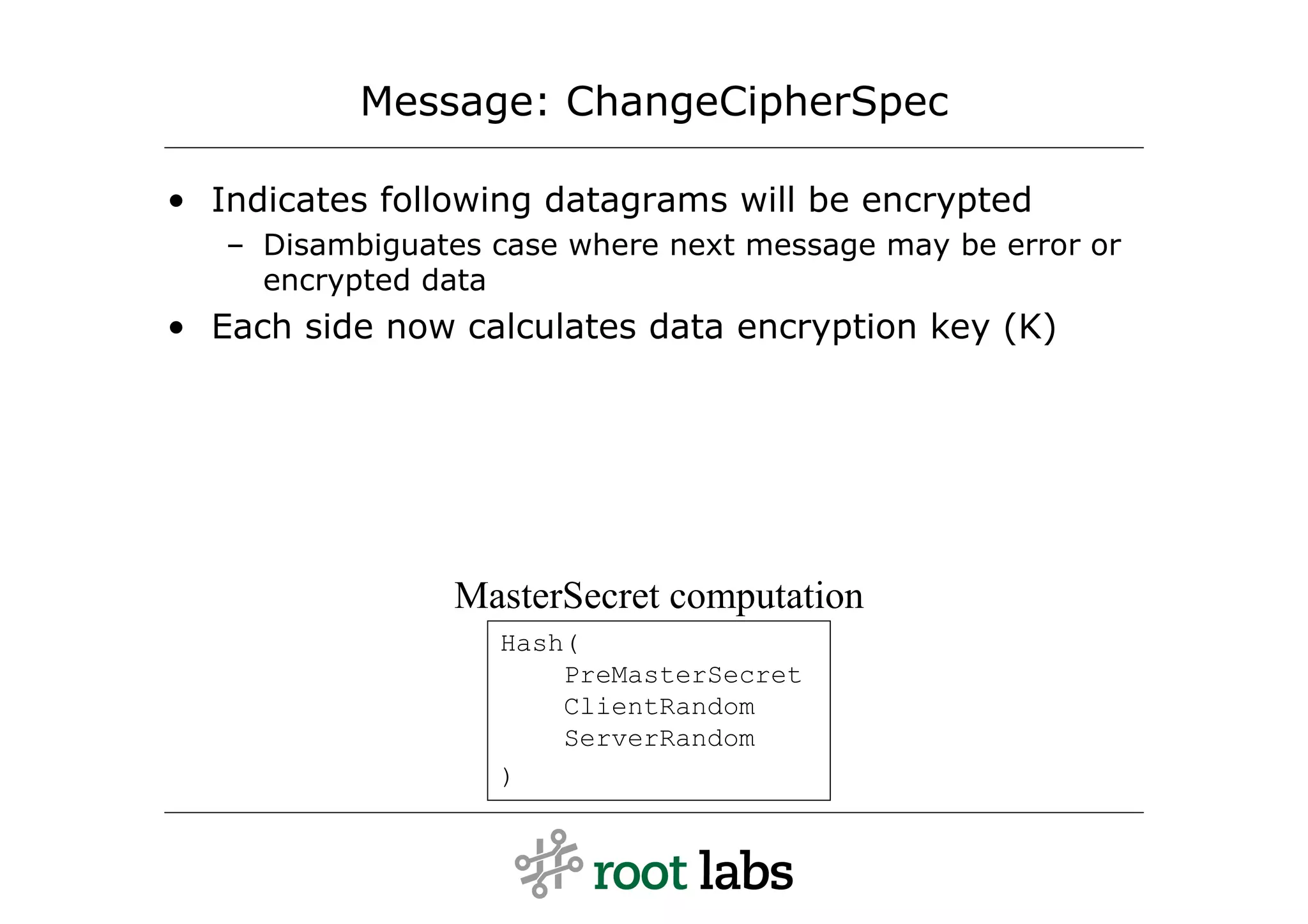
Message: ChangeCipherSpec

• Indicates following datagrams will be encrypted
   – Disambiguates case where next message may be error or
     encrypted data
• Each side now calculates data encryption key (K)


                 MasterSecret computation
                   Hash(
                       PreMasterSecret
                       ClientRandom
                       ServerRandom
                   )
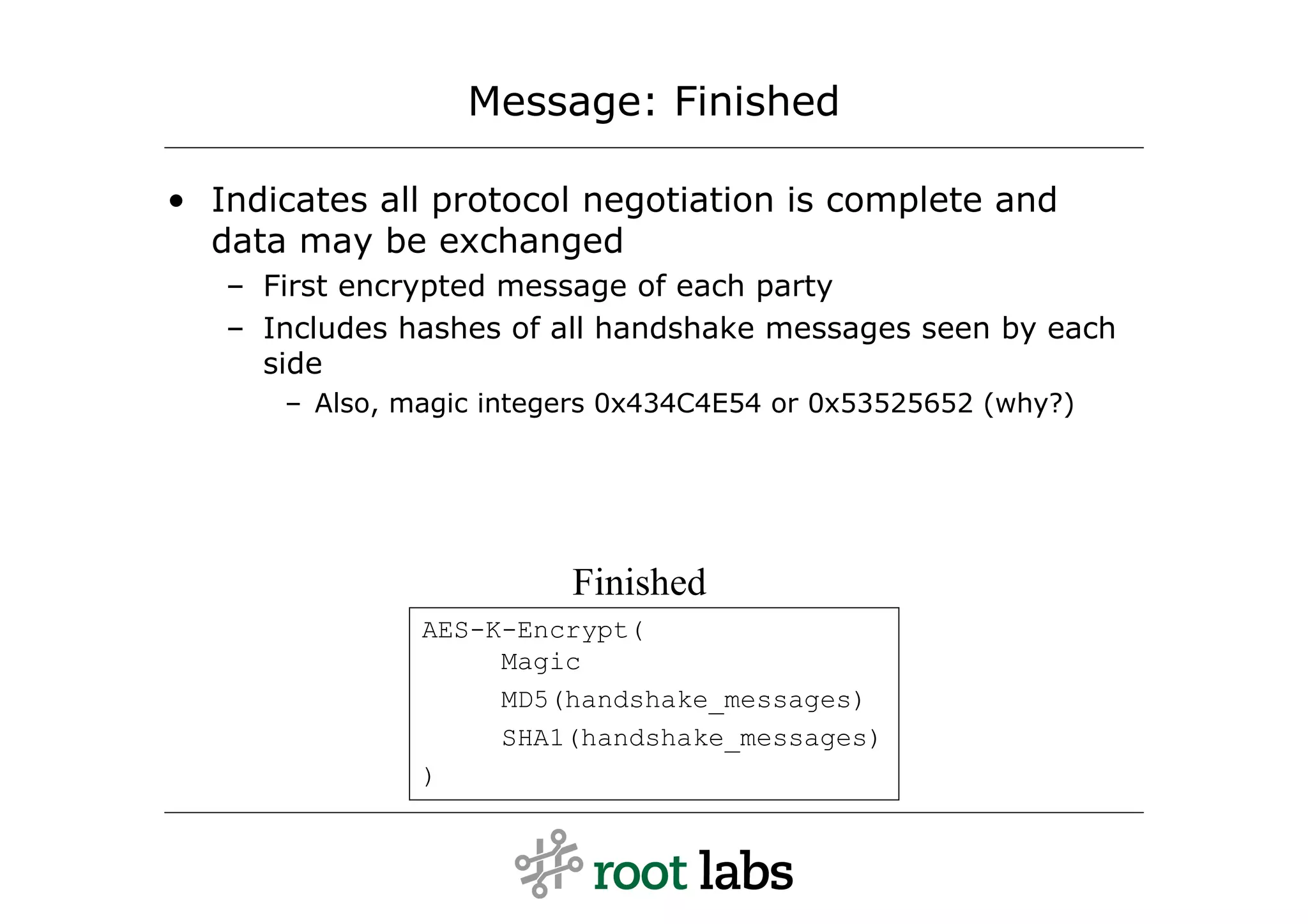
Message: Finished

• Indicates all protocol negotiation is complete and
  data may be exchanged
   – First encrypted message of each party
   – Includes hashes of all handshake messages seen by each
     side
      – Also, magic integers 0x434C4E54 or 0x53525652 (why?)


                         Finished
               AES-K-Encrypt(
                    Magic
                    MD5(handshake_messages)
                    SHA1(handshake_messages)
               )
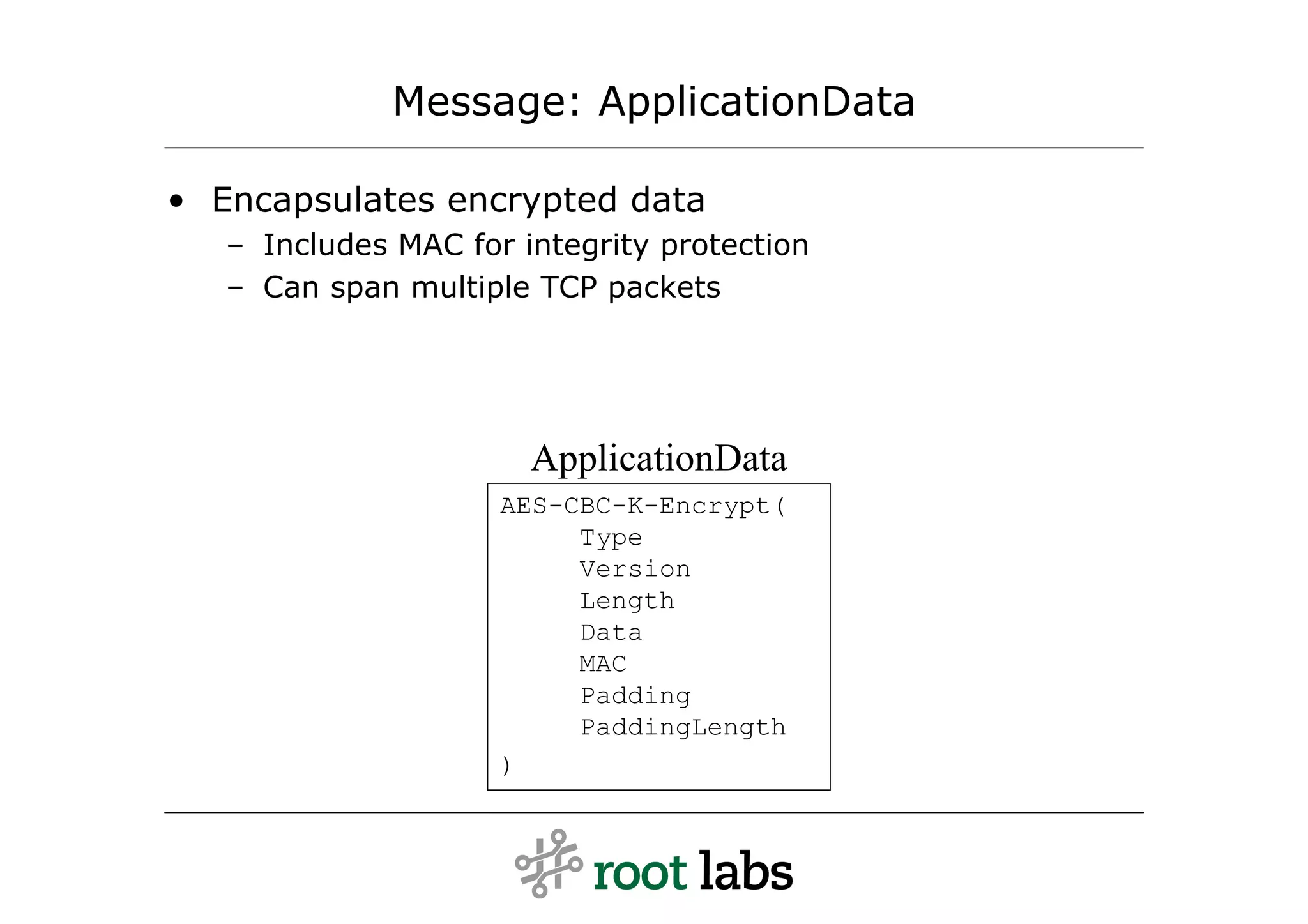
Message: ApplicationData

• Encapsulates encrypted data
   – Includes MAC for integrity protection
   – Can span multiple TCP packets


                       ApplicationData
                     AES-CBC-K-Encrypt(
                          Type
                          Version
                          Length
                          Data
                          MAC
                          Padding
                          PaddingLength
                     )
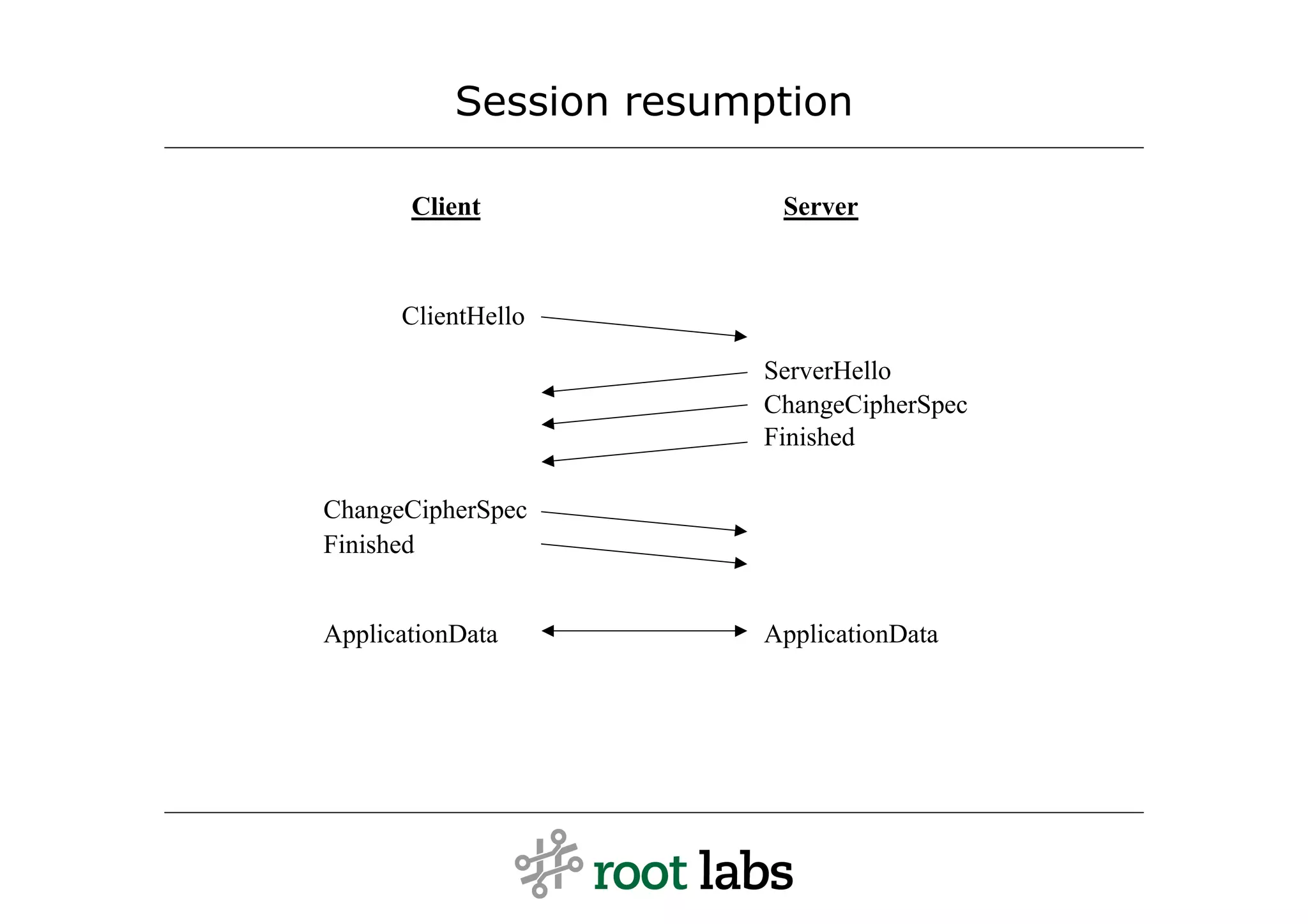
Session resumption

       Client            Server


      ClientHello

                        ServerHello
                        ChangeCipherSpec
                        Finished

ChangeCipherSpec
Finished


ApplicationData         ApplicationData
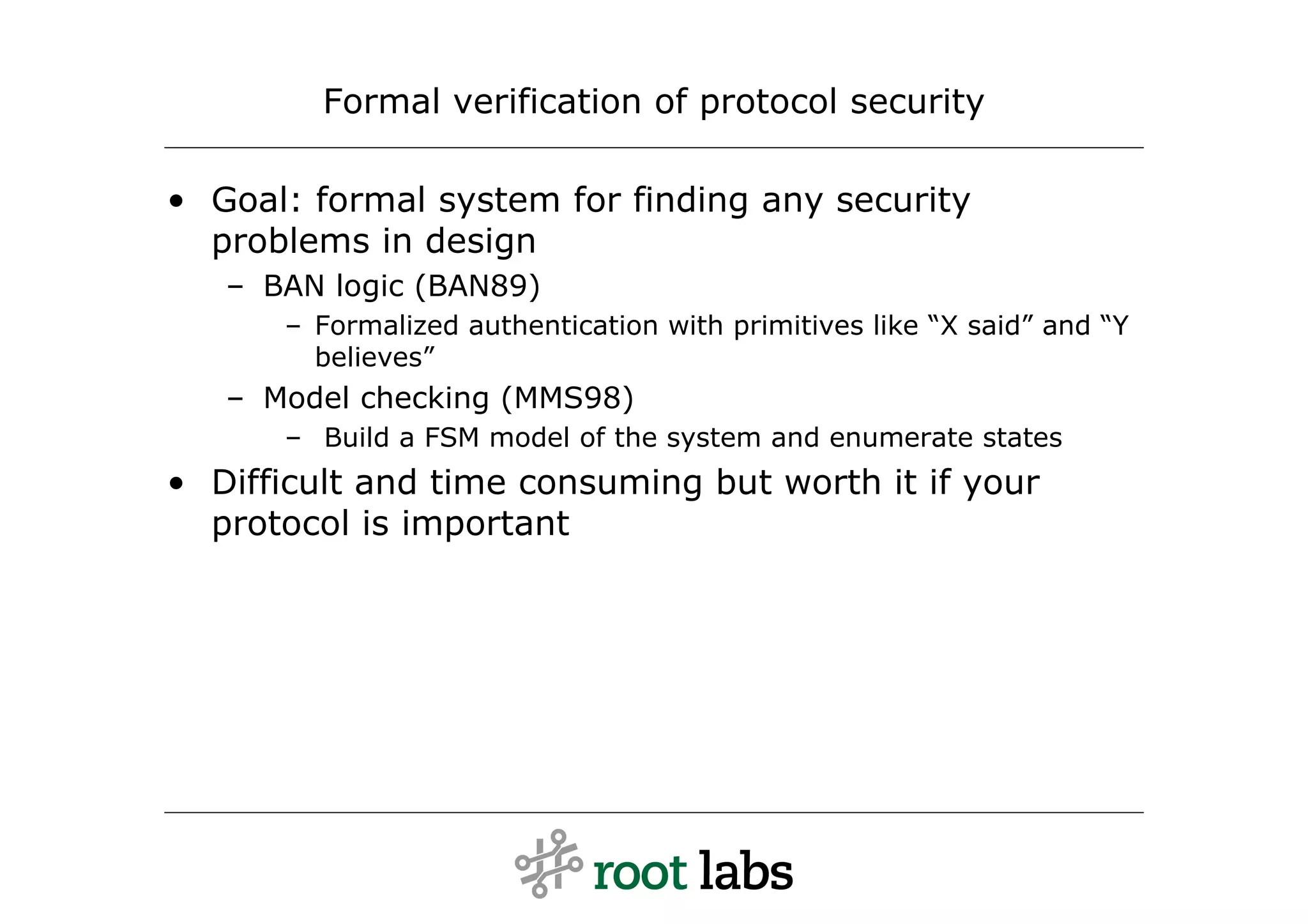
Formal verification of protocol security

• Goal: formal system for finding any security
  problems in design
   – BAN logic (BAN89)
      – Formalized authentication with primitives like “X said” and “Y
        believes”
   – Model checking (MMS98)
      – Build a FSM model of the system and enumerate states
• Difficult and time consuming but worth it if your
  protocol is important
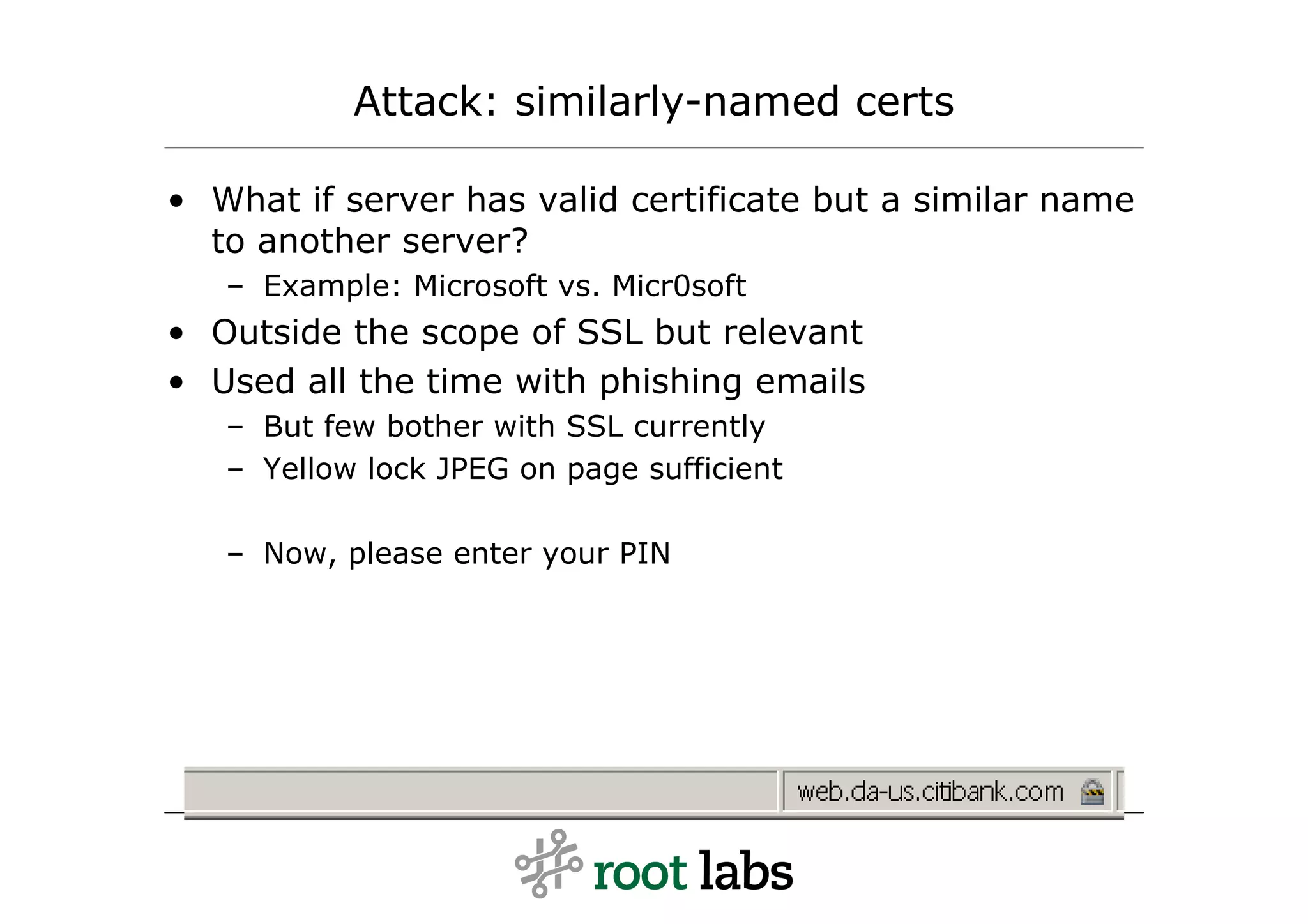
Attack: similarly-named certs

• What if server has valid certificate but a similar name
  to another server?
   – Example: Microsoft vs. Micr0soft
• Outside the scope of SSL but relevant
• Used all the time with phishing emails
   – But few bother with SSL currently
   – Yellow lock JPEG on page sufficient

   – Now, please enter your PIN
Attack: side channel

• Side effects of handling secure data can be indirectly
  observed
• Example: timing attack on server’s private key
  [BB03]
   – Observe how long the server takes to return an error
     when sending invalid ClientKeyExchange
   – Bits of the key can slowly be discovered
     … over the Internet
• Tricky problem to be sure you’ve solved adequately
Conclusions

• SSL provides a well-tested secure transport layer
• Security protocols require careful interdependence of
  primitives
   – Privacy
   – Integrity protection
   – Authentication
• Easy to make mistakes designing security and crypto
  in particular

• This stuff is a lot of fun!
Attack: 0-byte in CN field

• Certs are ASN.1 encoded
   – Length-counted strings vs. nul-terminated
   – Allows for i18n hostname in CommonName
• sslsniff (Marlinspike, 2009/7)
   – Browser may use C string routines while CA used length-
     counted routines
   – Attacker gets a cert for:
      – www.paypal.com0.example.org
      – Worse: *0.example.org
Attack: data injection via renegotiation

• Session can be renegotiated by client or server
   – Often used to go from anonymous to client-cert
     authenticated session (IIS)
   – Different from session resume
• MITM can insert bad data into authenticated session
  (Ray/Dispensa, 2009/11)
   – Client connects to server, blocked by MITM
   – MITM starts anon SSL session to server and sends
     malicious POST request over it
   – MITM forwards original ClientHello and all subsequent
     (re)negotiation messages
• Attacker has now run command as user, but can’t
  decrypt any of the output
Fixing v2.0: downgrade attacks

• Backwards compatibility with insecure protocol is
  difficult
   – Active attacker could change ServerHello to advertise v2-
     only
• Clever solution: put 64 bits of 0x3 in the RSA
  padding
   – Attacker cannot substitute their own key without breaking
     the server cert
   – Luckily, SSL v2 only supported RSA key exchange
Recommended reading
•   [TLS06] The Transport Layer Security (TLS) Protocol, Version 1.1. http://tools.ietf.org/html/rfc4346
•   [Resc02] Rescarola, E. Introduction to OpenSSL programming. http://www.rtfm.com/openssl-examples/
•   [WS96] David Wagner and Bruce Schneier. Analysis of the SSL 3.0 Protocol. 1996.
    http://citeseer.ist.psu.edu/wagner96analysis.html
•   [MMS98] John C. Mitchell, Vitaly Shmatikov, and Ulrich Stern. Finite-state analysis of SSL 3.0. In Seventh
    USENIX Security Symposium, pages 201 - 216, 1998. http://citeseer.ist.psu.edu/mitchell98finitestate.html
•   [BAN90] Burrows, M., Abadi, M., and Needham, R. M. "A Logic of Authentication", ACM Transactions on
    Computer Systems, Vol. 8, No. 1, Feb 1990, pp. 18 - 36. A Formal Semantics for Evaluating Cryptographic
    Protocols p 14. http://citeseer.ist.psu.edu/burrows90logic.htm
•   [BB03] D. Boneh and D. Brumley. Remote Timing Attacks are Practical. Proceedings of the 12th USENIX
    Security Symposium, August 2003. http://citeseer.ist.psu.edu/article/boneh03remote.html
•   M. Marlinspike, Null Prefix Attacks Against SSL/TLS Certificates. July 29, 2009.
    http://www.thoughtcrime.org/software/sslsniff/
•   M. Ray and S. Dispensa, Renegotiating TLS. November 4, 2009. http://extendedsubset.com/?p=10

TLS/SSL Protocol Design 201006

  • 1.
    TLS/SSL protocol design Nate Lawson nate@rootlabs.com Presented at Cal Poly June 3, 2010
  • 2.
    Overview • Introduction toSSL/TLS – Focus on HTTP+SSL • Design goals and result • Cryptography primer – Desired properties – Primitives for implementing them • Protocol walkthrough in detail • Attacks and mitigation
  • 3.
    My background • RootLabs founder – Design and analyze security systems – Emphasis on embedded, kernel, and crypto • Previously, Cryptography Research – Paul Kocher’s company (author of SSL 3.0) – Co-designed Blu-ray disc security layer, aka BD+ • Crypto engineer at Infogard Labs
  • 4.
    Security is hardbut rewarding • Protocols and crypto are susceptible to very minor mistakes • Example: SSL timing attacks over the Internet • Hard = fun and $ – Breaking and building things is exciting – Security is a desired skill for any resumé
  • 5.
    SSL history • SSL(Secure Sockets Layer) v2.0 (1994) – Serious security problems including incomplete MAC coverage of padding – Designed by Netscape • SSL v3.0 (1996) – Major revision to address security problems – Paul Kocher + Netscape • TLS (Transport Layer Security) 1.0 (1999) – Added new crypto algorithm support – IETF takes over • TLS 1.1 (2006) – Address Vaudenay’s CBC attacks on record layer – Provide implementation guidance
  • 6.
    Layered model • SSLprovides security at the transport layer (OSI model L4) – Stream of bytes in, private/untampered stream of bytes out – Application logic is unmodified – Can be adapted to datagram service also (DTLS) • Compare to IPSEC – Mostly used as an L3 protocol
  • 7.
    SMTP over SSL •HTTP, SMTP, POP, IMAP, etc. all have SSL variants • Two design choices to add SSL – Use alternate port since SSL session establishment differs from original protocol – SMTPS (TCP port 465 and 587) – Add protocol-specific message to toggle SSL mode – STARTTLS over port 25 (RFC 3207) • SMTP session over SSL is unchanged
  • 8.
    Security goals • Privacy – Data within SSL session should not be recoverable by anyone except the endpoints • Integrity – Data in transit should not be modified without detection except by the endpoints • Authentication – No endpoint should be able to masquerade as another
  • 9.
    Attacker capabilities • Sortedby increasing power • Normal participant – Can talk to server that is also talking to other parties • Passive eavesdropping – Observe any or all messages sent by other parties • Active (Man in the Middle) – Insert or replay old messages – Modify – Delete or reorder • Secure protocols must address all these threats
  • 10.
    Crypto property: privacy •No one other than the intended recipient of a message can determine its contents • Caveats – Adversary could have powers of knowing or choosing plaintext – Traffic analysis – Length, latency, unencrypted data like IP or Ethernet addresses – Side channel attacks: power consumption, EM, timing of operations
  • 11.
    Crypto property: integrity •Any change made to a message after it has been sent will be detected by the recipient – Corollary: reordering, replay, insertion, or deletion of messages will also be detected • Caveats – Privacy is not integrity protection – Error recovery – You can’t always terminate the session – Root of trust (shared system?)
  • 12.
    Crypto property: authentication •Messages can be associated with a given identity with high level of confidence • Caveats – Managing identification – Lost keys, forgotten passwords, laptop walks away – Revocation of old keys and refreshing to new ones – Bootstrapping: what is your root of trust?
  • 13.
    Security goal implementation •Privacy – Data is encrypted with block cipher (e.g., AES) – Cipher key is exchanged via public key crypto (e.g., RSA) • Integrity – Data is protected by a MAC (e.g., SHA1-HMAC) • Authentication – Server and/or client identity is verified via certificates
  • 14.
    Primitive: symmetric crypto •Block ciphers turn plaintext block into ciphertext using a secret key – Recipient inverts (decrypts) block using same key • Examples: AES, 3DES, RC5
  • 15.
    Primitive: symmetric crypto •Often requires “chaining” to encrypt messages longer than a single block • This does not provide integrity protection
  • 16.
    Primitive: public keycrypto • Data transformed with one key can only be inverted with the other key (asymmetric) • Examples: RSA, Diffie-Hellman, DSA – And elliptic curve variants • Can encrypt data to a recipient without also being able to decrypt it afterward • Can sign data by encrypting it with one key and publishing the other
  • 17.
  • 18.
    Primitive: certificates • Associatea name with a public key – Trusted party uses private key to sign the message “joe.com = 0x09f9…” – Public key of trusted party came with your web browser • Key management still a problem – Expire certs and explicitly revoke them if a private key is compromised (CRL) – Or, check with the trusted party each time you want to use one (OCSP)
  • 19.
    Primitive: message authenticationcode • A MAC combines a hash function and secret key with the data to protect – Resulting MAC is transmitted with message – Recipient performs same process and verifies result matches • Attacker cannot… – Modify message without changing its hash – Forge a new MAC value without knowing the key • Examples: SHA1-HMAC, AES CMAC
  • 20.
    Primitive: secure PRNG •Outputs a cryptographically-strong, pseudo-random stream of data based on initial seed – Initial seed needs to have enough entropy – PRNGs used many places (key generation, IVs, nonces) • Examples: /dev/random, Yarrow – Often based on a hash function like SHA-1
  • 21.
    Overview of typicalsession Client Server ClientHello ServerHello Certificate ServerHelloDone ClientKeyExchange ChangeCipherSpec Finished ChangeCipherSpec Finished ApplicationData ApplicationData
  • 22.
  • 23.
    Message: Client/ServerHello • Initiatesconnection and specifies parameters – Initiator sends list (i.e., CipherSuites) and responder selects one item from list – SessionID is used for resuming (explained later) Client/ServerHello Version RandomData SessionID CipherSuites CompressionMethods
  • 24.
    Message: Certificate • Providesa signed public key value to the other party – Almost always the server although clients can also authenticate with a cert – Other side must verify information in cert (i.e., the CN field is myhost.com = IP address in my TCP connection) Certificate ASN.1Cert
  • 25.
    Message: ServerHelloDone • Signifiesend of server auth process – Allows multi-pass authentication handshake – Otherwise unimportant • Cert-based auth is single-pass
  • 26.
    Message: ClientKeyExchange • Clientsends encrypted premaster secret to server – Assumes RSA public key crypto (most common) – Server checks ClientVersion matches highest advertised version ClientKeyExchange RSA-PubKey-Encrypt( ClientVersion PreMasterSecret[48] )
  • 27.
    Message: ChangeCipherSpec • Indicatesfollowing datagrams will be encrypted – Disambiguates case where next message may be error or encrypted data • Each side now calculates data encryption key (K) MasterSecret computation Hash( PreMasterSecret ClientRandom ServerRandom )
  • 28.
    Message: Finished • Indicatesall protocol negotiation is complete and data may be exchanged – First encrypted message of each party – Includes hashes of all handshake messages seen by each side – Also, magic integers 0x434C4E54 or 0x53525652 (why?) Finished AES-K-Encrypt( Magic MD5(handshake_messages) SHA1(handshake_messages) )
  • 29.
    Message: ApplicationData • Encapsulatesencrypted data – Includes MAC for integrity protection – Can span multiple TCP packets ApplicationData AES-CBC-K-Encrypt( Type Version Length Data MAC Padding PaddingLength )
  • 30.
    Session resumption Client Server ClientHello ServerHello ChangeCipherSpec Finished ChangeCipherSpec Finished ApplicationData ApplicationData
  • 31.
    Formal verification ofprotocol security • Goal: formal system for finding any security problems in design – BAN logic (BAN89) – Formalized authentication with primitives like “X said” and “Y believes” – Model checking (MMS98) – Build a FSM model of the system and enumerate states • Difficult and time consuming but worth it if your protocol is important
  • 32.
    Attack: similarly-named certs •What if server has valid certificate but a similar name to another server? – Example: Microsoft vs. Micr0soft • Outside the scope of SSL but relevant • Used all the time with phishing emails – But few bother with SSL currently – Yellow lock JPEG on page sufficient – Now, please enter your PIN
  • 33.
    Attack: side channel •Side effects of handling secure data can be indirectly observed • Example: timing attack on server’s private key [BB03] – Observe how long the server takes to return an error when sending invalid ClientKeyExchange – Bits of the key can slowly be discovered … over the Internet • Tricky problem to be sure you’ve solved adequately
  • 34.
    Conclusions • SSL providesa well-tested secure transport layer • Security protocols require careful interdependence of primitives – Privacy – Integrity protection – Authentication • Easy to make mistakes designing security and crypto in particular • This stuff is a lot of fun!
  • 35.
    Attack: 0-byte inCN field • Certs are ASN.1 encoded – Length-counted strings vs. nul-terminated – Allows for i18n hostname in CommonName • sslsniff (Marlinspike, 2009/7) – Browser may use C string routines while CA used length- counted routines – Attacker gets a cert for: – www.paypal.com0.example.org – Worse: *0.example.org
  • 36.
    Attack: data injectionvia renegotiation • Session can be renegotiated by client or server – Often used to go from anonymous to client-cert authenticated session (IIS) – Different from session resume • MITM can insert bad data into authenticated session (Ray/Dispensa, 2009/11) – Client connects to server, blocked by MITM – MITM starts anon SSL session to server and sends malicious POST request over it – MITM forwards original ClientHello and all subsequent (re)negotiation messages • Attacker has now run command as user, but can’t decrypt any of the output
  • 37.
    Fixing v2.0: downgradeattacks • Backwards compatibility with insecure protocol is difficult – Active attacker could change ServerHello to advertise v2- only • Clever solution: put 64 bits of 0x3 in the RSA padding – Attacker cannot substitute their own key without breaking the server cert – Luckily, SSL v2 only supported RSA key exchange
  • 38.
    Recommended reading • [TLS06] The Transport Layer Security (TLS) Protocol, Version 1.1. http://tools.ietf.org/html/rfc4346 • [Resc02] Rescarola, E. Introduction to OpenSSL programming. http://www.rtfm.com/openssl-examples/ • [WS96] David Wagner and Bruce Schneier. Analysis of the SSL 3.0 Protocol. 1996. http://citeseer.ist.psu.edu/wagner96analysis.html • [MMS98] John C. Mitchell, Vitaly Shmatikov, and Ulrich Stern. Finite-state analysis of SSL 3.0. In Seventh USENIX Security Symposium, pages 201 - 216, 1998. http://citeseer.ist.psu.edu/mitchell98finitestate.html • [BAN90] Burrows, M., Abadi, M., and Needham, R. M. "A Logic of Authentication", ACM Transactions on Computer Systems, Vol. 8, No. 1, Feb 1990, pp. 18 - 36. A Formal Semantics for Evaluating Cryptographic Protocols p 14. http://citeseer.ist.psu.edu/burrows90logic.htm • [BB03] D. Boneh and D. Brumley. Remote Timing Attacks are Practical. Proceedings of the 12th USENIX Security Symposium, August 2003. http://citeseer.ist.psu.edu/article/boneh03remote.html • M. Marlinspike, Null Prefix Attacks Against SSL/TLS Certificates. July 29, 2009. http://www.thoughtcrime.org/software/sslsniff/ • M. Ray and S. Dispensa, Renegotiating TLS. November 4, 2009. http://extendedsubset.com/?p=10