Network Security
Presented by
Mr. Abhijeet A. More
(Perfect Training Center)
Security and Cryptography
• Security: all issues which make secure
communication (information transmission, two
(multiple) party interaction) over insecure channels.
• Cryptography: the science and art of manipulating
messages to make them secure.
• Classical cryptographic techniques.
• Along with the development of communication
networks and their broad applications, network
security is becoming a more serious problem.
• Thus, call for modern cryptography.
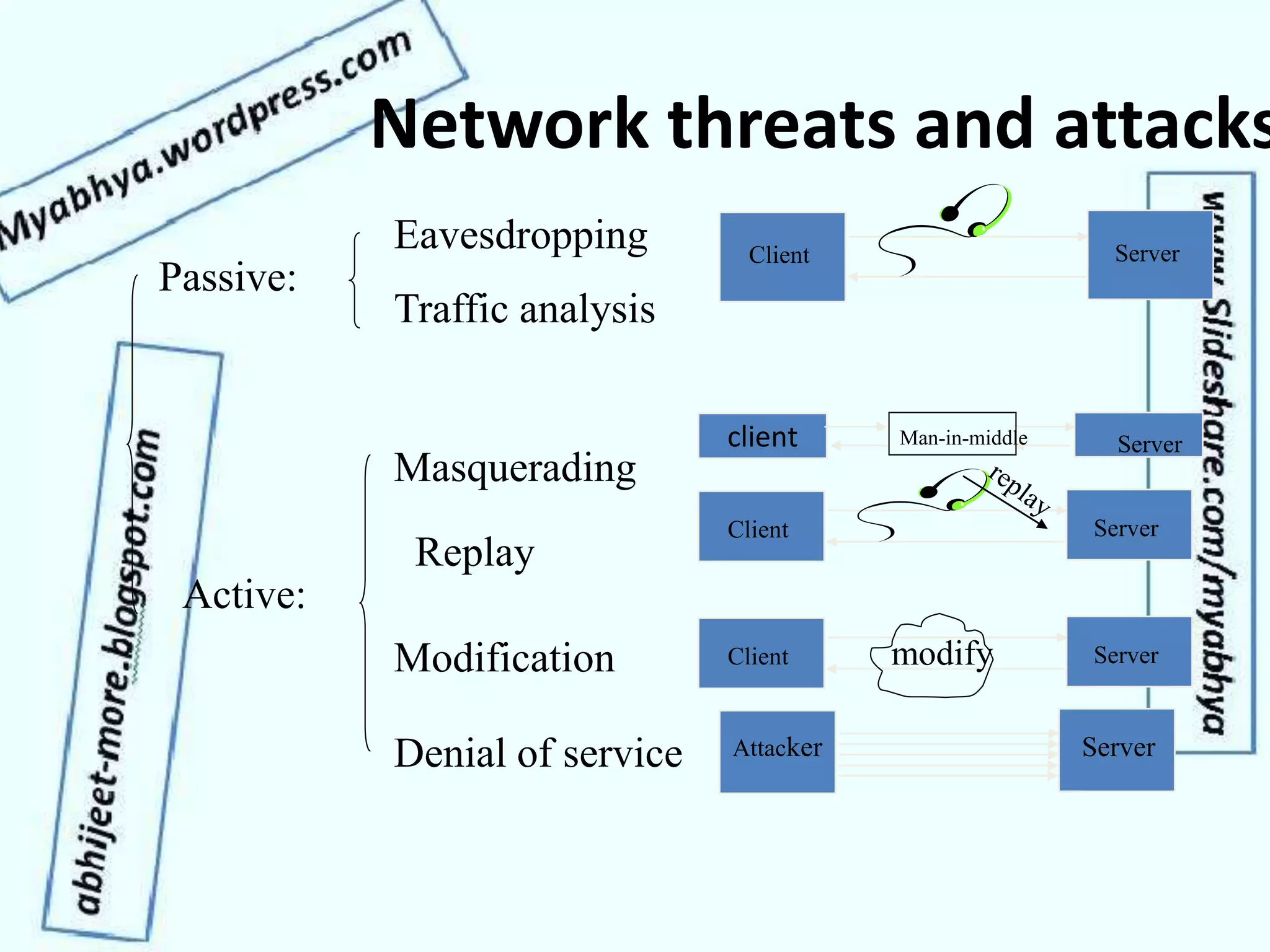
Network threats and attacks
Passive:
Active:
Eavesdropping
Traffic analysis
Masquerading
Replay
Modification
Denial of service
Client Server
Attacker Server
Client Servermodify
Clientclient ServerMan-in-middle
Client Server
Security Requirements
• Privacy or confidentiality: The information should
be readable only by the intended receiver. i.e.,
protect the information from eavesdropping.
• Integrity: The receiver can confirm that a message
has not been altered during transmission, i.e.,
protect the information from tampering.
• Authentication: Any party (sender or receiver) can
verify that the other party is who he or she claims
to be, i.e., validate the identity of the other party.
• Nonrepudiation: The sender can not deny having
sent a given message. i.e., if a transaction (e.g., a
purchase) has occurred between two parties, the
nonrepudiation service can prove that for any
party, he/she really performed the transaction
him/herself, not by any other person.
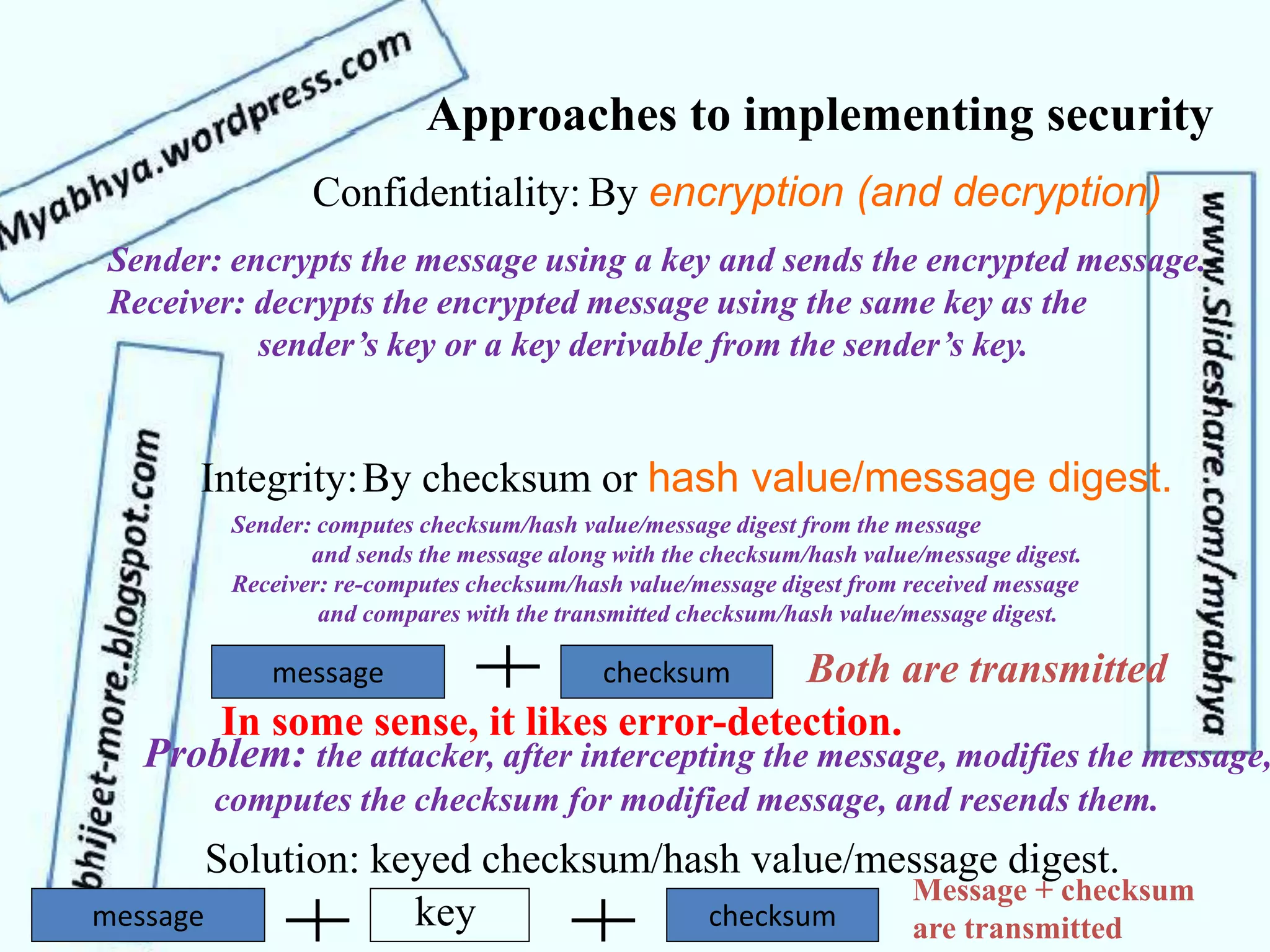
Approaches to implementing security
Confidentiality: By encryption (and decryption)
Sender: encrypts the message using a key and sends the encrypted message.
Receiver: decrypts the encrypted message using the same key as the
sender’s key or a key derivable from the sender’s key.
Integrity:By checksum or hash value/message digest.
Sender: computes checksum/hash value/message digest from the message
and sends the message along with the checksum/hash value/message digest.
Receiver: re-computes checksum/hash value/message digest from received message
and compares with the transmitted checksum/hash value/message digest.
In some sense, it likes error-detection.
Problem: the attacker, after intercepting the message, modifies the message,
computes the checksum for modified message, and resends them.
Solution: keyed checksum/hash value/message digest.
message checksum Both are transmitted
message checksumkey
Message + checksum
are transmitted
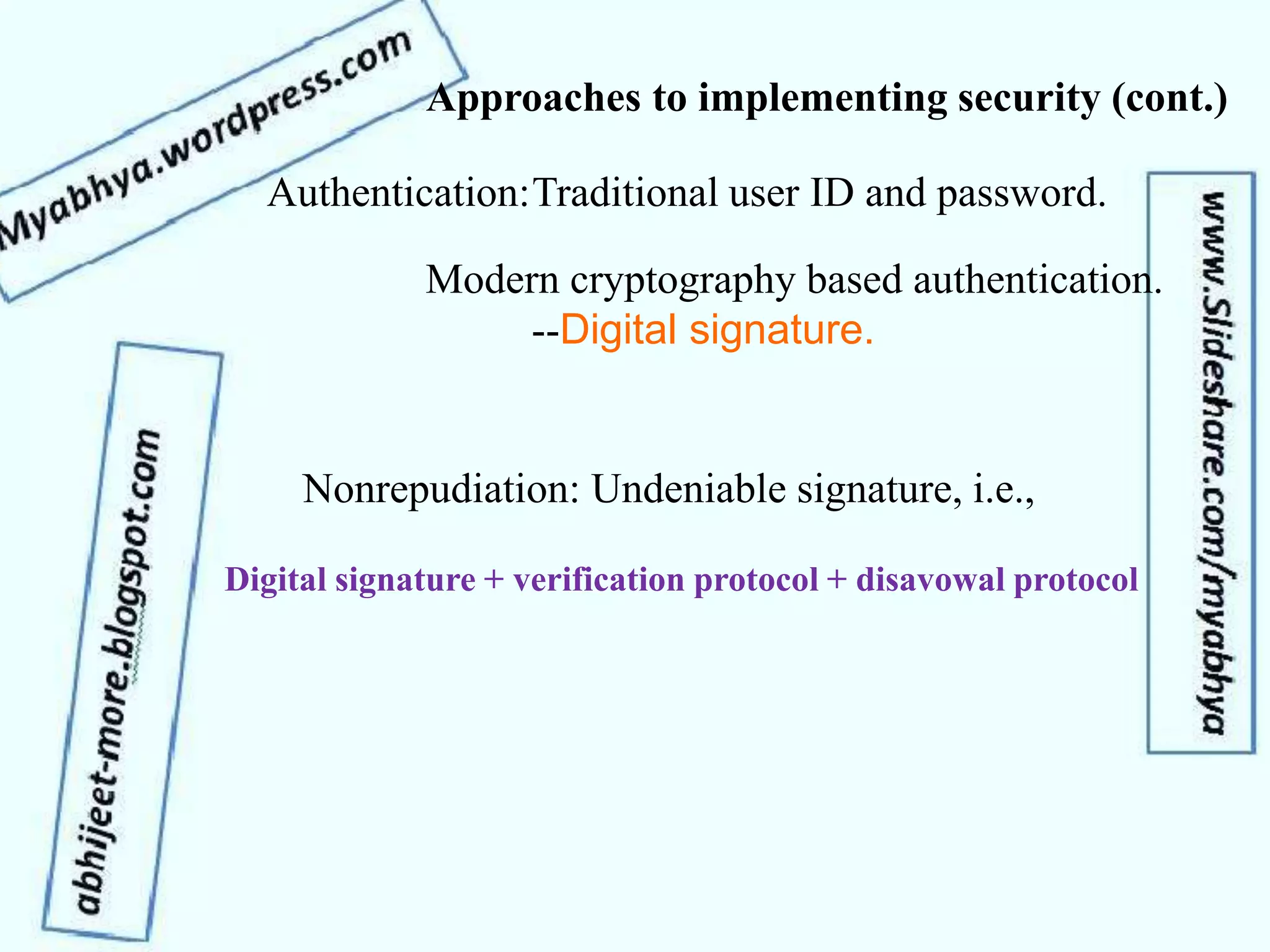
Approaches to implementing security (cont.)
Authentication:Traditional user ID and password.
Modern cryptography based authentication.
--Digital signature.
Nonrepudiation: Undeniable signature, i.e.,
Digital signature + verification protocol + disavowal protocol
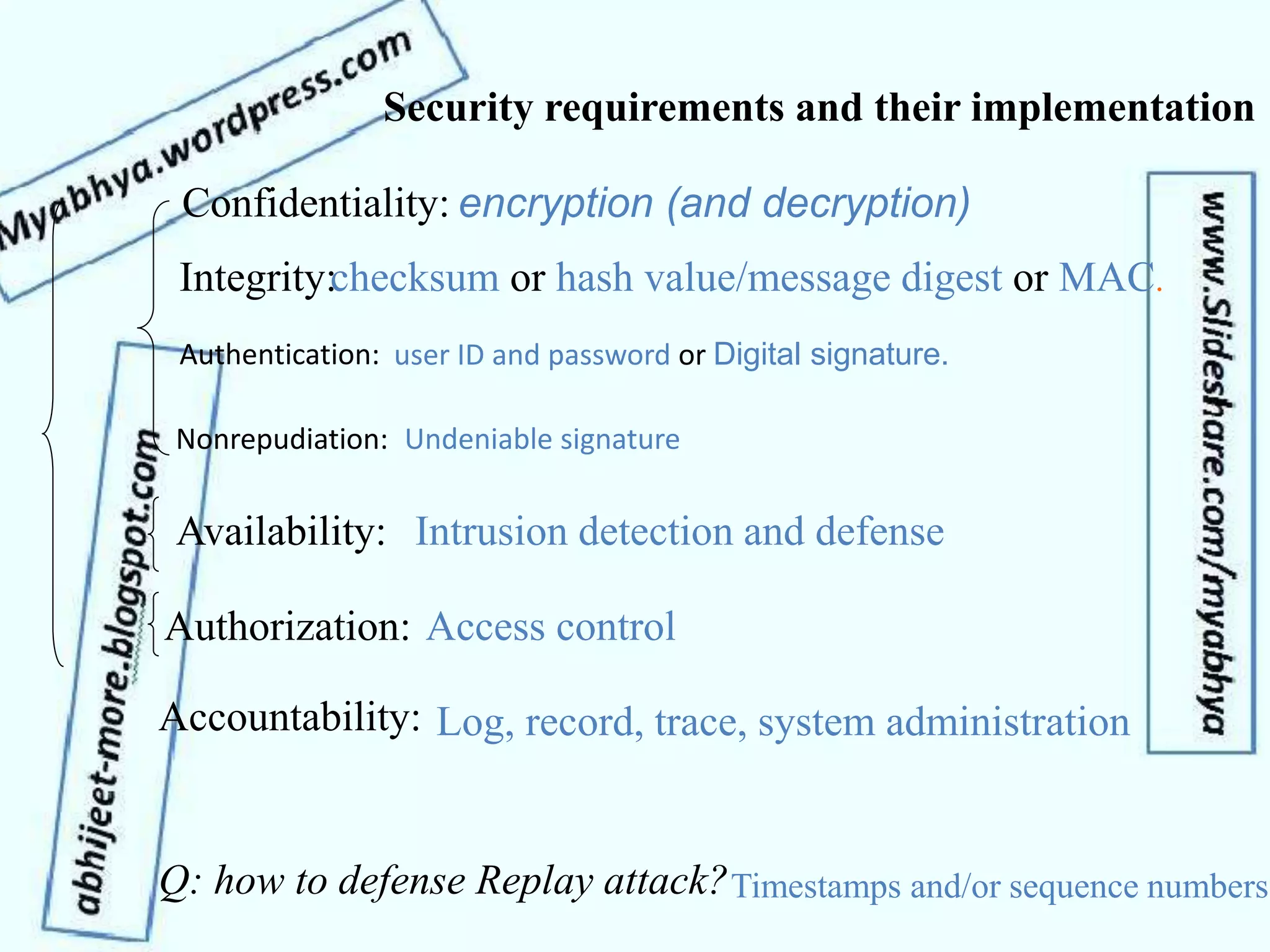
Security requirements and their implementation
Confidentiality: encryption (and decryption)
Integrity:checksum or hash value/message digest or MAC.
Authentication: user ID and password or Digital signature.
Nonrepudiation: Undeniable signature
Availability: Intrusion detection and defense
Authorization: Access control
Accountability: Log, record, trace, system administration
Q: how to defense Replay attack?Timestamps and/or sequence numbers.
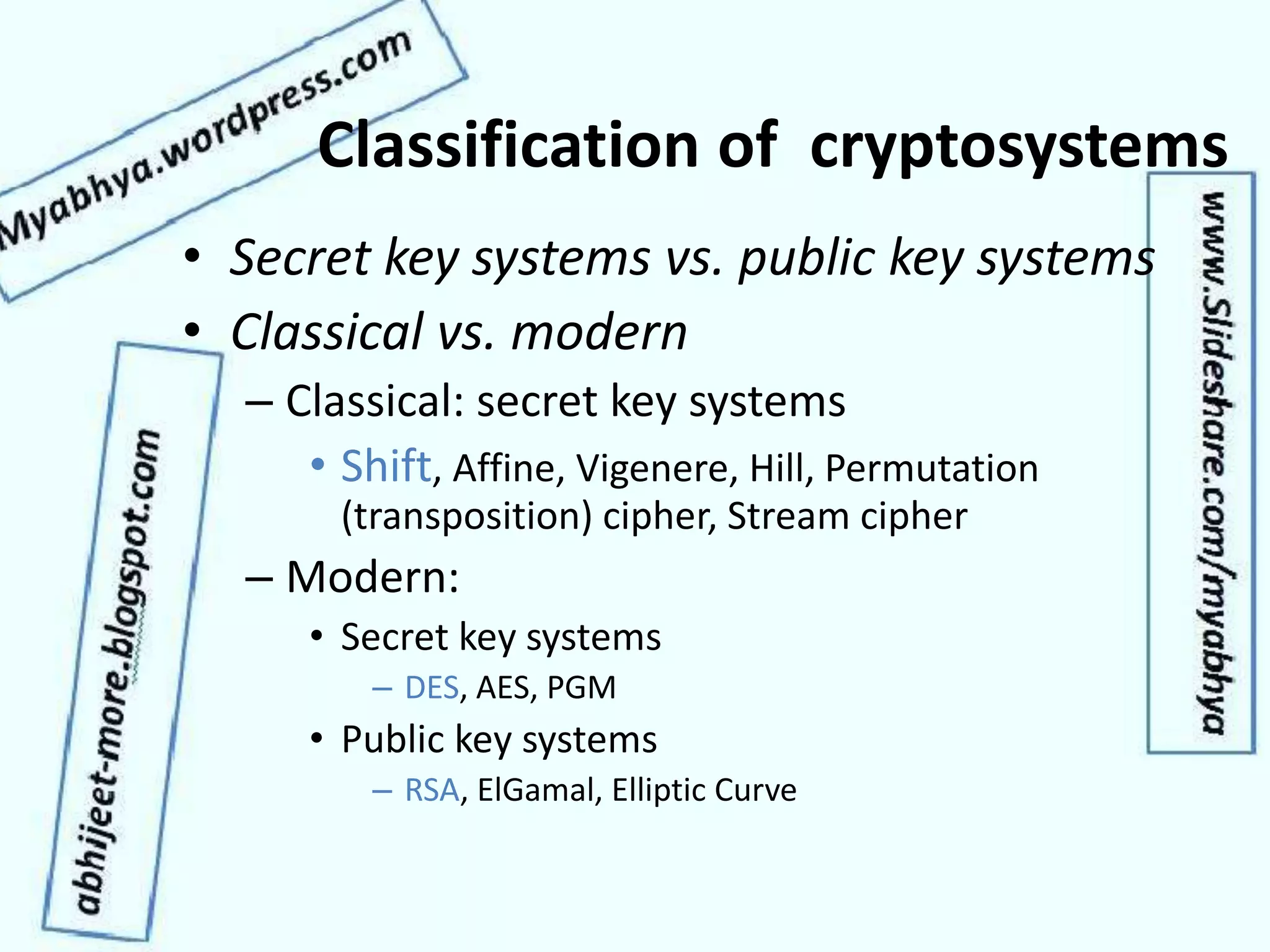
Classification of cryptosystems
• Secret key systems vs. public key systems
• Classical vs. modern
– Classical: secret key systems
• Shift, Affine, Vigenere, Hill, Permutation
(transposition) cipher, Stream cipher
– Modern:
• Secret key systems
– DES, AES, PGM
• Public key systems
– RSA, ElGamal, Elliptic Curve
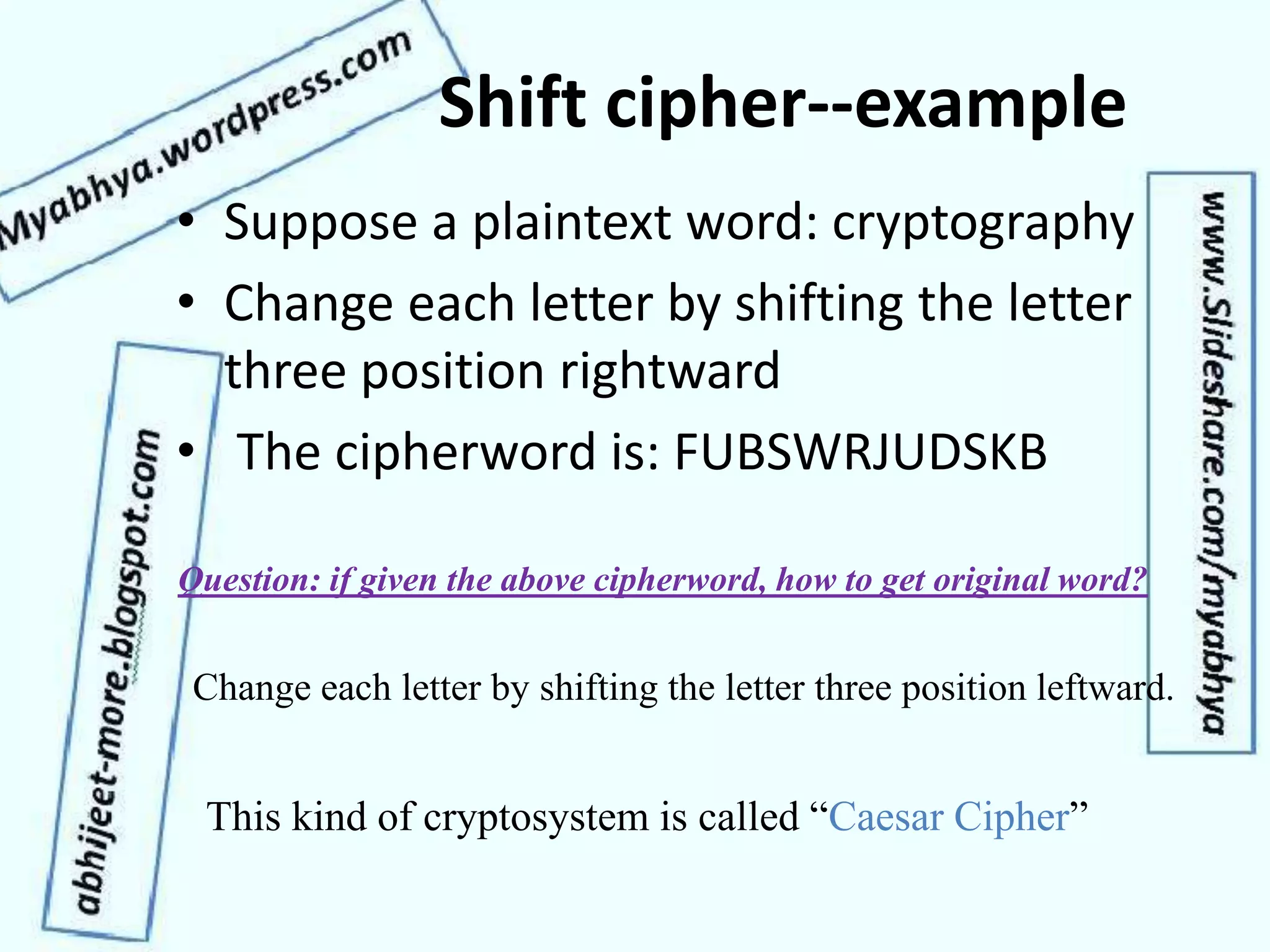
Shift cipher--example
• Suppose a plaintext word: cryptography
• Change each letter by shifting the letter
three position rightward
• The cipherword is: FUBSWRJUDSKB
Question: if given the above cipherword, how to get original word?
Change each letter by shifting the letter three position leftward.
This kind of cryptosystem is called “Caesar Cipher”
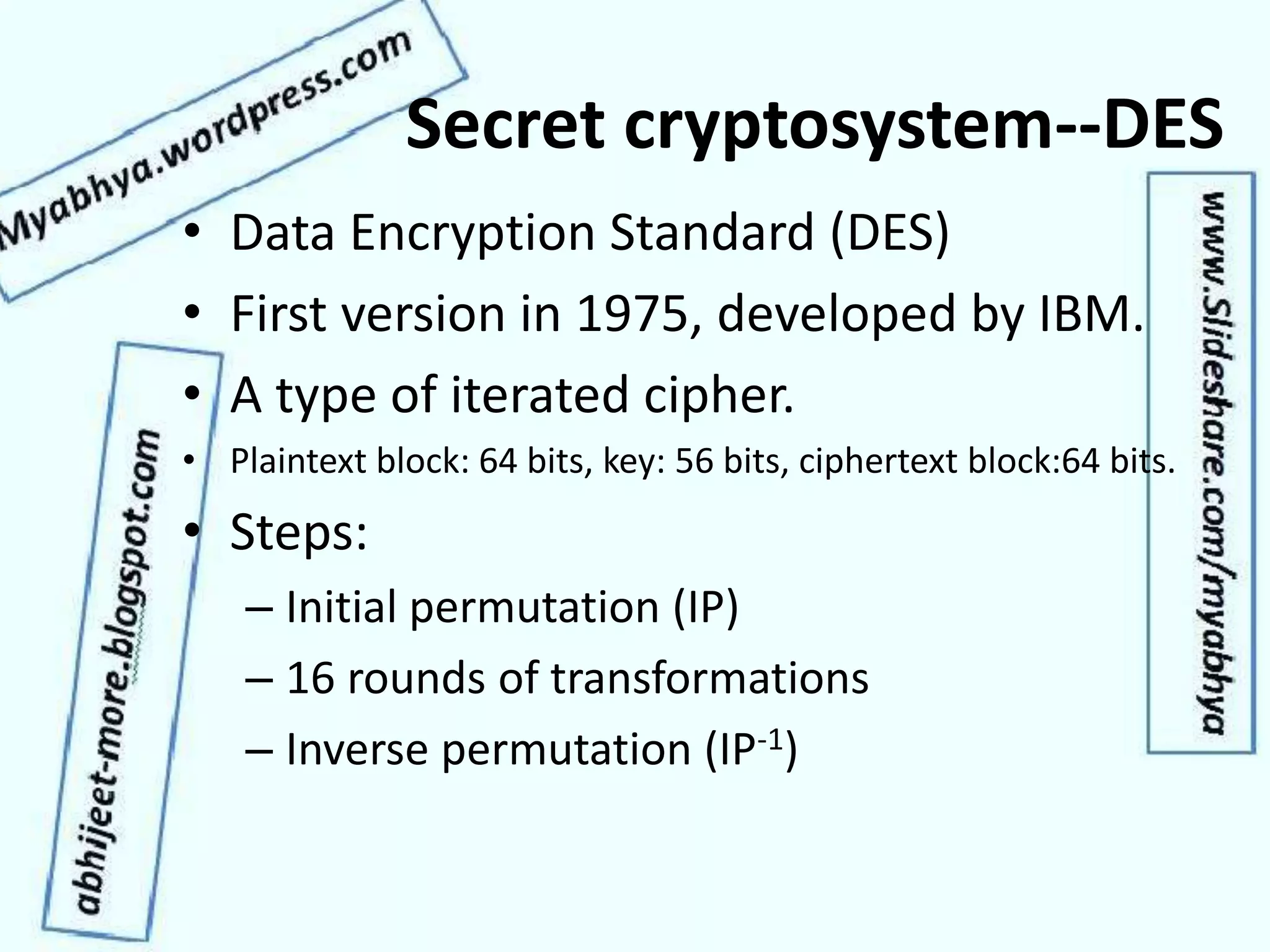
Secret cryptosystem--DES
• Data Encryption Standard (DES)
• First version in 1975, developed by IBM.
• A type of iterated cipher.
• Plaintext block: 64 bits, key: 56 bits, ciphertext block:64 bits.
• Steps:
– Initial permutation (IP)
– 16 rounds of transformations
– Inverse permutation (IP-1)
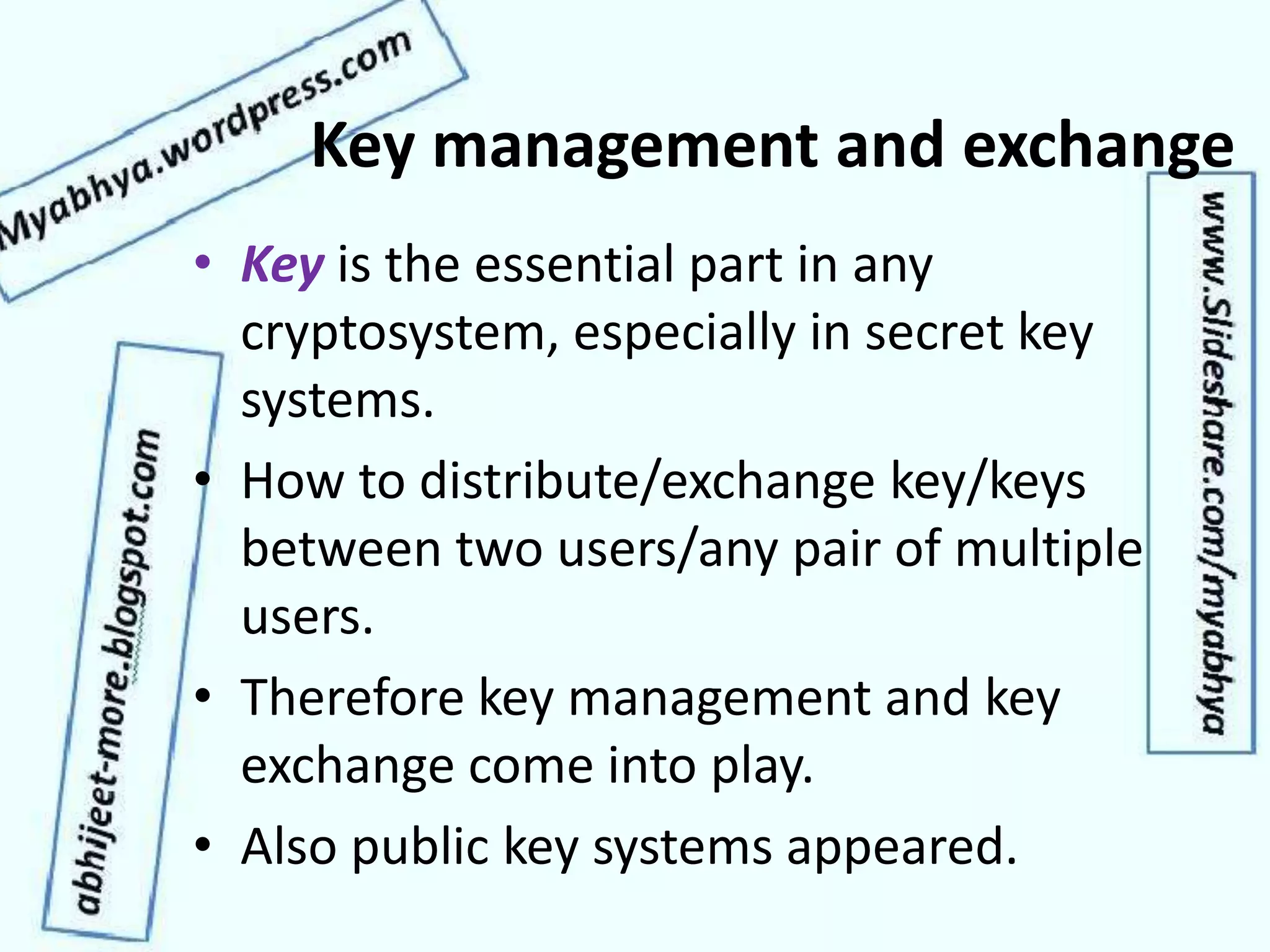
Key management and exchange
• Key is the essential part in any
cryptosystem, especially in secret key
systems.
• How to distribute/exchange key/keys
between two users/any pair of multiple
users.
• Therefore key management and key
exchange come into play.
• Also public key systems appeared.
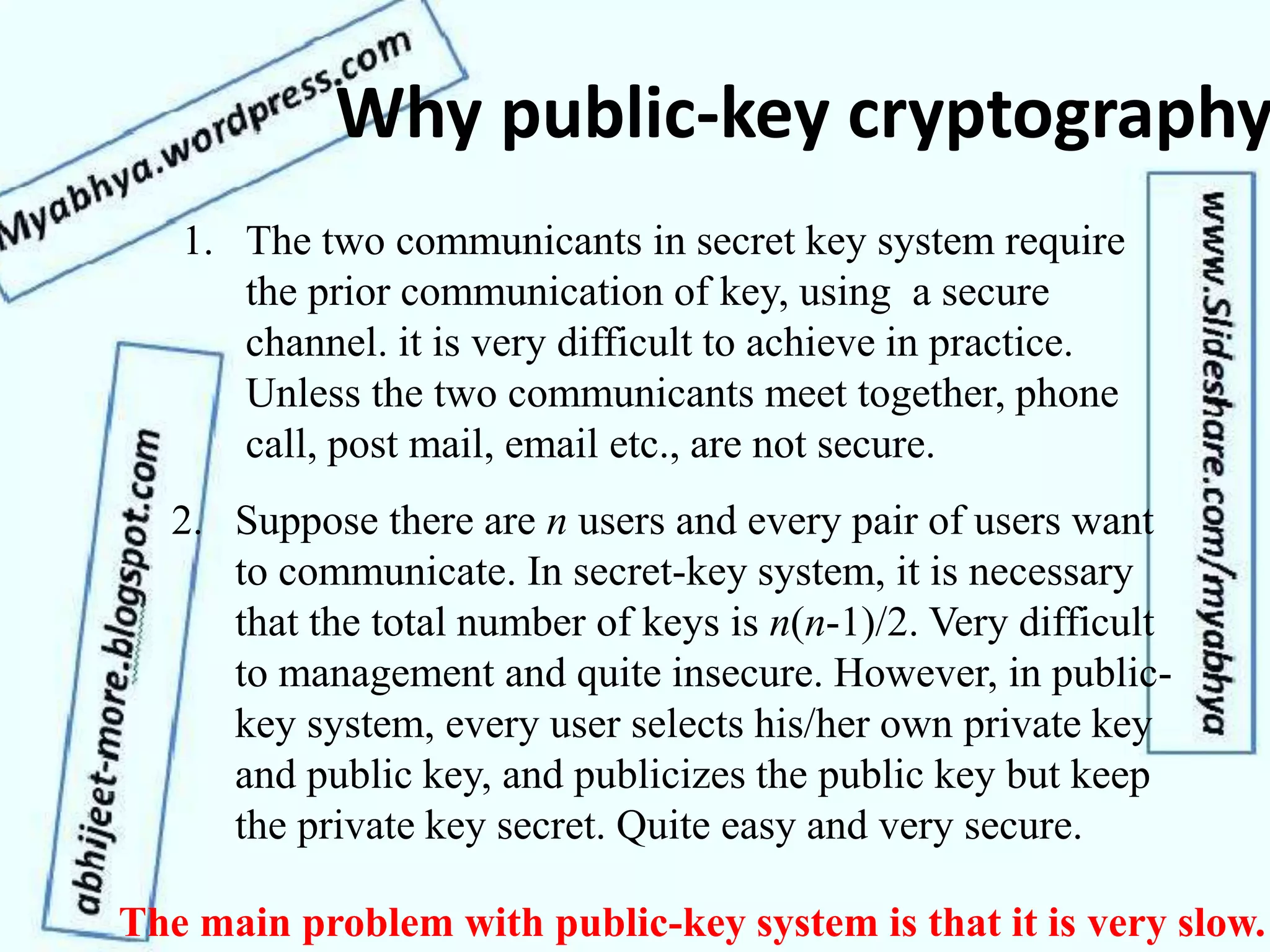
Why public-key cryptography
1. The two communicants in secret key system require
the prior communication of key, using a secure
channel. it is very difficult to achieve in practice.
Unless the two communicants meet together, phone
call, post mail, email etc., are not secure.
2. Suppose there are n users and every pair of users want
to communicate. In secret-key system, it is necessary
that the total number of keys is n(n-1)/2. Very difficult
to management and quite insecure. However, in public-
key system, every user selects his/her own private key
and public key, and publicizes the public key but keep
the private key secret. Quite easy and very secure.
The main problem with public-key system is that it is very slow.
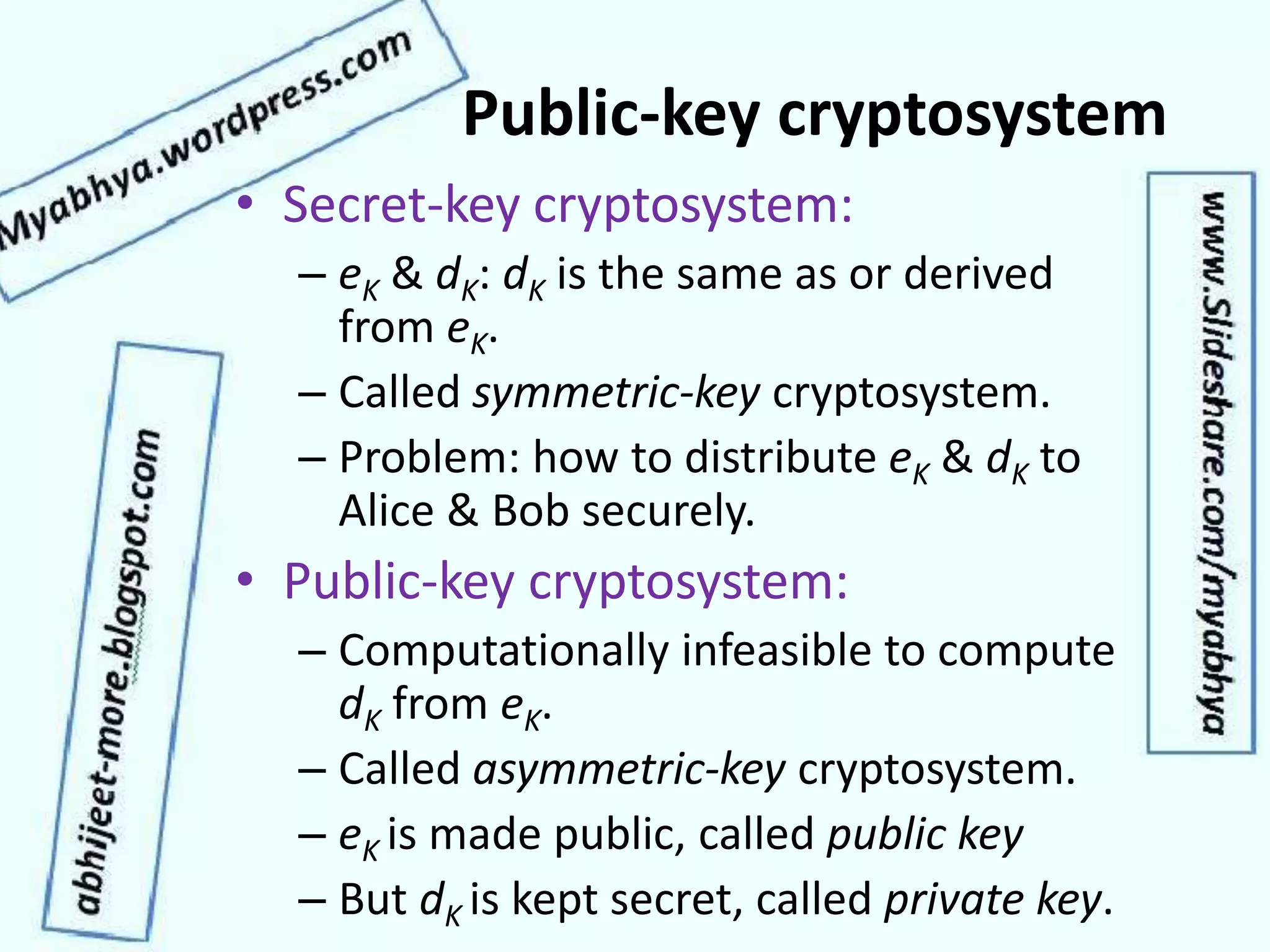
Public-key cryptosystem
• Secret-key cryptosystem:
– eK & dK: dK is the same as or derived
from eK.
– Called symmetric-key cryptosystem.
– Problem: how to distribute eK & dK to
Alice & Bob securely.
• Public-key cryptosystem:
– Computationally infeasible to compute
dK from eK.
– Called asymmetric-key cryptosystem.
– eK is made public, called public key
– But dK is kept secret, called private key.
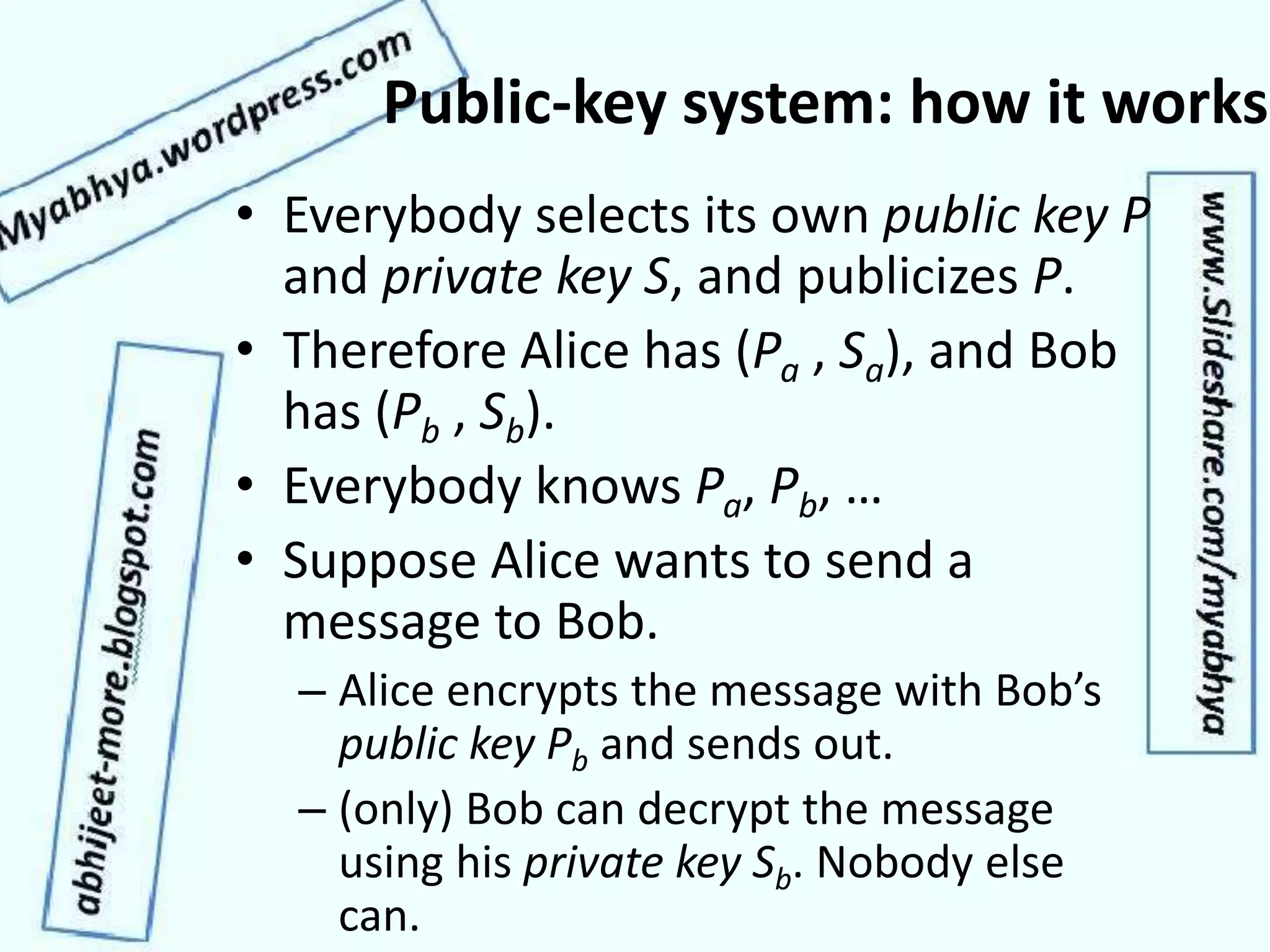
Public-key system: how it works
• Everybody selects its own public key P
and private key S, and publicizes P.
• Therefore Alice has (Pa , Sa), and Bob
has (Pb , Sb).
• Everybody knows Pa, Pb, …
• Suppose Alice wants to send a
message to Bob.
– Alice encrypts the message with Bob’s
public key Pb and sends out.
– (only) Bob can decrypt the message
using his private key Sb. Nobody else
can.
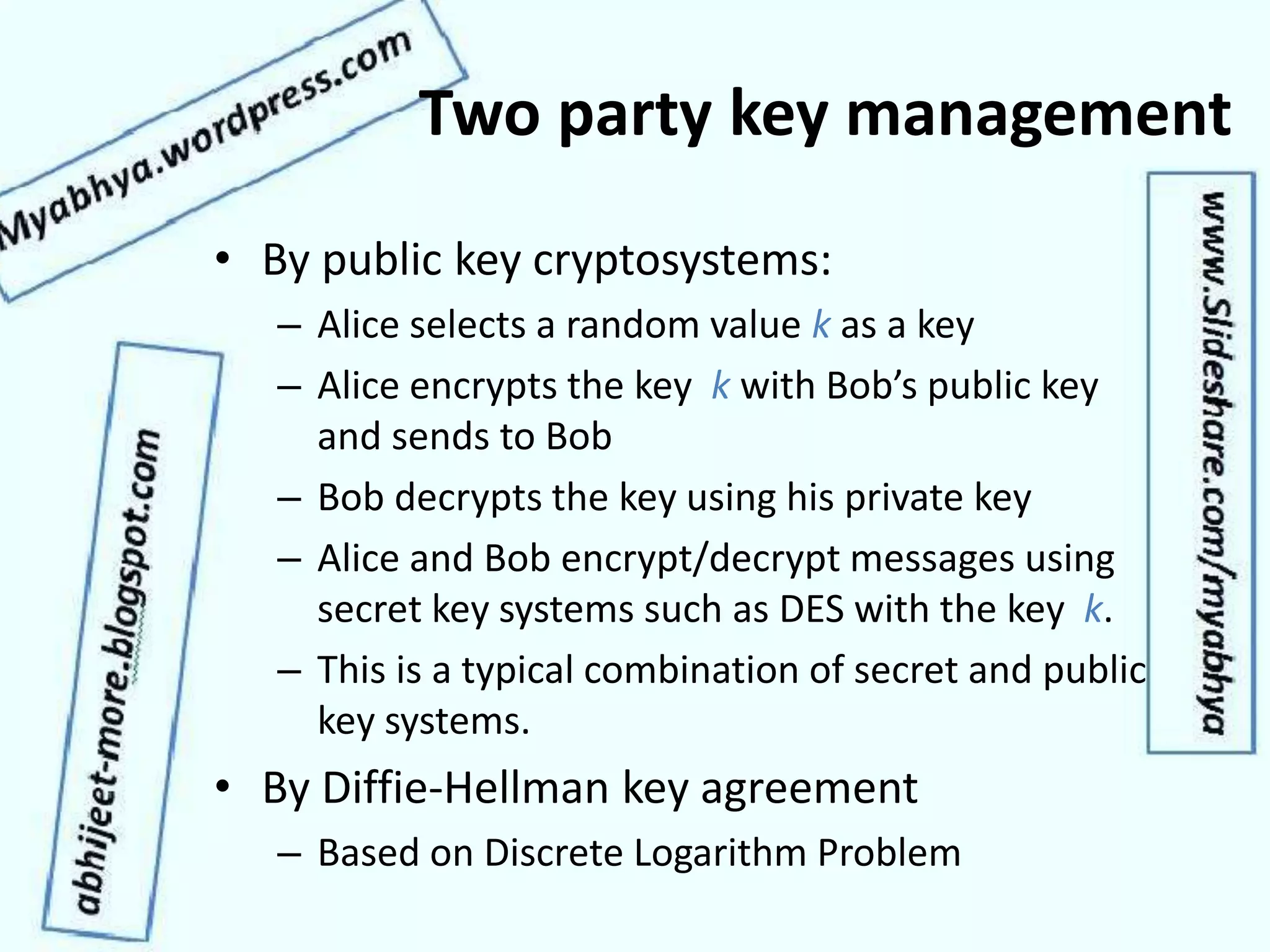
Two party key management
• By public key cryptosystems:
– Alice selects a random value k as a key
– Alice encrypts the key k with Bob’s public key
and sends to Bob
– Bob decrypts the key using his private key
– Alice and Bob encrypt/decrypt messages using
secret key systems such as DES with the key k.
– This is a typical combination of secret and public
key systems.
• By Diffie-Hellman key agreement
– Based on Discrete Logarithm Problem
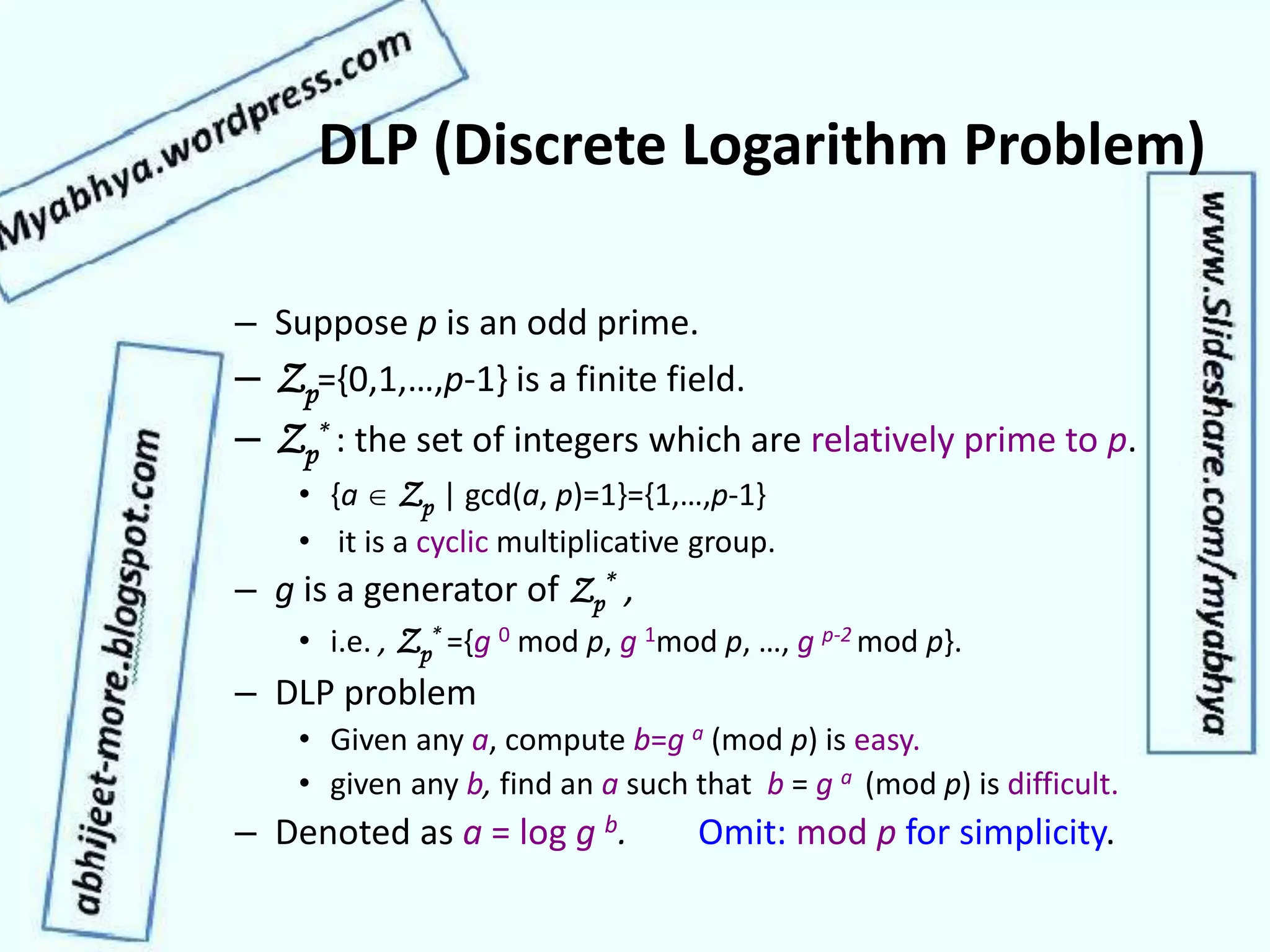
DLP (Discrete Logarithm Problem)
– Suppose p is an odd prime.
– Zp={0,1,…,p-1} is a finite field.
– Zp
* : the set of integers which are relatively prime to p.
• {a  Zp | gcd(a, p)=1}={1,…,p-1}
• it is a cyclic multiplicative group.
– g is a generator of Zp
* ,
• i.e. , Zp
* ={g 0 mod p, g 1mod p, …, g p-2 mod p}.
– DLP problem
• Given any a, compute b=g a (mod p) is easy.
• given any b, find an a such that b = g a (mod p) is difficult.
– Denoted as a = log g b. Omit: mod p for simplicity.
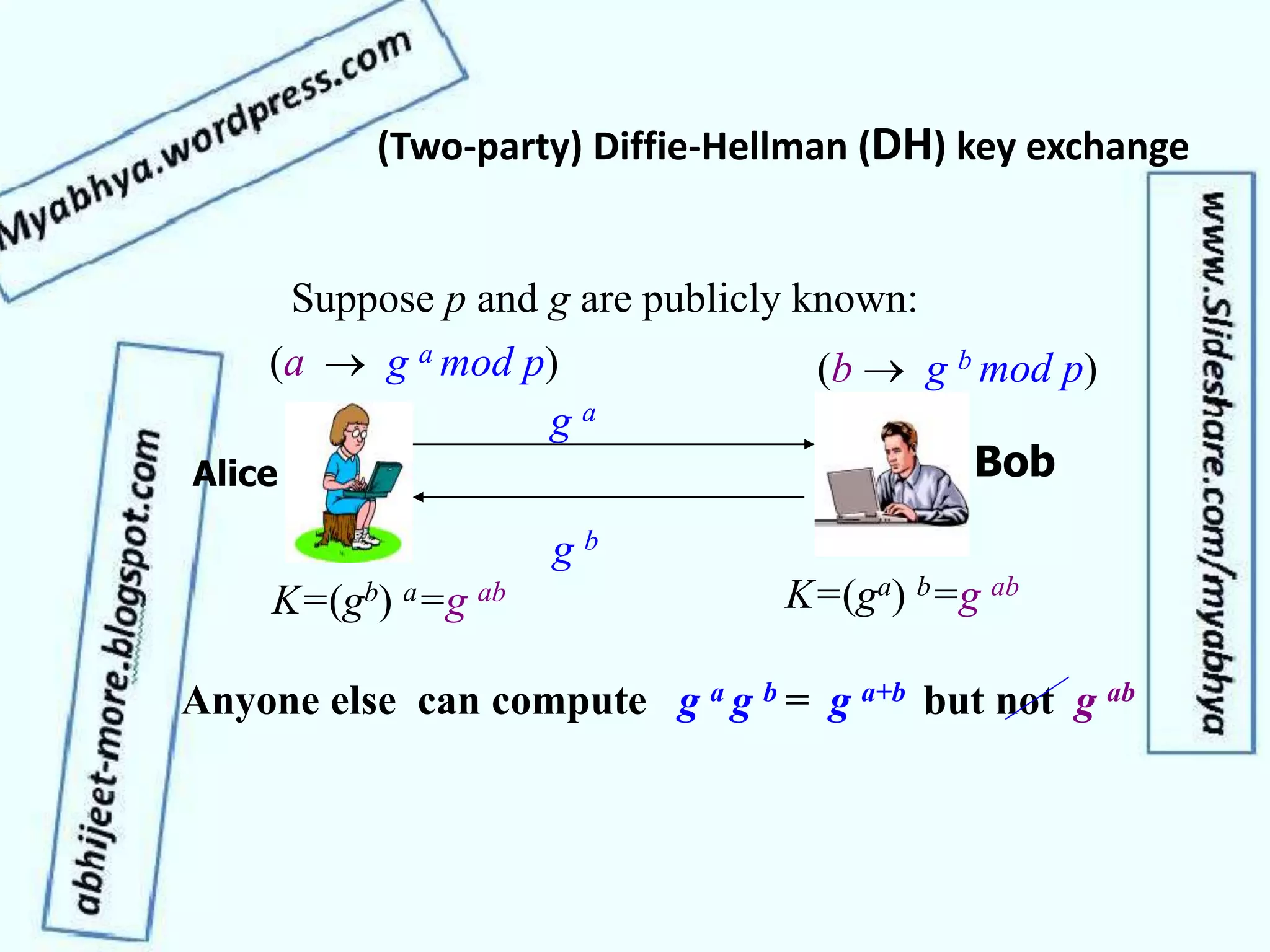
(Two-party) Diffie-Hellman (DH) key exchange
Suppose p and g are publicly known:
g a
g b
(a (b  g b mod p)
K=(gb) a=g ab K=(ga) b=g ab
Alice Bob
 g a mod p)
Anyone else can compute g a g b = g a+b but not g ab
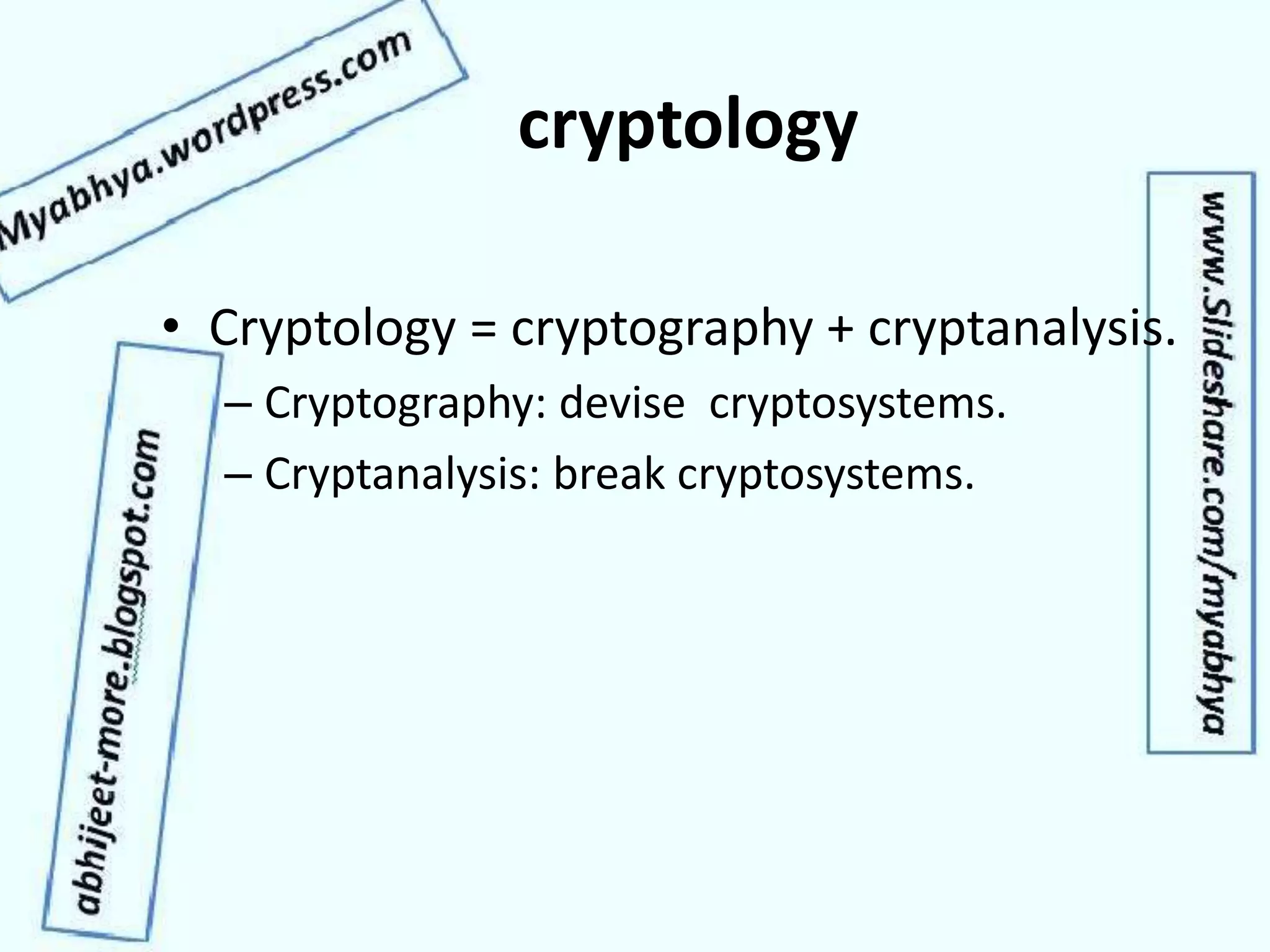
cryptology
• Cryptology = cryptography + cryptanalysis.
– Cryptography: devise cryptosystems.
– Cryptanalysis: break cryptosystems.
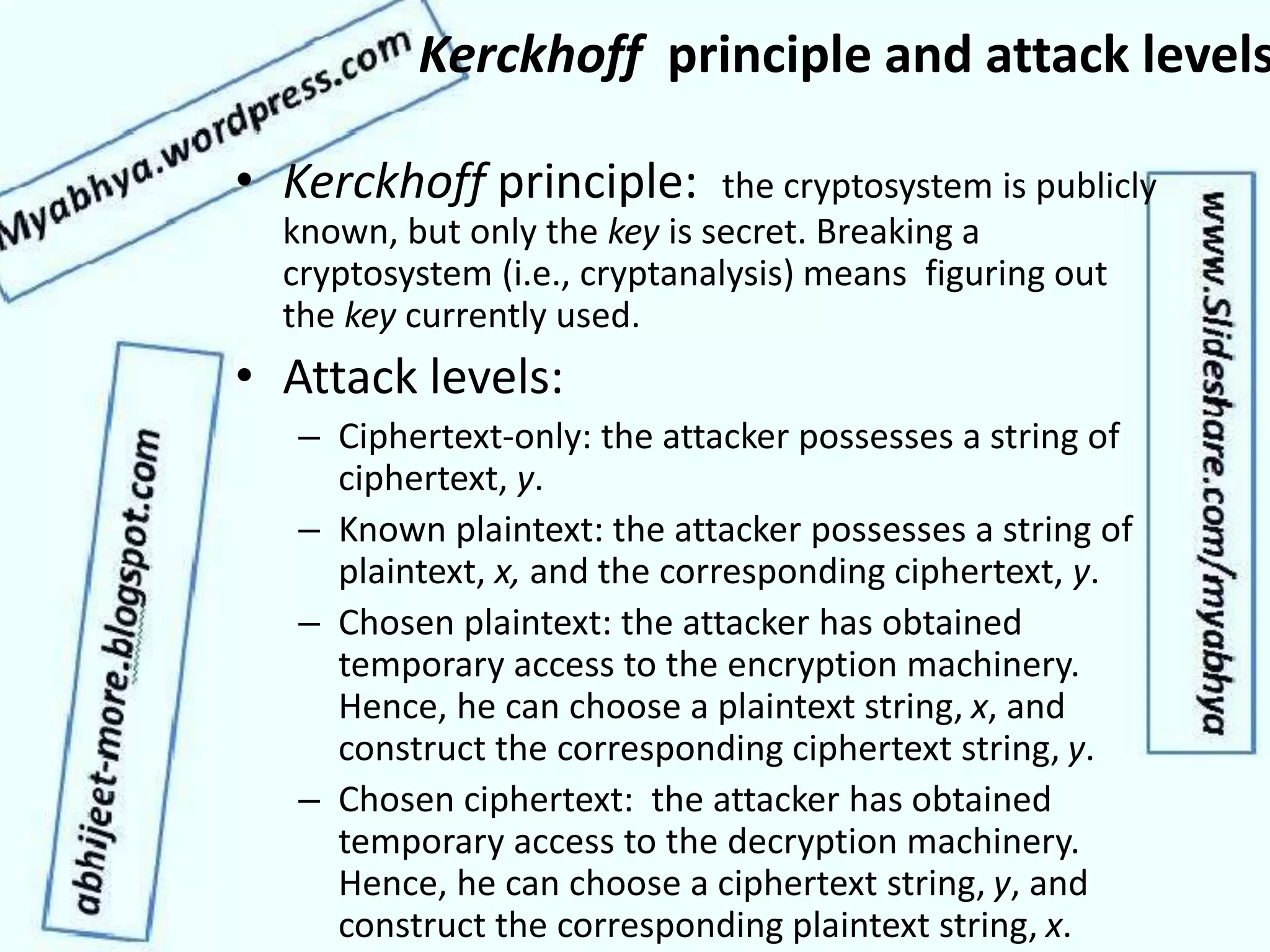
Kerckhoff principle and attack levels
• Kerckhoff principle: the cryptosystem is publicly
known, but only the key is secret. Breaking a
cryptosystem (i.e., cryptanalysis) means figuring out
the key currently used.
• Attack levels:
– Ciphertext-only: the attacker possesses a string of
ciphertext, y.
– Known plaintext: the attacker possesses a string of
plaintext, x, and the corresponding ciphertext, y.
– Chosen plaintext: the attacker has obtained
temporary access to the encryption machinery.
Hence, he can choose a plaintext string, x, and
construct the corresponding ciphertext string, y.
– Chosen ciphertext: the attacker has obtained
temporary access to the decryption machinery.
Hence, he can choose a ciphertext string, y, and
construct the corresponding plaintext string, x.
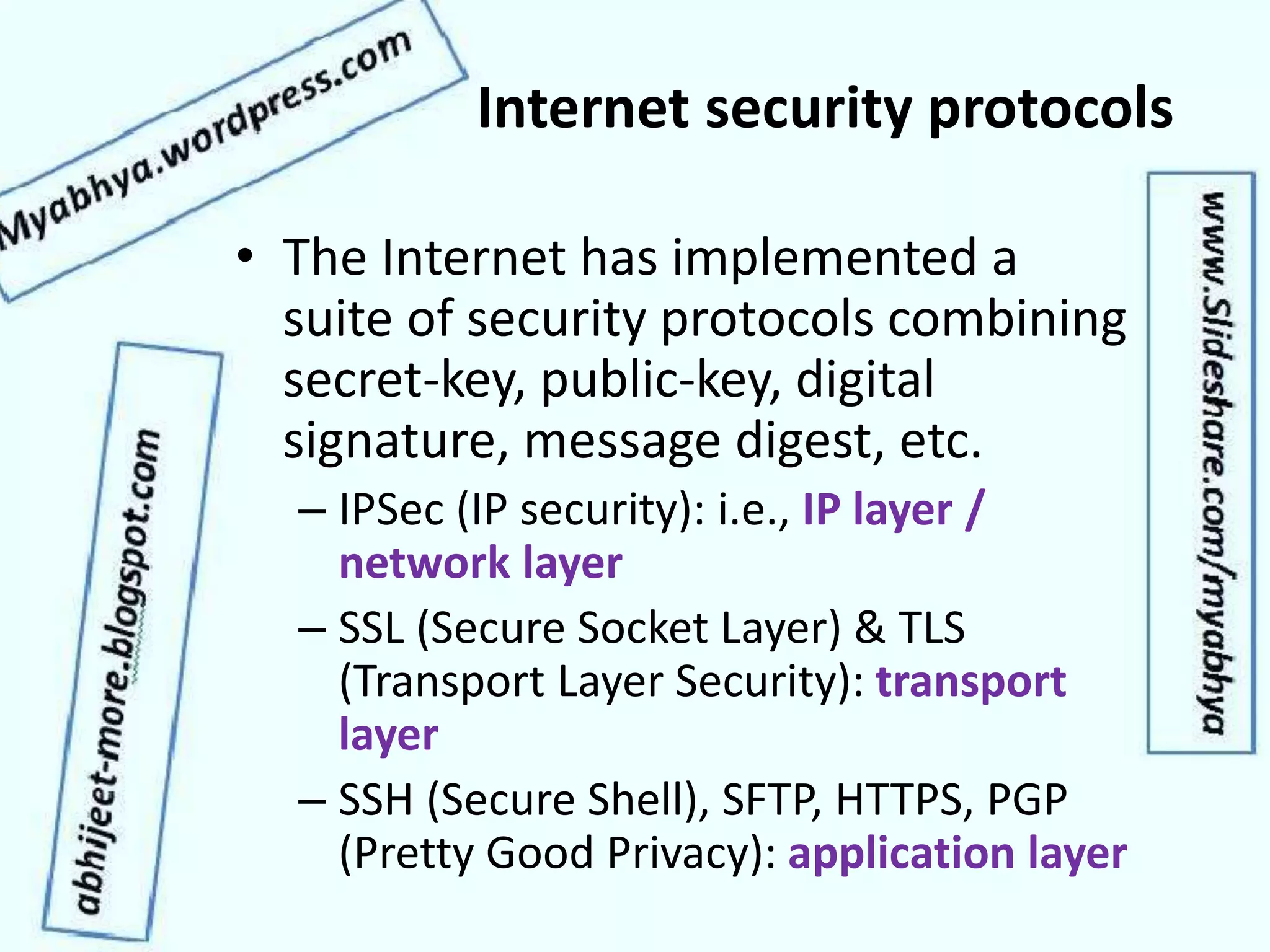
Internet security protocols
• The Internet has implemented a
suite of security protocols combining
secret-key, public-key, digital
signature, message digest, etc.
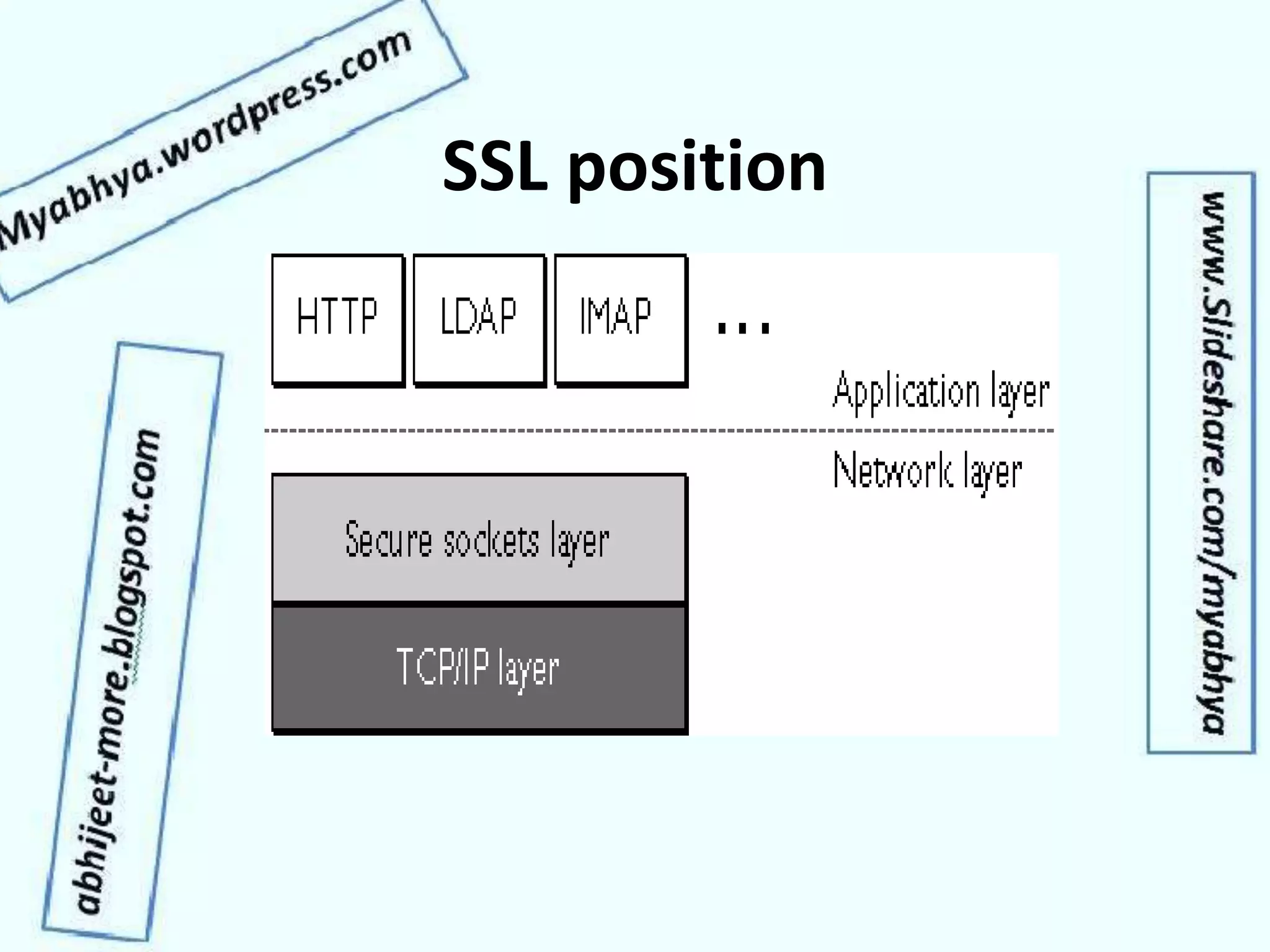
– IPSec (IP security): i.e., IP layer /
network layer
– SSL (Secure Socket Layer) & TLS
(Transport Layer Security): transport
layer
– SSH (Secure Shell), SFTP, HTTPS, PGP
(Pretty Good Privacy): application layer
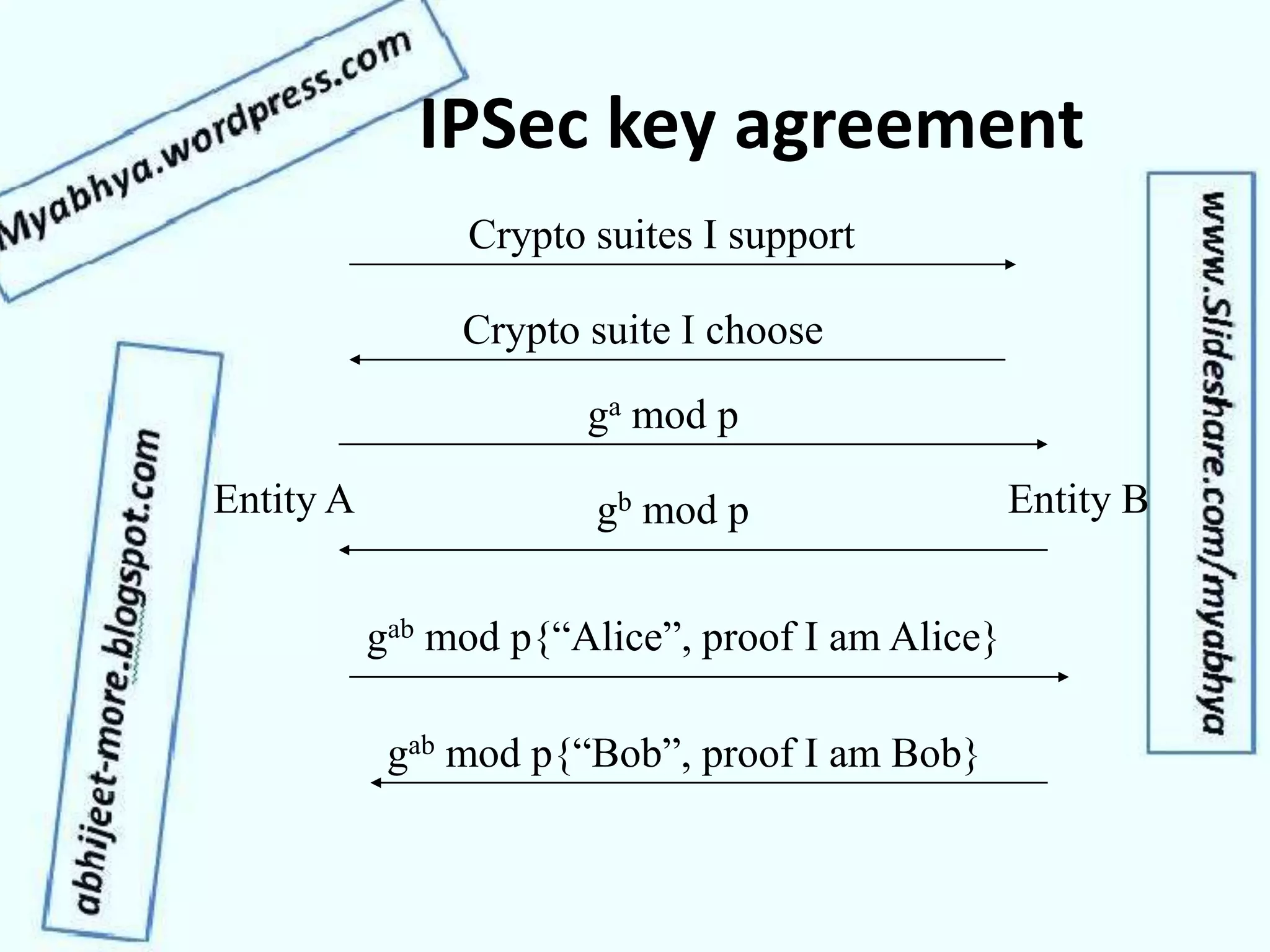
IPSec key agreement
Entity A Entity B
Crypto suites I support
Crypto suite I choose
ga mod p
gb mod p
gab mod p{“Alice”, proof I am Alice}
gab mod p{“Bob”, proof I am Bob}
SSL position
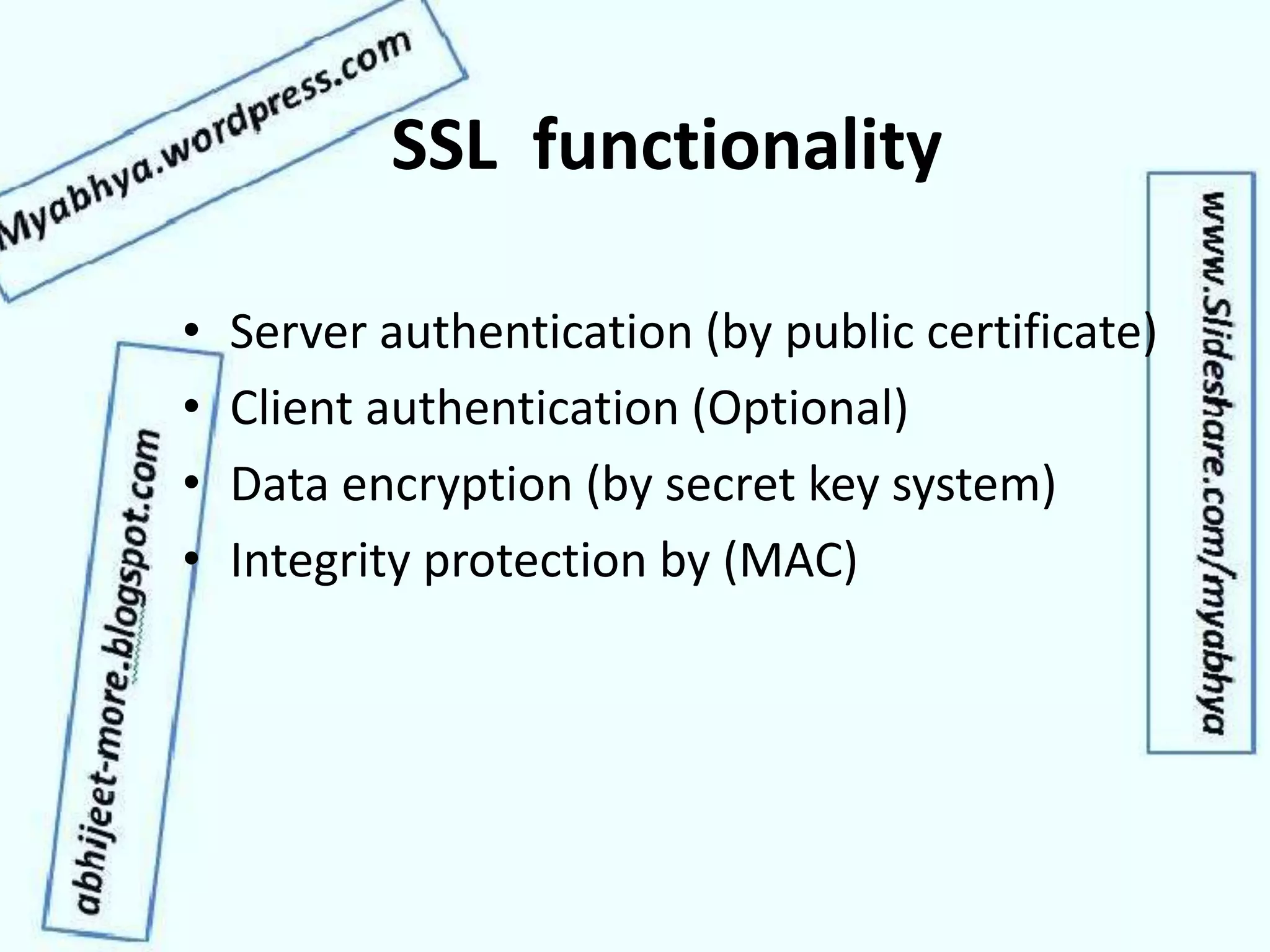
SSL functionality
• Server authentication (by public certificate)
• Client authentication (Optional)
• Data encryption (by secret key system)
• Integrity protection by (MAC)
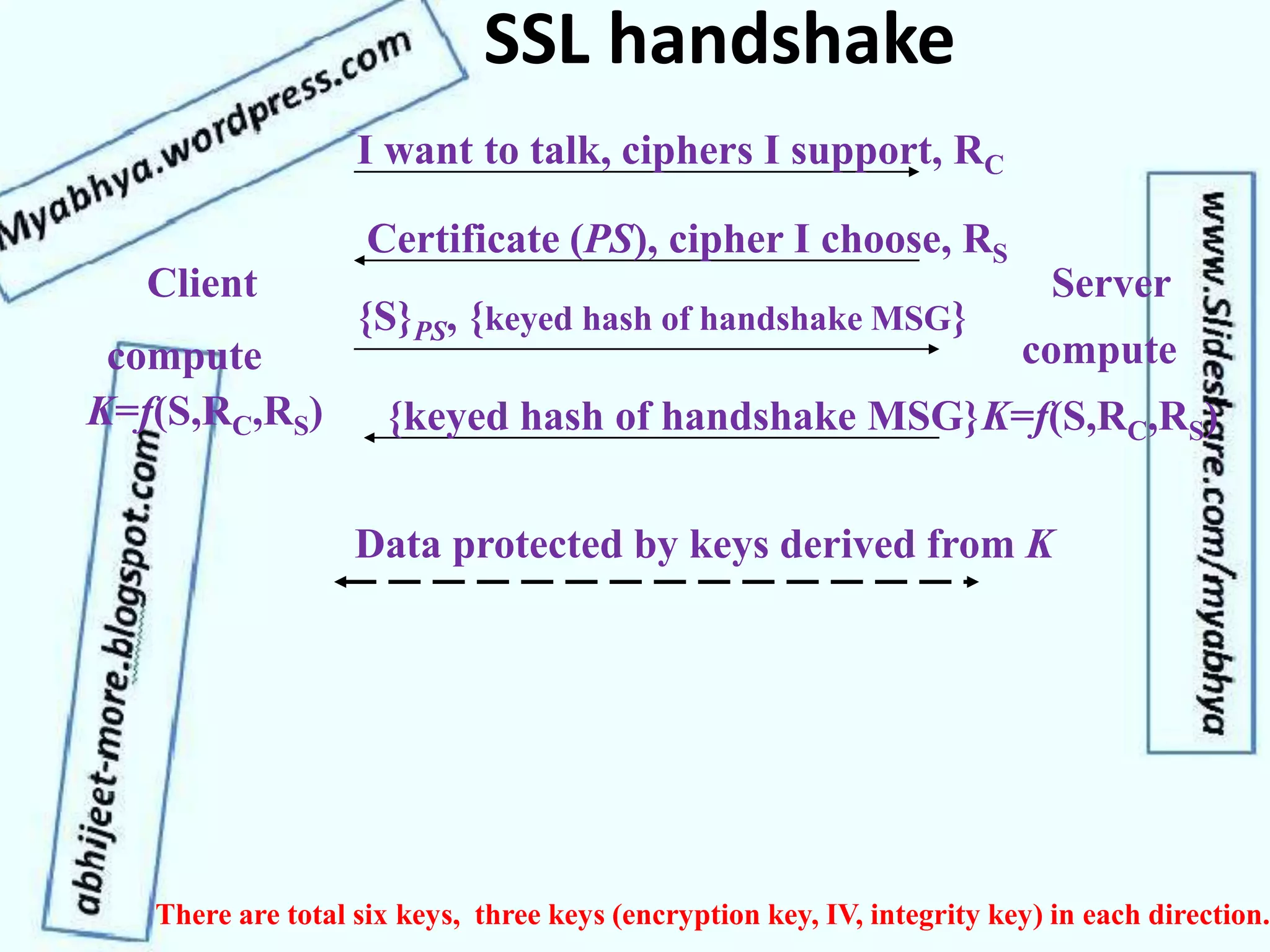
SSL handshake
Client Server
I want to talk, ciphers I support, RC
Certificate (PS), cipher I choose, RS
{S}PS, {keyed hash of handshake MSG}
{keyed hash of handshake MSG}
Data protected by keys derived from K
K=f(S,RC,RS) K=f(S,RC,RS)
compute compute
There are total six keys, three keys (encryption key, IV, integrity key) in each direction.
Questions?
Those who have any Query Contact me on my
Whats App No : 9766677504(only message)
25

Network security

  • 1.
    Network Security Presented by Mr.Abhijeet A. More (Perfect Training Center)
  • 2.
    Security and Cryptography •Security: all issues which make secure communication (information transmission, two (multiple) party interaction) over insecure channels. • Cryptography: the science and art of manipulating messages to make them secure. • Classical cryptographic techniques. • Along with the development of communication networks and their broad applications, network security is becoming a more serious problem. • Thus, call for modern cryptography.
  • 3.
    Network threats andattacks Passive: Active: Eavesdropping Traffic analysis Masquerading Replay Modification Denial of service Client Server Attacker Server Client Servermodify Clientclient ServerMan-in-middle Client Server
  • 4.
    Security Requirements • Privacyor confidentiality: The information should be readable only by the intended receiver. i.e., protect the information from eavesdropping. • Integrity: The receiver can confirm that a message has not been altered during transmission, i.e., protect the information from tampering. • Authentication: Any party (sender or receiver) can verify that the other party is who he or she claims to be, i.e., validate the identity of the other party. • Nonrepudiation: The sender can not deny having sent a given message. i.e., if a transaction (e.g., a purchase) has occurred between two parties, the nonrepudiation service can prove that for any party, he/she really performed the transaction him/herself, not by any other person.
  • 5.
    Approaches to implementingsecurity Confidentiality: By encryption (and decryption) Sender: encrypts the message using a key and sends the encrypted message. Receiver: decrypts the encrypted message using the same key as the sender’s key or a key derivable from the sender’s key. Integrity:By checksum or hash value/message digest. Sender: computes checksum/hash value/message digest from the message and sends the message along with the checksum/hash value/message digest. Receiver: re-computes checksum/hash value/message digest from received message and compares with the transmitted checksum/hash value/message digest. In some sense, it likes error-detection. Problem: the attacker, after intercepting the message, modifies the message, computes the checksum for modified message, and resends them. Solution: keyed checksum/hash value/message digest. message checksum Both are transmitted message checksumkey Message + checksum are transmitted
  • 6.
    Approaches to implementingsecurity (cont.) Authentication:Traditional user ID and password. Modern cryptography based authentication. --Digital signature. Nonrepudiation: Undeniable signature, i.e., Digital signature + verification protocol + disavowal protocol
  • 7.
    Security requirements andtheir implementation Confidentiality: encryption (and decryption) Integrity:checksum or hash value/message digest or MAC. Authentication: user ID and password or Digital signature. Nonrepudiation: Undeniable signature Availability: Intrusion detection and defense Authorization: Access control Accountability: Log, record, trace, system administration Q: how to defense Replay attack?Timestamps and/or sequence numbers.
  • 8.
    Classification of cryptosystems •Secret key systems vs. public key systems • Classical vs. modern – Classical: secret key systems • Shift, Affine, Vigenere, Hill, Permutation (transposition) cipher, Stream cipher – Modern: • Secret key systems – DES, AES, PGM • Public key systems – RSA, ElGamal, Elliptic Curve
  • 9.
    Shift cipher--example • Supposea plaintext word: cryptography • Change each letter by shifting the letter three position rightward • The cipherword is: FUBSWRJUDSKB Question: if given the above cipherword, how to get original word? Change each letter by shifting the letter three position leftward. This kind of cryptosystem is called “Caesar Cipher”
  • 10.
    Secret cryptosystem--DES • DataEncryption Standard (DES) • First version in 1975, developed by IBM. • A type of iterated cipher. • Plaintext block: 64 bits, key: 56 bits, ciphertext block:64 bits. • Steps: – Initial permutation (IP) – 16 rounds of transformations – Inverse permutation (IP-1)
  • 11.
    Key management andexchange • Key is the essential part in any cryptosystem, especially in secret key systems. • How to distribute/exchange key/keys between two users/any pair of multiple users. • Therefore key management and key exchange come into play. • Also public key systems appeared.
  • 12.
    Why public-key cryptography 1.The two communicants in secret key system require the prior communication of key, using a secure channel. it is very difficult to achieve in practice. Unless the two communicants meet together, phone call, post mail, email etc., are not secure. 2. Suppose there are n users and every pair of users want to communicate. In secret-key system, it is necessary that the total number of keys is n(n-1)/2. Very difficult to management and quite insecure. However, in public- key system, every user selects his/her own private key and public key, and publicizes the public key but keep the private key secret. Quite easy and very secure. The main problem with public-key system is that it is very slow.
  • 13.
    Public-key cryptosystem • Secret-keycryptosystem: – eK & dK: dK is the same as or derived from eK. – Called symmetric-key cryptosystem. – Problem: how to distribute eK & dK to Alice & Bob securely. • Public-key cryptosystem: – Computationally infeasible to compute dK from eK. – Called asymmetric-key cryptosystem. – eK is made public, called public key – But dK is kept secret, called private key.
  • 14.
    Public-key system: howit works • Everybody selects its own public key P and private key S, and publicizes P. • Therefore Alice has (Pa , Sa), and Bob has (Pb , Sb). • Everybody knows Pa, Pb, … • Suppose Alice wants to send a message to Bob. – Alice encrypts the message with Bob’s public key Pb and sends out. – (only) Bob can decrypt the message using his private key Sb. Nobody else can.
  • 15.
    Two party keymanagement • By public key cryptosystems: – Alice selects a random value k as a key – Alice encrypts the key k with Bob’s public key and sends to Bob – Bob decrypts the key using his private key – Alice and Bob encrypt/decrypt messages using secret key systems such as DES with the key k. – This is a typical combination of secret and public key systems. • By Diffie-Hellman key agreement – Based on Discrete Logarithm Problem
  • 16.
    DLP (Discrete LogarithmProblem) – Suppose p is an odd prime. – Zp={0,1,…,p-1} is a finite field. – Zp * : the set of integers which are relatively prime to p. • {a  Zp | gcd(a, p)=1}={1,…,p-1} • it is a cyclic multiplicative group. – g is a generator of Zp * , • i.e. , Zp * ={g 0 mod p, g 1mod p, …, g p-2 mod p}. – DLP problem • Given any a, compute b=g a (mod p) is easy. • given any b, find an a such that b = g a (mod p) is difficult. – Denoted as a = log g b. Omit: mod p for simplicity.
  • 17.
    (Two-party) Diffie-Hellman (DH)key exchange Suppose p and g are publicly known: g a g b (a (b  g b mod p) K=(gb) a=g ab K=(ga) b=g ab Alice Bob  g a mod p) Anyone else can compute g a g b = g a+b but not g ab
  • 18.
    cryptology • Cryptology =cryptography + cryptanalysis. – Cryptography: devise cryptosystems. – Cryptanalysis: break cryptosystems.
  • 19.
    Kerckhoff principle andattack levels • Kerckhoff principle: the cryptosystem is publicly known, but only the key is secret. Breaking a cryptosystem (i.e., cryptanalysis) means figuring out the key currently used. • Attack levels: – Ciphertext-only: the attacker possesses a string of ciphertext, y. – Known plaintext: the attacker possesses a string of plaintext, x, and the corresponding ciphertext, y. – Chosen plaintext: the attacker has obtained temporary access to the encryption machinery. Hence, he can choose a plaintext string, x, and construct the corresponding ciphertext string, y. – Chosen ciphertext: the attacker has obtained temporary access to the decryption machinery. Hence, he can choose a ciphertext string, y, and construct the corresponding plaintext string, x.
  • 20.
    Internet security protocols •The Internet has implemented a suite of security protocols combining secret-key, public-key, digital signature, message digest, etc. – IPSec (IP security): i.e., IP layer / network layer – SSL (Secure Socket Layer) & TLS (Transport Layer Security): transport layer – SSH (Secure Shell), SFTP, HTTPS, PGP (Pretty Good Privacy): application layer
  • 21.
    IPSec key agreement EntityA Entity B Crypto suites I support Crypto suite I choose ga mod p gb mod p gab mod p{“Alice”, proof I am Alice} gab mod p{“Bob”, proof I am Bob}
  • 22.
  • 23.
    SSL functionality • Serverauthentication (by public certificate) • Client authentication (Optional) • Data encryption (by secret key system) • Integrity protection by (MAC)
  • 24.
    SSL handshake Client Server Iwant to talk, ciphers I support, RC Certificate (PS), cipher I choose, RS {S}PS, {keyed hash of handshake MSG} {keyed hash of handshake MSG} Data protected by keys derived from K K=f(S,RC,RS) K=f(S,RC,RS) compute compute There are total six keys, three keys (encryption key, IV, integrity key) in each direction.
  • 25.
    Questions? Those who haveany Query Contact me on my Whats App No : 9766677504(only message) 25