Cryptography and Network Security Chapter 8 by William Stallings by  B . A . Forouzan
Objectives ❏  To introduce prime numbers and their applications   in cryptography. ❏  To discuss some primality test algorithms and their   efficiencies. ❏  To discuss factorization algorithms and their   applications in cryptography. ❏  To describe the Chinese remainder theorem and its   application. ❏  To introduce quadratic congruence. ❏  To introduce modular exponentiation and   logarithm.
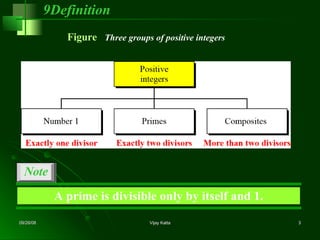
9Definition Figure  Three groups of positive integers A prime is divisible only by itself and 1. Note
Prime Numbers prime numbers only have divisors of 1 and self  they cannot be written as a product of other numbers  note: 1 is prime, but is generally not of interest  eg. 2,3,5,7 are prime, 4,6,8,9,10 are not prime numbers are central to number theory
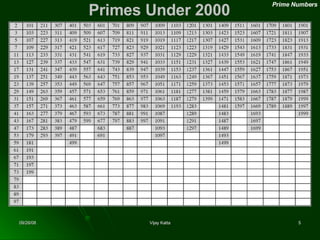
Primes Under 2000 Prime Numbers
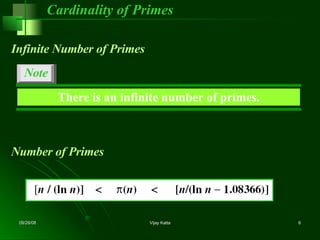
Cardinality of Primes Infinite Number of Primes There is an infinite number of primes. Number of Primes Note
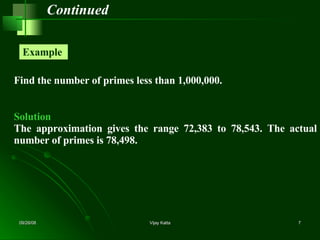
Continued Find the number of primes less than 1,000,000. Example  Solution The approximation gives the range 72,383 to 78,543. The actual number of primes is 78,498.
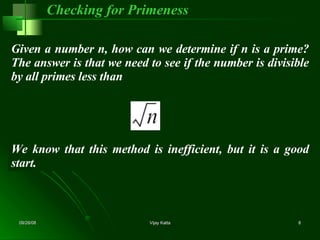
Given a number n, how can we determine if n is a prime? The answer is that we need to see if the number is divisible by all primes less than Checking for Primeness We know that this method is inefficient, but it is a good start.
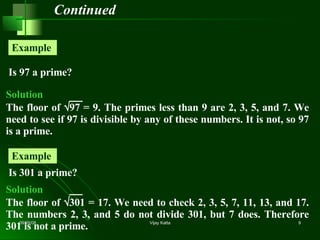
Continued Is 97 a prime? Example  Is 301 a prime? Example  Solution The floor of   97 = 9. The primes less than 9 are 2, 3, 5, and 7. We need to see if 97 is divisible by any of these numbers. It is not, so 97 is a prime. Solution The floor of   301 = 17. We need to check 2, 3, 5, 7, 11, 13, and 17. The numbers 2, 3, and 5 do not divide 301, but 7 does. Therefore 301 is not a prime.
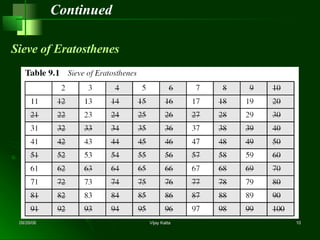
Sieve of Eratosthenes Continued
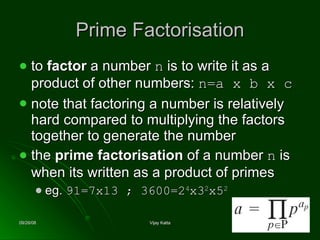
Prime Factorisation to  factor  a number  n  is to write it as a product of other numbers:  n=a x b x c   note that factoring a number is relatively hard compared to multiplying the factors together to generate the number  the  prime factorisation  of a number  n  is when its written as a product of primes  eg.  91=7x13 ; 3600=2 4 x3 2 x5 2
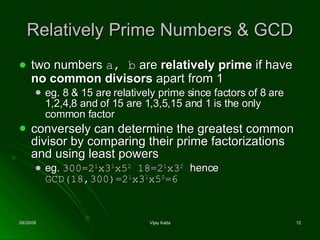
Relatively Prime Numbers & GCD two numbers  a, b  are  relatively prime  if have  no common divisors  apart from 1  eg. 8 & 15 are relatively prime since factors of 8 are 1,2,4,8 and of 15 are 1,3,5,15 and 1 is the only common factor  conversely can determine the greatest common divisor by comparing their prime factorizations and using least powers eg.  300 =2 1 x3 1 x5 2  18=2 1 x3 2   hence  GCD(18,300)=2 1 x3 1 x5 0 =6
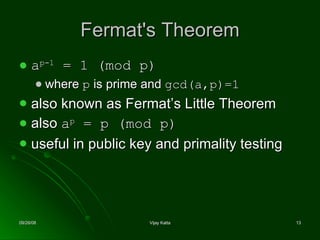
Fermat's Theorem a p-1  = 1 (mod p) where  p  is prime and  gcd(a,p)=1 also known as Fermat’s Little Theorem also  a p  = p (mod p) useful in public key and primality testing
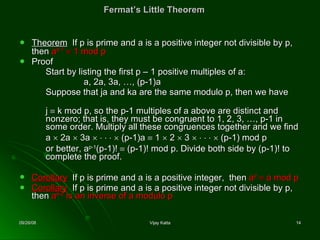
Fermat’s Little Theorem Theorem   If p is prime and a is a positive integer not divisible by p, then  a p-1     1 mod p Proof Start by listing the first p – 1 positive multiples of a: a, 2a, 3a, …, (p-1)a Suppose that  j a and  k a are the same modulo p, then we have  j      k  mod p, so the p-1 multiples of a above are distinct and nonzero; that is, they must be congruent to 1, 2, 3, …, p-1 in some order. Multiply all these congruence s  together and we find a    2a    3a                (p-1)a    1    2    3                (p-1) mod p or better, a p-1 (p-1)!    (p-1)! mod p. Divide both side by (p-1)! to complete the proof .  Corollary   If p is prime and a is a positive integer,  then  a p     a mod p Corollary   If p is prime and a is a positive integer not divisible by p, then  a p-2  is an inverse of a modulo p
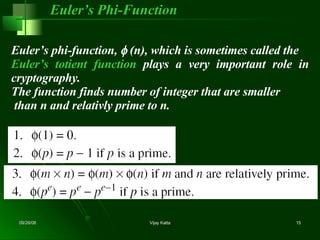
Euler’s phi-function,   (n), which is sometimes called the Euler’s totient function  plays a very important role in cryptography.  The function finds number of integer that are smaller  than n and relativly prime to n.  Euler’s Phi-Function
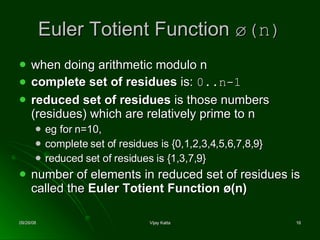
Euler Totient Function  ø(n) when doing arithmetic modulo n  complete set of residues  is:  0..n-1   reduced set of residues  is those numbers (residues) which are relatively prime to n  eg for n=10,  complete set of residues is {0,1,2,3,4,5,6,7,8,9}  reduced set of residues is {1,3,7,9}  number of elements in reduced set of residues is called the  Euler Totient Function ø(n)
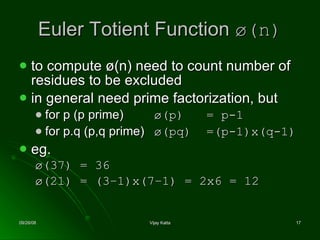
Euler Totient Function  ø(n) to compute ø(n) need to count number of residues to be excluded in general need prime factorization, but for p (p prime)    ø(p)  = p-1   for p.q (p,q prime)   ø(pq)  =(p-1)x(q-1)   eg. ø(37) = 36 ø(21) = (3–1)x(7–1) = 2x6 = 12
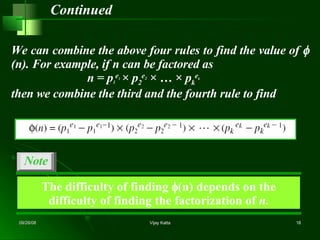
We can combine the above four rules to find the value of   (n). For example, if n can be factored as  n = p 1 e 1   × p 2 e 2  × … × p k e k  then we combine the third and the fourth rule to find Continued The difficulty of finding   (n) depends on the difficulty of finding the factorization of  n . Note
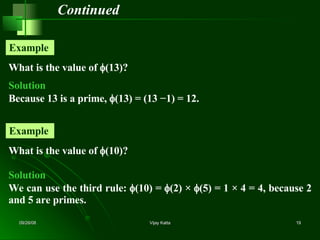
Continued What is the value of   (13)? Example  Solution Because 13 is a prime,   (13) = (13 −1) = 12. What is the value of   (10)? Example  Solution We can use the third rule:   (10) =   (2) ×   (5) = 1 × 4 = 4, because 2 and 5 are primes.
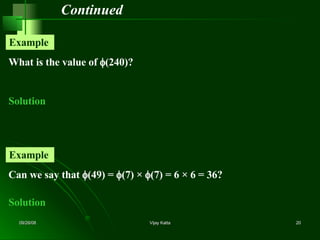
Continued What is the value of   (240)? Example  Solution Can we say that   (49) =   (7) ×   (7) = 6 × 6 = 36? Example  Solution
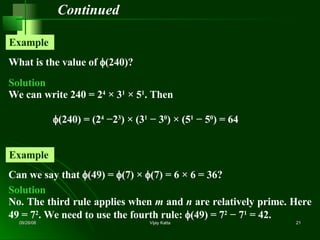
Continued What is the value of   (240)? Example  Solution We can write 240 = 2 4  × 3 1  × 5 1 . Then  (240) = (2 4  −2 3 ) × (3 1  − 3 0 ) × (5 1  − 5 0 ) = 64 Can we say that   (49) =   (7) ×   (7) = 6 × 6 = 36? Example  Solution No. The third rule applies when  m  and  n  are relatively prime. Here 49 = 7 2 . We need to use the fourth rule:   (49) = 7 2  − 7 1  = 42.
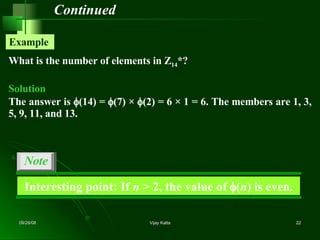
Continued What is the number of elements in Z 14 *? Example  Solution The answer is   (14) =   (7) ×   (2) = 6 × 1 = 6. The members are 1, 3, 5, 9, 11, and 13. Interesting point: If  n  > 2, the value of   ( n ) is even. Note
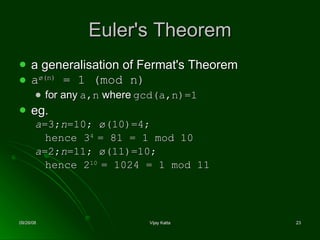
Euler's Theorem a generalisation of Fermat's Theorem  a ø(n)  = 1 (mod n) for any  a,n  where  gcd(a,n)=1 eg. a =3; n =10; ø(10)=4;  hence 3 4  = 81 = 1 mod 10 a =2; n =11; ø(11)=10; hence 2 10  = 1024 = 1 mod 11
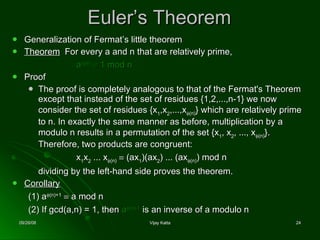
Euler’s Theorem Generalization of Fermat’s little theorem Theorem   For every a and n that are relatively prime,  a  ( n)      1 mod n Proof The proof is completely analogous to that of the Fermat's Theorem except that instead of the set of residues {1,2,...,n-1} we now consider the set of residues {x 1 ,x 2 ,...,x  ( n) } which are relatively prime to n. In exactly the same manner as before, multiplication by a modulo n results in a permutation of the set {x 1 , x 2 , ..., x  ( n) }. Therefore, two products are congruent: x 1 x 2  ... x  ( n)      (ax 1 )(ax 2 ) ... (ax  ( n) ) mod n  dividing by the left-hand side proves the theorem. Corollary   (1) a  ( n)+1      a mod n (2)   If gcd(a,n) = 1, then  a  ( n)-1   is an inverse of a modulo n
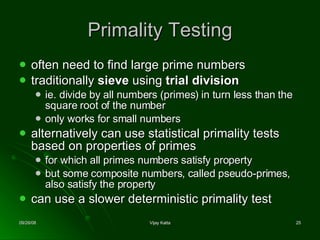
Primality Testing often need to find large prime numbers  traditionally  sieve  using  trial division   ie. divide by all numbers (primes) in turn less than the square root of the number  only works for small numbers alternatively can use statistical primality tests based on properties of primes  for which all primes numbers satisfy property  but some composite numbers, called pseudo-primes, also satisfy the property can use a slower deterministic primality test
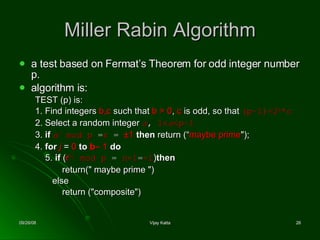
Miller Rabin Algorithm a test based on Fermat’s Theorem for odd integer number p. algorithm is: TEST (p) is: 1. Find integers  b,c  such that  b   > 0 ,  c  is odd, so that  (p–1)=2 b *c 2. Select a random integer  a ,  1< a <p–1 3.  if  a c   mod p   = r  =   ±1   then  return (“ maybe prime &quot;); 4.  for  j  =  0   to  b – 1   do 5.  if  ( r 2j   mod p   =   n -1 = -1 ) then  return(&quot; maybe prime &quot;) else return (&quot;composite&quot;)
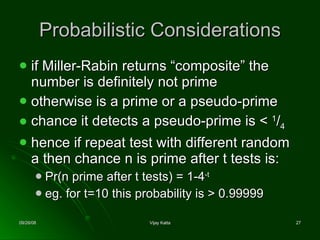
Probabilistic Considerations if Miller-Rabin returns “composite” the number is definitely not prime otherwise is a prime or a pseudo-prime chance it detects a pseudo-prime is <  1 / 4 hence if repeat test with different random a then chance n is prime after t tests is: Pr(n prime after t tests) = 1-4 -t eg. for t=10 this probability is > 0.99999
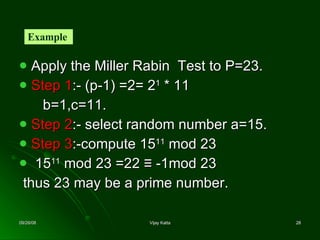
Apply the Miller Rabin  Test to P=23. Step 1 :- (p-1) =2= 2 1  * 11 b=1,c=11. Step 2 :- select random number a=15. Step 3 :-compute 15 11  mod 23 15 11  mod 23 =22  ≡ -1mod 23 thus 23 may be a prime number. Example
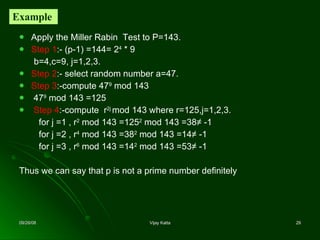
Apply the Miller Rabin  Test to P=143. Step 1 :- (p-1) =144= 2 4  * 9 b=4,c=9, j=1,2,3. Step 2 :- select random number a=47. Step 3 :-compute 47 9  mod 143 47 9  mod 143 =125  Step 4 :-compute  r 2j  mod 143 where r=125,j=1,2,3. for j =1 , r 2  mod 143 =125 2  mod 143 =38≠ -1 for j =2 , r 4  mod 143 =38 2  mod 143 =14≠ -1 for j =3 , r 6  mod 143 =14 2  mod 143 =53≠ -1 Thus we can say that p is not a prime number definitely  Example
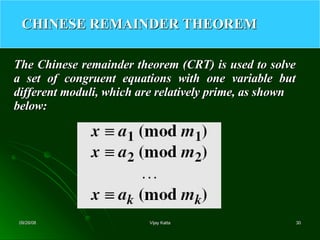
CHINESE REMAINDER THEOREM The Chinese remainder theorem (CRT) is used to solve a set of congruent equations with one variable but different moduli, which are relatively prime, as shown below:
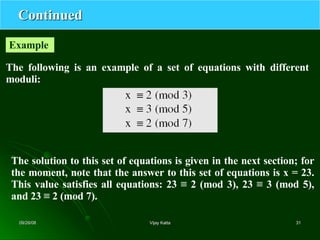
Continued The following is an example of a set of equations with different moduli: Example  The solution to this set of equations is given in the next section; for the moment, note that the answer to this set of equations is x = 23. This value satisfies all equations: 23 ≡ 2 (mod 3), 23 ≡ 3 (mod 5), and 23 ≡ 2 (mod 7).
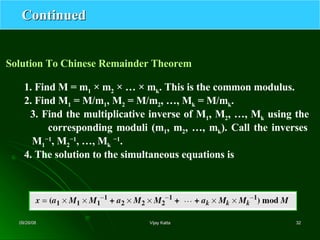
Continued Solution To Chinese Remainder Theorem 1. Find M = m 1  × m 2  × … × m k . This is the common modulus. 2. Find M 1  = M/m 1 , M 2  = M/m 2 , …, M k  = M/m k . 3. Find the multiplicative inverse of M 1 , M 2 , …, M k  using the   corresponding moduli (m 1 , m 2 , …, m k ). Call the inverses   M 1 −1 , M 2 −1 , …, M k   −1 . 4. The solution to the simultaneous equations is
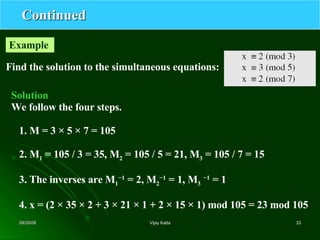
Continued Find the solution to the simultaneous equations: Example  Solution We follow the four steps. 1. M = 3 × 5 × 7 = 105 2. M 1  = 105 / 3 = 35, M 2  = 105 / 5 = 21, M 3  = 105 / 7 = 15 3. The inverses are M 1 −1  = 2, M 2 −1  = 1, M 3   −1  = 1 4. x = (2 × 35 × 2 + 3 × 21 × 1 + 2 × 15 × 1) mod 105 = 23 mod 105
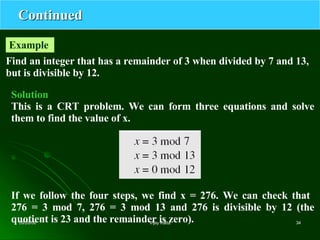
Continued Find an integer that has a remainder of 3 when divided by 7 and 13, but is divisible by 12. Example  Solution This is a CRT problem. We can form three equations and solve them to find the value of x. If we follow the four steps, we find x = 276. We can check that  276 = 3 mod 7, 276 = 3 mod 13 and 276 is divisible by 12 (the quotient is 23 and the remainder is zero).
Chinese Remainder Theorem used to speed up modulo computations  if working modulo a product of numbers  eg.  mod M = m 1 m 2 ..m k   Chinese Remainder theorem lets us work in each moduli m i  separately  since computational cost is proportional to size, this is faster than working in the full modulus M
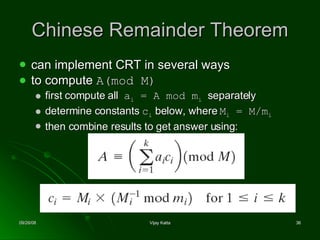
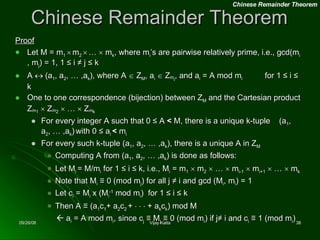
Chinese Remainder Theorem can implement CRT in several ways to compute  A(mod M) first compute all  a i  = A mod m i   separately determine constants  c i  below, where  M i  = M/m i then combine results to get answer using:
Chinese Remainder Theorem Chinese Remainder Theorem (CRT) Suppose m 1  ,   … , m k  are pairwise relatively prime positive  integers, and suppose a 1  ,   … , a k  are integers. Then the  system of k congruences x    a i  (mod m i ) (1 ≤ i ≤ k) has a  unique solution modulo M = m 1                m k , which is given by where c i  = M i  (M i -1  mod m i ) and M i  = M / m i  , for 1 ≤ i ≤ k. Chinese Remainder Theorem
Chinese Remainder Theorem Proof Let M = m 1     m 2     …    m k , where m i ’s are pairwise relatively prime, i.e., gcd(m i  , m j ) = 1, 1 ≤ i ≠ j ≤ k A    (a 1 , a 2 , … ,a k ), where A    Z M , a i     Z m i , and a i  = A mod m i   for 1 ≤ i ≤ k One to one correspondence (bijection) between Z M  and the Cartesian product Z m 1     Z m 2     …    Z m k For every integer A such that 0 ≤ A  <  M, there is a unique k-tuple  (a 1 , a 2 , … ,a k )   with 0 ≤ a i  <  m i For every such k-tuple (a 1 , a 2 , … ,a k ), there is a unique A in Z M  Computing A from (a 1 , a 2 , … ,a k ) is done as follows: Let M i  = M/m i  for 1 ≤ i ≤ k, i.e., M i  = m 1     m 2     …    m i-1     m i+1     …    m k Note that M i  ≡ 0 (mod m j ) for all j ≠ i and gcd (M i , m i ) = 1 Let c i  = M i  x (M i -1  mod m i )  for 1 ≤ i ≤ k Then A ≡ (a 1 c 1 + a 2 c 2  +          + a k c k ) mod M    a i  = A mod m i , since c j  ≡ M j  ≡ 0 (mod m i ) if j≠ i and c i  ≡ 1 (mod m i ) Chinese Remainder Theorem
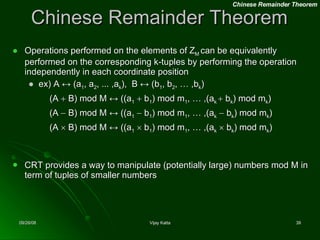
Chinese Remainder Theorem Operations performed on the elements of Z M  can be equivalently performed on the corresponding k-tuples by performing the operation independently in each coordinate position ex) A ↔ (a 1 , a 2 , ... ,a k ),  B ↔ (b 1 , b 2 , … ,b k ) (A    B) mod M ↔ ((a 1     b 1 ) mod m 1 , … ,(a k    b k ) mod m k ) (A    B) mod M ↔ ((a 1     b 1 ) mod m 1 , … ,(a k     b k ) mod m k ) (A    B) mod M ↔ ((a 1     b 1 ) mod m 1 , … ,(a k     b k ) mod m k ) CRT provides a way to manipulate (potentially large) numbers mod M in term of tuples of smaller numbers Chinese Remainder Theorem
Chinese Remainder Theorem Example Let m 1  = 37, m 2  = 49, M = m 1      m 2  = 1813, A = 973 , B = 678 M 1  = 49, M 2  = 37 Using the extended Euclid’s alg orithm M 1 -1  mod m 1   = 34,  and M 2 -1  mod m 2  =  4 Taking residues modulo 37 and 49 973     (11, 42),  678    (12, 41) Add the tuples element-wise (11 + 12 mod 37, 42 + 41 mod 49) = (23, 34) To verify, we compute (23, 34)    (a 1 c 1 + a 2 c 2 ) mod M = (a 1 M 1 M 1 -1  + a 2 M 2 M 2 -1  ) mod M = [(23)(49)(34) + (34)(37)(4)] mod 1813 = 1651 which is equal to (678 + 973) mod 1813 = 1651 Chinese Remainder Theorem
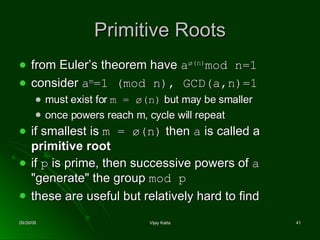
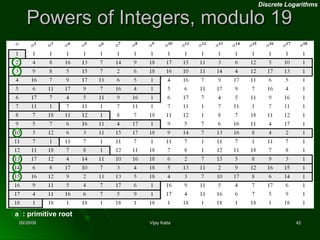
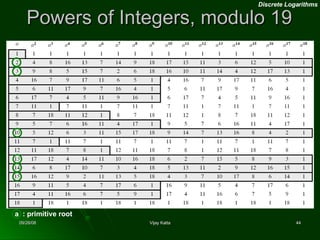
Primitive Roots from Euler’s theorem have  a ø(n) mod n=1  consider  a m =1 (mod n), GCD(a,n)=1 must exist for  m =  ø(n)  but may be smaller once powers reach m, cycle will repeat if smallest is  m =  ø(n)  then  a  is called a  primitive root   if  p  is prime, then successive powers of  a  &quot;generate&quot; the group  mod p   these are useful but relatively hard to find
Powers of Integers, modulo 19 Discrete Logarithms a  : primitive root
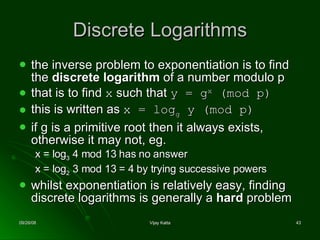
Discrete Logarithms the inverse problem to exponentiation is to find the  discrete logarithm  of a number modulo p  that is to find  x  such that  y = g x  (mod p)   this is written as  x = log g  y (mod p) if g is a primitive root then it always exists, otherwise it may not, eg. x = log 3  4 mod 13 has no answer  x = log 2  3 mod 13 = 4 by trying successive powers  whilst exponentiation is relatively easy, finding discrete logarithms is generally a  hard  problem
Powers of Integers, modulo 19 Discrete Logarithms a  : primitive root
Summary have considered: prime numbers Fermat’s and Euler’s Theorems &  ø(n)   Primality Testing Chinese Remainder Theorem Discrete Logarithms

Ch08

  • 1.
    Cryptography and NetworkSecurity Chapter 8 by William Stallings by B . A . Forouzan
  • 2.
    Objectives ❏ To introduce prime numbers and their applications in cryptography. ❏ To discuss some primality test algorithms and their efficiencies. ❏ To discuss factorization algorithms and their applications in cryptography. ❏ To describe the Chinese remainder theorem and its application. ❏ To introduce quadratic congruence. ❏ To introduce modular exponentiation and logarithm.
  • 3.
    9Definition Figure Three groups of positive integers A prime is divisible only by itself and 1. Note
  • 4.
    Prime Numbers primenumbers only have divisors of 1 and self they cannot be written as a product of other numbers note: 1 is prime, but is generally not of interest eg. 2,3,5,7 are prime, 4,6,8,9,10 are not prime numbers are central to number theory
  • 5.
    Primes Under 2000Prime Numbers
  • 6.
    Cardinality of PrimesInfinite Number of Primes There is an infinite number of primes. Number of Primes Note
  • 7.
    Continued Find thenumber of primes less than 1,000,000. Example Solution The approximation gives the range 72,383 to 78,543. The actual number of primes is 78,498.
  • 8.
    Given a numbern, how can we determine if n is a prime? The answer is that we need to see if the number is divisible by all primes less than Checking for Primeness We know that this method is inefficient, but it is a good start.
  • 9.
    Continued Is 97a prime? Example Is 301 a prime? Example Solution The floor of  97 = 9. The primes less than 9 are 2, 3, 5, and 7. We need to see if 97 is divisible by any of these numbers. It is not, so 97 is a prime. Solution The floor of  301 = 17. We need to check 2, 3, 5, 7, 11, 13, and 17. The numbers 2, 3, and 5 do not divide 301, but 7 does. Therefore 301 is not a prime.
  • 10.
  • 11.
    Prime Factorisation to factor a number n is to write it as a product of other numbers: n=a x b x c note that factoring a number is relatively hard compared to multiplying the factors together to generate the number the prime factorisation of a number n is when its written as a product of primes eg. 91=7x13 ; 3600=2 4 x3 2 x5 2
  • 12.
    Relatively Prime Numbers& GCD two numbers a, b are relatively prime if have no common divisors apart from 1 eg. 8 & 15 are relatively prime since factors of 8 are 1,2,4,8 and of 15 are 1,3,5,15 and 1 is the only common factor conversely can determine the greatest common divisor by comparing their prime factorizations and using least powers eg. 300 =2 1 x3 1 x5 2 18=2 1 x3 2 hence GCD(18,300)=2 1 x3 1 x5 0 =6
  • 13.
    Fermat's Theorem ap-1 = 1 (mod p) where p is prime and gcd(a,p)=1 also known as Fermat’s Little Theorem also a p = p (mod p) useful in public key and primality testing
  • 14.
    Fermat’s Little TheoremTheorem If p is prime and a is a positive integer not divisible by p, then a p-1  1 mod p Proof Start by listing the first p – 1 positive multiples of a: a, 2a, 3a, …, (p-1)a Suppose that j a and k a are the same modulo p, then we have j  k mod p, so the p-1 multiples of a above are distinct and nonzero; that is, they must be congruent to 1, 2, 3, …, p-1 in some order. Multiply all these congruence s together and we find a  2a  3a      (p-1)a  1  2  3      (p-1) mod p or better, a p-1 (p-1)!  (p-1)! mod p. Divide both side by (p-1)! to complete the proof . Corollary If p is prime and a is a positive integer, then a p  a mod p Corollary If p is prime and a is a positive integer not divisible by p, then a p-2 is an inverse of a modulo p
  • 15.
    Euler’s phi-function,  (n), which is sometimes called the Euler’s totient function plays a very important role in cryptography. The function finds number of integer that are smaller than n and relativly prime to n. Euler’s Phi-Function
  • 16.
    Euler Totient Function ø(n) when doing arithmetic modulo n complete set of residues is: 0..n-1 reduced set of residues is those numbers (residues) which are relatively prime to n eg for n=10, complete set of residues is {0,1,2,3,4,5,6,7,8,9} reduced set of residues is {1,3,7,9} number of elements in reduced set of residues is called the Euler Totient Function ø(n)
  • 17.
    Euler Totient Function ø(n) to compute ø(n) need to count number of residues to be excluded in general need prime factorization, but for p (p prime) ø(p) = p-1 for p.q (p,q prime) ø(pq) =(p-1)x(q-1) eg. ø(37) = 36 ø(21) = (3–1)x(7–1) = 2x6 = 12
  • 18.
    We can combinethe above four rules to find the value of  (n). For example, if n can be factored as n = p 1 e 1 × p 2 e 2 × … × p k e k then we combine the third and the fourth rule to find Continued The difficulty of finding  (n) depends on the difficulty of finding the factorization of n . Note
  • 19.
    Continued What isthe value of  (13)? Example Solution Because 13 is a prime,  (13) = (13 −1) = 12. What is the value of  (10)? Example Solution We can use the third rule:  (10) =  (2) ×  (5) = 1 × 4 = 4, because 2 and 5 are primes.
  • 20.
    Continued What isthe value of  (240)? Example Solution Can we say that  (49) =  (7) ×  (7) = 6 × 6 = 36? Example Solution
  • 21.
    Continued What isthe value of  (240)? Example Solution We can write 240 = 2 4 × 3 1 × 5 1 . Then  (240) = (2 4 −2 3 ) × (3 1 − 3 0 ) × (5 1 − 5 0 ) = 64 Can we say that  (49) =  (7) ×  (7) = 6 × 6 = 36? Example Solution No. The third rule applies when m and n are relatively prime. Here 49 = 7 2 . We need to use the fourth rule:  (49) = 7 2 − 7 1 = 42.
  • 22.
    Continued What isthe number of elements in Z 14 *? Example Solution The answer is  (14) =  (7) ×  (2) = 6 × 1 = 6. The members are 1, 3, 5, 9, 11, and 13. Interesting point: If n > 2, the value of  ( n ) is even. Note
  • 23.
    Euler's Theorem ageneralisation of Fermat's Theorem a ø(n) = 1 (mod n) for any a,n where gcd(a,n)=1 eg. a =3; n =10; ø(10)=4; hence 3 4 = 81 = 1 mod 10 a =2; n =11; ø(11)=10; hence 2 10 = 1024 = 1 mod 11
  • 24.
    Euler’s Theorem Generalizationof Fermat’s little theorem Theorem For every a and n that are relatively prime, a  ( n)  1 mod n Proof The proof is completely analogous to that of the Fermat's Theorem except that instead of the set of residues {1,2,...,n-1} we now consider the set of residues {x 1 ,x 2 ,...,x  ( n) } which are relatively prime to n. In exactly the same manner as before, multiplication by a modulo n results in a permutation of the set {x 1 , x 2 , ..., x  ( n) }. Therefore, two products are congruent: x 1 x 2 ... x  ( n)  (ax 1 )(ax 2 ) ... (ax  ( n) ) mod n dividing by the left-hand side proves the theorem. Corollary (1) a  ( n)+1  a mod n (2) If gcd(a,n) = 1, then a  ( n)-1 is an inverse of a modulo n
  • 25.
    Primality Testing oftenneed to find large prime numbers traditionally sieve using trial division ie. divide by all numbers (primes) in turn less than the square root of the number only works for small numbers alternatively can use statistical primality tests based on properties of primes for which all primes numbers satisfy property but some composite numbers, called pseudo-primes, also satisfy the property can use a slower deterministic primality test
  • 26.
    Miller Rabin Algorithma test based on Fermat’s Theorem for odd integer number p. algorithm is: TEST (p) is: 1. Find integers b,c such that b > 0 , c is odd, so that (p–1)=2 b *c 2. Select a random integer a , 1< a <p–1 3. if a c mod p = r = ±1 then return (“ maybe prime &quot;); 4. for j = 0 to b – 1 do 5. if ( r 2j mod p = n -1 = -1 ) then return(&quot; maybe prime &quot;) else return (&quot;composite&quot;)
  • 27.
    Probabilistic Considerations ifMiller-Rabin returns “composite” the number is definitely not prime otherwise is a prime or a pseudo-prime chance it detects a pseudo-prime is < 1 / 4 hence if repeat test with different random a then chance n is prime after t tests is: Pr(n prime after t tests) = 1-4 -t eg. for t=10 this probability is > 0.99999
  • 28.
    Apply the MillerRabin Test to P=23. Step 1 :- (p-1) =2= 2 1 * 11 b=1,c=11. Step 2 :- select random number a=15. Step 3 :-compute 15 11 mod 23 15 11 mod 23 =22 ≡ -1mod 23 thus 23 may be a prime number. Example
  • 29.
    Apply the MillerRabin Test to P=143. Step 1 :- (p-1) =144= 2 4 * 9 b=4,c=9, j=1,2,3. Step 2 :- select random number a=47. Step 3 :-compute 47 9 mod 143 47 9 mod 143 =125 Step 4 :-compute r 2j mod 143 where r=125,j=1,2,3. for j =1 , r 2 mod 143 =125 2 mod 143 =38≠ -1 for j =2 , r 4 mod 143 =38 2 mod 143 =14≠ -1 for j =3 , r 6 mod 143 =14 2 mod 143 =53≠ -1 Thus we can say that p is not a prime number definitely Example
  • 30.
    CHINESE REMAINDER THEOREMThe Chinese remainder theorem (CRT) is used to solve a set of congruent equations with one variable but different moduli, which are relatively prime, as shown below:
  • 31.
    Continued The followingis an example of a set of equations with different moduli: Example The solution to this set of equations is given in the next section; for the moment, note that the answer to this set of equations is x = 23. This value satisfies all equations: 23 ≡ 2 (mod 3), 23 ≡ 3 (mod 5), and 23 ≡ 2 (mod 7).
  • 32.
    Continued Solution ToChinese Remainder Theorem 1. Find M = m 1 × m 2 × … × m k . This is the common modulus. 2. Find M 1 = M/m 1 , M 2 = M/m 2 , …, M k = M/m k . 3. Find the multiplicative inverse of M 1 , M 2 , …, M k using the corresponding moduli (m 1 , m 2 , …, m k ). Call the inverses M 1 −1 , M 2 −1 , …, M k −1 . 4. The solution to the simultaneous equations is
  • 33.
    Continued Find thesolution to the simultaneous equations: Example Solution We follow the four steps. 1. M = 3 × 5 × 7 = 105 2. M 1 = 105 / 3 = 35, M 2 = 105 / 5 = 21, M 3 = 105 / 7 = 15 3. The inverses are M 1 −1 = 2, M 2 −1 = 1, M 3 −1 = 1 4. x = (2 × 35 × 2 + 3 × 21 × 1 + 2 × 15 × 1) mod 105 = 23 mod 105
  • 34.
    Continued Find aninteger that has a remainder of 3 when divided by 7 and 13, but is divisible by 12. Example Solution This is a CRT problem. We can form three equations and solve them to find the value of x. If we follow the four steps, we find x = 276. We can check that 276 = 3 mod 7, 276 = 3 mod 13 and 276 is divisible by 12 (the quotient is 23 and the remainder is zero).
  • 35.
    Chinese Remainder Theoremused to speed up modulo computations if working modulo a product of numbers eg. mod M = m 1 m 2 ..m k Chinese Remainder theorem lets us work in each moduli m i separately since computational cost is proportional to size, this is faster than working in the full modulus M
  • 36.
    Chinese Remainder Theoremcan implement CRT in several ways to compute A(mod M) first compute all a i = A mod m i separately determine constants c i below, where M i = M/m i then combine results to get answer using:
  • 37.
    Chinese Remainder TheoremChinese Remainder Theorem (CRT) Suppose m 1 , … , m k are pairwise relatively prime positive integers, and suppose a 1 , … , a k are integers. Then the system of k congruences x  a i (mod m i ) (1 ≤ i ≤ k) has a unique solution modulo M = m 1      m k , which is given by where c i = M i (M i -1 mod m i ) and M i = M / m i , for 1 ≤ i ≤ k. Chinese Remainder Theorem
  • 38.
    Chinese Remainder TheoremProof Let M = m 1  m 2  …  m k , where m i ’s are pairwise relatively prime, i.e., gcd(m i , m j ) = 1, 1 ≤ i ≠ j ≤ k A  (a 1 , a 2 , … ,a k ), where A  Z M , a i  Z m i , and a i = A mod m i for 1 ≤ i ≤ k One to one correspondence (bijection) between Z M and the Cartesian product Z m 1  Z m 2  …  Z m k For every integer A such that 0 ≤ A < M, there is a unique k-tuple (a 1 , a 2 , … ,a k ) with 0 ≤ a i < m i For every such k-tuple (a 1 , a 2 , … ,a k ), there is a unique A in Z M Computing A from (a 1 , a 2 , … ,a k ) is done as follows: Let M i = M/m i for 1 ≤ i ≤ k, i.e., M i = m 1  m 2  …  m i-1  m i+1  …  m k Note that M i ≡ 0 (mod m j ) for all j ≠ i and gcd (M i , m i ) = 1 Let c i = M i x (M i -1 mod m i ) for 1 ≤ i ≤ k Then A ≡ (a 1 c 1 + a 2 c 2 +    + a k c k ) mod M  a i = A mod m i , since c j ≡ M j ≡ 0 (mod m i ) if j≠ i and c i ≡ 1 (mod m i ) Chinese Remainder Theorem
  • 39.
    Chinese Remainder TheoremOperations performed on the elements of Z M can be equivalently performed on the corresponding k-tuples by performing the operation independently in each coordinate position ex) A ↔ (a 1 , a 2 , ... ,a k ), B ↔ (b 1 , b 2 , … ,b k ) (A  B) mod M ↔ ((a 1  b 1 ) mod m 1 , … ,(a k  b k ) mod m k ) (A  B) mod M ↔ ((a 1  b 1 ) mod m 1 , … ,(a k  b k ) mod m k ) (A  B) mod M ↔ ((a 1  b 1 ) mod m 1 , … ,(a k  b k ) mod m k ) CRT provides a way to manipulate (potentially large) numbers mod M in term of tuples of smaller numbers Chinese Remainder Theorem
  • 40.
    Chinese Remainder TheoremExample Let m 1 = 37, m 2 = 49, M = m 1  m 2 = 1813, A = 973 , B = 678 M 1 = 49, M 2 = 37 Using the extended Euclid’s alg orithm M 1 -1 mod m 1 = 34, and M 2 -1 mod m 2 = 4 Taking residues modulo 37 and 49 973  (11, 42), 678  (12, 41) Add the tuples element-wise (11 + 12 mod 37, 42 + 41 mod 49) = (23, 34) To verify, we compute (23, 34)  (a 1 c 1 + a 2 c 2 ) mod M = (a 1 M 1 M 1 -1 + a 2 M 2 M 2 -1 ) mod M = [(23)(49)(34) + (34)(37)(4)] mod 1813 = 1651 which is equal to (678 + 973) mod 1813 = 1651 Chinese Remainder Theorem
  • 41.
    Primitive Roots fromEuler’s theorem have a ø(n) mod n=1 consider a m =1 (mod n), GCD(a,n)=1 must exist for m = ø(n) but may be smaller once powers reach m, cycle will repeat if smallest is m = ø(n) then a is called a primitive root if p is prime, then successive powers of a &quot;generate&quot; the group mod p these are useful but relatively hard to find
  • 42.
    Powers of Integers,modulo 19 Discrete Logarithms a : primitive root
  • 43.
    Discrete Logarithms theinverse problem to exponentiation is to find the discrete logarithm of a number modulo p that is to find x such that y = g x (mod p) this is written as x = log g y (mod p) if g is a primitive root then it always exists, otherwise it may not, eg. x = log 3 4 mod 13 has no answer x = log 2 3 mod 13 = 4 by trying successive powers whilst exponentiation is relatively easy, finding discrete logarithms is generally a hard problem
  • 44.
    Powers of Integers,modulo 19 Discrete Logarithms a : primitive root
  • 45.
    Summary have considered:prime numbers Fermat’s and Euler’s Theorems & ø(n) Primality Testing Chinese Remainder Theorem Discrete Logarithms

Editor's Notes

  • #2 Lecture slides by Lawrie Brown for “Cryptography and Network Security”, 4/e, by William Stallings, Chapter 8 – “ Introduction to Number Theory ”.