Computer and Network Security
Lecture 6
JCE tutorial
♦ In class next Wednesday
♦ HW1 will use it
Assigned readings from lecture 1
♦ “Inside the Twisted Mind of the Security
Professional”
♦ “We are All Security Customers”
♦ “Information Security and Externalities”
♦ Comments?
A high-level survey of
cryptography
Caveats
♦ Everything I present will be (relatively) informal
– I may simplify, but I will not say anything that is an
outright lie…
♦ Cryptography offers formal definitions and
rigorous proofs of security (neither of which we
will cover here)
– For more details, take CMSC 456 in the Fall (or read
my book)!
♦ If you think you already know cryptography from
somewhere else (CMSC456, CISSP, your job, the
news), you are probably mistaken
Goals of cryptography
♦ Crypto deals primarily with three goals:
– Confidentiality
– Integrity (of data)
– Authentication (of resources, people, systems)
♦ Other goals also considered
– E.g., non-repudiation
– E-cash (e.g., double spending)
– General secure multi-party computation
– Anonymity
– …
Private- vs. public-key settings
♦ For the basic goals, there are two settings:
– Private-key / shared-key / symmetric-key / secret-key
– Public-key
♦ The private-key setting is the “classical” one
(thousands of years old)
♦ The public-key setting dates to the 1970s
Private-key cryptography
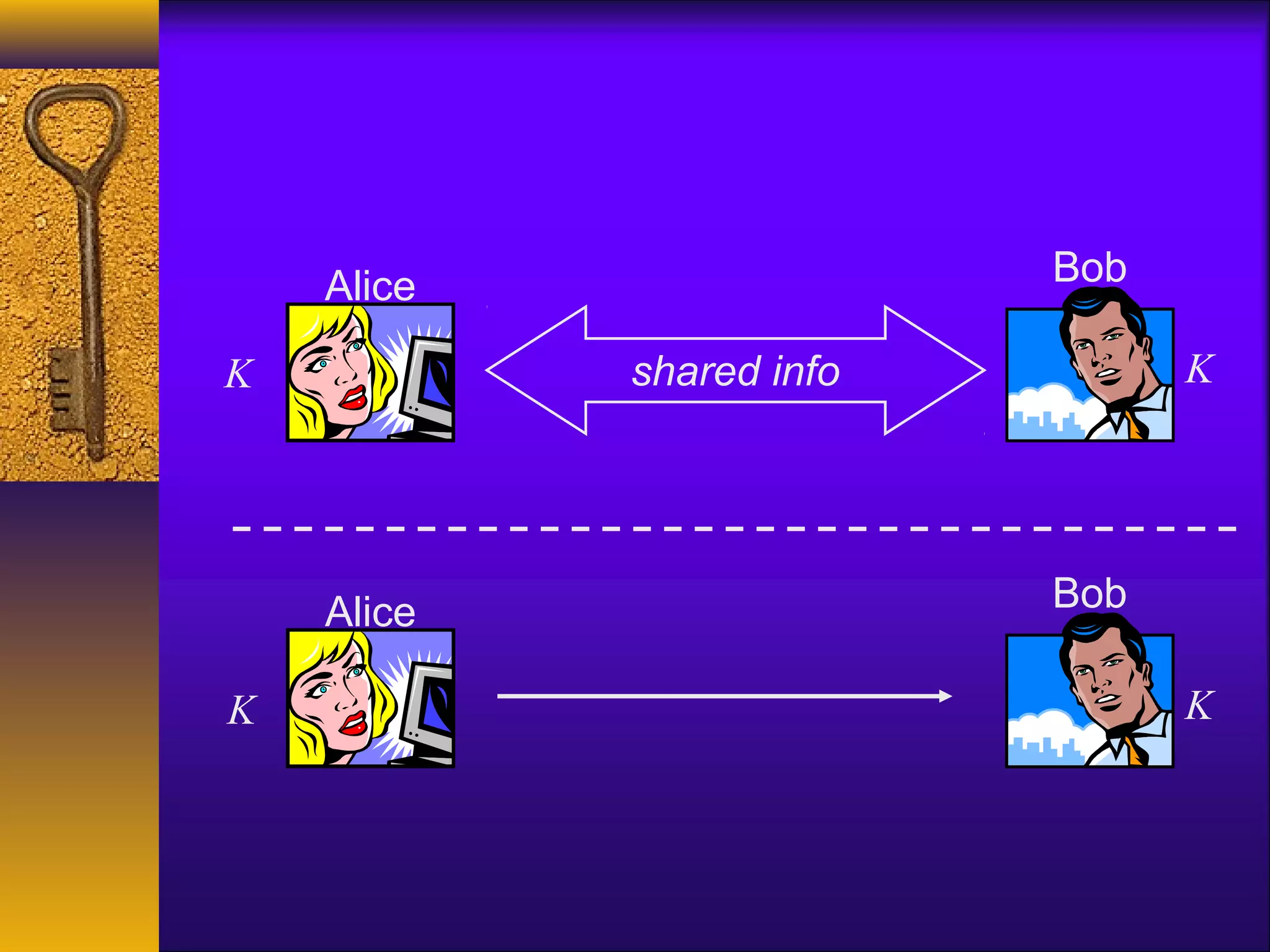
♦ The communicating parties share some
information that is random and secret
– This shared information is called a key
– Key is not known to an attacker
– This key must be shared (somehow) in advance of their
communication
To emphasize
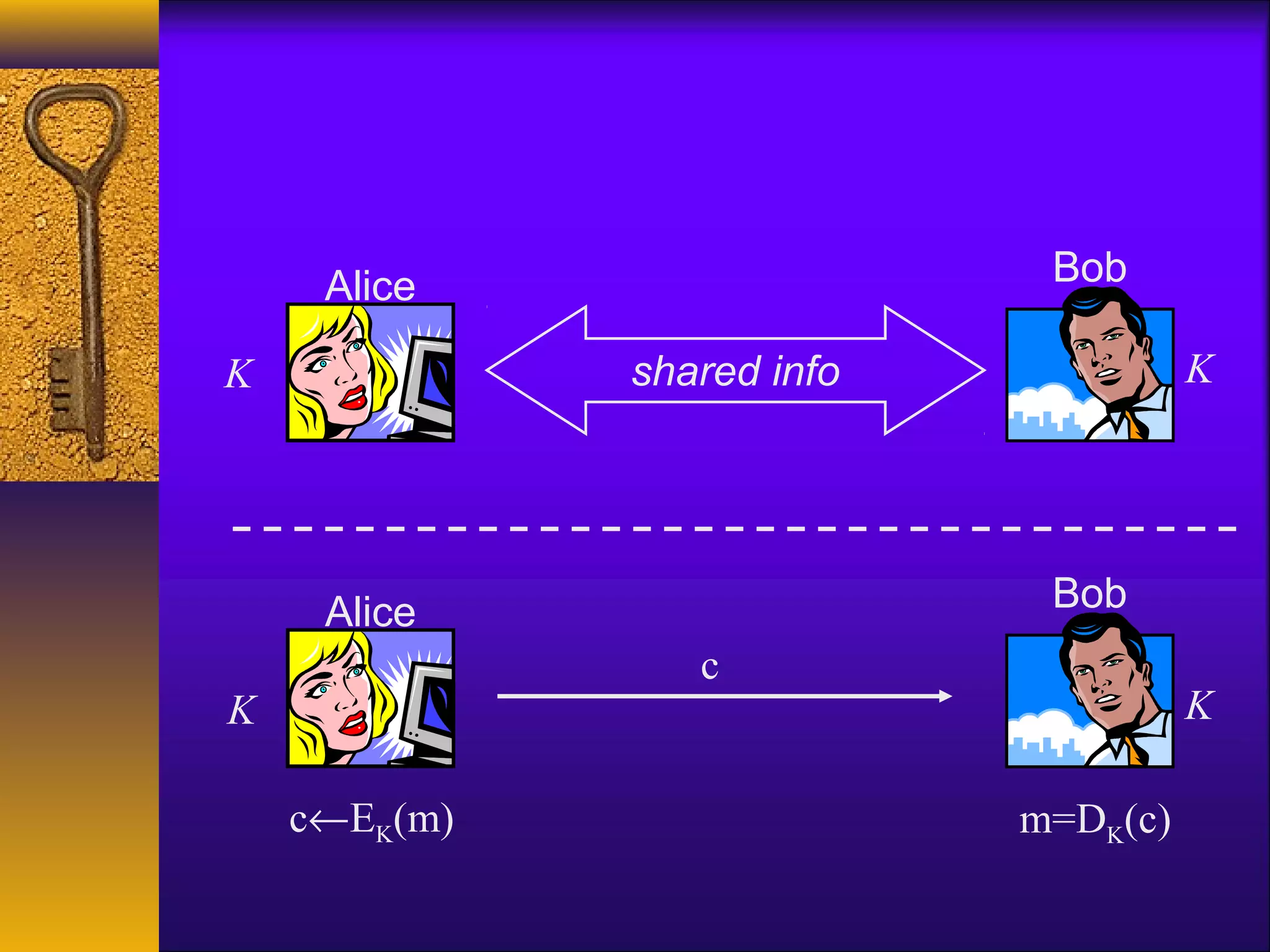
♦ Alice and Bob share a key K
– Must be shared securely
– Must be completely random
– Must be kept completely secret from attacker
♦ We don’t discuss (for now) how they do this
– You can imagine they meet on a dark street corner and
Alice hands a USB device (with a key on it) to Bob
Private-key cryptography
♦ For confidentiality:
– Private-key (symmetric-key) encryption
♦ For data integrity:
– Message authentication codes
Canonical applications
♦ Two (or more) distinct parties communicating
over an insecure network
– E.g., secure communication
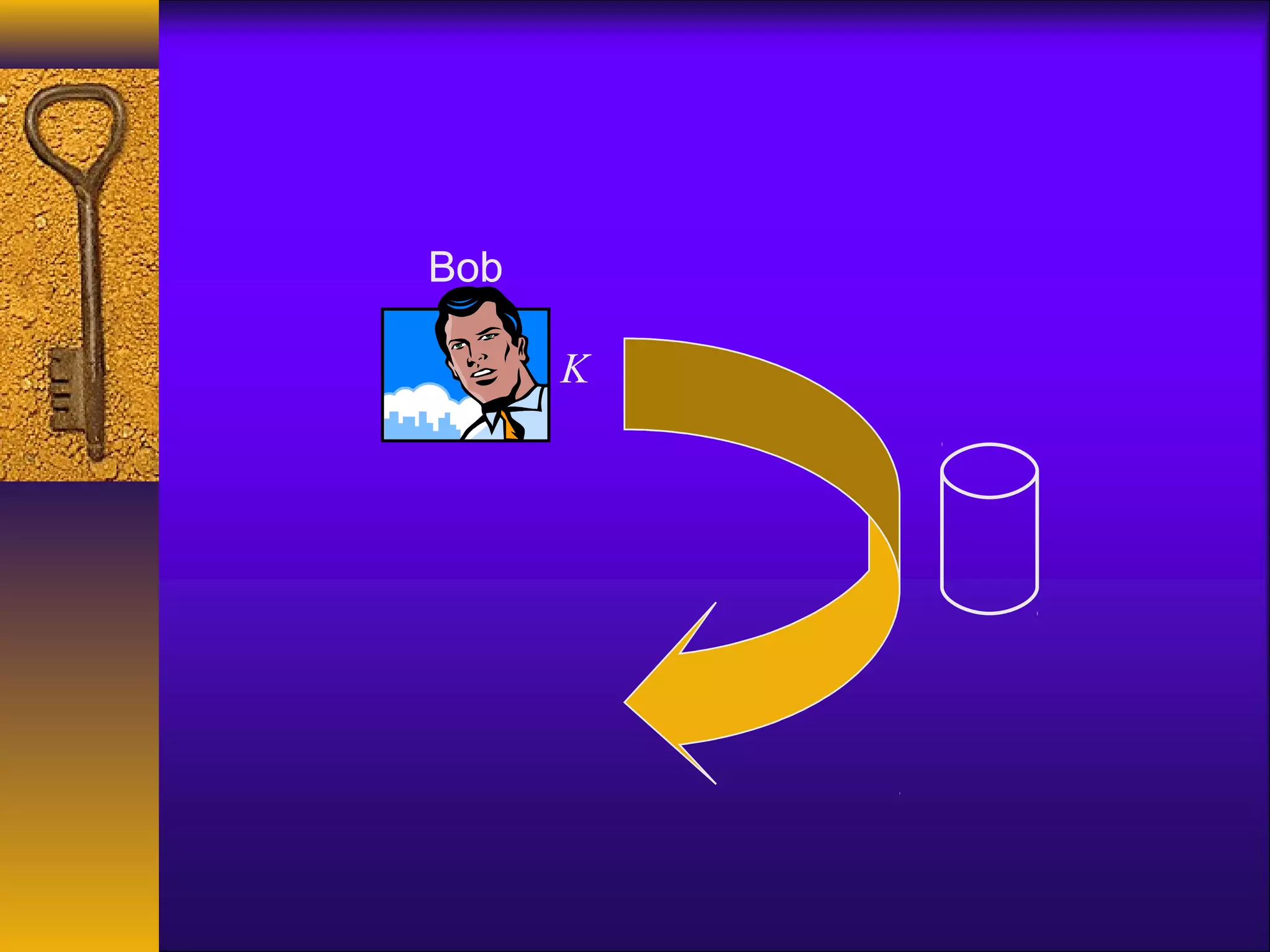
♦ A single party who is communicating “with itself”
over time
– E.g., secure storage
Alice Bob
shared infoK K
Alice
K
Bob
K
Bob
K
Bob
K
Security?
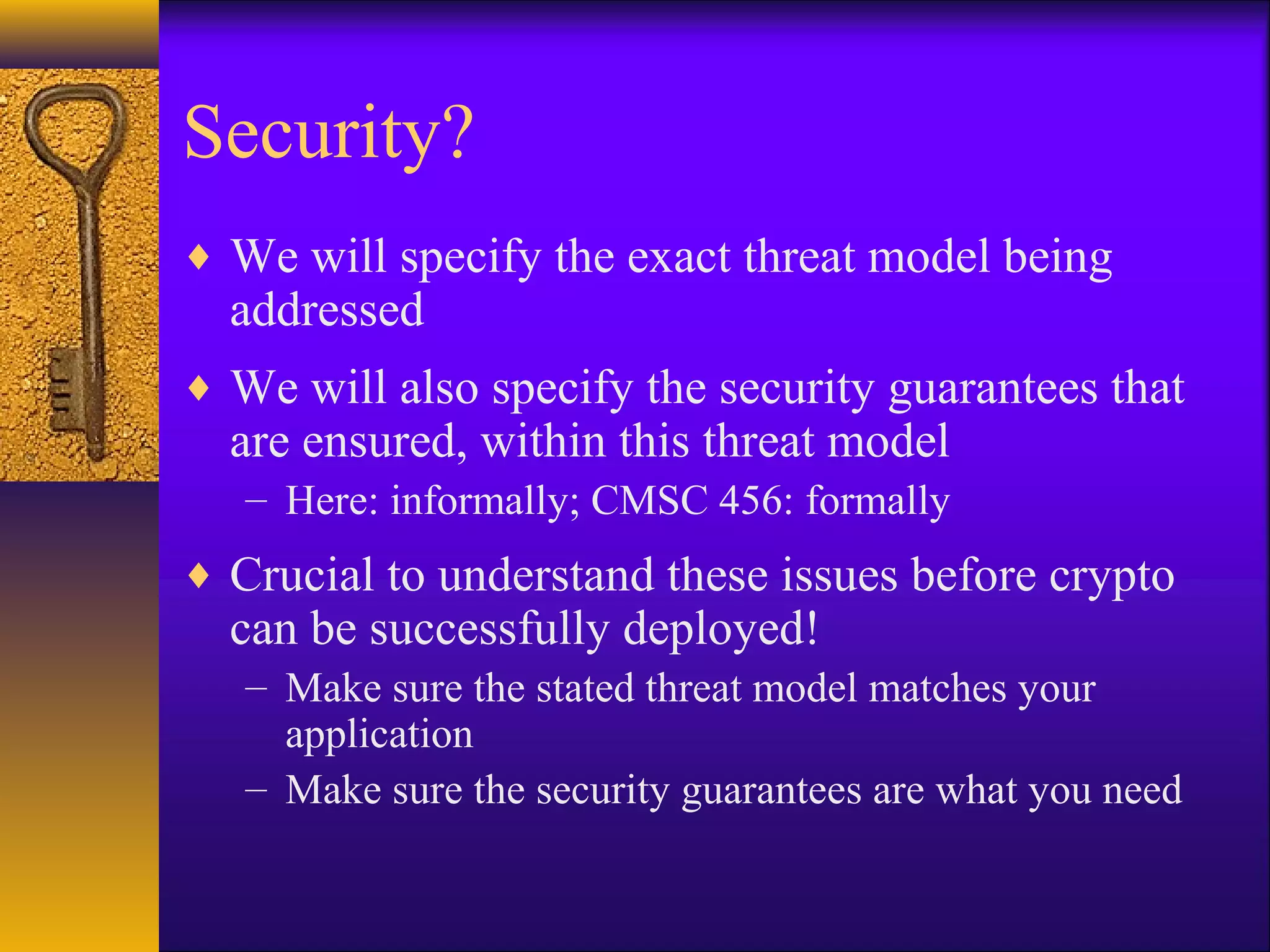
♦ We will specify the exact threat model being
addressed
♦ We will also specify the security guarantees that
are ensured, within this threat model
– Here: informally; CMSC 456: formally
♦ Crucial to understand these issues before crypto
can be successfully deployed!
– Make sure the stated threat model matches your
application
– Make sure the security guarantees are what you need
Security through obscurity?
♦ Always assume that the full details of crypto
protocols and algorithms are public
– Known as Kerckhoffs’ principle
– The only secret information is a key
♦ “Security through obscurity” is a bad idea…
– True in general; even more true in the case of
cryptography
– Home-brewed solutions are BAD!
– Standardized, widely-accepted solutions are GOOD!
Security through obscurity?
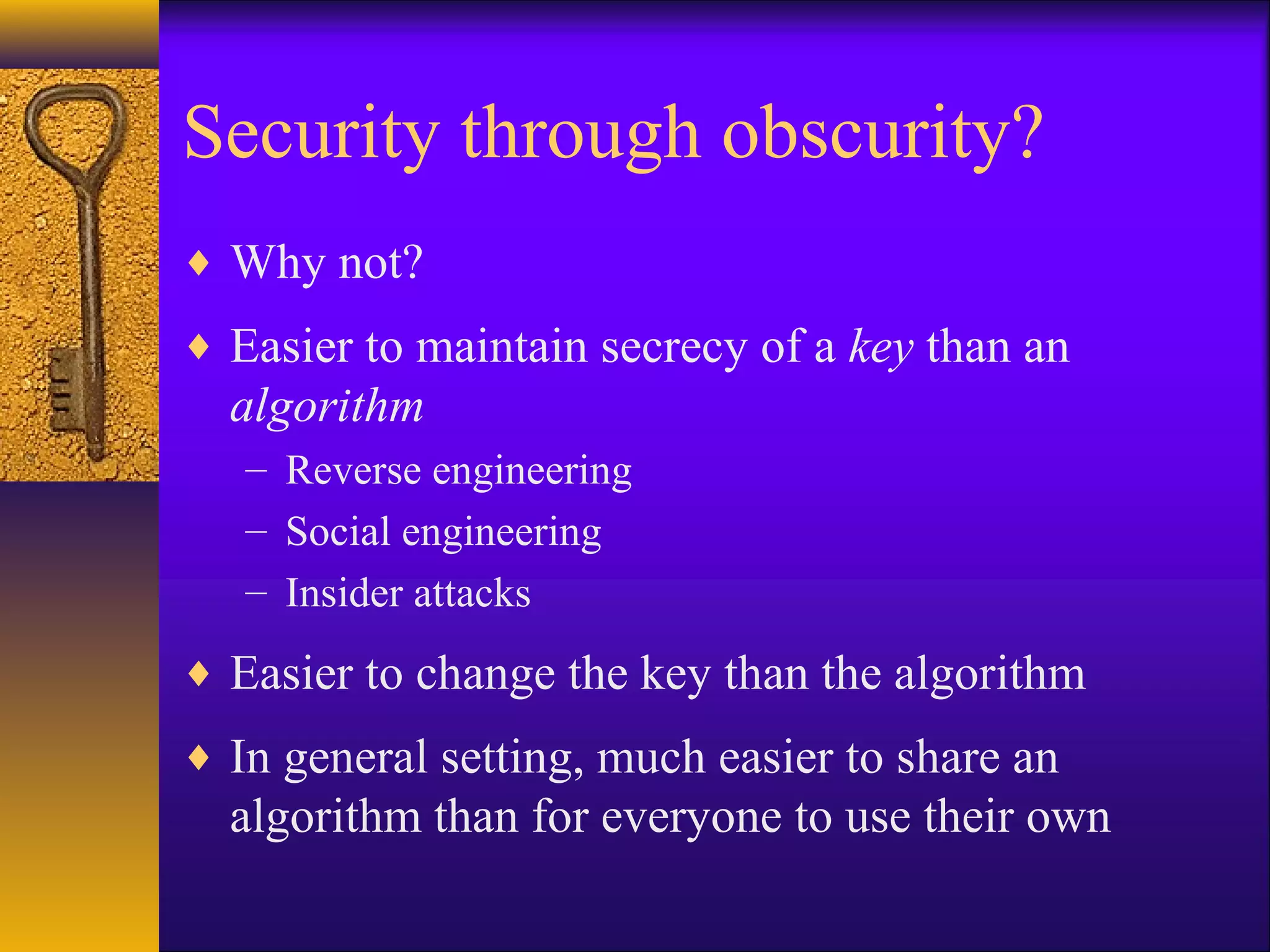
♦ Why not?
♦ Easier to maintain secrecy of a key than an
algorithm
– Reverse engineering
– Social engineering
– Insider attacks
♦ Easier to change the key than the algorithm
♦ In general setting, much easier to share an
algorithm than for everyone to use their own
Private-key encryption
Functional definition
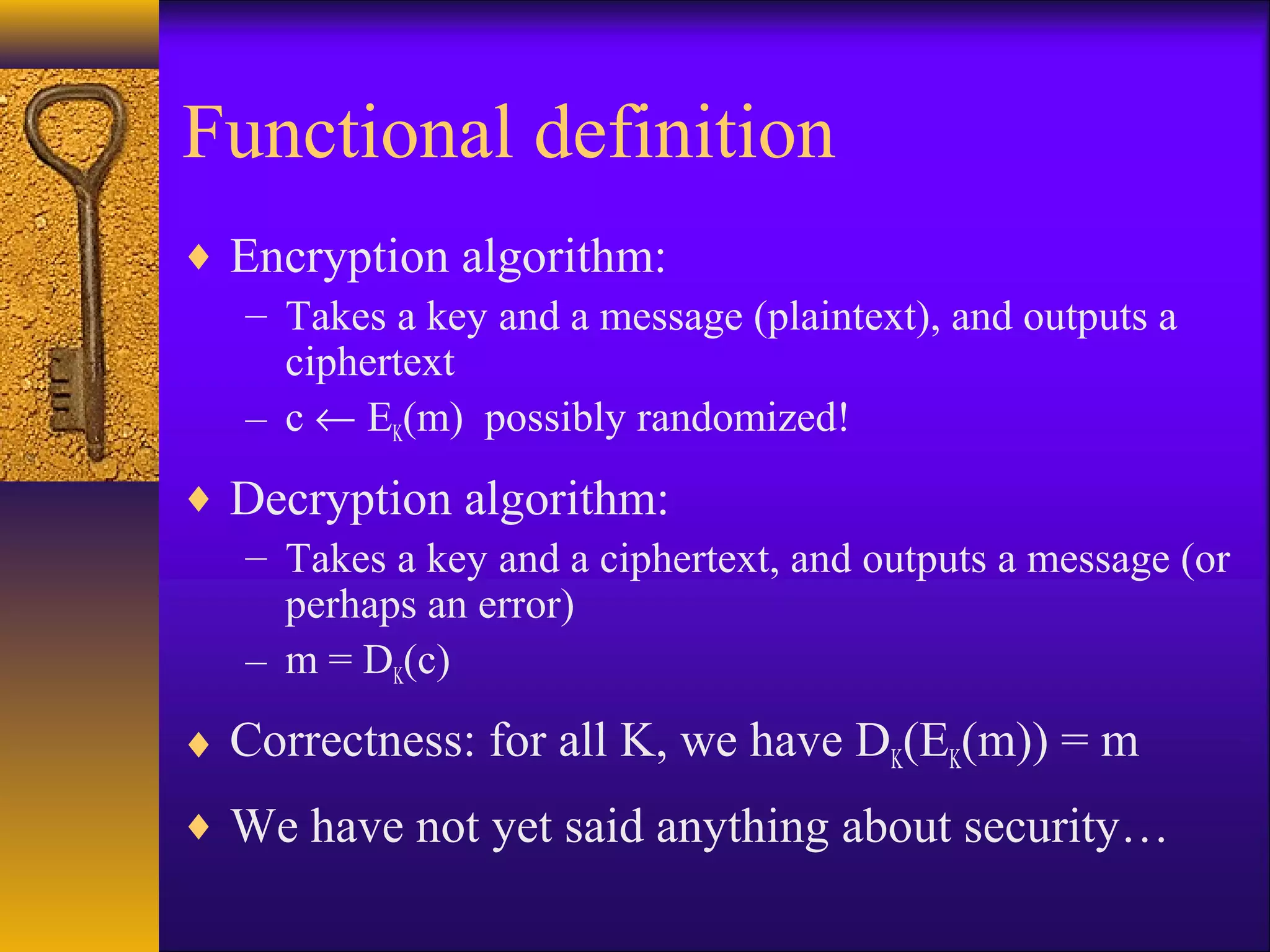
♦ Encryption algorithm:
– Takes a key and a message (plaintext), and outputs a
ciphertext
– c ← EK(m) possibly randomized!
♦ Decryption algorithm:
– Takes a key and a ciphertext, and outputs a message (or
perhaps an error)
– m = DK(c)
♦ Correctness: for all K, we have DK(EK(m)) = m
♦ We have not yet said anything about security…
Alice Bob
shared infoK K
Alice
K
Bob
K
c
c←EK(m) m=DK(c)
A classic example: shift cipher
♦ Assume the English uppercase alphabet (no
lowercase, punctuation, etc.)
– View letters as numbers in {0, …, 25}
♦ The key is a random letter of the alphabet
♦ Encryption done by addition modulo 26
♦ Is this secure?
– Exhaustive key search
– Automated determination of the key
Another example: substitution cipher
♦ The key is a random permutation of the alphabet
– Note: key space is huge!
♦ Encryption done in the natural way
♦ Is this secure?
– Frequency analysis
♦ A large key space is necessary, but not sufficient,
for security
Another example: Vigenere cipher
♦ More complicated version of shift cipher
♦ Believed to be secure for over 100 years
♦ Is it secure?
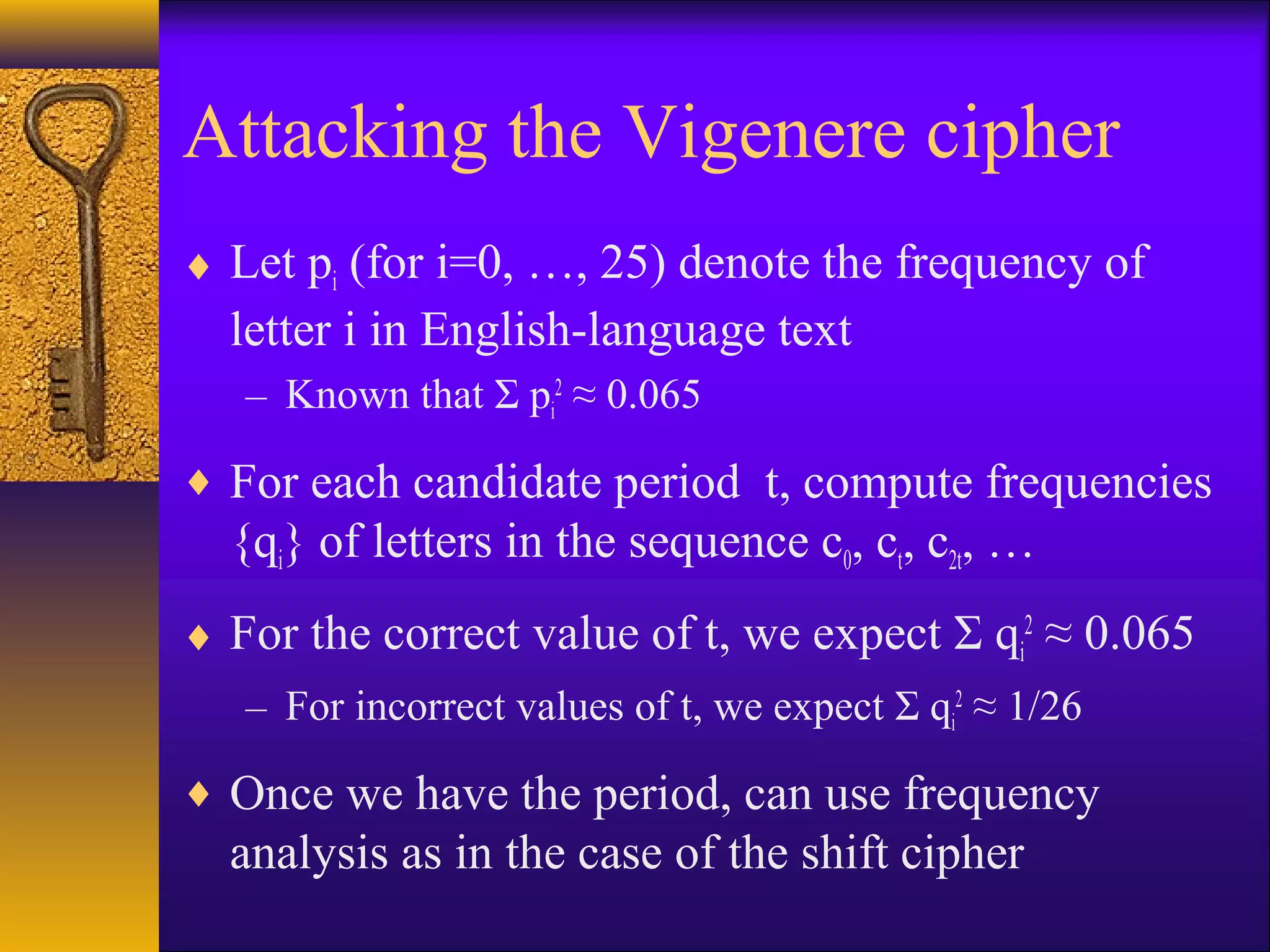
Attacking the Vigenere cipher
♦ Let pi (for i=0, …, 25) denote the frequency of
letter i in English-language text
– Known that Σ pi
2
≈ 0.065
♦ For each candidate period t, compute frequencies
{qi} of letters in the sequence c0, ct, c2t, …
♦ For the correct value of t, we expect Σ qi
2
≈ 0.065
– For incorrect values of t, we expect Σ qi
2
≈ 1/26
♦ Once we have the period, can use frequency
analysis as in the case of the shift cipher
Moral of the story?
♦ Don’t use “simple” schemes
♦ Don’t use schemes that you design yourself
– Use schemes that other people have already designed
and analyzed…
A fundamental problem
♦ A fundamental problem with “classical”
cryptography is that no definition of security was
ever specified
– It was not even clear what it meant for a scheme to be
“secure”
♦ As a consequence, proving security was not even
an option
– So how can you know when something is secure?
– (Or is at least based on well-studied, widely-believed
assumptions)
Defining security?
♦ What is a good definition?
♦ Why is a good definition important?
Security goals?
♦ Adversary unable to recover the key
– Necessary, but meaningless on its own…
♦ Adversary unable to recover entire plaintext
– Good, but is it enough?
♦ Adversary unable to determine any information at
all about the plaintext
– Formalize?
– Sounds great!
– Can we achieve it?
Note
♦ Even given our definition, we need to consider the
threat model
– Multiple messages or a single message?
– Passive/active adversary?
– Chosen-plaintext attacks?
♦ The threat model matters!
– The classical ciphers we have seen are immediately
broken by a known-plaintext attack
Defining secrecy (take 1)
♦ Even an adversary running for an unbounded
amount of time learns nothing about the message
from the ciphertext
♦ Perfect secrecy
♦ Formally, for all distributions over the message
space, all m, and all c:
Pr[M=m | C=c] = Pr[M=m]
Next time: the one-time pad;
its limitations;
overcoming these limitations

Computer and Network Security

  • 1.
    Computer and NetworkSecurity Lecture 6
  • 2.
    JCE tutorial ♦ Inclass next Wednesday ♦ HW1 will use it
  • 3.
    Assigned readings fromlecture 1 ♦ “Inside the Twisted Mind of the Security Professional” ♦ “We are All Security Customers” ♦ “Information Security and Externalities” ♦ Comments?
  • 4.
    A high-level surveyof cryptography
  • 5.
    Caveats ♦ Everything Ipresent will be (relatively) informal – I may simplify, but I will not say anything that is an outright lie… ♦ Cryptography offers formal definitions and rigorous proofs of security (neither of which we will cover here) – For more details, take CMSC 456 in the Fall (or read my book)! ♦ If you think you already know cryptography from somewhere else (CMSC456, CISSP, your job, the news), you are probably mistaken
  • 6.
    Goals of cryptography ♦Crypto deals primarily with three goals: – Confidentiality – Integrity (of data) – Authentication (of resources, people, systems) ♦ Other goals also considered – E.g., non-repudiation – E-cash (e.g., double spending) – General secure multi-party computation – Anonymity – …
  • 7.
    Private- vs. public-keysettings ♦ For the basic goals, there are two settings: – Private-key / shared-key / symmetric-key / secret-key – Public-key ♦ The private-key setting is the “classical” one (thousands of years old) ♦ The public-key setting dates to the 1970s
  • 8.
    Private-key cryptography ♦ Thecommunicating parties share some information that is random and secret – This shared information is called a key – Key is not known to an attacker – This key must be shared (somehow) in advance of their communication
  • 9.
    To emphasize ♦ Aliceand Bob share a key K – Must be shared securely – Must be completely random – Must be kept completely secret from attacker ♦ We don’t discuss (for now) how they do this – You can imagine they meet on a dark street corner and Alice hands a USB device (with a key on it) to Bob
  • 10.
    Private-key cryptography ♦ Forconfidentiality: – Private-key (symmetric-key) encryption ♦ For data integrity: – Message authentication codes
  • 11.
    Canonical applications ♦ Two(or more) distinct parties communicating over an insecure network – E.g., secure communication ♦ A single party who is communicating “with itself” over time – E.g., secure storage
  • 12.
    Alice Bob shared infoKK Alice K Bob K
  • 13.
  • 14.
    Security? ♦ We willspecify the exact threat model being addressed ♦ We will also specify the security guarantees that are ensured, within this threat model – Here: informally; CMSC 456: formally ♦ Crucial to understand these issues before crypto can be successfully deployed! – Make sure the stated threat model matches your application – Make sure the security guarantees are what you need
  • 15.
    Security through obscurity? ♦Always assume that the full details of crypto protocols and algorithms are public – Known as Kerckhoffs’ principle – The only secret information is a key ♦ “Security through obscurity” is a bad idea… – True in general; even more true in the case of cryptography – Home-brewed solutions are BAD! – Standardized, widely-accepted solutions are GOOD!
  • 16.
    Security through obscurity? ♦Why not? ♦ Easier to maintain secrecy of a key than an algorithm – Reverse engineering – Social engineering – Insider attacks ♦ Easier to change the key than the algorithm ♦ In general setting, much easier to share an algorithm than for everyone to use their own
  • 17.
  • 18.
    Functional definition ♦ Encryptionalgorithm: – Takes a key and a message (plaintext), and outputs a ciphertext – c ← EK(m) possibly randomized! ♦ Decryption algorithm: – Takes a key and a ciphertext, and outputs a message (or perhaps an error) – m = DK(c) ♦ Correctness: for all K, we have DK(EK(m)) = m ♦ We have not yet said anything about security…
  • 19.
    Alice Bob shared infoKK Alice K Bob K c c←EK(m) m=DK(c)
  • 20.
    A classic example:shift cipher ♦ Assume the English uppercase alphabet (no lowercase, punctuation, etc.) – View letters as numbers in {0, …, 25} ♦ The key is a random letter of the alphabet ♦ Encryption done by addition modulo 26 ♦ Is this secure? – Exhaustive key search – Automated determination of the key
  • 21.
    Another example: substitutioncipher ♦ The key is a random permutation of the alphabet – Note: key space is huge! ♦ Encryption done in the natural way ♦ Is this secure? – Frequency analysis ♦ A large key space is necessary, but not sufficient, for security
  • 22.
    Another example: Vigenerecipher ♦ More complicated version of shift cipher ♦ Believed to be secure for over 100 years ♦ Is it secure?
  • 23.
    Attacking the Vigenerecipher ♦ Let pi (for i=0, …, 25) denote the frequency of letter i in English-language text – Known that Σ pi 2 ≈ 0.065 ♦ For each candidate period t, compute frequencies {qi} of letters in the sequence c0, ct, c2t, … ♦ For the correct value of t, we expect Σ qi 2 ≈ 0.065 – For incorrect values of t, we expect Σ qi 2 ≈ 1/26 ♦ Once we have the period, can use frequency analysis as in the case of the shift cipher
  • 24.
    Moral of thestory? ♦ Don’t use “simple” schemes ♦ Don’t use schemes that you design yourself – Use schemes that other people have already designed and analyzed…
  • 25.
    A fundamental problem ♦A fundamental problem with “classical” cryptography is that no definition of security was ever specified – It was not even clear what it meant for a scheme to be “secure” ♦ As a consequence, proving security was not even an option – So how can you know when something is secure? – (Or is at least based on well-studied, widely-believed assumptions)
  • 26.
    Defining security? ♦ Whatis a good definition? ♦ Why is a good definition important?
  • 27.
    Security goals? ♦ Adversaryunable to recover the key – Necessary, but meaningless on its own… ♦ Adversary unable to recover entire plaintext – Good, but is it enough? ♦ Adversary unable to determine any information at all about the plaintext – Formalize? – Sounds great! – Can we achieve it?
  • 28.
    Note ♦ Even givenour definition, we need to consider the threat model – Multiple messages or a single message? – Passive/active adversary? – Chosen-plaintext attacks? ♦ The threat model matters! – The classical ciphers we have seen are immediately broken by a known-plaintext attack
  • 29.
    Defining secrecy (take1) ♦ Even an adversary running for an unbounded amount of time learns nothing about the message from the ciphertext ♦ Perfect secrecy ♦ Formally, for all distributions over the message space, all m, and all c: Pr[M=m | C=c] = Pr[M=m]
  • 30.
    Next time: theone-time pad; its limitations; overcoming these limitations