


BINOMIAL
DISTRIBUTION
THE BINOMIAL DISTRIBUTION IS A
DISCRETE DISTRIBUTION.
 The Binomial is type of distribution that has two possible
outcomes.
 It is applicable to Discrete random variables only.
 A binomial distribution can be thought of as simply the
probability of a SUCCESS or FAILURE outcome in an
experiment or survey that is repeated multiple times.
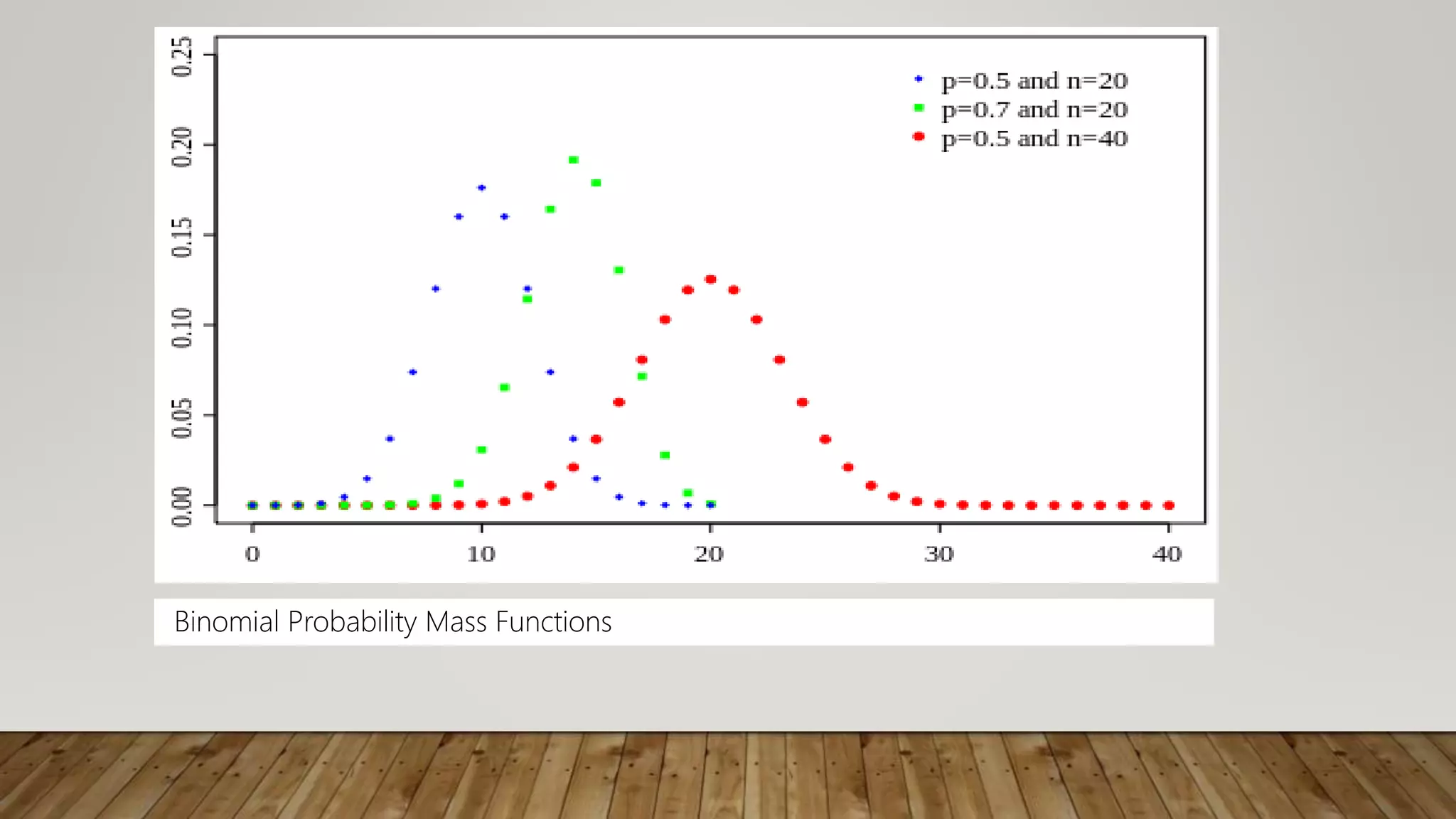
Binomial Probability Mass Functions
Binomial distribution experimental
conditions.
Each trial results in two mutually disjoint outcomes
termed as success and failure.
The number of trials is ‘n’ finite.
The trials are independent of each other.
The probability of success ‘p’ is constant for each trial.
.
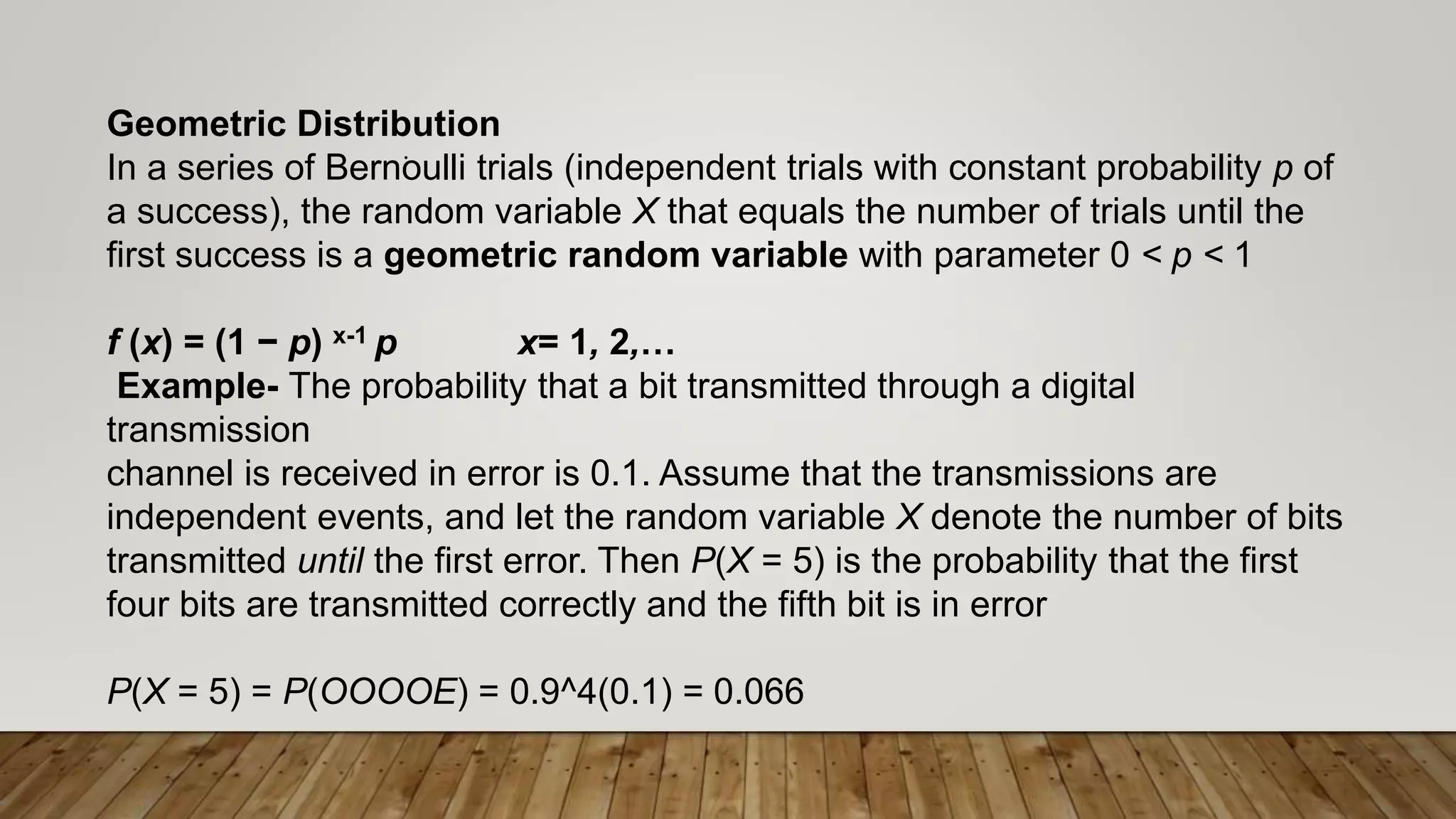
Geometric Distribution
In a series of Bernoulli trials (independent trials with constant probability p of
a success), the random variable X that equals the number of trials until the
first success is a geometric random variable with parameter 0 < p < 1
f (x) = (1 − p) x-1 p x= 1, 2,…
Example- The probability that a bit transmitted through a digital
transmission
channel is received in error is 0.1. Assume that the transmissions are
independent events, and let the random variable X denote the number of bits
transmitted until the first error. Then P(X = 5) is the probability that the first
four bits are transmitted correctly and the fifth bit is in error
P(X = 5) = P(OOOOE) = 0.9^4(0.1) = 0.066
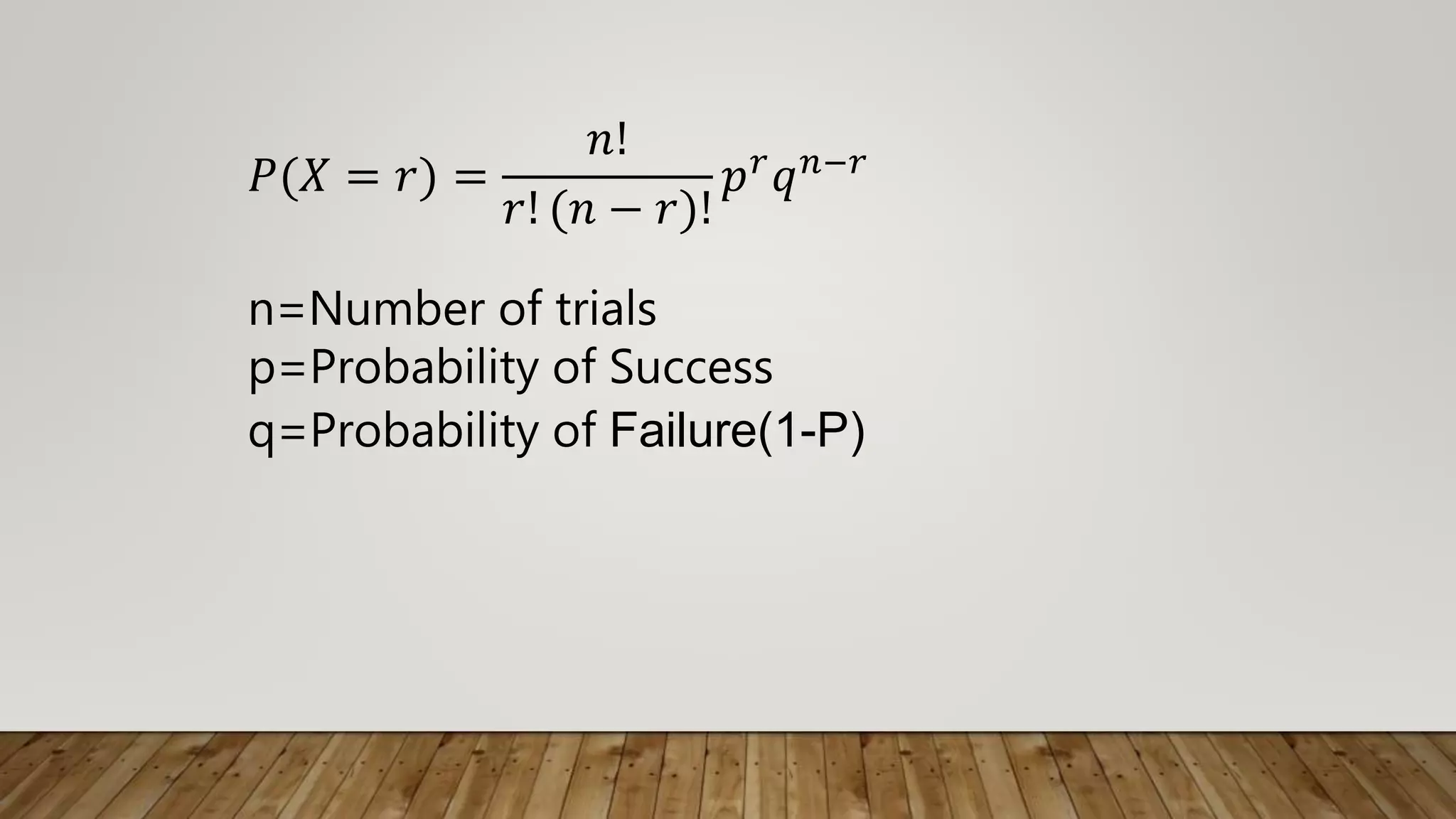
𝑃(𝑋 = 𝑟) =
𝑛!
𝑟! (𝑛 − 𝑟)!
𝑝 𝑟
𝑞 𝑛−𝑟
n=Number of trials
p=Probability of Success
q=Probability of Failure(1-P)
Mean and Standard Deviation
The mean (expected value) of a binomial random
variable is
The standard deviation of a binomial random variable
is
np
npq
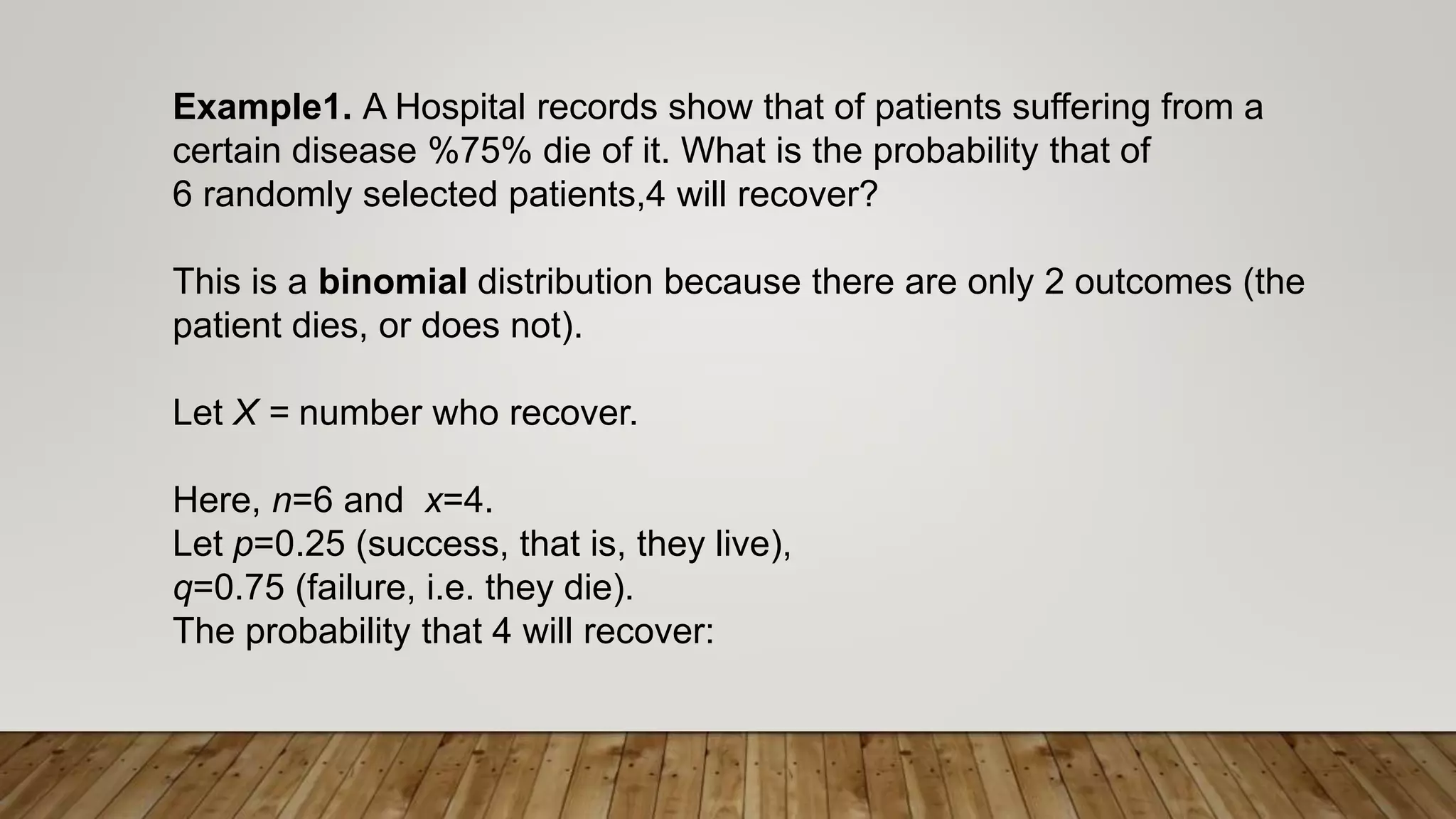
Example1. A Hospital records show that of patients suffering from a
certain disease %75% die of it. What is the probability that of
6 randomly selected patients,4 will recover?
This is a binomial distribution because there are only 2 outcomes (the
patient dies, or does not).
Let X = number who recover.
Here, n=6 and x=4.
Let p=0.25 (success, that is, they live),
q=0.75 (failure, i.e. they die).
The probability that 4 will recover:
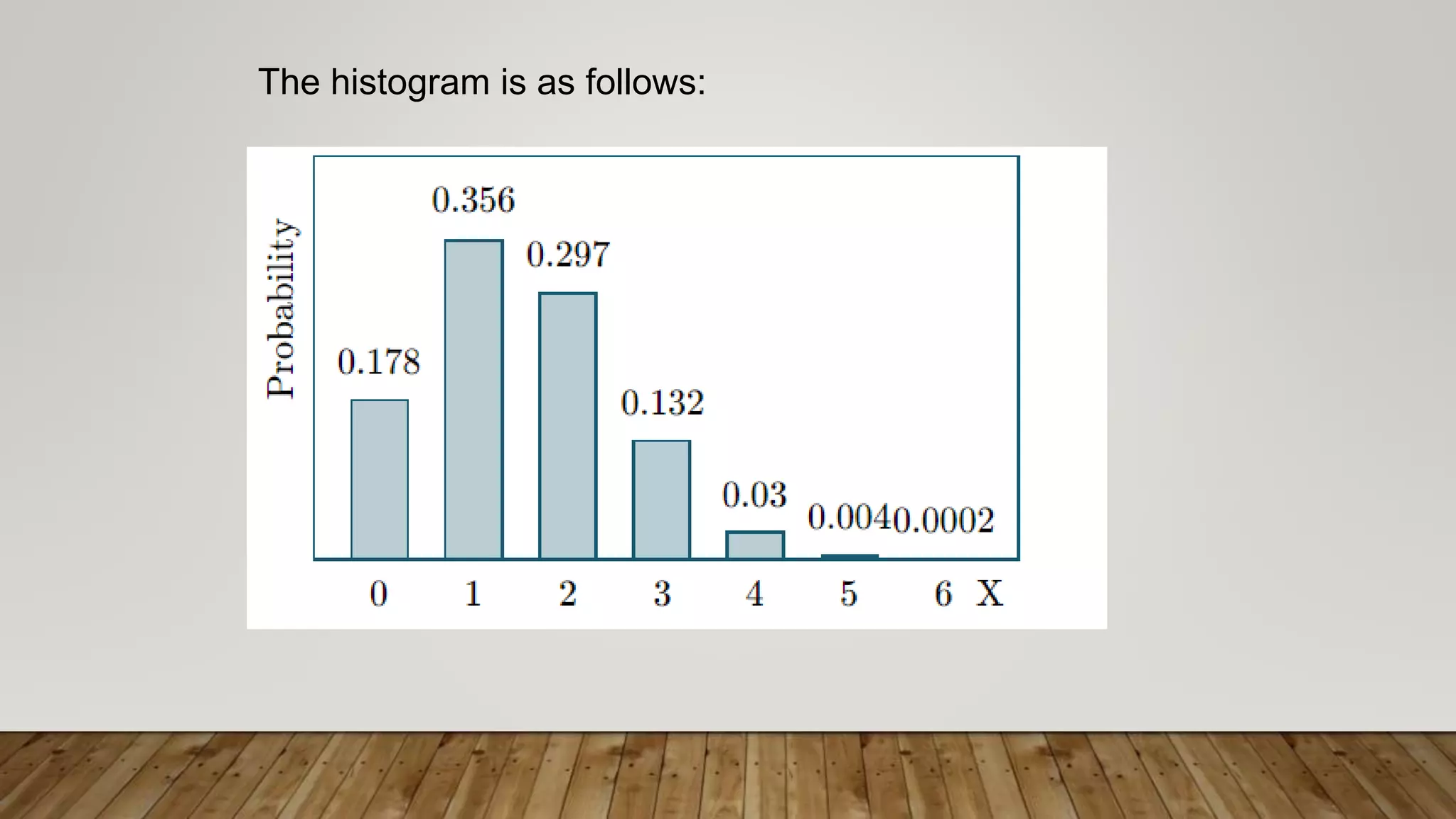
The histogram is as follows:
It means that out of the 6 patients chosen, the
probability that:
None of them will recover is 0.17798,
One will recover is 0.35596, and
All 6 will recover is extremely small.
Example 2.
Ten percent of computer parts produced by a certain supplier are
defective. What is the probability that a sample of 10 parts contains
more than 3 defective ones?
Thank You

Binomial distribution

  • 1.
  • 2.
     The Binomialis type of distribution that has two possible outcomes.  It is applicable to Discrete random variables only.  A binomial distribution can be thought of as simply the probability of a SUCCESS or FAILURE outcome in an experiment or survey that is repeated multiple times.
  • 3.
  • 4.
    Binomial distribution experimental conditions. Eachtrial results in two mutually disjoint outcomes termed as success and failure. The number of trials is ‘n’ finite. The trials are independent of each other. The probability of success ‘p’ is constant for each trial.
  • 5.
    . Geometric Distribution In aseries of Bernoulli trials (independent trials with constant probability p of a success), the random variable X that equals the number of trials until the first success is a geometric random variable with parameter 0 < p < 1 f (x) = (1 − p) x-1 p x= 1, 2,… Example- The probability that a bit transmitted through a digital transmission channel is received in error is 0.1. Assume that the transmissions are independent events, and let the random variable X denote the number of bits transmitted until the first error. Then P(X = 5) is the probability that the first four bits are transmitted correctly and the fifth bit is in error P(X = 5) = P(OOOOE) = 0.9^4(0.1) = 0.066
  • 6.
    𝑃(𝑋 = 𝑟)= 𝑛! 𝑟! (𝑛 − 𝑟)! 𝑝 𝑟 𝑞 𝑛−𝑟 n=Number of trials p=Probability of Success q=Probability of Failure(1-P)
  • 7.
    Mean and StandardDeviation The mean (expected value) of a binomial random variable is The standard deviation of a binomial random variable is np npq
  • 8.
    Example1. A Hospitalrecords show that of patients suffering from a certain disease %75% die of it. What is the probability that of 6 randomly selected patients,4 will recover? This is a binomial distribution because there are only 2 outcomes (the patient dies, or does not). Let X = number who recover. Here, n=6 and x=4. Let p=0.25 (success, that is, they live), q=0.75 (failure, i.e. they die). The probability that 4 will recover:
  • 10.
    The histogram isas follows:
  • 11.
    It means thatout of the 6 patients chosen, the probability that: None of them will recover is 0.17798, One will recover is 0.35596, and All 6 will recover is extremely small.
  • 12.
    Example 2. Ten percentof computer parts produced by a certain supplier are defective. What is the probability that a sample of 10 parts contains more than 3 defective ones?
  • 13.