Basic Graph Algorithms
BasicGraph Algorithms
Programming Puzzles and Competitions
Programming Puzzles and Competitions
CIS 4900 / 5920
CIS 4900 / 5920
Spring 2009
Spring 2009
2.
Outline
• Introduction/review ofgraphs
• Some basic graph problems &
algorithms
• Start of an example question from
ICPC’07 (“Tunnels”)
3.
Relation to Contests
•Many programming contest problems
can be viewed as graph problems.
• Some graph algorithms are
complicated, but a few are very
simple.
• If you can find a way to apply one of
these, you will do well.
4.
How short &simple?
int [][] path = new int[edge.length][edge.length];
for (int i =0; i < n; i++)
for (int j = 0; j < n; j++)
path[i][j] = edge[i][j];
for (int k = 0; k < n; k++)
for (int i =0; i < n; i++)
for (int j = 0; j < n; j++)
if (path[i][k] != 0 && path[k,j] != 0) {
x = path[i][k] + path[k][j];
if ((path[i,j] == 0) || path[i][j] > x) path[i][j] = x;
}
5.
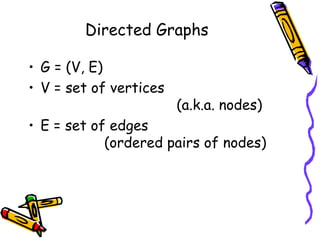
Directed Graphs
• G= (V, E)
• V = set of vertices
(a.k.a. nodes)
• E = set of edges
(ordered pairs of nodes)
6.
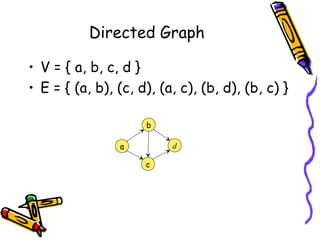
Directed Graph
• V= { a, b, c, d }
• E = { (a, b), (c, d), (a, c), (b, d), (b, c) }
c
b
d
a
7.
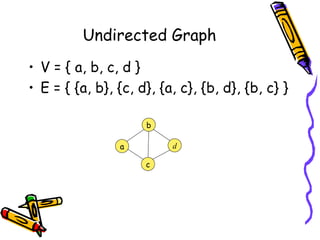
Undirected Graph
• V= { a, b, c, d }
• E = { {a, b}, {c, d}, {a, c}, {b, d}, {b, c} }
c
b
d
a
8.
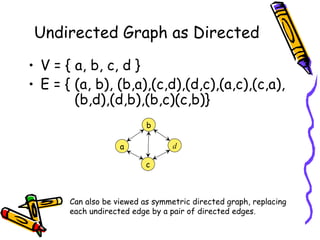
Undirected Graph asDirected
• V = { a, b, c, d }
• E = { (a, b), (b,a),(c,d),(d,c),(a,c),(c,a),
(b,d),(d,b),(b,c)(c,b)}
c
b
d
a
Can also be viewed as symmetric directed graph, replacing
each undirected edge by a pair of directed edges.
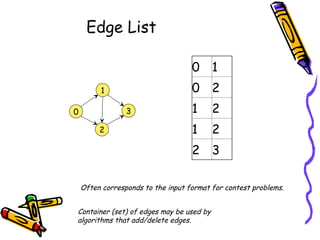
Edge List
2
1
3
0
Often correspondsto the input format for contest problems.
0 1
0 2
1 2
1 2
2 3
Container (set) of edges may be used by
algorithms that add/delete edges.
11.
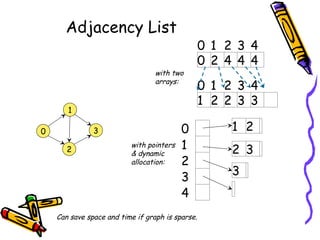
Adjacency List
2
1
3
0 0
1
2
3
4
Cansave space and time if graph is sparse.
3
2 3
1 2
with pointers
& dynamic
allocation:
0 1 2 3 4
0 2 4 4 4
with two
arrays:
0 1 2 3 4
1 2 2 3 3
12.
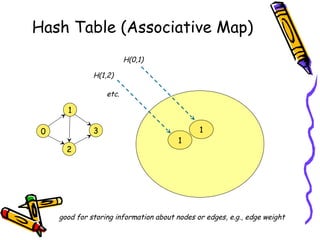
Hash Table (AssociativeMap)
2
1
3
0
good for storing information about nodes or edges, e.g., edge weight
H(1,2)
1
H(0,1)
1
etc.
13.
Adjacency/Incidence Matrix
2
1
3
0
0 12 3
0 0 1 1 0
1 0 0 1 1
2 0 0 0 1
3 0 0 0 0
A[i][j] = 1 → (i,j) i E
A[i][j] = 0 otherwise
a very convenient representation for simple coding of algorithms,
although it may waste time & space if the graph is sparse.
14.
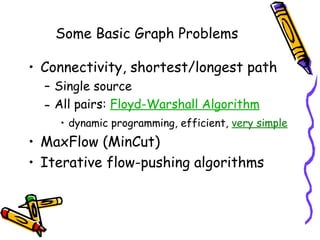
Some Basic GraphProblems
• Connectivity, shortest/longest path
– Single source
– All pairs: Floyd-Warshall Algorithm
• dynamic programming, efficient, very simple
• MaxFlow (MinCut)
• Iterative flow-pushing algorithms
15.
Floyd-Warshall Algorithm
Assume edgeCost(i,j)returns the cost of the edge from i to j
(infinity if there is none), n is the number of vertices, and
edgeCost(i,i) = 0
int path[][]; // a 2-D matrix.
// At each step, path[i][j] is the (cost of the) shortest path
// from i to j using intermediate vertices (1..k-1).
// Each path[i][j] is initialized to edgeCost (i,j)
// or ∞ if there is no edge between i and j.
procedure FloydWarshall ()
for k in 1..n
for each pair (i,j) in {1,..,n}x{1,..,n}
path[i][j] = min ( path[i][j], path[i][k]+path[k][j] );
* Time complexity: O(|V|3
).
16.
Details
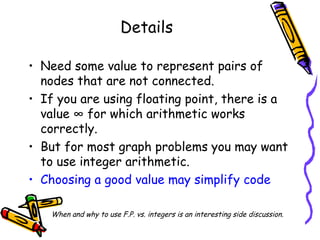
• Need somevalue to represent pairs of
nodes that are not connected.
• If you are using floating point, there is a
value ∞ for which arithmetic works
correctly.
• But for most graph problems you may want
to use integer arithmetic.
• Choosing a good value may simplify code
When and why to use F.P. vs. integers is an interesting side discussion.
17.
if (path[i][k] !=0 && path[k,j] != 0) {
x = path[i][k] + path[k][j];
if ((path[i,j] == 0) || path[i][j] > x) path[i][j] = x;
}
Suppose we use path[i][j] == 0 to
indicate lack of connection.
Example
Correction
In class, Iclaimed that this algorithm could be adapted to find
length of longest cycle-free path, and to count cycle-free
paths.
That is not true.
However there is a generalization to find the maximum flow
between points, and the maximum-flow path:
for k in 1,..,n
for each pair (i,j) in {1,..,n}x{1,..,n}
maxflow[i][j] = max (maxflow[i][j]
min (maxflow[i][k], maxflow[k][j]);

![How short & simple?
int [][] path = new int[edge.length][edge.length];
for (int i =0; i < n; i++)
for (int j = 0; j < n; j++)
path[i][j] = edge[i][j];
for (int k = 0; k < n; k++)
for (int i =0; i < n; i++)
for (int j = 0; j < n; j++)
if (path[i][k] != 0 && path[k,j] != 0) {
x = path[i][k] + path[k][j];
if ((path[i,j] == 0) || path[i][j] > x) path[i][j] = x;
}](https://image.slidesharecdn.com/warshall-251129044611-781b98d0/85/shortestwarshashortestwarshashortestwarshall-ppt-4-320.jpg)

![Adjacency/Incidence Matrix
2
1
3
0
0 1 2 3
0 0 1 1 0
1 0 0 1 1
2 0 0 0 1
3 0 0 0 0
A[i][j] = 1 → (i,j) i E
A[i][j] = 0 otherwise
a very convenient representation for simple coding of algorithms,
although it may waste time & space if the graph is sparse.](https://image.slidesharecdn.com/warshall-251129044611-781b98d0/85/shortestwarshashortestwarshashortestwarshall-ppt-13-320.jpg)
![Floyd-Warshall Algorithm
Assume edgeCost(i,j) returns the cost of the edge from i to j
(infinity if there is none), n is the number of vertices, and
edgeCost(i,i) = 0
int path[][]; // a 2-D matrix.
// At each step, path[i][j] is the (cost of the) shortest path
// from i to j using intermediate vertices (1..k-1).
// Each path[i][j] is initialized to edgeCost (i,j)
// or ∞ if there is no edge between i and j.
procedure FloydWarshall ()
for k in 1..n
for each pair (i,j) in {1,..,n}x{1,..,n}
path[i][j] = min ( path[i][j], path[i][k]+path[k][j] );
* Time complexity: O(|V|3
).](https://image.slidesharecdn.com/warshall-251129044611-781b98d0/85/shortestwarshashortestwarshashortestwarshall-ppt-15-320.jpg)
![if (path[i][k] != 0 && path[k,j] != 0) {
x = path[i][k] + path[k][j];
if ((path[i,j] == 0) || path[i][j] > x) path[i][j] = x;
}
Suppose we use path[i][j] == 0 to
indicate lack of connection.
Example](https://image.slidesharecdn.com/warshall-251129044611-781b98d0/85/shortestwarshashortestwarshashortestwarshall-ppt-17-320.jpg)
![i j
k
path[i][j]
path[i][k] path[k,j]
paths that go
though only
nodes 0..k-1
How it works](https://image.slidesharecdn.com/warshall-251129044611-781b98d0/85/shortestwarshashortestwarshashortestwarshall-ppt-18-320.jpg)
![Correction
In class, I claimed that this algorithm could be adapted to find
length of longest cycle-free path, and to count cycle-free
paths.
That is not true.
However there is a generalization to find the maximum flow
between points, and the maximum-flow path:
for k in 1,..,n
for each pair (i,j) in {1,..,n}x{1,..,n}
maxflow[i][j] = max (maxflow[i][j]
min (maxflow[i][k], maxflow[k][j]);](https://image.slidesharecdn.com/warshall-251129044611-781b98d0/85/shortestwarshashortestwarshashortestwarshall-ppt-19-320.jpg)


