The Floyd-Warshall algorithm is a fundamental method in computer science used to find the shortest paths between all pairs of nodes in a weighted graph, capable of handling both positive and negative edge weights. The algorithm operates with a time complexity of O(v³) and is particularly efficient for dense graphs, making it ideal for applications in networking, aviation, and GIS. A detailed pseudo-code and example usage illustrate the algorithm's process and effectiveness in calculating shortest paths.




![IDEA BEHIND FLOYD
WARSHALL ALGORITHM
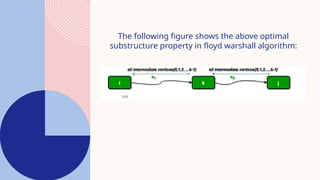
Suppose we have a graph G[][] with V vertices
from 1 to N. Now we have to evaluate
a shortestPathMatrix[][] where shortestPathMatrix[i]
[j] represents the shortest path between
vertices i and j.
Obviously the shortest path between i to j will have
some k number of intermediate nodes. The idea
behind floyd warshall algorithm is to treat each and
every vertex from 1 to N as an intermediate node one
by one.](https://image.slidesharecdn.com/floydwarshallalgorithm-240809045408-78328d77/85/Floyd-warshall-algorithm-and-it-s-applications-4-320.jpg)
![ALGORITHM
•Initialize the solution matrix same as the input graph matrix as a first step.
•Then update the solution matrix by considering all vertices as an intermediate
vertex.
•The idea is to pick all vertices one by one and updates all shortest paths which
include the picked vertex as an intermediate vertex in the shortest path.
•When we pick vertex number k as an intermediate vertex, we already have
considered vertices {0, 1, 2, .. k-1} as intermediate vertices.
•For every pair (i, j) of the source and destination vertices respectively, there are two
possible cases.
• k is not an intermediate vertex in shortest path from i to j. We keep the value
of dist[i][j] as it is.
• k is an intermediate vertex in shortest path from i to j. We update the value
of dist[i][j] as dist[i][k] + dist[k][j], if dist[i][j] > dist[i][k] + dist[k][j]](https://image.slidesharecdn.com/floydwarshallalgorithm-240809045408-78328d77/85/Floyd-warshall-algorithm-and-it-s-applications-6-320.jpg)
![PSEUDOCODE
For k = 0 to n – 1
For i = 0 to n – 1
For j = 0 to n – 1
Distance[i, j] = min(Distance[i, j], Distance[i, k] +
Distance[k, j])
where i = source Node, j = Destination Node, k =
Intermediate Node](https://image.slidesharecdn.com/floydwarshallalgorithm-240809045408-78328d77/85/Floyd-warshall-algorithm-and-it-s-applications-7-320.jpg)
![STEP-1
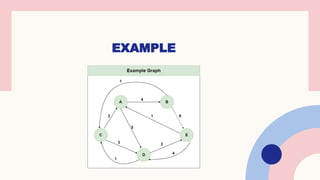
Step 1: Initialize the Distance[][] matrix using the input graph such that Distance[i]
[j]= weight of edge from i to j, also Distance[i][j] = Infinity if there is no edge
from i to j.](https://image.slidesharecdn.com/floydwarshallalgorithm-240809045408-78328d77/85/Floyd-warshall-algorithm-and-it-s-applications-9-320.jpg)
![STEP-2
Step 2: Treat node A as an intermediate node and calculate the Distance[][] for every
{i,j} node pair using the formula:
= Distance[i][j] = minimum (Distance[i][j], (Distance from i to A) + (Distance from A to j
))
= Distance[i][j] = minimum (Distance[i][j], Distance[i][A] + Distance[A][j])](https://image.slidesharecdn.com/floydwarshallalgorithm-240809045408-78328d77/85/Floyd-warshall-algorithm-and-it-s-applications-10-320.jpg)
![STEP-3
Step 3: Treat node B as an intermediate node and calculate the Distance[][] for every
{i,j} node pair using the formula:
= Distance[i][j] = minimum (Distance[i][j], (Distance from i to B) + (Distance from B to
j ))
= Distance[i][j] = minimum (Distance[i][j], Distance[i][B] + Distance[B][j])](https://image.slidesharecdn.com/floydwarshallalgorithm-240809045408-78328d77/85/Floyd-warshall-algorithm-and-it-s-applications-11-320.jpg)
![STEP-4
Step 4: Treat node C as an intermediate node and calculate the Distance[][] for every
{i,j} node pair using the formula:
= Distance[i][j] = minimum (Distance[i][j], (Distance from i to C) + (Distance from C to
j ))
= Distance[i][j] = minimum (Distance[i][j], Distance[i][C] + Distance[C][j])](https://image.slidesharecdn.com/floydwarshallalgorithm-240809045408-78328d77/85/Floyd-warshall-algorithm-and-it-s-applications-12-320.jpg)
![STEP-5
Step 5: Treat node D as an intermediate node and calculate the Distance[][] for every
{i,j} node pair using the formula:
= Distance[i][j] = minimum (Distance[i][j], (Distance from i to D) + (Distance from D to j
))
= Distance[i][j] = minimum (Distance[i][j], Distance[i][D] + Distance[D][j])](https://image.slidesharecdn.com/floydwarshallalgorithm-240809045408-78328d77/85/Floyd-warshall-algorithm-and-it-s-applications-13-320.jpg)
![STEP-6
Step 6: Treat node E as an intermediate node and calculate the Distance[][] for every
{i,j} node pair using the formula:
= Distance[i][j] = minimum (Distance[i][j], (Distance from i to E) + (Distance from E to
j ))
= Distance[i][j] = minimum (Distance[i][j], Distance[i][E] + Distance[E][j])](https://image.slidesharecdn.com/floydwarshallalgorithm-240809045408-78328d77/85/Floyd-warshall-algorithm-and-it-s-applications-14-320.jpg)
![STEP-7
Step 7: Since all the nodes have been treated as an intermediate node, we can now
return the updated Distance[][] matrix as our answer matrix.](https://image.slidesharecdn.com/floydwarshallalgorithm-240809045408-78328d77/85/Floyd-warshall-algorithm-and-it-s-applications-15-320.jpg)







![Getting Started with Apache Spark: Big Data Made Simple [Free Meetup]](https://cdn.slidesharecdn.com/ss_thumbnails/apachesparkgettingstarted-260203175547-8361bcc3-thumbnail.jpg?width=640&height=640&fit=bounds)

