First Onsite Net Zero Energy
Green Building of India
Dr K M Soni, ADG(Retd.), CPWD,
New Delhi
Zero Energy Building
• Zero energy building or zero net energy
building is a building which consumes energy
on annual basis equivalent to the renewable
energy generated.
• Generated energy may be onsite or offsite
Zero Energy Building
• Zero energy building generates renewable
energy hence helps in prevention of Green
House Gases.
• Generated energy may be or may not be used
in the building all the time.
• Generated energy is connected to the grid
and equivalent energy is drawn as per the
requirement
Energy Plus Campus
• In case, renewable energy generated is more
than the energy consumed by the building on
annual basis, it is called energy plus or plus
energy or net plus energy building
• In case of a campus, it can be called energy
plus or plus energy or net plus energy
campus.
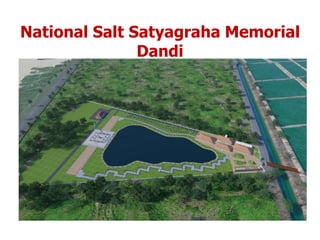
National Salt Satyagraha Memorial
Dandi
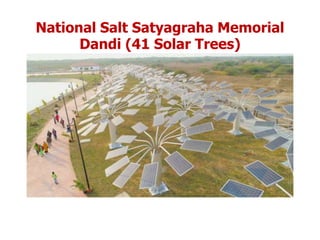
National Salt Satyagraha Memorial
Dandi (41 Solar Trees)
First Net Zero Energy Building
• CPWD constructed first net zero energy building
of India, particularly in government sector
• This is an onsite net zero energy building
• Annual demand estimated: 14 lakh units (kWh)
i.e. 1.4 million units
• Annual generation: 14 lakh i.e. 1.4 million units
(kWh)
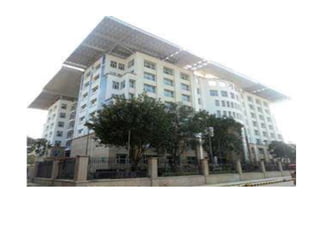
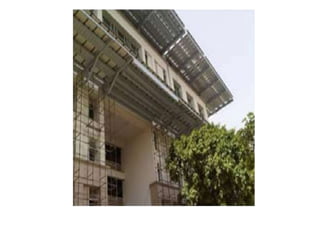
Indira Paryavaran Bhawan
• Location: Jorbagh, New Delhi
• Plinth Area: 32,000 sqm
• Structure: 3B+G+7
• AC with 400TR HVAC capacity
• All essential services
• 5 Star/Platinum Rated Green Building Project
• Owner: Ministry of Env, Forest & CC, Government of
India
Energy Management
• Energy generation
• Energy conservation
Energy Conservation
• Architectural design (ventilation, Courtyard)
• Orientation
• Envelope insulation
• Trees/plantation
• Energy efficient chilled beam system for a.c.
• Regenerative lifts
• Geothermal heat exchange system to reduce load on
HVAC system
• Thin client system
Geothermal Heat Exchange
System
• The system with vertical closed loop system
• Have 32 mm diameter HDPE U – loops, 180
in number and 80 m deep each.
• Resulted into reduction of 160TR load on
cooling tower and consequent
Energy Conservation
• Building orientation in E-W direction and separation of various blocks
with connecting corridors and central courtyard.
• Building envelope designed to ensure daylight in 75% occupied areas.
• Plantation and grassing in more than 50% area outside the building.
• Grass pavers in circulation areas.
• Terrace garden.
• Energy efficient air conditioning system and lighting.
• Energy efficiency through conversion of braking energy into electricity
in the lifts
• Chillers and AHUs with Variable Frequency Drives(VFDs), heat recovery
wheels and thermostat controls for HVAC
• LED lights and occupancy and Lux level sensors, etc
Energy Generation
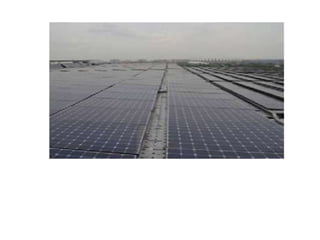
• Solar Rooftop Panels
• Solar panels on extended roof
• Solar panels on courtyard
Solar PV Panels
• Mono crystalline solar panels of 20% efficiency
• Rooftop covered are 4600sqm against 6000sqm
• Central courtyard area about 2000sqm
• Cantilever of 6m on rooftop and 4th floor on southern side
• Total availability of area for solar panels @ 6000sqm
which was generating 1.4 million units
• Total energy requirement of energy was estimated as 15
lakh units (1.5million)
• Demand of 0.1 million units was reduced by energy
conservation measures
Indira Paryavaran Bhawan
• Net zero energy building
• 5 star GRIHA rated
• Platinum rated
• @13% costly compared to conventional RCC construction
• Energy consumption in a conventional building would
have been 2.1 million units while in the present case it
was 1.4 million units, saving 1300-1400 tonnes CO2
emissions per year compared to conventional
construction
• Rate of Return of capital investment @ 14 years
Thanks for attending
Dr K M Soni, ADG (Retd.), CPWD, New Delhi
Also available on Youtube: KRISHNA MURARI Soni at
https://www.youtube.com/channel/UC_pPYxk0jI1ayqA5rO6fBOw

Net zero energy building

  • 1.
    First Onsite NetZero Energy Green Building of India Dr K M Soni, ADG(Retd.), CPWD, New Delhi
  • 2.
    Zero Energy Building •Zero energy building or zero net energy building is a building which consumes energy on annual basis equivalent to the renewable energy generated. • Generated energy may be onsite or offsite
  • 3.
    Zero Energy Building •Zero energy building generates renewable energy hence helps in prevention of Green House Gases. • Generated energy may be or may not be used in the building all the time. • Generated energy is connected to the grid and equivalent energy is drawn as per the requirement
  • 4.
    Energy Plus Campus •In case, renewable energy generated is more than the energy consumed by the building on annual basis, it is called energy plus or plus energy or net plus energy building • In case of a campus, it can be called energy plus or plus energy or net plus energy campus.
  • 5.
  • 6.
    National Salt SatyagrahaMemorial Dandi (41 Solar Trees)
  • 7.
    First Net ZeroEnergy Building • CPWD constructed first net zero energy building of India, particularly in government sector • This is an onsite net zero energy building • Annual demand estimated: 14 lakh units (kWh) i.e. 1.4 million units • Annual generation: 14 lakh i.e. 1.4 million units (kWh)
  • 8.
    Indira Paryavaran Bhawan •Location: Jorbagh, New Delhi • Plinth Area: 32,000 sqm • Structure: 3B+G+7 • AC with 400TR HVAC capacity • All essential services • 5 Star/Platinum Rated Green Building Project • Owner: Ministry of Env, Forest & CC, Government of India
  • 10.
    Energy Management • Energygeneration • Energy conservation
  • 11.
    Energy Conservation • Architecturaldesign (ventilation, Courtyard) • Orientation • Envelope insulation • Trees/plantation • Energy efficient chilled beam system for a.c. • Regenerative lifts • Geothermal heat exchange system to reduce load on HVAC system • Thin client system
  • 12.
    Geothermal Heat Exchange System •The system with vertical closed loop system • Have 32 mm diameter HDPE U – loops, 180 in number and 80 m deep each. • Resulted into reduction of 160TR load on cooling tower and consequent
  • 13.
    Energy Conservation • Buildingorientation in E-W direction and separation of various blocks with connecting corridors and central courtyard. • Building envelope designed to ensure daylight in 75% occupied areas. • Plantation and grassing in more than 50% area outside the building. • Grass pavers in circulation areas. • Terrace garden. • Energy efficient air conditioning system and lighting. • Energy efficiency through conversion of braking energy into electricity in the lifts • Chillers and AHUs with Variable Frequency Drives(VFDs), heat recovery wheels and thermostat controls for HVAC • LED lights and occupancy and Lux level sensors, etc
  • 14.
    Energy Generation • SolarRooftop Panels • Solar panels on extended roof • Solar panels on courtyard
  • 15.
    Solar PV Panels •Mono crystalline solar panels of 20% efficiency • Rooftop covered are 4600sqm against 6000sqm • Central courtyard area about 2000sqm • Cantilever of 6m on rooftop and 4th floor on southern side • Total availability of area for solar panels @ 6000sqm which was generating 1.4 million units • Total energy requirement of energy was estimated as 15 lakh units (1.5million) • Demand of 0.1 million units was reduced by energy conservation measures
  • 16.
    Indira Paryavaran Bhawan •Net zero energy building • 5 star GRIHA rated • Platinum rated • @13% costly compared to conventional RCC construction • Energy consumption in a conventional building would have been 2.1 million units while in the present case it was 1.4 million units, saving 1300-1400 tonnes CO2 emissions per year compared to conventional construction • Rate of Return of capital investment @ 14 years
  • 19.
    Thanks for attending DrK M Soni, ADG (Retd.), CPWD, New Delhi Also available on Youtube: KRISHNA MURARI Soni at https://www.youtube.com/channel/UC_pPYxk0jI1ayqA5rO6fBOw