GEOSYSNTHETICS
Dr K M Soni, ADG(Retd.), CPWD,
New Delhi
Geosysnthetics
Geosynthetics are the polymeric materials
used with geological materials to modify civil
engineering properties.
Therefore, the definition includes the
following;
• Polymeric materials
• Used with geological materials
• Modification of properties
Polymeric Materials
Geosynthetics are made of polymeric
materials like polypropylene, polyester, and
polyethylene.
Now natural synthetic materials or natural
materials are also used to manufacture
geosynthetics like jute, coir and glass fibres.
Type of Polymeric Geosynthetics
• Geotextiles
• Geogrids
• Geomembranes
• Geocomposites
Geotextiles
• Non woven geotextiles
• Woven geotextiles
• Knitted geotextiles
Non Woven Textiles
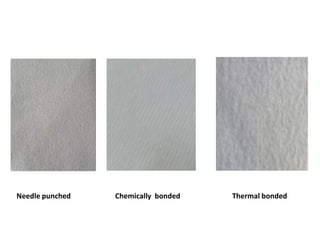
• Non-woven geotextiles are manufactured
from either continuous filament yarn or short
staple fiber
• The bonding of fibers is done using thermal,
chemical or mechanical techniques or a
combination of these
Needle punched Chemically bonded Thermal bonded
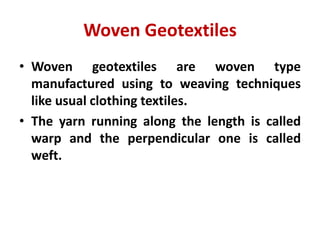
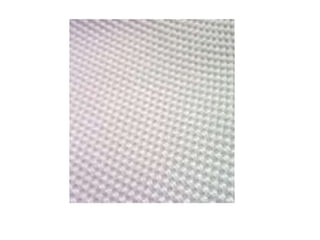
Woven Geotextiles
• Woven geotextiles are woven type
manufactured using to weaving techniques
like usual clothing textiles.
• The yarn running along the length is called
warp and the perpendicular one is called
weft.
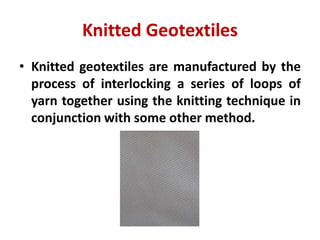
Knitted Geotextiles
• Knitted geotextiles are manufactured by the
process of interlocking a series of loops of
yarn together using the knitting technique in
conjunction with some other method.
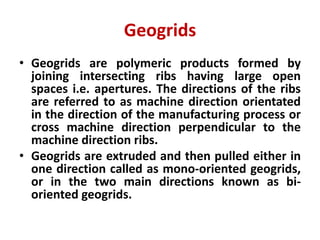
Geogrids
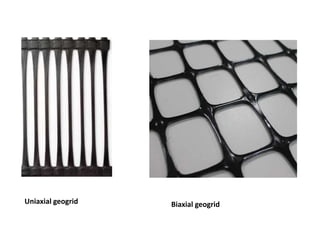
• Geogrids are polymeric products formed by
joining intersecting ribs having large open
spaces i.e. apertures. The directions of the ribs
are referred to as machine direction orientated
in the direction of the manufacturing process or
cross machine direction perpendicular to the
machine direction ribs.
• Geogrids are extruded and then pulled either in
one direction called as mono-oriented geogrids,
or in the two main directions known as bi-
oriented geogrids.
Uniaxial geogrid Biaxial geogrid
Geomembranes
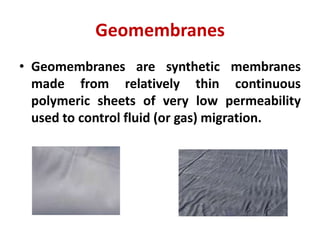
• Geomembranes are synthetic membranes
made from relatively thin continuous
polymeric sheets of very low permeability
used to control fluid (or gas) migration.
Geocomposites
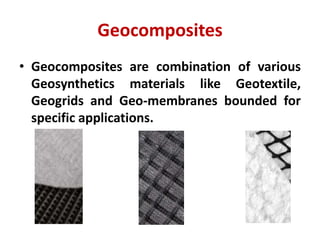
• Geocomposites are combination of various
Geosynthetics materials like Geotextile,
Geogrids and Geo-membranes bounded for
specific applications.
Geosynthetics
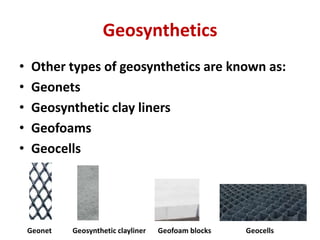
• Other types of geosynthetics are known as:
• Geonets
• Geosynthetic clay liners
• Geofoams
• Geocells
Geonet Geosynthetic clayliner Geofoam blocks Geocells
Principle of working of Geosynthetics
• Friction for reinforcing action
• Hydraulic flow
Friction
• Friction between soil and geosynthetics
– Thus soil has to be frictional soil like sand
– Geosynthetics may be of geogrids, geotextiles,
Geofoams
Uses are for roads, retaining walls,
embankments, bearing capacity
improvement
Hydraulic flow
• Hydraulic flow required
– filtration across the plane
– drainage along the plane
– Uses of non woven geotextiles, Geodrains
• Hydraulic flow not required
– Geomembranes
– Geotextile clay line
Friction and hydraulic properties
• Geonets
• Geocells
Functions
• Separation
• Reinforcement
• Filtration
• Drainage
• Barrier
• Protection
• Stiffening
Separation
• Mixing of soft and hard materials
Reinforcement
• Retaining walls
• Bearing capacity improvement
Drainage/Filtration
• Drains
– Non woven geotextiles
• Gabions
– For reinforcing action, Geogrids, for filtration and
drainage: Non woven geotextiles
• Geopipes
– Non woven geotextiles
Barriers
• Geocomposites
• Geotextile clay liners
Thanks for attending
Dr K M Soni, ADG (Retd.), CPWD, New Delhi
Also available on Youtube: KRISHNA MURARI Soni at
https://www.youtube.com/channel/UC_pPYxk0jI1ayqA5rO6fBOw

Geosynthetics

  • 1.
    GEOSYSNTHETICS Dr K MSoni, ADG(Retd.), CPWD, New Delhi
  • 2.
    Geosysnthetics Geosynthetics are thepolymeric materials used with geological materials to modify civil engineering properties. Therefore, the definition includes the following; • Polymeric materials • Used with geological materials • Modification of properties
  • 3.
    Polymeric Materials Geosynthetics aremade of polymeric materials like polypropylene, polyester, and polyethylene. Now natural synthetic materials or natural materials are also used to manufacture geosynthetics like jute, coir and glass fibres.
  • 4.
    Type of PolymericGeosynthetics • Geotextiles • Geogrids • Geomembranes • Geocomposites
  • 5.
    Geotextiles • Non wovengeotextiles • Woven geotextiles • Knitted geotextiles
  • 6.
    Non Woven Textiles •Non-woven geotextiles are manufactured from either continuous filament yarn or short staple fiber • The bonding of fibers is done using thermal, chemical or mechanical techniques or a combination of these
  • 7.
    Needle punched Chemicallybonded Thermal bonded
  • 8.
    Woven Geotextiles • Wovengeotextiles are woven type manufactured using to weaving techniques like usual clothing textiles. • The yarn running along the length is called warp and the perpendicular one is called weft.
  • 10.
    Knitted Geotextiles • Knittedgeotextiles are manufactured by the process of interlocking a series of loops of yarn together using the knitting technique in conjunction with some other method.
  • 11.
    Geogrids • Geogrids arepolymeric products formed by joining intersecting ribs having large open spaces i.e. apertures. The directions of the ribs are referred to as machine direction orientated in the direction of the manufacturing process or cross machine direction perpendicular to the machine direction ribs. • Geogrids are extruded and then pulled either in one direction called as mono-oriented geogrids, or in the two main directions known as bi- oriented geogrids.
  • 12.
  • 13.
    Geomembranes • Geomembranes aresynthetic membranes made from relatively thin continuous polymeric sheets of very low permeability used to control fluid (or gas) migration.
  • 14.
    Geocomposites • Geocomposites arecombination of various Geosynthetics materials like Geotextile, Geogrids and Geo-membranes bounded for specific applications.
  • 15.
    Geosynthetics • Other typesof geosynthetics are known as: • Geonets • Geosynthetic clay liners • Geofoams • Geocells Geonet Geosynthetic clayliner Geofoam blocks Geocells
  • 16.
    Principle of workingof Geosynthetics • Friction for reinforcing action • Hydraulic flow
  • 17.
    Friction • Friction betweensoil and geosynthetics – Thus soil has to be frictional soil like sand – Geosynthetics may be of geogrids, geotextiles, Geofoams Uses are for roads, retaining walls, embankments, bearing capacity improvement
  • 18.
    Hydraulic flow • Hydraulicflow required – filtration across the plane – drainage along the plane – Uses of non woven geotextiles, Geodrains • Hydraulic flow not required – Geomembranes – Geotextile clay line
  • 19.
    Friction and hydraulicproperties • Geonets • Geocells
  • 20.
    Functions • Separation • Reinforcement •Filtration • Drainage • Barrier • Protection • Stiffening
  • 21.
    Separation • Mixing ofsoft and hard materials
  • 22.
    Reinforcement • Retaining walls •Bearing capacity improvement
  • 23.
    Drainage/Filtration • Drains – Nonwoven geotextiles • Gabions – For reinforcing action, Geogrids, for filtration and drainage: Non woven geotextiles • Geopipes – Non woven geotextiles
  • 24.
  • 25.
    Thanks for attending DrK M Soni, ADG (Retd.), CPWD, New Delhi Also available on Youtube: KRISHNA MURARI Soni at https://www.youtube.com/channel/UC_pPYxk0jI1ayqA5rO6fBOw