
CONTRACT CONDITIONS-IV:
PRICE VARIATION
Dr K M Soni, ADG(Retd.), CPWD,
New Delhi
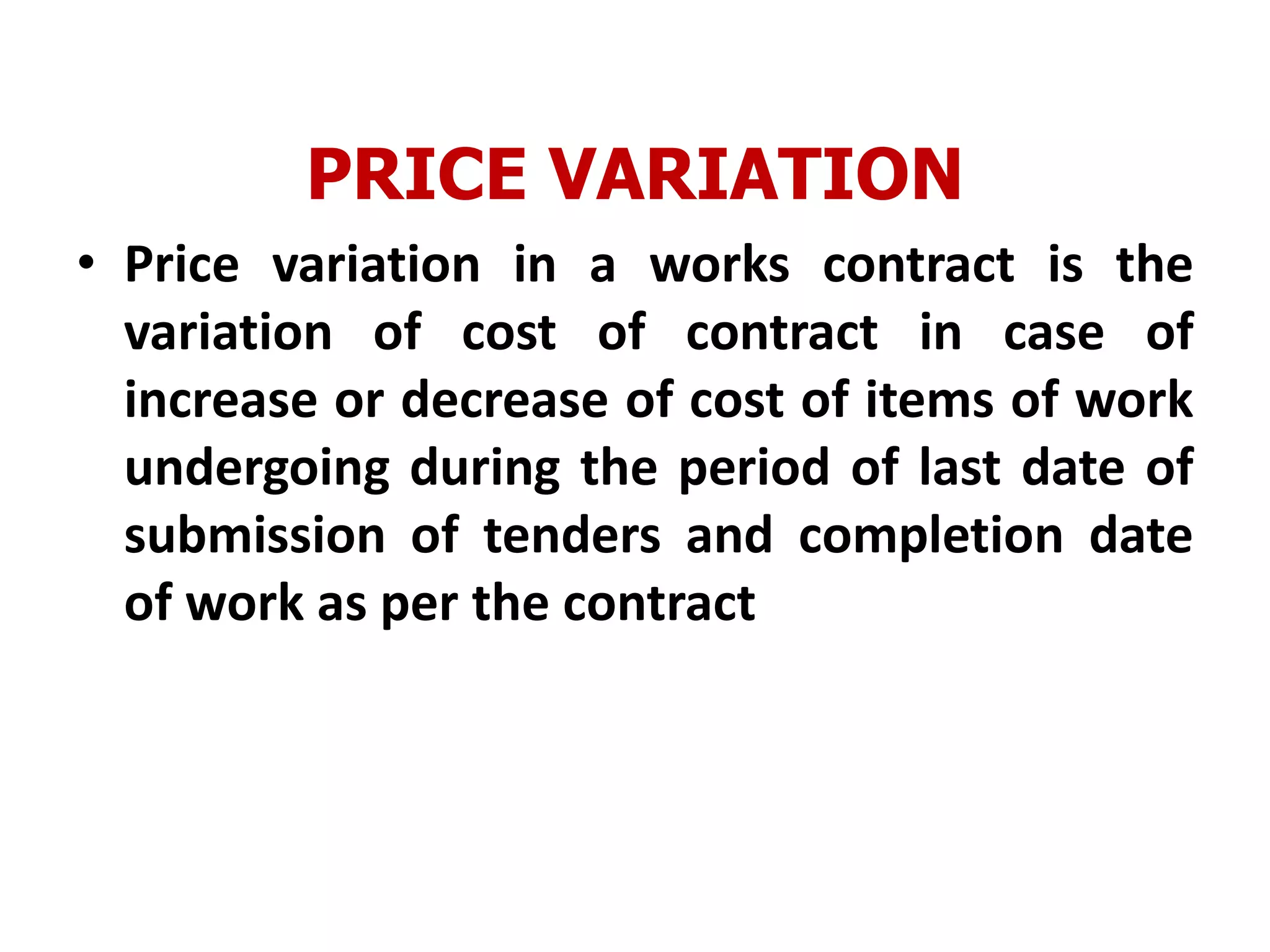
PRICE VARIATION
• Price variation in a works contract is the
variation of cost of contract in case of
increase or decrease of cost of items of work
undergoing during the period of last date of
submission of tenders and completion date
of work as per the contract
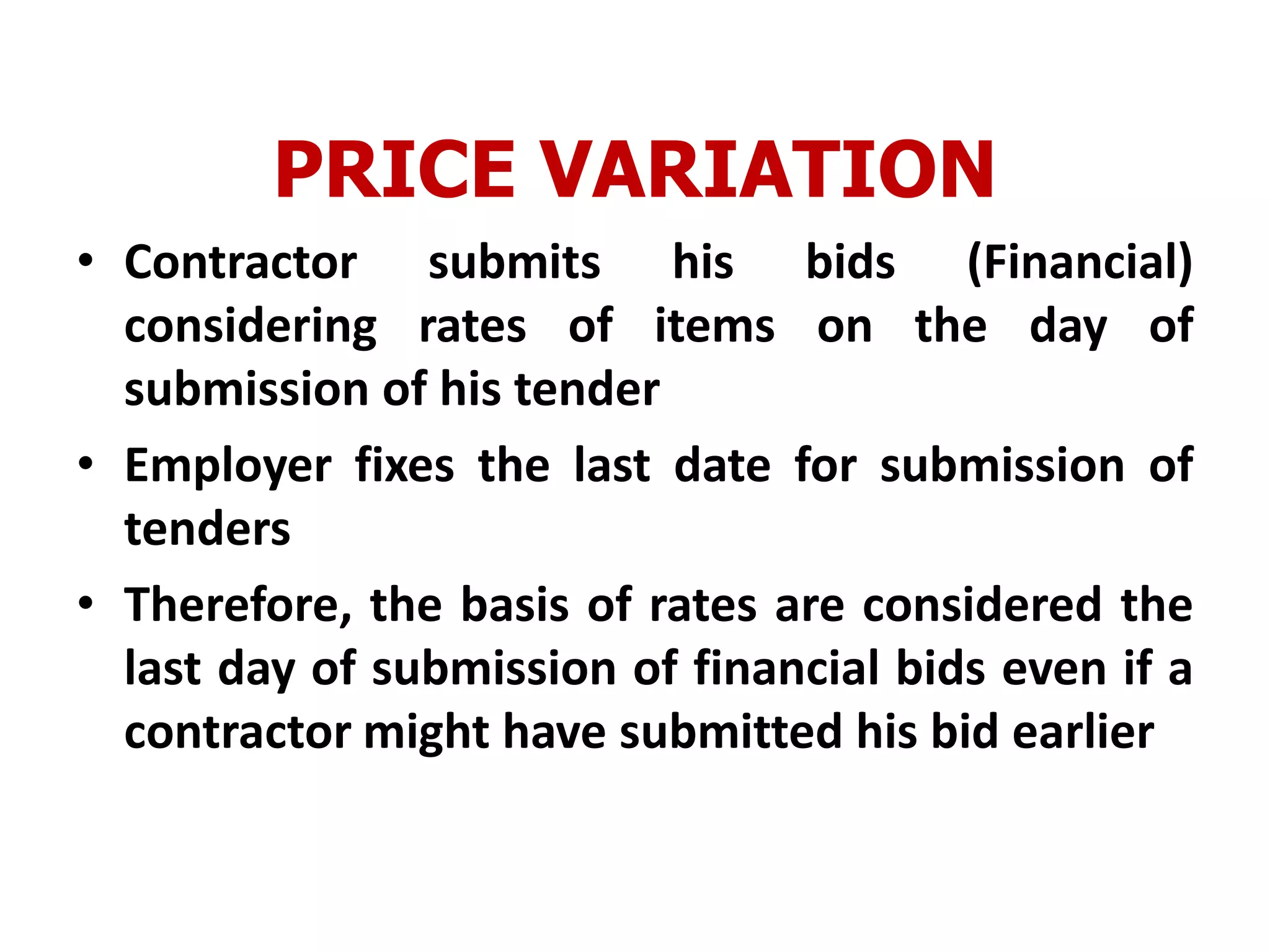
PRICE VARIATION
• Contractor submits his bids (Financial)
considering rates of items on the day of
submission of his tender
• Employer fixes the last date for submission of
tenders
• Therefore, the basis of rates are considered the
last day of submission of financial bids even if a
contractor might have submitted his bid earlier
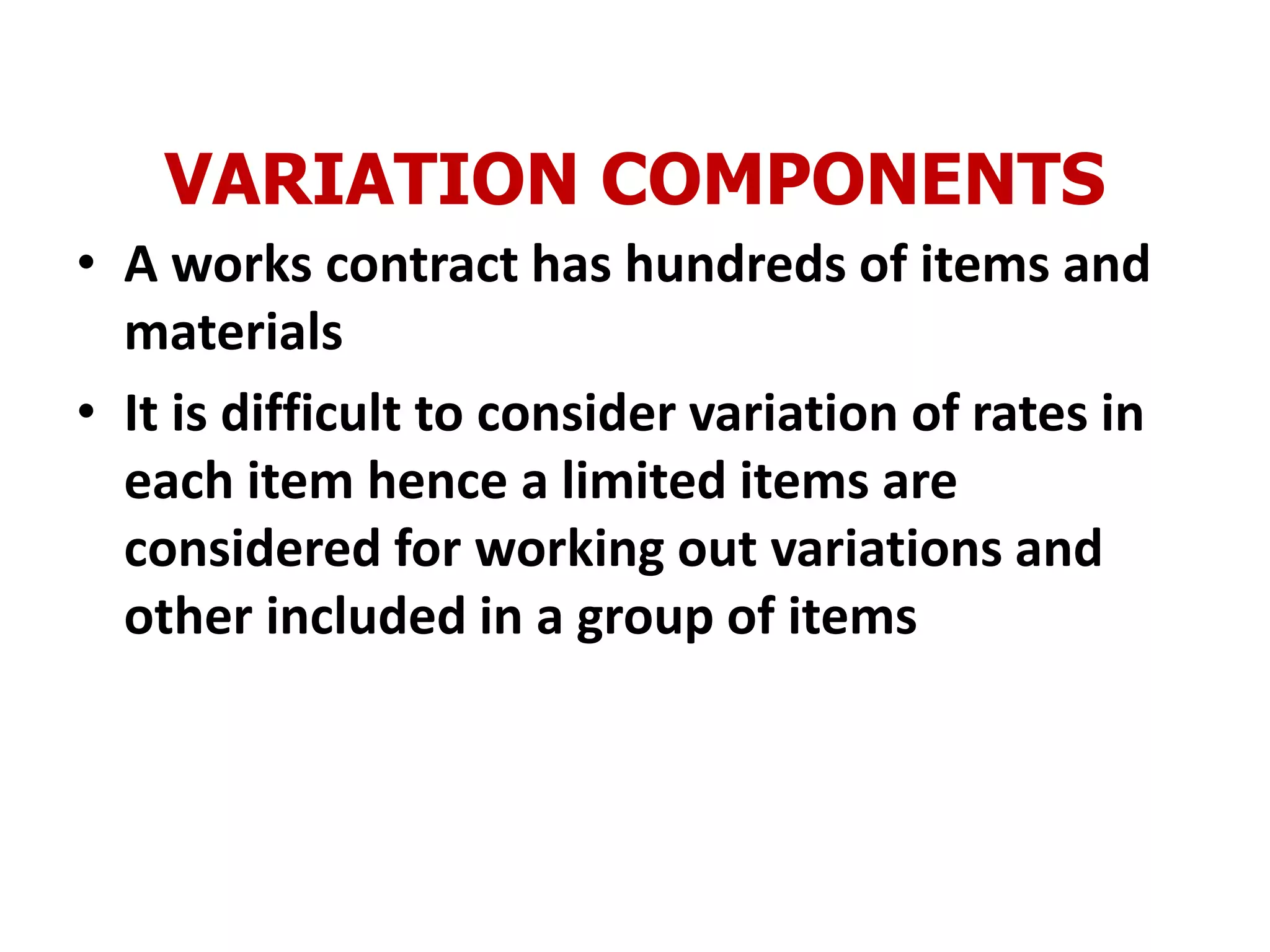
VARIATION COMPONENTS
• A works contract has hundreds of items and
materials
• It is difficult to consider variation of rates in
each item hence a limited items are
considered for working out variations and
other included in a group of items
MAJOR COMPONENTS
• Labour
– Skilled
– unskilled
• Steel
– Reinforcement bars
– Structural steel
• Cement
– OPC
– PPC
• POL
• Bitumen
• Others
LABOUR
Unskilled 13584 13896 1.023
Semiskilled 14958 15296 1.023
Skilled 16468 16858 1.024
As seen, rate increase is almost with same percentage
hence rates for
unskilled worker are considered in the analysis
STEEL
• Reinforcement bars
– TMT
– Fe 415
– Fe 500
– FE550/600
– Fe500D
• Structural steel
• Dia of bars, manufacturer, rates at site or factory
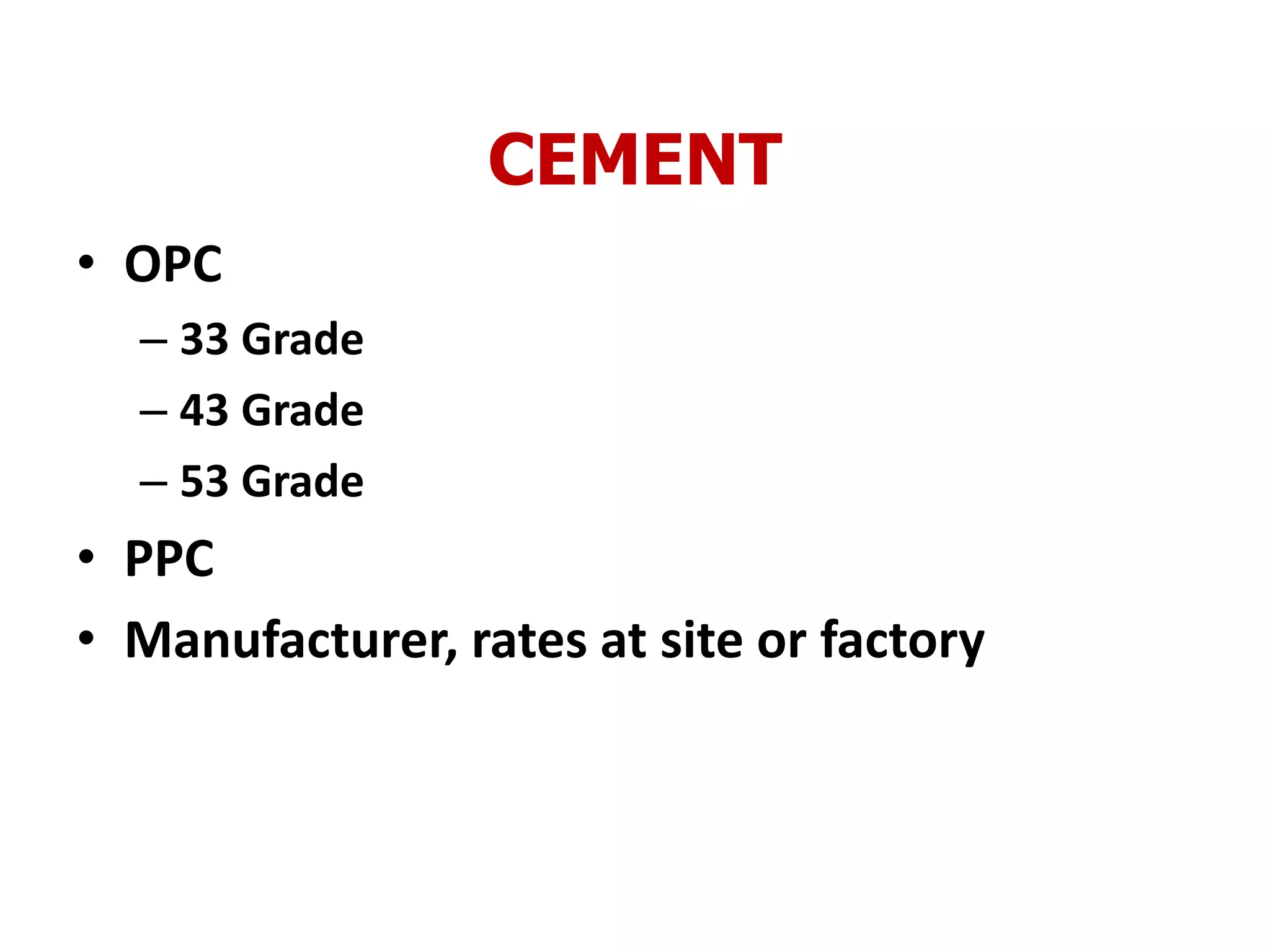
CEMENT
• OPC
– 33 Grade
– 43 Grade
– 53 Grade
• PPC
• Manufacturer, rates at site or factory
MATERIALS
• Materials except the materials for which
escalation is paid separately
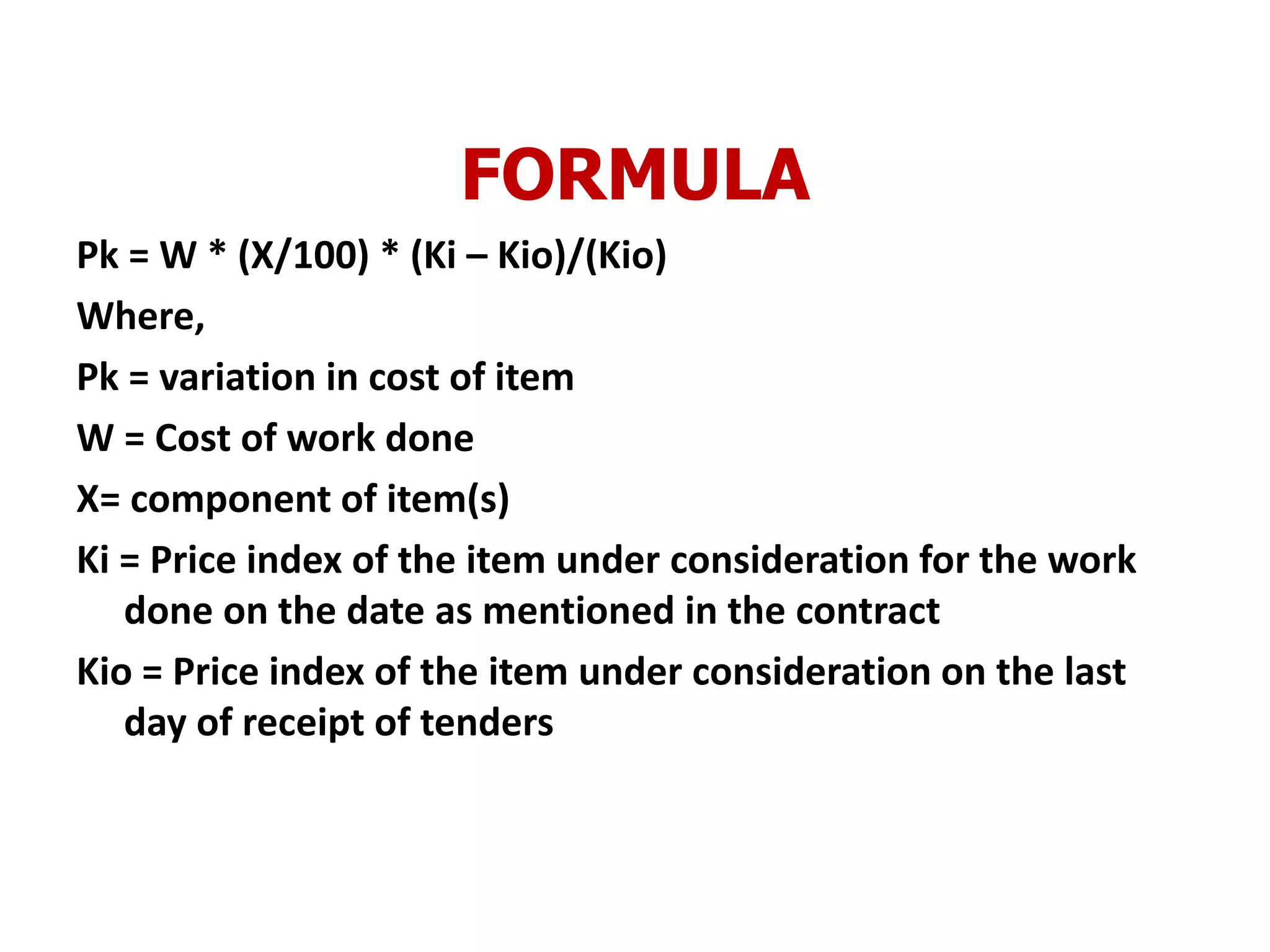
FORMULA
Pk = W * (X/100) * (Ki – Kio)/(Kio)
Where,
Pk = variation in cost of item
W = Cost of work done
X= component of item(s)
Ki = Price index of the item under consideration for the work
done on the date as mentioned in the contract
Kio = Price index of the item under consideration on the last
day of receipt of tenders
PRICE VARIATION
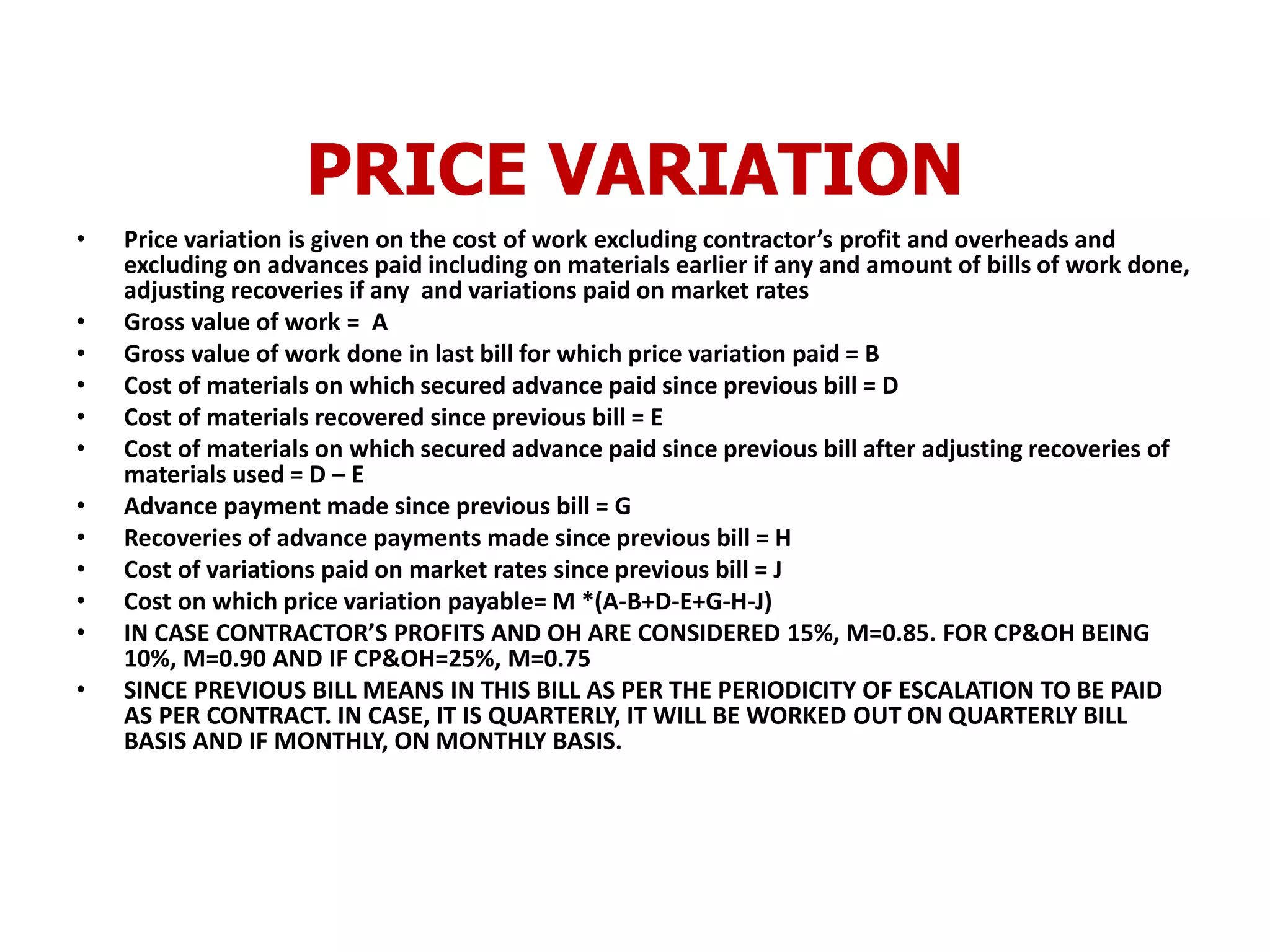
• Price variation is given on the cost of work excluding contractor’s profit and overheads and
excluding on advances paid including on materials earlier if any and amount of bills of work done,
adjusting recoveries if any and variations paid on market rates
• Gross value of work = A
• Gross value of work done in last bill for which price variation paid = B
• Cost of materials on which secured advance paid since previous bill = D
• Cost of materials recovered since previous bill = E
• Cost of materials on which secured advance paid since previous bill after adjusting recoveries of
materials used = D – E
• Advance payment made since previous bill = G
• Recoveries of advance payments made since previous bill = H
• Cost of variations paid on market rates since previous bill = J
• Cost on which price variation payable= M *(A-B+D-E+G-H-J)
• IN CASE CONTRACTOR’S PROFITS AND OH ARE CONSIDERED 15%, M=0.85. FOR CP&OH BEING
10%, M=0.90 AND IF CP&OH=25%, M=0.75
• SINCE PREVIOUS BILL MEANS IN THIS BILL AS PER THE PERIODICITY OF ESCALATION TO BE PAID
AS PER CONTRACT. IN CASE, IT IS QUARTERLY, IT WILL BE WORKED OUT ON QUARTERLY BILL
BASIS AND IF MONTHLY, ON MONTHLY BASIS.
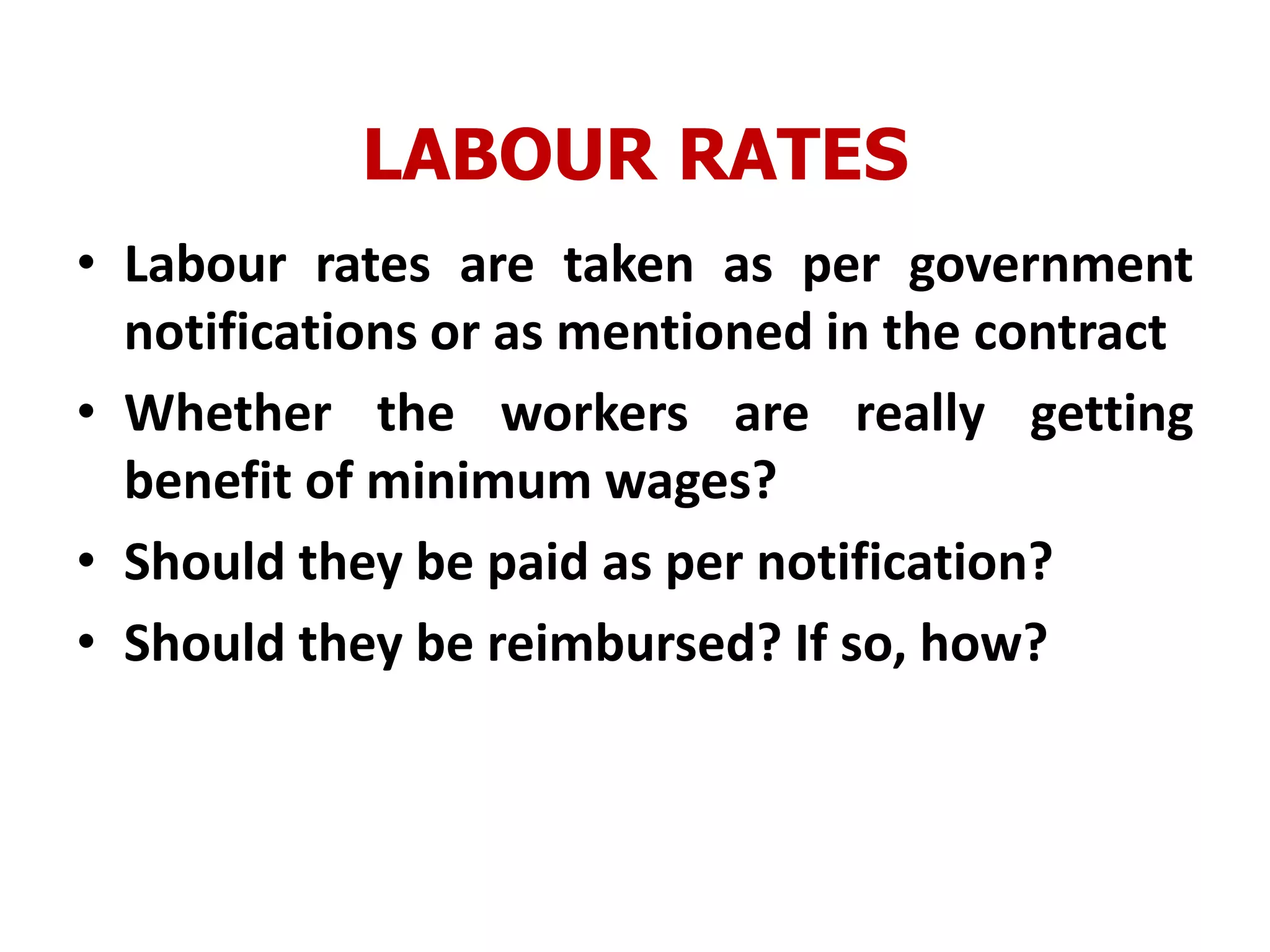
LABOUR RATES
• Labour rates are taken as per government
notifications or as mentioned in the contract
• Whether the workers are really getting
benefit of minimum wages?
• Should they be paid as per notification?
• Should they be reimbursed? If so, how?
RATES OF MATERIALS
• Are taken as per wholesale price index for
civil/electrical components of construction
materials as published by economic advisor,
Govt. of India, Ministry of commerce and
industry or as mentioned in the contract
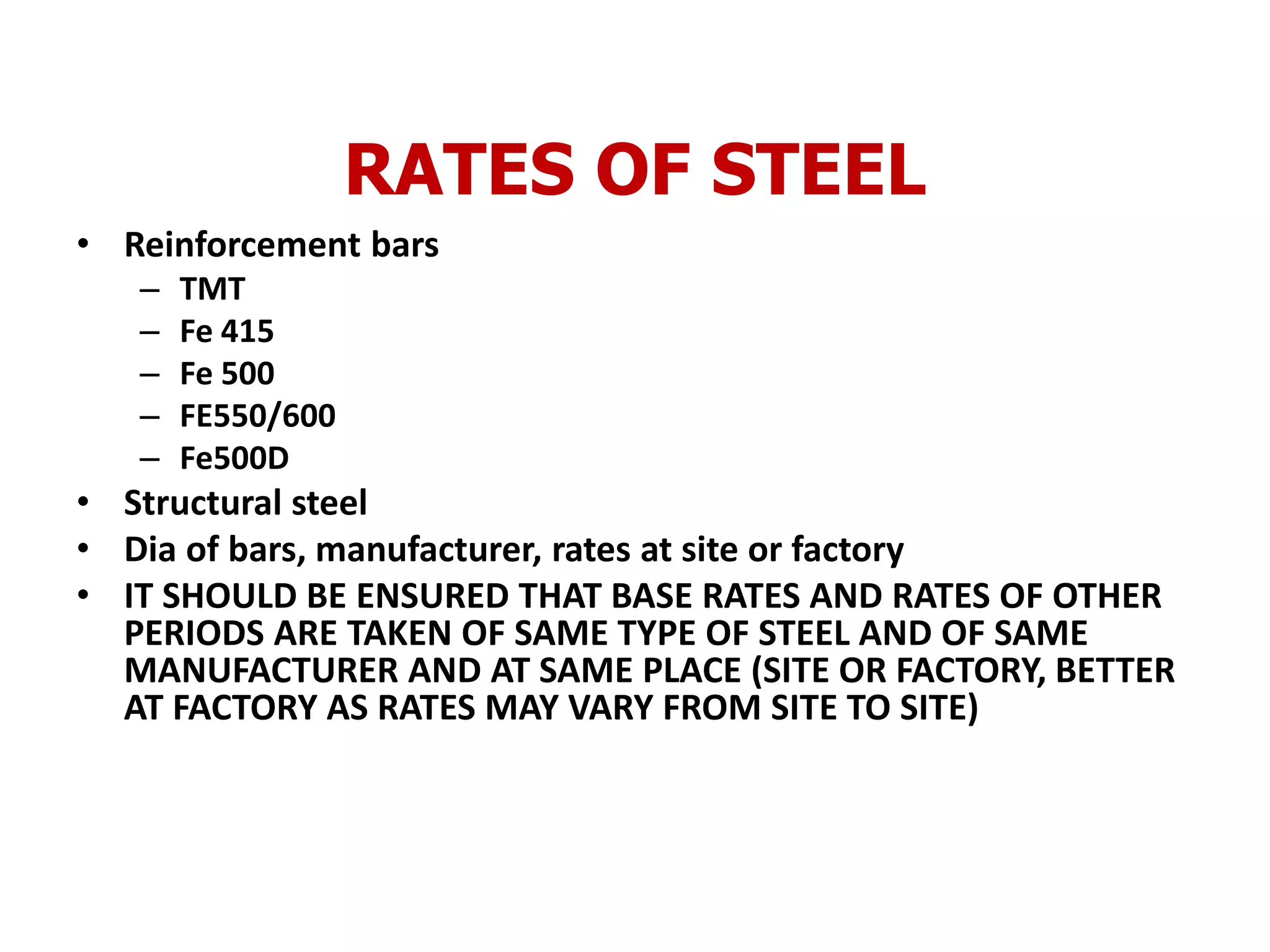
RATES OF STEEL
• Reinforcement bars
– TMT
– Fe 415
– Fe 500
– FE550/600
– Fe500D
• Structural steel
• Dia of bars, manufacturer, rates at site or factory
• IT SHOULD BE ENSURED THAT BASE RATES AND RATES OF OTHER
PERIODS ARE TAKEN OF SAME TYPE OF STEEL AND OF SAME
MANUFACTURER AND AT SAME PLACE (SITE OR FACTORY, BETTER
AT FACTORY AS RATES MAY VARY FROM SITE TO SITE)
RATES OF CEMENT
• OPC
– 33 Grade
– 43 Grade
– 53 Grade
• PPC
• Manufacturer, rates at site or factory
• IT SHOULD BE ENSURED THAT BASE RATES AND RATES OF
OTHER PERIODS ARE TAKEN OF SAME TYPE OF CEMENT
AND OF SAME MANUFACTURER AND AT SAME PLACE
(SITE OR FACTORY, BETTER AT FACTORY AS RATES MAY
VARY FROM SITE TO SITE)
PRICE VARIATION
• Sometimes price variations is not allowed, or allowed
for works having contract period more than specified
time.
• Price variation is normally paid quarterly
• It therefore appears that price variation may be paid
for all works having contract period more than 6
months to avoid uncertainties and risks of contractors
• Some EPC and Turn key contracts do not have
provisions of price variation clause
Thanks for attending
Dr K M Soni, ADG (Retd.), CPWD, New Delhi
Also available on Youtube: KRISHNA MURARI Soni at
https://www.youtube.com/channel/UC_pPYxk0jI1ayqA5rO6fBOw

Price variation in works contracts

  • 1.
    CONTRACT CONDITIONS-IV: PRICE VARIATION DrK M Soni, ADG(Retd.), CPWD, New Delhi
  • 2.
    PRICE VARIATION • Pricevariation in a works contract is the variation of cost of contract in case of increase or decrease of cost of items of work undergoing during the period of last date of submission of tenders and completion date of work as per the contract
  • 3.
    PRICE VARIATION • Contractorsubmits his bids (Financial) considering rates of items on the day of submission of his tender • Employer fixes the last date for submission of tenders • Therefore, the basis of rates are considered the last day of submission of financial bids even if a contractor might have submitted his bid earlier
  • 4.
    VARIATION COMPONENTS • Aworks contract has hundreds of items and materials • It is difficult to consider variation of rates in each item hence a limited items are considered for working out variations and other included in a group of items
  • 5.
    MAJOR COMPONENTS • Labour –Skilled – unskilled • Steel – Reinforcement bars – Structural steel • Cement – OPC – PPC • POL • Bitumen • Others
  • 6.
    LABOUR Unskilled 13584 138961.023 Semiskilled 14958 15296 1.023 Skilled 16468 16858 1.024 As seen, rate increase is almost with same percentage hence rates for unskilled worker are considered in the analysis
  • 7.
    STEEL • Reinforcement bars –TMT – Fe 415 – Fe 500 – FE550/600 – Fe500D • Structural steel • Dia of bars, manufacturer, rates at site or factory
  • 8.
    CEMENT • OPC – 33Grade – 43 Grade – 53 Grade • PPC • Manufacturer, rates at site or factory
  • 9.
    MATERIALS • Materials exceptthe materials for which escalation is paid separately
  • 10.
    FORMULA Pk = W* (X/100) * (Ki – Kio)/(Kio) Where, Pk = variation in cost of item W = Cost of work done X= component of item(s) Ki = Price index of the item under consideration for the work done on the date as mentioned in the contract Kio = Price index of the item under consideration on the last day of receipt of tenders
  • 11.
    PRICE VARIATION • Pricevariation is given on the cost of work excluding contractor’s profit and overheads and excluding on advances paid including on materials earlier if any and amount of bills of work done, adjusting recoveries if any and variations paid on market rates • Gross value of work = A • Gross value of work done in last bill for which price variation paid = B • Cost of materials on which secured advance paid since previous bill = D • Cost of materials recovered since previous bill = E • Cost of materials on which secured advance paid since previous bill after adjusting recoveries of materials used = D – E • Advance payment made since previous bill = G • Recoveries of advance payments made since previous bill = H • Cost of variations paid on market rates since previous bill = J • Cost on which price variation payable= M *(A-B+D-E+G-H-J) • IN CASE CONTRACTOR’S PROFITS AND OH ARE CONSIDERED 15%, M=0.85. FOR CP&OH BEING 10%, M=0.90 AND IF CP&OH=25%, M=0.75 • SINCE PREVIOUS BILL MEANS IN THIS BILL AS PER THE PERIODICITY OF ESCALATION TO BE PAID AS PER CONTRACT. IN CASE, IT IS QUARTERLY, IT WILL BE WORKED OUT ON QUARTERLY BILL BASIS AND IF MONTHLY, ON MONTHLY BASIS.
  • 12.
    LABOUR RATES • Labourrates are taken as per government notifications or as mentioned in the contract • Whether the workers are really getting benefit of minimum wages? • Should they be paid as per notification? • Should they be reimbursed? If so, how?
  • 13.
    RATES OF MATERIALS •Are taken as per wholesale price index for civil/electrical components of construction materials as published by economic advisor, Govt. of India, Ministry of commerce and industry or as mentioned in the contract
  • 14.
    RATES OF STEEL •Reinforcement bars – TMT – Fe 415 – Fe 500 – FE550/600 – Fe500D • Structural steel • Dia of bars, manufacturer, rates at site or factory • IT SHOULD BE ENSURED THAT BASE RATES AND RATES OF OTHER PERIODS ARE TAKEN OF SAME TYPE OF STEEL AND OF SAME MANUFACTURER AND AT SAME PLACE (SITE OR FACTORY, BETTER AT FACTORY AS RATES MAY VARY FROM SITE TO SITE)
  • 15.
    RATES OF CEMENT •OPC – 33 Grade – 43 Grade – 53 Grade • PPC • Manufacturer, rates at site or factory • IT SHOULD BE ENSURED THAT BASE RATES AND RATES OF OTHER PERIODS ARE TAKEN OF SAME TYPE OF CEMENT AND OF SAME MANUFACTURER AND AT SAME PLACE (SITE OR FACTORY, BETTER AT FACTORY AS RATES MAY VARY FROM SITE TO SITE)
  • 16.
    PRICE VARIATION • Sometimesprice variations is not allowed, or allowed for works having contract period more than specified time. • Price variation is normally paid quarterly • It therefore appears that price variation may be paid for all works having contract period more than 6 months to avoid uncertainties and risks of contractors • Some EPC and Turn key contracts do not have provisions of price variation clause
  • 17.
    Thanks for attending DrK M Soni, ADG (Retd.), CPWD, New Delhi Also available on Youtube: KRISHNA MURARI Soni at https://www.youtube.com/channel/UC_pPYxk0jI1ayqA5rO6fBOw