DAYLIGHTING
STRATEGIES
An architect should consider the following items
when designing an energy-efficient nonresidential
building, regardless of size and building type.
Windows placed high in the wall near the
ceiling provide the most daylight for any
given window area, permitting daylight to
penetrate more deeply into the interior.
PLACE WINDOWS HIGH IN
THE WALL OF EACH FLOOR
Because window glass has little or no resistance
to heat flow, it is one of the primary sources of
energy waste and discomfort. Window areas
should, therefore, be kept to a reasonable
minimum, justified by clearly defined needs for
view, visual relief, ventilation, and/or daylighting.
SIZE WINDOWS ACCORDING
TO USE AND ORIENTATION
USE LIGHT SHELVES
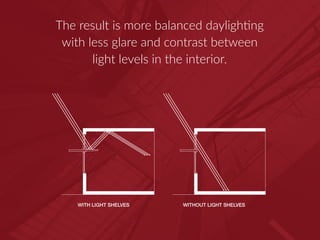
Light shelves are horizontal projections placed on
the outside and below a window to reflect sunlight
onto the interior ceiling, making it a light-reflecting
surface. At the same time, the light shelf shades the
lower portion of the window, reducing the amount
of light near the window, which is typically overlit.
The result is more balanced daylighting
with less glare and contrast between
light levels in the interior.
WITH LIGHT SHELVES WITHOUT LIGHT SHELVES
USE SKYLIGHTING FOR
DAYLIGHTING, WITH PROPER
SOLAR CONTROLS
Skylighting that is properly sized and oriented
is an efficient and cost-effective source
of lighting. White-painted ceilings and walls
further improve the efficiency. Electric lighting
costs, peak demand charges, and work
interruptions during power brownouts can be
greatly reduced by using daylight.
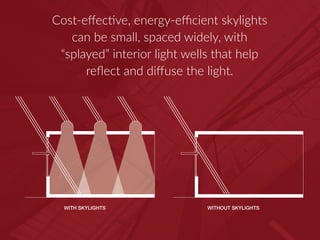
Cost-effective, energy-efficient skylights
can be small, spaced widely, with
“splayed” interior light wells that help
reflect and diffuse the light.
WITH SKYLIGHTS WITHOUT SKYLIGHTS
Wiley is a registered trademark of John Wiley & Sons, Inc.
Steel and glass building photos © Manuel Gutjahr/iStockphoto
Learn even more about strategies for
designing energy-efficient buildings with
Architectural Graphic Standards Online.
Visit us at graphicstandards.com.

Architectural Daylighting Strategies

  • 1.
  • 2.
    An architect shouldconsider the following items when designing an energy-efficient nonresidential building, regardless of size and building type.
  • 3.
    Windows placed highin the wall near the ceiling provide the most daylight for any given window area, permitting daylight to penetrate more deeply into the interior. PLACE WINDOWS HIGH IN THE WALL OF EACH FLOOR
  • 4.
    Because window glasshas little or no resistance to heat flow, it is one of the primary sources of energy waste and discomfort. Window areas should, therefore, be kept to a reasonable minimum, justified by clearly defined needs for view, visual relief, ventilation, and/or daylighting. SIZE WINDOWS ACCORDING TO USE AND ORIENTATION
  • 5.
    USE LIGHT SHELVES Lightshelves are horizontal projections placed on the outside and below a window to reflect sunlight onto the interior ceiling, making it a light-reflecting surface. At the same time, the light shelf shades the lower portion of the window, reducing the amount of light near the window, which is typically overlit.
  • 6.
    The result ismore balanced daylighting with less glare and contrast between light levels in the interior. WITH LIGHT SHELVES WITHOUT LIGHT SHELVES
  • 7.
    USE SKYLIGHTING FOR DAYLIGHTING,WITH PROPER SOLAR CONTROLS Skylighting that is properly sized and oriented is an efficient and cost-effective source of lighting. White-painted ceilings and walls further improve the efficiency. Electric lighting costs, peak demand charges, and work interruptions during power brownouts can be greatly reduced by using daylight.
  • 8.
    Cost-effective, energy-efficient skylights canbe small, spaced widely, with “splayed” interior light wells that help reflect and diffuse the light. WITH SKYLIGHTS WITHOUT SKYLIGHTS
  • 9.
    Wiley is aregistered trademark of John Wiley & Sons, Inc. Steel and glass building photos © Manuel Gutjahr/iStockphoto Learn even more about strategies for designing energy-efficient buildings with Architectural Graphic Standards Online. Visit us at graphicstandards.com.