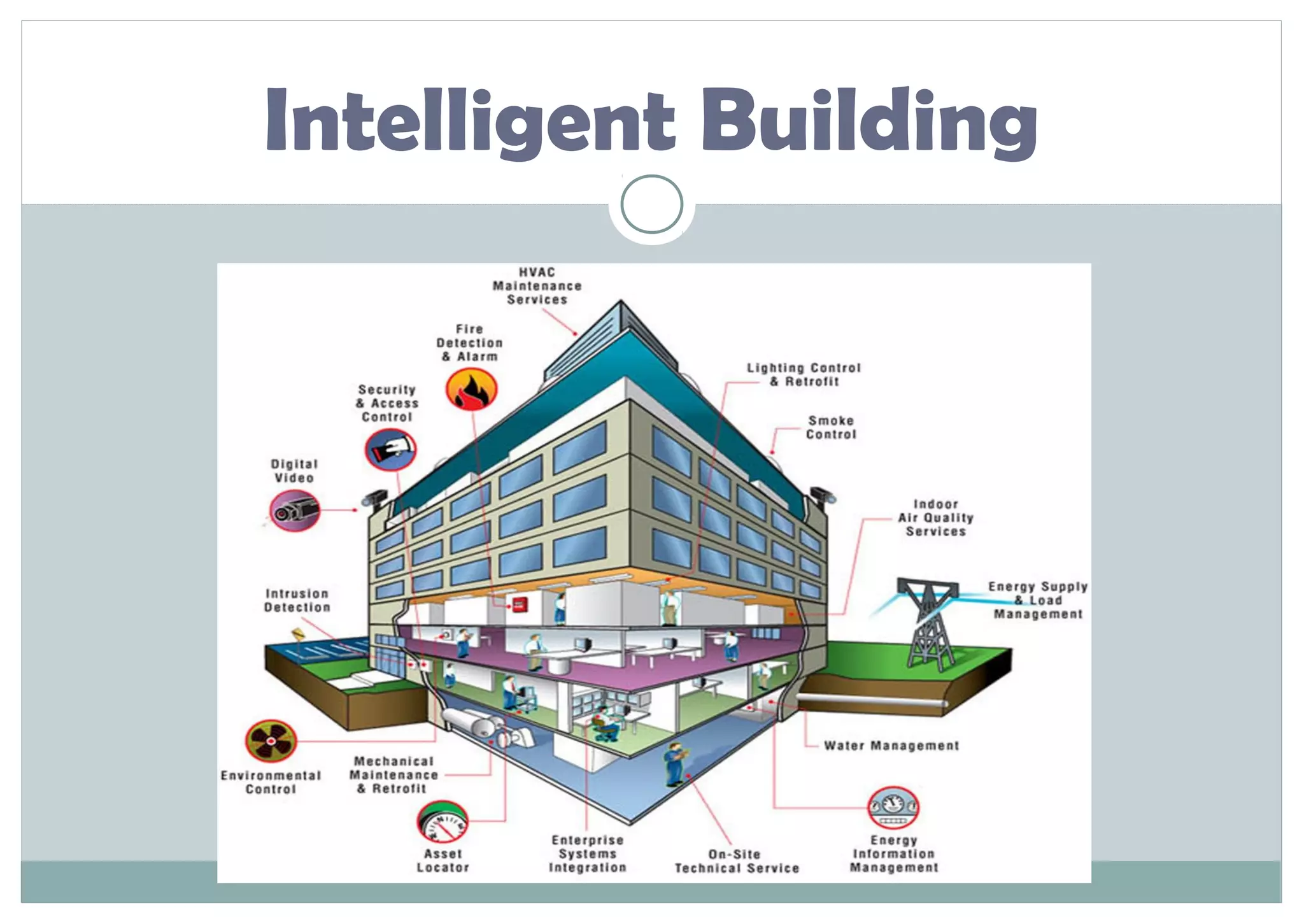
Intelligent Building
Intelligent buildings are buildings that through their
physical design and IT installations are responsive,
flexible and adaptive to changing needs from its users
and the organizations that inhabit the building during it's
life time. The building will supply services for its
inhabitants, its administration and operation &
maintenance. The intelligent building will accomplish
transparent 'intelligent' behavior, have state memory,
support human and installation systems communication,
and be equipped with sensors and actuators.
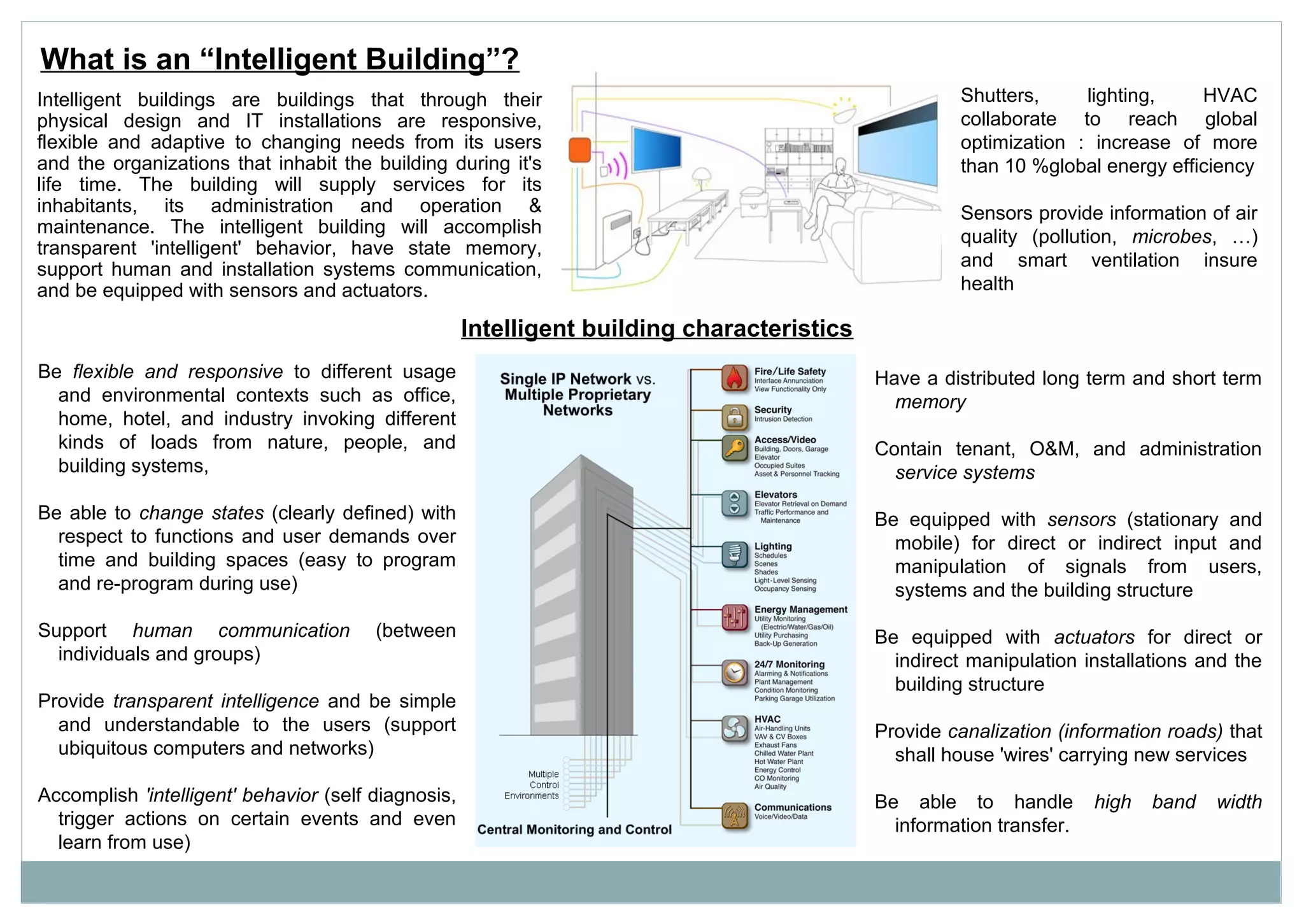
What is an “Intelligent Building”?
Shutters, lighting, HVAC
collaborate to reach global
optimization : increase of more
than 10 %global energy efficiency
Sensors provide information of air
quality (pollution, microbes, …)
and smart ventilation insure
health
Be flexible and responsive to different usage
and environmental contexts such as office,
home, hotel, and industry invoking different
kinds of loads from nature, people, and
building systems,
Be able to change states (clearly defined) with
respect to functions and user demands over
time and building spaces (easy to program
and re-program during use)
Support human communication (between
individuals and groups)
Provide transparent intelligence and be simple
and understandable to the users (support
ubiquitous computers and networks)
Accomplish 'intelligent' behavior (self diagnosis,
trigger actions on certain events and even
learn from use)
Have a distributed long term and short term
memory
Contain tenant, O&M, and administration
service systems
Be equipped with sensors (stationary and
mobile) for direct or indirect input and
manipulation of signals from users,
systems and the building structure
Be equipped with actuators for direct or
indirect manipulation installations and the
building structure
Provide canalization (information roads) that
shall house 'wires' carrying new services
Be able to handle high band width
information transfer.
Intelligent building characteristics
• Optimize T&D infrastructure
– Deploy efficient substation automation
– Upgrade to smart metering solutions
• Optimize quality and availability of supplied power
– Measure and improve delivered power quality
– Implement DG in frequently congested areas
• Influence demand consumption
– Introduce new tariff structures and smart revenue metering
– Implement AMR
– Provide customers with accurate and relevant consumption
data
– Establish DR/DSM programs
• Deploy modern IT infrastructure
– High speed telecoms infrastructure
– Modern Energy Information Systems
• Act on Users
– Educate people on efficient use of energy
– Act on business related procedures
• Act on loads
– Replace, renovate aging loads (lighting, motors, HVAC, …)
– Implement intelligent load control (variable speed drives, regulation
systems, lighting control, ...)
• Optimize quality and availability of on site power
– Measure and improve on site power quality
– Implement backup generation
– Exploit co-generation means
• Optimize supply costs
– Use the right tariffs according to specific load profile
– Participate in DR/DSM programs
– Resell excess power
On the Demand Side
On the Supply Side
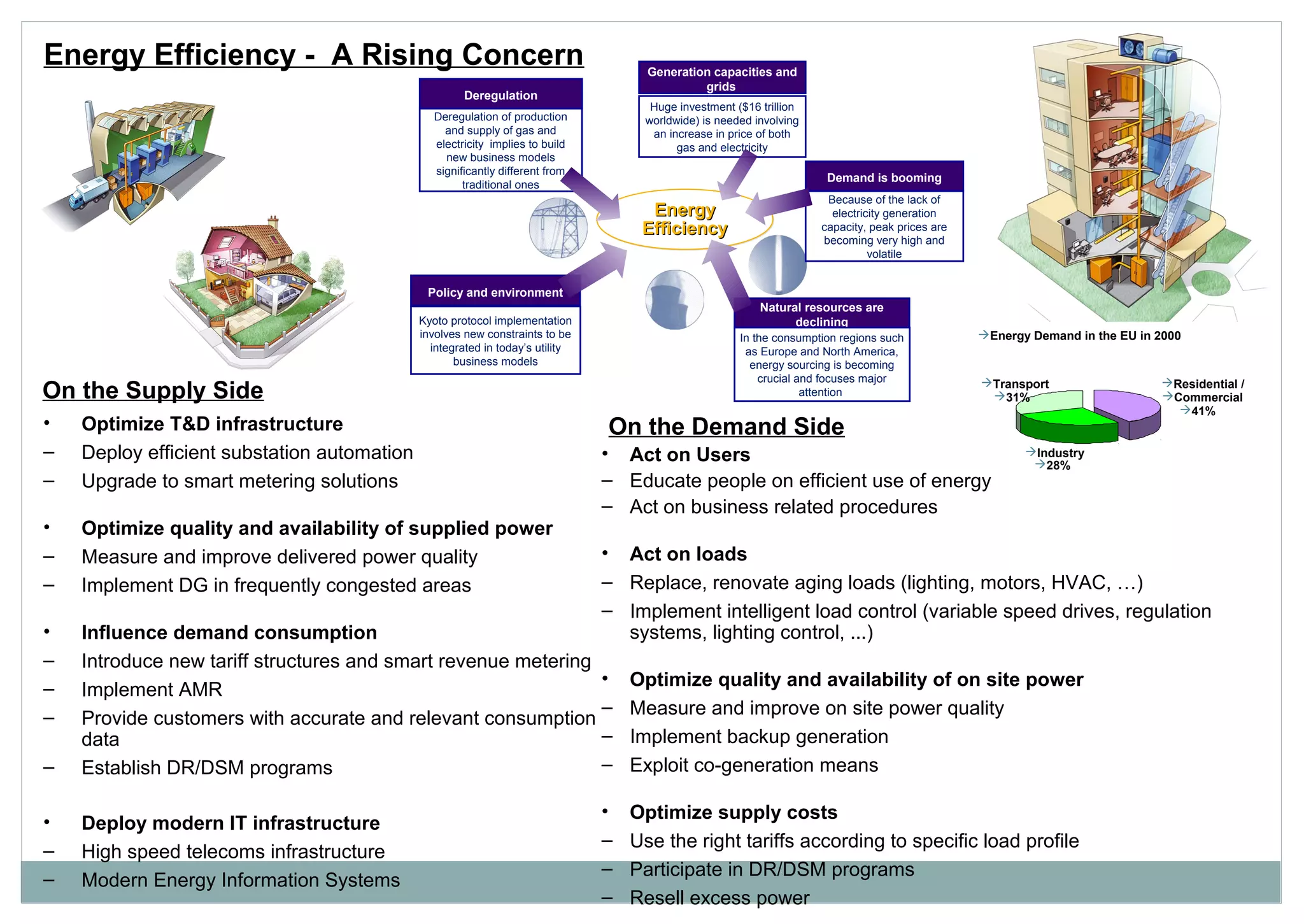
Energy Efficiency - A Rising Concern
EnergyEnergy
EfficiencyEfficiency
EnergyEnergy
EfficiencyEfficiency
Deregulation
Deregulation of production
and supply of gas and
electricity implies to build
new business models
significantly different from
traditional ones
Generation capacities and
grids
Huge investment ($16 trillion
worldwide) is needed involving
an increase in price of both
gas and electricity
Policy and environment
Kyoto protocol implementation
involves new constraints to be
integrated in today’s utility
business models
Demand is booming
Because of the lack of
electricity generation
capacity, peak prices are
becoming very high and
volatile
Natural resources are
declining
In the consumption regions such
as Europe and North America,
energy sourcing is becoming
crucial and focuses major
attention
Energy Demand in the EU in 2000
Transport
31%
Industry
28%
Residential /
Commercial
41%
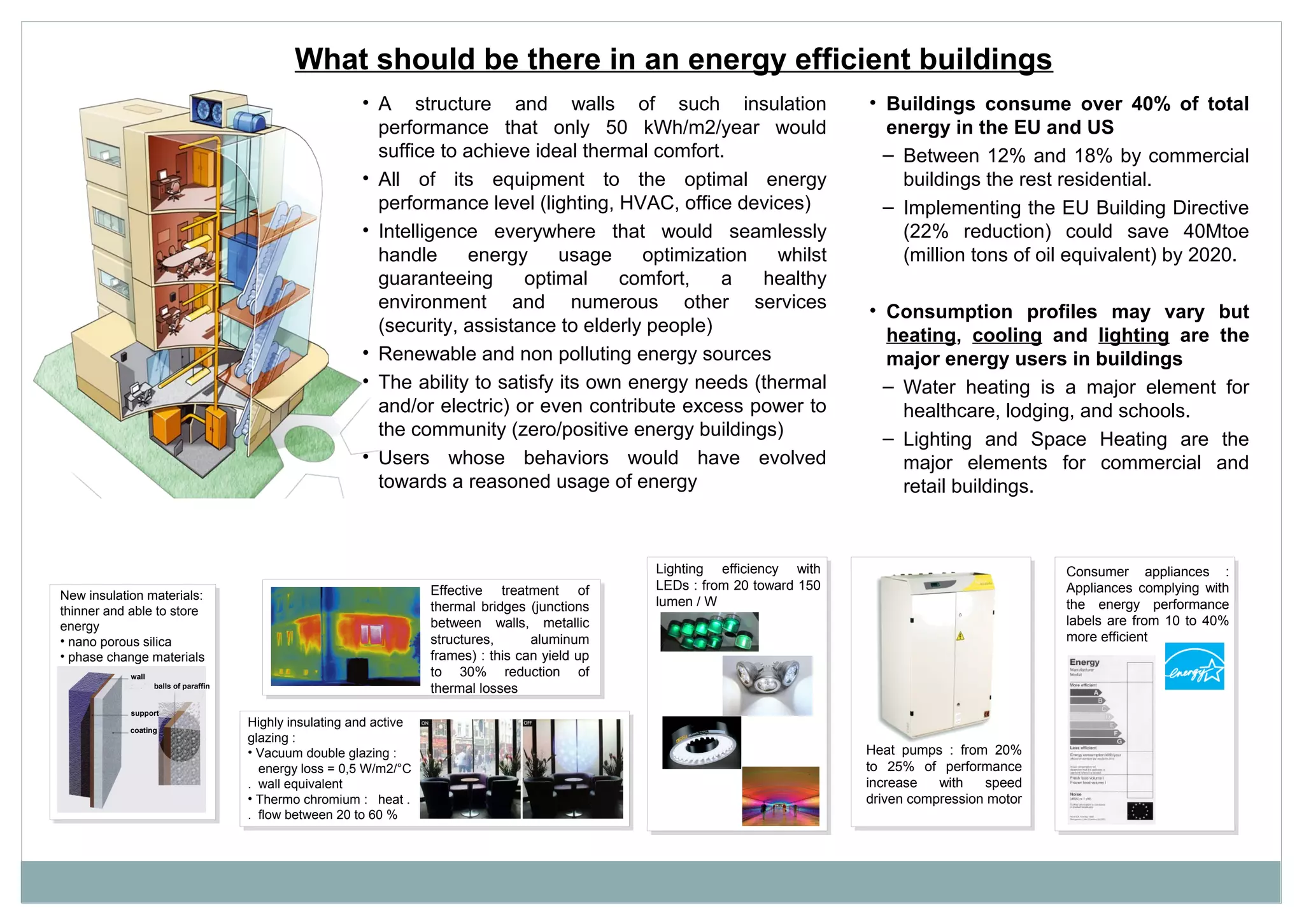
Highly insulating and active
glazing :
• Vacuum double glazing :
energy loss = 0,5 W/m2/°C
. wall equivalent
• Thermo chromium : heat .
. flow between 20 to 60 %
New insulation materials:
thinner and able to store
energy
• nano porous silica
• phase change materials
wall
coating
support
balls of paraffin
Effective treatment of
thermal bridges (junctions
between walls, metallic
structures, aluminum
frames) : this can yield up
to 30% reduction of
thermal losses
• A structure and walls of such insulation
performance that only 50 kWh/m2/year would
suffice to achieve ideal thermal comfort.
• All of its equipment to the optimal energy
performance level (lighting, HVAC, office devices)
• Intelligence everywhere that would seamlessly
handle energy usage optimization whilst
guaranteeing optimal comfort, a healthy
environment and numerous other services
(security, assistance to elderly people)
• Renewable and non polluting energy sources
• The ability to satisfy its own energy needs (thermal
and/or electric) or even contribute excess power to
the community (zero/positive energy buildings)
• Users whose behaviors would have evolved
towards a reasoned usage of energy
Lighting efficiency with
LEDs : from 20 toward 150
lumen / W
Heat pumps : from 20%
to 25% of performance
increase with speed
driven compression motor
Consumer appliances :
Appliances complying with
the energy performance
labels are from 10 to 40%
more efficient
• Buildings consume over 40% of total
energy in the EU and US
– Between 12% and 18% by commercial
buildings the rest residential.
– Implementing the EU Building Directive
(22% reduction) could save 40Mtoe
(million tons of oil equivalent) by 2020.
• Consumption profiles may vary but
heating, cooling and lighting are the
major energy users in buildings
– Water heating is a major element for
healthcare, lodging, and schools.
– Lighting and Space Heating are the
major elements for commercial and
retail buildings.
What should be there in an energy efficient buildings
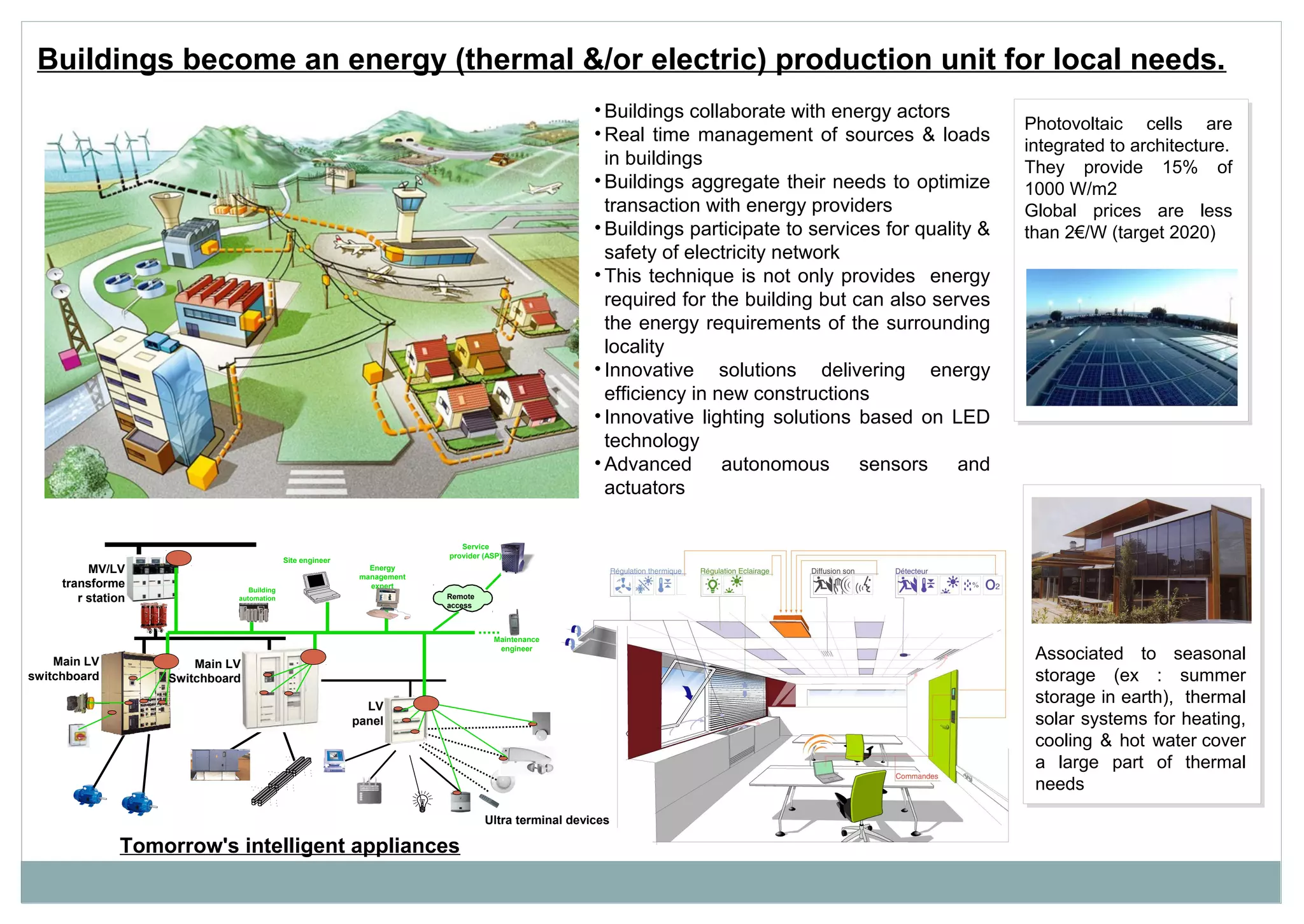
Buildings become an energy (thermal &/or electric) production unit for local needs.
• Buildings collaborate with energy actors
• Real time management of sources & loads
in buildings
• Buildings aggregate their needs to optimize
transaction with energy providers
• Buildings participate to services for quality &
safety of electricity network
• This technique is not only provides energy
required for the building but can also serves
the energy requirements of the surrounding
locality
• Innovative solutions delivering energy
efficiency in new constructions
• Innovative lighting solutions based on LED
technology
• Advanced autonomous sensors and
actuators
Photovoltaic cells are
integrated to architecture.
They provide 15% of
1000 W/m2
Global prices are less
than 2€/W (target 2020)
Associated to seasonal
storage (ex : summer
storage in earth), thermal
solar systems for heating,
cooling & hot water cover
a large part of thermal
needs
MV/LV
transforme
r station
Main LV
switchboard
Main LV
Switchboard
LV
panel
Ultra terminal devices
Service
provider (ASP)
Remote
access
Energy
management
expert
Maintenance
engineer
Building
automation
Site engineer
Tomorrow's intelligent appliances
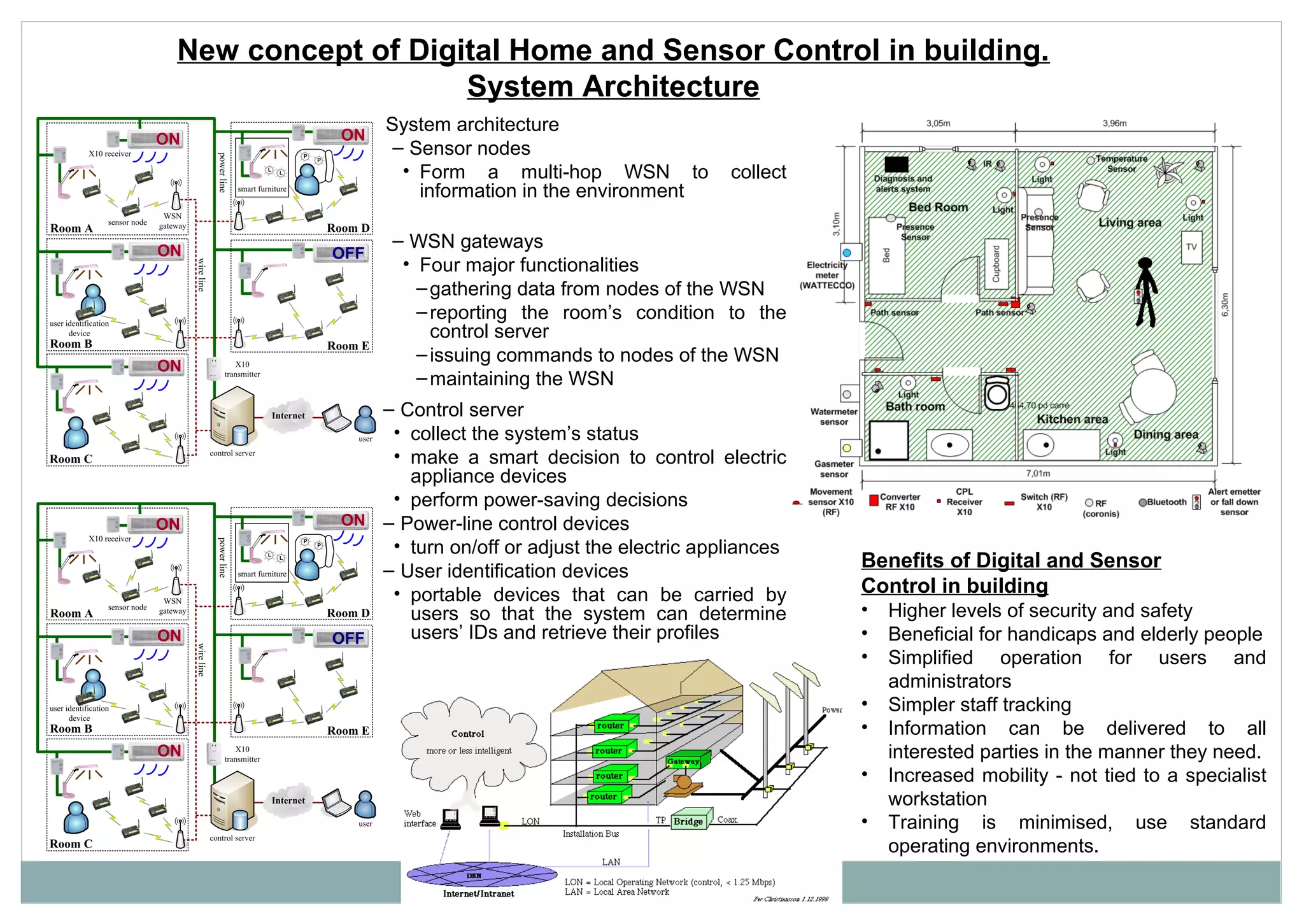
New concept of Digital Home and Sensor Control in building.
System Architecture
System architecture
– Sensor nodes
• Form a multi-hop WSN to collect
information in the environment
– WSN gateways
• Four major functionalities
–gathering data from nodes of the WSN
–reporting the room’s condition to the
control server
–issuing commands to nodes of the WSN
–maintaining the WSN
• Higher levels of security and safety
• Beneficial for handicaps and elderly people
• Simplified operation for users and
administrators
• Simpler staff tracking
• Information can be delivered to all
interested parties in the manner they need.
• Increased mobility - not tied to a specialist
workstation
• Training is minimised, use standard
operating environments.
Benefits of Digital and Sensor
Control in building
– Control server
• collect the system’s status
• make a smart decision to control electric
appliance devices
• perform power-saving decisions
– Power-line control devices
• turn on/off or adjust the electric appliances
– User identification devices
• portable devices that can be carried by
users so that the system can determine
users’ IDs and retrieve their profiles
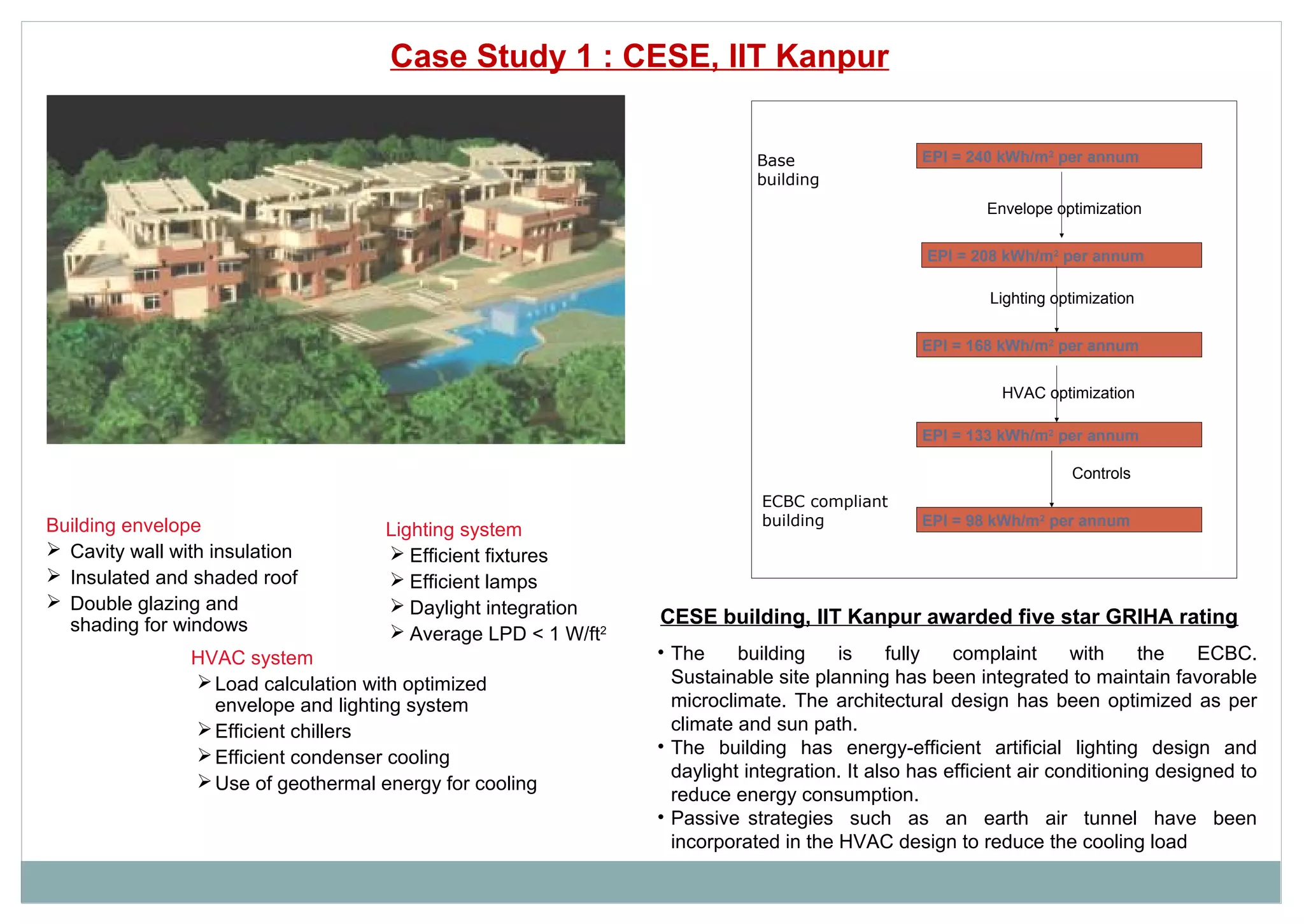
EPI = 240 kWh/m2
per annum
EPI = 208 kWh/m2
per annum
EPI = 133 kWh/m2
per annum
EPI = 168 kWh/m2
per annum
EPI = 98 kWh/m2
per annum
Base
building
ECBC compliant
building
Envelope optimization
Lighting optimization
HVAC optimization
Controls
HVAC system
Load calculation with optimized
envelope and lighting system
Efficient chillers
Efficient condenser cooling
Use of geothermal energy for cooling
Lighting system
 Efficient fixtures
 Efficient lamps
 Daylight integration
 Average LPD < 1 W/ft2
Building envelope
 Cavity wall with insulation
 Insulated and shaded roof
 Double glazing and
shading for windows
Case Study 1 : CESE, IIT Kanpur
• The building is fully complaint with the ECBC.
Sustainable site planning has been integrated to maintain favorable
microclimate. The architectural design has been optimized as per
climate and sun path.
• The building has energy-efficient artificial lighting design and
daylight integration. It also has efficient air conditioning designed to
reduce energy consumption.
• Passive strategies such as an earth air tunnel have been
incorporated in the HVAC design to reduce the cooling load
CESE building, IIT Kanpur awarded five star GRIHA rating
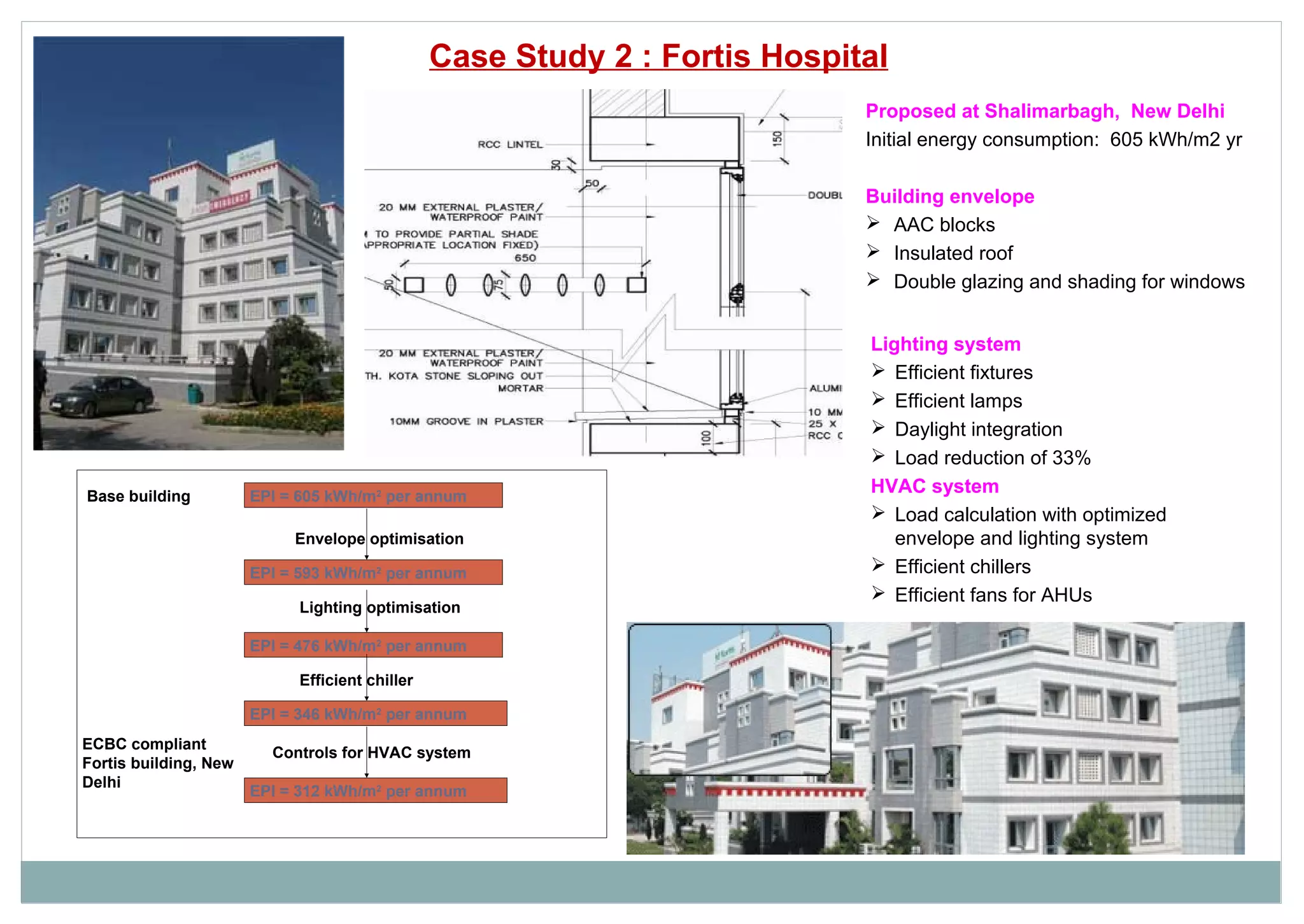
Proposed at Shalimarbagh, New Delhi
Initial energy consumption: 605 kWh/m2 yr
Building envelope
 AAC blocks
 Insulated roof
 Double glazing and shading for windows
Lighting system
 Efficient fixtures
 Efficient lamps
 Daylight integration
 Load reduction of 33%
HVAC system
 Load calculation with optimized
envelope and lighting system
 Efficient chillers
 Efficient fans for AHUs
EPI = 605 kWh/m2
per annum
EPI = 593 kWh/m2
per annum
EPI = 346 kWh/m2
per annum
EPI = 476 kWh/m2
per annum
EPI = 312 kWh/m2
per annum
Base building
ECBC compliant
Fortis building, New
Delhi
Envelope optimisation
Lighting optimisation
Efficient chiller
Controls for HVAC system
Case Study 2 : Fortis Hospital

Intelligent building library study

  • 1.
  • 2.
    Intelligent buildings arebuildings that through their physical design and IT installations are responsive, flexible and adaptive to changing needs from its users and the organizations that inhabit the building during it's life time. The building will supply services for its inhabitants, its administration and operation & maintenance. The intelligent building will accomplish transparent 'intelligent' behavior, have state memory, support human and installation systems communication, and be equipped with sensors and actuators. What is an “Intelligent Building”? Shutters, lighting, HVAC collaborate to reach global optimization : increase of more than 10 %global energy efficiency Sensors provide information of air quality (pollution, microbes, …) and smart ventilation insure health Be flexible and responsive to different usage and environmental contexts such as office, home, hotel, and industry invoking different kinds of loads from nature, people, and building systems, Be able to change states (clearly defined) with respect to functions and user demands over time and building spaces (easy to program and re-program during use) Support human communication (between individuals and groups) Provide transparent intelligence and be simple and understandable to the users (support ubiquitous computers and networks) Accomplish 'intelligent' behavior (self diagnosis, trigger actions on certain events and even learn from use) Have a distributed long term and short term memory Contain tenant, O&M, and administration service systems Be equipped with sensors (stationary and mobile) for direct or indirect input and manipulation of signals from users, systems and the building structure Be equipped with actuators for direct or indirect manipulation installations and the building structure Provide canalization (information roads) that shall house 'wires' carrying new services Be able to handle high band width information transfer. Intelligent building characteristics
  • 3.
    • Optimize T&Dinfrastructure – Deploy efficient substation automation – Upgrade to smart metering solutions • Optimize quality and availability of supplied power – Measure and improve delivered power quality – Implement DG in frequently congested areas • Influence demand consumption – Introduce new tariff structures and smart revenue metering – Implement AMR – Provide customers with accurate and relevant consumption data – Establish DR/DSM programs • Deploy modern IT infrastructure – High speed telecoms infrastructure – Modern Energy Information Systems • Act on Users – Educate people on efficient use of energy – Act on business related procedures • Act on loads – Replace, renovate aging loads (lighting, motors, HVAC, …) – Implement intelligent load control (variable speed drives, regulation systems, lighting control, ...) • Optimize quality and availability of on site power – Measure and improve on site power quality – Implement backup generation – Exploit co-generation means • Optimize supply costs – Use the right tariffs according to specific load profile – Participate in DR/DSM programs – Resell excess power On the Demand Side On the Supply Side Energy Efficiency - A Rising Concern EnergyEnergy EfficiencyEfficiency EnergyEnergy EfficiencyEfficiency Deregulation Deregulation of production and supply of gas and electricity implies to build new business models significantly different from traditional ones Generation capacities and grids Huge investment ($16 trillion worldwide) is needed involving an increase in price of both gas and electricity Policy and environment Kyoto protocol implementation involves new constraints to be integrated in today’s utility business models Demand is booming Because of the lack of electricity generation capacity, peak prices are becoming very high and volatile Natural resources are declining In the consumption regions such as Europe and North America, energy sourcing is becoming crucial and focuses major attention Energy Demand in the EU in 2000 Transport 31% Industry 28% Residential / Commercial 41%
  • 4.
    Highly insulating andactive glazing : • Vacuum double glazing : energy loss = 0,5 W/m2/°C . wall equivalent • Thermo chromium : heat . . flow between 20 to 60 % New insulation materials: thinner and able to store energy • nano porous silica • phase change materials wall coating support balls of paraffin Effective treatment of thermal bridges (junctions between walls, metallic structures, aluminum frames) : this can yield up to 30% reduction of thermal losses • A structure and walls of such insulation performance that only 50 kWh/m2/year would suffice to achieve ideal thermal comfort. • All of its equipment to the optimal energy performance level (lighting, HVAC, office devices) • Intelligence everywhere that would seamlessly handle energy usage optimization whilst guaranteeing optimal comfort, a healthy environment and numerous other services (security, assistance to elderly people) • Renewable and non polluting energy sources • The ability to satisfy its own energy needs (thermal and/or electric) or even contribute excess power to the community (zero/positive energy buildings) • Users whose behaviors would have evolved towards a reasoned usage of energy Lighting efficiency with LEDs : from 20 toward 150 lumen / W Heat pumps : from 20% to 25% of performance increase with speed driven compression motor Consumer appliances : Appliances complying with the energy performance labels are from 10 to 40% more efficient • Buildings consume over 40% of total energy in the EU and US – Between 12% and 18% by commercial buildings the rest residential. – Implementing the EU Building Directive (22% reduction) could save 40Mtoe (million tons of oil equivalent) by 2020. • Consumption profiles may vary but heating, cooling and lighting are the major energy users in buildings – Water heating is a major element for healthcare, lodging, and schools. – Lighting and Space Heating are the major elements for commercial and retail buildings. What should be there in an energy efficient buildings
  • 5.
    Buildings become anenergy (thermal &/or electric) production unit for local needs. • Buildings collaborate with energy actors • Real time management of sources & loads in buildings • Buildings aggregate their needs to optimize transaction with energy providers • Buildings participate to services for quality & safety of electricity network • This technique is not only provides energy required for the building but can also serves the energy requirements of the surrounding locality • Innovative solutions delivering energy efficiency in new constructions • Innovative lighting solutions based on LED technology • Advanced autonomous sensors and actuators Photovoltaic cells are integrated to architecture. They provide 15% of 1000 W/m2 Global prices are less than 2€/W (target 2020) Associated to seasonal storage (ex : summer storage in earth), thermal solar systems for heating, cooling & hot water cover a large part of thermal needs MV/LV transforme r station Main LV switchboard Main LV Switchboard LV panel Ultra terminal devices Service provider (ASP) Remote access Energy management expert Maintenance engineer Building automation Site engineer Tomorrow's intelligent appliances
  • 6.
    New concept ofDigital Home and Sensor Control in building. System Architecture System architecture – Sensor nodes • Form a multi-hop WSN to collect information in the environment – WSN gateways • Four major functionalities –gathering data from nodes of the WSN –reporting the room’s condition to the control server –issuing commands to nodes of the WSN –maintaining the WSN • Higher levels of security and safety • Beneficial for handicaps and elderly people • Simplified operation for users and administrators • Simpler staff tracking • Information can be delivered to all interested parties in the manner they need. • Increased mobility - not tied to a specialist workstation • Training is minimised, use standard operating environments. Benefits of Digital and Sensor Control in building – Control server • collect the system’s status • make a smart decision to control electric appliance devices • perform power-saving decisions – Power-line control devices • turn on/off or adjust the electric appliances – User identification devices • portable devices that can be carried by users so that the system can determine users’ IDs and retrieve their profiles
  • 7.
    EPI = 240kWh/m2 per annum EPI = 208 kWh/m2 per annum EPI = 133 kWh/m2 per annum EPI = 168 kWh/m2 per annum EPI = 98 kWh/m2 per annum Base building ECBC compliant building Envelope optimization Lighting optimization HVAC optimization Controls HVAC system Load calculation with optimized envelope and lighting system Efficient chillers Efficient condenser cooling Use of geothermal energy for cooling Lighting system  Efficient fixtures  Efficient lamps  Daylight integration  Average LPD < 1 W/ft2 Building envelope  Cavity wall with insulation  Insulated and shaded roof  Double glazing and shading for windows Case Study 1 : CESE, IIT Kanpur • The building is fully complaint with the ECBC. Sustainable site planning has been integrated to maintain favorable microclimate. The architectural design has been optimized as per climate and sun path. • The building has energy-efficient artificial lighting design and daylight integration. It also has efficient air conditioning designed to reduce energy consumption. • Passive strategies such as an earth air tunnel have been incorporated in the HVAC design to reduce the cooling load CESE building, IIT Kanpur awarded five star GRIHA rating
  • 8.
    Proposed at Shalimarbagh,New Delhi Initial energy consumption: 605 kWh/m2 yr Building envelope  AAC blocks  Insulated roof  Double glazing and shading for windows Lighting system  Efficient fixtures  Efficient lamps  Daylight integration  Load reduction of 33% HVAC system  Load calculation with optimized envelope and lighting system  Efficient chillers  Efficient fans for AHUs EPI = 605 kWh/m2 per annum EPI = 593 kWh/m2 per annum EPI = 346 kWh/m2 per annum EPI = 476 kWh/m2 per annum EPI = 312 kWh/m2 per annum Base building ECBC compliant Fortis building, New Delhi Envelope optimisation Lighting optimisation Efficient chiller Controls for HVAC system Case Study 2 : Fortis Hospital