



Capital Budgeting   Er. SS POWER GP.
Capital  Budgeting : # The process of making investment    decision in capital expenditures.  # The planning for purchases of long-    term assets. Capital Expenditure: An expenditure the benefits of which are received over a period of time exceeding one year.
Examples of Capital Expenditure: Acquisition of permanent assets such as plant & mach. Cost of addition, expansion, improvement or alteration of FA Cost of replacement of FA R&D project cost etc.
Need and Importance CB Exchange of current funds for future benefits Large investment Long term commitment of funds Irreversible nature Long term effect on profitability Difficulties of investment decisions Strategic investment decisions National Importance
CB Process Identification of potential investment opportunities Screening the opportunities  Evaluation of Various opportunities Ranking the opportunities Final approval & preparation of capital expenditure budget Implementation Review & follow up
CB Decisions Accept reject   decisions Mutually exclusive decisions Capital Rationing decisions
Project Classification Mandatory investments Replacement projects Expansion Projects Diversification projects R &c D projects Misc. projects: e.g. recreational facilities, landscaped gardens etc.
Example :   Suppose our firm wants to decide whether to purchase a new machine for Rs.15,00,000.  How do we decide? Will the machine be profitable? Will our firm earn a high rate of return on the investment?
Decision-making Criteria in Capital Budgeting How do we decide if a capital investment project should be accepted or rejected?
The Ideal Evaluation Method should: a)  include  all cash flows  that occur during the life of the project, b) consider the  time value of money , c) incorporate the  required rate of return  on the project.   Decision-making Criteria in Capital Budgeting
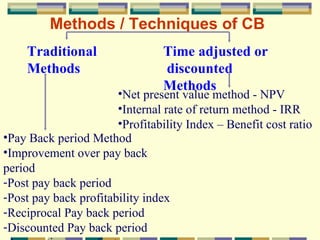
Methods / Techniques of CB Traditional  Methods Time adjusted or discounted Methods Net present value method - NPV Internal rate of return method - IRR Profitability Index – Benefit cost ratio Pay Back period Method Improvement over pay back period Post pay back period Post pay back profitability index Reciprocal Pay back period  Discounted Pay back period Accounting rate of return
A. Traditional Methods
1. Payback Period How long will it take for the project to generate enough cash to pay for itself? It is the length of the time required to recover initial cash outlay on the project
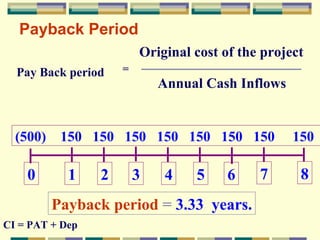
Payback Period Payback period  =  3.33  years. Pay Back period = Original cost of the project Annual Cash Inflows CI = PAT + Dep 0 1 2 3 4 5 8 6 7 (500)  150  150  150  150  150  150  150  150
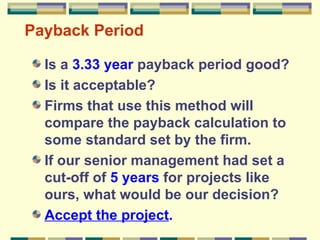
Is a  3.33 year  payback period good? Is it acceptable? Firms that use this method will compare the payback calculation to some standard set by the firm. If our senior management had set a cut-off of  5 years  for projects like ours, what would be our decision? Accept the project . Payback Period
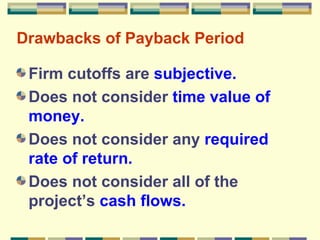
Drawbacks of Payback Period Firm cutoffs are  subjective. Does not consider  time value of   money. Does not consider any  required rate of return. Does not consider all of the project’s  cash flows.
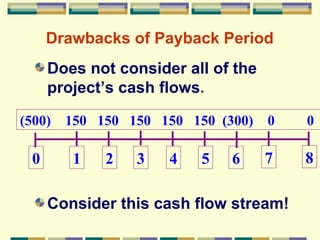
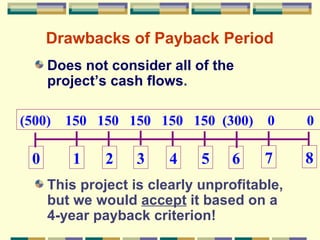
Drawbacks of Payback Period Does not consider all of the project’s cash flows . Consider this cash flow stream! 0 1 2 3 4 5 8 6 7 (500)  150  150  150  150  150  (300)  0  0
Drawbacks of Payback Period Does not consider all of the project’s cash flows . This project is clearly unprofitable, but we would  accept  it based on a 4-year payback criterion! 0 1 2 3 4 5 8 6 7 (500)  150  150  150  150  150  (300)  0  0
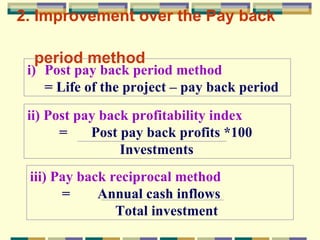
2. Improvement over the Pay back    period method   Post pay back period method  = Life of the project – pay back period ii)   Post pay back profitability index =  Post pay back profits *100   Investments iii) Pay back reciprocal method =  Annual cash inflows    Total investment
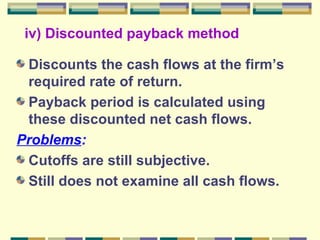
iv) Discounted payback method Discounts the cash flows at the firm’s required rate of return. Payback period is calculated using these discounted net cash flows. Problems : Cutoffs are still subjective. Still does not examine all cash flows.
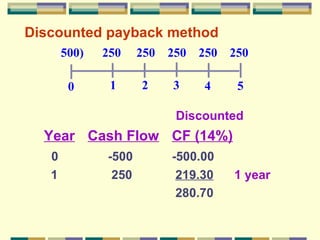
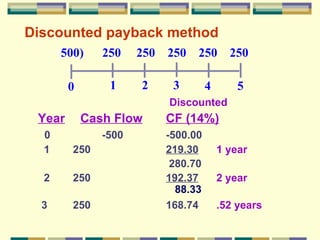
Discounted payback method   Discounted Year   Cash Flow CF (14%) 0 -500 -500.00 1  250   219.30   1 year   280.70 0 1 2 3 4 5 ( 500)  250  250  250  250  250
Discounted payback method   Discounted Year   Cash Flow CF (14%) 0 -500 -500.00 1  250   219.30   1 year   280.70 2  250   192.37   2 year     88.33 3  250 168.74  .52 years 0 1 2 3 4 5 ( 500)  250  250  250  250  250
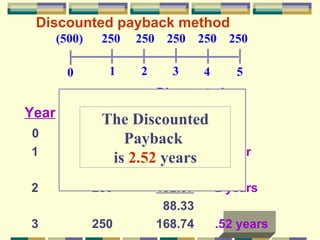
Discounted payback method   Discounted Year   Cash Flow CF (14%) 0 -500 -500.00 1  250   219.30   1 year   280.70 2  250   192.37   2 years   88.33 3  250  168.74  .52 years 0 1 2 3 4 5 (500)  250  250  250  250  250  The Discounted Payback  is  2.52  years
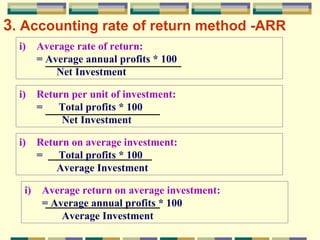
3 . Accounting rate of return method   -ARR Average rate of return:  = Average annual profits * 100 Net Investment Return per unit of investment:  =  Total profits * 100 Net Investment Return on average investment:  =  Total profits * 100 Average Investment Average return on average investment:  = Average annual profits * 100 Average Investment
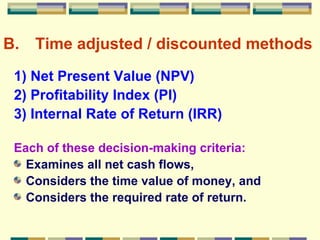
B. Time adjusted / discounted methods 1) Net Present Value (NPV) 2) Profitability Index (PI) 3) Internal Rate of Return (IRR) Each of these decision-making criteria: Examines all net cash flows, Considers the time value of money, and Considers the required rate of return.
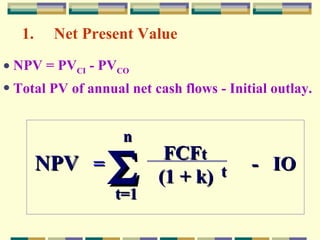
1. Net Present Value NPV = PV CI  - PV CO Total PV of annual net cash flows - Initial outlay. NPV   =   -  IO   FCF t (1 + k) t n t=1 
Net Present Value Decision Rule : In case of independent projects If NPV is positive,  accept. If NPV is negative, reject. In case of mutually exclusive projects Accept the project with highest  positive NPV
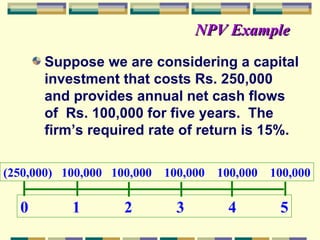
Suppose we are considering a capital investment that costs Rs. 250,000 and provides annual net cash flows of  Rs. 100,000 for five years.  The firm’s required rate of return is 15%. NPV Example 0   1  2  3  4  5 (250,000)  100,000  100,000  100,000  100,000  100,000
Net Present Value (NPV) NPV is just the PV of the annual cash flows minus the initial outflow. Using PVM: Present value of annuity of Rs. 1 in 5 years = 3.3522 PV CI   = 100,000 *3.3522 = 3,35,220  PV CO  = 250,000 PV of cash flows =  Rs.335,220 - Initial outflow:  (Rs. 250,000) = Net PV   Rs.  85,220
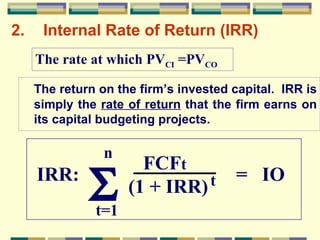
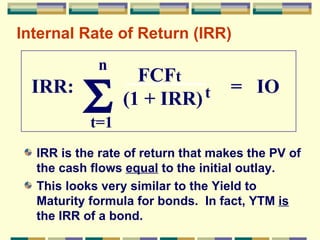
2. Internal Rate of Return (IRR) The return on the firm’s invested capital.  IRR is simply the  rate of return  that the firm earns on its capital budgeting projects. The rate at which PV CI  =PV CO n t=1  IRR:  =  IO  FCF t (1 + IRR) t
Internal Rate of Return (IRR) IRR is the rate of return that makes the PV of the cash flows  equal  to the initial outlay. This looks very similar to the Yield to Maturity formula for bonds.  In fact, YTM  is  the IRR of a bond. n t=1  IRR:  =  IO  FCF t (1 + IRR) t
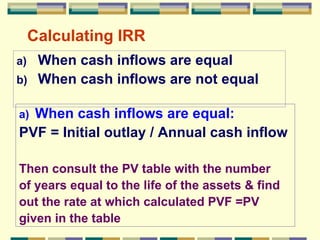
Calculating IRR When cash inflows are equal When cash inflows are not equal When cash inflows are equal: PVF = Initial outlay / Annual cash inflow  Then consult the PV table with the number  of years equal to the life of the assets & find out the rate at which calculated PVF =PV  given in the table
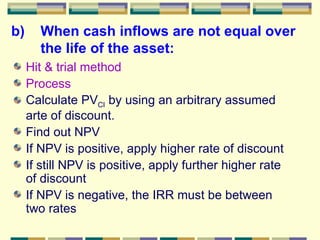
b) When cash inflows are not equal over the life of the asset: Hit & trial method Process Calculate PV CI  by using an arbitrary assumed arte of discount. Find out NPV If NPV is positive, apply higher rate of discount If still NPV is positive, apply further higher rate of discount If NPV is negative, the IRR must be between two rates
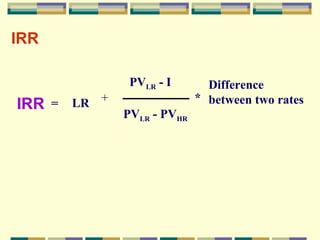
IRR = LR + PV LR  - I PV LR  - PV HR   * Difference between two rates IRR
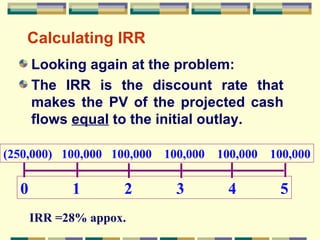
Calculating IRR Looking again at the problem: The IRR is the discount rate that makes the PV of the projected cash flows  equal  to the initial outlay. IRR =28% appox. 0  1  2  3  4  5 (250,000)  100,000  100,000  100,000  100,000  100,000
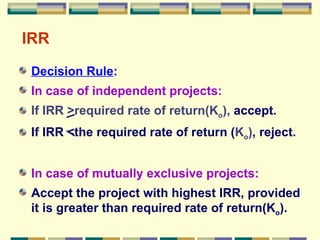
IRR Decision Rule : In case of independent projects: If IRR  > required rate of return(K o ),  accept. If IRR  < the required rate of return ( K o ) , reject. In case of mutually exclusive projects: Accept the project with highest IRR, provided it is greater than required rate of return(K o ).
Modified Internal Rate of Return - MIRR IRR assumes that all cash flows are reinvested at the IRR. MIRR provides a rate of return measure that assumes cash flows are reinvested at the required rate of return.
MIRR Steps: Calculate the PV of the cash outflows. Using the required rate of return. Calculate the FV of the cash inflows at the last year of the project’s time line.  This is called the terminal value (TV). Using the required rate of return. MIRR:  the discount rate that equates the PV of the cash outflows with the PV of the terminal value, ie, that makes : PV outflows  = PV inflows
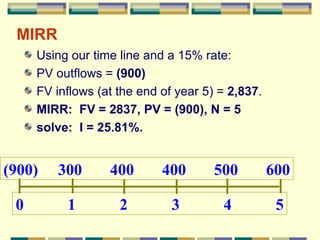
MIRR Using our time line and a 15% rate: PV outflows =  (900) FV inflows (at the end of year 5) =  2,837 . MIRR:  FV = 2837, PV = (900), N = 5 solve:  I = 25.81%. 0  1  2  3  4  5 (900)  300  400  400  500  600
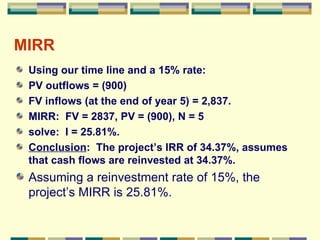
MIRR Using our time line and a 15% rate: PV outflows = (900) FV inflows (at the end of year 5) = 2,837. MIRR:  FV = 2837, PV = (900), N = 5 solve:  I = 25.81%. Conclusion :  The project’s IRR of 34.37%, assumes that cash flows are reinvested at 34.37%. Assuming a reinvestment rate of 15%, the project’s MIRR is 25.81%.
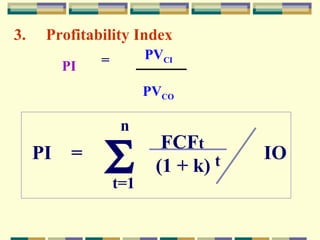
3. Profitability Index PI = PV CI PV CO PI  =  IO   FCF t (1 + k) n t=1  t
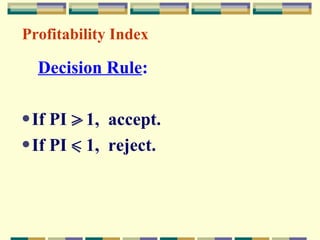
Decision Rule : If PI  >  1,  accept. If PI  <  1,  reject. Profitability Index
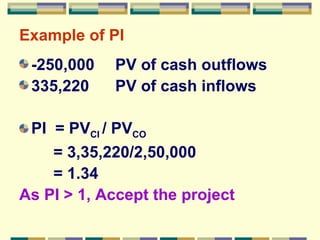
Example of PI -250,000 PV of cash outflows 335,220  PV of cash inflows PI  = PV CI  / PV CO    = 3,35,220/2,50,000   = 1.34 As PI  > 1, Accept the project
Factors affecting CB decisions Urgency Degree of certainty Intangible factors Legal factors Availability of funds Future earnings Obsolescence R&D projects Cost considerations
Risk & uncertainty in CB Expected economic life of the asset Salvage value Capacity of the project Selling price of the product Depreciation rate Production cost Rate of taxation Future demand of the product
Methods for ascertaining risk & uncertainty in CB Risk adjusted cut off or varying  discount rate Certainity equivalent method Sensitivity technique Probability technique Standard deviation method Coefficient variation method Decision tree analysis
Method of appraisal & their rationale Wide variety of measures Small size investment projects – pay back period method Large size investment projects – ARR method Large size investment projects – Discounted cash flows method Several other criteria: profit per rupee invested, cost saving per unit etc. By and large no fixed standard  Bottleneck due to limited funds

Capital Budgeting Er. S Sood

  • 1.
    Capital Budgeting Er. SS POWER GP.
  • 2.
    Capital Budgeting: # The process of making investment decision in capital expenditures. # The planning for purchases of long- term assets. Capital Expenditure: An expenditure the benefits of which are received over a period of time exceeding one year.
  • 3.
    Examples of CapitalExpenditure: Acquisition of permanent assets such as plant & mach. Cost of addition, expansion, improvement or alteration of FA Cost of replacement of FA R&D project cost etc.
  • 4.
    Need and ImportanceCB Exchange of current funds for future benefits Large investment Long term commitment of funds Irreversible nature Long term effect on profitability Difficulties of investment decisions Strategic investment decisions National Importance
  • 5.
    CB Process Identificationof potential investment opportunities Screening the opportunities Evaluation of Various opportunities Ranking the opportunities Final approval & preparation of capital expenditure budget Implementation Review & follow up
  • 6.
    CB Decisions Acceptreject decisions Mutually exclusive decisions Capital Rationing decisions
  • 7.
    Project Classification Mandatoryinvestments Replacement projects Expansion Projects Diversification projects R &c D projects Misc. projects: e.g. recreational facilities, landscaped gardens etc.
  • 8.
    Example : Suppose our firm wants to decide whether to purchase a new machine for Rs.15,00,000. How do we decide? Will the machine be profitable? Will our firm earn a high rate of return on the investment?
  • 9.
    Decision-making Criteria inCapital Budgeting How do we decide if a capital investment project should be accepted or rejected?
  • 10.
    The Ideal EvaluationMethod should: a) include all cash flows that occur during the life of the project, b) consider the time value of money , c) incorporate the required rate of return on the project. Decision-making Criteria in Capital Budgeting
  • 11.
    Methods / Techniquesof CB Traditional Methods Time adjusted or discounted Methods Net present value method - NPV Internal rate of return method - IRR Profitability Index – Benefit cost ratio Pay Back period Method Improvement over pay back period Post pay back period Post pay back profitability index Reciprocal Pay back period Discounted Pay back period Accounting rate of return
  • 12.
  • 13.
    1. Payback PeriodHow long will it take for the project to generate enough cash to pay for itself? It is the length of the time required to recover initial cash outlay on the project
  • 14.
    Payback Period Paybackperiod = 3.33 years. Pay Back period = Original cost of the project Annual Cash Inflows CI = PAT + Dep 0 1 2 3 4 5 8 6 7 (500) 150 150 150 150 150 150 150 150
  • 15.
    Is a 3.33 year payback period good? Is it acceptable? Firms that use this method will compare the payback calculation to some standard set by the firm. If our senior management had set a cut-off of 5 years for projects like ours, what would be our decision? Accept the project . Payback Period
  • 16.
    Drawbacks of PaybackPeriod Firm cutoffs are subjective. Does not consider time value of money. Does not consider any required rate of return. Does not consider all of the project’s cash flows.
  • 17.
    Drawbacks of PaybackPeriod Does not consider all of the project’s cash flows . Consider this cash flow stream! 0 1 2 3 4 5 8 6 7 (500) 150 150 150 150 150 (300) 0 0
  • 18.
    Drawbacks of PaybackPeriod Does not consider all of the project’s cash flows . This project is clearly unprofitable, but we would accept it based on a 4-year payback criterion! 0 1 2 3 4 5 8 6 7 (500) 150 150 150 150 150 (300) 0 0
  • 19.
    2. Improvement overthe Pay back period method Post pay back period method = Life of the project – pay back period ii) Post pay back profitability index = Post pay back profits *100 Investments iii) Pay back reciprocal method = Annual cash inflows Total investment
  • 20.
    iv) Discounted paybackmethod Discounts the cash flows at the firm’s required rate of return. Payback period is calculated using these discounted net cash flows. Problems : Cutoffs are still subjective. Still does not examine all cash flows.
  • 21.
    Discounted payback method Discounted Year Cash Flow CF (14%) 0 -500 -500.00 1 250 219.30 1 year 280.70 0 1 2 3 4 5 ( 500) 250 250 250 250 250
  • 22.
    Discounted payback method Discounted Year Cash Flow CF (14%) 0 -500 -500.00 1 250 219.30 1 year 280.70 2 250 192.37 2 year 88.33 3 250 168.74 .52 years 0 1 2 3 4 5 ( 500) 250 250 250 250 250
  • 23.
    Discounted payback method Discounted Year Cash Flow CF (14%) 0 -500 -500.00 1 250 219.30 1 year 280.70 2 250 192.37 2 years 88.33 3 250 168.74 .52 years 0 1 2 3 4 5 (500) 250 250 250 250 250 The Discounted Payback is 2.52 years
  • 24.
    3 . Accountingrate of return method -ARR Average rate of return: = Average annual profits * 100 Net Investment Return per unit of investment: = Total profits * 100 Net Investment Return on average investment: = Total profits * 100 Average Investment Average return on average investment: = Average annual profits * 100 Average Investment
  • 25.
    B. Time adjusted/ discounted methods 1) Net Present Value (NPV) 2) Profitability Index (PI) 3) Internal Rate of Return (IRR) Each of these decision-making criteria: Examines all net cash flows, Considers the time value of money, and Considers the required rate of return.
  • 26.
    1. Net PresentValue NPV = PV CI - PV CO Total PV of annual net cash flows - Initial outlay. NPV = - IO FCF t (1 + k) t n t=1 
  • 27.
    Net Present ValueDecision Rule : In case of independent projects If NPV is positive, accept. If NPV is negative, reject. In case of mutually exclusive projects Accept the project with highest positive NPV
  • 28.
    Suppose we areconsidering a capital investment that costs Rs. 250,000 and provides annual net cash flows of Rs. 100,000 for five years. The firm’s required rate of return is 15%. NPV Example 0 1 2 3 4 5 (250,000) 100,000 100,000 100,000 100,000 100,000
  • 29.
    Net Present Value(NPV) NPV is just the PV of the annual cash flows minus the initial outflow. Using PVM: Present value of annuity of Rs. 1 in 5 years = 3.3522 PV CI = 100,000 *3.3522 = 3,35,220 PV CO = 250,000 PV of cash flows = Rs.335,220 - Initial outflow: (Rs. 250,000) = Net PV Rs. 85,220
  • 30.
    2. Internal Rateof Return (IRR) The return on the firm’s invested capital. IRR is simply the rate of return that the firm earns on its capital budgeting projects. The rate at which PV CI =PV CO n t=1  IRR: = IO FCF t (1 + IRR) t
  • 31.
    Internal Rate ofReturn (IRR) IRR is the rate of return that makes the PV of the cash flows equal to the initial outlay. This looks very similar to the Yield to Maturity formula for bonds. In fact, YTM is the IRR of a bond. n t=1  IRR: = IO FCF t (1 + IRR) t
  • 32.
    Calculating IRR Whencash inflows are equal When cash inflows are not equal When cash inflows are equal: PVF = Initial outlay / Annual cash inflow Then consult the PV table with the number of years equal to the life of the assets & find out the rate at which calculated PVF =PV given in the table
  • 33.
    b) When cashinflows are not equal over the life of the asset: Hit & trial method Process Calculate PV CI by using an arbitrary assumed arte of discount. Find out NPV If NPV is positive, apply higher rate of discount If still NPV is positive, apply further higher rate of discount If NPV is negative, the IRR must be between two rates
  • 34.
    IRR = LR+ PV LR - I PV LR - PV HR * Difference between two rates IRR
  • 35.
    Calculating IRR Lookingagain at the problem: The IRR is the discount rate that makes the PV of the projected cash flows equal to the initial outlay. IRR =28% appox. 0 1 2 3 4 5 (250,000) 100,000 100,000 100,000 100,000 100,000
  • 36.
    IRR Decision Rule: In case of independent projects: If IRR > required rate of return(K o ), accept. If IRR < the required rate of return ( K o ) , reject. In case of mutually exclusive projects: Accept the project with highest IRR, provided it is greater than required rate of return(K o ).
  • 37.
    Modified Internal Rateof Return - MIRR IRR assumes that all cash flows are reinvested at the IRR. MIRR provides a rate of return measure that assumes cash flows are reinvested at the required rate of return.
  • 38.
    MIRR Steps: Calculatethe PV of the cash outflows. Using the required rate of return. Calculate the FV of the cash inflows at the last year of the project’s time line. This is called the terminal value (TV). Using the required rate of return. MIRR: the discount rate that equates the PV of the cash outflows with the PV of the terminal value, ie, that makes : PV outflows = PV inflows
  • 39.
    MIRR Using ourtime line and a 15% rate: PV outflows = (900) FV inflows (at the end of year 5) = 2,837 . MIRR: FV = 2837, PV = (900), N = 5 solve: I = 25.81%. 0 1 2 3 4 5 (900) 300 400 400 500 600
  • 40.
    MIRR Using ourtime line and a 15% rate: PV outflows = (900) FV inflows (at the end of year 5) = 2,837. MIRR: FV = 2837, PV = (900), N = 5 solve: I = 25.81%. Conclusion : The project’s IRR of 34.37%, assumes that cash flows are reinvested at 34.37%. Assuming a reinvestment rate of 15%, the project’s MIRR is 25.81%.
  • 41.
    3. Profitability IndexPI = PV CI PV CO PI = IO FCF t (1 + k) n t=1  t
  • 42.
    Decision Rule :If PI > 1, accept. If PI < 1, reject. Profitability Index
  • 43.
    Example of PI-250,000 PV of cash outflows 335,220 PV of cash inflows PI = PV CI / PV CO = 3,35,220/2,50,000 = 1.34 As PI > 1, Accept the project
  • 44.
    Factors affecting CBdecisions Urgency Degree of certainty Intangible factors Legal factors Availability of funds Future earnings Obsolescence R&D projects Cost considerations
  • 45.
    Risk & uncertaintyin CB Expected economic life of the asset Salvage value Capacity of the project Selling price of the product Depreciation rate Production cost Rate of taxation Future demand of the product
  • 46.
    Methods for ascertainingrisk & uncertainty in CB Risk adjusted cut off or varying discount rate Certainity equivalent method Sensitivity technique Probability technique Standard deviation method Coefficient variation method Decision tree analysis
  • 47.
    Method of appraisal& their rationale Wide variety of measures Small size investment projects – pay back period method Large size investment projects – ARR method Large size investment projects – Discounted cash flows method Several other criteria: profit per rupee invested, cost saving per unit etc. By and large no fixed standard Bottleneck due to limited funds