PRESENTED TO:-
Prof. Uttam Kumar.
PRESENTED BY:-
Ravi Shankar Verma
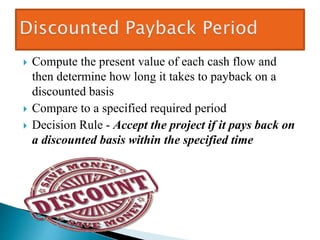
 Compute the present value of each cash flow and
then determine how long it takes to payback on a
discounted basis
 Compare to a specified required period
 Decision Rule - Accept the project if it pays back on
a discounted basis within the specified time
 Does the discounted payback rule account for the
time value of money?
 Does the discounted payback rule account for the risk
of the cash flows?
 Does the discounted payback rule provide an
indication about the increase in value?
 Should we consider the discounted payback rule for
our primary decision criteria?
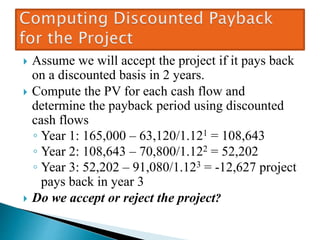
 Assume we will accept the project if it pays back
on a discounted basis in 2 years.
 Compute the PV for each cash flow and
determine the payback period using discounted
cash flows
◦ Year 1: 165,000 – 63,120/1.121 = 108,643
◦ Year 2: 108,643 – 70,800/1.122 = 52,202
◦ Year 3: 52,202 – 91,080/1.123 = -12,627 project
pays back in year 3
 Do we accept or reject the project?
Advantages Disadvantages
◦ Includes time value of
money
◦ Easy to understand
◦ Does not accept negative
estimated NPV
investments
◦ Biased towards liquidity
◦ May reject positive NPV
investments
◦ Requires an arbitrary
cutoff point
◦ Ignores cash flows
beyond the cutoff point
◦ Biased against long-term
projects, such as R&D
and new products
 The difference between the market value of a project
and its cost
 How much value is created from undertaking an
investment?
◦ The first step is to estimate the expected future cash flows.
◦ The second step is to estimate the required return for projects
of this risk level.
◦ The third step is to find the present value of the cash flows and
subtract the initial investment.
 If the NPV is positive, accept the project
 A positive NPV means that the project is expected to
add value to the firm and will therefore increase the
wealth of the owners.
 Since our goal is to increase owner wealth, NPV is a
direct measure of how well this project will meet our
goal.
 This is the most important alternative to NPV
 It is often used in practice and is intuitively appealing
 It is based entirely on the estimated cash flows and is
independent of interest rates found elsewhere
 Definition: IRR is the return that makes the NPV = 0
 Decision Rule: Accept the project if the IRR is
greater than the required return
Discounted payback period

Discounted payback period

  • 1.
    PRESENTED TO:- Prof. UttamKumar. PRESENTED BY:- Ravi Shankar Verma
  • 2.
     Compute thepresent value of each cash flow and then determine how long it takes to payback on a discounted basis  Compare to a specified required period  Decision Rule - Accept the project if it pays back on a discounted basis within the specified time
  • 3.
     Does thediscounted payback rule account for the time value of money?  Does the discounted payback rule account for the risk of the cash flows?  Does the discounted payback rule provide an indication about the increase in value?  Should we consider the discounted payback rule for our primary decision criteria?
  • 4.
     Assume wewill accept the project if it pays back on a discounted basis in 2 years.  Compute the PV for each cash flow and determine the payback period using discounted cash flows ◦ Year 1: 165,000 – 63,120/1.121 = 108,643 ◦ Year 2: 108,643 – 70,800/1.122 = 52,202 ◦ Year 3: 52,202 – 91,080/1.123 = -12,627 project pays back in year 3  Do we accept or reject the project?
  • 5.
    Advantages Disadvantages ◦ Includestime value of money ◦ Easy to understand ◦ Does not accept negative estimated NPV investments ◦ Biased towards liquidity ◦ May reject positive NPV investments ◦ Requires an arbitrary cutoff point ◦ Ignores cash flows beyond the cutoff point ◦ Biased against long-term projects, such as R&D and new products
  • 6.
     The differencebetween the market value of a project and its cost  How much value is created from undertaking an investment? ◦ The first step is to estimate the expected future cash flows. ◦ The second step is to estimate the required return for projects of this risk level. ◦ The third step is to find the present value of the cash flows and subtract the initial investment.
  • 7.
     If theNPV is positive, accept the project  A positive NPV means that the project is expected to add value to the firm and will therefore increase the wealth of the owners.  Since our goal is to increase owner wealth, NPV is a direct measure of how well this project will meet our goal.
  • 8.
     This isthe most important alternative to NPV  It is often used in practice and is intuitively appealing  It is based entirely on the estimated cash flows and is independent of interest rates found elsewhere
  • 9.
     Definition: IRRis the return that makes the NPV = 0  Decision Rule: Accept the project if the IRR is greater than the required return