Building	
Pro	Forma	Financial	
Statement
Dr.	Wisnu	Sakti	Dewobroto
Dr.	Wisnu	Dewobroto
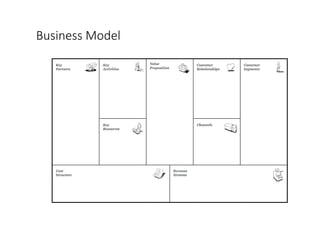
Business	Model
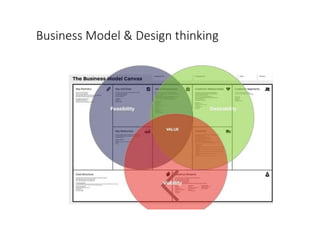
Business	Model	&	Design	thinking
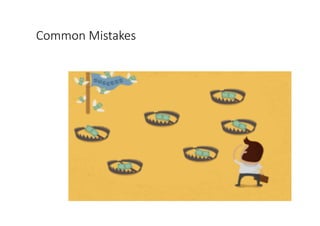
Common	Mistakes
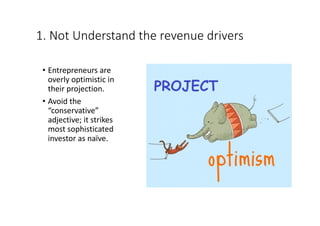
1.	Not	Understand	the	revenue	drivers
• Entrepreneurs	are	
overly	optimistic	in	
their	projection.
• Avoid	the	
“conservative”	
adjective;	it	strikes	
most	sophisticated	
investor	as	naïve.
2.	Underestimating	Cost
• Revenue	growing	in	a	“Hockey	stick”	fashion,	while	cost	slowly	
progress	upward	
• The	assumes	that	nearly	impossible
• Often	entrepreneurs	underestimate	how	much	infrastructure	they	
need	in	the	way	of	employees	and	physical	assets	to	achieve	that	
level	of	sales
• Entrepreneurs	also	underestimate	the	cost	of	marketing	expenditures	
to	acquire	and	retain	customers.	Poor	projections	lead	to	cash	
crunches	and	ultimately	to	failure.
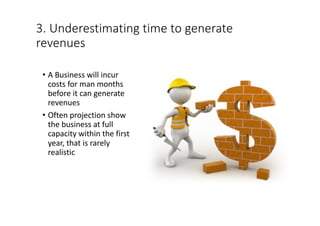
3.	Underestimating	time	to	generate	
revenues
• A	Business	will	incur	
costs	for	man	months	
before	it	can	generate	
revenues
• Often	projection	show	
the	business	at	full	
capacity	within	the	first	
year,	that	is	rarely	
realistic
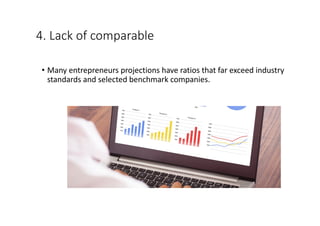
4.	Lack	of	comparable
• Many	entrepreneurs	projections	have	ratios	that	far	exceed	industry	
standards	and	selected	benchmark	companies.
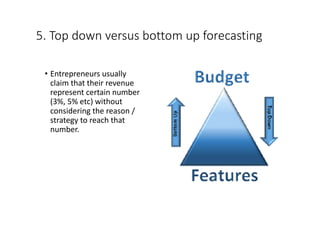
5.	Top	down	versus	bottom	up	forecasting
• Entrepreneurs	usually	
claim	that	their	revenue	
represent	certain	number	
(3%,	5%	etc)	without	
considering	the	reason	/	
strategy	to	reach	that	
number.
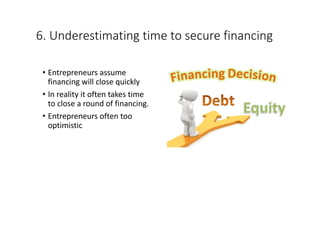
6.	Underestimating	time	to	secure	financing
• Entrepreneurs	assume	
financing	will	close	quickly
• In	reality	it	often	takes	time	
to	close	a	round	of	financing.
• Entrepreneurs	often	too	
optimistic
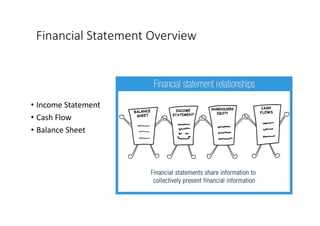
Financial	Statement	Overview
• Income	Statement
• Cash	Flow
• Balance	Sheet
https://www.facebook.com/ialwaysthinkprettythings
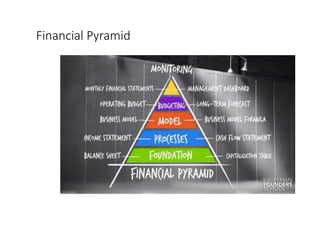
Financial	Pyramid
Building	pro	forma	Financial	Statement	(1)
• Build	up	Method
1. Identify	all	your	sources	of	revenues
2. Determine	your	revenues	for	a	typical	day
3. Understand	you	revenue	drivers
a. How	many	customers	you	will	serve
b. How	much	product	they	will	buy
c. How	much	they	will	pay	for	each	product
d. How	often	they	will	buy
4. Validate	driver	assumptions
a. Primary	research	(talk	to	customers,	attend	tradeshow	etc.)
b. Secondary	research	(industry	reports,	company	reports	etc.)
5. Recombine.	Multiply	the	typical	day	by	the	number	of	days	in	a	year
6. Determine	COGS	for	a	typical	day
7. Recombine.	Multiply	COGS	by	number	of	days	in	a	year
8. Determine	operating	expenses	by	most	appropriate	time	frame
9. Refine	operating	costs
10. Crate	preliminary	income	statement
Building	pro	forma	Financial	Statement	(2)
• Comparable	method
11. Compare	revenue	projections	to	industry	metrics
12. Run	scenario	analysis
13. Compare	common-sized	cost	percentages	to	industry	averages
• Building	integrated	Financial	statements
14. Derive	monthly	income	statements	for	two	years,	yearly	statements	for	
year	3	-5
15. Create	balance	sheet	(yearly	for	year	1	-5)	
16. Create	cash-flow	statement	(monthly	for	years	1	and	2	yearly	for	years	3	–
5)
• Final	steps
17. Write	a	two- to	three-page	description	of	financial	statements
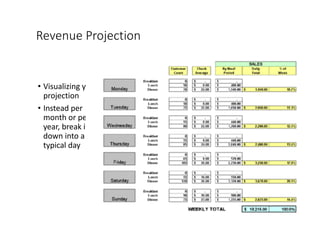
Revenue	Projection
• Visualizing	your	
projection
• Instead	per	
month	or	per	
year,	break	it	
down	into	a	
typical	day
Cost	of	Good	Sold
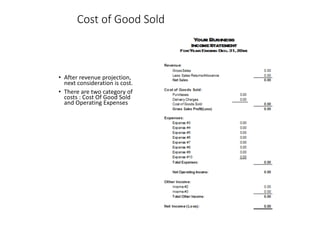
• After	revenue	projection,	
next	consideration	is	cost.	
• There	are	two	category	of	
costs	:	Cost	Of	Good	Sold	
and	Operating	Expenses
Operating	Expenses
• Operating	expenses	are	the	costs	of	keeping	your	business	running.	
Think	of	these	as	the	things	you're	going	to	have	to	pay	each	
month.	Your	list	of	operating	expenses	may	include:
• salaries	(yours	and	staff	salaries)
• rent	or	mortgage	payments
• telecommunications
• utilities
• raw	materials
• storage
• distribution
• promotion
• loan	payments
• office	supplies
• maintenance
Income	Statement
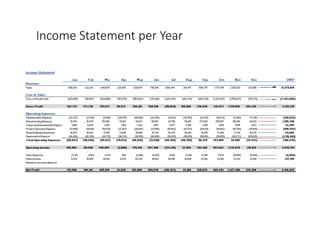
• The	Income	Statement	is	one	of	the	three	financial	statements	
that	you	need	to	include	in	the	Financial	Plan	section	of	the	
business	plan.
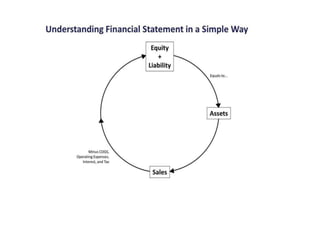
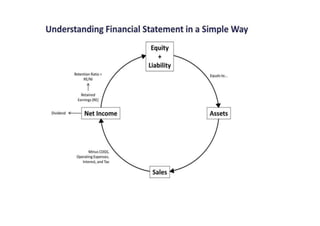
• The	Income	Statement	shows	your	Revenues,	Expenses,	and	
Profit	for	a	particular	period.	It's	a	snapshot	of	your	business	
that	shows	whether	or	not	your	business	is	profitable	at	that	
point	in	time;	Revenue	- Expenses	=	Profit/Loss.
• While	established	businesses	normally	produce	an	Income	
Statement	each	fiscal	quarter,	or	even	once	each	fiscal	year,	for	
the	purposes	of	the	business	plan,	an	Income	Statement	should	
be	generated	more	frequently	- monthly	for	the	first	year.
Income	Statement	per	Year
The	Cash	Flow	Projection
• The	Cash	Flow	Projection	shows	how	cash	is	expected	to	flow	in	and	out	of	
your	business.	For	you,	it's	an	important	tool	for	cash	flow	management,	
letting	you	know	when	your	expenditures	are	too	high	or	when	you	might	
want	to	arrange	short	term	investments	to	deal	with	a	cash	flow	surplus.	As	
part	of	your	business	plan,	a	Cash	Flow	Projection	will	give	you	a	much	
better	idea	of	how	much	capital	investment	your	business	idea	needs.
• For	a	bank	loans	officer,	the	Cash	Flow	Projection	offers	evidence	that	your	
business	is	a	good	credit	risk	and	that	there	will	be	enough	cash	on	hand	to	
make	your	business	a	good	candidate	for	a	line	of	credit	or	short	term	loan.
• Do	not	confuse	a	Cash	Flow	Projection	with	a	Cash	Flow	Statement.	The	
Cash	Flow	Statement	shows	how	cash	has	flowed	in	and	out	of	your	
business.	In	other	words,	it	describes	the	cash	flow	that	has	occurred	in	the	
past.	The	Cash	Flow	Projection	shows	the	cash	that	is	anticipated	to	be	
generated	or	expended	over	a	chosen	period	of	time	in	the	future.
• While	both	types	of	Cash	Flow	reports	are	important	business	decision-
making	tools	for	businesses,	we're	only	concerned	with	the	Cash	Flow	
Projection	in	the	business	plan.	You	will	want	to	show	Cash	Flow	
Projections	for	each	month	over	a	one	year	period	as	part	of	the	Financial	
Plan	portion	of	your	business	plan.
Cash	Flow	Projection
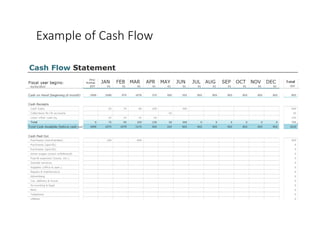
• There	are	three	parts	to	the	Cash	Flow	Projection.	The	first	part	
details	your	Cash	Revenues.	Enter	your	estimated	sales	figures	for	
each	month.	Remember	that	these	are	Cash	Revenues;	you	will	only	
enter	the	sales	that	are	collectible	in	cash	during	the	specific	month	
you	are	dealing	with.
• The	second	part	is	your	Cash	Disbursements.	Take	the	various	
expense	categories	from	your	ledger	and	list	the	cash	expenditures	
you	actually	expect	to	pay	that	month	for	each	month.
• The	third	part	of	the	Cash	Flow	Projection	is	the	Reconciliation	of	
Cash	Revenues	to	Cash	Disbursements.	As	the	word	"reconciliation"	
suggests,	this	section	starts	with	an	opening	balance	which	is	the	
carryover	from	the	previous	month's	operations.	The	current	month's	
Revenues	are	added	to	this	balance;	the	current	month's	
Disbursements	are	subtracted,	and	the	adjusted	cash	flow	balance	is	
carried	over	to	the	next	month.
Example	of	Cash	Flow
Balance	Sheet
• The	Balance	Sheet	presents	a	picture	of	your	business'	net	worth	at	a	
particular	point	in	time.	It	summarizes	all	the	financial	data	about	your	
business,	breaking	that	data	into	3	categories;	assets,	liabilities,	and	equity.
• Some	definitions	first:
• Assets are	tangible	objects	of	financial	value	that	are	owned	by	the	company.
• A	liability	is	a	debt	owed	to	a	creditor	of	the	company.
• Equity	is	the	net	difference	when	the	total	liabilities	are	subtracted	from	the	total	
assets.
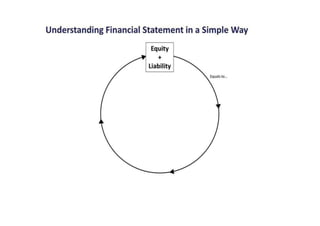
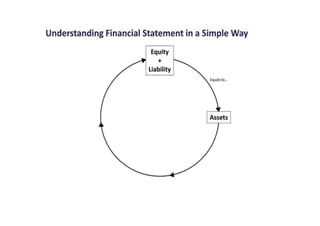
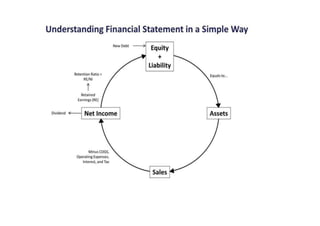
• All	accounts	in	your	General	Ledger	are	categorized	as	an	asset,	a	liability	or	
equity.	The	relationship	between	them	is	expressed	in	this	equation:	Assets	
=	Liabilities	+	Equity.
• For	the	purposes	of	your	business	plan,	you'll	be	creating	a	pro	forma	
Balance	Sheet	intended	to	summarize	the	information	in	the	Income	
Statement	and	Cash	Flow	Projections.	Normally	a	business	prepares	a	
Balance	Sheet	once	a	year.
Brief	Analysis
• Once	you	have	your	Balance	Sheet	completed,	you're	ready	to	
write	a	brief	analysis	of	each	of	the	three	financial	statements.	
When	you're	writing	these	analysis	paragraphs,	you	want	to	keep	
them	short	and	cover	the	highlights,	rather	than	writing	an	in-
depth	analysis.

Pro forma financial statement