Ramesh Kumar N Capital Budget1
Capital Budgeting – an analysis
Ramesh Kumar N
Ramesh Kumar N C2
Presenter’s background
RAMESH KUMAR NANJUNDAIYA – MS (Belgium), MBA (US)
 Associate Partner & Head - Finance/Business set-up and Family Office of M/s. Insta Solu Venture
Consultants, LLP, Bangalore, India
 Certified as “Independent Corporate Director”, by World Council For Corporate Governance,
London, UK [License # WCFCG/IID/DCD/2011/1711] – 2011
 Visiting Guest Faculty in “International Marketing”and “Corporate Finance” course for final year
MBA students at a known institutions in Bangalore, India.
Professional overview
 An accomplished professional with over 32 years’ of experience in banking and the financial
sector with established credentials in Corporate Banking and Marketing, Financial Management,
Venture & PE Capital sourcing, setting up JVs and with forte in Start ups to promote new
commercial banks, ventures, undertaking IPO groundwork & Listing for SMEs.
 Senior banker with working experience gained in known international banks as BNP, SCB,
Citibank, EBIL, Barclays Bank, Banque Saudi Fransi in such diverse countries as the Middle East
(GCC) region, West Europe and India.
 Trainer in Corporate Banking and Credit, International Trade and Marketing and Business
Consultation.
Ramesh Kumar N C3
Definition
 Budget – It is a description of a financial plan. It is a
list of estimates of revenues to and expenditures by
an agent for a stated period of time. Normally a
budget describes a period in the future not the past.
 Capital Budgeting - Capital budgeting (also known
as investment appraisal) is the process by which
a company determines whether projects (such as
investing in R&D, opening a new branch, replacing a
machine) are worth pursuing. A project is worth
pursuing if it increases the value of the company. A
project typically adds value to the company if it earns
a rate of return that exceeds the cost of capital.
Ramesh Kumar N C4
Meaning and Risk issues
 Capital budgeting addresses the issue of strategic
long-term investment decisions.
 Capital budgeting can be defined as the process of
analyzing, evaluating and deciding whether
resources should be allocated to a project or not.
 Process of capital budgeting ensure optimal
allocation of resources and helps management work
towards the goal of shareholder wealth
maximization.
Ramesh Kumar N C5
Why is it so significant for a company
 Considered to be the most important
decision that a corporate treasurer has to
make for the company and for the benefit of
its shareholders/stakeholders.
 So much is the significance of capital
budgeting that many business schools offer a
separate course on capital budgeting
Ramesh Kumar N C6
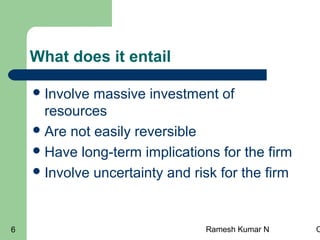
What does it entail
Involve massive investment of
resources
Are not easily reversible
Have long-term implications for the firm
Involve uncertainty and risk for the firm
Ramesh Kumar N C7
Is this a critical decision
 Due to the above factors, capital budgeting decisions become
critical and must be evaluated very carefully.
 Any firm that does not follow the capital budgeting process will
not be maximizing shareholder wealth and
 Management will not be acting in the best interests of
shareholders.
 Kingfisher Airlines – present situation
 Concorde Plane – had to face major problem due to bad capital
budgeting.
 Good international company today is CISCO.
Ramesh Kumar N C8
Techniques
 Payback Period Approach
 Discounted Payback Period Approach
 Net Present Value Approach
 Internal Rate of Return
 Profitability Index
Ramesh Kumar N C9
Which method to use and follow
 A technique that helps us in selecting
projects that are consistent with the principle
of shareholder wealth maximization.
 A technique is considered consistent with
wealth maximization if
– It is based on cash flows
– Considers all the cash flows
– Considers time value of money
– Is unbiased in selecting projects
Ramesh Kumar N C10
Pay back period
 The amount of time needed to recover the initial
investment
 The number of years it takes including a fraction of
the year to recover initial investment is called
payback period
 To compute payback period, keep adding the cash
flows till the sum equals initial investment
 Simplicity is the main benefit, but suffers from
drawbacks
 Technique is not consistent with wealth maximization
—Why?
Ramesh Kumar N C11
Discounted pay back
 Similar to payback period approach with one
difference that it considers time value of money
 The amount of time needed to recover initial
investment given the present value of cash inflows
 Keep adding the discounted cash flows till the sum
equals initial investment
 All other drawbacks of the payback period remains in
this approach
 Not consistent with wealth maximization
Ramesh Kumar N C12
Net present value
 Based on the dollar amount of cash flows
 The dollar amount of value added by a
project
 NPV equals the present value of cash inflows
minus initial investment
 Technique is consistent with the principle of
wealth maximization—Why?
 Accept a project if NPV ≥ 0
Ramesh Kumar N C13
IRR
 The rate at which the net present value of
cash flows of a project is zero, I.e., the rate at
which the present value of cash inflows
equals initial investment
 Project’s promised rate of return given initial
investment and cash flows
 Consistent with wealth maximization
 Accept a project if IRR ≥ Cost of Capital
Ramesh Kumar N C14
NPV versus IRR
 Usually, NPV and IRR are consistent with each
other. If IRR says accept the project, NPV will also
say accept the project
 IRR can be in conflict with NPV if
– Investing or Financing Decisions
– Projects are mutually exclusive
 Projects differ in scale of investment
 Cash flow patterns of projects is different
– If cash flows alternate in sign—problem of multiple IRR
 If IRR and NPV conflict, use NPV approach
Ramesh Kumar N C15
Profitability index [PI]
 A part of discounted cash flow family
 PI = PV of Cash Inflows/initial investment
 Accept a project if PI ≥ 1.0, which means positive
NPV
 Usually, PI consistent with NPV
 PI may be in conflict with NPV if
– Projects are mutually exclusive
 Scale of projects differ
 Pattern of cash flows of projects is different
 When in conflict with NPV, use NPV
Ramesh Kumar N C16
Project evaluation methods
 Replacement Chain Analysis
 Equivalent Annual Cost Method
 If two machines are unequal in life, we need
to make adjustment before computing NPV.
Ramesh Kumar N C17
Which technique is good
 Although our decision should be based on NPV, but
each technique contributes in its own way.
 Payback period is a rough measure of riskiness.
The longer the payback period, more risky the
project is.
 IRR is a measure of safety margin in a project.
Higher IRR means more safety margin in the
project’s estimated cash flows.
 PI is a measure of cost-benefit analysis. How much
NPV for every dollar of initial investment.
 xxxx

Capital budgeting analysis

  • 1.
    Ramesh Kumar NCapital Budget1 Capital Budgeting – an analysis Ramesh Kumar N
  • 2.
    Ramesh Kumar NC2 Presenter’s background RAMESH KUMAR NANJUNDAIYA – MS (Belgium), MBA (US)  Associate Partner & Head - Finance/Business set-up and Family Office of M/s. Insta Solu Venture Consultants, LLP, Bangalore, India  Certified as “Independent Corporate Director”, by World Council For Corporate Governance, London, UK [License # WCFCG/IID/DCD/2011/1711] – 2011  Visiting Guest Faculty in “International Marketing”and “Corporate Finance” course for final year MBA students at a known institutions in Bangalore, India. Professional overview  An accomplished professional with over 32 years’ of experience in banking and the financial sector with established credentials in Corporate Banking and Marketing, Financial Management, Venture & PE Capital sourcing, setting up JVs and with forte in Start ups to promote new commercial banks, ventures, undertaking IPO groundwork & Listing for SMEs.  Senior banker with working experience gained in known international banks as BNP, SCB, Citibank, EBIL, Barclays Bank, Banque Saudi Fransi in such diverse countries as the Middle East (GCC) region, West Europe and India.  Trainer in Corporate Banking and Credit, International Trade and Marketing and Business Consultation.
  • 3.
    Ramesh Kumar NC3 Definition  Budget – It is a description of a financial plan. It is a list of estimates of revenues to and expenditures by an agent for a stated period of time. Normally a budget describes a period in the future not the past.  Capital Budgeting - Capital budgeting (also known as investment appraisal) is the process by which a company determines whether projects (such as investing in R&D, opening a new branch, replacing a machine) are worth pursuing. A project is worth pursuing if it increases the value of the company. A project typically adds value to the company if it earns a rate of return that exceeds the cost of capital.
  • 4.
    Ramesh Kumar NC4 Meaning and Risk issues  Capital budgeting addresses the issue of strategic long-term investment decisions.  Capital budgeting can be defined as the process of analyzing, evaluating and deciding whether resources should be allocated to a project or not.  Process of capital budgeting ensure optimal allocation of resources and helps management work towards the goal of shareholder wealth maximization.
  • 5.
    Ramesh Kumar NC5 Why is it so significant for a company  Considered to be the most important decision that a corporate treasurer has to make for the company and for the benefit of its shareholders/stakeholders.  So much is the significance of capital budgeting that many business schools offer a separate course on capital budgeting
  • 6.
    Ramesh Kumar NC6 What does it entail Involve massive investment of resources Are not easily reversible Have long-term implications for the firm Involve uncertainty and risk for the firm
  • 7.
    Ramesh Kumar NC7 Is this a critical decision  Due to the above factors, capital budgeting decisions become critical and must be evaluated very carefully.  Any firm that does not follow the capital budgeting process will not be maximizing shareholder wealth and  Management will not be acting in the best interests of shareholders.  Kingfisher Airlines – present situation  Concorde Plane – had to face major problem due to bad capital budgeting.  Good international company today is CISCO.
  • 8.
    Ramesh Kumar NC8 Techniques  Payback Period Approach  Discounted Payback Period Approach  Net Present Value Approach  Internal Rate of Return  Profitability Index
  • 9.
    Ramesh Kumar NC9 Which method to use and follow  A technique that helps us in selecting projects that are consistent with the principle of shareholder wealth maximization.  A technique is considered consistent with wealth maximization if – It is based on cash flows – Considers all the cash flows – Considers time value of money – Is unbiased in selecting projects
  • 10.
    Ramesh Kumar NC10 Pay back period  The amount of time needed to recover the initial investment  The number of years it takes including a fraction of the year to recover initial investment is called payback period  To compute payback period, keep adding the cash flows till the sum equals initial investment  Simplicity is the main benefit, but suffers from drawbacks  Technique is not consistent with wealth maximization —Why?
  • 11.
    Ramesh Kumar NC11 Discounted pay back  Similar to payback period approach with one difference that it considers time value of money  The amount of time needed to recover initial investment given the present value of cash inflows  Keep adding the discounted cash flows till the sum equals initial investment  All other drawbacks of the payback period remains in this approach  Not consistent with wealth maximization
  • 12.
    Ramesh Kumar NC12 Net present value  Based on the dollar amount of cash flows  The dollar amount of value added by a project  NPV equals the present value of cash inflows minus initial investment  Technique is consistent with the principle of wealth maximization—Why?  Accept a project if NPV ≥ 0
  • 13.
    Ramesh Kumar NC13 IRR  The rate at which the net present value of cash flows of a project is zero, I.e., the rate at which the present value of cash inflows equals initial investment  Project’s promised rate of return given initial investment and cash flows  Consistent with wealth maximization  Accept a project if IRR ≥ Cost of Capital
  • 14.
    Ramesh Kumar NC14 NPV versus IRR  Usually, NPV and IRR are consistent with each other. If IRR says accept the project, NPV will also say accept the project  IRR can be in conflict with NPV if – Investing or Financing Decisions – Projects are mutually exclusive  Projects differ in scale of investment  Cash flow patterns of projects is different – If cash flows alternate in sign—problem of multiple IRR  If IRR and NPV conflict, use NPV approach
  • 15.
    Ramesh Kumar NC15 Profitability index [PI]  A part of discounted cash flow family  PI = PV of Cash Inflows/initial investment  Accept a project if PI ≥ 1.0, which means positive NPV  Usually, PI consistent with NPV  PI may be in conflict with NPV if – Projects are mutually exclusive  Scale of projects differ  Pattern of cash flows of projects is different  When in conflict with NPV, use NPV
  • 16.
    Ramesh Kumar NC16 Project evaluation methods  Replacement Chain Analysis  Equivalent Annual Cost Method  If two machines are unequal in life, we need to make adjustment before computing NPV.
  • 17.
    Ramesh Kumar NC17 Which technique is good  Although our decision should be based on NPV, but each technique contributes in its own way.  Payback period is a rough measure of riskiness. The longer the payback period, more risky the project is.  IRR is a measure of safety margin in a project. Higher IRR means more safety margin in the project’s estimated cash flows.  PI is a measure of cost-benefit analysis. How much NPV for every dollar of initial investment.  xxxx