R E S P I R ATO RY FA I L U R E
P R E S E N T E D B Y
N U R U L H I D A Y U B I N T I I B R A H I M
N I K N O R L I Y A N A
A U D I A D I B A H R A H M A N
TERM
RESPIRATORY DISTRESS
Abnormal (increased or decreased) respiratory rate or effort.
 It encompasses a spectrum of signs from tachypnea with retractions to agonal
gasps.
 Respiratory distress includes increased work of breathing, inadequate
respiratory effort (e.g. hypoventilation or bradypnea), and irregular breathing.
 Respiratory distress leads to respiratory failure.
TERM
That is, there is inadequate blood oxygenation, ventilation, or both to meet the metabolic
demands of body tissues. The job of the lungs is to ventilate and oxygenate. When it
doesn’t do any of that, it is failing.
RESPIRATORY FAILURE
Respiratory failure is a clinical state of inadequate oxygenation, ventilation, or
both.
RESPIRATORY ARREST
Absence of breathing. The patient isn’t breathing.
INTRODUCTION
W H AT I S R E S P I R ATO RY FA I LU R E ?
 Respiratory failure is a syndrome in which the respiratory system fails in one
or both of its gas exchange functions: oxygenation and carbon dioxide
elimination.
 In practice, it may be classified as either type I respiratory failure (hypoxemic)
or type II respiratory failure (hypercapnic), and also acute and chronic
respiratory failure.
 Morbidity and mortality rates increase with age and presence of
comorbidities.
INTRODUCTION
W H AT I S R E S P I R ATO RY FA I LU R E ?
It is also due to dysfunction of one or more essential components of the respiratory
apparatus which commonly associated with type II respiratory failure :
 CNS or Brain stem
 Spinal cord
 Nerves
 Neuromuscular Junction
 Muscle of respiration
 Chest wall movement
RISK FACTORS
 Age
 Pulmonary infection
 Cigarette smoking
 Chronic lung disease
 Upper or lower airway obstruction
 Congenital Heart Problem (Right – Left Shunt)
 History of stroke
 Opiate and sedative medications (Benzodiazepine)
 Muscle system abnormalities
 CNS disorders (Gullain Barre Syndrome, Myasthenia Gravis)
 Traumatic spinal injury
 Pneumothorax
 Hypercoagulable states (Pulmonary Embolism)
CLASSIFICATION
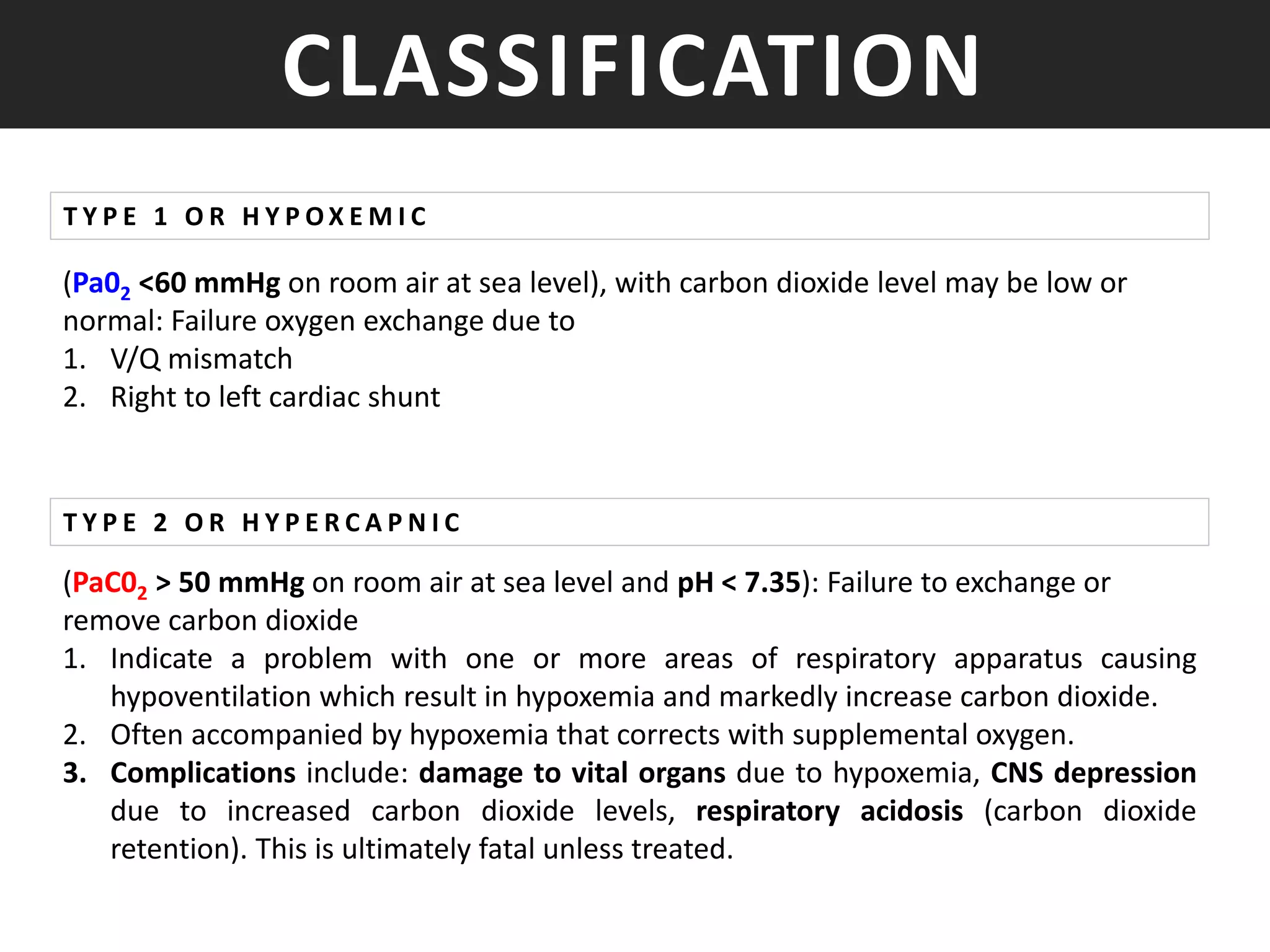
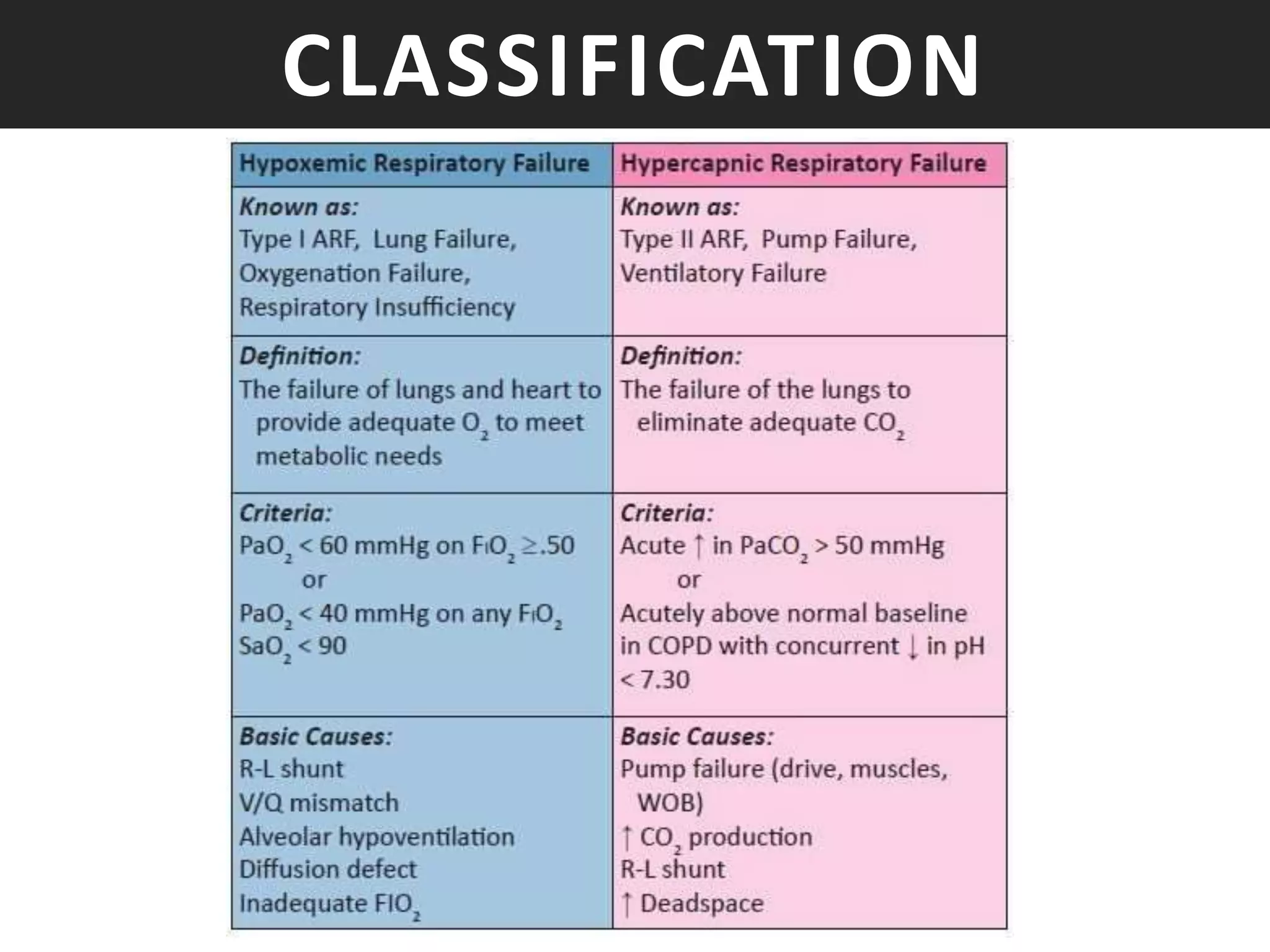
T Y P E 1 O R H Y P OX E M I C
(Pa02 <60 mmHg on room air at sea level), with carbon dioxide level may be low or
normal: Failure oxygen exchange due to
1. V/Q mismatch
2. Right to left cardiac shunt
T Y P E 2 O R H Y P E R C A P N I C
(PaC02 > 50 mmHg on room air at sea level and pH < 7.35): Failure to exchange or
remove carbon dioxide
1. Indicate a problem with one or more areas of respiratory apparatus causing
hypoventilation which result in hypoxemia and markedly increase carbon dioxide.
2. Often accompanied by hypoxemia that corrects with supplemental oxygen.
3. Complications include: damage to vital organs due to hypoxemia, CNS depression
due to increased carbon dioxide levels, respiratory acidosis (carbon dioxide
retention). This is ultimately fatal unless treated.
CLASSIFICATION
CLASSIFICATION
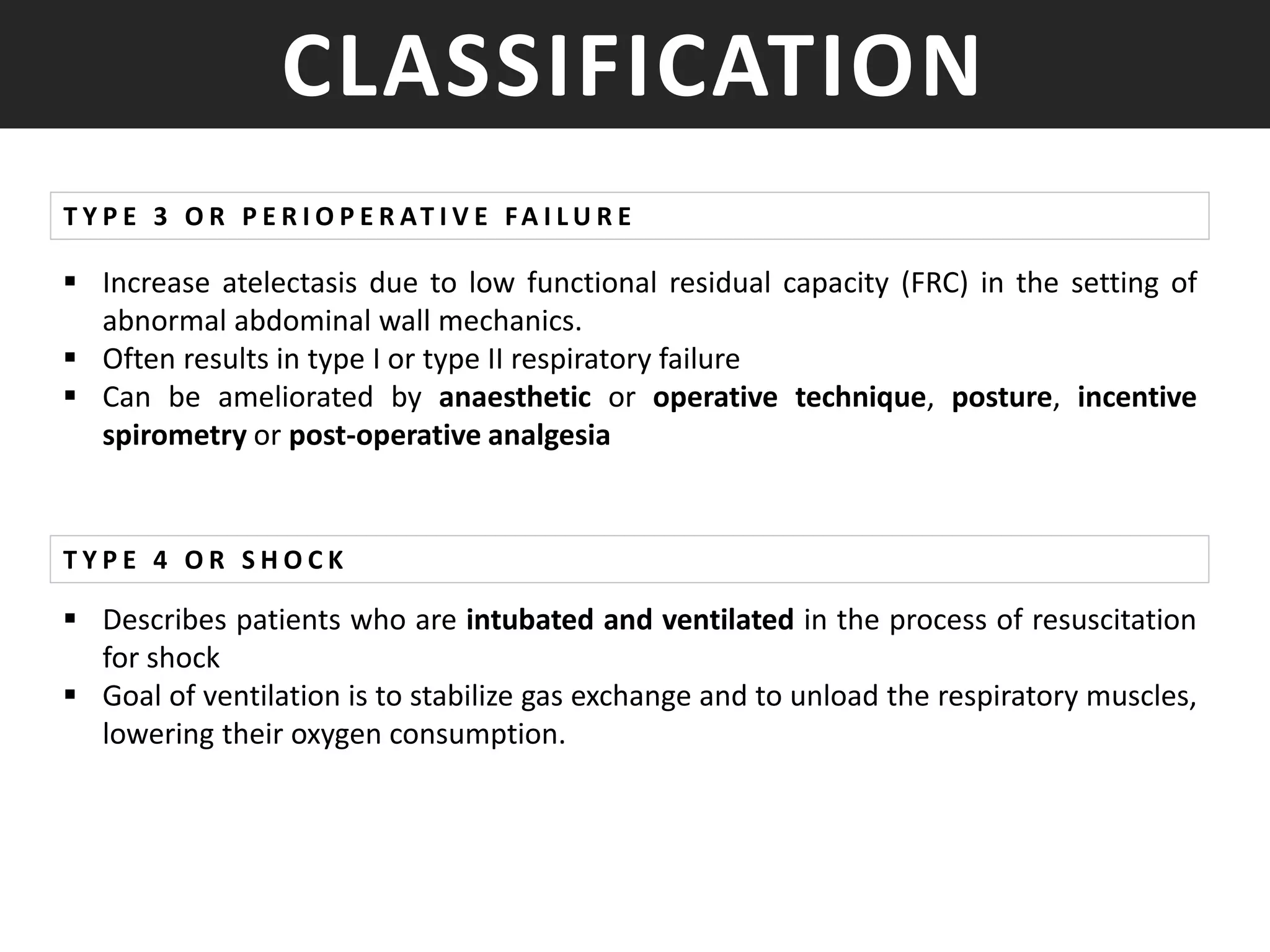
T Y P E 3 O R P E R I O P E R AT I V E FA I L U R E
 Increase atelectasis due to low functional residual capacity (FRC) in the setting of
abnormal abdominal wall mechanics.
 Often results in type I or type II respiratory failure
 Can be ameliorated by anaesthetic or operative technique, posture, incentive
spirometry or post-operative analgesia
T Y P E 4 O R S H O C K
 Describes patients who are intubated and ventilated in the process of resuscitation
for shock
 Goal of ventilation is to stabilize gas exchange and to unload the respiratory muscles,
lowering their oxygen consumption.
CLASSIFICATION
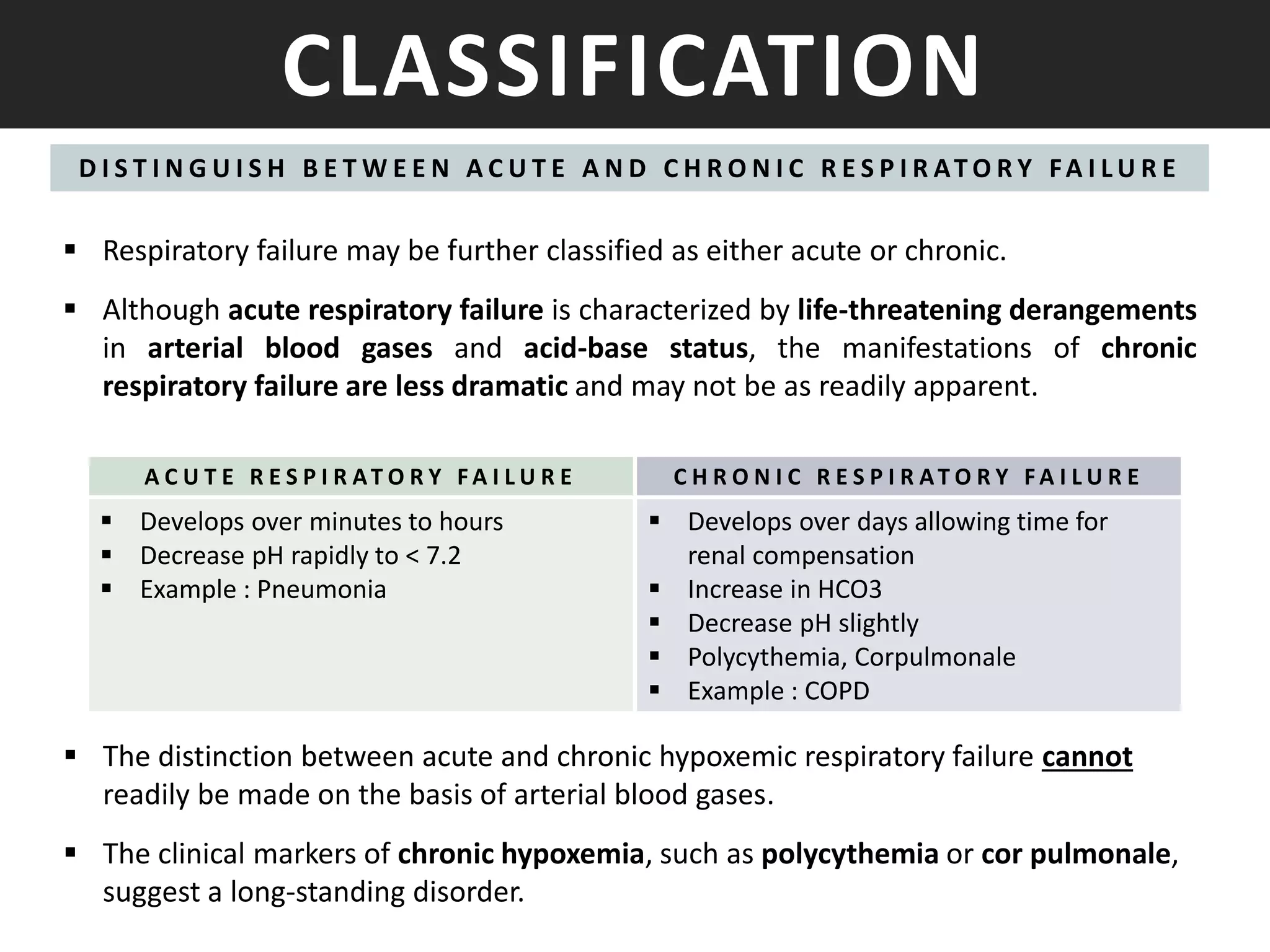
D I S T I N G U I S H B E T W E E N A C U T E A N D C H R O N I C R E S P I R AT O R Y FA I L U R E
 Respiratory failure may be further classified as either acute or chronic.
 Although acute respiratory failure is characterized by life-threatening derangements
in arterial blood gases and acid-base status, the manifestations of chronic
respiratory failure are less dramatic and may not be as readily apparent.
A C U T E R E S P I R AT O R Y F A I L U R E C H R O N I C R E S P I R AT O R Y F A I L U R E
 Develops over minutes to hours
 Decrease pH rapidly to < 7.2
 Example : Pneumonia
 Develops over days allowing time for
renal compensation
 Increase in HCO3
 Decrease pH slightly
 Polycythemia, Corpulmonale
 Example : COPD
 The distinction between acute and chronic hypoxemic respiratory failure cannot
readily be made on the basis of arterial blood gases.
 The clinical markers of chronic hypoxemia, such as polycythemia or cor pulmonale,
suggest a long-standing disorder.
PHYSIOLOGY
C E R E B R A L C O R T E X
P O N S
M E D U L L A O B L O N G A T A
S P I N A L C O R D
A P N E U S T I S
C E N T R E
( r e s p i r a t o r y
c e n t r e )
P N E U M O T A
X I C C E N T R E
( r e s p i r a t o r
y c e n t r e )
C H E M O R E C E P T O
R S
A o r t i c &
c a r o t i d b o d i e s
( P e r i p h e r a l )
C H E M O R E C E P T O
R S
M e d u l l a
o b l o n g a t a
( c e n t r a l )
M o t o r n e u r o n s t o
r e s p i r a t o r y m u s c l e s
C O N T R O L O F V E N T I L AT I O N B Y C N S
PHYSIOLOGY
C O N T R O L O F V E N T I L AT I O N B Y C N S
PHYSIOLOGY
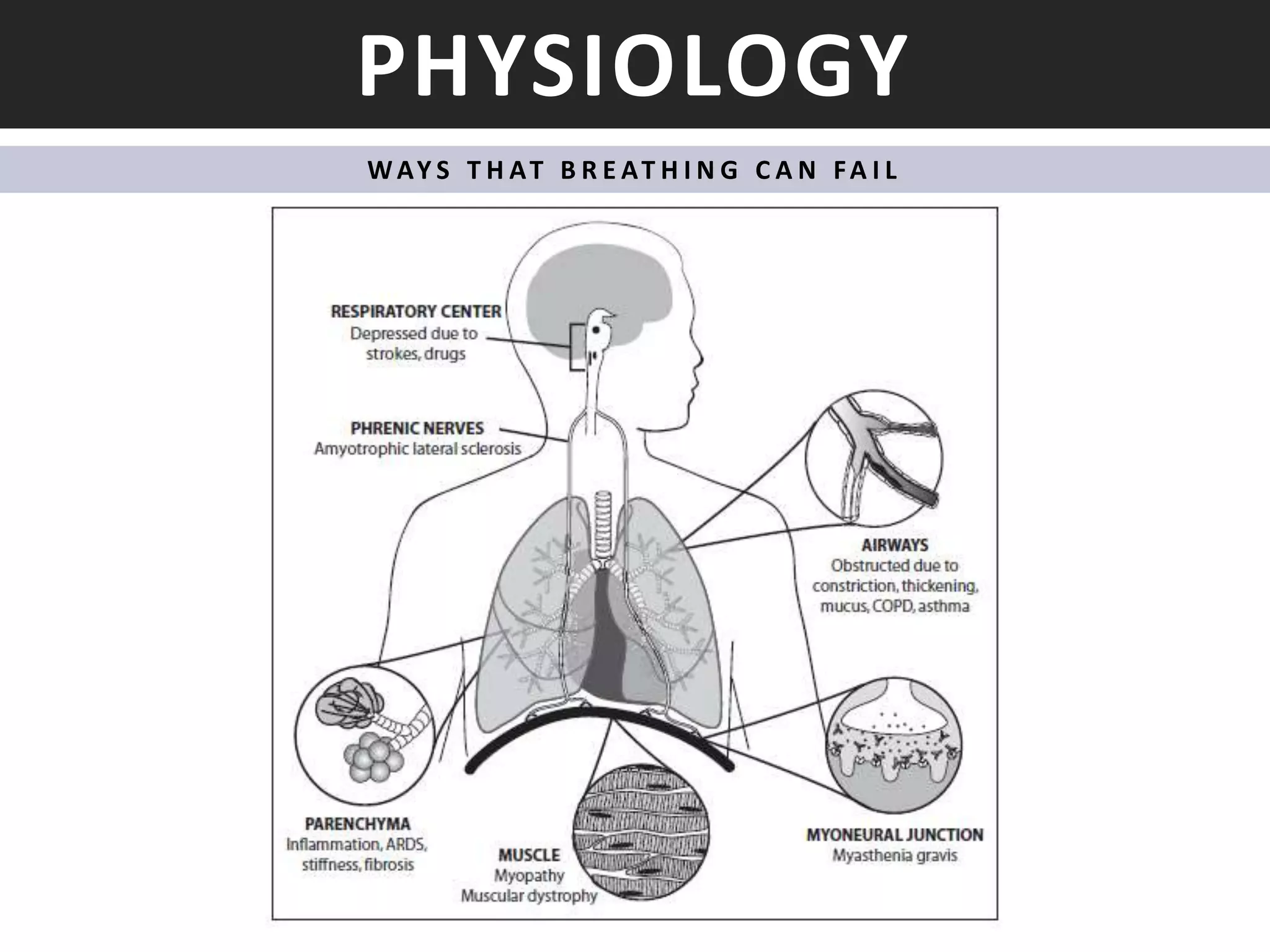
WAY S T H AT B R E AT H I N G C A N FA I L
PHYSIOLOGY
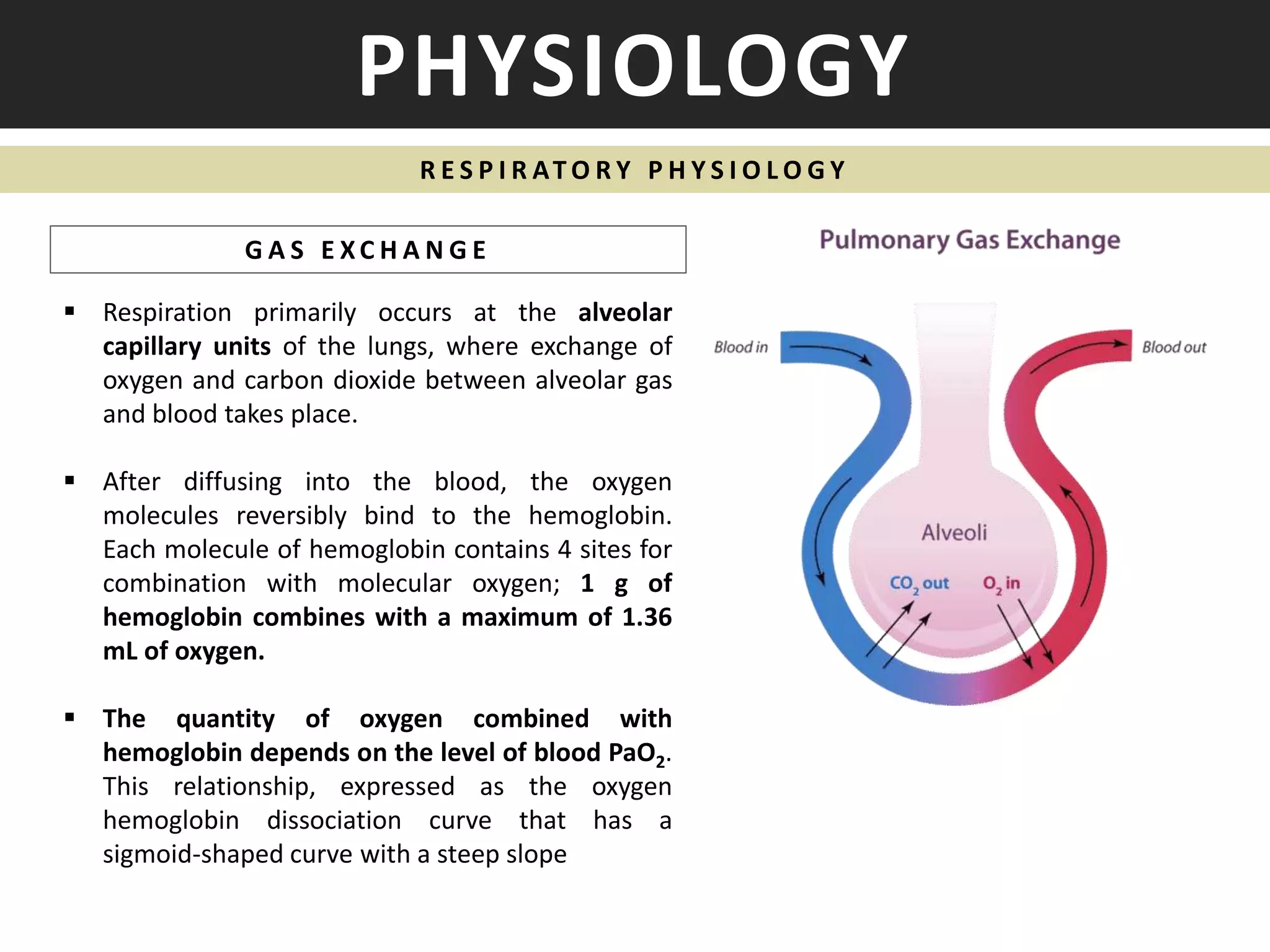
 Respiration primarily occurs at the alveolar
capillary units of the lungs, where exchange of
oxygen and carbon dioxide between alveolar gas
and blood takes place.
 After diffusing into the blood, the oxygen
molecules reversibly bind to the hemoglobin.
Each molecule of hemoglobin contains 4 sites for
combination with molecular oxygen; 1 g of
hemoglobin combines with a maximum of 1.36
mL of oxygen.
 The quantity of oxygen combined with
hemoglobin depends on the level of blood PaO2.
This relationship, expressed as the oxygen
hemoglobin dissociation curve that has a
sigmoid-shaped curve with a steep slope
G A S E XC H A N G E
R E S P I R AT O R Y P H Y S I O L O G Y
PHYSIOLOGY
The carbon dioxide is transported in 3 main forms:
1. In simple solution
2. As bicarbonate
3. Combined with protein of hemoglobin as a carbamino compound.
 During ideal gas exchange, blood flow and ventilation would perfectly match each other,
resulting in no alveolar-arterial oxygen tension (PO2) gradient.
 However, even in normal lungs, not all alveoli are ventilated and perfused perfectly.
 For a given perfusion, some alveoli are underventilated, while others are overventilated.
Similarly, for known alveolar ventilation, some units are underperfused, while others are
overperfused.
The optimally ventilated alveoli that are not perfused well have a large ventilation-to-
perfusion ratio (V/Q) and are called high-V/Q units (which act like dead space).
Alveoli that are optimally perfused but not adequately ventilated are called low-V/Q
units (which act like a shunt).
R E S P I R AT O R Y P H Y S I O L O G Y
PHYSIOLOGY
R E S P I R AT O R Y P H Y S I O L O G Y
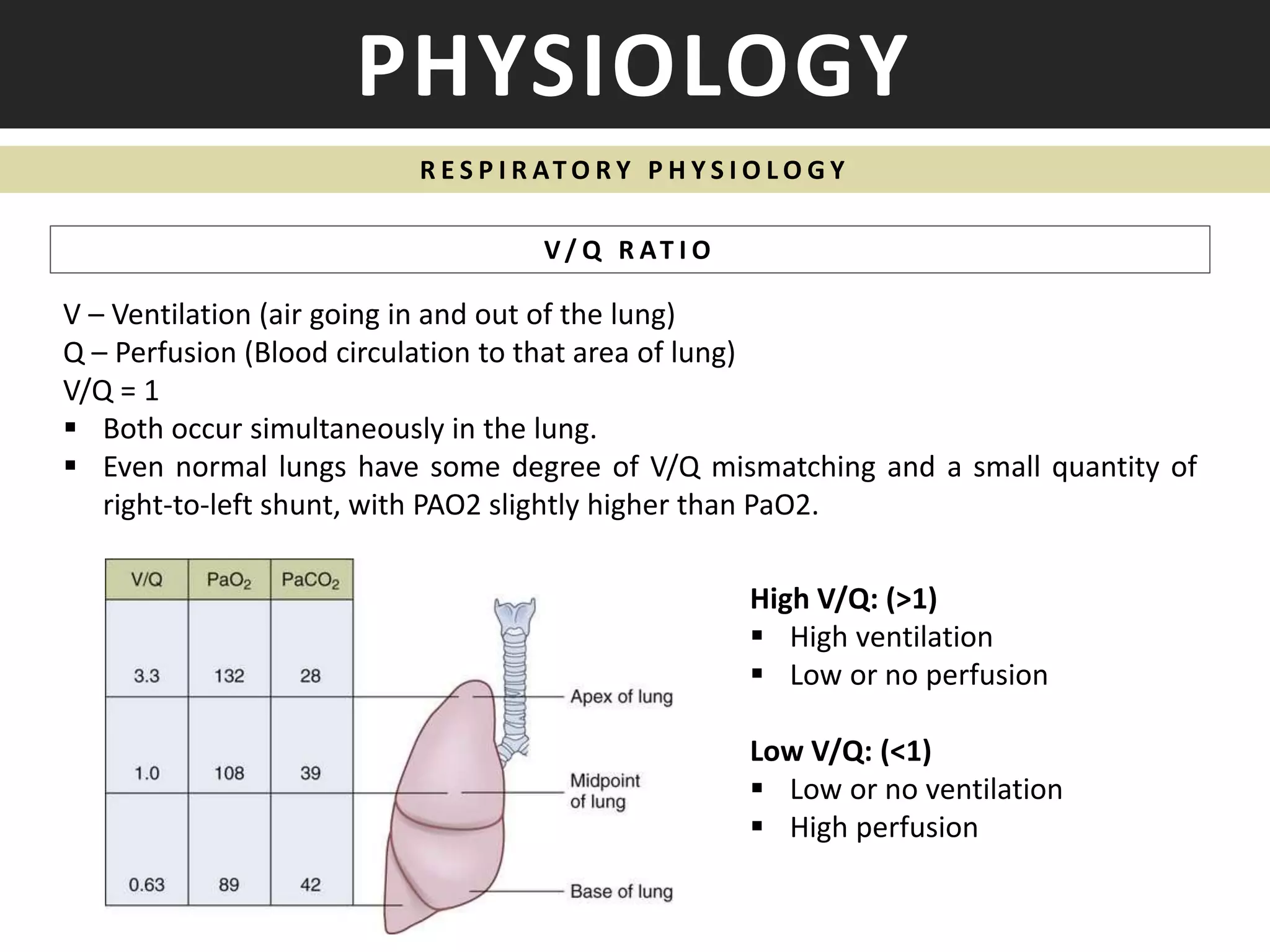
V – Ventilation (air going in and out of the lung)
Q – Perfusion (Blood circulation to that area of lung)
V/Q = 1
 Both occur simultaneously in the lung.
 Even normal lungs have some degree of V/Q mismatching and a small quantity of
right-to-left shunt, with PAO2 slightly higher than PaO2.
V/ Q R AT I O
High V/Q: (>1)
 High ventilation
 Low or no perfusion
Low V/Q: (<1)
 Low or no ventilation
 High perfusion
PHYSIOLOGY
R E S P I R AT O R Y P H Y S I O L O G Y
However, an increase in the alveolar-arterial PO2 gradient above 15-20 mm Hg indicates
pulmonary disease as the cause of hypoxemia.
V/Q mismatch is basically certain lung unit has high V/Q ratio and certain lung unit has
low V/Q ratio which will lead to hypoxemia.
V/ Q R AT I O
PATHOPHYSIOLOGY
T Y P E 1 R E S P I R AT O R Y F A I L U R E
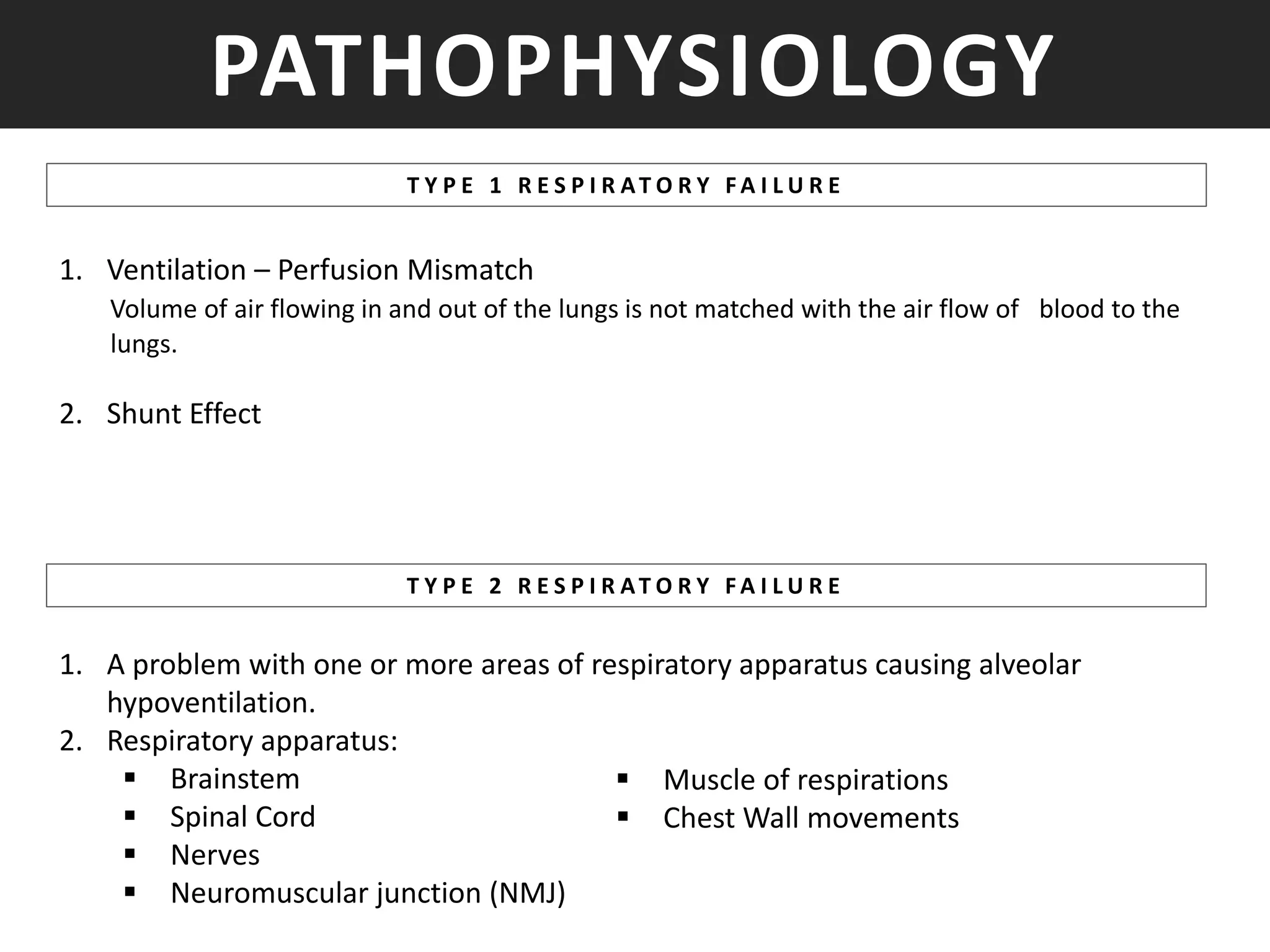
1. Ventilation – Perfusion Mismatch
Volume of air flowing in and out of the lungs is not matched with the air flow of blood to the
lungs.
2. Shunt Effect
T Y P E 2 R E S P I R AT O R Y F A I L U R E
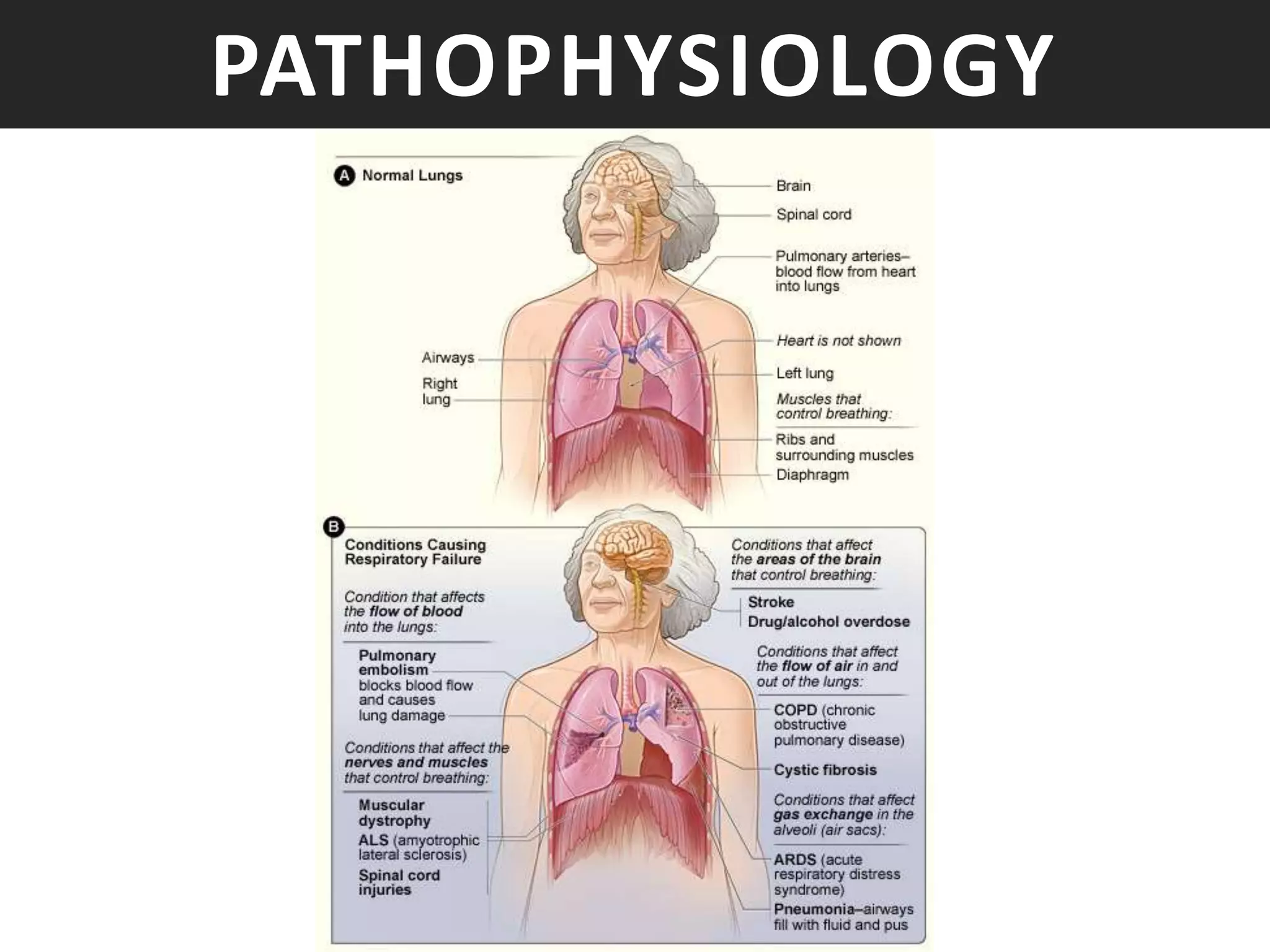
1. A problem with one or more areas of respiratory apparatus causing alveolar
hypoventilation.
2. Respiratory apparatus:
 Brainstem
 Spinal Cord
 Nerves
 Neuromuscular junction (NMJ)
 Muscle of respirations
 Chest Wall movements
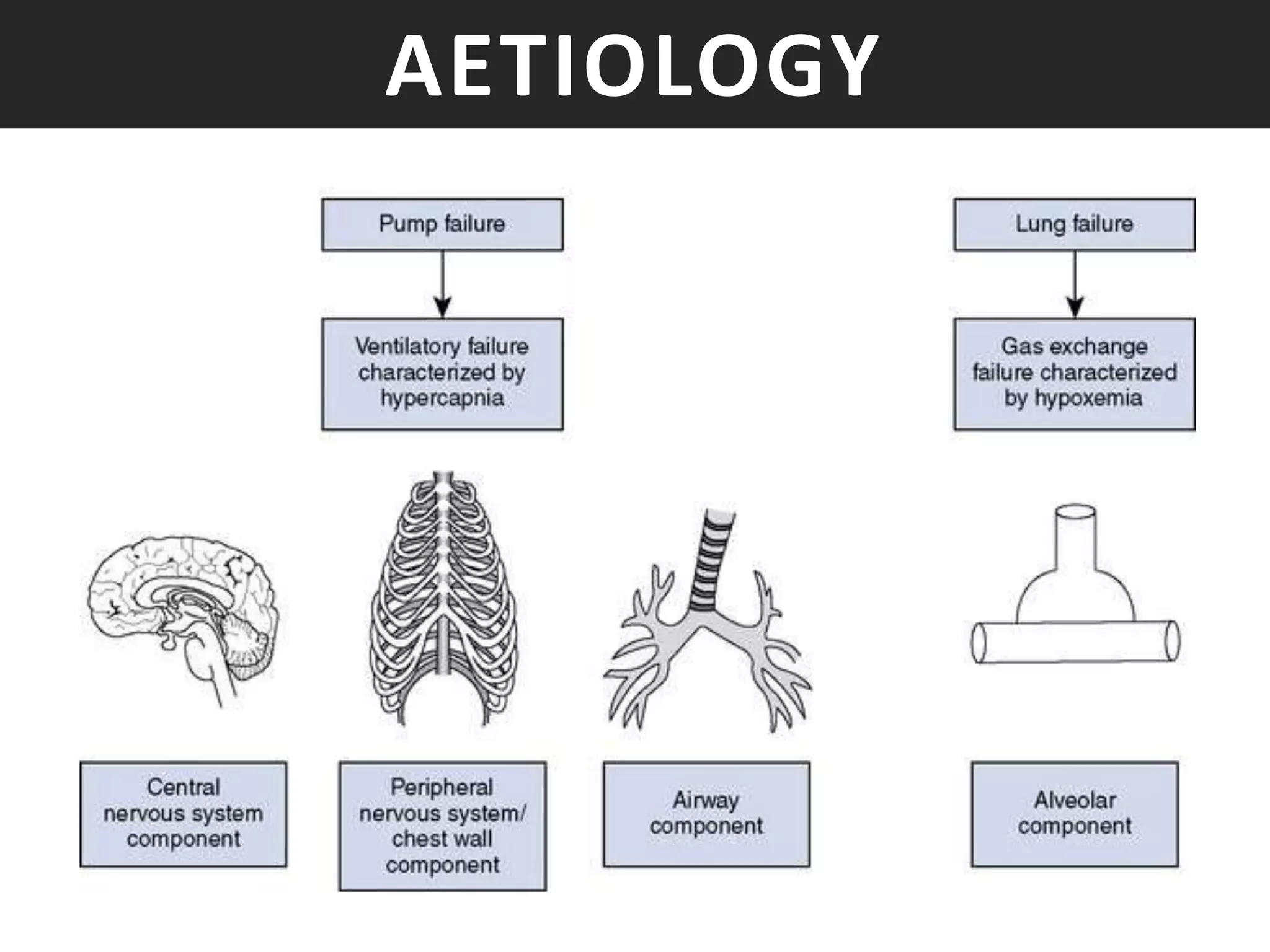
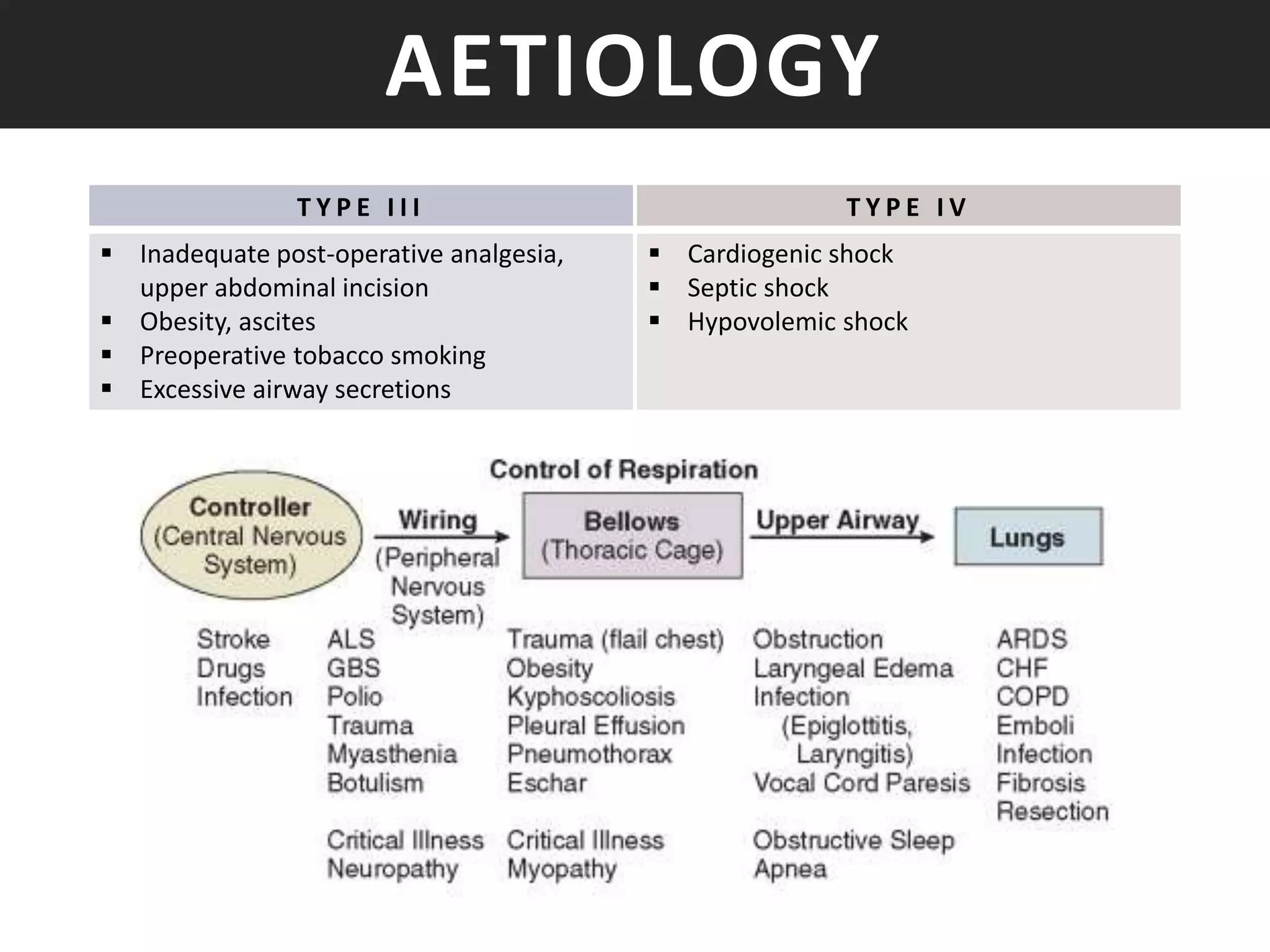
AETIOLOGY
PATHOPHYSIOLOGY
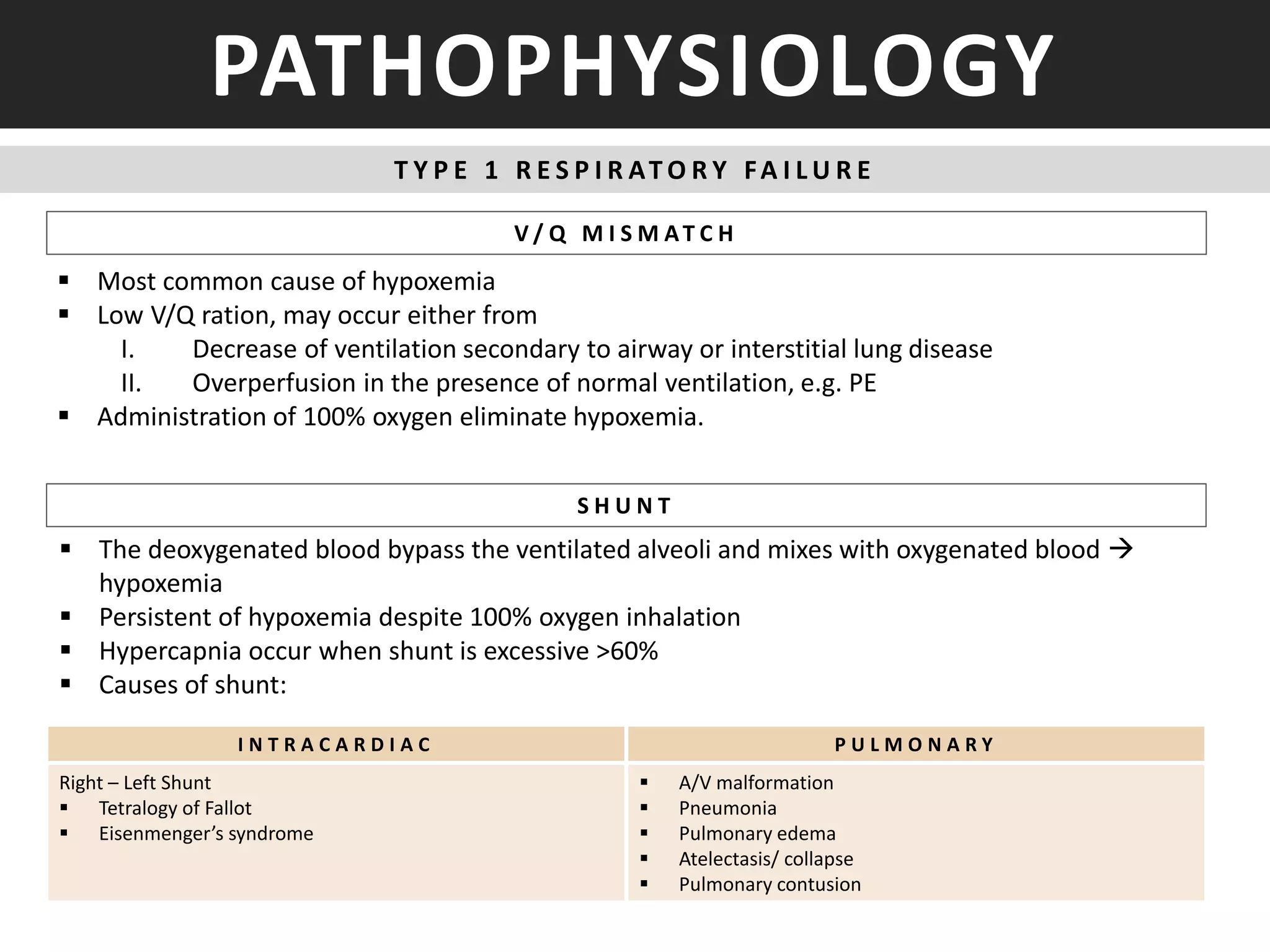
 The deoxygenated blood bypass the ventilated alveoli and mixes with oxygenated blood 
hypoxemia
 Persistent of hypoxemia despite 100% oxygen inhalation
 Hypercapnia occur when shunt is excessive >60%
 Causes of shunt:
T Y P E 1 R E S P I R AT O R Y FA I L U R E
V / Q M I S M AT C H
 Most common cause of hypoxemia
 Low V/Q ration, may occur either from
I. Decrease of ventilation secondary to airway or interstitial lung disease
II. Overperfusion in the presence of normal ventilation, e.g. PE
 Administration of 100% oxygen eliminate hypoxemia.
S H U N T
I N T R A C A R D I A C P U L M O N A R Y
Right – Left Shunt
 Tetralogy of Fallot
 Eisenmenger’s syndrome
 A/V malformation
 Pneumonia
 Pulmonary edema
 Atelectasis/ collapse
 Pulmonary contusion
PATHOPHYSIOLOGY
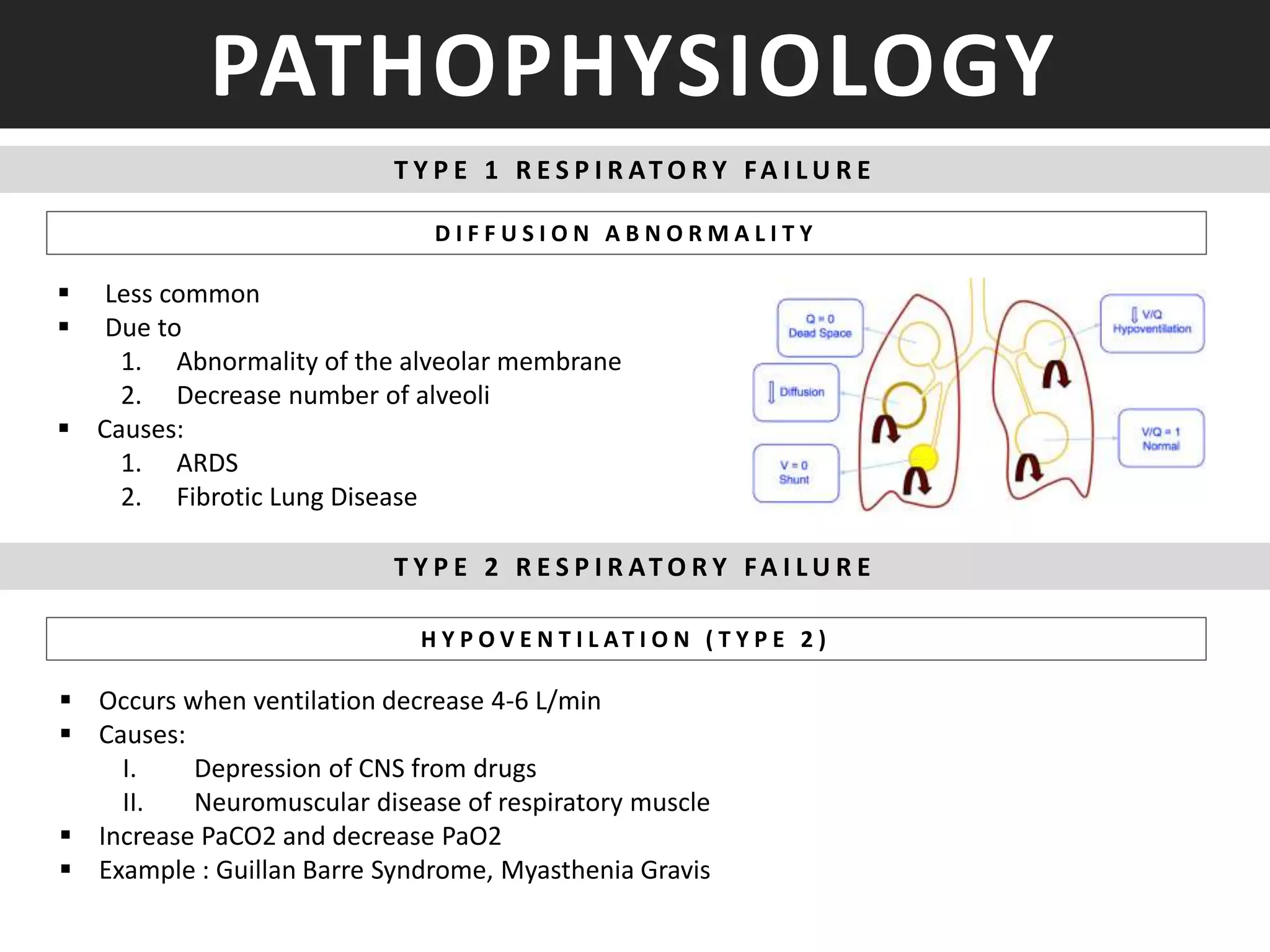
 Occurs when ventilation decrease 4-6 L/min
 Causes:
I. Depression of CNS from drugs
II. Neuromuscular disease of respiratory muscle
 Increase PaCO2 and decrease PaO2
 Example : Guillan Barre Syndrome, Myasthenia Gravis
T Y P E 1 R E S P I R AT O R Y FA I L U R E
D I F F U S I O N A B N O R M A L I T Y
 Less common
 Due to
1. Abnormality of the alveolar membrane
2. Decrease number of alveoli
 Causes:
1. ARDS
2. Fibrotic Lung Disease
H Y P O V E N T I L AT I O N ( T Y P E 2 )
T Y P E 2 R E S P I R AT O R Y FA I L U R E
PATHOPHYSIOLOGY
PATHOPHYSIOLOGY
AETIOLOGY
T Y P E I T Y P E I I
Alveolar unit Failure
 Collapse
 Flooding: edema, pus, aspiration
 Fibrosis
Nervous System Failure
 Central hypoventilation
 Neuropathies
Pulmonary Vasculature Failure
 Pulmonary embolism
 Pulmonary Hypertension
Muscle (pump) failure
 Muscular dystrophies
 Myopathies
Pneumonia
Atelectasis
Asthma
ARDS
Pneumothorax
Neuromuscular transmission failure
 Myasthenia Gravis
Airway failure
 Obstruction
 Dysfunction
Chest wall & pleural space failure
 Kyphoscoliosis
 Morbid obesity – Obesity Hypoventilation
Syndrome
AETIOLOGY
T Y P E I I I T Y P E I V
 Inadequate post-operative analgesia,
upper abdominal incision
 Obesity, ascites
 Preoperative tobacco smoking
 Excessive airway secretions
 Cardiogenic shock
 Septic shock
 Hypovolemic shock
REFERENCES
1. Respiratory failure. (n.d.) Retrieved from https://www.thoracic.org/patients/patient-
resources/breathing-in-america/resources/chapter-20-respiratory-failure.pdf
2. Acute respiratory failure. (n.d.). Retrieved from https://bestpractice.bmj.com/topics/en-
us/853
3. Respiratory Failure Guidelines. (2018, September 15). Retrieved from
https://emedicine.medscape.com/article/167981-guidelines
4. Respiratory Failure Guidelines. (2018, September 15). Retrieved from
https://emedicine.medscape.com/article/167981-guidelines
5. Respiratory Failure Mechanical Ventilations. (n.d.) Retrieved from
https://www.thoracic.org/professionals/clinical-resources/critical-care/clinical-
education/mechanical-ventilation/respiratory-failure-mechanical-ventilation.pdf
6. Carson SS, Cox CE, Holmes GM, Howard A, Carey TS. The changing epidemiology of
mechanical ventilation: a population-based study. J Intensive Care Med 2006;21:173–
182.
7. Nava S, Hill N. Non-invasive ventilation for acute respiratory failure. Lancet 2009;
374:250–259.

Management of Respiratory Failure

  • 1.
    R E SP I R ATO RY FA I L U R E P R E S E N T E D B Y N U R U L H I D A Y U B I N T I I B R A H I M N I K N O R L I Y A N A A U D I A D I B A H R A H M A N
  • 2.
    TERM RESPIRATORY DISTRESS Abnormal (increasedor decreased) respiratory rate or effort.  It encompasses a spectrum of signs from tachypnea with retractions to agonal gasps.  Respiratory distress includes increased work of breathing, inadequate respiratory effort (e.g. hypoventilation or bradypnea), and irregular breathing.  Respiratory distress leads to respiratory failure.
  • 3.
    TERM That is, thereis inadequate blood oxygenation, ventilation, or both to meet the metabolic demands of body tissues. The job of the lungs is to ventilate and oxygenate. When it doesn’t do any of that, it is failing. RESPIRATORY FAILURE Respiratory failure is a clinical state of inadequate oxygenation, ventilation, or both. RESPIRATORY ARREST Absence of breathing. The patient isn’t breathing.
  • 4.
    INTRODUCTION W H ATI S R E S P I R ATO RY FA I LU R E ?  Respiratory failure is a syndrome in which the respiratory system fails in one or both of its gas exchange functions: oxygenation and carbon dioxide elimination.  In practice, it may be classified as either type I respiratory failure (hypoxemic) or type II respiratory failure (hypercapnic), and also acute and chronic respiratory failure.  Morbidity and mortality rates increase with age and presence of comorbidities.
  • 5.
    INTRODUCTION W H ATI S R E S P I R ATO RY FA I LU R E ? It is also due to dysfunction of one or more essential components of the respiratory apparatus which commonly associated with type II respiratory failure :  CNS or Brain stem  Spinal cord  Nerves  Neuromuscular Junction  Muscle of respiration  Chest wall movement
  • 6.
    RISK FACTORS  Age Pulmonary infection  Cigarette smoking  Chronic lung disease  Upper or lower airway obstruction  Congenital Heart Problem (Right – Left Shunt)  History of stroke  Opiate and sedative medications (Benzodiazepine)  Muscle system abnormalities  CNS disorders (Gullain Barre Syndrome, Myasthenia Gravis)  Traumatic spinal injury  Pneumothorax  Hypercoagulable states (Pulmonary Embolism)
  • 7.
    CLASSIFICATION T Y PE 1 O R H Y P OX E M I C (Pa02 <60 mmHg on room air at sea level), with carbon dioxide level may be low or normal: Failure oxygen exchange due to 1. V/Q mismatch 2. Right to left cardiac shunt T Y P E 2 O R H Y P E R C A P N I C (PaC02 > 50 mmHg on room air at sea level and pH < 7.35): Failure to exchange or remove carbon dioxide 1. Indicate a problem with one or more areas of respiratory apparatus causing hypoventilation which result in hypoxemia and markedly increase carbon dioxide. 2. Often accompanied by hypoxemia that corrects with supplemental oxygen. 3. Complications include: damage to vital organs due to hypoxemia, CNS depression due to increased carbon dioxide levels, respiratory acidosis (carbon dioxide retention). This is ultimately fatal unless treated.
  • 8.
  • 9.
    CLASSIFICATION T Y PE 3 O R P E R I O P E R AT I V E FA I L U R E  Increase atelectasis due to low functional residual capacity (FRC) in the setting of abnormal abdominal wall mechanics.  Often results in type I or type II respiratory failure  Can be ameliorated by anaesthetic or operative technique, posture, incentive spirometry or post-operative analgesia T Y P E 4 O R S H O C K  Describes patients who are intubated and ventilated in the process of resuscitation for shock  Goal of ventilation is to stabilize gas exchange and to unload the respiratory muscles, lowering their oxygen consumption.
  • 10.
    CLASSIFICATION D I ST I N G U I S H B E T W E E N A C U T E A N D C H R O N I C R E S P I R AT O R Y FA I L U R E  Respiratory failure may be further classified as either acute or chronic.  Although acute respiratory failure is characterized by life-threatening derangements in arterial blood gases and acid-base status, the manifestations of chronic respiratory failure are less dramatic and may not be as readily apparent. A C U T E R E S P I R AT O R Y F A I L U R E C H R O N I C R E S P I R AT O R Y F A I L U R E  Develops over minutes to hours  Decrease pH rapidly to < 7.2  Example : Pneumonia  Develops over days allowing time for renal compensation  Increase in HCO3  Decrease pH slightly  Polycythemia, Corpulmonale  Example : COPD  The distinction between acute and chronic hypoxemic respiratory failure cannot readily be made on the basis of arterial blood gases.  The clinical markers of chronic hypoxemia, such as polycythemia or cor pulmonale, suggest a long-standing disorder.
  • 11.
    PHYSIOLOGY C E RE B R A L C O R T E X P O N S M E D U L L A O B L O N G A T A S P I N A L C O R D A P N E U S T I S C E N T R E ( r e s p i r a t o r y c e n t r e ) P N E U M O T A X I C C E N T R E ( r e s p i r a t o r y c e n t r e ) C H E M O R E C E P T O R S A o r t i c & c a r o t i d b o d i e s ( P e r i p h e r a l ) C H E M O R E C E P T O R S M e d u l l a o b l o n g a t a ( c e n t r a l ) M o t o r n e u r o n s t o r e s p i r a t o r y m u s c l e s C O N T R O L O F V E N T I L AT I O N B Y C N S
  • 12.
    PHYSIOLOGY C O NT R O L O F V E N T I L AT I O N B Y C N S
  • 13.
    PHYSIOLOGY WAY S TH AT B R E AT H I N G C A N FA I L
  • 14.
    PHYSIOLOGY  Respiration primarilyoccurs at the alveolar capillary units of the lungs, where exchange of oxygen and carbon dioxide between alveolar gas and blood takes place.  After diffusing into the blood, the oxygen molecules reversibly bind to the hemoglobin. Each molecule of hemoglobin contains 4 sites for combination with molecular oxygen; 1 g of hemoglobin combines with a maximum of 1.36 mL of oxygen.  The quantity of oxygen combined with hemoglobin depends on the level of blood PaO2. This relationship, expressed as the oxygen hemoglobin dissociation curve that has a sigmoid-shaped curve with a steep slope G A S E XC H A N G E R E S P I R AT O R Y P H Y S I O L O G Y
  • 15.
    PHYSIOLOGY The carbon dioxideis transported in 3 main forms: 1. In simple solution 2. As bicarbonate 3. Combined with protein of hemoglobin as a carbamino compound.  During ideal gas exchange, blood flow and ventilation would perfectly match each other, resulting in no alveolar-arterial oxygen tension (PO2) gradient.  However, even in normal lungs, not all alveoli are ventilated and perfused perfectly.  For a given perfusion, some alveoli are underventilated, while others are overventilated. Similarly, for known alveolar ventilation, some units are underperfused, while others are overperfused. The optimally ventilated alveoli that are not perfused well have a large ventilation-to- perfusion ratio (V/Q) and are called high-V/Q units (which act like dead space). Alveoli that are optimally perfused but not adequately ventilated are called low-V/Q units (which act like a shunt). R E S P I R AT O R Y P H Y S I O L O G Y
  • 16.
    PHYSIOLOGY R E SP I R AT O R Y P H Y S I O L O G Y V – Ventilation (air going in and out of the lung) Q – Perfusion (Blood circulation to that area of lung) V/Q = 1  Both occur simultaneously in the lung.  Even normal lungs have some degree of V/Q mismatching and a small quantity of right-to-left shunt, with PAO2 slightly higher than PaO2. V/ Q R AT I O High V/Q: (>1)  High ventilation  Low or no perfusion Low V/Q: (<1)  Low or no ventilation  High perfusion
  • 17.
    PHYSIOLOGY R E SP I R AT O R Y P H Y S I O L O G Y However, an increase in the alveolar-arterial PO2 gradient above 15-20 mm Hg indicates pulmonary disease as the cause of hypoxemia. V/Q mismatch is basically certain lung unit has high V/Q ratio and certain lung unit has low V/Q ratio which will lead to hypoxemia. V/ Q R AT I O
  • 18.
    PATHOPHYSIOLOGY T Y PE 1 R E S P I R AT O R Y F A I L U R E 1. Ventilation – Perfusion Mismatch Volume of air flowing in and out of the lungs is not matched with the air flow of blood to the lungs. 2. Shunt Effect T Y P E 2 R E S P I R AT O R Y F A I L U R E 1. A problem with one or more areas of respiratory apparatus causing alveolar hypoventilation. 2. Respiratory apparatus:  Brainstem  Spinal Cord  Nerves  Neuromuscular junction (NMJ)  Muscle of respirations  Chest Wall movements
  • 19.
  • 20.
    PATHOPHYSIOLOGY  The deoxygenatedblood bypass the ventilated alveoli and mixes with oxygenated blood  hypoxemia  Persistent of hypoxemia despite 100% oxygen inhalation  Hypercapnia occur when shunt is excessive >60%  Causes of shunt: T Y P E 1 R E S P I R AT O R Y FA I L U R E V / Q M I S M AT C H  Most common cause of hypoxemia  Low V/Q ration, may occur either from I. Decrease of ventilation secondary to airway or interstitial lung disease II. Overperfusion in the presence of normal ventilation, e.g. PE  Administration of 100% oxygen eliminate hypoxemia. S H U N T I N T R A C A R D I A C P U L M O N A R Y Right – Left Shunt  Tetralogy of Fallot  Eisenmenger’s syndrome  A/V malformation  Pneumonia  Pulmonary edema  Atelectasis/ collapse  Pulmonary contusion
  • 21.
    PATHOPHYSIOLOGY  Occurs whenventilation decrease 4-6 L/min  Causes: I. Depression of CNS from drugs II. Neuromuscular disease of respiratory muscle  Increase PaCO2 and decrease PaO2  Example : Guillan Barre Syndrome, Myasthenia Gravis T Y P E 1 R E S P I R AT O R Y FA I L U R E D I F F U S I O N A B N O R M A L I T Y  Less common  Due to 1. Abnormality of the alveolar membrane 2. Decrease number of alveoli  Causes: 1. ARDS 2. Fibrotic Lung Disease H Y P O V E N T I L AT I O N ( T Y P E 2 ) T Y P E 2 R E S P I R AT O R Y FA I L U R E
  • 22.
  • 23.
  • 24.
    AETIOLOGY T Y PE I T Y P E I I Alveolar unit Failure  Collapse  Flooding: edema, pus, aspiration  Fibrosis Nervous System Failure  Central hypoventilation  Neuropathies Pulmonary Vasculature Failure  Pulmonary embolism  Pulmonary Hypertension Muscle (pump) failure  Muscular dystrophies  Myopathies Pneumonia Atelectasis Asthma ARDS Pneumothorax Neuromuscular transmission failure  Myasthenia Gravis Airway failure  Obstruction  Dysfunction Chest wall & pleural space failure  Kyphoscoliosis  Morbid obesity – Obesity Hypoventilation Syndrome
  • 25.
    AETIOLOGY T Y PE I I I T Y P E I V  Inadequate post-operative analgesia, upper abdominal incision  Obesity, ascites  Preoperative tobacco smoking  Excessive airway secretions  Cardiogenic shock  Septic shock  Hypovolemic shock
  • 26.
    REFERENCES 1. Respiratory failure.(n.d.) Retrieved from https://www.thoracic.org/patients/patient- resources/breathing-in-america/resources/chapter-20-respiratory-failure.pdf 2. Acute respiratory failure. (n.d.). Retrieved from https://bestpractice.bmj.com/topics/en- us/853 3. Respiratory Failure Guidelines. (2018, September 15). Retrieved from https://emedicine.medscape.com/article/167981-guidelines 4. Respiratory Failure Guidelines. (2018, September 15). Retrieved from https://emedicine.medscape.com/article/167981-guidelines 5. Respiratory Failure Mechanical Ventilations. (n.d.) Retrieved from https://www.thoracic.org/professionals/clinical-resources/critical-care/clinical- education/mechanical-ventilation/respiratory-failure-mechanical-ventilation.pdf 6. Carson SS, Cox CE, Holmes GM, Howard A, Carey TS. The changing epidemiology of mechanical ventilation: a population-based study. J Intensive Care Med 2006;21:173– 182. 7. Nava S, Hill N. Non-invasive ventilation for acute respiratory failure. Lancet 2009; 374:250–259.