Arterial Blood Gas Interpretation Sherry L. Knowles, RN, CCRN, CRNI Orlando Regional Medical Center 2004
Objectives Recognize Signs & Symptoms of Respiratory Failure Understand Ventilation and Perfusion Mechanics Analyze and Interpret Acid Base Disturbances  Identify Appropriate Treatments for Abnormal ABG’s
Objectives Recognize normal and abnormal values for pH, PaO 2 , PaCO 2 , SaO 2  and HCO 3 .  Relate the pH scale to acidosis and alkalosis.  Discuss the respiratory and metabolic mechanisms involved in controlling the body's acid-base balance.  Interpret basic arterial blood gas values and relate these values to patient conditions.  Anticipate appropriate therapies for acid-base correction.
Why Do ABG’s? 1) Check  oxygenation 2) Check the pH ( acid base balance ) 3) Define the problem 4) Determine the treatment
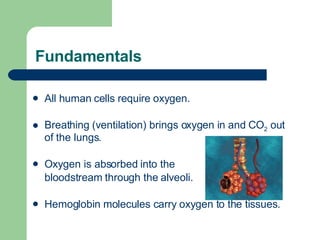
Fundamentals  All human cells require oxygen. Breathing (ventilation) brings oxygen in and CO 2  out of the lungs. Oxygen is absorbed into the  bloodstream through the alveoli. Hemoglobin molecules carry oxygen to the tissues.
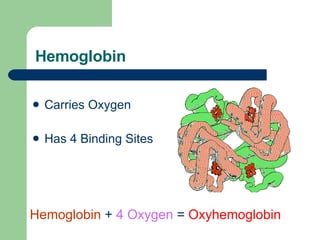
Hemoglobin Carries Oxygen Has 4 Binding Sites Hemoglobin  +   4 Oxygen  =  Oxyhemoglobin
Hemoglobin Binding Sites When all of 4 sites are occupied, the hemoglobin molecule cannot hold any more.  Molecules, other than oxygen, can attach to the oxygen binding sites.  If enough hemoglobin binding sites are occupied with molecules other than oxygen, severe tissue hypoxia can result.  Hypoxia can occur even in the presence of 100% oxygen. This can be a life-threatening condition.
Carboxyhemoglobin (HbCO) Carboxyhemoglobin (HbCO) is a hemoglobin molecule that has carbon monoxide attached where the oxygen should be.  Exposure to car exhaust, or other chemicals can cause carbon monoxide (CO) to attach to hemoglobin binding sites, instead of oxygen and thus compete with the oxygen for the limited number of binding sites. The blood will exhibit a cherry red color.
Methemoglobin (MetHb) Methemoglobin (MetHb) is produced when exposed to certain poisons or due to a genetic condition that affects the hemoglobin molecule.  The hemoglobin molecule is saturated with methemoglobin (MetHb) and competes with oxygen for the hemoglobin binding sites. Methemoglobin (MetHb) changes blood to a brownish color.
Oxygen and Hemoglobin CO 2 's affinity for hemoglobin is much less than  O 2 's affinity for hemoglobin.  When  CO 2  and  O 2  are   both available, hemoglobin will accept  oxygen  rather than  CO 2 .  In the oxygen rich environment of the alveoli, hemoglobin carries oxygen.  Oxygenated blood then travels through the body.
Acid Base Balance Understanding the  cause  of an acid-base imbalance is the key to treating it.  The Respiratory component of acid base balance affects the pH  within minutes .  The Metabolic component of acid base balance can  take days  to affect pH.
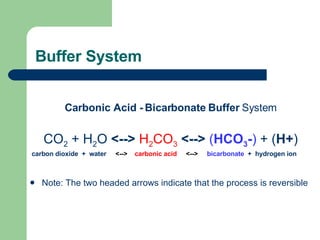
Buffer System Carbonic Acid -   Bicarbonate Buffer  System CO 2  + H 2 O  <-->   H 2 CO 3   <-->   ( HCO 3 - )  + ( H+ ) carbon dioxide  +  water  <-->   carbonic acid  <-->  bicarbonate  +  hydrogen ion Note: The two headed arrows indicate that the process is reversible
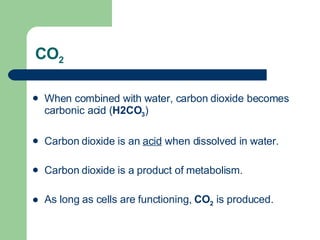
CO 2 When combined with water, carbon dioxide becomes carbonic acid ( H2CO 3 ) Carbon dioxide is an  acid  when dissolved in water.  Carbon dioxide is a product of metabolism.  As long as cells are functioning,  CO 2  is produced.
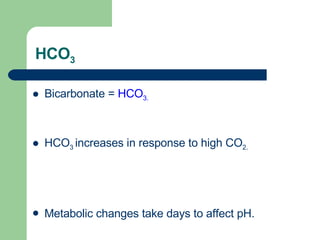
HCO 3 Bicarbonate =  HCO 3. HCO 3  increases in response to high CO 2. Metabolic changes take days to affect pH.
Basic ABG Components pH PaCO 2 HCO 3 PaO 2
pH The pH scale ranges from 1 to 14.  pH 7 is Neutral Low pH is  Acid .  High pH is  Alkaline .
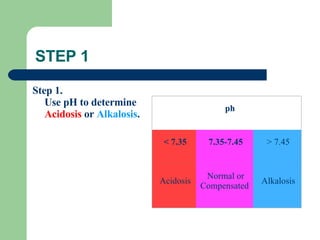
pH Normal pH is maintained by balancing the  H2CO3  (carbonic acid) and  HCO3-  (bicarb)  Normal blood pH =  7.35-7.45 pH < 7.35 =  acidosis Ph > 7.45 =  alkalosis
PaCO 2 CO2  has several forms in the blood.  Like oxygen, some is dissolved directly into the plasma. The  PaCO2  is the measurement of the partial pressure of carbon dioxide dissolved in the plasma. It is measured in mm Hg (millimeters of mercury).  The rest is found in the red blood cells on a hemoglobin molecule.
PaO 2 About 3% of the body's oxygen is dissolved in the plasma.  PaO 2   is a measurement of the partial pressure of oxygen dissolved in the plasma only. It is measured in mm Hg. The  PaO 2  does not tell us about the body's total oxygen content, but it  does  indicate how much oxygen was available in the alveoli to dissolve in the blood.
SaO 2 The remainder of the body's oxygen is carried attached to hemoglobin molecules.  SaO 2 ,   or  oxygen saturation , measures the degree to which oxygen is bound to hemoglobin.  Sa0 2  is expressed as a percentage.
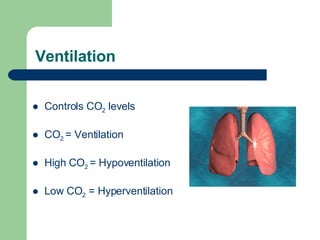
Ventilation Controls CO 2  levels CO 2  = Ventilation High CO 2  = Hypoventilation Low CO 2  = Hyperventilation
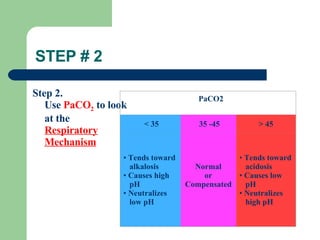
Respiratory Mechanism Respiratory Mechanism (depth and rate of breathing) controls  CO2.   CO 2  in solution is an acid.  Higher  PaCO2  causes acidosis (lower pH), or neutralizes alkalosis.  Lower  PaCO2  causes alkalosis (raises pH.), or neutralizes acidosis.
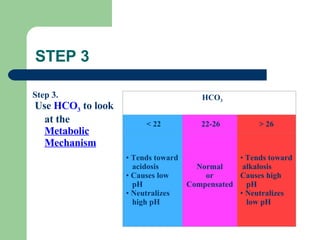
Metabolic Mechanism Bicarbonate = Alkaline =  HCO 3. HCO 3  increases in response to high CO 2. Metabolic changes take days to affect pH.
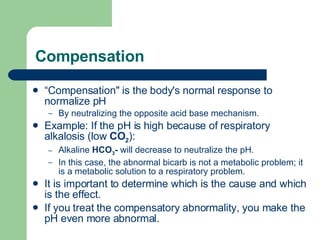
Compensation “ Compensation&quot; is the body's normal response to normalize pH  By neutralizing the opposite acid base mechanism.  Example: If the pH is high because of respiratory alkalosis (low  CO 2 ):  Alkaline  HCO 3 -  will decrease to neutralize the pH .  In this case, the abnormal bicarb is not a metabolic problem; it is a metabolic solution to a respiratory problem.  It is important to determine which is the cause and which is the effect.  If you treat the compensatory abnormality, you make the pH even more abnormal.
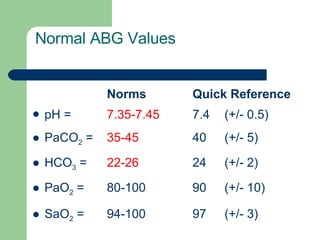
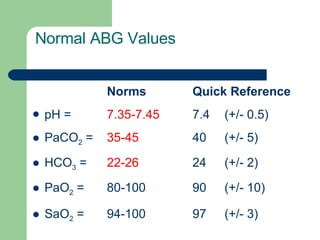
Normal ABG Values   pH =    7.35-7.45 7.4  (+/- 0.5)  PaCO 2  =   35-45 40  (+/- 5) HCO 3  =   22-26 24  (+/- 2) PaO 2  =   80-100 90  (+/- 10) SaO 2  =   94-100 97  (+/- 3)     Norms   Quick Reference
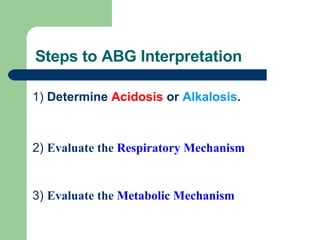
Steps to ABG Interpretation 1)  Determine  Acidosis  or  Alkalosis . 2)  Evaluate the  Respiratory   Mechanism 3)  Evaluate the  Metabolic Mechanism
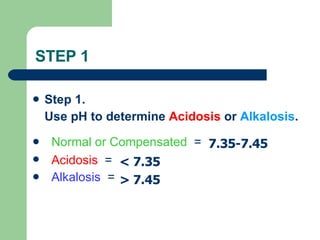
STEP 1 Step 1.  Use pH to determine  Acidosis  or  Alkalosis .    Normal or Compensated   =      Acidosis   =  Alkalosis   =    7.35-7.45     < 7.35     > 7.45  
STEP 1 Step 1.  Use pH to determine  Acidosis  or  Alkalosis .      ph   < 7.35   7.35-7.45   > 7.45   Acidosis   Normal or Compensated   Alkalosis
STEP # 2 Step 2. Use  PaCO 2  to look at the  Respiratory Mechanism     PaCO2   < 35   35 -45 > 45 Tends toward  alkalosis  Causes high  pH  Neutralizes  low pH    Normal  or Compensated   Tends toward acidosis  Causes low  pH  Neutralizes  high pH
STEP 3 Step 3. Use  HCO 3  to look at the  Metabolic Mechanism     HCO 3   < 22   22-26 > 26 Tends toward  acidosis  Causes low  pH  Neutralizes  high pH    Normal  or Compensated   Tends toward alkalosis Causes high pH  Neutralizes  low pH
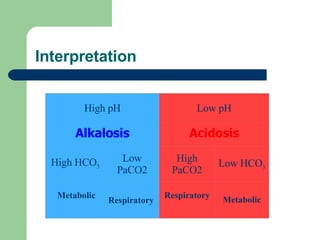
Interpretation   High pH Low pH   Alkalosis Acidosis   High HCO 3 Low PaCO2 High PaCO2 Low HCO 3   Metabolic Respiratory Respiratory Metabolic
Compensation “ Compensation&quot; is the body's normal response to normalize pH  By neutralizing the opposite acid base mechanism.  Example: If the pH is high because of respiratory alkalosis (low  CO 2 ):  Alkaline  HCO 3 -  will decrease to neutralize the pH.  In this case, the abnormal bicarb is not a metabolic problem; it is a metabolic solution to a respiratory problem.  It is important to determine which is the cause and which is the effect.  If you treat the compensatory abnormality, you make the pH even more abnormal.
Normal ABG Values     Norms   Quick Reference  pH =    7.35-7.45 7.4  (+/- 0.5)  PaCO 2  =   35-45 40  (+/- 5) HCO 3  =   22-26 24  (+/- 2) PaO 2  =   80-100 90  (+/- 10) SaO 2  =   94-100 97  (+/- 3)  
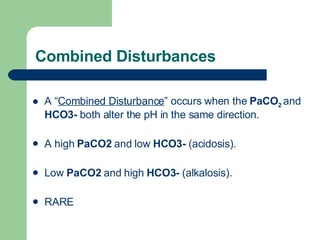
Combined Disturbances A “ Combined Disturbance ” occurs when the  PaCO 2   and   HCO3-  both alter the pH in the same direction.  A high  PaCO2  and low  HCO3-  (acidosis). Low  PaCO2  and high  HCO3-  (alkalosis).  RARE
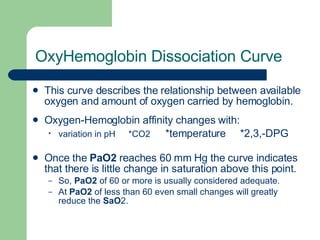
OxyHemoglobin Dissociation Curve  This curve describes the relationship between available oxygen and amount of oxygen carried by hemoglobin. Oxygen-Hemoglobin affinity changes with: variation in pH  *CO2    *temperature  *2,3,-DPG  Once the  PaO2  reaches 60 mm Hg the curve indicates that there is little change in saturation above this point. So,  PaO2  of 60 or more is usually considered adequate.  At  PaO2  of less than 60 even small changes will greatly reduce the  SaO 2.
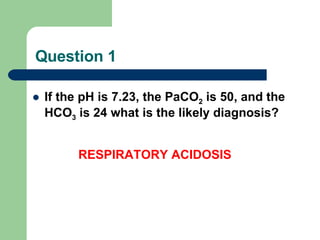
Question 1 If the pH is 7.23, the PaCO 2  is 50, and the  HCO 3  is 24 what is the likely diagnosis?         RESPIRATORY ACIDOSIS
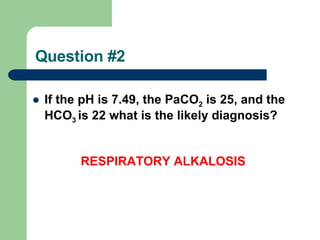
Question #2 If the pH is 7.49, the PaCO 2  is 25, and the HCO 3  is 22 what is the likely diagnosis? RESPIRATORY ALKALOSIS
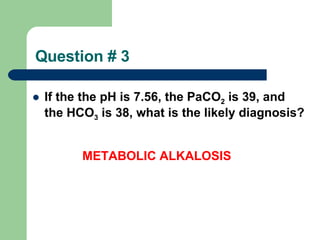
Question # 3 If the the pH is 7.56, the PaCO 2  is 39, and the HCO 3  is 38, what is the likely diagnosis? METABOLIC ALKALOSIS
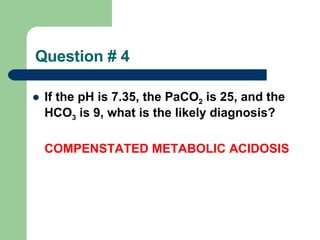
Question # 4 If the pH is 7.35, the PaCO 2  is 25, and the HCO 3  is 9, what is the likely diagnosis?     COMPENSTATED METABOLIC ACIDOSIS   
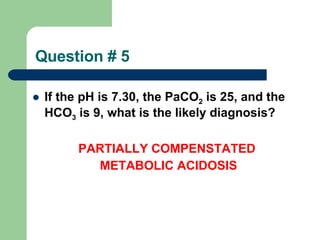
Question # 5 If the pH is 7.30, the PaCO 2  is 25, and the HCO 3  is 9, what is the likely diagnosis?       PARTIALLY COMPENSTATED    METABOLIC ACIDOSIS    
 

Arterial Blood Gases

  • 1.
    Arterial Blood GasInterpretation Sherry L. Knowles, RN, CCRN, CRNI Orlando Regional Medical Center 2004
  • 2.
    Objectives Recognize Signs& Symptoms of Respiratory Failure Understand Ventilation and Perfusion Mechanics Analyze and Interpret Acid Base Disturbances Identify Appropriate Treatments for Abnormal ABG’s
  • 3.
    Objectives Recognize normaland abnormal values for pH, PaO 2 , PaCO 2 , SaO 2 and HCO 3 . Relate the pH scale to acidosis and alkalosis. Discuss the respiratory and metabolic mechanisms involved in controlling the body's acid-base balance. Interpret basic arterial blood gas values and relate these values to patient conditions. Anticipate appropriate therapies for acid-base correction.
  • 4.
    Why Do ABG’s?1) Check oxygenation 2) Check the pH ( acid base balance ) 3) Define the problem 4) Determine the treatment
  • 5.
    Fundamentals Allhuman cells require oxygen. Breathing (ventilation) brings oxygen in and CO 2 out of the lungs. Oxygen is absorbed into the bloodstream through the alveoli. Hemoglobin molecules carry oxygen to the tissues.
  • 6.
    Hemoglobin Carries OxygenHas 4 Binding Sites Hemoglobin + 4 Oxygen = Oxyhemoglobin
  • 7.
    Hemoglobin Binding SitesWhen all of 4 sites are occupied, the hemoglobin molecule cannot hold any more. Molecules, other than oxygen, can attach to the oxygen binding sites. If enough hemoglobin binding sites are occupied with molecules other than oxygen, severe tissue hypoxia can result. Hypoxia can occur even in the presence of 100% oxygen. This can be a life-threatening condition.
  • 8.
    Carboxyhemoglobin (HbCO) Carboxyhemoglobin(HbCO) is a hemoglobin molecule that has carbon monoxide attached where the oxygen should be. Exposure to car exhaust, or other chemicals can cause carbon monoxide (CO) to attach to hemoglobin binding sites, instead of oxygen and thus compete with the oxygen for the limited number of binding sites. The blood will exhibit a cherry red color.
  • 9.
    Methemoglobin (MetHb) Methemoglobin(MetHb) is produced when exposed to certain poisons or due to a genetic condition that affects the hemoglobin molecule. The hemoglobin molecule is saturated with methemoglobin (MetHb) and competes with oxygen for the hemoglobin binding sites. Methemoglobin (MetHb) changes blood to a brownish color.
  • 10.
    Oxygen and HemoglobinCO 2 's affinity for hemoglobin is much less than O 2 's affinity for hemoglobin. When CO 2 and O 2 are both available, hemoglobin will accept oxygen rather than CO 2 . In the oxygen rich environment of the alveoli, hemoglobin carries oxygen. Oxygenated blood then travels through the body.
  • 11.
    Acid Base BalanceUnderstanding the cause of an acid-base imbalance is the key to treating it. The Respiratory component of acid base balance affects the pH within minutes . The Metabolic component of acid base balance can take days to affect pH.
  • 12.
    Buffer System CarbonicAcid - Bicarbonate Buffer System CO 2 + H 2 O <--> H 2 CO 3 <--> ( HCO 3 - ) + ( H+ ) carbon dioxide + water <--> carbonic acid <--> bicarbonate + hydrogen ion Note: The two headed arrows indicate that the process is reversible
  • 13.
    CO 2 Whencombined with water, carbon dioxide becomes carbonic acid ( H2CO 3 ) Carbon dioxide is an acid when dissolved in water. Carbon dioxide is a product of metabolism. As long as cells are functioning, CO 2 is produced.
  • 14.
    HCO 3 Bicarbonate= HCO 3. HCO 3 increases in response to high CO 2. Metabolic changes take days to affect pH.
  • 15.
    Basic ABG ComponentspH PaCO 2 HCO 3 PaO 2
  • 16.
    pH The pHscale ranges from 1 to 14. pH 7 is Neutral Low pH is Acid . High pH is Alkaline .
  • 17.
    pH Normal pHis maintained by balancing the H2CO3 (carbonic acid) and HCO3- (bicarb) Normal blood pH = 7.35-7.45 pH < 7.35 = acidosis Ph > 7.45 = alkalosis
  • 18.
    PaCO 2 CO2 has several forms in the blood. Like oxygen, some is dissolved directly into the plasma. The PaCO2 is the measurement of the partial pressure of carbon dioxide dissolved in the plasma. It is measured in mm Hg (millimeters of mercury). The rest is found in the red blood cells on a hemoglobin molecule.
  • 19.
    PaO 2 About3% of the body's oxygen is dissolved in the plasma. PaO 2 is a measurement of the partial pressure of oxygen dissolved in the plasma only. It is measured in mm Hg. The PaO 2 does not tell us about the body's total oxygen content, but it does indicate how much oxygen was available in the alveoli to dissolve in the blood.
  • 20.
    SaO 2 Theremainder of the body's oxygen is carried attached to hemoglobin molecules. SaO 2 , or oxygen saturation , measures the degree to which oxygen is bound to hemoglobin. Sa0 2 is expressed as a percentage.
  • 21.
    Ventilation Controls CO2 levels CO 2 = Ventilation High CO 2 = Hypoventilation Low CO 2 = Hyperventilation
  • 22.
    Respiratory Mechanism RespiratoryMechanism (depth and rate of breathing) controls CO2. CO 2 in solution is an acid. Higher PaCO2 causes acidosis (lower pH), or neutralizes alkalosis. Lower PaCO2 causes alkalosis (raises pH.), or neutralizes acidosis.
  • 23.
    Metabolic Mechanism Bicarbonate= Alkaline = HCO 3. HCO 3 increases in response to high CO 2. Metabolic changes take days to affect pH.
  • 24.
    Compensation “ Compensation&quot;is the body's normal response to normalize pH By neutralizing the opposite acid base mechanism. Example: If the pH is high because of respiratory alkalosis (low CO 2 ): Alkaline HCO 3 - will decrease to neutralize the pH . In this case, the abnormal bicarb is not a metabolic problem; it is a metabolic solution to a respiratory problem. It is important to determine which is the cause and which is the effect. If you treat the compensatory abnormality, you make the pH even more abnormal.
  • 25.
    Normal ABG Values  pH = 7.35-7.45 7.4 (+/- 0.5)  PaCO 2  = 35-45 40 (+/- 5) HCO 3  = 22-26 24 (+/- 2) PaO 2  = 80-100 90 (+/- 10) SaO 2  = 94-100 97 (+/- 3)   Norms Quick Reference
  • 26.
    Steps to ABGInterpretation 1) Determine Acidosis or Alkalosis . 2) Evaluate the Respiratory Mechanism 3) Evaluate the Metabolic Mechanism
  • 27.
    STEP 1 Step1. Use pH to determine Acidosis or Alkalosis .   Normal or Compensated =     Acidosis = Alkalosis =   7.35-7.45 < 7.35 > 7.45  
  • 28.
    STEP 1 Step1. Use pH to determine Acidosis or Alkalosis .     ph   < 7.35   7.35-7.45   > 7.45   Acidosis   Normal or Compensated   Alkalosis
  • 29.
    STEP # 2Step 2. Use PaCO 2 to look at the Respiratory Mechanism     PaCO2   < 35   35 -45 > 45 Tends toward alkalosis Causes high pH Neutralizes low pH   Normal or Compensated   Tends toward acidosis Causes low pH Neutralizes high pH
  • 30.
    STEP 3 Step3. Use HCO 3 to look at the Metabolic Mechanism     HCO 3   < 22   22-26 > 26 Tends toward acidosis Causes low pH Neutralizes high pH   Normal or Compensated   Tends toward alkalosis Causes high pH Neutralizes low pH
  • 31.
    Interpretation   HighpH Low pH   Alkalosis Acidosis   High HCO 3 Low PaCO2 High PaCO2 Low HCO 3   Metabolic Respiratory Respiratory Metabolic
  • 32.
    Compensation “ Compensation&quot;is the body's normal response to normalize pH By neutralizing the opposite acid base mechanism. Example: If the pH is high because of respiratory alkalosis (low CO 2 ): Alkaline HCO 3 - will decrease to neutralize the pH. In this case, the abnormal bicarb is not a metabolic problem; it is a metabolic solution to a respiratory problem. It is important to determine which is the cause and which is the effect. If you treat the compensatory abnormality, you make the pH even more abnormal.
  • 33.
    Normal ABG Values  Norms Quick Reference pH = 7.35-7.45 7.4 (+/- 0.5)  PaCO 2  = 35-45 40 (+/- 5) HCO 3  = 22-26 24 (+/- 2) PaO 2  = 80-100 90 (+/- 10) SaO 2  = 94-100 97 (+/- 3)  
  • 34.
    Combined Disturbances A“ Combined Disturbance ” occurs when the PaCO 2 and HCO3- both alter the pH in the same direction. A high PaCO2 and low HCO3- (acidosis). Low PaCO2 and high HCO3- (alkalosis). RARE
  • 35.
    OxyHemoglobin Dissociation Curve This curve describes the relationship between available oxygen and amount of oxygen carried by hemoglobin. Oxygen-Hemoglobin affinity changes with: variation in pH *CO2 *temperature *2,3,-DPG Once the PaO2 reaches 60 mm Hg the curve indicates that there is little change in saturation above this point. So, PaO2 of 60 or more is usually considered adequate. At PaO2 of less than 60 even small changes will greatly reduce the SaO 2.
  • 36.
    Question 1 Ifthe pH is 7.23, the PaCO 2 is 50, and the HCO 3 is 24 what is the likely diagnosis?   RESPIRATORY ACIDOSIS
  • 37.
    Question #2 Ifthe pH is 7.49, the PaCO 2 is 25, and the HCO 3 is 22 what is the likely diagnosis? RESPIRATORY ALKALOSIS
  • 38.
    Question # 3If the the pH is 7.56, the PaCO 2 is 39, and the HCO 3 is 38, what is the likely diagnosis? METABOLIC ALKALOSIS
  • 39.
    Question # 4If the pH is 7.35, the PaCO 2 is 25, and the HCO 3 is 9, what is the likely diagnosis?    COMPENSTATED METABOLIC ACIDOSIS   
  • 40.
    Question # 5If the pH is 7.30, the PaCO 2 is 25, and the HCO 3 is 9, what is the likely diagnosis?    PARTIALLY COMPENSTATED METABOLIC ACIDOSIS   
  • 41.