INTRODUCTION
 Neoprene or poly chloroprene is a family of
synthetic rubbers produced by polymerization of
chloroprene.
 Neoprene exhibits good chemical stability and
maintains flexibility over a wide temperature
range.
 It is used in wide variety of applications , such
as laptop sleeves , orthopedic braces , electrical
insulation and automotive fan belts.
PRODUCTION
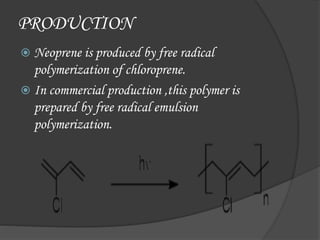
 Neoprene is produced by free radical
polymerization of chloroprene.
 In commercial production ,this polymer is
prepared by free radical emulsion
polymerization.
PRODUCTION
 Polymerization is initiated by using potassium
per sulfate.
 Neoprene can be produced either in closed cell or
open cell form.
 The closed cell form is water proof ,less
compatible and more expensive.
 The open cell form can be breathable
HISTORY
 Neoprene was invented by DuPont scientists on
April 17, 1930 after Dr Elmer K.
Bolton of DuPont attended a lecture
by Fr Julius Arthur Nieuwland, a professor
of chemistry at the University of Notre Dame.
 Nieuwland's research was focused
on acetylene chemistry and during the course of
his work he produced di vinyl acetylene, a jelly
that firms into an elastic compound similar to
rubber when passed over sulfur dichloride.
HISTORY
 After DuPont purchased the patent rights
from the university, Wallace Carothers of
DuPont took over commercial development of
Nieuwland's discovery in collaboration with
Nieuwland himself.
 Arnold Collins at DuPont focused on mono
vinyl acetylene and reacted the substance
with hydrogen chloride gas,
manufacturing chloroprene.[5]
APPLICATIONS
 Neoprene resists degradation more than natural or
synthetic rubber.
 This relative inertness makes it well suited for
demanding applications such as gaskets, hoses,
and corrosion-resistant coatings.

 It can be used as a base for adhesives, noise
isolation in power transformer installations,
and as padding in external metal cases to
protect the contents while allowing a snug fit.
APPLICATIONS
IN AQUATICS:
 Neoprene is commonly used as a material for fly
fishing waders, as it provides excellent insulation
against cold.
 Neoprene waders are usually about 5 mm thick,
and in the medium price range as compared to
cheaper materials such as nylon and rubber.
 However, neoprene is less expensive than
breathable fabrics. A foamed neoprene containing
gas cells is used as an insulation material, most
notably in wetsuits.
APPLICATIONS
IN SPORTS:
 In the equestrian world, it is used in cinches, saddle
pads, bareback pads, and many other applications in
all disciplines.
 It is often used in Air soft as a protective garment, as
it is thin enough to feel the hit, but thick enough to
reduce the impact velocity, thus avoiding breakage of
the skin by the pellet.
 Training knives and swords are made of Neoprene for
safe self-defense instructions, practice, sparring, and
martial arts demonstrations.
THANK YOU

Neoprene

  • 2.
    INTRODUCTION  Neoprene orpoly chloroprene is a family of synthetic rubbers produced by polymerization of chloroprene.  Neoprene exhibits good chemical stability and maintains flexibility over a wide temperature range.  It is used in wide variety of applications , such as laptop sleeves , orthopedic braces , electrical insulation and automotive fan belts.
  • 3.
    PRODUCTION  Neoprene isproduced by free radical polymerization of chloroprene.  In commercial production ,this polymer is prepared by free radical emulsion polymerization.
  • 4.
    PRODUCTION  Polymerization isinitiated by using potassium per sulfate.  Neoprene can be produced either in closed cell or open cell form.  The closed cell form is water proof ,less compatible and more expensive.  The open cell form can be breathable
  • 5.
    HISTORY  Neoprene wasinvented by DuPont scientists on April 17, 1930 after Dr Elmer K. Bolton of DuPont attended a lecture by Fr Julius Arthur Nieuwland, a professor of chemistry at the University of Notre Dame.  Nieuwland's research was focused on acetylene chemistry and during the course of his work he produced di vinyl acetylene, a jelly that firms into an elastic compound similar to rubber when passed over sulfur dichloride.
  • 6.
    HISTORY  After DuPontpurchased the patent rights from the university, Wallace Carothers of DuPont took over commercial development of Nieuwland's discovery in collaboration with Nieuwland himself.  Arnold Collins at DuPont focused on mono vinyl acetylene and reacted the substance with hydrogen chloride gas, manufacturing chloroprene.[5]
  • 7.
    APPLICATIONS  Neoprene resistsdegradation more than natural or synthetic rubber.  This relative inertness makes it well suited for demanding applications such as gaskets, hoses, and corrosion-resistant coatings.  It can be used as a base for adhesives, noise isolation in power transformer installations, and as padding in external metal cases to protect the contents while allowing a snug fit.
  • 8.
    APPLICATIONS IN AQUATICS:  Neopreneis commonly used as a material for fly fishing waders, as it provides excellent insulation against cold.  Neoprene waders are usually about 5 mm thick, and in the medium price range as compared to cheaper materials such as nylon and rubber.  However, neoprene is less expensive than breathable fabrics. A foamed neoprene containing gas cells is used as an insulation material, most notably in wetsuits.
  • 9.
    APPLICATIONS IN SPORTS:  Inthe equestrian world, it is used in cinches, saddle pads, bareback pads, and many other applications in all disciplines.  It is often used in Air soft as a protective garment, as it is thin enough to feel the hit, but thick enough to reduce the impact velocity, thus avoiding breakage of the skin by the pellet.  Training knives and swords are made of Neoprene for safe self-defense instructions, practice, sparring, and martial arts demonstrations.
  • 10.