Quality Inspection and Testing of Arc stud
welding (metallic materials)
Sai Anjaneya
Contents
▪ Introduction
▪ Welding procedure qualification
▪ Examination and testing
▪ Acceptance criteria
▪ Process control
2
Introduction
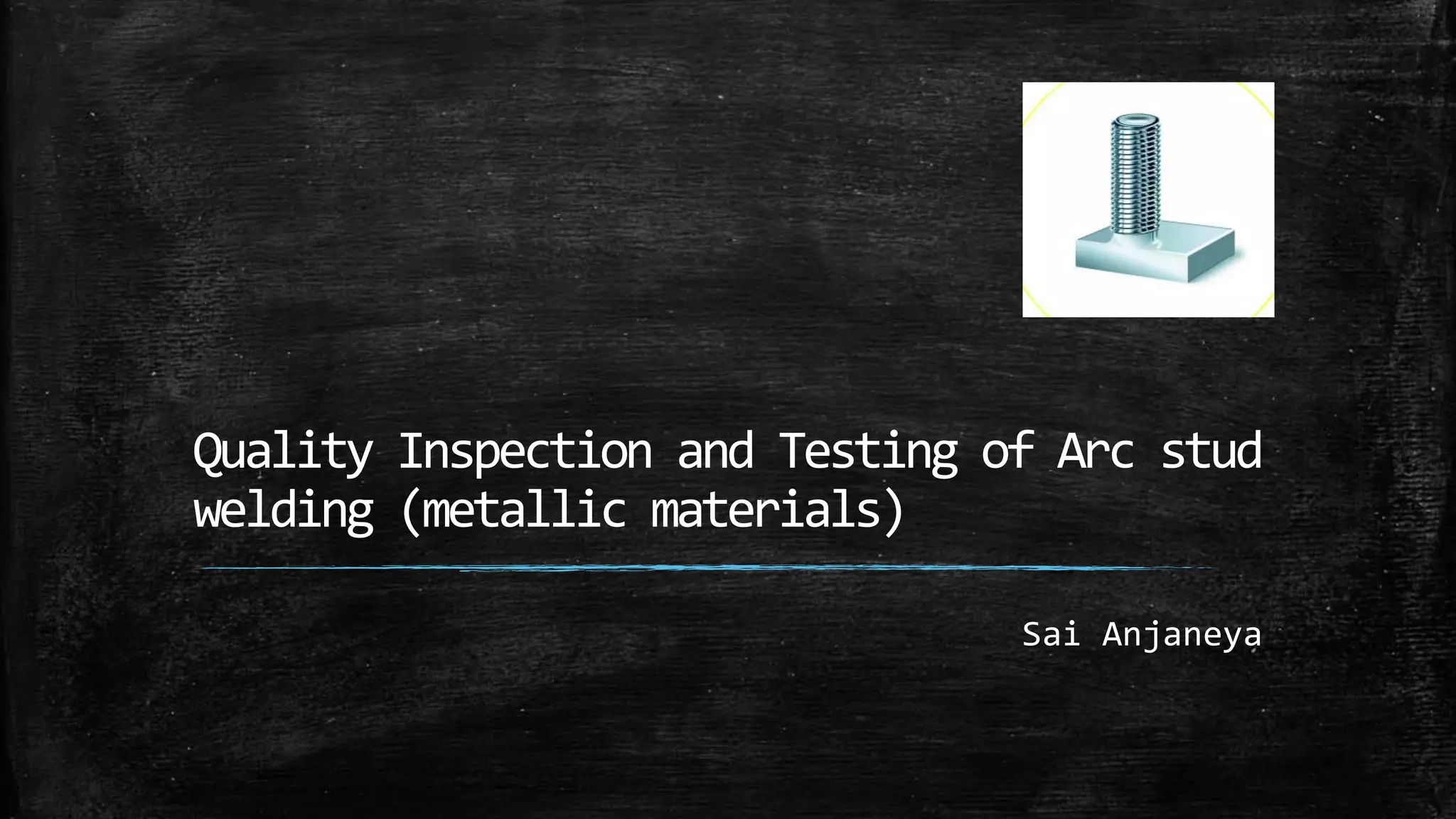
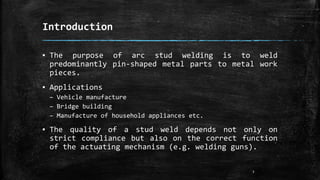
▪ The purpose of arc stud welding is to weld
predominantly pin-shaped metal parts to metal work
pieces.
▪ Applications
– Vehicle manufacture
– Bridge building
– Manufacture of household appliances etc.
▪ The quality of a stud weld depends not only on
strict compliance but also on the correct function
of the actuating mechanism (e.g. welding guns).
3
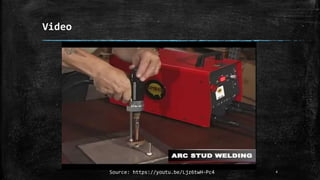
Video
4Source: https://youtu.be/Ljz6twH-Pc4
Welding procedure qualification
▪ In principle, the following methods of qualification
are permitted
– welding procedure test
– pre-production tests
– previous experience
5
Examination, Testing and Acceptance criteria
▪ Visual examination
▪ Bend testing
▪ Tensile testing
▪ Torque test
▪ Macro examination
▪ Radiographic examination
6
Visual examination
7
In drawn arc stud welding with ceramic ferrule or
shielding gas visual examination is used for assessing
the following:
• The uniformity of the shape and the size of the
collar
• Location, length and angle of the stud after welding
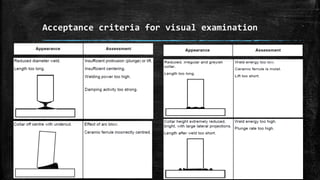
Acceptance criteria for visual examination
8
Bend Testing
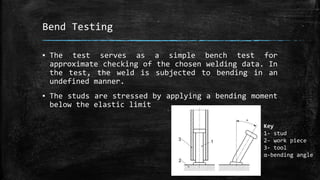
▪ The test serves as a simple bench test for
approximate checking of the chosen welding data. In
the test, the weld is subjected to bending in an
undefined manner.
▪ The studs are stressed by applying a bending moment
below the elastic limit
9
Key
1- stud
2- work piece
3- tool
α-bending angle
10
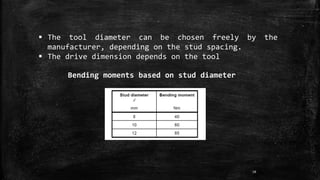
 The tool diameter can be chosen freely by the
manufacturer, depending on the stud spacing.
 The drive dimension depends on the tool
Bending moments based on stud diameter
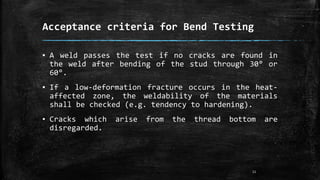
Acceptance criteria for Bend Testing
▪ A weld passes the test if no cracks are found in
the weld after bending of the stud through 30° or
60°.
▪ If a low-deformation fracture occurs in the heat-
affected zone, the weldability of the materials
shall be checked (e.g. tendency to hardening).
▪ Cracks which arise from the thread bottom are
disregarded.
11
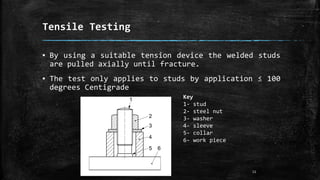
Tensile Testing
▪ By using a suitable tension device the welded studs
are pulled axially until fracture.
▪ The test only applies to studs by application ≤ 100
degrees Centigrade
12
Key
1- stud
2- steel nut
3- washer
4- sleeve
5- collar
6- work piece
Acceptance criteria for Tensile Testing
▪ A fracture in the weld area is not permitted.
▪ Fractures within the weld zone are only permitted
if the nominal tensile strength of the stud
material is reached.
13
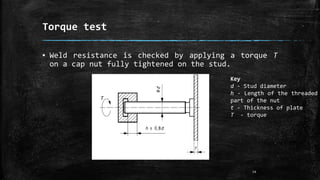
Torque test
▪ Weld resistance is checked by applying a torque T
on a cap nut fully tightened on the stud.
14
Key
d - Stud diameter
h - Length of the threaded
part of the nut
t - Thickness of plate
T - torque
15
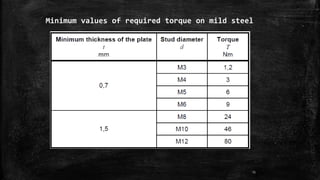
Minimum values of required torque on mild steel
Macro examination
▪ The macro examination serves to check the shape and
depth of the penetration.
▪ The assessment shall be carried out with a maximum
of tenfold magnification.
▪ For the specimen, a stud which has passed the bend
test may be chosen.
▪ Imperfections with dimensions larger than specified
are not acceptable.
16
Radiographic examination
▪ The radiographic examination serves to check the
weld area for internal imperfections.
▪ Required for the welding process, drawn arc stud
welding with ceramic ferrule or shielding gas above
d > 12 mm for applications ≤ 100 °C, when
tensile tests are not carried out.
17
Process control
▪ Before, during and after production, tests shall
therefore be performed.
▪ The various tests are as follows:
– production test
– simplified production test
– production surveillance
18
Production Test
▪ Production tests shall be performed by the
manufacturer before the beginning of welding
operations on a construction or a group of similar
constructions, and/or after a specified number of
welds.
▪ The following examinations and tests shall be
performed:
– visual examination (all studs)
– bend testing (five studs)
– macro examinations of two different studs
19
References
▪ http://www.betawelding.ir/en/images/ISO_14555.pdf
▪ ISO 14555
20
21

Welding — arc stud welding of metallic

  • 1.
    Quality Inspection andTesting of Arc stud welding (metallic materials) Sai Anjaneya
  • 2.
    Contents ▪ Introduction ▪ Weldingprocedure qualification ▪ Examination and testing ▪ Acceptance criteria ▪ Process control 2
  • 3.
    Introduction ▪ The purposeof arc stud welding is to weld predominantly pin-shaped metal parts to metal work pieces. ▪ Applications – Vehicle manufacture – Bridge building – Manufacture of household appliances etc. ▪ The quality of a stud weld depends not only on strict compliance but also on the correct function of the actuating mechanism (e.g. welding guns). 3
  • 4.
  • 5.
    Welding procedure qualification ▪In principle, the following methods of qualification are permitted – welding procedure test – pre-production tests – previous experience 5
  • 6.
    Examination, Testing andAcceptance criteria ▪ Visual examination ▪ Bend testing ▪ Tensile testing ▪ Torque test ▪ Macro examination ▪ Radiographic examination 6
  • 7.
    Visual examination 7 In drawnarc stud welding with ceramic ferrule or shielding gas visual examination is used for assessing the following: • The uniformity of the shape and the size of the collar • Location, length and angle of the stud after welding
  • 8.
    Acceptance criteria forvisual examination 8
  • 9.
    Bend Testing ▪ Thetest serves as a simple bench test for approximate checking of the chosen welding data. In the test, the weld is subjected to bending in an undefined manner. ▪ The studs are stressed by applying a bending moment below the elastic limit 9 Key 1- stud 2- work piece 3- tool α-bending angle
  • 10.
    10  The tooldiameter can be chosen freely by the manufacturer, depending on the stud spacing.  The drive dimension depends on the tool Bending moments based on stud diameter
  • 11.
    Acceptance criteria forBend Testing ▪ A weld passes the test if no cracks are found in the weld after bending of the stud through 30° or 60°. ▪ If a low-deformation fracture occurs in the heat- affected zone, the weldability of the materials shall be checked (e.g. tendency to hardening). ▪ Cracks which arise from the thread bottom are disregarded. 11
  • 12.
    Tensile Testing ▪ Byusing a suitable tension device the welded studs are pulled axially until fracture. ▪ The test only applies to studs by application ≤ 100 degrees Centigrade 12 Key 1- stud 2- steel nut 3- washer 4- sleeve 5- collar 6- work piece
  • 13.
    Acceptance criteria forTensile Testing ▪ A fracture in the weld area is not permitted. ▪ Fractures within the weld zone are only permitted if the nominal tensile strength of the stud material is reached. 13
  • 14.
    Torque test ▪ Weldresistance is checked by applying a torque T on a cap nut fully tightened on the stud. 14 Key d - Stud diameter h - Length of the threaded part of the nut t - Thickness of plate T - torque
  • 15.
    15 Minimum values ofrequired torque on mild steel
  • 16.
    Macro examination ▪ Themacro examination serves to check the shape and depth of the penetration. ▪ The assessment shall be carried out with a maximum of tenfold magnification. ▪ For the specimen, a stud which has passed the bend test may be chosen. ▪ Imperfections with dimensions larger than specified are not acceptable. 16
  • 17.
    Radiographic examination ▪ Theradiographic examination serves to check the weld area for internal imperfections. ▪ Required for the welding process, drawn arc stud welding with ceramic ferrule or shielding gas above d > 12 mm for applications ≤ 100 °C, when tensile tests are not carried out. 17
  • 18.
    Process control ▪ Before,during and after production, tests shall therefore be performed. ▪ The various tests are as follows: – production test – simplified production test – production surveillance 18
  • 19.
    Production Test ▪ Productiontests shall be performed by the manufacturer before the beginning of welding operations on a construction or a group of similar constructions, and/or after a specified number of welds. ▪ The following examinations and tests shall be performed: – visual examination (all studs) – bend testing (five studs) – macro examinations of two different studs 19
  • 20.
  • 21.

Editor's Notes

  • #4 In this international Standard it is referred to simply as stud welding. This International Standard covers arc stud welding of metallic materials subject to static and dynamic loading.
  • #16 Acceptance criteria for torque testing The required torque shall be reached without weld failure.