POLYPROPYLENE
PRESENTED BY-
MANNU KUMAR
B.TECH 4TH YR
PLASTIC ENGINEERING
CIPET LUCKNOW
CIPET LUCKNOW
POLYPROPYLENE
INTRODUCTION
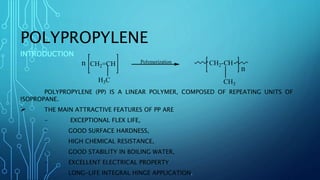
POLYPROPYLENE (PP) IS A LINEAR POLYMER, COMPOSED OF REPEATING UNITS OF
ISOPROPANE.
 THE MAIN ATTRACTIVE FEATURES OF PP ARE
- EXCEPTIONAL FLEX LIFE,
- GOOD SURFACE HARDNESS,
- HIGH CHEMICAL RESISTANCE,
- GOOD STABILITY IN BOILING WATER,
- EXCELLENT ELECTRICAL PROPERTY
- LONG-LIFE INTEGRAL HINGE APPLICATION.
PolymerizationCH2=CH
H3C
CH2-CH
CH3
n
n
PP IS PREPARED BY USING ZIEGLER TYPE CATALYST – TITANIUM TRI
CHLORIDE WITH ALUMINIUM TRI ETHYL, ALUMINIUM TRI BUTYL, OR
ALUMINIUM DI ETHYL CHLORIDE IN NAPHTHA UNDER NITROGEN
ATMOSPHERE TO FORM SLURRY CONSISTING OF 10% CATALYST AND 90%
NAPHTHA.
THE MOLECULAR WEIGHT CAN BE CONTROLLED BY USING HYDROGEN AS A
CHAIN TRANSFER AGENT.
IN SUSPENSION PROCESS, PROPYLENE IS CHARGED INTO THE
POLYMERIZATION VESSEL UNDER PRESSURE WHILE THE CATALYST AND THE
REACTION DILUENT ARE METERED IN SEPARATELY.
• Preparation of Polypropylene
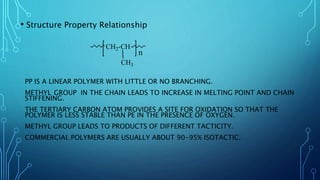
PP IS A LINEAR POLYMER WITH LITTLE OR NO BRANCHING.
METHYL GROUP IN THE CHAIN LEADS TO INCREASE IN MELTING POINT AND CHAIN
STIFFENING.
THE TERTIARY CARBON ATOM PROVIDES A SITE FOR OXIDATION SO THAT THE
POLYMER IS LESS STABLE THAN PE IN THE PRESENCE OF OXYGEN.
METHYL GROUP LEADS TO PRODUCTS OF DIFFERENT TACTICITY.
COMMERCIAL POLYMERS ARE USUALLY ABOUT 90-95% ISOTACTIC.
• Structure Property Relationship
CH2-CH
CH3
n
TACTICITY
Isotactic
CORPORATE TRAINING AND PLANNING
Syndiotactic
Atactic
C
C
C
C
C
C
CH3
H
H
CH3
CH3
CH3
C
C
H
H H
H
H
H
H
HH
H
C
H
H
C
C
C
C
C
CH
CH3
H
H
H
H
H
H
H
H
CH3 CH3
C
H
H
C
C
C
C
C
CH
CH3
H
H
H
H
H
H
H
H
CH3
CH3
PROPERTIES OF ISOTACTIC PP
Compare to Polyethylene
 It has lower density (0.90 gm / cc).
 It has a higher softening point and hence a higher maximum
service temperature.
 Articles can withstand boiling water and can be subjected to
steam sterilizing operations.
 It has a higher brittle point.
 It is more susceptible to oxidation.
Atactic PP
 Atactic PP is an amorphous some what rubbery in nature.
 Commercial polymer is usually 90-95% isotactic and rest is
GENERAL PROPERTIES
Chemical properties
No solvent affects PP at room temperature. Polypropylene will dissolve in
Decaline at 130°C.
Aromatic and chlorinated solvents often swell polymer at elevated
temperature.
Strong oxidizing acids slowly attacks the resin (fuming HNO3)
Electrical properties
PP is an excellent insulator due to its non-polarity.
It is used in many molded products, as well as in winding coils and
transformers.
Flammability
PP burns slowly and can be identified by an odour of crude oil.
Flame–retardant grades are available for specific electrical applications.
Mechanical properties
ADDITIVES FOR ISOTACTIC PP
Fillers
• About 3% of PP compounds are filled with talc.
• Talc filler improves stiffness and heat deformation resistance.
Rubbers
• Particularly butyl rubber is used to reduce the brittleness of PP
Carbon black
• To improve the resistance to UV light, carbon black is used as a light
screener
Antioxidants
• Antioxidants are necessary for prevention from adversity of
oxidation.
PROCESSING TECHNIQUES
Injection Molding
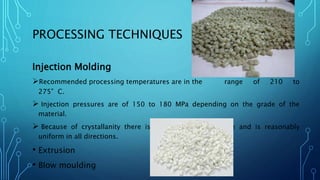
Recommended processing temperatures are in the range of 210 to
275°C.
 Injection pressures are of 150 to 180 MPa depending on the grade of the
material.
 Because of crystallanity there is high molding shrinkage and is reasonably
uniform in all directions.
• Extrusion
• Blow moulding
APPLICATIONS
• Automotive
 PP is used in bumpers, steering wheel covers, profiles,
consoles, door pockets, radiator grills, spoilers, rubbing strips
Packaging
 PP is used in packaging for goods wrapping, sleeping bags,
films for packing tobacco products, candy, cosmetics, contact
lens cases, first aid cases, drums
• Electrical / Electronics
 PP is used in cable connectors and fittings, cable and
wire coatings, industrial lights
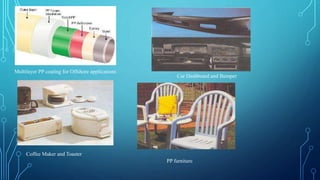
Multilayer PP coating for Offshore applications
Car Dashboard and Bumper
Coffee Maker and Toaster
PP furniture
THANK
YOU

Polypropylene

  • 1.
    POLYPROPYLENE PRESENTED BY- MANNU KUMAR B.TECH4TH YR PLASTIC ENGINEERING CIPET LUCKNOW CIPET LUCKNOW
  • 2.
    POLYPROPYLENE INTRODUCTION POLYPROPYLENE (PP) ISA LINEAR POLYMER, COMPOSED OF REPEATING UNITS OF ISOPROPANE.  THE MAIN ATTRACTIVE FEATURES OF PP ARE - EXCEPTIONAL FLEX LIFE, - GOOD SURFACE HARDNESS, - HIGH CHEMICAL RESISTANCE, - GOOD STABILITY IN BOILING WATER, - EXCELLENT ELECTRICAL PROPERTY - LONG-LIFE INTEGRAL HINGE APPLICATION. PolymerizationCH2=CH H3C CH2-CH CH3 n n
  • 3.
    PP IS PREPAREDBY USING ZIEGLER TYPE CATALYST – TITANIUM TRI CHLORIDE WITH ALUMINIUM TRI ETHYL, ALUMINIUM TRI BUTYL, OR ALUMINIUM DI ETHYL CHLORIDE IN NAPHTHA UNDER NITROGEN ATMOSPHERE TO FORM SLURRY CONSISTING OF 10% CATALYST AND 90% NAPHTHA. THE MOLECULAR WEIGHT CAN BE CONTROLLED BY USING HYDROGEN AS A CHAIN TRANSFER AGENT. IN SUSPENSION PROCESS, PROPYLENE IS CHARGED INTO THE POLYMERIZATION VESSEL UNDER PRESSURE WHILE THE CATALYST AND THE REACTION DILUENT ARE METERED IN SEPARATELY. • Preparation of Polypropylene
  • 4.
    PP IS ALINEAR POLYMER WITH LITTLE OR NO BRANCHING. METHYL GROUP IN THE CHAIN LEADS TO INCREASE IN MELTING POINT AND CHAIN STIFFENING. THE TERTIARY CARBON ATOM PROVIDES A SITE FOR OXIDATION SO THAT THE POLYMER IS LESS STABLE THAN PE IN THE PRESENCE OF OXYGEN. METHYL GROUP LEADS TO PRODUCTS OF DIFFERENT TACTICITY. COMMERCIAL POLYMERS ARE USUALLY ABOUT 90-95% ISOTACTIC. • Structure Property Relationship CH2-CH CH3 n
  • 5.
    TACTICITY Isotactic CORPORATE TRAINING ANDPLANNING Syndiotactic Atactic C C C C C C CH3 H H CH3 CH3 CH3 C C H H H H H H H HH H C H H C C C C C CH CH3 H H H H H H H H CH3 CH3 C H H C C C C C CH CH3 H H H H H H H H CH3 CH3
  • 6.
    PROPERTIES OF ISOTACTICPP Compare to Polyethylene  It has lower density (0.90 gm / cc).  It has a higher softening point and hence a higher maximum service temperature.  Articles can withstand boiling water and can be subjected to steam sterilizing operations.  It has a higher brittle point.  It is more susceptible to oxidation. Atactic PP  Atactic PP is an amorphous some what rubbery in nature.  Commercial polymer is usually 90-95% isotactic and rest is
  • 7.
    GENERAL PROPERTIES Chemical properties Nosolvent affects PP at room temperature. Polypropylene will dissolve in Decaline at 130°C. Aromatic and chlorinated solvents often swell polymer at elevated temperature. Strong oxidizing acids slowly attacks the resin (fuming HNO3) Electrical properties PP is an excellent insulator due to its non-polarity. It is used in many molded products, as well as in winding coils and transformers. Flammability PP burns slowly and can be identified by an odour of crude oil. Flame–retardant grades are available for specific electrical applications. Mechanical properties
  • 8.
    ADDITIVES FOR ISOTACTICPP Fillers • About 3% of PP compounds are filled with talc. • Talc filler improves stiffness and heat deformation resistance. Rubbers • Particularly butyl rubber is used to reduce the brittleness of PP Carbon black • To improve the resistance to UV light, carbon black is used as a light screener Antioxidants • Antioxidants are necessary for prevention from adversity of oxidation.
  • 9.
    PROCESSING TECHNIQUES Injection Molding Recommendedprocessing temperatures are in the range of 210 to 275°C.  Injection pressures are of 150 to 180 MPa depending on the grade of the material.  Because of crystallanity there is high molding shrinkage and is reasonably uniform in all directions. • Extrusion • Blow moulding
  • 10.
    APPLICATIONS • Automotive  PPis used in bumpers, steering wheel covers, profiles, consoles, door pockets, radiator grills, spoilers, rubbing strips Packaging  PP is used in packaging for goods wrapping, sleeping bags, films for packing tobacco products, candy, cosmetics, contact lens cases, first aid cases, drums • Electrical / Electronics  PP is used in cable connectors and fittings, cable and wire coatings, industrial lights
  • 11.
    Multilayer PP coatingfor Offshore applications Car Dashboard and Bumper Coffee Maker and Toaster PP furniture
  • 12.