MATERIALS FOR PRODUCTION OF
POLYSTYRENE
 BASIC STUFF FOR PRODUCTION OF MATERIALS FROM PLASTIC IS OIL.
 MATERIALS FOR PRODUCTION OF STYRENE:
 *BENZENE
 *ETHYLENE
HISTORY
 POLYSTYRENE WAS DISCOVERED IN 1839 BY EDUARD
SIMON,AN APOTHECARY FROM BERLIN
 From storax, the resin of the Turkish sweetgum
treeLiquidambar orientalis, he distilled an oily substance,
a monomer that he named styrol.
 In 1866 Marcelin Berthelot correctly identified the formation
of metastyrol/Styroloxyd from styrol as
a polymerization process.
 The crystal structure of isotactic polystyrene was reported
by Giulio Natta.
 In 1954, the Koppers Company in Pittsburgh,
Pennsylvania, developed expanded polystyrene (EPS)
foam under the trade name Dylite.
 In 1960, Dart Container, the largest manufacturer of
foam cups, shipped their first order.
 In 1988, the first U.S. ban of general polystyrene
foam was enacted in Berkeley, California.
PRODUCTION OF POLYSTYRENE
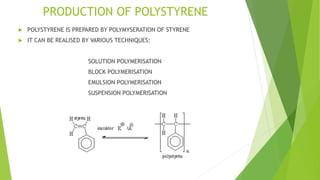
 POLYSTYRENE IS PREPARED BY POLYMYSERATION OF STYRENE
 IT CAN BE REALISED BY VARIOUS TECHNIQUES:
SOLUTION POLYMERISATION
BLOCK POLYMERISATION
EMULSION POLYMERISATION
SUSPENSION POLYMERISATION
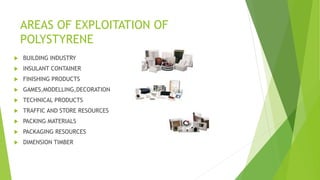
AREAS OF EXPLOITATION OF
POLYSTYRENE
 BUILDING INDUSTRY
 INSULANT CONTAINER
 FINISHING PRODUCTS
 GAMES,MODELLING,DECORATION
 TECHNICAL PRODUCTS
 TRAFFIC AND STORE RESOURCES
 PACKING MATERIALS
 PACKAGING RESOURCES
 DIMENSION TIMBER
PHYSICAL PROPERTIES
Polystyrene has good thermal and electrical insulation properties
Density of EPS 16–640 kg/m3[15]
Young's modulus (E) 3000–3600 MPa
Tensile strength (st) 46–60 MPa
Elongation at break 3–4%
Notch test 2–5 kJ/m2
Glass transition temperature 100 °C[16]
Vicat B 90 °C[17]
Linear expansion coefficient (a) 8×10⁻⁵ /K
Specific heat (c) 1.3 kJ/(kg·K)
Water absorption (ASTM) 0.03–0.1
Decomposition X years, still decaying
CHEMICAL PROPERTIES
 Polystyrene is chemically inert, and does not react
with most substances.
 The transformation of carbon-carbon double bonds
into less reactive single bonds in polystyrene, is the
main reason for its chemical stability. Most of the
chemical properties of polystyrene are as a result of
the unique properties of carbon.
 It dissolves in some organic solvents. It is soluble
in solvents that contain acetone, such as most
aerosol paint sprays and cyanoacrylate glues.
 It is highly flammable and burns with an orange
yellow flame, giving off carbon particles or soot,
as a characteristic of all aromatic hydrocarbons.
Polystyrene, on complete oxidation, produces
only carbon dioxide and water vapour.
THANK YOU

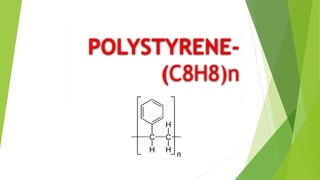
Polystyrene

  • 2.
    MATERIALS FOR PRODUCTIONOF POLYSTYRENE  BASIC STUFF FOR PRODUCTION OF MATERIALS FROM PLASTIC IS OIL.  MATERIALS FOR PRODUCTION OF STYRENE:  *BENZENE  *ETHYLENE
  • 3.
    HISTORY  POLYSTYRENE WASDISCOVERED IN 1839 BY EDUARD SIMON,AN APOTHECARY FROM BERLIN  From storax, the resin of the Turkish sweetgum treeLiquidambar orientalis, he distilled an oily substance, a monomer that he named styrol.  In 1866 Marcelin Berthelot correctly identified the formation of metastyrol/Styroloxyd from styrol as a polymerization process.  The crystal structure of isotactic polystyrene was reported by Giulio Natta.
  • 4.
     In 1954,the Koppers Company in Pittsburgh, Pennsylvania, developed expanded polystyrene (EPS) foam under the trade name Dylite.  In 1960, Dart Container, the largest manufacturer of foam cups, shipped their first order.  In 1988, the first U.S. ban of general polystyrene foam was enacted in Berkeley, California.
  • 5.
    PRODUCTION OF POLYSTYRENE POLYSTYRENE IS PREPARED BY POLYMYSERATION OF STYRENE  IT CAN BE REALISED BY VARIOUS TECHNIQUES: SOLUTION POLYMERISATION BLOCK POLYMERISATION EMULSION POLYMERISATION SUSPENSION POLYMERISATION
  • 6.
    AREAS OF EXPLOITATIONOF POLYSTYRENE  BUILDING INDUSTRY  INSULANT CONTAINER  FINISHING PRODUCTS  GAMES,MODELLING,DECORATION  TECHNICAL PRODUCTS  TRAFFIC AND STORE RESOURCES  PACKING MATERIALS  PACKAGING RESOURCES  DIMENSION TIMBER
  • 7.
    PHYSICAL PROPERTIES Polystyrene hasgood thermal and electrical insulation properties Density of EPS 16–640 kg/m3[15] Young's modulus (E) 3000–3600 MPa Tensile strength (st) 46–60 MPa Elongation at break 3–4% Notch test 2–5 kJ/m2 Glass transition temperature 100 °C[16] Vicat B 90 °C[17] Linear expansion coefficient (a) 8×10⁻⁵ /K Specific heat (c) 1.3 kJ/(kg·K) Water absorption (ASTM) 0.03–0.1 Decomposition X years, still decaying
  • 8.
    CHEMICAL PROPERTIES  Polystyreneis chemically inert, and does not react with most substances.  The transformation of carbon-carbon double bonds into less reactive single bonds in polystyrene, is the main reason for its chemical stability. Most of the chemical properties of polystyrene are as a result of the unique properties of carbon.
  • 9.
     It dissolvesin some organic solvents. It is soluble in solvents that contain acetone, such as most aerosol paint sprays and cyanoacrylate glues.  It is highly flammable and burns with an orange yellow flame, giving off carbon particles or soot, as a characteristic of all aromatic hydrocarbons. Polystyrene, on complete oxidation, produces only carbon dioxide and water vapour.
  • 10.