PVC
What is PVC?
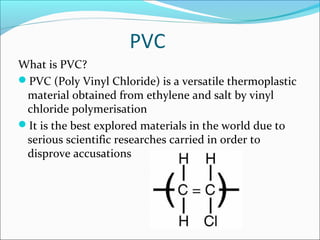
PVC (Poly Vinyl Chloride) is a versatile thermoplastic
material obtained from ethylene and salt by vinyl
chloride polymerisation
It is the best explored materials in the world due to
serious scientific researches carried in order to
disprove accusations
Synthesis of PVC
Suspension polymerisation:
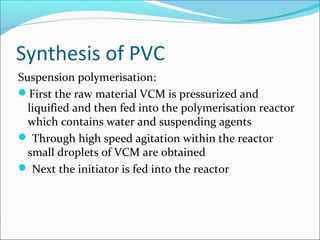
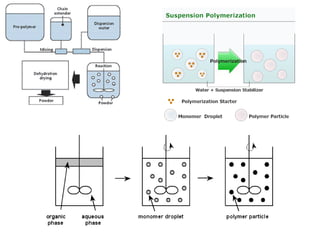
First the raw material VCM is pressurized and
liquified and then fed into the polymerisation reactor
which contains water and suspending agents
 Through high speed agitation within the reactor
small droplets of VCM are obtained
 Next the initiator is fed into the reactor
PVC is produced by reaction under a few bar at
40⁰ C – 60⁰ C
PVC obtained through suspension polymerisation is
suspended in water as particles of 50 – 200 µm
Therefore the slurry discharged from the
polymerisation reactor is stripped of residual
monomer, dehydrated and the particle size is
controlled by screening to yield PVC in the form of
white powder
Applications of PVC
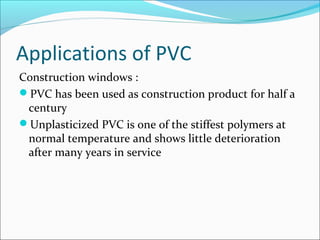
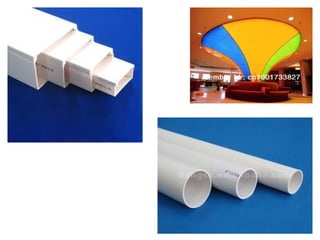
Construction windows :
PVC has been used as construction product for half a
century
Unplasticized PVC is one of the stiffest polymers at
normal temperature and shows little deterioration
after many years in service
Health Care – Blood Bags:
Flexible PVC is used to make storage bags and in fact
the only material approved by the European
pharmacopoeia
The other health care products of PVC are
i)Artificial skin
ii)Blood transfusion sets
iii) Blood vessels for artificial kidneys
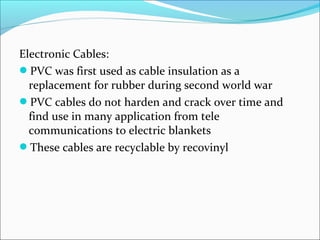
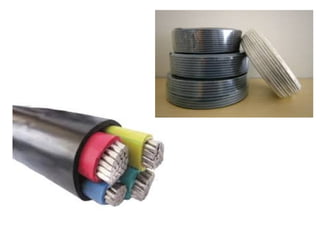
Electronic Cables:
PVC was first used as cable insulation as a
replacement for rubber during second world war
PVC cables do not harden and crack over time and
find use in many application from tele
communications to electric blankets
These cables are recyclable by recovinyl
Automotives – Cars:
PVC brings both high performance qualities and
important cost benefits to the automotive industry
Instrument panels, seat coverings, head lining,
protective strips, floor coverings and anti stone
damage protection are things done by using PVC
Sports:
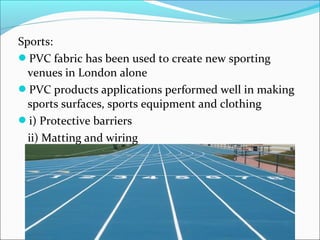
PVC fabric has been used to create new sporting
venues in London alone
PVC products applications performed well in making
sports surfaces, sports equipment and clothing
i) Protective barriers
ii) Matting and wiring
Properties
i) Weathering stability:
PVC is resistive to aggressive environmental factors
is therefore the material of choice for roofing
ii) Versatility:
PVC can be flexible and rigid
iii) Fire Protection:
PVC is a material resistant to ignition due to its
chlorine content
iv) Longevity:
PVC products can last upto 100 years and even more
v) Energy Recovery:
PVC has high thermal power
When utilized in incinerators PVC provides power
and heat for home and industry
vi) Barrier Properties:
PVC can be made impervious to liquids and vapours
vii) Recyclability:
PVC is recyclable more than other plastics
viii) Economical Efficiency:
PVC is the cheapest of the large tonnage polymers
providing many products with the best quality price
ratio
THANK
YOU

Pvc

  • 1.
    PVC What is PVC? PVC(Poly Vinyl Chloride) is a versatile thermoplastic material obtained from ethylene and salt by vinyl chloride polymerisation It is the best explored materials in the world due to serious scientific researches carried in order to disprove accusations
  • 2.
    Synthesis of PVC Suspensionpolymerisation: First the raw material VCM is pressurized and liquified and then fed into the polymerisation reactor which contains water and suspending agents  Through high speed agitation within the reactor small droplets of VCM are obtained  Next the initiator is fed into the reactor
  • 4.
    PVC is producedby reaction under a few bar at 40⁰ C – 60⁰ C PVC obtained through suspension polymerisation is suspended in water as particles of 50 – 200 µm Therefore the slurry discharged from the polymerisation reactor is stripped of residual monomer, dehydrated and the particle size is controlled by screening to yield PVC in the form of white powder
  • 5.
    Applications of PVC Constructionwindows : PVC has been used as construction product for half a century Unplasticized PVC is one of the stiffest polymers at normal temperature and shows little deterioration after many years in service
  • 7.
    Health Care –Blood Bags: Flexible PVC is used to make storage bags and in fact the only material approved by the European pharmacopoeia The other health care products of PVC are i)Artificial skin ii)Blood transfusion sets iii) Blood vessels for artificial kidneys
  • 9.
    Electronic Cables: PVC wasfirst used as cable insulation as a replacement for rubber during second world war PVC cables do not harden and crack over time and find use in many application from tele communications to electric blankets These cables are recyclable by recovinyl
  • 11.
    Automotives – Cars: PVCbrings both high performance qualities and important cost benefits to the automotive industry Instrument panels, seat coverings, head lining, protective strips, floor coverings and anti stone damage protection are things done by using PVC
  • 13.
    Sports: PVC fabric hasbeen used to create new sporting venues in London alone PVC products applications performed well in making sports surfaces, sports equipment and clothing i) Protective barriers ii) Matting and wiring
  • 15.
    Properties i) Weathering stability: PVCis resistive to aggressive environmental factors is therefore the material of choice for roofing ii) Versatility: PVC can be flexible and rigid iii) Fire Protection: PVC is a material resistant to ignition due to its chlorine content
  • 16.
    iv) Longevity: PVC productscan last upto 100 years and even more v) Energy Recovery: PVC has high thermal power When utilized in incinerators PVC provides power and heat for home and industry vi) Barrier Properties: PVC can be made impervious to liquids and vapours
  • 17.
    vii) Recyclability: PVC isrecyclable more than other plastics viii) Economical Efficiency: PVC is the cheapest of the large tonnage polymers providing many products with the best quality price ratio
  • 18.