ENGINEERING
MATERIALS
By
Dr. Jagadale S.K
Assistant Prof. Engineering Chemistry
S.B.Patil College Of Engineering,
Indapur
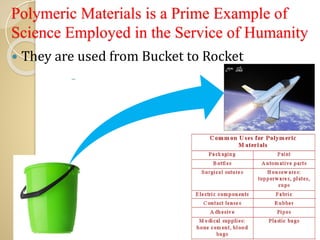
Polymeric Materials is a Prime Example of
Science Employed in the Service of Humanity
 They are used from Bucket to Rocket
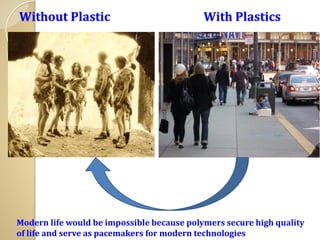
Without Plastic With Plastics
Modern life would be impossible because polymers secure high quality
of life and serve as pacemakers for modern technologies
Synthetic Polymers used as Substitute
or Alternative Materials for…………..
 Metals
 Wood
 Cotton & Wool
 Gums
 Glass
 Conductors & Insulators
 Ceramics
Properties of Synthetic Polymer
 Low Density ( light in weight).
 Resistance to Chemicals.
 Thermal & Electrical insulator.
 Flexible, Soft and less brittle.
 Good plasticity ( Easy molding).
 Elasticity.
 Ability to absorb Shock, Sound and
Vibrations.
 Some are Transparent like Glass.
 Some can act as Adhesive.
 Thermal Stability.
 Can be given Attractive colors.
Disadvantages
 Combustible
 Softer
 Costly
 Temperature limitation
 Limited Mechanical strength.
 Not Biodegradable easily &
poses problem of pollution.
DIFFERENT TERMS IN POLYMERS
 Polymer :- A polymer is defined as the
substance having very high molecular
weight & is made of many repeating small
molecular units that are joined to each
other by the covalent bond.
 e.g i) Polyvinyl chloride (PVC)
ii) Polyester (PS)
iii) Polyethylene (PE)
iv) Nylon-6
v) Polypropylene (PP)
MONOMER :
i)Simple chemical substance of low molecular weight
converted in to a polymer
ii) They have reactive positions or Functional groups, at
least bi-functionality
iii)Monomer has the easily reacting position in the form of
either functional group or in the form of C=C.
vi) Acts as building blocks of polymer.
v)These functional group like -COOH, - OH, -NH2, -
COOR, -Cl, C=N, cyclic amide, lactone , anhydride group.
vi)Hydrogen atoms at ortho & para on the activated
aromatic rings also used.
Polymerization: The chemical process of converting
monomer into polymer molecule.
FUNCTIONALITY OF MONOMERS
 The number of reactive position or groups in the molecule
of monomer.
 Monomers may contain two, three, four functional group
 BI-FUNCTIONAL :- Monomer molecule contain two reacting
groups & it forms a linear polymer
e.g HO-CH2-CH2-OH Ethylene Glycol
NH2-CH2-COOH Glycine
CH2=CH-Cl Vinyl chloride
CH2=CH-C6H5 Styrene
HOOC-(CH2)4-COOH Adipic Acid
 TRI-FUNCTIONAL :- It has three reactive position & forms
highly branched polymer. e.g Phenol, Glycerol, Epichlorhydrin
 TETRA-FUNCTIONAL :- It has four reactive position & forms
three dimensional network or cross linked polymer.
Eg. Acetylene, Urea , Butadiene, Maleic Anhydride, Dimethylol Urea.
DEGREE OF POLYMERIZATION (Dp)
 ‘Average number of repeating units
present in the molecule of the polymer.’
 Helps to know the size of polymer molecule.
 Dp is depends on- Time , temperature, concentration
of monomer & the initiator (catalyst).
 Strength of the polymer increases with increase in Dp
in a non linear way.
 Polymer to have desirable properties it must have Dp
at least 20,000 molecular Wt.
ADDITION POLYMERIZATION REACTION MECHANISM
 i)This polymerization reaction involves use of
initiator like free radical or reactive cationic or
anion or co-ordination catalyst.
 ii)No by-product formation.
 iii)This mechanism involves Initiation,
Propagation, & Termination.
 iv)C=C in the monomer is utilized for
polymerization.
 v)The reaction is highly Exothermic.
 vi)Polymer molecules ends are not reactive or
dead.
 vii)This reaction proceeds fast.
 viii)Polymer molecule formula is an exact multiple
of monomer molecule formula.
B)CONDENSATION POLYMERIZATION REACTION MECHANISM
 Polymer formed by reaction between the reactive functional
groups present in monomer molecule. The reaction takes place
slowly in stepwise manner.
CHARACTERISTICS OF CONDENSATION OR STEP POLYMERIZATION
 i)Catalyst may or may not be required.
 ii)There is formation of simple by- product along with polymer.
 iii)Mechanism involves condensation reaction between functional
group of monomer.
 iv)Functional groups like –COOH, -OH, -COOR, -NH2 used for
condensation reaction.
 v)The reaction is endothermic & proceeds slowly
 vi)The polymer molecules ends are reactive or live.
 vii)Polymer molecule formula is not exact multiple monomer
molecule formula.
 e.g Nylon-6, Nylon66, Bakelite, Epoxy Resin, Urea- Formaldehyde
Resin.
COMPOUNDING OF PLASTIC
It is a process by which polymers mixed with additives to impart
some special desirable properties to the final product.
The main types of additives & their functions are described below.
 1)Fillers :- Cheap materials – Saw dust, Sand powder,BaSO4,
Glass fibers, Clay, Carbon black,CaCO3,Metal powder and
quartz etc. It reduces cost of plastic. Increases mechanical strength
& imparts some special properties to plastic.
Air is used as filler in foamed plastic.
 2) Resin or Binders :-
i) It is used for obtaining thermosetting polymer.
ii) when thermosoftaning polymer mixed with cross linking agent
on heating produce thermosetting polymer.
 3) Color pigments :- They are used to impart color to plastic.
a) Pigments – pigments impart opaque (non transparent)
coloration.
b) Dyes –dye impart transparent coloration.
e.g. Organic dyes, carbon black, Inorganic Oxides.
 4) Stabilizers :- They are of following types
a) Heat stabilizer – They prevent thermal degradation at
high temperature.
e.g Pd, Cd, & Ba salts.
b) Light stabilizer – They protect polymer from u.v light
which degrade polymer. E.g Titanium dioxide
c) Antioxidants :- Antioxidants prevent oxidative
degradation of polymer. e.g phenol, amines etc.
 5) Plasticizer :-
i) Commonly used plasticizer are vegetable oil, ester of
Phthalic acid or Steric acid, Tri-butyl phosphate, Tri-phenyl
phosphate.
ii) They decrease the intermolecular force of attraction due to
the separation between polymer molecules.
 Plasticizer has following functions :-
i)Reduces softening temperature of plastic & makes molding easier
ii)Increases plasticity, flexibility of plastic.
iii)Reduces the solvent & chemical resistance of plastic.
iv)Make polymer more amorphous by decreasing strength.
v) It reduces Tg of the plastic.
 6) Lubricants :-
i) Lubricating material oil, waxes, Vaseline applied to inner side of
mold before a plastic is molded.
ii) This helps in easier molding & glossy finish to molded article.
iii) Lubricant prevent plastic material from sticking to molding
equipment.
 7) Accelerators :-
i) Accelerators increases the rate of formation of thermosetting
polymer during molding by the use of some catalyst like benzoyl
peroxide, transition metal oxides, Cu, lead, are mixed in small
amount in the resin.
 e.g Oxalic acid, ZnO, CaO.
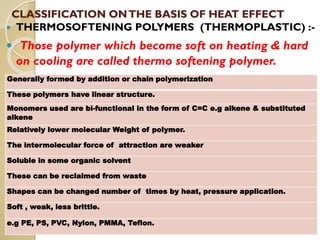
CLASSIFICATION ONTHE BASIS OF HEAT EFFECT
 THERMOSOFTENING POLYMERS (THERMOPLASTIC) :-
 Those polymer which become soft on heating & hard
on cooling are called thermo softening polymer.
Generally formed by addition or chain polymerization
These polymers have linear structure.
Monomers used are bi-functional in the form of C=C e.g alkene & substituted
alkene
Relatively lower molecular Weight of polymer.
The intermolecular force of attraction are weaker
Soluble in some organic solvent
These can be reclaimed from waste
Shapes can be changed number of times by heat, pressure application.
Soft , weak, less brittle.
e.g PE, PS, PVC, Nylon, PMMA, Teflon.
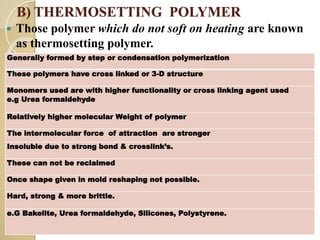
B) THERMOSETTING POLYMER
 Those polymer which do not soft on heating are known
as thermosetting polymer.
Generally formed by step or condensation polymerization
These polymers have cross linked or 3-D structure
Monomers used are with higher functionality or cross linking agent used
e.g Urea formaldehyde
Relatively higher molecular Weight of polymer
The intermolecular force of attraction are stronger
Insoluble due to strong bond & crosslink’s.
These can not be reclaimed
Once shape given in mold reshaping not possible.
Hard, strong & more brittle.
e.G Bakelite, Urea formaldehyde, Silicones, Polystyrene.
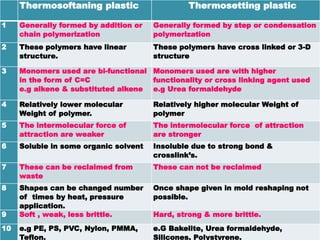
Thermosoftaning plastic Thermosetting plastic
1 Generally formed by addition or
chain polymerization
Generally formed by step or condensation
polymerization
2 These polymers have linear
structure.
These polymers have cross linked or 3-D
structure
3 Monomers used are bi-functional
in the form of C=C
e.g alkene & substituted alkene
Monomers used are with higher
functionality or cross linking agent used
e.g Urea formaldehyde
4 Relatively lower molecular
Weight of polymer.
Relatively higher molecular Weight of
polymer
5 The intermolecular force of
attraction are weaker
The intermolecular force of attraction
are stronger
6 Soluble in some organic solvent Insoluble due to strong bond &
crosslink’s.
7 These can be reclaimed from
waste
These can not be reclaimed
8 Shapes can be changed number
of times by heat, pressure
application.
Once shape given in mold reshaping not
possible.
9 Soft , weak, less brittle. Hard, strong & more brittle.
10 e.g PE, PS, PVC, Nylon, PMMA,
Teflon.
e.G Bakelite, Urea formaldehyde,
Silicones, Polystyrene.
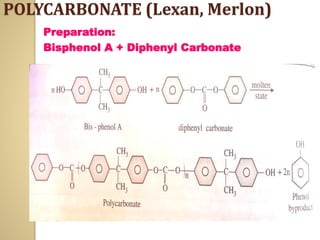
POLYCARBONATE (Lexan, Merlon)
Preparation:
Bisphenol A + Diphenyl Carbonate
Properties :
 It has high impact strength.
 It has Very high tensile strength.
 Transparent with refractive index 1.58
 It dissolves in organic solvents &
Alkali.
 Not resistant to UV.
 It is thermosoftaning, but resistance
to heat & flame.
 Its specific gravity is 1.2 gm/cc.,
 Tm=230-250 C & Tg =145 C
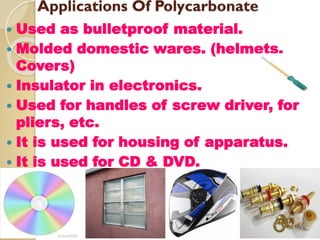
Applications Of Polycarbonate
 Used as bulletproof material.
 Molded domestic wares. (helmets,
Covers)
 Insulator in electronics.
 Used for handles of screw driver, for
pliers, etc.
 It is used for housing of apparatus.
 It is used for CD & DVD.
Biodegradable Polymer
 Biodegradation of polymer is a process of
converting polymer material into harmless
simple gaseous products (such as CO2, H2O,
NH3, CH4 ), by the action of enzymes of
micro-organisms and water.
 Following components are important .…
 A) Degradation by Micro-organism :-
Bacteria in the nature such as
pseudomonas, bacilli, protozoa, fungi act on
polymer & break C-C bond slowly and
polymers degraded slowly.
 b) Degradation by Environment
The constituents of atmosphere
such as moisture, oxygen, ozone acts on the σ
bond in the polymer chain which result in
breaking of long polymer chains in to smaller
chain that finally get converted to low
molecular weight constituent such as NH3, CH4
, CO2, N2 & finally polymer is degraded
although the process is very slow.
 c) Nature of polymer
If the polymers contain functional groups
(condensation polymer) like –NH2, –COOH, -
OCOR such polymer undergo degradation
easily as these groups have tendency to absorb
water, moisture & swell & finally decompose.
Factors Accelerating Degradation
 Hydrophilic chain backbone of
polymer, with atoms like O,N,S in
polymer chain.
 Amorphous nature of polymer.
 Small size of polymer or high porosity.
Limitations
 Cannot manufactured on large scale.
 Are very costly.
 Do not possess required high
mechanical strengths.
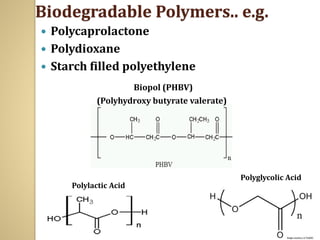
 Polycaprolactone
 Polydioxane
 Starch filled polyethylene
Biodegradable Polymers.. e.g.
Polylactic Acid
Polyglycolic Acid
Biopol (PHBV)
(Polyhydroxy butyrate valerate)
1) Medical field :
Polymers like Polylactic acid, Polyglycolic acid,
Polydioxane, are important in biomedical applications
like organ regeneration, Surgical sutures, Orthopedic
treatments, slow release drugs Also for making artificial
organ. It is useful in targeted drug delivery.
2) Moulded Articles:
Biodegradable polymers Biopol, Polycaprolactone
can be used for injection molding, blow molding for
common consumer applications. From biodegradable
polymers.
3) Packaging industry :
Biodegradable polymers like biopol, starch
filled polyethylene are used in packaging, lamination,
Carry bags, disposable bottles, because these polymer
do not causes pollution.
4) Agriculture : Mulching, Netting
Applications
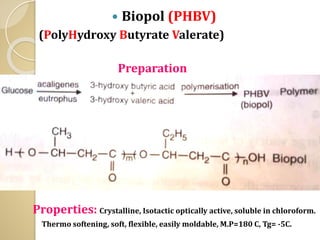
 Biopol (PHBV)
(PolyHydroxy Butyrate Valerate)
Properties: Crystalline, Isotactic optically active, soluble in chloroform.
Thermo softening, soft, flexible, easily moldable, M.P=180 C, Tg= -5C.
Preparation
Applications:
1.Moulded articles, films for packaging and
lamination.
2.Medical & veterinary applications.
3.Surgical sutures, orthopedic treatments,
sustained release of fertilizers.
4. Medicines & growth hormones for plants.
Conducting Polymer
 Polymers conduct electricity like metals, on doping.
 Two types: 1.Extrinsically conducting polymer
2.Intrinsically conducting polymer
If they have the following structural requirement.
 i) Must contain conjugation (i .e alternate δ & π
bond) throughout its chain so that there are
mobile electrons for conduction.
 ii) Highly crystalline & high planarity in structure.
 iii) Presence of aromatic rings in the chain with
continuous resonance, enhances conductivity.
 iv) Polymer has linear chain structure .
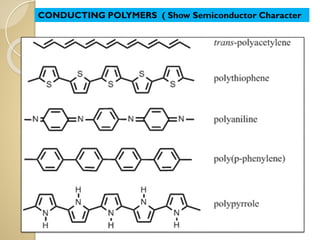
CONDUCTING POLYMERS ( Show Semiconductor Character
 INTRINSIC CONDUCTOR :-
 i) These polymers are linear & have high
planarity in structure & possess conjugation
(alternate double bond & single bond) in the
polymer chain.
 ii) When electric field is applied, conjugated π
electrons of the polymer get excited & can be
transported through the polymer.
 iii) Increase in conjugation increase the
conductivity to a largest extent.
e.g. i) Transpolyacetylene ii)Polyaniline
iii) Poly(para)phenylene iv) Polypyrrole
v) Polythiophene
TWO Types Of Conductor
 EXTRINSIC CONDUCTOR :-
 If the polymers are made conducting by doping
it is called extrinsic conductors. There are two
types,
A]P-TYPE DOPING OR OXIDATIVE DOPING :-
 i) Doping of suitable oxidizing agent to
conjugated polymer chains. (Lewis acid like I2,
Br2, FeCl2, PF6)
 ii) The oxidizing agents extract a pair of π
electrons from chain & make it a positively
charged cation.
iii) Delocalization of positive charge (hole)
takes place over the whole polymer chain & it
becomes conducting.
B] N-TYPE DOPING OR REDUCTIVE DOPING
 i) A suitable reducing agent lewis base (Na, Li, K,
Metals, napthyl amines) are added to conjugated
polymer chain which donate a pair of electron to
polymer chain.
 ii) This makes the polymer chain negatively
charged anion & it becomes conducting.
 e.g. Polyacetylene + Na
 iii) This is called reductive doping because polymer
chain has accepted electrons from the metal atom.
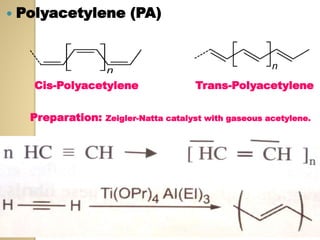
 Polyacetylene (PA)
Cis-Polyacetylene Trans-Polyacetylene
Preparation: Zeigler-Natta catalyst with gaseous acetylene.
Properties:
1.Cis form is flexible & coppery, trans form is
silvery and brittle.
2. PA has bulk density 0.4 g/cm3
3. Insoluble in solvents, difficult to process
the material
4. High thermal stability
5. When PA is exposed to air oxidation takes
place.
Applications of Doped PA
i) In rechargeable light weight batteries doped conducting polymers
are used.
ii) Sensors :- Conductive polymers have chemical properties suitable
to use them as sensors for pH, O2, NO2, SO2, NH3, glucose,
reducing & oxidizing chemicals - study of their even very low
concentration.
iii) In electronics:- For photodiodes, light emitting wall papers, light
emitting diodes (LED) & data storage.
iv) In optical display devices.
v) In telecommunication system.
vi) As antistatic material : To avoid static electricity in plastic
carpets in offices, theaters, explosive industry, computer industry.
vii) In Molecular wires & Molecular switches.
viii) In Solar Cells .
ix) As Optical filter to absorb radiation from computer screen.
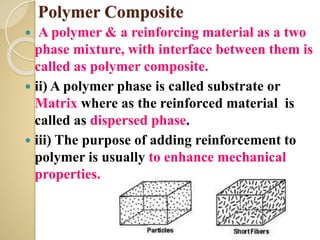
Polymer Composite
 A polymer & a reinforcing material as a two
phase mixture, with interface between them is
called as polymer composite.
 ii) A polymer phase is called substrate or
Matrix where as the reinforced material is
called as dispersed phase.
 iii) The purpose of adding reinforcement to
polymer is usually to enhance mechanical
properties.
FUNCTIONS OF MATRIX CONSTITUENT IN
POLYMER COMPOSITE
i)To bind reinforcing particle/fibers strongly.
ii) It acts as medium for distribution of
applied load to the dispersal phase.
iii) It keeps the reinforcing fibers in proper
orientation for the high strength
development. Depending on the nature of
reinforced material.
iv) It prevents propagation of cracks due to
its plasticity.
Important Dispersed Phases
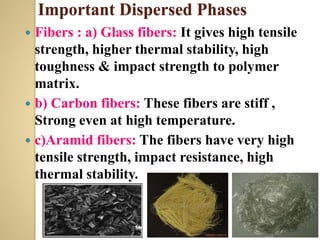
 Fibers : a) Glass fibers: It gives high tensile
strength, higher thermal stability, high
toughness & impact strength to polymer
matrix.
 b) Carbon fibers: These fibers are stiff ,
Strong even at high temperature.
 c)Aramid fibers: The fibers have very high
tensile strength, impact resistance, high
thermal stability.
 Classification of Composites
 a) Particle reinforced polymer composites
The material having particle nature such as
metal oxides, Metal powder, Nano-particles,
dust, Carbon black, Metal carbides, Silica
powder, mica, various salts are used for
reinforcement.
 b) Fiber reinforced polymer composites
The materials having fibrous nature such as
glass, wool, carbon fibers, aramid fibers, silicon
carbide fibers, aluminum oxide fibers, cellulose are
added to the polymer matrix as dispersed phase.
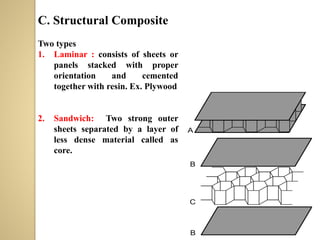
C. Structural Composite
Two types
1. Laminar : consists of sheets or
panels stacked with proper
orientation and cemented
together with resin. Ex. Plywood
2. Sandwich: Two strong outer
sheets separated by a layer of
less dense material called as
core.
Properties of glass reinforced Composite
 Low density 2.5gm/cc.
 Low coefficients of expansion.
 High mechanical strength and heat stability.
 High dimensional stability.
 High heat stability.
 Better abrasion resistance and high tensile
strength.
 Low cost of production.
 Better toughness and impact strength.
Application of polymer composites
Both thermosoftaning & thermosetting
plastics can be fiber/ particle reinforced.
 i) Automobile components such as main
body, chassis, racing vehicle components.
 ii) They used to making boat parts, air craft
shafts & aircraft components, Helicopters
etc.
 iii) Used in manufacturing of sports goods
(rackets), musical instruments, toys etc.
 iv) High speed machinery parts, bodies of
refrigerator, coolers, cabin for offices, doors,
windows etc.
Liquid Crystal Polymer (LCP)
 Liquid crystal polymer are those polymers which
have tendency to align their chains parallel over a
long distance before crystallization from their melt
or solution, under suitable conditions temperature ,
pressure and concentration are known as LCP .
 This means that in LCP, polymer chains are
present in the organized manner even when
the polymer is physically not crystallized.
 iii) This intermediate phase is called an
mesophase & individual polymer chains are
called as mesogens.
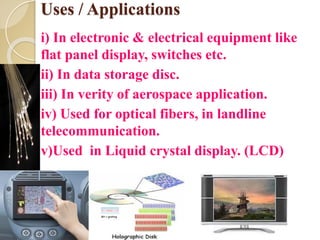
Uses / Applications
i) In electronic & electrical equipment like
flat panel display, switches etc.
ii) In data storage disc.
iii) In verity of aerospace application.
iv) Used for optical fibers, in landline
telecommunication.
v)Used in Liquid crystal display. (LCD)
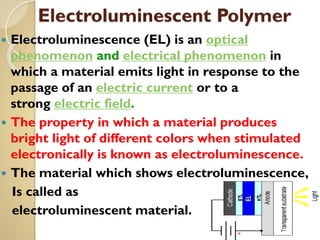
Electroluminescent Polymer
 Electroluminescence (EL) is an optical
phenomenon and electrical phenomenon in
which a material emits light in response to the
passage of an electric current or to a
strong electric field.
 The property in which a material produces
bright light of different colors when stimulated
electronically is known as electroluminescence.
 The material which shows electroluminescence,
Is called as
electroluminescent material.
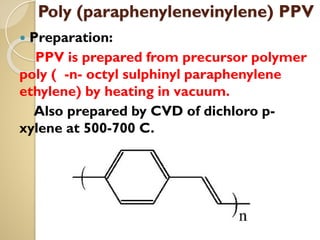
Poly (paraphenylenevinylene) PPV
 Preparation:
PPV is prepared from precursor polymer
poly ( -n- octyl sulphinyl paraphenylene
ethylene) by heating in vacuum.
Also prepared by CVD of dichloro p-
xylene at 500-700 C.
Properties:
 Self emitting device of high brightness.
 High efficiency
 Direct current low voltage operation
 No heat and Long life.
 High speed response.
Applications …..
 In the form of thin films for information
display.
 Automotive instrument panel
backlighting.
 Backlight for LCD’s
 Electroluminescent night lamps.
 Long life , full color displays.
 Flat panel displays.
 Photovoltaic cells.
 Theatre,Assembly hall decoration.
 Light stripes for decorating buildings &
vehicle safety precautions.
 Nanomaterials are the materials in which
particle size ranges from 1 nm to 100nm.
 Study and use of these particles called as
Nanotechnology.
 They can be found in such things as sunscreens
(ZnO), cosmetics, sporting goods, stain-resistant
clothing, tires, electronics, as well as many other
everyday items, and are used in medicine for
purposes of diagnosis, imaging and drug delivery.
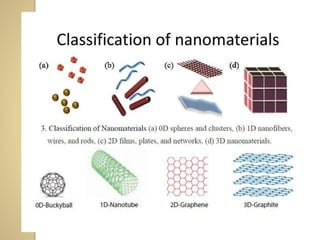
Introduction to Nanomaterials
Classification of Nanomaterials
1. Zero dimensional nanomaterials
Def: The nanomaterials have all dimensions within nanoscale range and larger than 100 nm.
Properties: crystalline or polycrystalline in structure, crystalline or amorphous in nature and
exist individually or in matrix.
Ex. Quantum dots, core shell, heterogeneous particles, hollow spheres etc.
Applications: LED’s solar cells, lasers etc.
2. One dimensional nanomaterials
Def: The nanomaterials have two dimension within nanoscale range and one dimension at
macro scale.
Ex. Nanowires, nanorods, nanotubes, nanofilms, Nano ribbons etc.
Applications: Thin films used in Si IC industry.
Thin films with large surface area are important for applications like fuel cells
and catalysis.
3. Two dimensional nanomaterials
Def: The nanomaterials have one dimension within nanoscale range and two dimension at
macro scale. These are in the form of layers & used as single layer or multilayer.
Ex. CNT’s, Nanoplates, Nanosheets, Nanowalls, Nanodiscs etc.
Applications: Nanodevices, Sensors, photocatalysis, Nanoreactors
CNT’s: SW or MW, diameter in nm and microns to mm in length, flexible, mechanically
strong, and conductors.
Used in reinforced composites, Sensors, nanoelectronics, display devices etc.
4. Three dimensional nanomaterials
Def: These are the bulk nanomaterials which are not confined to
nanoscale in any dimension. (3 dimensions above 100nm scale).
Properties: Nanocrystalline structure, larger surface area due to
quantum effects.
Bulk materials composed of a multiple arrangement of nanosized
crystals in different orientations.
Their behavior depends upon shape, size and morphology – key
factors for performance and applications.
Ex. Fullerene, dispersed of nano particles, bundles of nanowires,
bundles of nanotubes, nanoballs, nanocoils etc.
Applications: Fullerene C60, C70, C540 important for ball
bearings to lubricate surfaces, drug delivery, vehicles and
electronic circuits.
2. They are important in catalysis, magnetic materials,
electrodes for batteries,
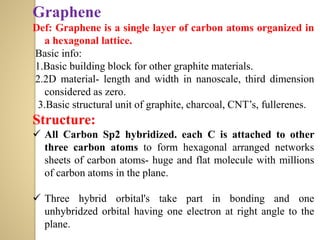
Graphene
Def: Graphene is a single layer of carbon atoms organized in
a hexagonal lattice.
Basic info:
1.Basic building block for other graphite materials.
2.2D material- length and width in nanoscale, third dimension
considered as zero.
3.Basic structural unit of graphite, charcoal, CNT’s, fullerenes.
Structure:
✓ All Carbon Sp2 hybridized. each C is attached to other
three carbon atoms to form hexagonal arranged networks
sheets of carbon atoms- huge and flat molecule with millions
of carbon atoms in the plane.
✓ Three hybrid orbital's take part in bonding and one
unhybridzed orbital having one electron at right angle to the
plane.
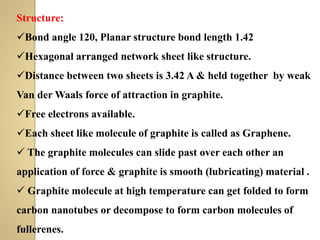
Structure:
✓Bond angle 120, Planar structure bond length 1.42
✓Hexagonal arranged network sheet like structure.
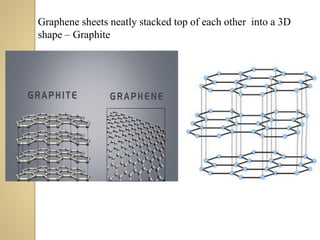
✓Distance between two sheets is 3.42 A & held together by weak
Van der Waals force of attraction in graphite.
✓Free electrons available.
✓Each sheet like molecule of graphite is called as Graphene.
✓ The graphite molecules can slide past over each other an
application of force & graphite is smooth (lubricating) material .
✓ Graphite molecule at high temperature can get folded to form
carbon nanotubes or decompose to form carbon molecules of
fullerenes.
Graphene sheets neatly stacked top of each other into a 3D
shape – Graphite
✓Preparation of Graphene
The Most common techniques available for the production of
Graphene includes Micromechanical cleavage, chemical vapor
deposition, epitaxial growth on SiC substrates, chemical
reduction of Graphene oxide etc.
Properties of Graphene
The most promising Nanomaterials because of its unique
combination, thinnest but also strongest, better conductor of
heats, & electricity, optically transparent, Impermeable to gases.
Electronic Properties
It is one of the best electrical conductors on earth.
The unique atomic arrangement of the carbon atom in Graphene
allows its electrons to easily travel at extremely high velocity
without the significant chance of scattering, saving precious
energy typically lost in other conductors.
Mechanical Properties
The intrinsic mechanical property its stiffness, strength &
toughness Graphene stand out both as an individual material &
as a reinforcing agent in composites.
The stiffness of Graphene is vary good & the experimental
value of the second order elastic stiffness was equal to 380
Nm-1. This value corresponds to a young's modules of 1.1 Tpa,
assuming an effective thickness of 0.335nm.
Strength
Defect free, monolayer Graphene is considered to be the
strongest material ever tested with a strength of 42Nm-1 which
equates to an intrinsic of 130GPa.
Toughness
Fracture toughness, which is very relevant property to
engineering applications, is one of the most important
mechanical properties of Graphene & was measured as a
critical stress intensity factor of 4.0 +- 0.6 Mpa.
Applications of Graphene
1.Energy storage & Solar cells
Graphene is used to improve both energy capacity & charge
rate in rechargeable batteries, activated Graphene makes
superior super capacitors for energy storage, Graphene
electrodes used for making solar cell are inexpensive,
lightweight & flexible & multifunctional.
Graphene is useful for solar cells, super capacitors, Graphene
batteries, & catalysis for fuel cells. Graphene sheets has high
strength & toughness in all sheet directions for diverse
applications as Graphene based composite for vehicles,
optoelectronics & neural implants.
2.Photovoltaic devices
Due to their excellent electron transport properties & extremely
high carrier mobility, Graphene & other direct band gap
monolayer materials such as Transition-Metal Dichalcogenides
(TMDCs) used for low-cost flexible & highly efficient.
3.Graphene Composites
It is the first ever Graphene infused carbon fiber helmet that
capitalizes on the materials thin strong & conductive, flexible &
light characteristics to create a helmet that absorbs & dissipates
impact better than your average helmet. It also disperses heat
more efficiently so its cooler.
Another example is the Graphene bike & bicycle. Enhancing
carbon fiber with Graphene allows to make lighter thinner tubes
that are stronger than regular carbon.
4.Sensors
Selective gas sensing with pristine Graphene, is also prepared.
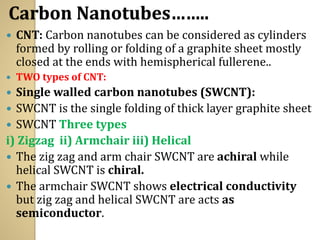
Carbon Nanotubes……..
 CNT: Carbon nanotubes can be considered as cylinders
formed by rolling or folding of a graphite sheet mostly
closed at the ends with hemispherical fullerene..
 TWO types of CNT:
 Single walled carbon nanotubes (SWCNT):
 SWCNT is the single folding of thick layer graphite sheet
 SWCNT Three types
i) Zigzag ii) Armchair iii) Helical
 The zig zag and arm chair SWCNT are achiral while
helical SWCNT is chiral.
 The armchair SWCNT shows electrical conductivity
but zig zag and helical SWCNT are acts as
semiconductor.
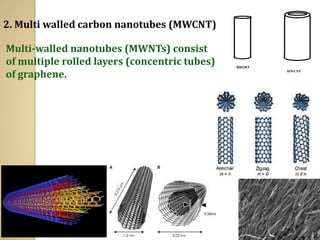
2. Multi walled carbon nanotubes (MWCNT)
Multi-walled nanotubes (MWNTs) consist
of multiple rolled layers (concentric tubes)
of graphene.
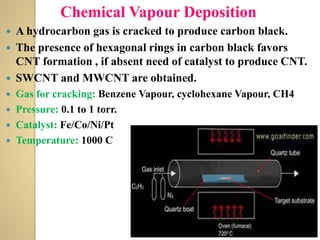
Chemical Vapour Deposition
 A hydrocarbon gas is cracked to produce carbon black.
 The presence of hexagonal rings in carbon black favors
CNT formation , if absent need of catalyst to produce CNT.
 SWCNT and MWCNT are obtained.
 Gas for cracking: Benzene Vapour, cyclohexane Vapour, CH4
 Pressure: 0.1 to 1 torr.
 Catalyst: Fe/Co/Ni/Pt
 Temperature: 1000 C
Properties………..
1.Mechanical properties:
✓ CNTs have exceptional mechanical stiffness and tensile
strength.
✓ CNTs are strongest and stiffest materials yet discovered
in terms of strength and elastic module (sp2 bonds).
2.They also show chemical stability, high electrical and
extraordinary thermal conductivity.
3.Optical properties: CNTs have useful absorption,
photoluminescence properties.
4.Electrical Conductivity:
✓ Semiconductor with Eg = 0-1eV.
✓ Made conducting by making its compounds with alkali
metals.
Applications of CNT………..
 Filtration- to separate particles of size greater than
diameter of CNT.
 To carry Stereospecific reactions.
 CNT as Nano cylinders for storing gas like hydrogen.
 Masks.
 Catalyst in some reactions.
 Coatings.
 Drug delivery System.
 Body part implants.
 Applications related to conductivity , in electronics.
Quantum Dots……..
 They are tiny semiconductor particles of a few
nanometers in size, having optical
and electronic properties that differ from larger
particles due to quantum effect.
 Typical dimensions 1 to 10nm
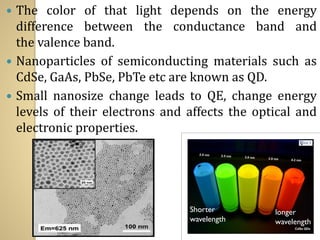
 QD are fluorescent Nanoparticles, when the quantum
dots are illuminated by UV light, can exhibit a range of
colors, depending upon their composition and size.
 An electron in the quantum dot excited to a state of
higher energy.
 In the case of a semiconducting quantum dot, this
process corresponds to the transition of an electron
from the valence band to the conductance band.
 The color of that light depends on the energy
difference between the conductance band and
the valence band.
 Nanoparticles of semiconducting materials such as
CdSe, GaAs, PbSe, PbTe etc are known as QD.
 Small nanosize change leads to QE, change energy
levels of their electrons and affects the optical and
electronic properties.
Shorter
wavelength
longer
wavelength
Properties of QD
1. Optoelectronic Properties:
✓Quantum dots have properties intermediate between
bulk semiconductors and discrete atoms or molecules.
✓Their optoelectronic properties change as a function of
both size and shape.
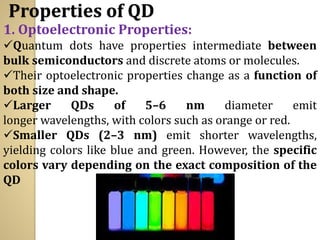
✓Larger QDs of 5–6 nm diameter emit
longer wavelengths, with colors such as orange or red.
✓Smaller QDs (2–3 nm) emit shorter wavelengths,
yielding colors like blue and green. However, the specific
colors vary depending on the exact composition of the
QD
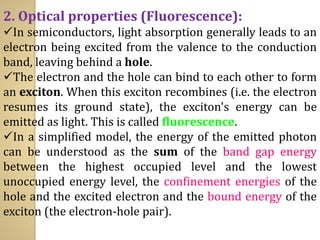
2. Optical properties (Fluorescence):
✓In semiconductors, light absorption generally leads to an
electron being excited from the valence to the conduction
band, leaving behind a hole.
✓The electron and the hole can bind to each other to form
an exciton. When this exciton recombines (i.e. the electron
resumes its ground state), the exciton's energy can be
emitted as light. This is called fluorescence.
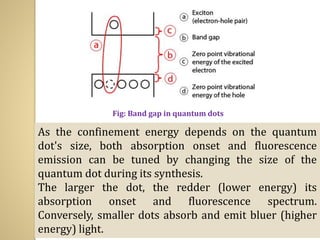
✓In a simplified model, the energy of the emitted photon
can be understood as the sum of the band gap energy
between the highest occupied level and the lowest
unoccupied energy level, the confinement energies of the
hole and the excited electron and the bound energy of the
exciton (the electron-hole pair).
Fig: Band gap in quantum dots
As the confinement energy depends on the quantum
dot's size, both absorption onset and fluorescence
emission can be tuned by changing the size of the
quantum dot during its synthesis.
The larger the dot, the redder (lower energy) its
absorption onset and fluorescence spectrum.
Conversely, smaller dots absorb and emit bluer (higher
energy) light.
Quantum Dots Applications……..
A. In Electronics:
1.Have applications in thermoelectric, Solar cells and
fluorescent biological labels.
2.Quantum dot displays for more accurate colors.
3.Light emitting diodes are prepared by using quantum dots
such as QD-LED, QD-WLED displays.
B. In biology: Superior drugs and chemical transport,
Study of intracellular processes at the single molecule level,
high resolution cellular imaging, cell trafficking, tumor
targeting and diagnosis, antibacterial application.
C. Stability of fluorescent dyes:
QD coupled with OD to prepare dyes with 20 times brighter
and 100 times stable than traditional fluorescent dyes.
ANY
QUESTIONS…..
Thank You

Engineering materials:Polymer

  • 1.
    ENGINEERING MATERIALS By Dr. Jagadale S.K AssistantProf. Engineering Chemistry S.B.Patil College Of Engineering, Indapur
  • 2.
    Polymeric Materials isa Prime Example of Science Employed in the Service of Humanity  They are used from Bucket to Rocket
  • 3.
    Without Plastic WithPlastics Modern life would be impossible because polymers secure high quality of life and serve as pacemakers for modern technologies
  • 4.
    Synthetic Polymers usedas Substitute or Alternative Materials for…………..  Metals  Wood  Cotton & Wool  Gums  Glass  Conductors & Insulators  Ceramics
  • 5.
    Properties of SyntheticPolymer  Low Density ( light in weight).  Resistance to Chemicals.  Thermal & Electrical insulator.  Flexible, Soft and less brittle.  Good plasticity ( Easy molding).  Elasticity.  Ability to absorb Shock, Sound and Vibrations.  Some are Transparent like Glass.  Some can act as Adhesive.  Thermal Stability.  Can be given Attractive colors.
  • 6.
    Disadvantages  Combustible  Softer Costly  Temperature limitation  Limited Mechanical strength.  Not Biodegradable easily & poses problem of pollution.
  • 8.
    DIFFERENT TERMS INPOLYMERS  Polymer :- A polymer is defined as the substance having very high molecular weight & is made of many repeating small molecular units that are joined to each other by the covalent bond.  e.g i) Polyvinyl chloride (PVC) ii) Polyester (PS) iii) Polyethylene (PE) iv) Nylon-6 v) Polypropylene (PP)
  • 9.
    MONOMER : i)Simple chemicalsubstance of low molecular weight converted in to a polymer ii) They have reactive positions or Functional groups, at least bi-functionality iii)Monomer has the easily reacting position in the form of either functional group or in the form of C=C. vi) Acts as building blocks of polymer. v)These functional group like -COOH, - OH, -NH2, - COOR, -Cl, C=N, cyclic amide, lactone , anhydride group. vi)Hydrogen atoms at ortho & para on the activated aromatic rings also used. Polymerization: The chemical process of converting monomer into polymer molecule.
  • 10.
    FUNCTIONALITY OF MONOMERS The number of reactive position or groups in the molecule of monomer.  Monomers may contain two, three, four functional group  BI-FUNCTIONAL :- Monomer molecule contain two reacting groups & it forms a linear polymer e.g HO-CH2-CH2-OH Ethylene Glycol NH2-CH2-COOH Glycine CH2=CH-Cl Vinyl chloride CH2=CH-C6H5 Styrene HOOC-(CH2)4-COOH Adipic Acid  TRI-FUNCTIONAL :- It has three reactive position & forms highly branched polymer. e.g Phenol, Glycerol, Epichlorhydrin  TETRA-FUNCTIONAL :- It has four reactive position & forms three dimensional network or cross linked polymer. Eg. Acetylene, Urea , Butadiene, Maleic Anhydride, Dimethylol Urea.
  • 11.
    DEGREE OF POLYMERIZATION(Dp)  ‘Average number of repeating units present in the molecule of the polymer.’  Helps to know the size of polymer molecule.  Dp is depends on- Time , temperature, concentration of monomer & the initiator (catalyst).  Strength of the polymer increases with increase in Dp in a non linear way.  Polymer to have desirable properties it must have Dp at least 20,000 molecular Wt.
  • 12.
    ADDITION POLYMERIZATION REACTIONMECHANISM  i)This polymerization reaction involves use of initiator like free radical or reactive cationic or anion or co-ordination catalyst.  ii)No by-product formation.  iii)This mechanism involves Initiation, Propagation, & Termination.  iv)C=C in the monomer is utilized for polymerization.  v)The reaction is highly Exothermic.  vi)Polymer molecules ends are not reactive or dead.  vii)This reaction proceeds fast.  viii)Polymer molecule formula is an exact multiple of monomer molecule formula.
  • 13.
    B)CONDENSATION POLYMERIZATION REACTIONMECHANISM  Polymer formed by reaction between the reactive functional groups present in monomer molecule. The reaction takes place slowly in stepwise manner. CHARACTERISTICS OF CONDENSATION OR STEP POLYMERIZATION  i)Catalyst may or may not be required.  ii)There is formation of simple by- product along with polymer.  iii)Mechanism involves condensation reaction between functional group of monomer.  iv)Functional groups like –COOH, -OH, -COOR, -NH2 used for condensation reaction.  v)The reaction is endothermic & proceeds slowly  vi)The polymer molecules ends are reactive or live.  vii)Polymer molecule formula is not exact multiple monomer molecule formula.  e.g Nylon-6, Nylon66, Bakelite, Epoxy Resin, Urea- Formaldehyde Resin.
  • 14.
    COMPOUNDING OF PLASTIC Itis a process by which polymers mixed with additives to impart some special desirable properties to the final product. The main types of additives & their functions are described below.  1)Fillers :- Cheap materials – Saw dust, Sand powder,BaSO4, Glass fibers, Clay, Carbon black,CaCO3,Metal powder and quartz etc. It reduces cost of plastic. Increases mechanical strength & imparts some special properties to plastic. Air is used as filler in foamed plastic.  2) Resin or Binders :- i) It is used for obtaining thermosetting polymer. ii) when thermosoftaning polymer mixed with cross linking agent on heating produce thermosetting polymer.  3) Color pigments :- They are used to impart color to plastic. a) Pigments – pigments impart opaque (non transparent) coloration. b) Dyes –dye impart transparent coloration. e.g. Organic dyes, carbon black, Inorganic Oxides.
  • 15.
     4) Stabilizers:- They are of following types a) Heat stabilizer – They prevent thermal degradation at high temperature. e.g Pd, Cd, & Ba salts. b) Light stabilizer – They protect polymer from u.v light which degrade polymer. E.g Titanium dioxide c) Antioxidants :- Antioxidants prevent oxidative degradation of polymer. e.g phenol, amines etc.  5) Plasticizer :- i) Commonly used plasticizer are vegetable oil, ester of Phthalic acid or Steric acid, Tri-butyl phosphate, Tri-phenyl phosphate. ii) They decrease the intermolecular force of attraction due to the separation between polymer molecules.
  • 16.
     Plasticizer hasfollowing functions :- i)Reduces softening temperature of plastic & makes molding easier ii)Increases plasticity, flexibility of plastic. iii)Reduces the solvent & chemical resistance of plastic. iv)Make polymer more amorphous by decreasing strength. v) It reduces Tg of the plastic.  6) Lubricants :- i) Lubricating material oil, waxes, Vaseline applied to inner side of mold before a plastic is molded. ii) This helps in easier molding & glossy finish to molded article. iii) Lubricant prevent plastic material from sticking to molding equipment.  7) Accelerators :- i) Accelerators increases the rate of formation of thermosetting polymer during molding by the use of some catalyst like benzoyl peroxide, transition metal oxides, Cu, lead, are mixed in small amount in the resin.  e.g Oxalic acid, ZnO, CaO.
  • 17.
    CLASSIFICATION ONTHE BASISOF HEAT EFFECT  THERMOSOFTENING POLYMERS (THERMOPLASTIC) :-  Those polymer which become soft on heating & hard on cooling are called thermo softening polymer. Generally formed by addition or chain polymerization These polymers have linear structure. Monomers used are bi-functional in the form of C=C e.g alkene & substituted alkene Relatively lower molecular Weight of polymer. The intermolecular force of attraction are weaker Soluble in some organic solvent These can be reclaimed from waste Shapes can be changed number of times by heat, pressure application. Soft , weak, less brittle. e.g PE, PS, PVC, Nylon, PMMA, Teflon.
  • 18.
    B) THERMOSETTING POLYMER Those polymer which do not soft on heating are known as thermosetting polymer. Generally formed by step or condensation polymerization These polymers have cross linked or 3-D structure Monomers used are with higher functionality or cross linking agent used e.g Urea formaldehyde Relatively higher molecular Weight of polymer The intermolecular force of attraction are stronger Insoluble due to strong bond & crosslink’s. These can not be reclaimed Once shape given in mold reshaping not possible. Hard, strong & more brittle. e.G Bakelite, Urea formaldehyde, Silicones, Polystyrene.
  • 19.
    Thermosoftaning plastic Thermosettingplastic 1 Generally formed by addition or chain polymerization Generally formed by step or condensation polymerization 2 These polymers have linear structure. These polymers have cross linked or 3-D structure 3 Monomers used are bi-functional in the form of C=C e.g alkene & substituted alkene Monomers used are with higher functionality or cross linking agent used e.g Urea formaldehyde 4 Relatively lower molecular Weight of polymer. Relatively higher molecular Weight of polymer 5 The intermolecular force of attraction are weaker The intermolecular force of attraction are stronger 6 Soluble in some organic solvent Insoluble due to strong bond & crosslink’s. 7 These can be reclaimed from waste These can not be reclaimed 8 Shapes can be changed number of times by heat, pressure application. Once shape given in mold reshaping not possible. 9 Soft , weak, less brittle. Hard, strong & more brittle. 10 e.g PE, PS, PVC, Nylon, PMMA, Teflon. e.G Bakelite, Urea formaldehyde, Silicones, Polystyrene.
  • 20.
  • 21.
    Properties :  Ithas high impact strength.  It has Very high tensile strength.  Transparent with refractive index 1.58  It dissolves in organic solvents & Alkali.  Not resistant to UV.  It is thermosoftaning, but resistance to heat & flame.  Its specific gravity is 1.2 gm/cc.,  Tm=230-250 C & Tg =145 C
  • 22.
    Applications Of Polycarbonate Used as bulletproof material.  Molded domestic wares. (helmets, Covers)  Insulator in electronics.  Used for handles of screw driver, for pliers, etc.  It is used for housing of apparatus.  It is used for CD & DVD.
  • 23.
    Biodegradable Polymer  Biodegradationof polymer is a process of converting polymer material into harmless simple gaseous products (such as CO2, H2O, NH3, CH4 ), by the action of enzymes of micro-organisms and water.  Following components are important .…  A) Degradation by Micro-organism :- Bacteria in the nature such as pseudomonas, bacilli, protozoa, fungi act on polymer & break C-C bond slowly and polymers degraded slowly.
  • 24.
     b) Degradationby Environment The constituents of atmosphere such as moisture, oxygen, ozone acts on the σ bond in the polymer chain which result in breaking of long polymer chains in to smaller chain that finally get converted to low molecular weight constituent such as NH3, CH4 , CO2, N2 & finally polymer is degraded although the process is very slow.  c) Nature of polymer If the polymers contain functional groups (condensation polymer) like –NH2, –COOH, - OCOR such polymer undergo degradation easily as these groups have tendency to absorb water, moisture & swell & finally decompose.
  • 25.
    Factors Accelerating Degradation Hydrophilic chain backbone of polymer, with atoms like O,N,S in polymer chain.  Amorphous nature of polymer.  Small size of polymer or high porosity. Limitations  Cannot manufactured on large scale.  Are very costly.  Do not possess required high mechanical strengths.
  • 26.
     Polycaprolactone  Polydioxane Starch filled polyethylene Biodegradable Polymers.. e.g. Polylactic Acid Polyglycolic Acid Biopol (PHBV) (Polyhydroxy butyrate valerate)
  • 27.
    1) Medical field: Polymers like Polylactic acid, Polyglycolic acid, Polydioxane, are important in biomedical applications like organ regeneration, Surgical sutures, Orthopedic treatments, slow release drugs Also for making artificial organ. It is useful in targeted drug delivery. 2) Moulded Articles: Biodegradable polymers Biopol, Polycaprolactone can be used for injection molding, blow molding for common consumer applications. From biodegradable polymers. 3) Packaging industry : Biodegradable polymers like biopol, starch filled polyethylene are used in packaging, lamination, Carry bags, disposable bottles, because these polymer do not causes pollution. 4) Agriculture : Mulching, Netting Applications
  • 28.
     Biopol (PHBV) (PolyHydroxyButyrate Valerate) Properties: Crystalline, Isotactic optically active, soluble in chloroform. Thermo softening, soft, flexible, easily moldable, M.P=180 C, Tg= -5C. Preparation
  • 29.
    Applications: 1.Moulded articles, filmsfor packaging and lamination. 2.Medical & veterinary applications. 3.Surgical sutures, orthopedic treatments, sustained release of fertilizers. 4. Medicines & growth hormones for plants.
  • 30.
    Conducting Polymer  Polymersconduct electricity like metals, on doping.  Two types: 1.Extrinsically conducting polymer 2.Intrinsically conducting polymer If they have the following structural requirement.  i) Must contain conjugation (i .e alternate δ & π bond) throughout its chain so that there are mobile electrons for conduction.  ii) Highly crystalline & high planarity in structure.  iii) Presence of aromatic rings in the chain with continuous resonance, enhances conductivity.  iv) Polymer has linear chain structure .
  • 31.
    CONDUCTING POLYMERS (Show Semiconductor Character
  • 32.
     INTRINSIC CONDUCTOR:-  i) These polymers are linear & have high planarity in structure & possess conjugation (alternate double bond & single bond) in the polymer chain.  ii) When electric field is applied, conjugated π electrons of the polymer get excited & can be transported through the polymer.  iii) Increase in conjugation increase the conductivity to a largest extent. e.g. i) Transpolyacetylene ii)Polyaniline iii) Poly(para)phenylene iv) Polypyrrole v) Polythiophene TWO Types Of Conductor
  • 33.
     EXTRINSIC CONDUCTOR:-  If the polymers are made conducting by doping it is called extrinsic conductors. There are two types, A]P-TYPE DOPING OR OXIDATIVE DOPING :-  i) Doping of suitable oxidizing agent to conjugated polymer chains. (Lewis acid like I2, Br2, FeCl2, PF6)  ii) The oxidizing agents extract a pair of π electrons from chain & make it a positively charged cation. iii) Delocalization of positive charge (hole) takes place over the whole polymer chain & it becomes conducting.
  • 34.
    B] N-TYPE DOPINGOR REDUCTIVE DOPING  i) A suitable reducing agent lewis base (Na, Li, K, Metals, napthyl amines) are added to conjugated polymer chain which donate a pair of electron to polymer chain.  ii) This makes the polymer chain negatively charged anion & it becomes conducting.  e.g. Polyacetylene + Na  iii) This is called reductive doping because polymer chain has accepted electrons from the metal atom.
  • 35.
     Polyacetylene (PA) Cis-PolyacetyleneTrans-Polyacetylene Preparation: Zeigler-Natta catalyst with gaseous acetylene.
  • 36.
    Properties: 1.Cis form isflexible & coppery, trans form is silvery and brittle. 2. PA has bulk density 0.4 g/cm3 3. Insoluble in solvents, difficult to process the material 4. High thermal stability 5. When PA is exposed to air oxidation takes place.
  • 37.
    Applications of DopedPA i) In rechargeable light weight batteries doped conducting polymers are used. ii) Sensors :- Conductive polymers have chemical properties suitable to use them as sensors for pH, O2, NO2, SO2, NH3, glucose, reducing & oxidizing chemicals - study of their even very low concentration. iii) In electronics:- For photodiodes, light emitting wall papers, light emitting diodes (LED) & data storage. iv) In optical display devices. v) In telecommunication system. vi) As antistatic material : To avoid static electricity in plastic carpets in offices, theaters, explosive industry, computer industry. vii) In Molecular wires & Molecular switches. viii) In Solar Cells . ix) As Optical filter to absorb radiation from computer screen.
  • 38.
    Polymer Composite  Apolymer & a reinforcing material as a two phase mixture, with interface between them is called as polymer composite.  ii) A polymer phase is called substrate or Matrix where as the reinforced material is called as dispersed phase.  iii) The purpose of adding reinforcement to polymer is usually to enhance mechanical properties.
  • 39.
    FUNCTIONS OF MATRIXCONSTITUENT IN POLYMER COMPOSITE i)To bind reinforcing particle/fibers strongly. ii) It acts as medium for distribution of applied load to the dispersal phase. iii) It keeps the reinforcing fibers in proper orientation for the high strength development. Depending on the nature of reinforced material. iv) It prevents propagation of cracks due to its plasticity.
  • 40.
    Important Dispersed Phases Fibers : a) Glass fibers: It gives high tensile strength, higher thermal stability, high toughness & impact strength to polymer matrix.  b) Carbon fibers: These fibers are stiff , Strong even at high temperature.  c)Aramid fibers: The fibers have very high tensile strength, impact resistance, high thermal stability.
  • 41.
     Classification ofComposites  a) Particle reinforced polymer composites The material having particle nature such as metal oxides, Metal powder, Nano-particles, dust, Carbon black, Metal carbides, Silica powder, mica, various salts are used for reinforcement.  b) Fiber reinforced polymer composites The materials having fibrous nature such as glass, wool, carbon fibers, aramid fibers, silicon carbide fibers, aluminum oxide fibers, cellulose are added to the polymer matrix as dispersed phase.
  • 42.
    C. Structural Composite Twotypes 1. Laminar : consists of sheets or panels stacked with proper orientation and cemented together with resin. Ex. Plywood 2. Sandwich: Two strong outer sheets separated by a layer of less dense material called as core.
  • 43.
    Properties of glassreinforced Composite  Low density 2.5gm/cc.  Low coefficients of expansion.  High mechanical strength and heat stability.  High dimensional stability.  High heat stability.  Better abrasion resistance and high tensile strength.  Low cost of production.  Better toughness and impact strength.
  • 44.
    Application of polymercomposites Both thermosoftaning & thermosetting plastics can be fiber/ particle reinforced.  i) Automobile components such as main body, chassis, racing vehicle components.  ii) They used to making boat parts, air craft shafts & aircraft components, Helicopters etc.  iii) Used in manufacturing of sports goods (rackets), musical instruments, toys etc.  iv) High speed machinery parts, bodies of refrigerator, coolers, cabin for offices, doors, windows etc.
  • 46.
    Liquid Crystal Polymer(LCP)  Liquid crystal polymer are those polymers which have tendency to align their chains parallel over a long distance before crystallization from their melt or solution, under suitable conditions temperature , pressure and concentration are known as LCP .  This means that in LCP, polymer chains are present in the organized manner even when the polymer is physically not crystallized.  iii) This intermediate phase is called an mesophase & individual polymer chains are called as mesogens.
  • 47.
    Uses / Applications i)In electronic & electrical equipment like flat panel display, switches etc. ii) In data storage disc. iii) In verity of aerospace application. iv) Used for optical fibers, in landline telecommunication. v)Used in Liquid crystal display. (LCD)
  • 48.
    Electroluminescent Polymer  Electroluminescence(EL) is an optical phenomenon and electrical phenomenon in which a material emits light in response to the passage of an electric current or to a strong electric field.  The property in which a material produces bright light of different colors when stimulated electronically is known as electroluminescence.  The material which shows electroluminescence, Is called as electroluminescent material.
  • 49.
    Poly (paraphenylenevinylene) PPV Preparation: PPV is prepared from precursor polymer poly ( -n- octyl sulphinyl paraphenylene ethylene) by heating in vacuum. Also prepared by CVD of dichloro p- xylene at 500-700 C.
  • 50.
    Properties:  Self emittingdevice of high brightness.  High efficiency  Direct current low voltage operation  No heat and Long life.  High speed response.
  • 51.
    Applications …..  Inthe form of thin films for information display.  Automotive instrument panel backlighting.  Backlight for LCD’s  Electroluminescent night lamps.  Long life , full color displays.  Flat panel displays.  Photovoltaic cells.  Theatre,Assembly hall decoration.  Light stripes for decorating buildings & vehicle safety precautions.
  • 53.
     Nanomaterials arethe materials in which particle size ranges from 1 nm to 100nm.  Study and use of these particles called as Nanotechnology.  They can be found in such things as sunscreens (ZnO), cosmetics, sporting goods, stain-resistant clothing, tires, electronics, as well as many other everyday items, and are used in medicine for purposes of diagnosis, imaging and drug delivery. Introduction to Nanomaterials
  • 54.
    Classification of Nanomaterials 1.Zero dimensional nanomaterials Def: The nanomaterials have all dimensions within nanoscale range and larger than 100 nm. Properties: crystalline or polycrystalline in structure, crystalline or amorphous in nature and exist individually or in matrix. Ex. Quantum dots, core shell, heterogeneous particles, hollow spheres etc. Applications: LED’s solar cells, lasers etc. 2. One dimensional nanomaterials Def: The nanomaterials have two dimension within nanoscale range and one dimension at macro scale. Ex. Nanowires, nanorods, nanotubes, nanofilms, Nano ribbons etc. Applications: Thin films used in Si IC industry. Thin films with large surface area are important for applications like fuel cells and catalysis. 3. Two dimensional nanomaterials Def: The nanomaterials have one dimension within nanoscale range and two dimension at macro scale. These are in the form of layers & used as single layer or multilayer. Ex. CNT’s, Nanoplates, Nanosheets, Nanowalls, Nanodiscs etc. Applications: Nanodevices, Sensors, photocatalysis, Nanoreactors CNT’s: SW or MW, diameter in nm and microns to mm in length, flexible, mechanically strong, and conductors. Used in reinforced composites, Sensors, nanoelectronics, display devices etc.
  • 55.
    4. Three dimensionalnanomaterials Def: These are the bulk nanomaterials which are not confined to nanoscale in any dimension. (3 dimensions above 100nm scale). Properties: Nanocrystalline structure, larger surface area due to quantum effects. Bulk materials composed of a multiple arrangement of nanosized crystals in different orientations. Their behavior depends upon shape, size and morphology – key factors for performance and applications. Ex. Fullerene, dispersed of nano particles, bundles of nanowires, bundles of nanotubes, nanoballs, nanocoils etc. Applications: Fullerene C60, C70, C540 important for ball bearings to lubricate surfaces, drug delivery, vehicles and electronic circuits. 2. They are important in catalysis, magnetic materials, electrodes for batteries,
  • 57.
    Graphene Def: Graphene isa single layer of carbon atoms organized in a hexagonal lattice. Basic info: 1.Basic building block for other graphite materials. 2.2D material- length and width in nanoscale, third dimension considered as zero. 3.Basic structural unit of graphite, charcoal, CNT’s, fullerenes. Structure: ✓ All Carbon Sp2 hybridized. each C is attached to other three carbon atoms to form hexagonal arranged networks sheets of carbon atoms- huge and flat molecule with millions of carbon atoms in the plane. ✓ Three hybrid orbital's take part in bonding and one unhybridzed orbital having one electron at right angle to the plane.
  • 58.
    Structure: ✓Bond angle 120,Planar structure bond length 1.42 ✓Hexagonal arranged network sheet like structure. ✓Distance between two sheets is 3.42 A & held together by weak Van der Waals force of attraction in graphite. ✓Free electrons available. ✓Each sheet like molecule of graphite is called as Graphene. ✓ The graphite molecules can slide past over each other an application of force & graphite is smooth (lubricating) material . ✓ Graphite molecule at high temperature can get folded to form carbon nanotubes or decompose to form carbon molecules of fullerenes.
  • 59.
    Graphene sheets neatlystacked top of each other into a 3D shape – Graphite
  • 60.
    ✓Preparation of Graphene TheMost common techniques available for the production of Graphene includes Micromechanical cleavage, chemical vapor deposition, epitaxial growth on SiC substrates, chemical reduction of Graphene oxide etc. Properties of Graphene The most promising Nanomaterials because of its unique combination, thinnest but also strongest, better conductor of heats, & electricity, optically transparent, Impermeable to gases. Electronic Properties It is one of the best electrical conductors on earth. The unique atomic arrangement of the carbon atom in Graphene allows its electrons to easily travel at extremely high velocity without the significant chance of scattering, saving precious energy typically lost in other conductors.
  • 61.
    Mechanical Properties The intrinsicmechanical property its stiffness, strength & toughness Graphene stand out both as an individual material & as a reinforcing agent in composites. The stiffness of Graphene is vary good & the experimental value of the second order elastic stiffness was equal to 380 Nm-1. This value corresponds to a young's modules of 1.1 Tpa, assuming an effective thickness of 0.335nm. Strength Defect free, monolayer Graphene is considered to be the strongest material ever tested with a strength of 42Nm-1 which equates to an intrinsic of 130GPa. Toughness Fracture toughness, which is very relevant property to engineering applications, is one of the most important mechanical properties of Graphene & was measured as a critical stress intensity factor of 4.0 +- 0.6 Mpa.
  • 62.
    Applications of Graphene 1.Energystorage & Solar cells Graphene is used to improve both energy capacity & charge rate in rechargeable batteries, activated Graphene makes superior super capacitors for energy storage, Graphene electrodes used for making solar cell are inexpensive, lightweight & flexible & multifunctional. Graphene is useful for solar cells, super capacitors, Graphene batteries, & catalysis for fuel cells. Graphene sheets has high strength & toughness in all sheet directions for diverse applications as Graphene based composite for vehicles, optoelectronics & neural implants. 2.Photovoltaic devices Due to their excellent electron transport properties & extremely high carrier mobility, Graphene & other direct band gap monolayer materials such as Transition-Metal Dichalcogenides (TMDCs) used for low-cost flexible & highly efficient.
  • 63.
    3.Graphene Composites It isthe first ever Graphene infused carbon fiber helmet that capitalizes on the materials thin strong & conductive, flexible & light characteristics to create a helmet that absorbs & dissipates impact better than your average helmet. It also disperses heat more efficiently so its cooler. Another example is the Graphene bike & bicycle. Enhancing carbon fiber with Graphene allows to make lighter thinner tubes that are stronger than regular carbon. 4.Sensors Selective gas sensing with pristine Graphene, is also prepared.
  • 64.
    Carbon Nanotubes……..  CNT:Carbon nanotubes can be considered as cylinders formed by rolling or folding of a graphite sheet mostly closed at the ends with hemispherical fullerene..  TWO types of CNT:  Single walled carbon nanotubes (SWCNT):  SWCNT is the single folding of thick layer graphite sheet  SWCNT Three types i) Zigzag ii) Armchair iii) Helical  The zig zag and arm chair SWCNT are achiral while helical SWCNT is chiral.  The armchair SWCNT shows electrical conductivity but zig zag and helical SWCNT are acts as semiconductor.
  • 65.
    2. Multi walledcarbon nanotubes (MWCNT) Multi-walled nanotubes (MWNTs) consist of multiple rolled layers (concentric tubes) of graphene.
  • 66.
    Chemical Vapour Deposition A hydrocarbon gas is cracked to produce carbon black.  The presence of hexagonal rings in carbon black favors CNT formation , if absent need of catalyst to produce CNT.  SWCNT and MWCNT are obtained.  Gas for cracking: Benzene Vapour, cyclohexane Vapour, CH4  Pressure: 0.1 to 1 torr.  Catalyst: Fe/Co/Ni/Pt  Temperature: 1000 C
  • 67.
    Properties……….. 1.Mechanical properties: ✓ CNTshave exceptional mechanical stiffness and tensile strength. ✓ CNTs are strongest and stiffest materials yet discovered in terms of strength and elastic module (sp2 bonds). 2.They also show chemical stability, high electrical and extraordinary thermal conductivity. 3.Optical properties: CNTs have useful absorption, photoluminescence properties. 4.Electrical Conductivity: ✓ Semiconductor with Eg = 0-1eV. ✓ Made conducting by making its compounds with alkali metals.
  • 68.
    Applications of CNT……….. Filtration- to separate particles of size greater than diameter of CNT.  To carry Stereospecific reactions.  CNT as Nano cylinders for storing gas like hydrogen.  Masks.  Catalyst in some reactions.  Coatings.  Drug delivery System.  Body part implants.  Applications related to conductivity , in electronics.
  • 69.
    Quantum Dots……..  Theyare tiny semiconductor particles of a few nanometers in size, having optical and electronic properties that differ from larger particles due to quantum effect.  Typical dimensions 1 to 10nm  QD are fluorescent Nanoparticles, when the quantum dots are illuminated by UV light, can exhibit a range of colors, depending upon their composition and size.  An electron in the quantum dot excited to a state of higher energy.  In the case of a semiconducting quantum dot, this process corresponds to the transition of an electron from the valence band to the conductance band.
  • 70.
     The colorof that light depends on the energy difference between the conductance band and the valence band.  Nanoparticles of semiconducting materials such as CdSe, GaAs, PbSe, PbTe etc are known as QD.  Small nanosize change leads to QE, change energy levels of their electrons and affects the optical and electronic properties. Shorter wavelength longer wavelength
  • 71.
    Properties of QD 1.Optoelectronic Properties: ✓Quantum dots have properties intermediate between bulk semiconductors and discrete atoms or molecules. ✓Their optoelectronic properties change as a function of both size and shape. ✓Larger QDs of 5–6 nm diameter emit longer wavelengths, with colors such as orange or red. ✓Smaller QDs (2–3 nm) emit shorter wavelengths, yielding colors like blue and green. However, the specific colors vary depending on the exact composition of the QD
  • 72.
    2. Optical properties(Fluorescence): ✓In semiconductors, light absorption generally leads to an electron being excited from the valence to the conduction band, leaving behind a hole. ✓The electron and the hole can bind to each other to form an exciton. When this exciton recombines (i.e. the electron resumes its ground state), the exciton's energy can be emitted as light. This is called fluorescence. ✓In a simplified model, the energy of the emitted photon can be understood as the sum of the band gap energy between the highest occupied level and the lowest unoccupied energy level, the confinement energies of the hole and the excited electron and the bound energy of the exciton (the electron-hole pair).
  • 73.
    Fig: Band gapin quantum dots As the confinement energy depends on the quantum dot's size, both absorption onset and fluorescence emission can be tuned by changing the size of the quantum dot during its synthesis. The larger the dot, the redder (lower energy) its absorption onset and fluorescence spectrum. Conversely, smaller dots absorb and emit bluer (higher energy) light.
  • 74.
    Quantum Dots Applications…….. A.In Electronics: 1.Have applications in thermoelectric, Solar cells and fluorescent biological labels. 2.Quantum dot displays for more accurate colors. 3.Light emitting diodes are prepared by using quantum dots such as QD-LED, QD-WLED displays. B. In biology: Superior drugs and chemical transport, Study of intracellular processes at the single molecule level, high resolution cellular imaging, cell trafficking, tumor targeting and diagnosis, antibacterial application. C. Stability of fluorescent dyes: QD coupled with OD to prepare dyes with 20 times brighter and 100 times stable than traditional fluorescent dyes.
  • 75.
  • 76.