Polyethylene
Juguan
What is
Polyethylene?
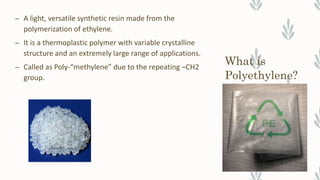
– A light, versatile synthetic resin made from the
polymerization of ethylene.
– It is a thermoplastic polymer with variable crystalline
structure and an extremely large range of applications.
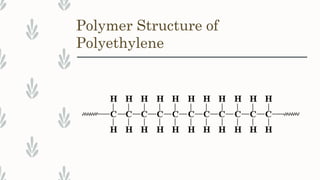
– Called as Poly-“methylene” due to the repeating –CH2
group.
What is
Polyethylene?
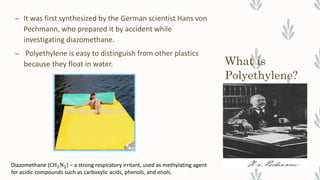
– It was first synthesized by the German scientist Hans von
Pechmann, who prepared it by accident while
investigating diazomethane.
– Polyethylene is easy to distinguish from other plastics
because they float in water.
Diazomethane (CH2N2) – a strong respiratory irritant, used as methylating agent
for acidic compounds such as carboxylic acids, phenols, and enols.
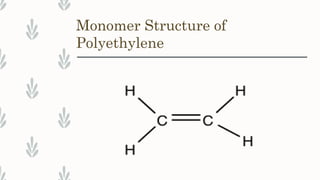
Monomer Structure of
Polyethylene
Polymer Structure of
Polyethylene
Different types of Polyethylene
1. Low Density Polyethylene (LDPE)
2. High Density Polyethylene (HDPE)
3. Linear Low Density Polyethylene (LLDPE)
4. Ultrahigh Molecular Weight Polyethylene (UHMW)
Different types of Polyethylene
1. Low Density Polyethylene (LDPE)
- First polyethylene produced.
- As the name implied, it has a lower density compared to
High Density polyethylene.
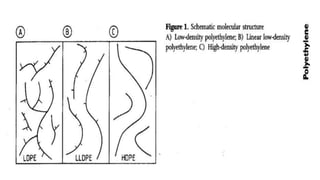
- LDPE has more branching, hence the molecules are less
tightly packed and less crystalline due to the side branches.
- LDPE is also frequently used in comsumer packaging, bags,
bottles, and liners.
Different types of Polyethylene
2. High Density Polyethylene (HDPE)
- It is a polyethylene made from petroleum.
- It is sometimes called “alkathene” or “polythene” when
used for pipes.
- HDPE has little branching, giving it stronger intermolecular
forces and tensile strength than LDPE.
- It is also harder and more opaque and can withstand higher
temperatures.
Different types of Polyethylene
3. Linear Low Density Polyethylene (LLDPE)
- LLDPE is the most flexible type of polyethylene.
- It is a blended form of LDPE where the film has much more
flexibility, tensile strength, and more comfortability.
- LLDPE is used for films that need a tremendous amount of
strength to absorb impacts without tearing or puncturing.
Different types of Polyethylene
4. Ultrahigh Molecular Weight Polyethylene (UHMWPE, UHMW)
- Also known as high-modulus polyethylene (HMPE) or high-
performance polyethylene (HPPE).
- It is odorless, tasteless and nontoxic.
- It has extremely long chains, which results in a very tough
material, with the highest impact strength of any thermoplastic
presently made.
Properties of Polyethylene
– The properties of polyethylene can be divided into mechanical,
chemical, electrical, optical, and thermal properties.
1. Mechanical properties
- low strength, hardness and rigidity but has high ductility and
impact strength as well as low friction.
- It shows strong creep under persistent force.
Properties of Polyethylene
2. Thermal properties
- The common commercial grade of medium- and
high-density polyethylene the melting point is typically in
the range of 120 to 180 °C.
- The melting point for LDPE is typically 105 to 115
°C.
- Temperature vary with the type of polyethylene.
Properties of Polyethylene
3. Chemical Properties
- Polyethylene consist of nonpolar, saturated, high molecular weight hydrocarbons.
- PE have low moisture absorption.
- PE can brittle when exposed to sunlight, carbon black is usually used as a stabilizer.
- PE burns slowly with a blue flame having yellow tip and gives off an odor of
paraffin.
- Resist acids, bases, esters, alcohol, hydrocarbons. Limited resistance to aldehydes.
- Does not react in room temperature
Properties of Polyethylene
4. Electrical Properties
- PE is a good electrical insulator.
- It offers good tracking resistance.
Properties of Polyethylene
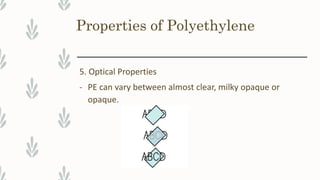
5. Optical Properties
- PE can vary between almost clear, milky opaque or
opaque.
Applications
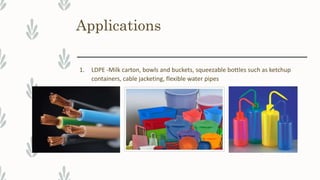
1. LDPE -Milk carton, bowls and buckets, squeezable bottles such as ketchup
containers, cable jacketing, flexible water pipes
Applications
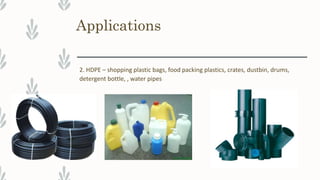
2. HDPE – shopping plastic bags, food packing plastics, crates, dustbin, drums,
detergent bottle, , water pipes
Applications
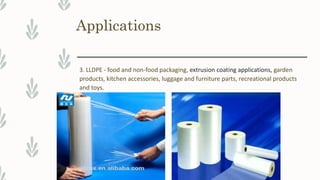
3. LLDPE - food and non-food packaging, extrusion coating applications, garden
products, kitchen accessories, luggage and furniture parts, recreational products
and toys.
Applications
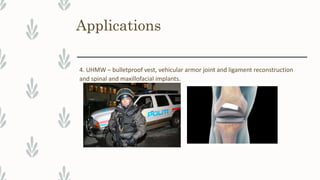
4. UHMW – bulletproof vest, vehicular armor joint and ligament reconstruction
and spinal and maxillofacial implants.
Thank you :D

Polyethylene

  • 1.
  • 2.
    What is Polyethylene? – Alight, versatile synthetic resin made from the polymerization of ethylene. – It is a thermoplastic polymer with variable crystalline structure and an extremely large range of applications. – Called as Poly-“methylene” due to the repeating –CH2 group.
  • 3.
    What is Polyethylene? – Itwas first synthesized by the German scientist Hans von Pechmann, who prepared it by accident while investigating diazomethane. – Polyethylene is easy to distinguish from other plastics because they float in water. Diazomethane (CH2N2) – a strong respiratory irritant, used as methylating agent for acidic compounds such as carboxylic acids, phenols, and enols.
  • 4.
  • 5.
  • 6.
    Different types ofPolyethylene 1. Low Density Polyethylene (LDPE) 2. High Density Polyethylene (HDPE) 3. Linear Low Density Polyethylene (LLDPE) 4. Ultrahigh Molecular Weight Polyethylene (UHMW)
  • 7.
    Different types ofPolyethylene 1. Low Density Polyethylene (LDPE) - First polyethylene produced. - As the name implied, it has a lower density compared to High Density polyethylene. - LDPE has more branching, hence the molecules are less tightly packed and less crystalline due to the side branches. - LDPE is also frequently used in comsumer packaging, bags, bottles, and liners.
  • 8.
    Different types ofPolyethylene 2. High Density Polyethylene (HDPE) - It is a polyethylene made from petroleum. - It is sometimes called “alkathene” or “polythene” when used for pipes. - HDPE has little branching, giving it stronger intermolecular forces and tensile strength than LDPE. - It is also harder and more opaque and can withstand higher temperatures.
  • 9.
    Different types ofPolyethylene 3. Linear Low Density Polyethylene (LLDPE) - LLDPE is the most flexible type of polyethylene. - It is a blended form of LDPE where the film has much more flexibility, tensile strength, and more comfortability. - LLDPE is used for films that need a tremendous amount of strength to absorb impacts without tearing or puncturing.
  • 10.
    Different types ofPolyethylene 4. Ultrahigh Molecular Weight Polyethylene (UHMWPE, UHMW) - Also known as high-modulus polyethylene (HMPE) or high- performance polyethylene (HPPE). - It is odorless, tasteless and nontoxic. - It has extremely long chains, which results in a very tough material, with the highest impact strength of any thermoplastic presently made.
  • 12.
    Properties of Polyethylene –The properties of polyethylene can be divided into mechanical, chemical, electrical, optical, and thermal properties. 1. Mechanical properties - low strength, hardness and rigidity but has high ductility and impact strength as well as low friction. - It shows strong creep under persistent force.
  • 13.
    Properties of Polyethylene 2.Thermal properties - The common commercial grade of medium- and high-density polyethylene the melting point is typically in the range of 120 to 180 °C. - The melting point for LDPE is typically 105 to 115 °C. - Temperature vary with the type of polyethylene.
  • 14.
    Properties of Polyethylene 3.Chemical Properties - Polyethylene consist of nonpolar, saturated, high molecular weight hydrocarbons. - PE have low moisture absorption. - PE can brittle when exposed to sunlight, carbon black is usually used as a stabilizer. - PE burns slowly with a blue flame having yellow tip and gives off an odor of paraffin. - Resist acids, bases, esters, alcohol, hydrocarbons. Limited resistance to aldehydes. - Does not react in room temperature
  • 15.
    Properties of Polyethylene 4.Electrical Properties - PE is a good electrical insulator. - It offers good tracking resistance.
  • 16.
    Properties of Polyethylene 5.Optical Properties - PE can vary between almost clear, milky opaque or opaque.
  • 17.
    Applications 1. LDPE -Milkcarton, bowls and buckets, squeezable bottles such as ketchup containers, cable jacketing, flexible water pipes
  • 18.
    Applications 2. HDPE –shopping plastic bags, food packing plastics, crates, dustbin, drums, detergent bottle, , water pipes
  • 19.
    Applications 3. LLDPE -food and non-food packaging, extrusion coating applications, garden products, kitchen accessories, luggage and furniture parts, recreational products and toys.
  • 20.
    Applications 4. UHMW –bulletproof vest, vehicular armor joint and ligament reconstruction and spinal and maxillofacial implants.
  • 21.