POLYMERS
12th State Board
FREYACARDOZO
What are polymers?
Chemically polymers are complex, giant macromolecules made
from the repeating units which are derived from small molecules
called 'monomers'. The term 'polymer' originates from Greek
word 'poly' meaning many and 'mer' meaning part or unit.
Interlinking of many units constitutes polymers.
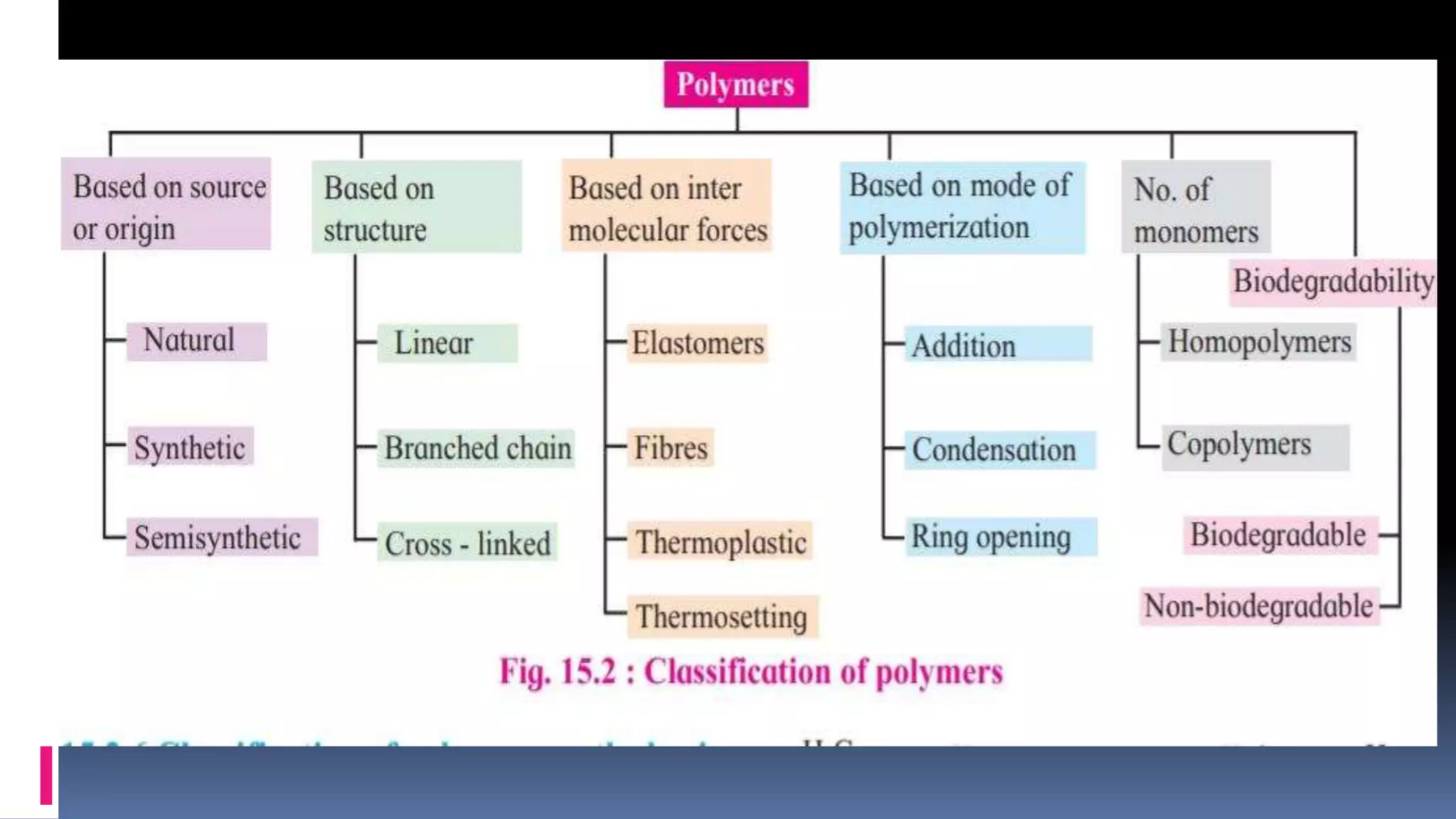
Classification of polymers
Based on the following
1. Source or origin
2. Structure
3. Intermolecular forces
4. Process of polymerization
5. types of monomers
6. Biodegradability
Based on origin or source
1. Natural polymers --- obtained From natural source
 Plant source: These are obtained from plants. For example, cotton and linen are obtained from
cotton plant and flax plant respectively. Natural rubber is another example of natural polymer
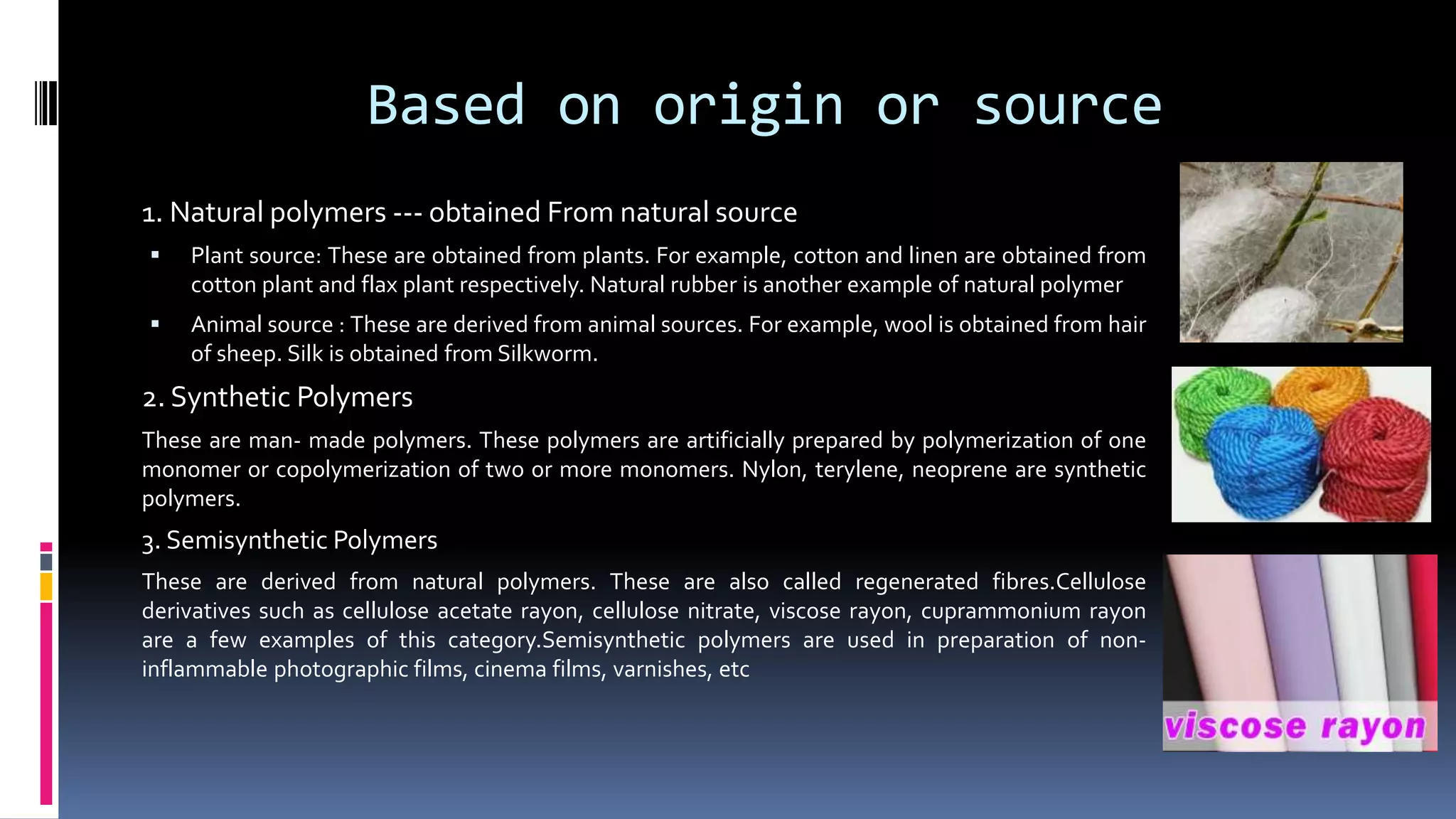
 Animal source : These are derived from animal sources. For example, wool is obtained from hair
of sheep. Silk is obtained from Silkworm.
2. Synthetic Polymers
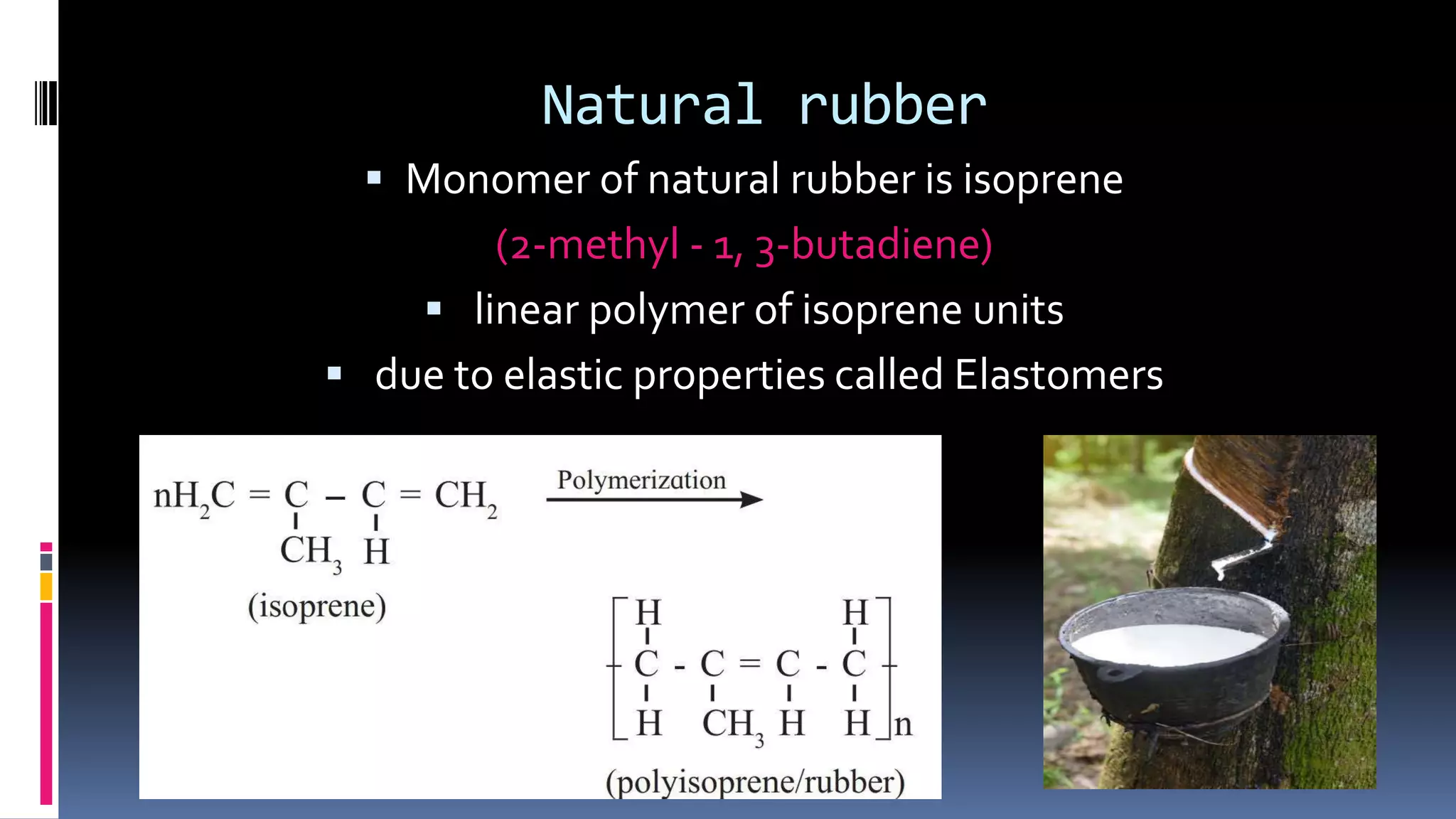
These are man- made polymers. These polymers are artificially prepared by polymerization of one
monomer or copolymerization of two or more monomers. Nylon, terylene, neoprene are synthetic
polymers.
3. Semisynthetic Polymers
These are derived from natural polymers. These are also called regenerated fibres.Cellulose
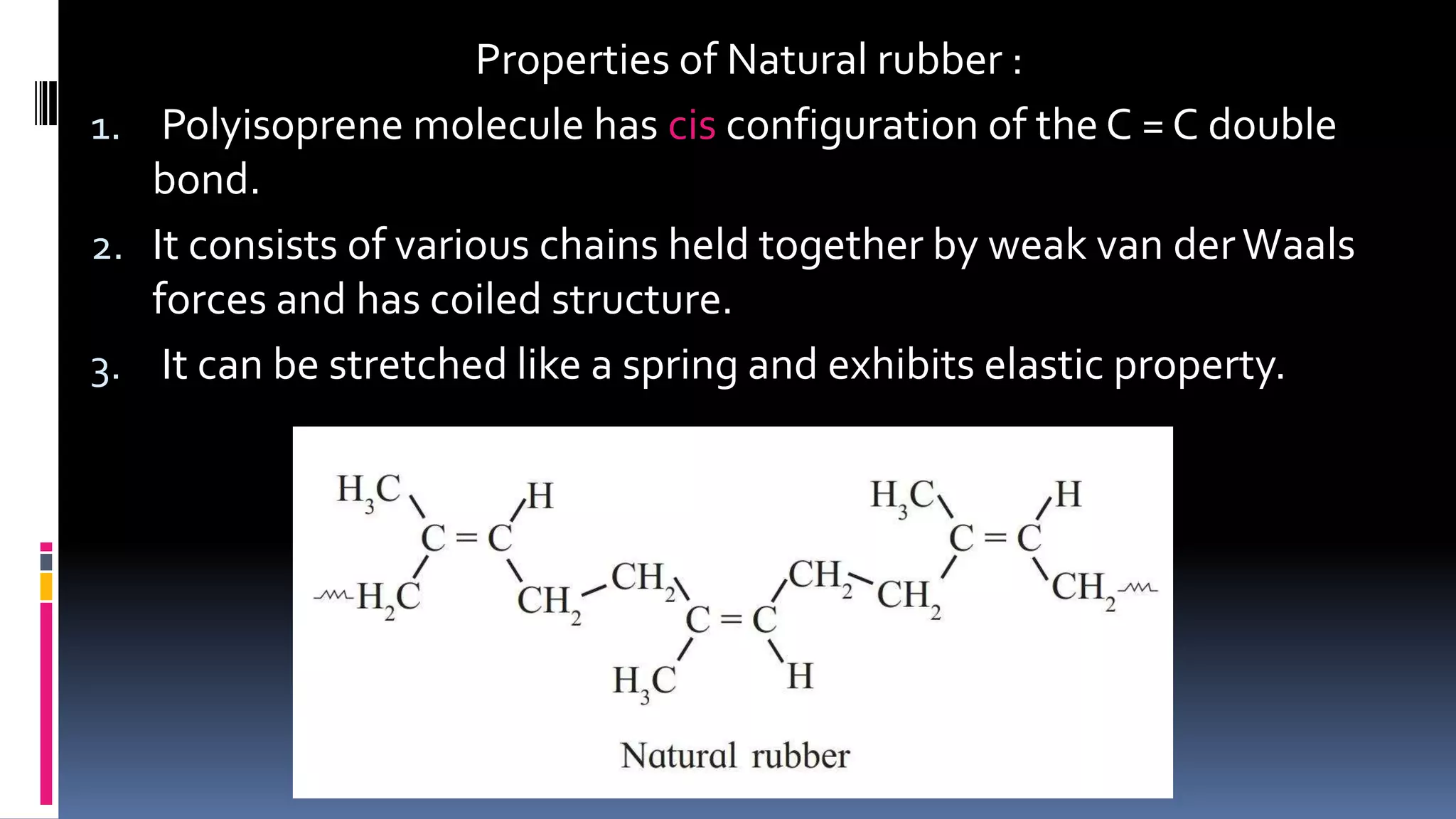
derivatives such as cellulose acetate rayon, cellulose nitrate, viscose rayon, cuprammonium rayon
are a few examples of this category.Semisynthetic polymers are used in preparation of non-
inflammable photographic films, cinema films, varnishes, etc
Natural rubber
 Monomer of natural rubber is isoprene
(2-methyl - 1, 3-butadiene)
 linear polymer of isoprene units
 due to elastic properties called Elastomers
Properties of Natural rubber :
1. Polyisoprene molecule has cis configuration of the C = C double
bond.
2. It consists of various chains held together by weak van derWaals
forces and has coiled structure.
3. It can be stretched like a spring and exhibits elastic property.
Vulcanization of rubber
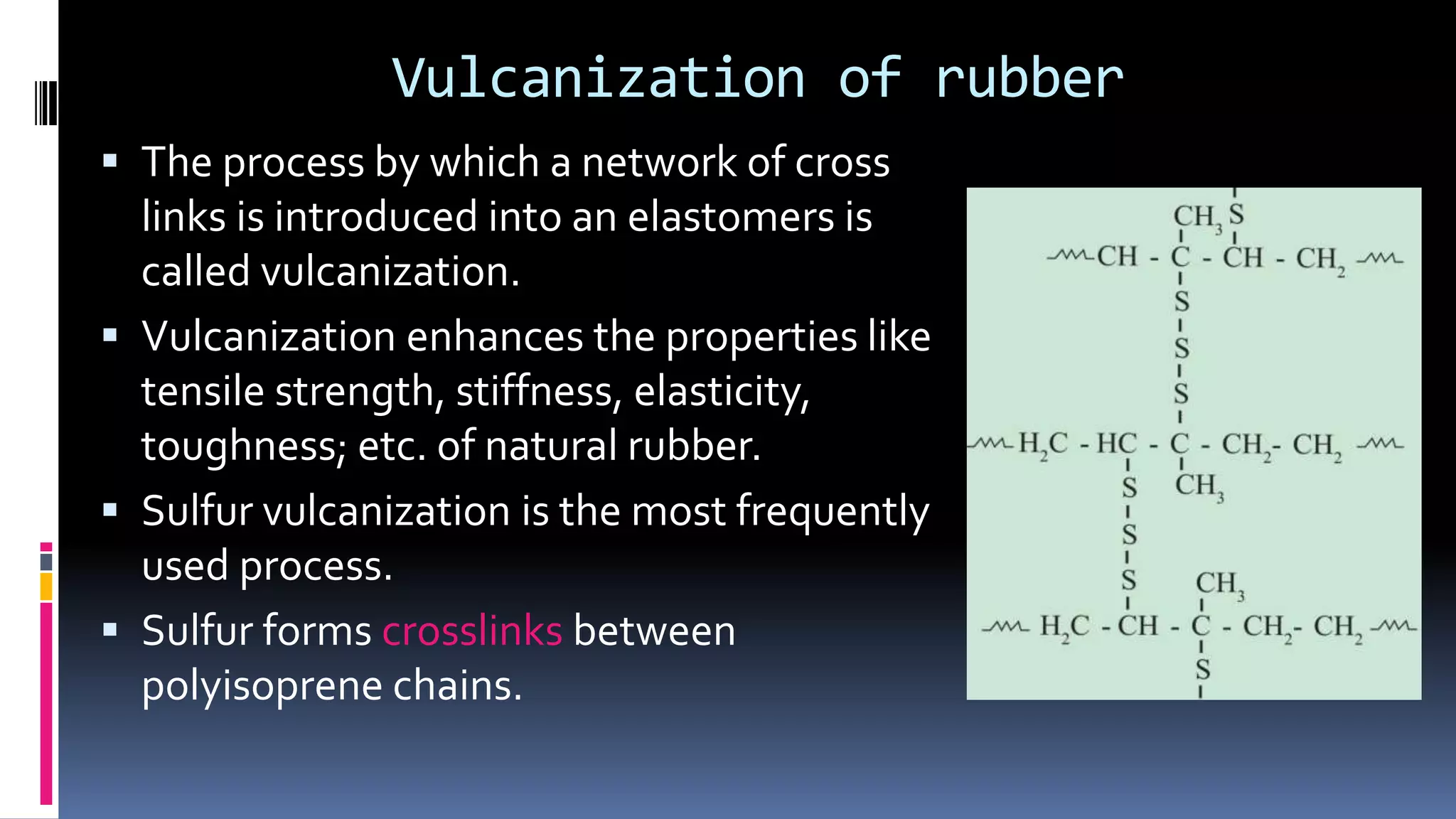
 The process by which a network of cross
links is introduced into an elastomers is
called vulcanization.
 Vulcanization enhances the properties like
tensile strength, stiffness, elasticity,
toughness; etc. of natural rubber.
 Sulfur vulcanization is the most frequently
used process.
 Sulfur forms crosslinks between
polyisoprene chains.
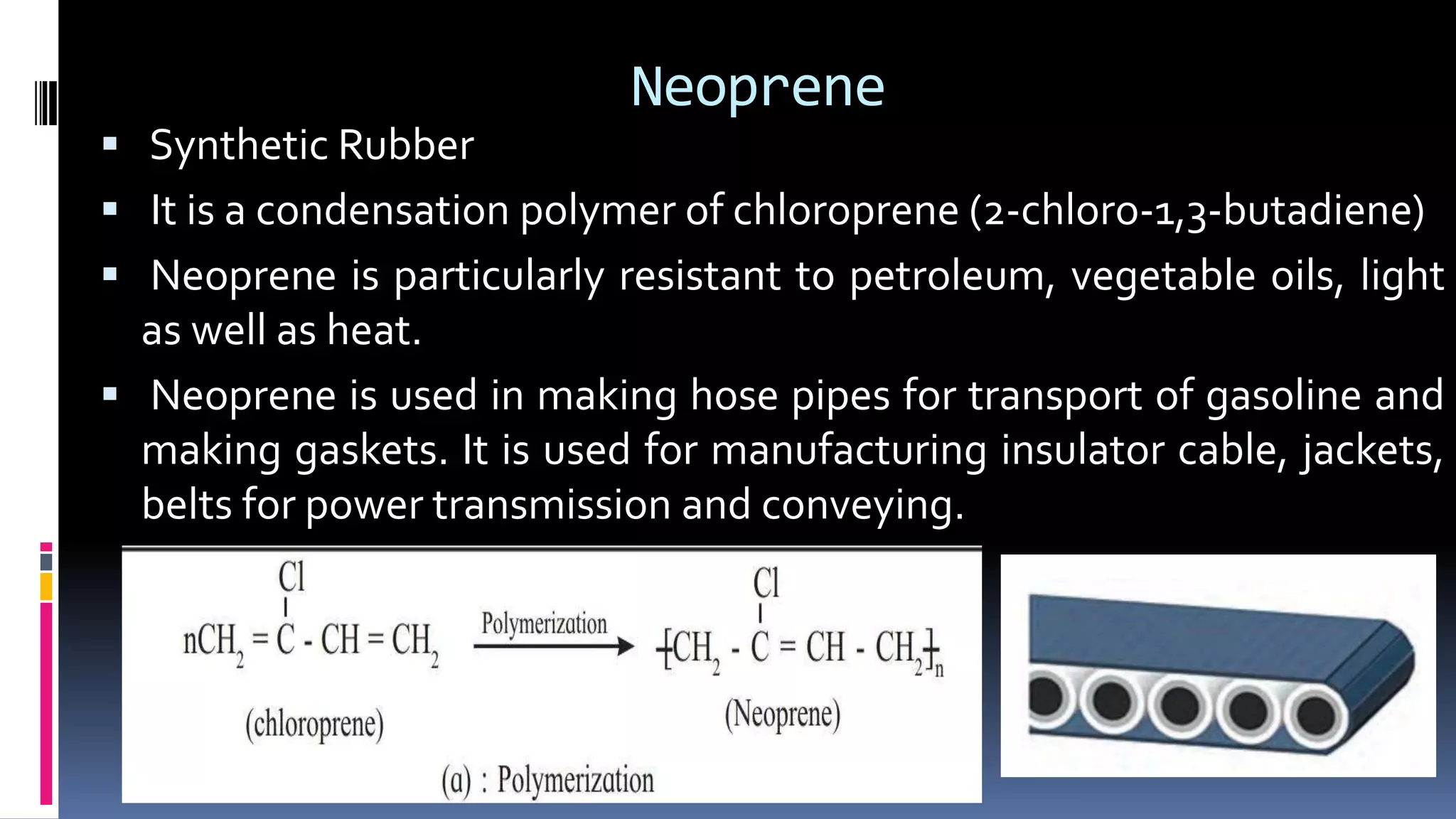
Neoprene
 Synthetic Rubber
 It is a condensation polymer of chloroprene (2-chloro-1,3-butadiene)
 Neoprene is particularly resistant to petroleum, vegetable oils, light
as well as heat.
 Neoprene is used in making hose pipes for transport of gasoline and
making gaskets. It is used for manufacturing insulator cable, jackets,
belts for power transmission and conveying.
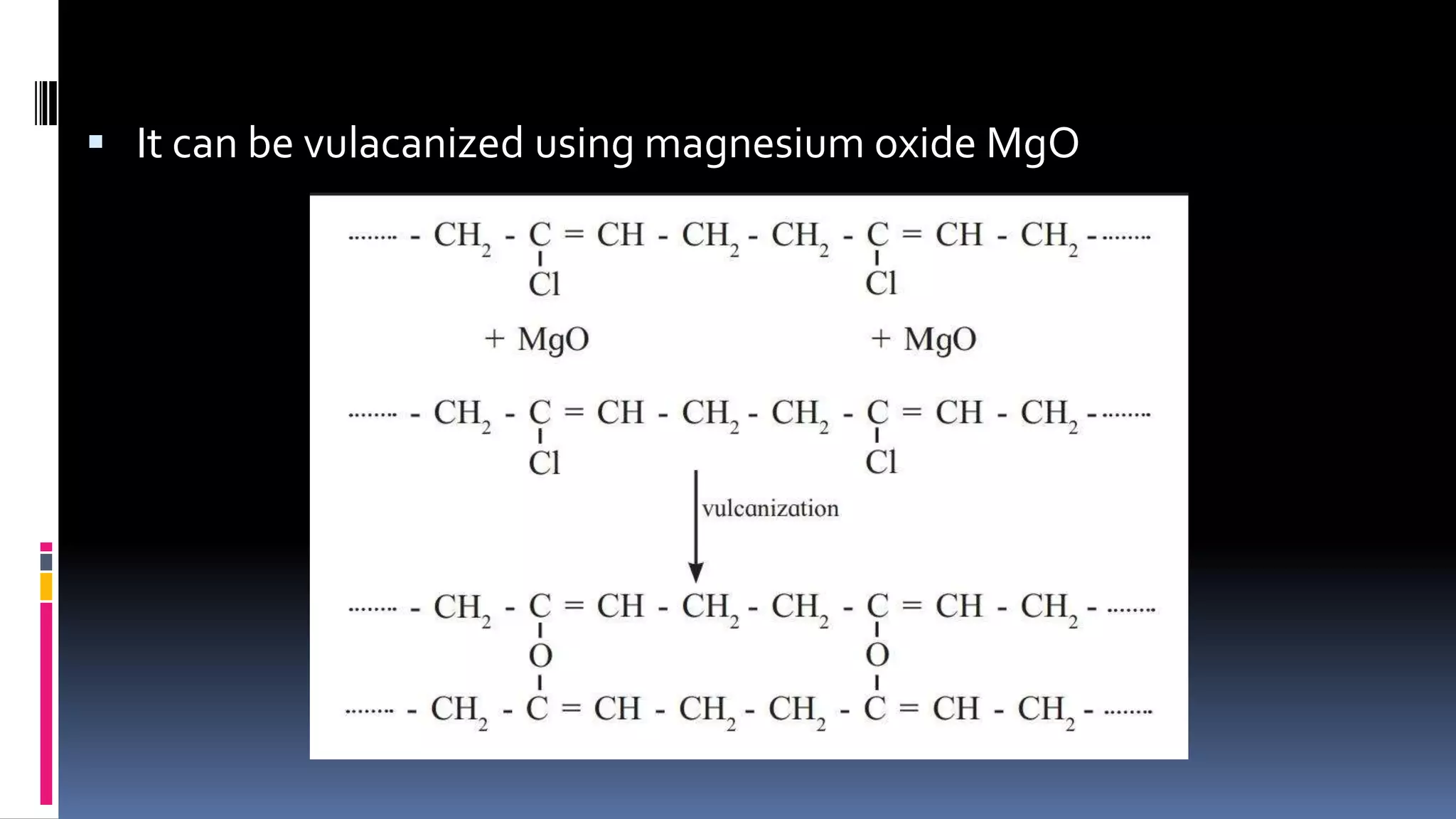
 It can be vulacanized using magnesium oxide MgO
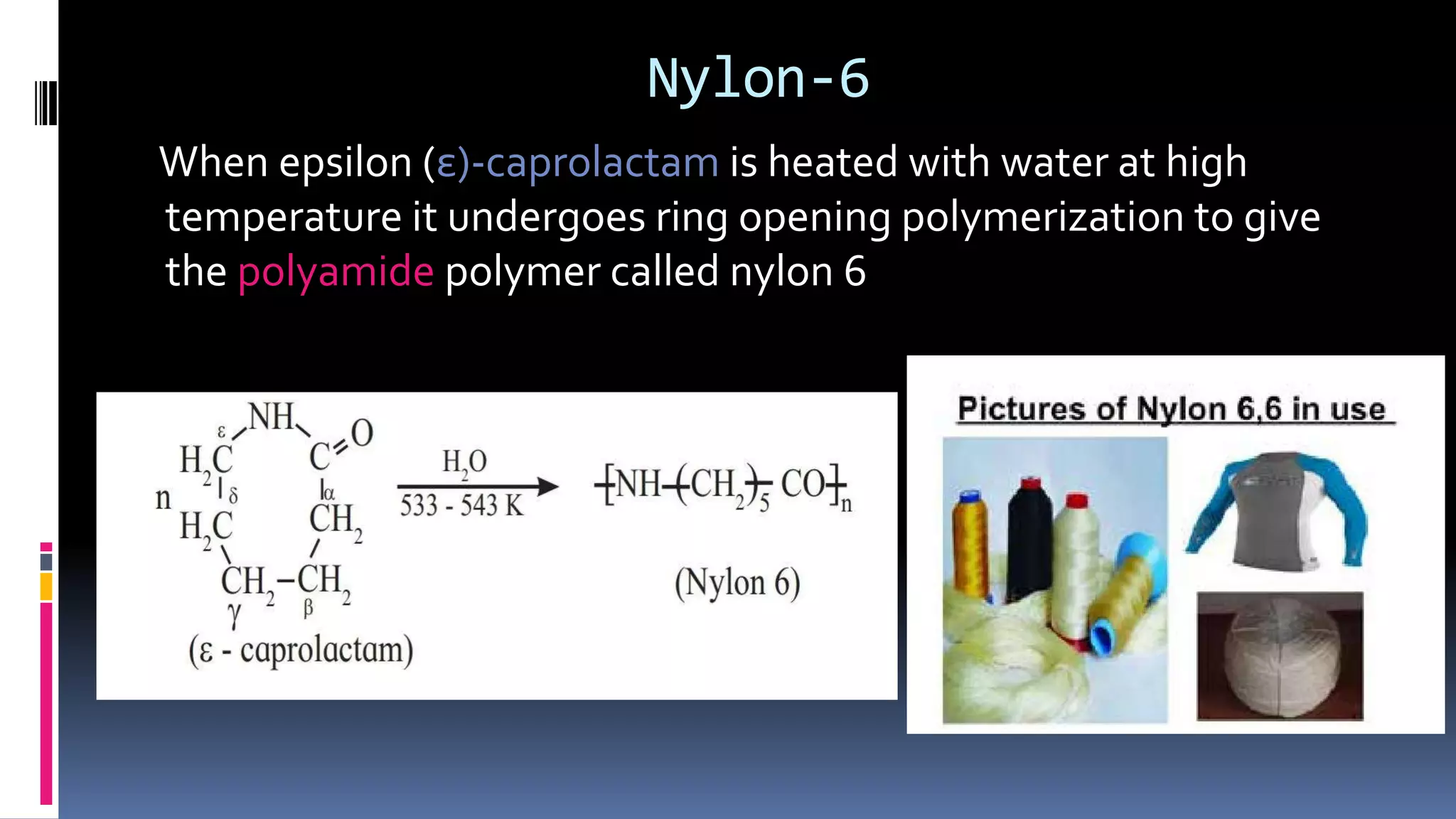
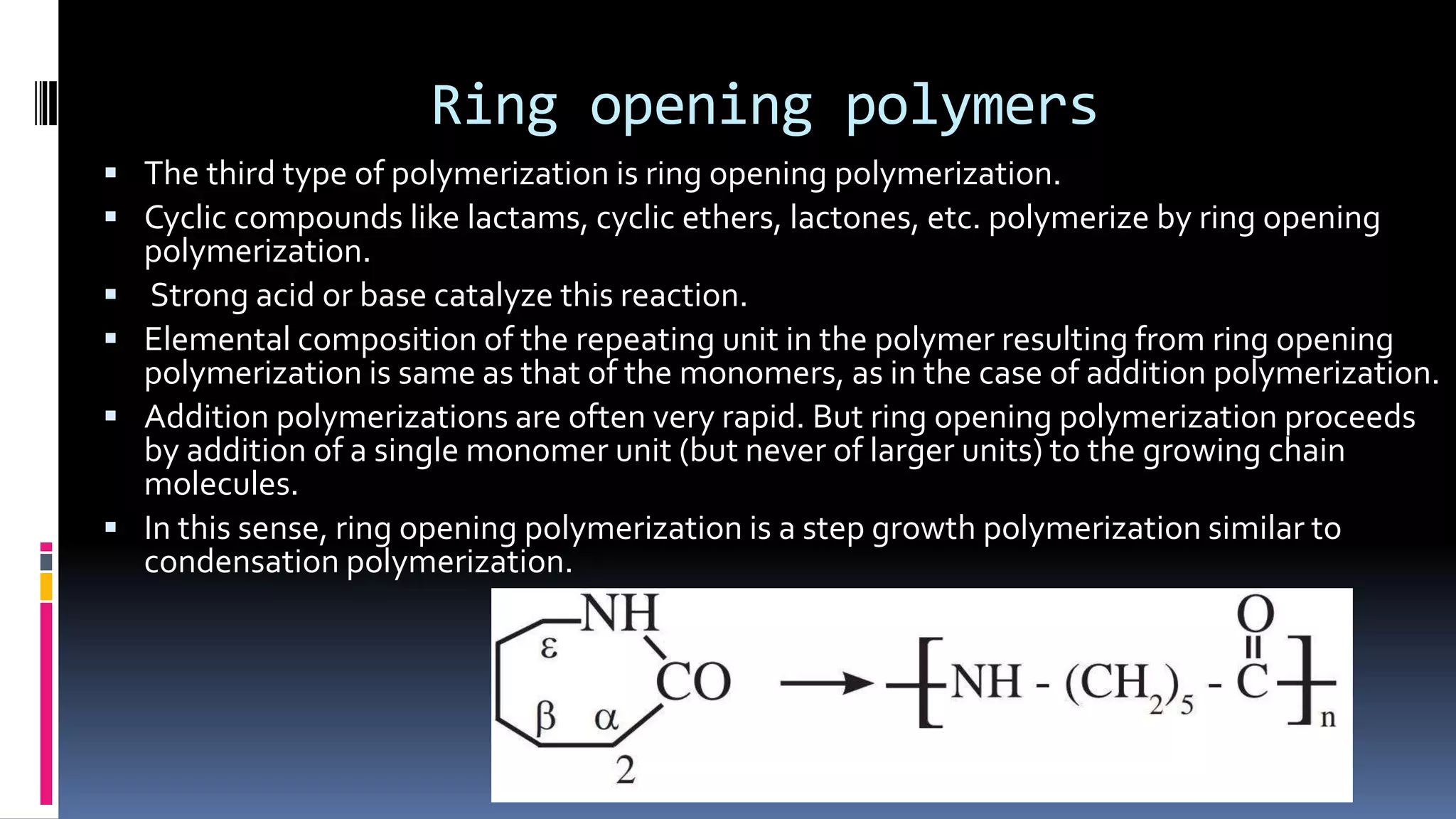
Nylon-6
When epsilon (ε)-caprolactam is heated with water at high
temperature it undergoes ring opening polymerization to give
the polyamide polymer called nylon 6
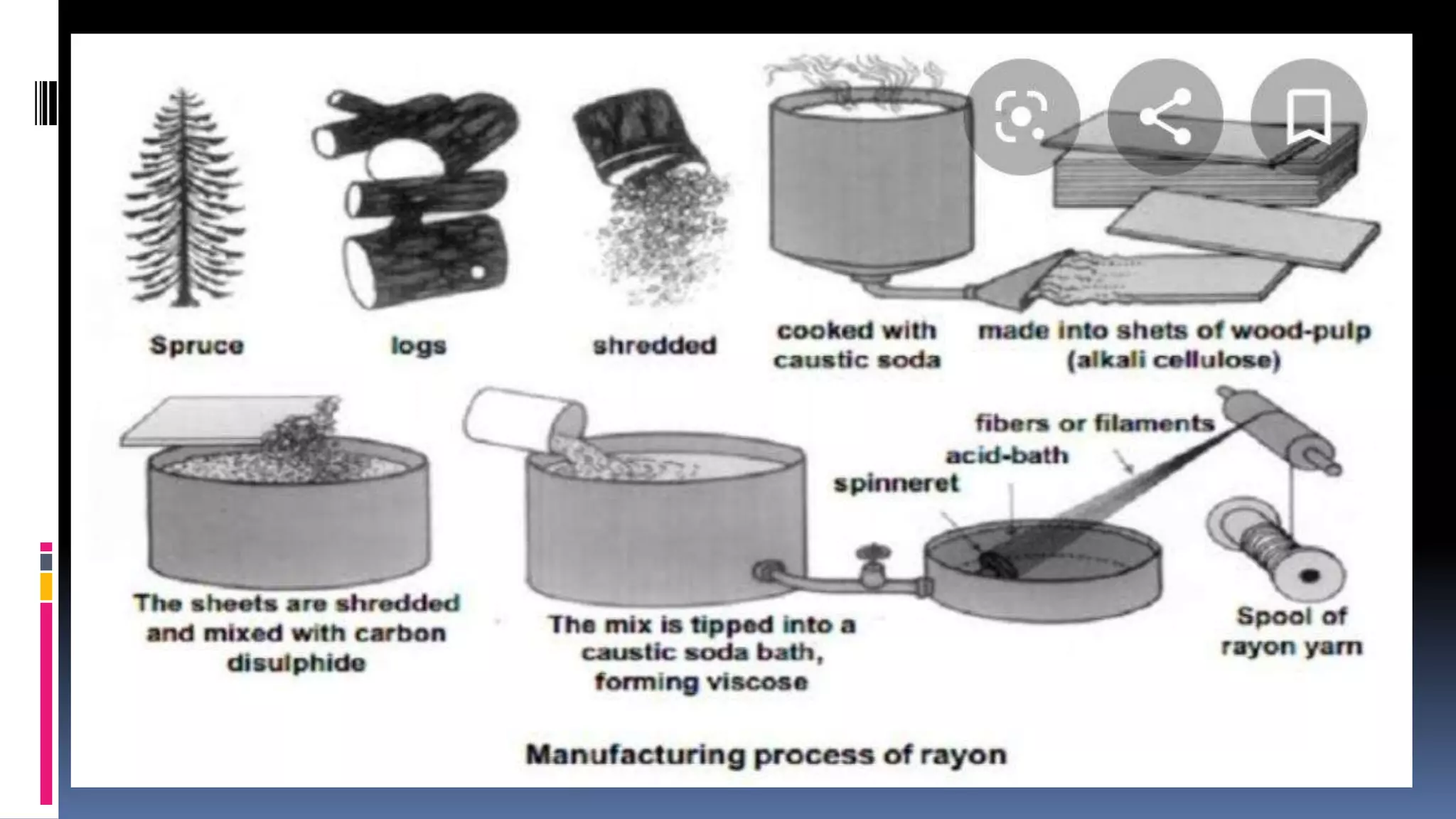
Semisynthetic Polymers- Viscose Rayon
Cellulose in the form of wood pulp is transformed into viscose rayon.
Cellulose is a linear polymer of glucose units and has molecular
formula (C6H10O5)n
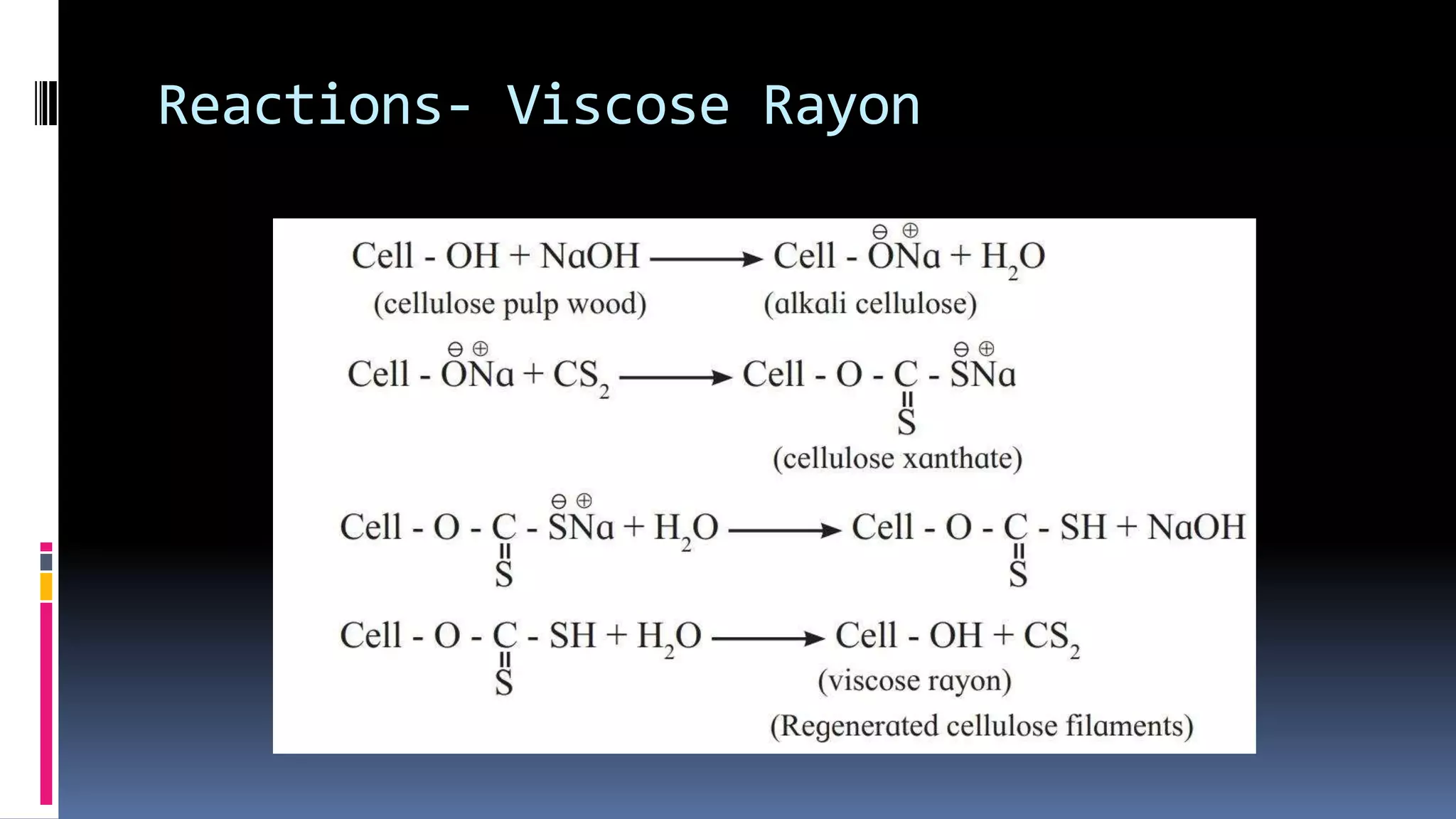
A modified representation of the molecular formula of cellulose Cell-
OH, is used in the reactions involved in viscose formation
1. Cellulose in the form of wood pulp is treated with concentrated
NaOH solution to get fluffy alkali cellulose.
2. It is then converted to xanthate by treating with carbon disulphide.
3. On mixing with dilute NaOH it gives viscose solution which is
extruded through spinnerates of spining machine into acid bath
when regenerated cellulose fibres precipitate.
Reactions- Viscose Rayon
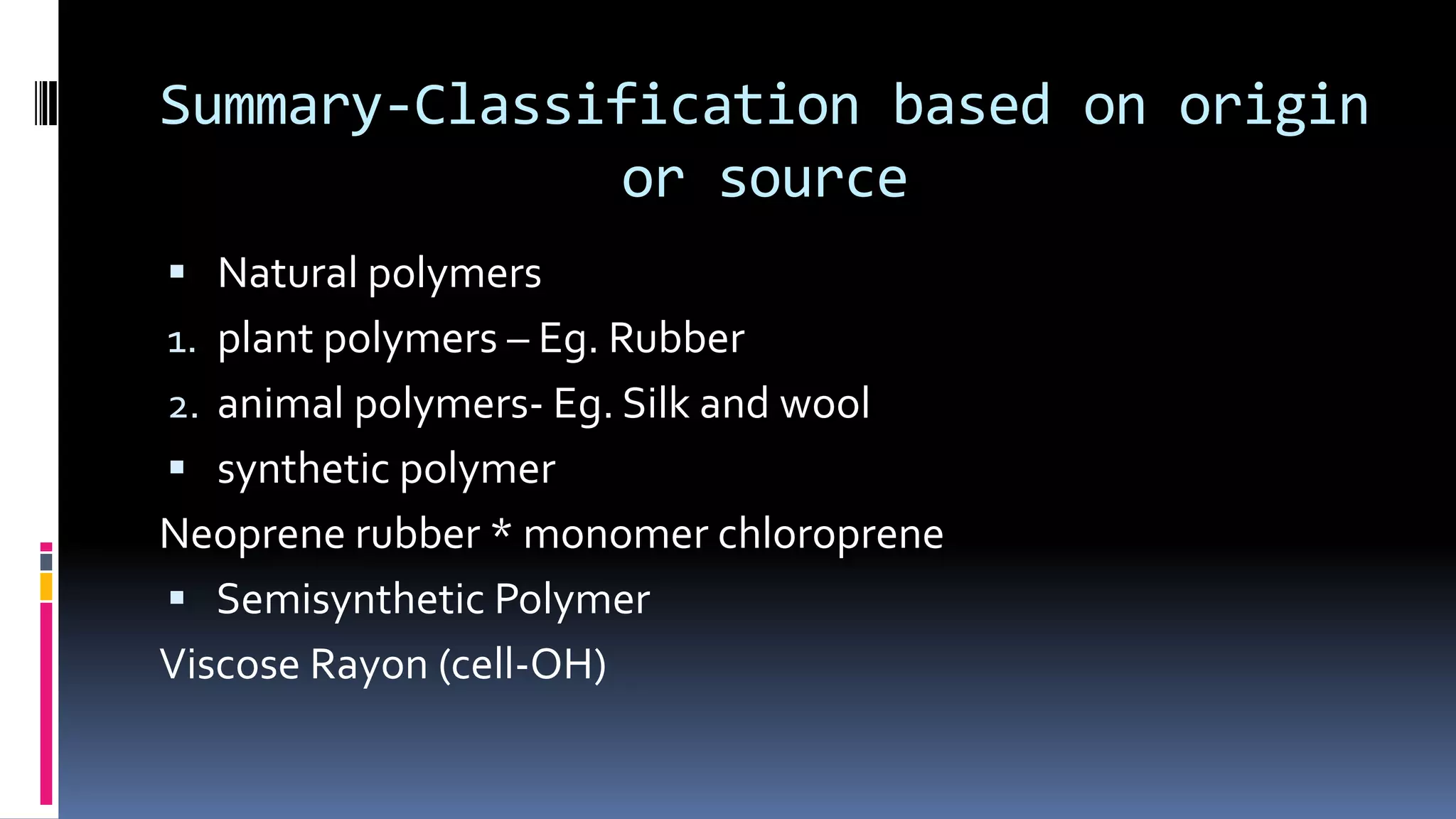
Summary-Classification based on origin
or source
 Natural polymers
1. plant polymers – Eg. Rubber
2. animal polymers- Eg. Silk and wool
 synthetic polymer
Neoprene rubber * monomer chloroprene
 Semisynthetic Polymer
Viscose Rayon (cell-OH)
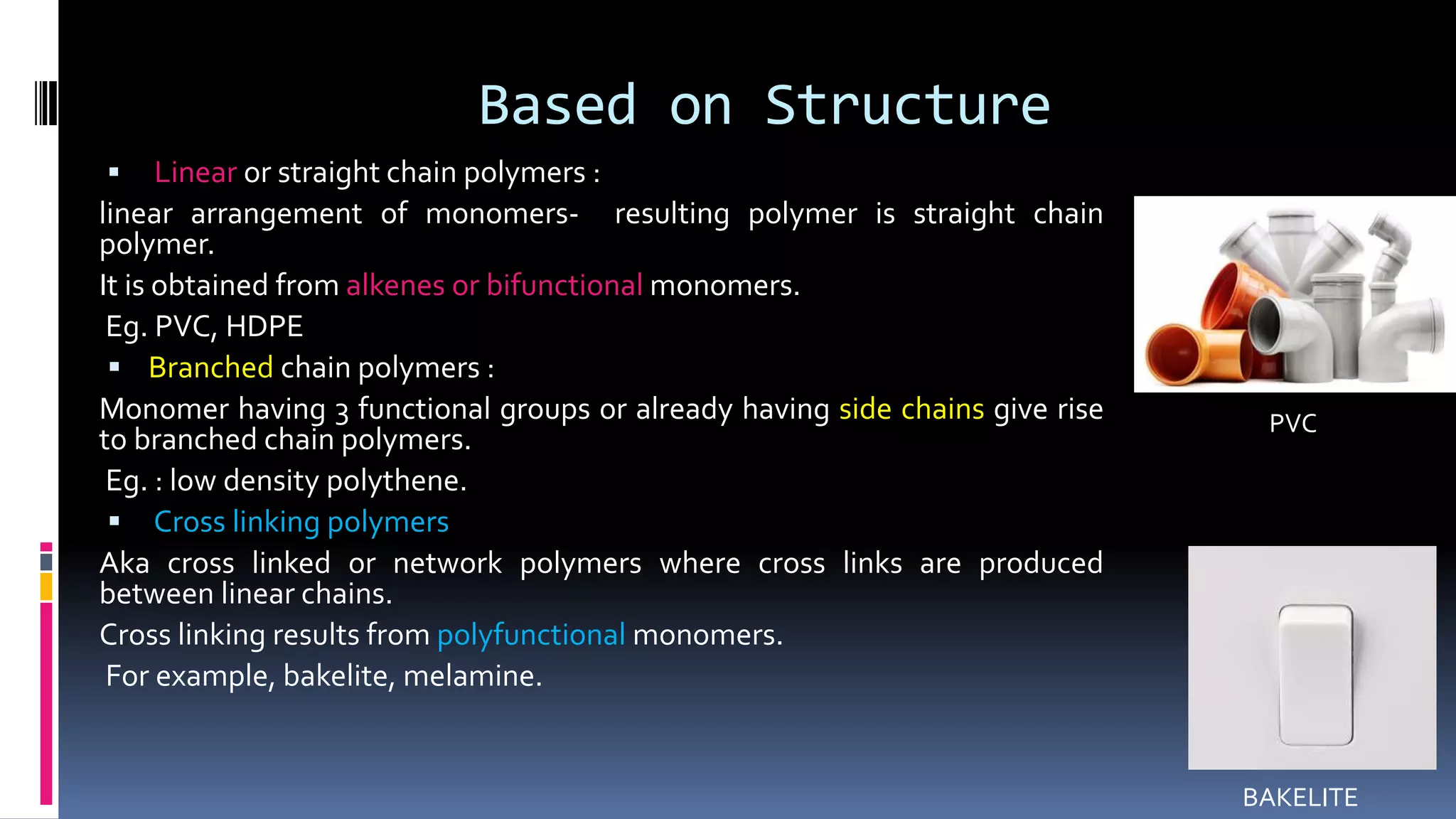
Based on Structure
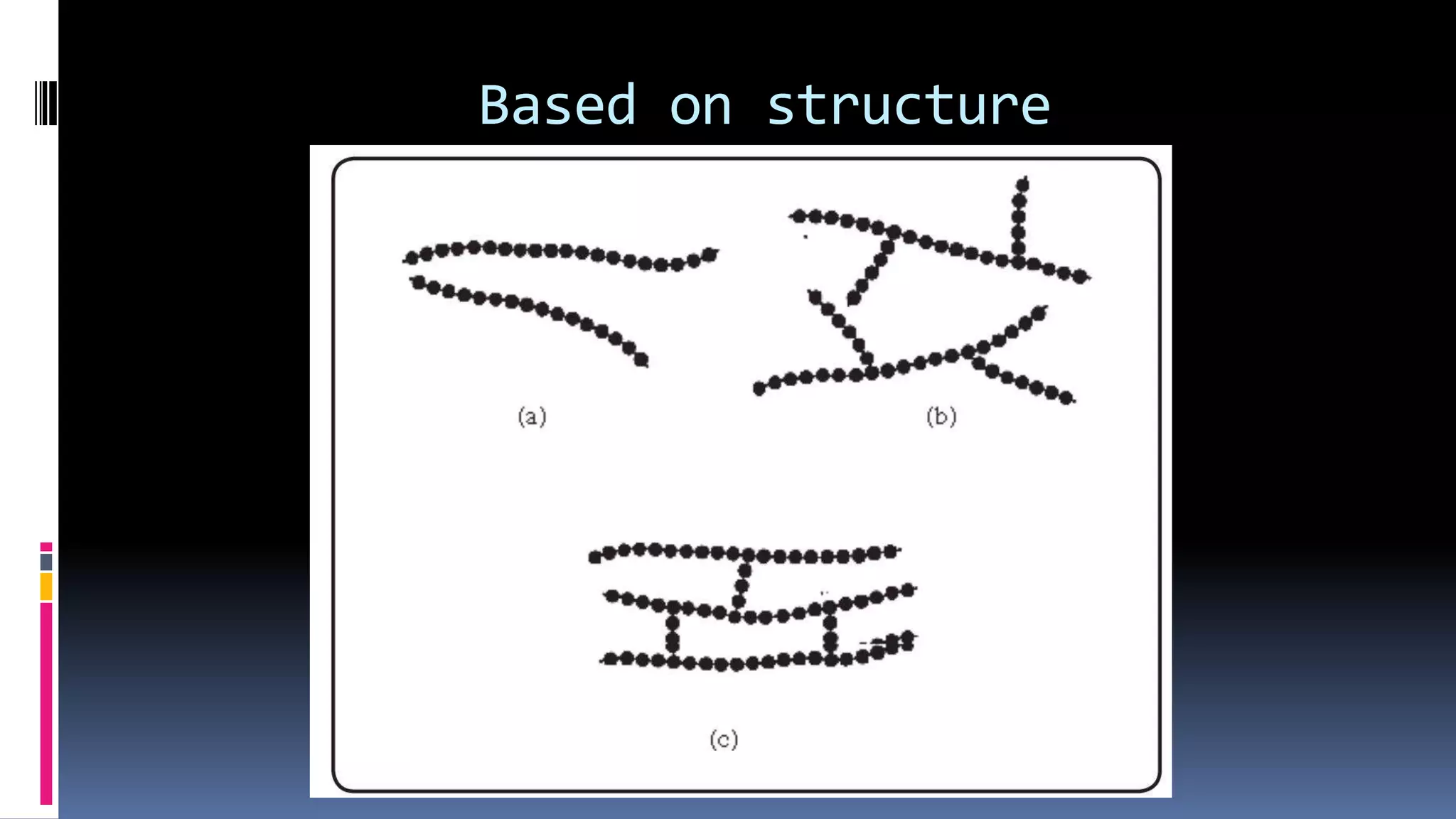
 Linear or straight chain polymers :
linear arrangement of monomers- resulting polymer is straight chain
polymer.
It is obtained from alkenes or bifunctional monomers.
Eg. PVC, HDPE
 Branched chain polymers :
Monomer having 3 functional groups or already having side chains give rise
to branched chain polymers.
Eg. : low density polythene.
 Cross linking polymers
Aka cross linked or network polymers where cross links are produced
between linear chains.
Cross linking results from polyfunctional monomers.
For example, bakelite, melamine.
BAKELITE
PVC
Based on structure
HDPE LDPE
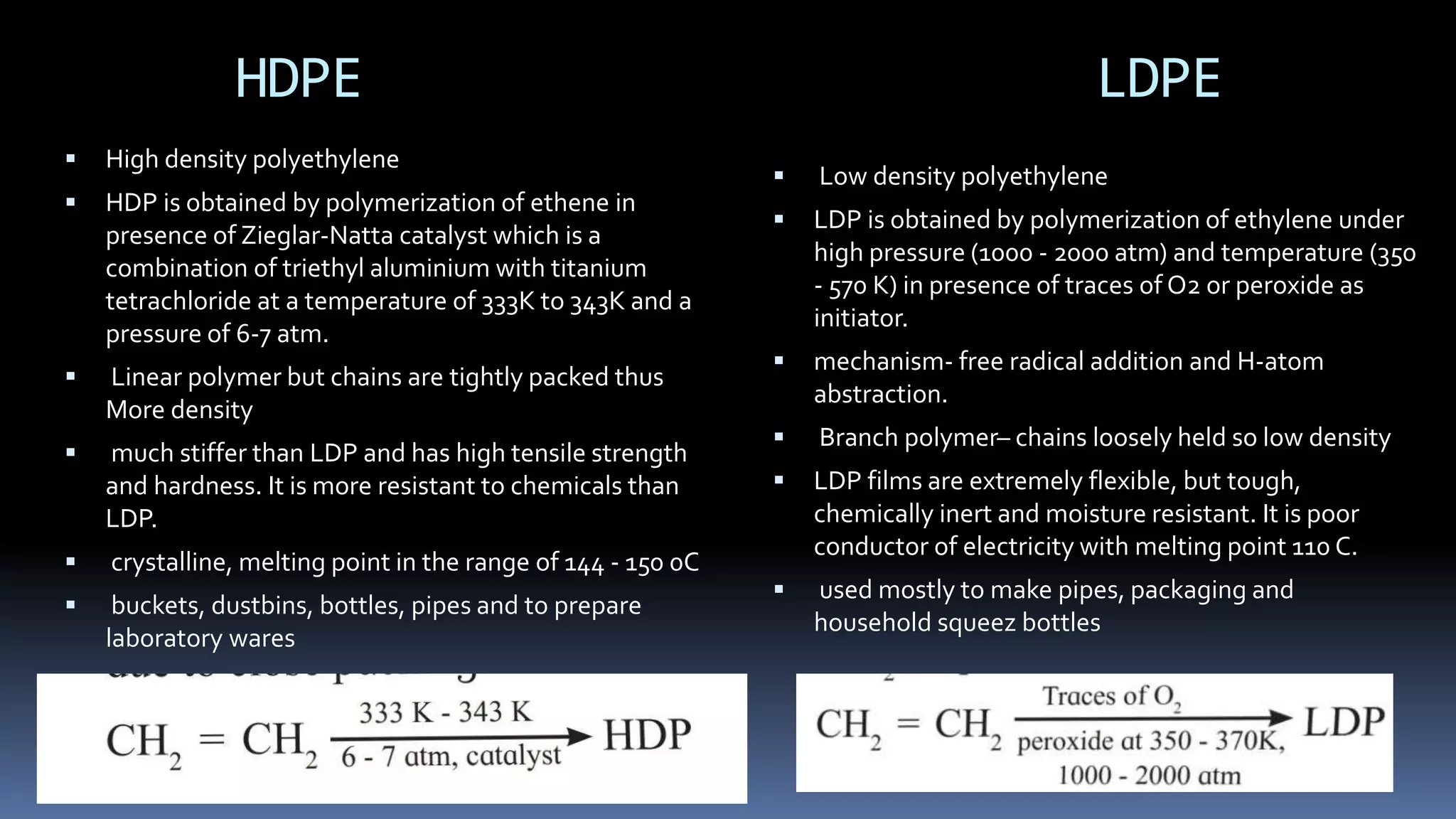
 High density polyethylene
 HDP is obtained by polymerization of ethene in
presence of Zieglar-Natta catalyst which is a
combination of triethyl aluminium with titanium
tetrachloride at a temperature of 333K to 343K and a
pressure of 6-7 atm.
 Linear polymer but chains are tightly packed thus
More density
 much stiffer than LDP and has high tensile strength
and hardness. It is more resistant to chemicals than
LDP.
 crystalline, melting point in the range of 144 - 150 0C
 buckets, dustbins, bottles, pipes and to prepare
laboratory wares
 Low density polyethylene
 LDP is obtained by polymerization of ethylene under
high pressure (1000 - 2000 atm) and temperature (350
- 570 K) in presence of traces of O2 or peroxide as
initiator.
 mechanism- free radical addition and H-atom
abstraction.
 Branch polymer– chains loosely held so low density
 LDP films are extremely flexible, but tough,
chemically inert and moisture resistant. It is poor
conductor of electricity with melting point 110 C.
 used mostly to make pipes, packaging and
household squeez bottles
Melamine-Formaldhyde Polymer
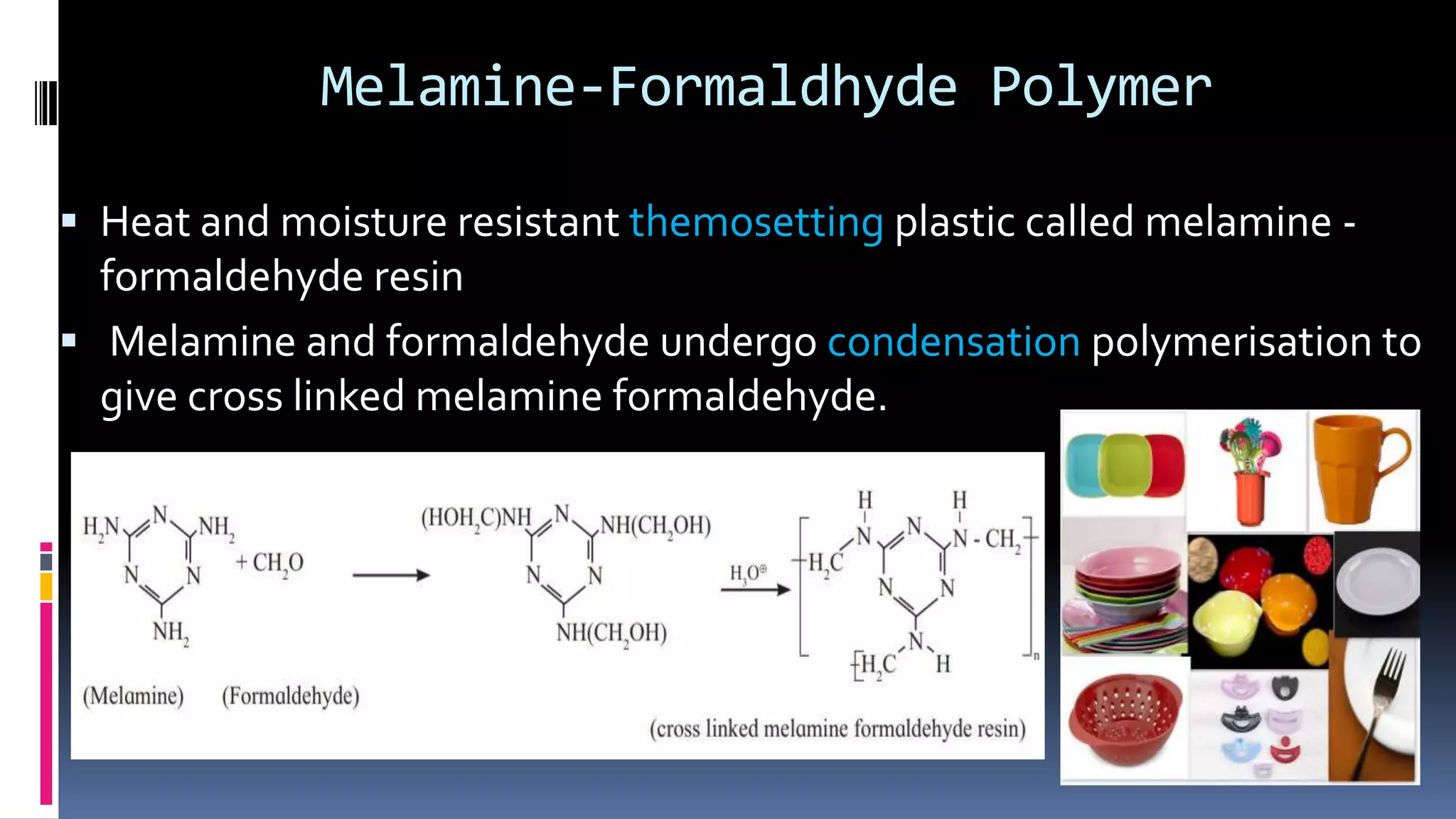
 Heat and moisture resistant themosetting plastic called melamine -
formaldehyde resin
 Melamine and formaldehyde undergo condensation polymerisation to
give cross linked melamine formaldehyde.
Based on inter molecular forces of
attraction
Types are:
1. Elastomers
 Elasticity is a property by which a substance gets stretched by
external force and restores its original shape on release of that
force.
 Have weak van derWaals type of intermolecular forces which
permit the polymer to be stretched.
 A few crosslinks between the chains help the stretched polymer to
retract to its original position on removal of applied force. For
example : vulcunized rubber, buna-S, buna-N, neoprene, etc.
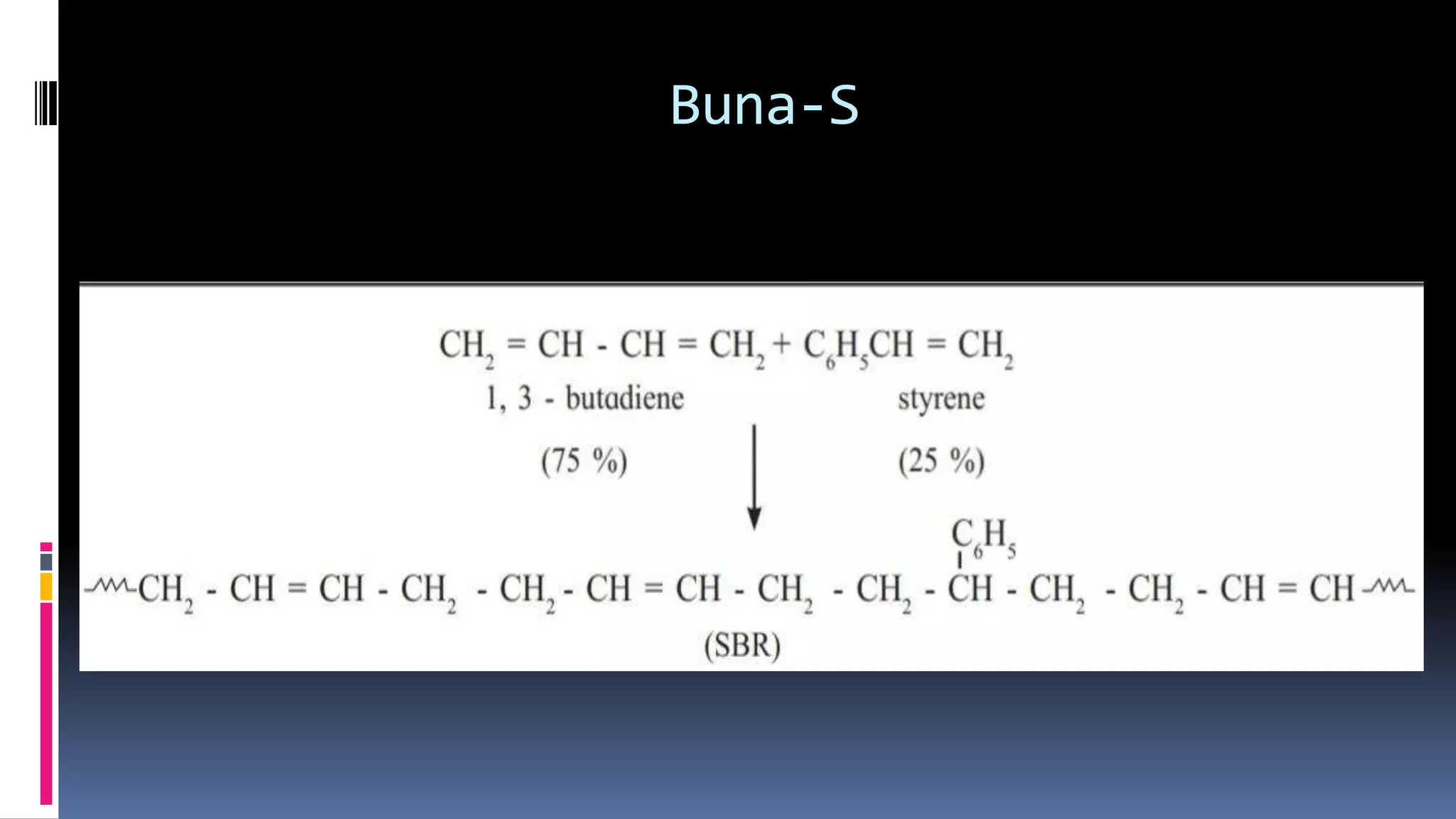
Eg. Of Elastomers --- Buna-S
 Buna-S is an elastomer which is a copolymer of styrene with
butadiene
 Its trade name is SBR (styrene-butadiene rubber).
 polymerization by the action of sodium. It is vulcanized with
sulfur.
 Buna-S is superior to natural rubber with regard to mechanical
strength and has abrasion resistance. Hence it is used in tyre
industry.
Buna-S
2. Fibers
 Polymeric solids which form threads are called fibres.
 The fibres possess high tensile strength which is a property to
have resistance to breaking under tension.
 This characteristic is due to the strong intermolecular forces
like hydrogen bonding and strong dipole-dipole forces.
 Due to these strong intermolecularforces the fibres are
crystalline in nature.
 For example : polyamides (nylon 6, 6), polyesters (terylene),
etc.
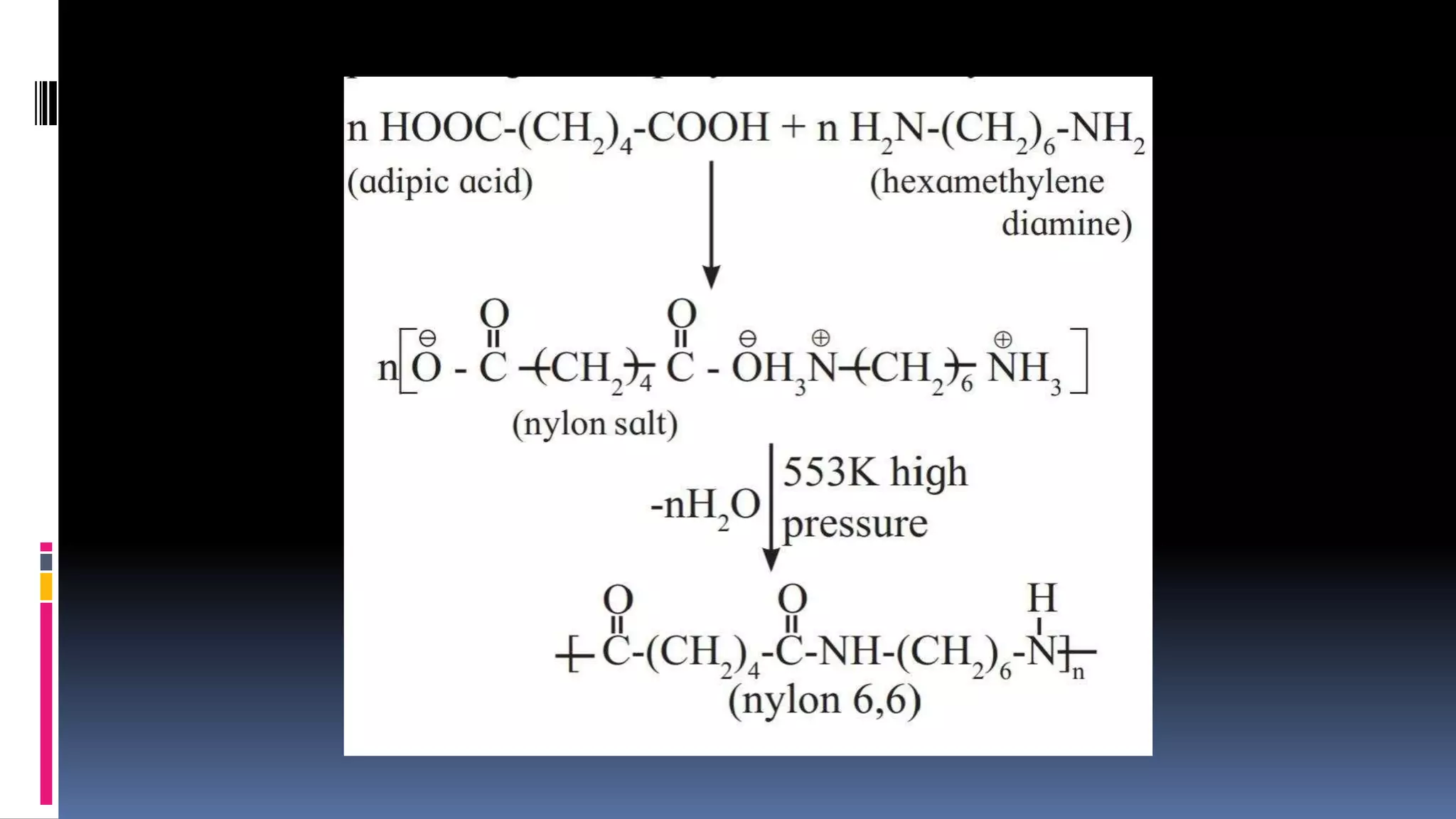
Eg. Nylon 6,6
 It is a condensation polymer
 Ring opening process of polymerizatiom
 monomers are adipic acid and hexamethylene diaammine
 monomers on reaction produce nylon salt, which upon
condensation polymerization under conditions of high
temperature and pressure give the polyamide fibre nylon 6,6.
 The numerals 6,6 in the name of this polymer stand for the
number of carbon atoms in the two bifunctional monomers,
namely, adipic acid and hexamethylenediamine.
 Nylon 6,6 is high molecular mass (12000-50000 u) linear
condensation polymer.
 It possesses high tensile strength.
 It does not soak in water.
 It is used for making sheets, bristles for brushes, surgical
sutures, textile fabrics, etc.
3.Thermoplastic Polymers
Plasticity is a property of being easily shaped or moulded.
Thermoplastic polymers are capable of repeated softening on heating and hardening on
cooling.
These polymers possess moderately strong intermolecular forces that are intermediate
between elastomers and fibres.
For example : polythene, polystyrene, polyvinyls, etc.
4.Thermosetting polymers
Themosetting polymers are rigid polymers.
During their formation they have property of being shaped on heating; but they get
hardened while hot.
Once hardened these become infusible; cannot be softened by heating and therefore
cannot be remoulded.
This characteristic is the result of extensive cross linking by covalent bonds formed in the
moulds during hardening/setting process while hot.
For example : bakelite, urea formaldehyde resin, etc.
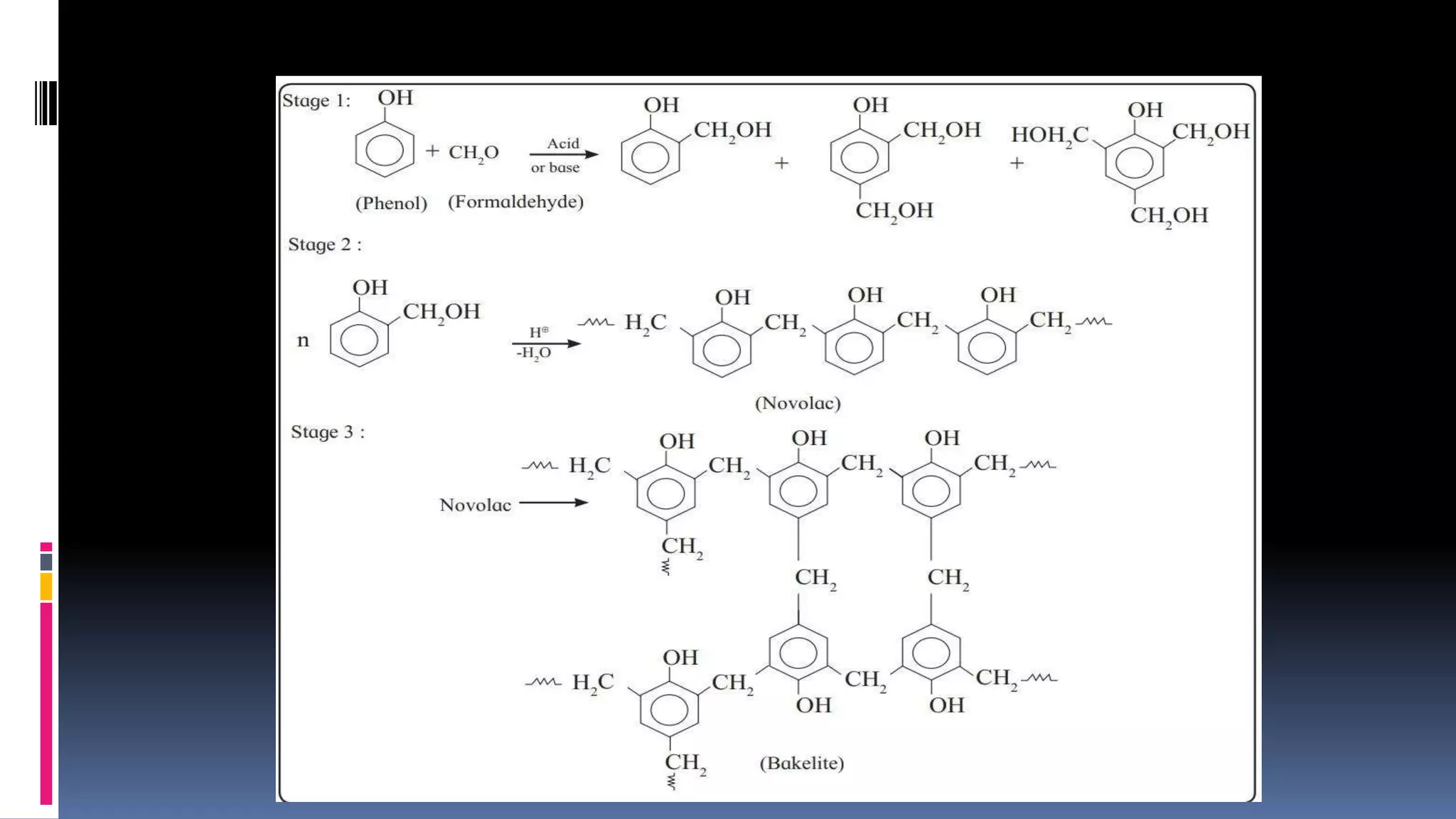
Thermosetting polymer- Bakelite
 Monomers- Formaldehyde and phenol
 Phenol and formaldehyde react in presence of acid or base catalyst to
form thermosetting/moulding powder (novolac) in two stages. In the
third stage, various articles are shaped from novolac by putting it in
appropriate moulds and heating at high temperature (1380C to 1760C)
and at high pressure.
 During the third stage of thermosetting in the moulds, many crosslinks
are formed which results in formation of rigid polymeric material, called
bakelite which is insoluble and infusible and has high tensile strength.
 It can also serve as substitute for glass.
 Bakelite is used for making articles like telephone instrument,
kitchenware, electric insulators.
Define polymerization!
 Polymerization is the fundamental process by which low
molecular mass compounds are converted into high molecular
weight compounds by linking together of repeating structural
units with covalent bonds.
 Depending upon the reactions between the monomors, the
process can be classified as follows
1. Addition polymerization (or chain growth polymerization)
2. Condensation polymerization (or step growth polymerization)
3. Ring opening polymerization
Ring opening polymers
 The third type of polymerization is ring opening polymerization.
 Cyclic compounds like lactams, cyclic ethers, lactones, etc. polymerize by ring opening
polymerization.
 Strong acid or base catalyze this reaction.
 Elemental composition of the repeating unit in the polymer resulting from ring opening
polymerization is same as that of the monomers, as in the case of addition polymerization.
 Addition polymerizations are often very rapid. But ring opening polymerization proceeds
by addition of a single monomer unit (but never of larger units) to the growing chain
molecules.
 In this sense, ring opening polymerization is a step growth polymerization similar to
condensation polymerization.
Addition polymers
 addition of monomers without loss of any small molecules.
 The repeating unit of an addition polymer has the same elemental
composition as that of original monomer
 Compounds containing double bond undergo addition polymerization.
It is also referred as vinyl polymerization, since majority of monomers
are from vinyl category. For example : vinyl chloride (CH2=CHCl),
acrylonitrile (CH2=CHCN).
 High molecular mass polymeric materials are produced without
formation of any intermediate low molecular mass polymeric
materials.
 major mechanism to form addition polymers is free radical
mechanism aka chain reaction
Free radical mechanism
3 main steps.
1. Chain initiation
2. chain propogation
3. Chain termination ki
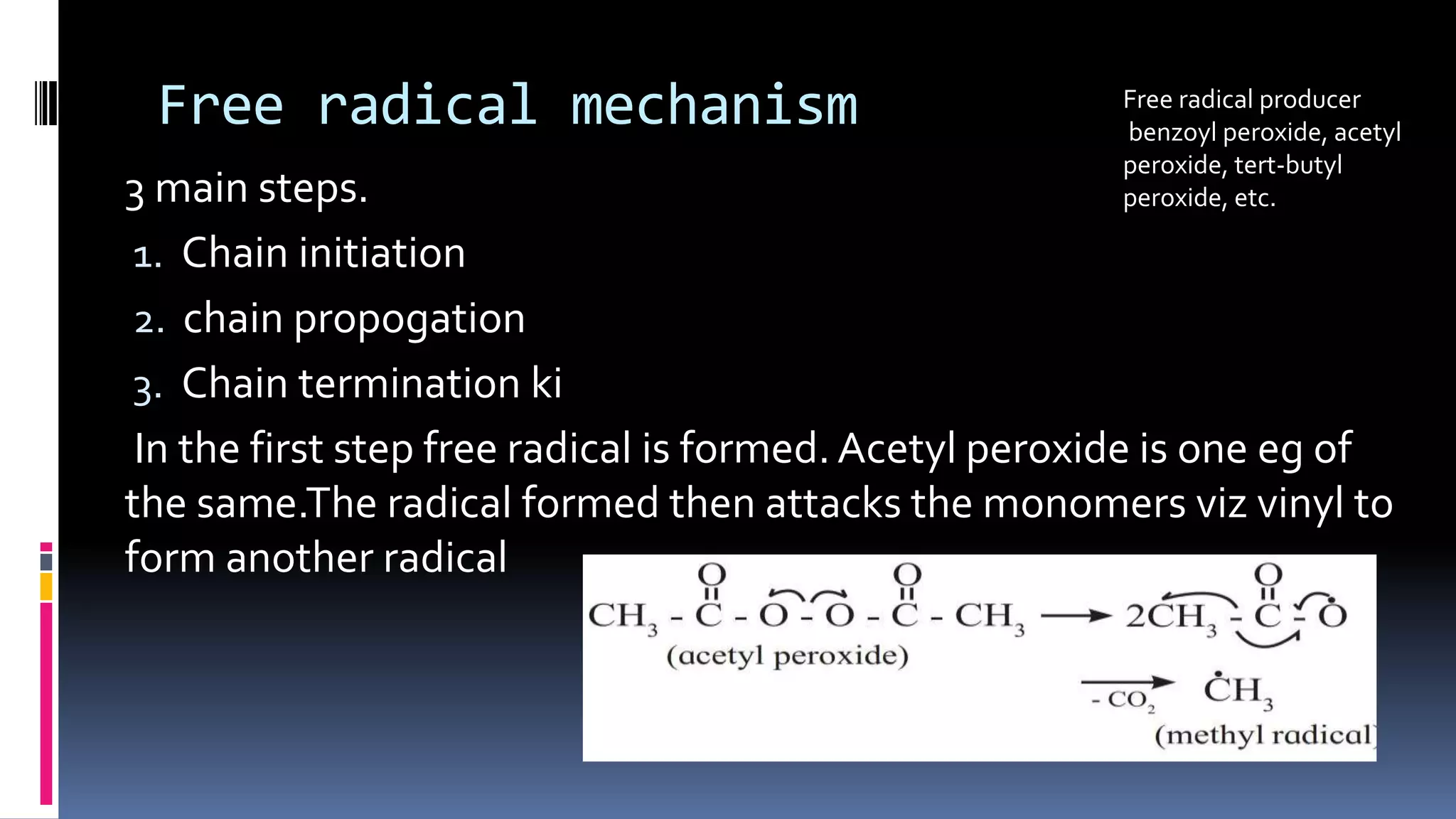
In the first step free radical is formed. Acetyl peroxide is one eg of
the same.The radical formed then attacks the monomers viz vinyl to
form another radical
Free radical producer
benzoyl peroxide, acetyl
peroxide, tert-butyl
peroxide, etc.
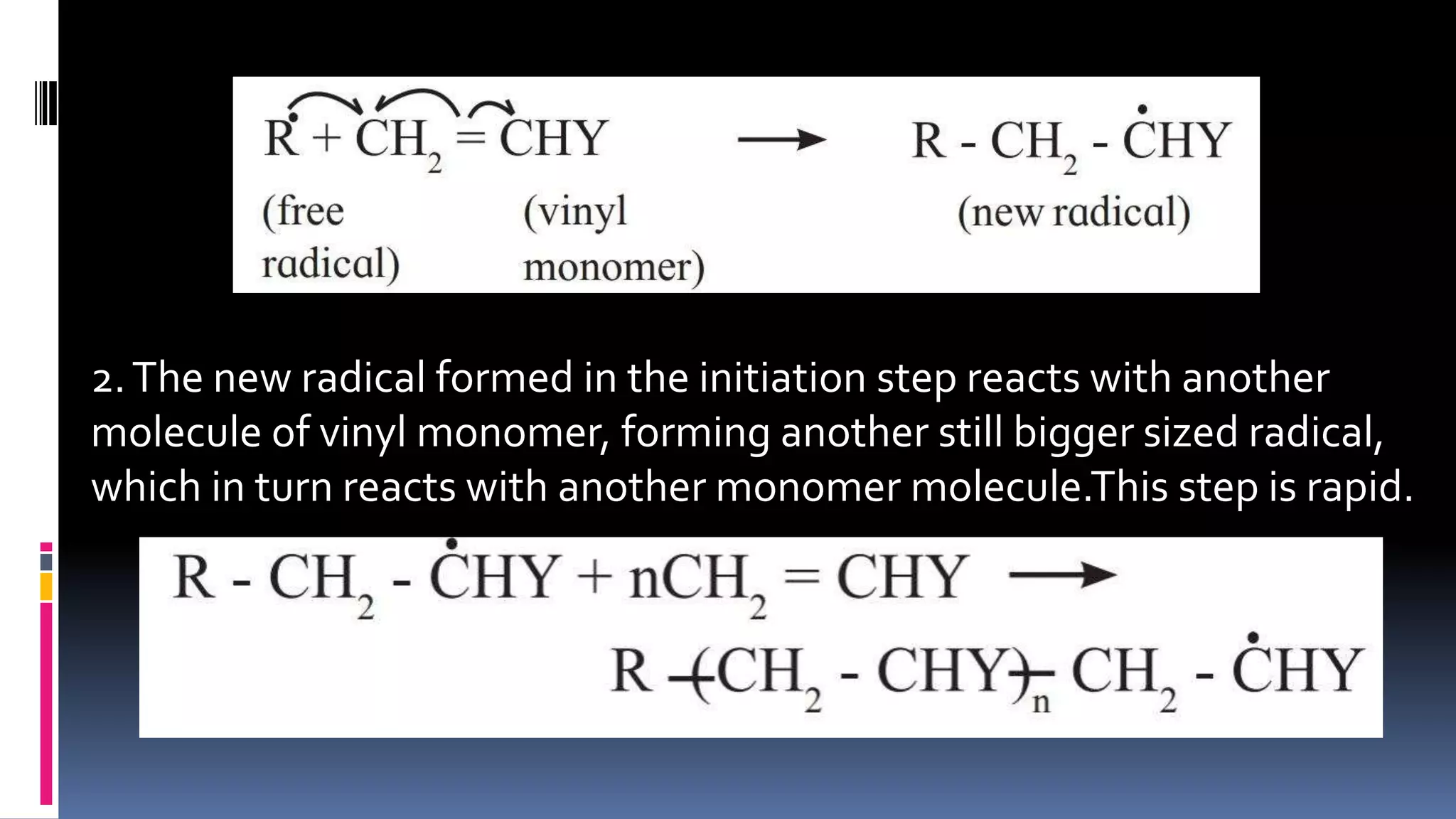
2.The new radical formed in the initiation step reacts with another
molecule of vinyl monomer, forming another still bigger sized radical,
which in turn reacts with another monomer molecule.This step is rapid.
3. Chain termination
termination is by combination of two growing chain radicals.
3 steps
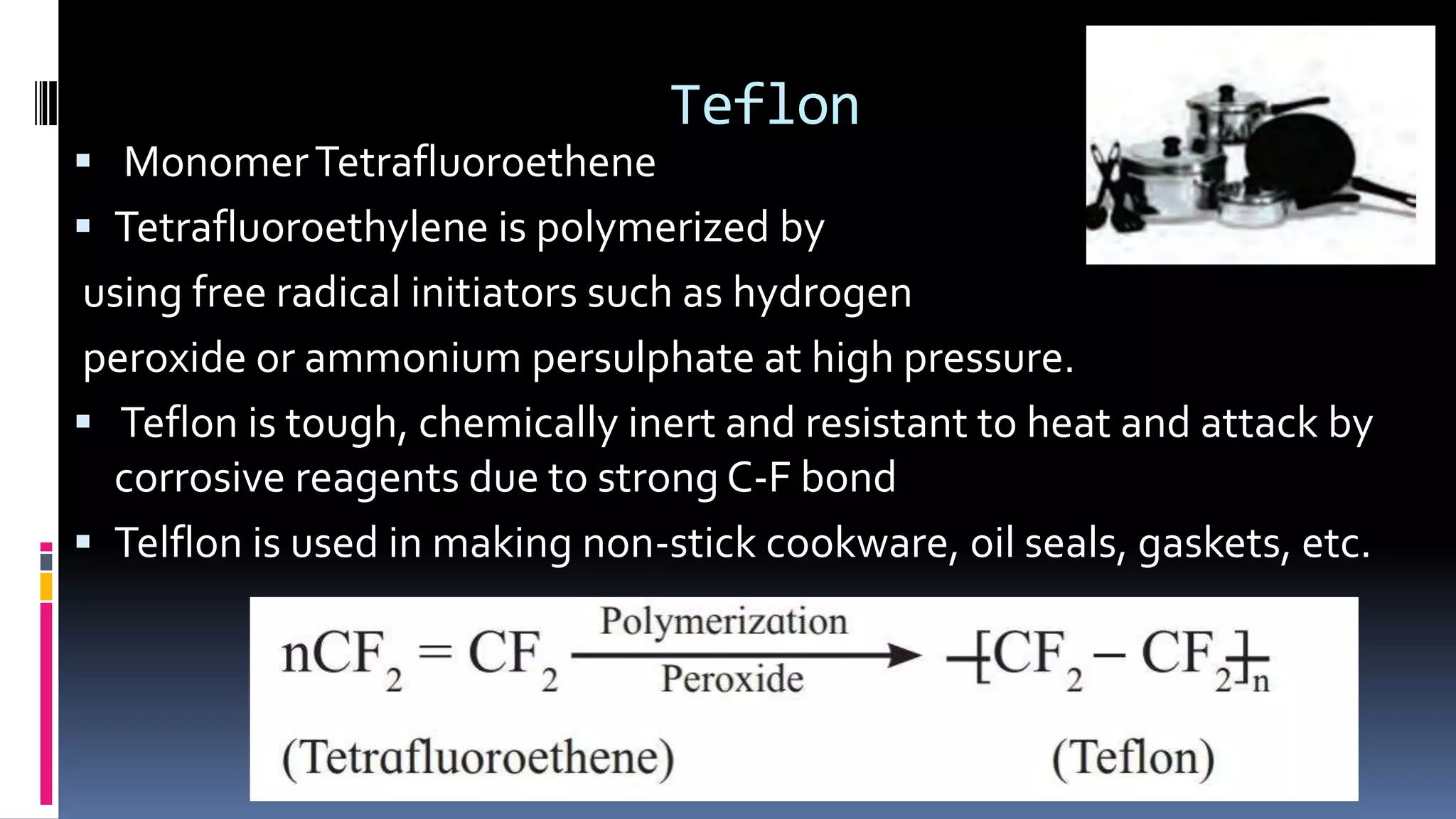
Teflon
 MonomerTetrafluoroethene
 Tetrafluoroethylene is polymerized by
using free radical initiators such as hydrogen
peroxide or ammonium persulphate at high pressure.
 Teflon is tough, chemically inert and resistant to heat and attack by
corrosive reagents due to strong C-F bond
 Telflon is used in making non-stick cookware, oil seals, gaskets, etc.
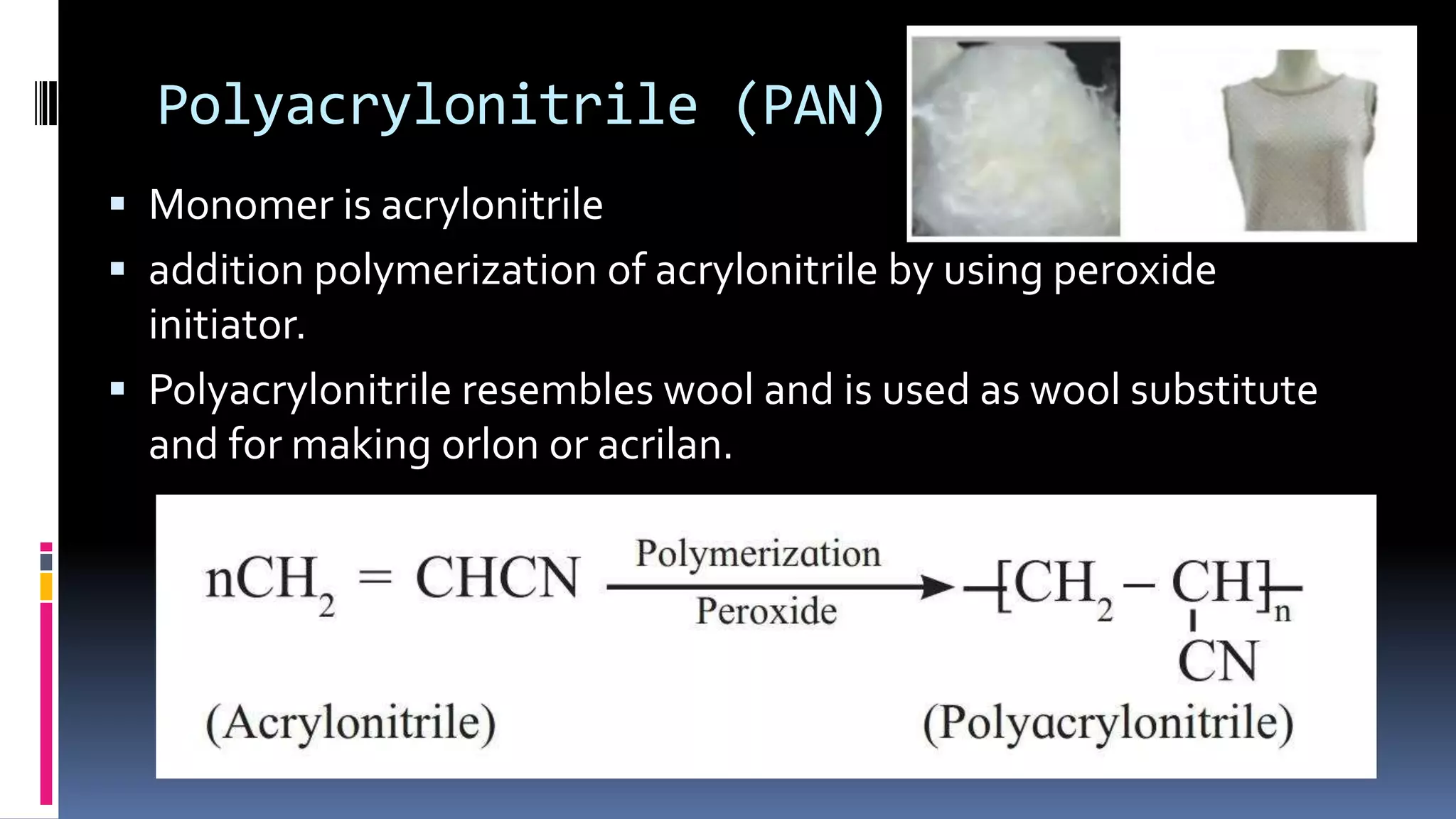
Polyacrylonitrile (PAN)
 Monomer is acrylonitrile
 addition polymerization of acrylonitrile by using peroxide
initiator.
 Polyacrylonitrile resembles wool and is used as wool substitute
and for making orlon or acrilan.
Condensation Polymer
 The process of formation of polymers from polyfunctional
monomers with the elimination of some small molecules such
as water, hydrochloric acid, methanol, ammonia is called
condensation polymerization.
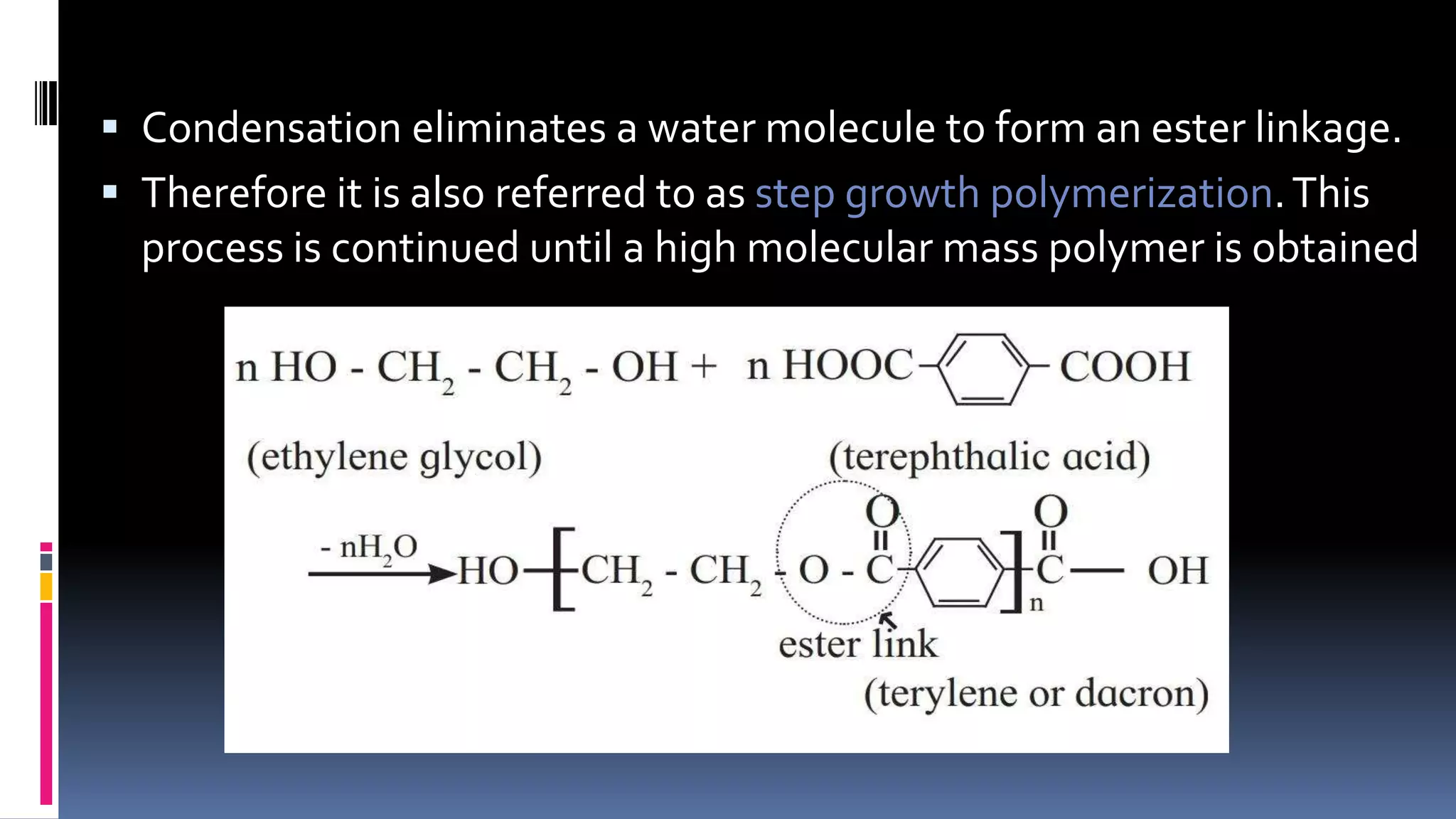
 Example. Formation of terelyene
 Monomers – ETHYLENE GLYCOL AND DIMETHYL
TEREPTHALATE
 Its a polyester polymer
 Condensation eliminates a water molecule to form an ester linkage.
 Therefore it is also referred to as step growth polymerization.This
process is continued until a high molecular mass polymer is obtained
Type of different monomers
 Homopolymers :
The polymers which have only one type of repeating unit are called homopolymers.
Usually they are formed from a single monomer. In some cases the repeating unit is
formed by condensation of two distinct monomers.
For example : polythene, polypropene, Nylon 6, polyacrylonitrile, Nylon 6, 6.
 Copolymers :
The polymers which have two or more types of repeating units are called copolymer.
They are formed by polymerization of two or more different types of monomers in
presence of each other.
The different monomer units are randomly sequenced in the copolymer. For
example : Buna-S, Buna-N.
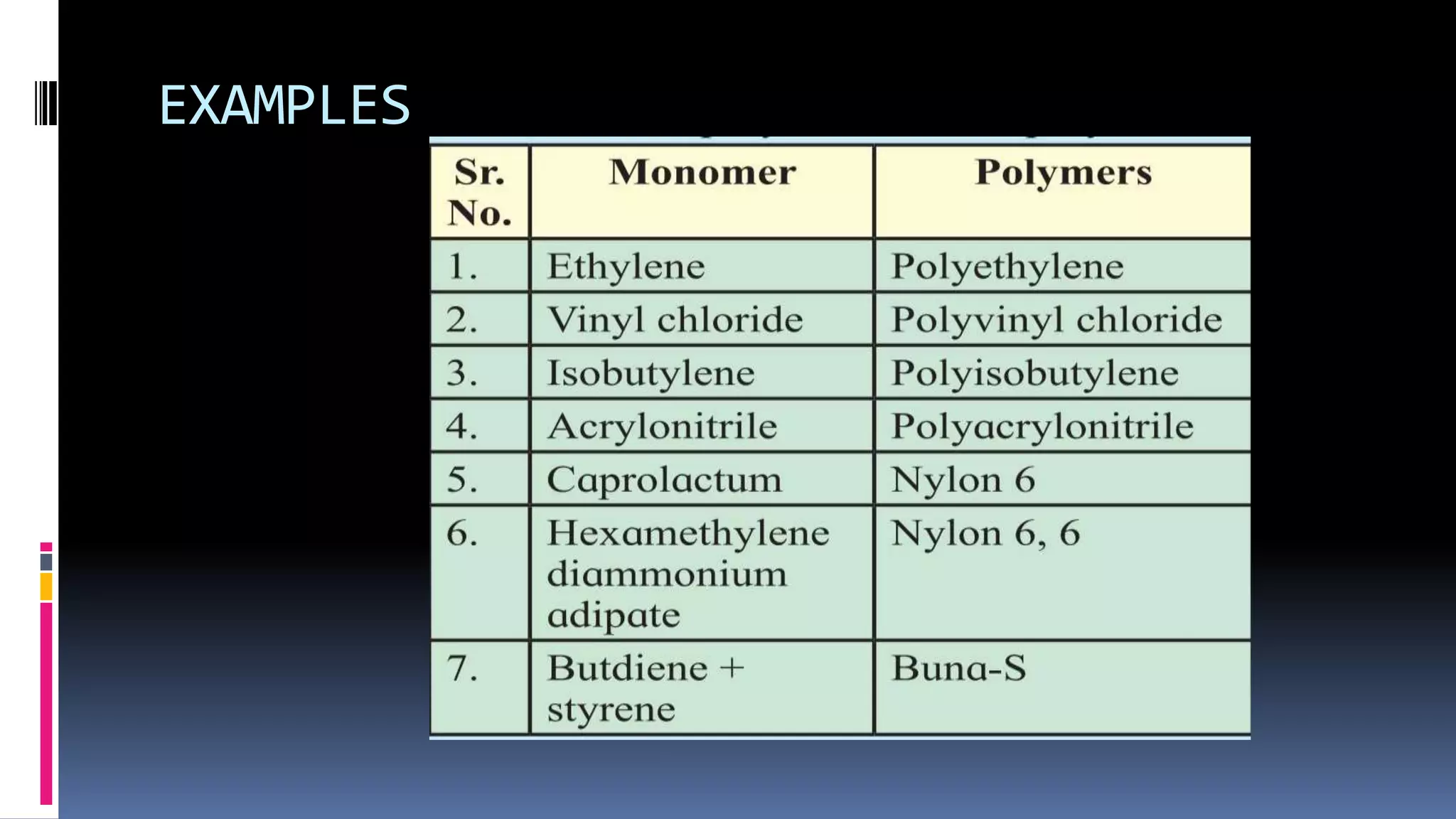
EXAMPLES
Based on degradibility
 Biodegradable
 Non biodegradable
Most of the synthetic polymers are not affected by
microbes.These
are called non-biodegradable polymers.
These, in the form of waste material which stays in the
environment for very long time and pose pollution hazards.
Most natural fibres in contrast are biodegradable.
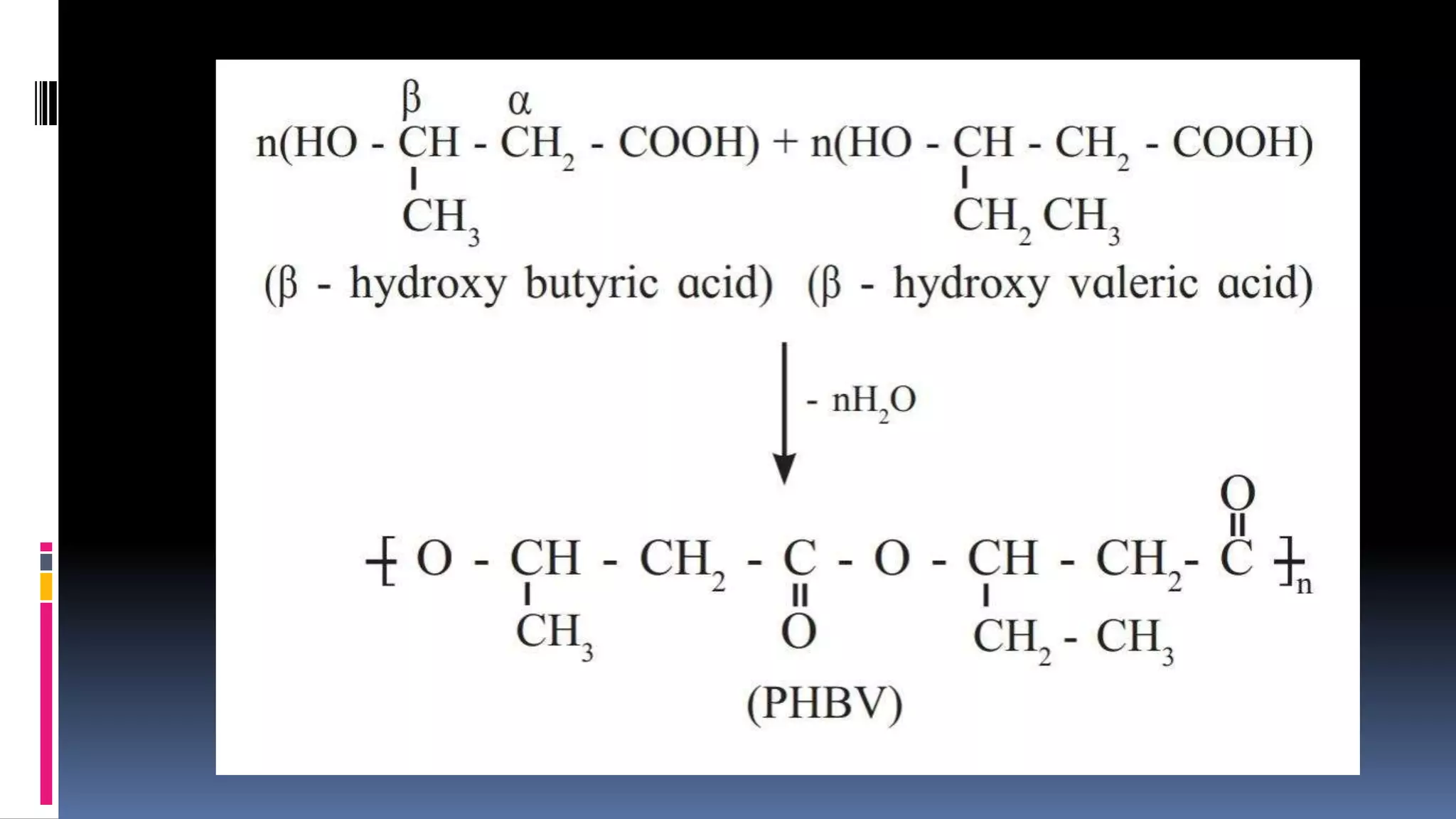
PHBV
 b- hydroxy carboxylic acids, namely, b- hydroxybutyric acid (3 -
hydroxybutanoic acid) and b- hydroxyvaleric acid (3 -
hydroxypentanoic acid).
 Hydroxyl group of one monomer forms ester link by reacting
with carboxyl group of the other.
 Thus PHBV is an aliphatic polyester with name poly b- hydroxy
butyrate - co - b- hydroxy valerate (PHBV).
 PHBV is degraded by microbes in the environment.
Nylon-2,6
Nylon 2 - nylon 6
is a polyamide copolymer of two amino acids,
namely, glycine and e - amino caproic acid. It
is a biodegradable polymer.
Molecular mass of polymers
 molecular mass of a polymer is an average of the molecular masses of
constituent molecules.
 Molecular mass of polymer depends upon the degree of polymerization
(DP).
 DP is the number of monomer units in a polymer molecule
 Mechanical Properties depends upon the molecular mass of the
polymer
 Low molecular mass polymers are liable to be brittle and have low
mechanical strength.
 very high molecular mass it becomes tough and unmanageable
 Thus to attain a certain molecular mass the concept of critical Degree
of polymerizatiom applies
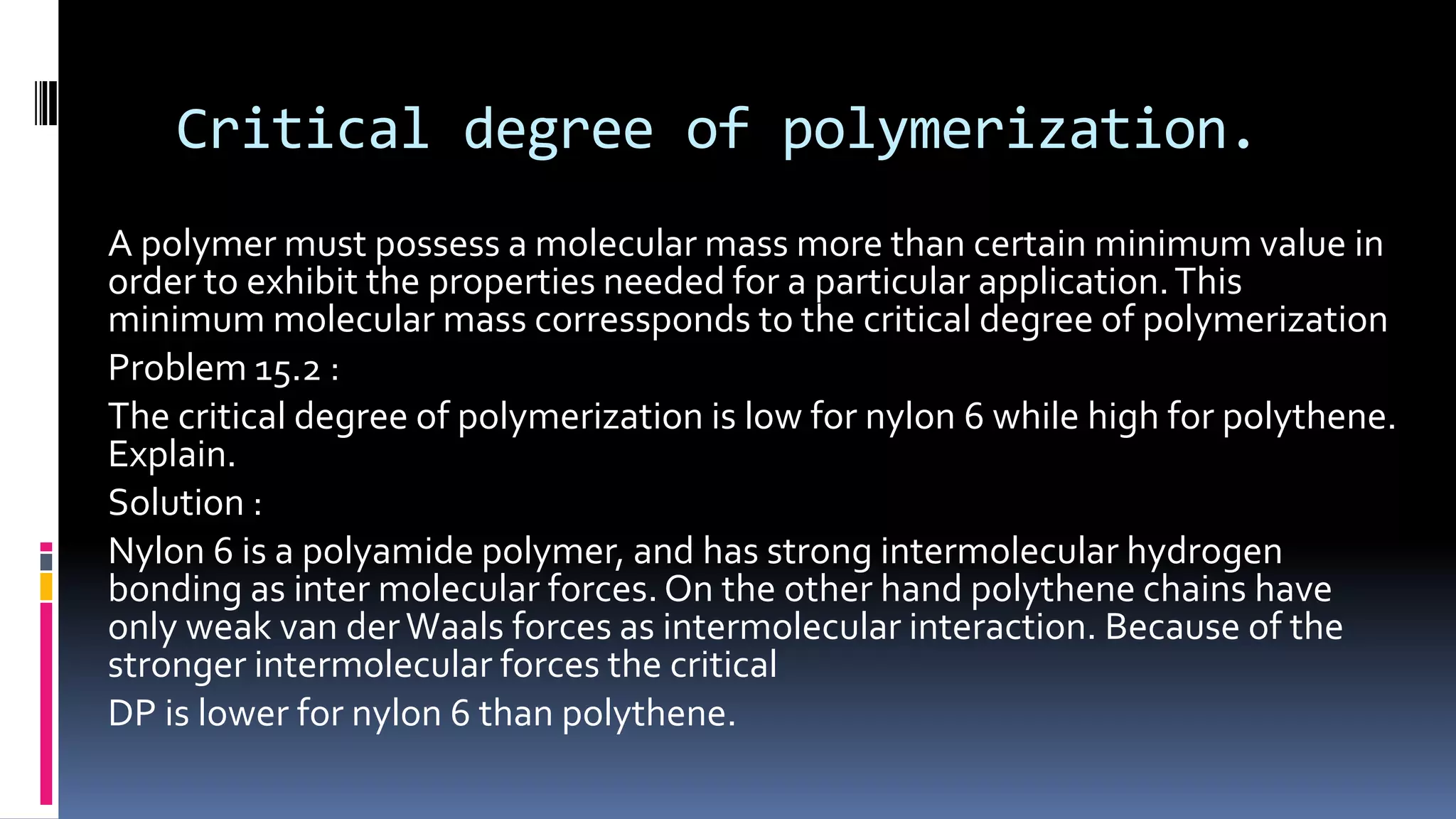
Critical degree of polymerization.
A polymer must possess a molecular mass more than certain minimum value in
order to exhibit the properties needed for a particular application.This
minimum molecular mass corressponds to the critical degree of polymerization
Problem 15.2 :
The critical degree of polymerization is low for nylon 6 while high for polythene.
Explain.
Solution :
Nylon 6 is a polyamide polymer, and has strong intermolecular hydrogen
bonding as inter molecular forces. On the other hand polythene chains have
only weak van derWaals forces as intermolecular interaction. Because of the
stronger intermolecular forces the critical
DP is lower for nylon 6 than polythene.
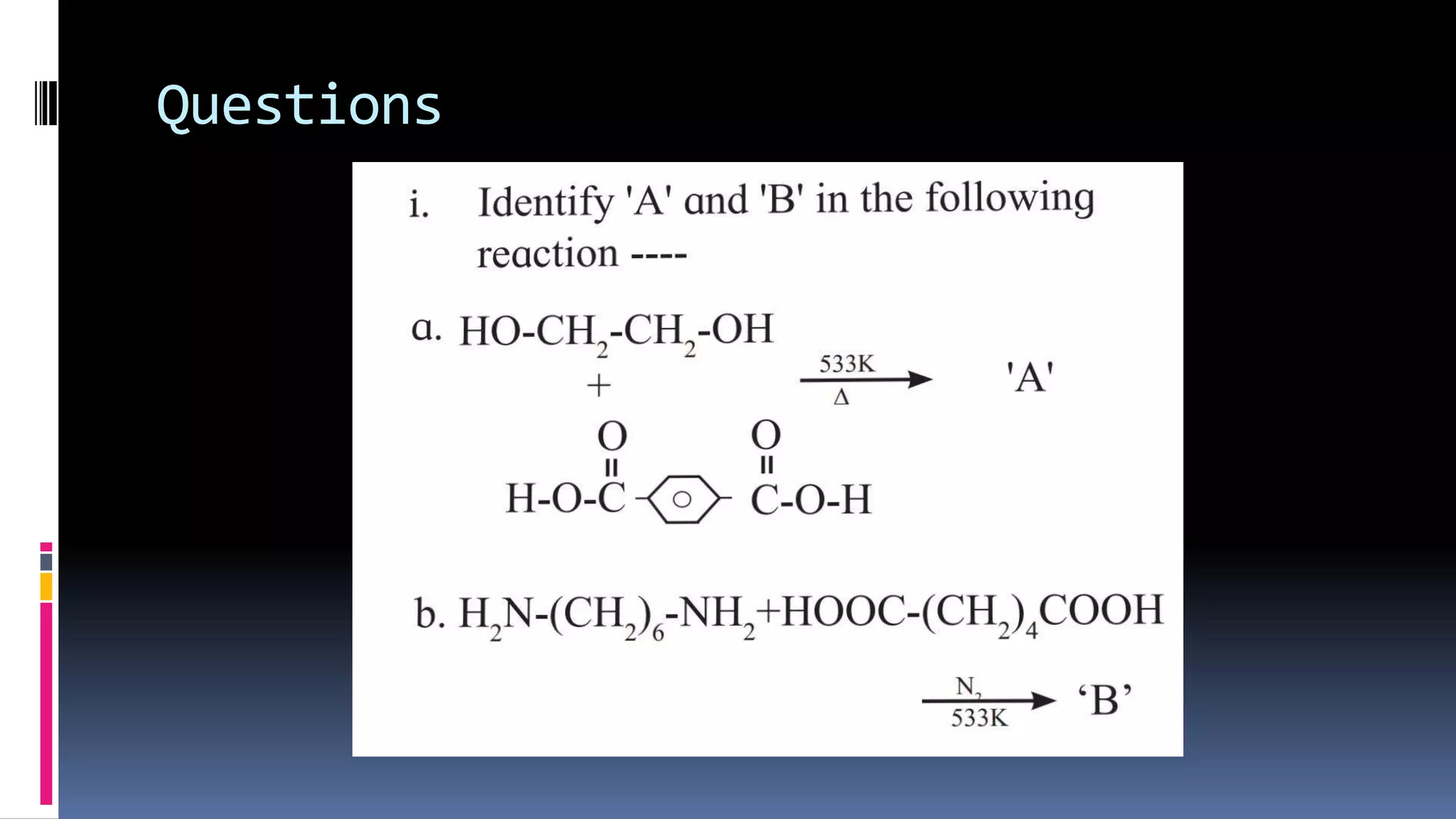
Questions
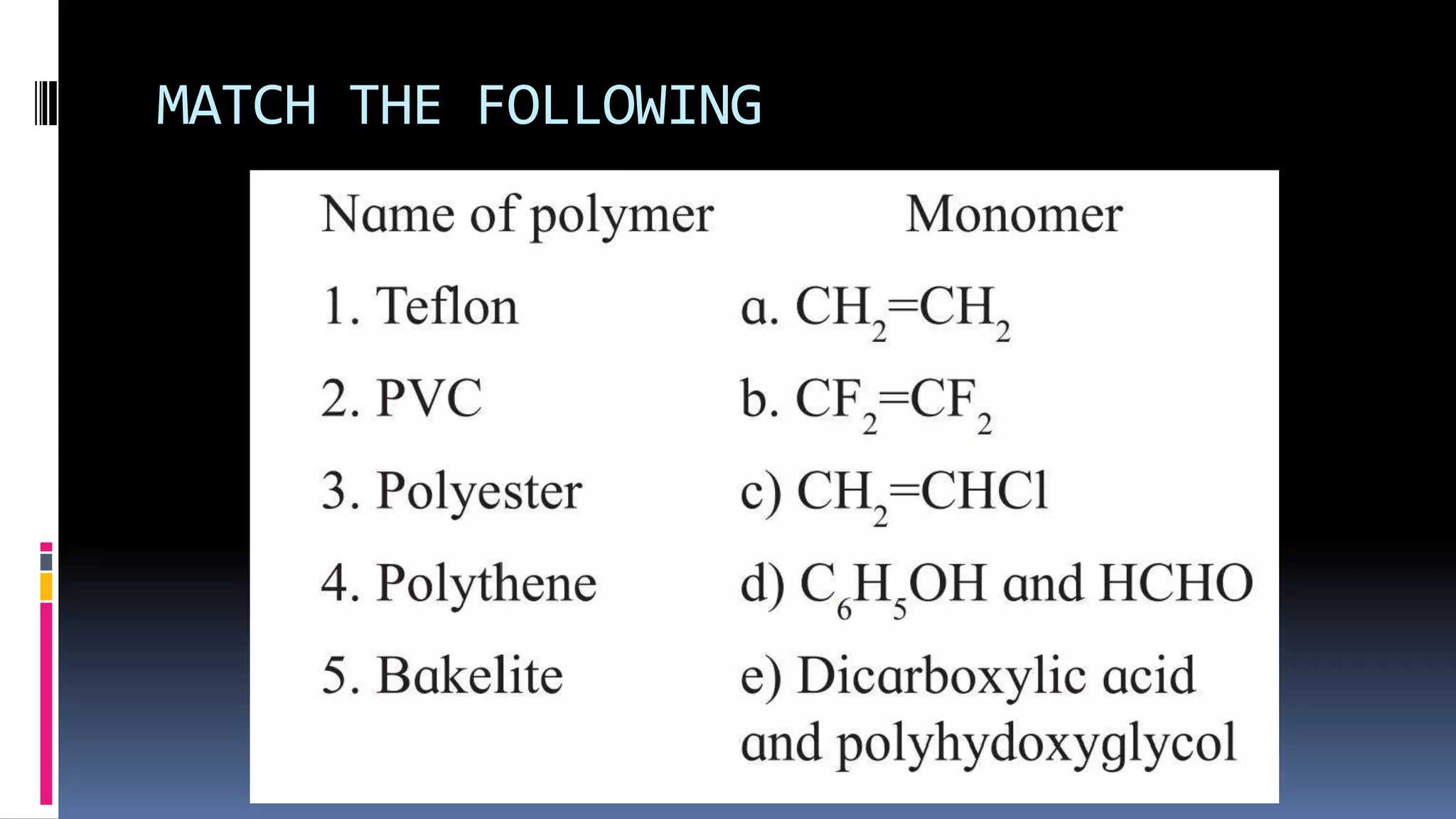
MATCH THE FOLLOWING

Polymers 12th State Board

  • 1.
  • 2.
    What are polymers? Chemicallypolymers are complex, giant macromolecules made from the repeating units which are derived from small molecules called 'monomers'. The term 'polymer' originates from Greek word 'poly' meaning many and 'mer' meaning part or unit. Interlinking of many units constitutes polymers.
  • 3.
    Classification of polymers Basedon the following 1. Source or origin 2. Structure 3. Intermolecular forces 4. Process of polymerization 5. types of monomers 6. Biodegradability
  • 5.
    Based on originor source 1. Natural polymers --- obtained From natural source  Plant source: These are obtained from plants. For example, cotton and linen are obtained from cotton plant and flax plant respectively. Natural rubber is another example of natural polymer  Animal source : These are derived from animal sources. For example, wool is obtained from hair of sheep. Silk is obtained from Silkworm. 2. Synthetic Polymers These are man- made polymers. These polymers are artificially prepared by polymerization of one monomer or copolymerization of two or more monomers. Nylon, terylene, neoprene are synthetic polymers. 3. Semisynthetic Polymers These are derived from natural polymers. These are also called regenerated fibres.Cellulose derivatives such as cellulose acetate rayon, cellulose nitrate, viscose rayon, cuprammonium rayon are a few examples of this category.Semisynthetic polymers are used in preparation of non- inflammable photographic films, cinema films, varnishes, etc
  • 6.
    Natural rubber  Monomerof natural rubber is isoprene (2-methyl - 1, 3-butadiene)  linear polymer of isoprene units  due to elastic properties called Elastomers
  • 7.
    Properties of Naturalrubber : 1. Polyisoprene molecule has cis configuration of the C = C double bond. 2. It consists of various chains held together by weak van derWaals forces and has coiled structure. 3. It can be stretched like a spring and exhibits elastic property.
  • 8.
    Vulcanization of rubber The process by which a network of cross links is introduced into an elastomers is called vulcanization.  Vulcanization enhances the properties like tensile strength, stiffness, elasticity, toughness; etc. of natural rubber.  Sulfur vulcanization is the most frequently used process.  Sulfur forms crosslinks between polyisoprene chains.
  • 9.
    Neoprene  Synthetic Rubber It is a condensation polymer of chloroprene (2-chloro-1,3-butadiene)  Neoprene is particularly resistant to petroleum, vegetable oils, light as well as heat.  Neoprene is used in making hose pipes for transport of gasoline and making gaskets. It is used for manufacturing insulator cable, jackets, belts for power transmission and conveying.
  • 10.
     It canbe vulacanized using magnesium oxide MgO
  • 11.
    Nylon-6 When epsilon (ε)-caprolactamis heated with water at high temperature it undergoes ring opening polymerization to give the polyamide polymer called nylon 6
  • 12.
    Semisynthetic Polymers- ViscoseRayon Cellulose in the form of wood pulp is transformed into viscose rayon. Cellulose is a linear polymer of glucose units and has molecular formula (C6H10O5)n A modified representation of the molecular formula of cellulose Cell- OH, is used in the reactions involved in viscose formation 1. Cellulose in the form of wood pulp is treated with concentrated NaOH solution to get fluffy alkali cellulose. 2. It is then converted to xanthate by treating with carbon disulphide. 3. On mixing with dilute NaOH it gives viscose solution which is extruded through spinnerates of spining machine into acid bath when regenerated cellulose fibres precipitate.
  • 14.
  • 15.
    Summary-Classification based onorigin or source  Natural polymers 1. plant polymers – Eg. Rubber 2. animal polymers- Eg. Silk and wool  synthetic polymer Neoprene rubber * monomer chloroprene  Semisynthetic Polymer Viscose Rayon (cell-OH)
  • 16.
    Based on Structure Linear or straight chain polymers : linear arrangement of monomers- resulting polymer is straight chain polymer. It is obtained from alkenes or bifunctional monomers. Eg. PVC, HDPE  Branched chain polymers : Monomer having 3 functional groups or already having side chains give rise to branched chain polymers. Eg. : low density polythene.  Cross linking polymers Aka cross linked or network polymers where cross links are produced between linear chains. Cross linking results from polyfunctional monomers. For example, bakelite, melamine. BAKELITE PVC
  • 17.
  • 18.
    HDPE LDPE  Highdensity polyethylene  HDP is obtained by polymerization of ethene in presence of Zieglar-Natta catalyst which is a combination of triethyl aluminium with titanium tetrachloride at a temperature of 333K to 343K and a pressure of 6-7 atm.  Linear polymer but chains are tightly packed thus More density  much stiffer than LDP and has high tensile strength and hardness. It is more resistant to chemicals than LDP.  crystalline, melting point in the range of 144 - 150 0C  buckets, dustbins, bottles, pipes and to prepare laboratory wares  Low density polyethylene  LDP is obtained by polymerization of ethylene under high pressure (1000 - 2000 atm) and temperature (350 - 570 K) in presence of traces of O2 or peroxide as initiator.  mechanism- free radical addition and H-atom abstraction.  Branch polymer– chains loosely held so low density  LDP films are extremely flexible, but tough, chemically inert and moisture resistant. It is poor conductor of electricity with melting point 110 C.  used mostly to make pipes, packaging and household squeez bottles
  • 19.
    Melamine-Formaldhyde Polymer  Heatand moisture resistant themosetting plastic called melamine - formaldehyde resin  Melamine and formaldehyde undergo condensation polymerisation to give cross linked melamine formaldehyde.
  • 20.
    Based on intermolecular forces of attraction Types are: 1. Elastomers  Elasticity is a property by which a substance gets stretched by external force and restores its original shape on release of that force.  Have weak van derWaals type of intermolecular forces which permit the polymer to be stretched.  A few crosslinks between the chains help the stretched polymer to retract to its original position on removal of applied force. For example : vulcunized rubber, buna-S, buna-N, neoprene, etc.
  • 21.
    Eg. Of Elastomers--- Buna-S  Buna-S is an elastomer which is a copolymer of styrene with butadiene  Its trade name is SBR (styrene-butadiene rubber).  polymerization by the action of sodium. It is vulcanized with sulfur.  Buna-S is superior to natural rubber with regard to mechanical strength and has abrasion resistance. Hence it is used in tyre industry.
  • 22.
  • 23.
    2. Fibers  Polymericsolids which form threads are called fibres.  The fibres possess high tensile strength which is a property to have resistance to breaking under tension.  This characteristic is due to the strong intermolecular forces like hydrogen bonding and strong dipole-dipole forces.  Due to these strong intermolecularforces the fibres are crystalline in nature.  For example : polyamides (nylon 6, 6), polyesters (terylene), etc.
  • 24.
    Eg. Nylon 6,6 It is a condensation polymer  Ring opening process of polymerizatiom  monomers are adipic acid and hexamethylene diaammine  monomers on reaction produce nylon salt, which upon condensation polymerization under conditions of high temperature and pressure give the polyamide fibre nylon 6,6.
  • 26.
     The numerals6,6 in the name of this polymer stand for the number of carbon atoms in the two bifunctional monomers, namely, adipic acid and hexamethylenediamine.  Nylon 6,6 is high molecular mass (12000-50000 u) linear condensation polymer.  It possesses high tensile strength.  It does not soak in water.  It is used for making sheets, bristles for brushes, surgical sutures, textile fabrics, etc.
  • 27.
    3.Thermoplastic Polymers Plasticity isa property of being easily shaped or moulded. Thermoplastic polymers are capable of repeated softening on heating and hardening on cooling. These polymers possess moderately strong intermolecular forces that are intermediate between elastomers and fibres. For example : polythene, polystyrene, polyvinyls, etc. 4.Thermosetting polymers Themosetting polymers are rigid polymers. During their formation they have property of being shaped on heating; but they get hardened while hot. Once hardened these become infusible; cannot be softened by heating and therefore cannot be remoulded. This characteristic is the result of extensive cross linking by covalent bonds formed in the moulds during hardening/setting process while hot. For example : bakelite, urea formaldehyde resin, etc.
  • 28.
    Thermosetting polymer- Bakelite Monomers- Formaldehyde and phenol  Phenol and formaldehyde react in presence of acid or base catalyst to form thermosetting/moulding powder (novolac) in two stages. In the third stage, various articles are shaped from novolac by putting it in appropriate moulds and heating at high temperature (1380C to 1760C) and at high pressure.  During the third stage of thermosetting in the moulds, many crosslinks are formed which results in formation of rigid polymeric material, called bakelite which is insoluble and infusible and has high tensile strength.  It can also serve as substitute for glass.  Bakelite is used for making articles like telephone instrument, kitchenware, electric insulators.
  • 30.
    Define polymerization!  Polymerizationis the fundamental process by which low molecular mass compounds are converted into high molecular weight compounds by linking together of repeating structural units with covalent bonds.  Depending upon the reactions between the monomors, the process can be classified as follows 1. Addition polymerization (or chain growth polymerization) 2. Condensation polymerization (or step growth polymerization) 3. Ring opening polymerization
  • 31.
    Ring opening polymers The third type of polymerization is ring opening polymerization.  Cyclic compounds like lactams, cyclic ethers, lactones, etc. polymerize by ring opening polymerization.  Strong acid or base catalyze this reaction.  Elemental composition of the repeating unit in the polymer resulting from ring opening polymerization is same as that of the monomers, as in the case of addition polymerization.  Addition polymerizations are often very rapid. But ring opening polymerization proceeds by addition of a single monomer unit (but never of larger units) to the growing chain molecules.  In this sense, ring opening polymerization is a step growth polymerization similar to condensation polymerization.
  • 32.
    Addition polymers  additionof monomers without loss of any small molecules.  The repeating unit of an addition polymer has the same elemental composition as that of original monomer  Compounds containing double bond undergo addition polymerization. It is also referred as vinyl polymerization, since majority of monomers are from vinyl category. For example : vinyl chloride (CH2=CHCl), acrylonitrile (CH2=CHCN).  High molecular mass polymeric materials are produced without formation of any intermediate low molecular mass polymeric materials.  major mechanism to form addition polymers is free radical mechanism aka chain reaction
  • 33.
    Free radical mechanism 3main steps. 1. Chain initiation 2. chain propogation 3. Chain termination ki In the first step free radical is formed. Acetyl peroxide is one eg of the same.The radical formed then attacks the monomers viz vinyl to form another radical Free radical producer benzoyl peroxide, acetyl peroxide, tert-butyl peroxide, etc.
  • 34.
    2.The new radicalformed in the initiation step reacts with another molecule of vinyl monomer, forming another still bigger sized radical, which in turn reacts with another monomer molecule.This step is rapid.
  • 35.
    3. Chain termination terminationis by combination of two growing chain radicals.
  • 36.
  • 37.
    Teflon  MonomerTetrafluoroethene  Tetrafluoroethyleneis polymerized by using free radical initiators such as hydrogen peroxide or ammonium persulphate at high pressure.  Teflon is tough, chemically inert and resistant to heat and attack by corrosive reagents due to strong C-F bond  Telflon is used in making non-stick cookware, oil seals, gaskets, etc.
  • 38.
    Polyacrylonitrile (PAN)  Monomeris acrylonitrile  addition polymerization of acrylonitrile by using peroxide initiator.  Polyacrylonitrile resembles wool and is used as wool substitute and for making orlon or acrilan.
  • 39.
    Condensation Polymer  Theprocess of formation of polymers from polyfunctional monomers with the elimination of some small molecules such as water, hydrochloric acid, methanol, ammonia is called condensation polymerization.  Example. Formation of terelyene  Monomers – ETHYLENE GLYCOL AND DIMETHYL TEREPTHALATE  Its a polyester polymer
  • 40.
     Condensation eliminatesa water molecule to form an ester linkage.  Therefore it is also referred to as step growth polymerization.This process is continued until a high molecular mass polymer is obtained
  • 41.
    Type of differentmonomers  Homopolymers : The polymers which have only one type of repeating unit are called homopolymers. Usually they are formed from a single monomer. In some cases the repeating unit is formed by condensation of two distinct monomers. For example : polythene, polypropene, Nylon 6, polyacrylonitrile, Nylon 6, 6.  Copolymers : The polymers which have two or more types of repeating units are called copolymer. They are formed by polymerization of two or more different types of monomers in presence of each other. The different monomer units are randomly sequenced in the copolymer. For example : Buna-S, Buna-N.
  • 42.
  • 43.
    Based on degradibility Biodegradable  Non biodegradable Most of the synthetic polymers are not affected by microbes.These are called non-biodegradable polymers. These, in the form of waste material which stays in the environment for very long time and pose pollution hazards. Most natural fibres in contrast are biodegradable.
  • 44.
    PHBV  b- hydroxycarboxylic acids, namely, b- hydroxybutyric acid (3 - hydroxybutanoic acid) and b- hydroxyvaleric acid (3 - hydroxypentanoic acid).  Hydroxyl group of one monomer forms ester link by reacting with carboxyl group of the other.  Thus PHBV is an aliphatic polyester with name poly b- hydroxy butyrate - co - b- hydroxy valerate (PHBV).  PHBV is degraded by microbes in the environment.
  • 46.
    Nylon-2,6 Nylon 2 -nylon 6 is a polyamide copolymer of two amino acids, namely, glycine and e - amino caproic acid. It is a biodegradable polymer.
  • 47.
    Molecular mass ofpolymers  molecular mass of a polymer is an average of the molecular masses of constituent molecules.  Molecular mass of polymer depends upon the degree of polymerization (DP).  DP is the number of monomer units in a polymer molecule  Mechanical Properties depends upon the molecular mass of the polymer  Low molecular mass polymers are liable to be brittle and have low mechanical strength.  very high molecular mass it becomes tough and unmanageable  Thus to attain a certain molecular mass the concept of critical Degree of polymerizatiom applies
  • 48.
    Critical degree ofpolymerization. A polymer must possess a molecular mass more than certain minimum value in order to exhibit the properties needed for a particular application.This minimum molecular mass corressponds to the critical degree of polymerization Problem 15.2 : The critical degree of polymerization is low for nylon 6 while high for polythene. Explain. Solution : Nylon 6 is a polyamide polymer, and has strong intermolecular hydrogen bonding as inter molecular forces. On the other hand polythene chains have only weak van derWaals forces as intermolecular interaction. Because of the stronger intermolecular forces the critical DP is lower for nylon 6 than polythene.
  • 50.
  • 51.