Necrotizing enterocolitis


                  Alan Mathew Skaria
                       TSMU
Overview
Necrotizing enterocolitis is the necrosis(death) of intestinal tissue. It
primarily affects premature infants or sick newborns.


"Necrotizing" means the death of
tissue, "entero" refers to the small
intestine, "colo" to the large intestine,
and "itis" means inflammation.
Necrotizing Enterocolitis
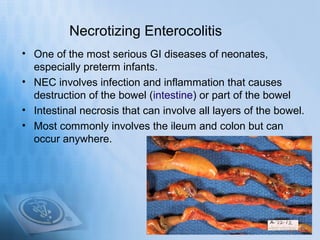
• One of the most serious GI diseases of neonates,
  especially preterm infants.
• NEC involves infection and inflammation that causes
  destruction of the bowel (intestine) or part of the bowel
• Intestinal necrosis that can involve all layers of the bowel.
• Most commonly involves the ileum and colon but can
  occur anywhere.
Epidemiology
• Most common GI emergency in newborns
• Incidence 3 per 1000 live births
• Incidence is 30 per 1000 live births for low birth weight
  neonates
• 90% are premature
• Incidence is 7% in newborns <1500 g
• Race: blacks > non-Hispanic whites
Risk Factors
• Prematurity (<34 weeks)
• Low birth weight (<1500g)
   – Occurs in 2-10% of neonates <1500g
• Enteral feeding of premature infants
   – Hypertonic formula/enteral meds
   – Breast milk protective compared to formula
   – Rate of feeds and timing of initiation of feeds don’t
     change rates of NEC
• Term infant with pre-existing illness
Causes:

• The exact cause of NEC is unknown
• These premature infants have immature bowels, weakened
  by too little oxygen or blood flow. So when feedings are
  started, the added stress of food moving through the intestine
  allows bacteria normally found in the intestine to invade and
  damage the wall of the intestinal tissues. The damage may
  affect only a short segment of the intestine or can progress
  quickly to involve a much larger portion.
Pathogenesis:
• A combination of risk factors predispose pts to NEC
• An insult begins the process
• Progression is due to stasis, bacterial overgrowth,
  vascular factors
• May resolve, or may progress to perforation


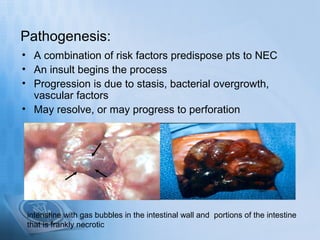
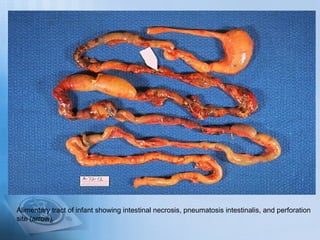
 intenstine with gas bubbles in the intestinal wall and portions of the intestine
 that is frankly necrotic
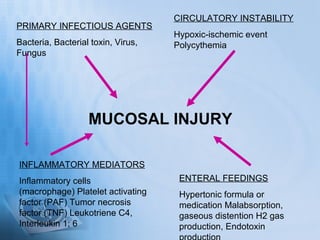
CIRCULATORY INSTABILITY
PRIMARY INFECTIOUS AGENTS
                                    Hypoxic-ischemic event
Bacteria, Bacterial toxin, Virus,   Polycythemia
Fungus


                   MUCOSAL INJURY

INFLAMMATORY MEDIATORS
Inflammatory cells                   ENTERAL FEEDINGS
(macrophage) Platelet activating     Hypertonic formula or
factor (PAF) Tumor necrosis          medication Malabsorption,
factor (TNF) Leukotriene C4,         gaseous distention H2 gas
Interleukin 1; 6                     production, Endotoxin
Symptoms

*Abdominal distention
*Blood in the stool
*Diarrhea
*Feeding intolerance
*Lethargy
*Temperature instability
*Vomiting
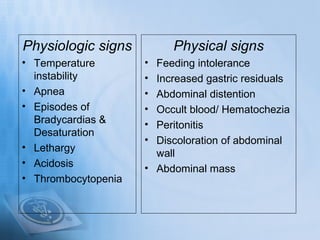
Physiologic signs         Physical signs
• Temperature        • Feeding intolerance
  instability        • Increased gastric residuals
• Apnea              • Abdominal distention
• Episodes of        • Occult blood/ Hematochezia
  Bradycardias &     • Peritonitis
  Desaturation
                     • Discoloration of abdominal
• Lethargy
                       wall
• Acidosis           • Abdominal mass
• Thrombocytopenia
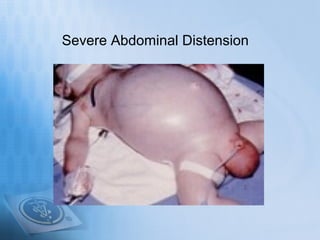
Severe Abdominal Distension
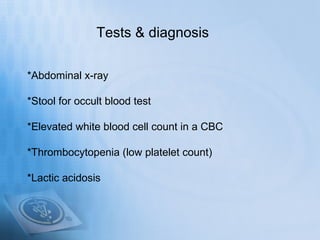
Tests & diagnosis

*Abdominal x-ray

*Stool for occult blood test

*Elevated white blood cell count in a CBC

*Thrombocytopenia (low platelet count)

*Lactic acidosis
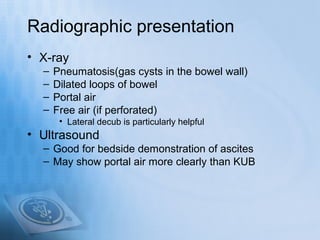
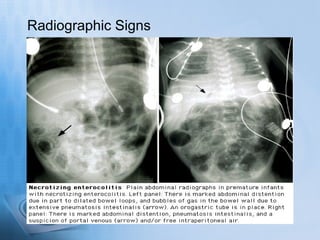
Radiographic presentation
• X-ray
  –   Pneumatosis(gas cysts in the bowel wall)
  –   Dilated loops of bowel
  –   Portal air
  –   Free air (if perforated)
       • Lateral decub is particularly helpful
• Ultrasound
  – Good for bedside demonstration of ascites
  – May show portal air more clearly than KUB
Radiographic Signs
Alimentary tract of infant showing intestinal necrosis, pneumatosis intestinalis, and perforation
site (arrow).
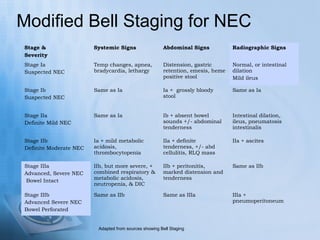
Modified Bell Staging for NEC
Stage &                 Systemic Signs                 Abdominal Signs           Radiographic Signs
Severity
Stage Ia                Temp changes, apnea,           Distension, gastric       Normal, or intestinal
Suspected NEC           bradycardia, lethargy          retention, emesis, heme   dilation
                                                       positive stool            Mild ileus

Stage Ib                Same as Ia                     Ia + grossly bloody       Same as Ia
Suspected NEC                                          stool


Stage IIa               Same as Ia                     Ib + absent bowel         Intestinal dilation,
Definite Mild NEC                                      sounds +/- abdominal      ileus, pneumatosis
                                                       tenderness                intestinalis

Stage IIb               Ia + mild metabolic            IIa + definite            IIa + ascites
Definite Moderate NEC   acidosis,                      tenderness, +/- abd
                        thrombocytopenia               cellulitis, RLQ mass

Stage IIIa              IIb, but more severe, +        IIb + peritonitis,        Same as IIb
Advanced, Severe NEC    combined respiratory &         marked distension and
Bowel Intact            metabolic acidosis,            tenderness
                        neutropenia, & DIC

Stage IIIb              Same as IIb                    Same as IIIa              IIIa +
Advanced Severe NEC                                                              pneumoperitoneum
Bowel Perforated


                         Adapted from sources showing Bell Staging
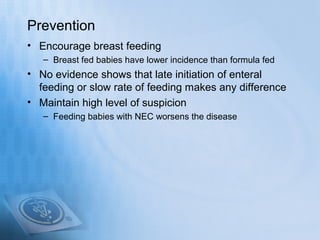
Prevention
• Encourage breast feeding
   – Breast fed babies have lower incidence than formula fed
• No evidence shows that late initiation of enteral
  feeding or slow rate of feeding makes any difference
• Maintain high level of suspicion
   – Feeding babies with NEC worsens the disease
Treatment
•In an infant suspected of having necrotizing enterocolitis,
feedings are stopped and gas is relieved from the bowel by
inserting a small tube into the stomach.
•Intravenous fluid replaces formula or breast milk.
•Antibiotic therapy is started.
•The infant's condition is monitored with abdominal x-rays,
blood tests, and blood gases.
•Surgery will be needed if there is a hole in the intestines or
peritonitis (inflammation of the abdominal wall).
•The dead bowel tissue is removed and a colostomy or
ileostomy is performed.
•The bowel is then reconnected several weeks or months
later when the infection and inflammation have healed.
Complications

*Intestinal perforation

*Intestinal stricture

*Peritonitis

*Sepsis
Prognosis
•Depends on the severity of the illness
•Necrotizing enterocolitis is a serious disease with a death rate
approaching 25%. Early, aggressive treatment helps improve the
outcome.
•Most infants who develop NEC recover fully and do not have further
feeding problems.
•In some cases, scarring and narrowing of the bowel may occur and
can cause future intestinal obstruction or blockage.
•Another residual problem may be malabsorption (the inability of the
bowel to absorb nutrients normally). This is more common in children
who required surgery for NEC and had part of their intestine removed.
THANK YOU!!!!

necrotizing enterocolitis

  • 1.
    Necrotizing enterocolitis Alan Mathew Skaria TSMU
  • 2.
    Overview Necrotizing enterocolitis isthe necrosis(death) of intestinal tissue. It primarily affects premature infants or sick newborns. "Necrotizing" means the death of tissue, "entero" refers to the small intestine, "colo" to the large intestine, and "itis" means inflammation.
  • 3.
    Necrotizing Enterocolitis • Oneof the most serious GI diseases of neonates, especially preterm infants. • NEC involves infection and inflammation that causes destruction of the bowel (intestine) or part of the bowel • Intestinal necrosis that can involve all layers of the bowel. • Most commonly involves the ileum and colon but can occur anywhere.
  • 4.
    Epidemiology • Most commonGI emergency in newborns • Incidence 3 per 1000 live births • Incidence is 30 per 1000 live births for low birth weight neonates • 90% are premature • Incidence is 7% in newborns <1500 g • Race: blacks > non-Hispanic whites
  • 5.
    Risk Factors • Prematurity(<34 weeks) • Low birth weight (<1500g) – Occurs in 2-10% of neonates <1500g • Enteral feeding of premature infants – Hypertonic formula/enteral meds – Breast milk protective compared to formula – Rate of feeds and timing of initiation of feeds don’t change rates of NEC • Term infant with pre-existing illness
  • 6.
    Causes: • The exactcause of NEC is unknown • These premature infants have immature bowels, weakened by too little oxygen or blood flow. So when feedings are started, the added stress of food moving through the intestine allows bacteria normally found in the intestine to invade and damage the wall of the intestinal tissues. The damage may affect only a short segment of the intestine or can progress quickly to involve a much larger portion.
  • 7.
    Pathogenesis: • A combinationof risk factors predispose pts to NEC • An insult begins the process • Progression is due to stasis, bacterial overgrowth, vascular factors • May resolve, or may progress to perforation intenstine with gas bubbles in the intestinal wall and portions of the intestine that is frankly necrotic
  • 8.
    CIRCULATORY INSTABILITY PRIMARY INFECTIOUSAGENTS Hypoxic-ischemic event Bacteria, Bacterial toxin, Virus, Polycythemia Fungus MUCOSAL INJURY INFLAMMATORY MEDIATORS Inflammatory cells ENTERAL FEEDINGS (macrophage) Platelet activating Hypertonic formula or factor (PAF) Tumor necrosis medication Malabsorption, factor (TNF) Leukotriene C4, gaseous distention H2 gas Interleukin 1; 6 production, Endotoxin
  • 9.
    Symptoms *Abdominal distention *Blood inthe stool *Diarrhea *Feeding intolerance *Lethargy *Temperature instability *Vomiting
  • 10.
    Physiologic signs Physical signs • Temperature • Feeding intolerance instability • Increased gastric residuals • Apnea • Abdominal distention • Episodes of • Occult blood/ Hematochezia Bradycardias & • Peritonitis Desaturation • Discoloration of abdominal • Lethargy wall • Acidosis • Abdominal mass • Thrombocytopenia
  • 11.
  • 12.
    Tests & diagnosis *Abdominalx-ray *Stool for occult blood test *Elevated white blood cell count in a CBC *Thrombocytopenia (low platelet count) *Lactic acidosis
  • 13.
    Radiographic presentation • X-ray – Pneumatosis(gas cysts in the bowel wall) – Dilated loops of bowel – Portal air – Free air (if perforated) • Lateral decub is particularly helpful • Ultrasound – Good for bedside demonstration of ascites – May show portal air more clearly than KUB
  • 14.
  • 15.
    Alimentary tract ofinfant showing intestinal necrosis, pneumatosis intestinalis, and perforation site (arrow).
  • 16.
    Modified Bell Stagingfor NEC Stage & Systemic Signs Abdominal Signs Radiographic Signs Severity Stage Ia Temp changes, apnea, Distension, gastric Normal, or intestinal Suspected NEC bradycardia, lethargy retention, emesis, heme dilation positive stool Mild ileus Stage Ib Same as Ia Ia + grossly bloody Same as Ia Suspected NEC stool Stage IIa Same as Ia Ib + absent bowel Intestinal dilation, Definite Mild NEC sounds +/- abdominal ileus, pneumatosis tenderness intestinalis Stage IIb Ia + mild metabolic IIa + definite IIa + ascites Definite Moderate NEC acidosis, tenderness, +/- abd thrombocytopenia cellulitis, RLQ mass Stage IIIa IIb, but more severe, + IIb + peritonitis, Same as IIb Advanced, Severe NEC combined respiratory & marked distension and Bowel Intact metabolic acidosis, tenderness neutropenia, & DIC Stage IIIb Same as IIb Same as IIIa IIIa + Advanced Severe NEC pneumoperitoneum Bowel Perforated Adapted from sources showing Bell Staging
  • 17.
    Prevention • Encourage breastfeeding – Breast fed babies have lower incidence than formula fed • No evidence shows that late initiation of enteral feeding or slow rate of feeding makes any difference • Maintain high level of suspicion – Feeding babies with NEC worsens the disease
  • 18.
    Treatment •In an infantsuspected of having necrotizing enterocolitis, feedings are stopped and gas is relieved from the bowel by inserting a small tube into the stomach. •Intravenous fluid replaces formula or breast milk. •Antibiotic therapy is started. •The infant's condition is monitored with abdominal x-rays, blood tests, and blood gases. •Surgery will be needed if there is a hole in the intestines or peritonitis (inflammation of the abdominal wall). •The dead bowel tissue is removed and a colostomy or ileostomy is performed. •The bowel is then reconnected several weeks or months later when the infection and inflammation have healed.
  • 19.
  • 20.
    Prognosis •Depends on theseverity of the illness •Necrotizing enterocolitis is a serious disease with a death rate approaching 25%. Early, aggressive treatment helps improve the outcome. •Most infants who develop NEC recover fully and do not have further feeding problems. •In some cases, scarring and narrowing of the bowel may occur and can cause future intestinal obstruction or blockage. •Another residual problem may be malabsorption (the inability of the bowel to absorb nutrients normally). This is more common in children who required surgery for NEC and had part of their intestine removed.
  • 21.