NECTOTIZING ENTEROCOLITIS
Presenter: BIMENYIMANA Phocas, Med student, UR
Supervisor: Dr. NUBAHUMPATSE Emmanuel
Case scenario
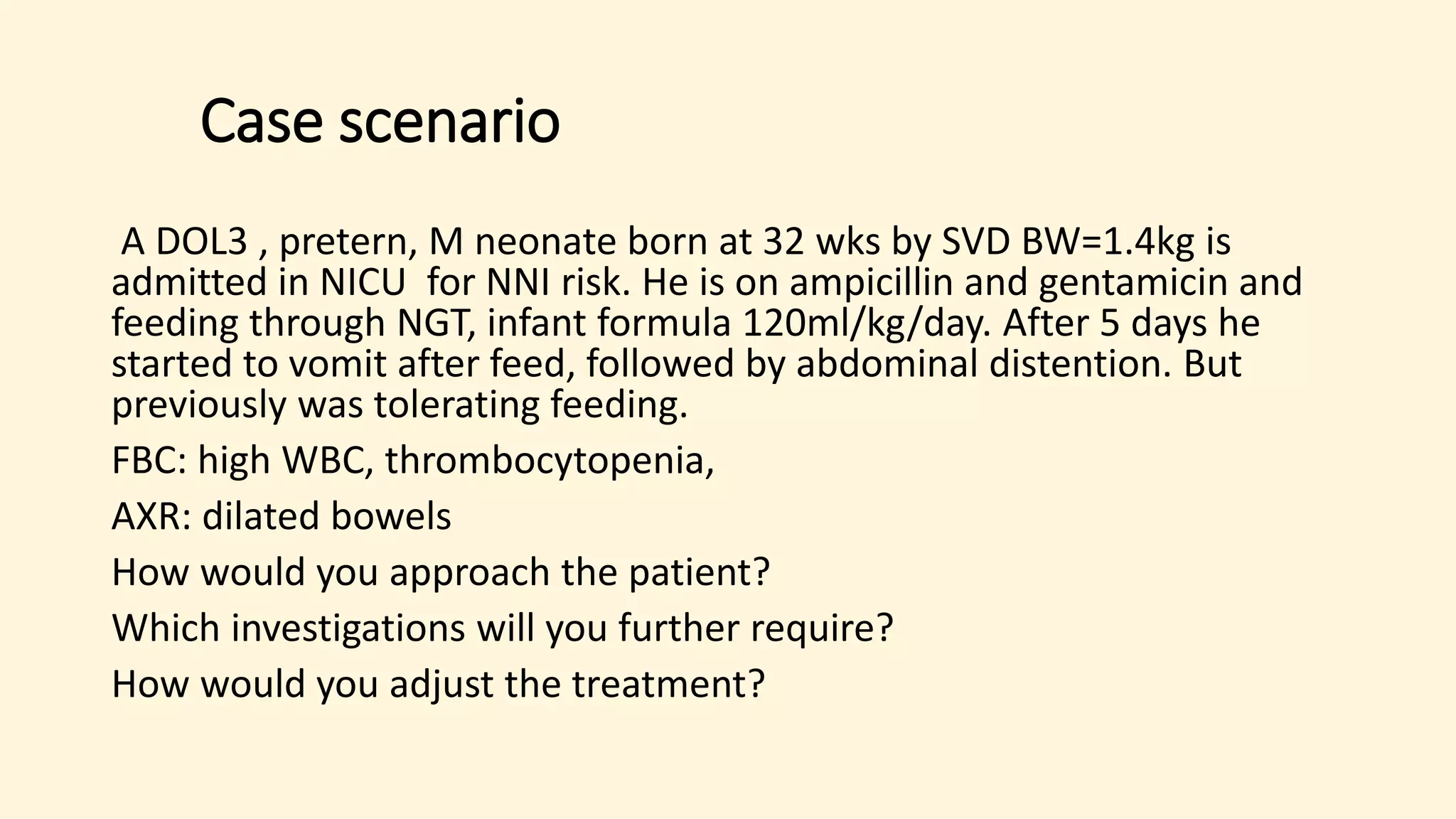
A DOL3 , pretern, M neonate born at 32 wks by SVD BW=1.4kg is
admitted in NICU for NNI risk. He is on ampicillin and gentamicin and
feeding through NGT, infant formula 120ml/kg/day. After 5 days he
started to vomit after feed, followed by abdominal distention. But
previously was tolerating feeding.
FBC: high WBC, thrombocytopenia,
AXR: dilated bowels
How would you approach the patient?
Which investigations will you further require?
How would you adjust the treatment?
Introduction
• Is one of the most common gastrointestinal emergencies in the
newborn infant.
• It is a disorder characterized by ischemic necrosis of the intestinal
mucosa, which is associated with inflammation, invasion of enteric
gas forming organisms, transmural involvement and perforation
• Necrotizing enterocolitis (NEC) is an inflammatory intestinal disease
that affects 5–7% of preterm neonates.
• The terminal ileum and proximal colon are the sections of bowel
affected most commonly, although more extensive disease is possible
from the stomach to the rectum.
RISK FACTORS
Why the Preterm Gut is Different?
◦Decreased IgA
◦Decreased Intestinal T lymphocytes
◦Poor Antibody Response
◦Higher Membrane Permeability of GI Epithelial Lining
◦Lower Gastric Motility
Pathophysiology
Is based on 3 main problems:
1. immature gut an immune system
2. enteral nutrition and
3. the presence of bacteria
Pathophysiology
Pathophysiology
• Bacteria reported to be associated with NEC include
Escherichia coli, Klebsiella, Enterobacter, Pseudomonas,
Salmonella, Clostridium, coagulase-negative
Staphylococcus, and Enterococcus sp.
• Gram-positive organisms are more common in stages I and
II disease, and enteric organisms predominate in more severe
cases.
Pathophysiology
• Viral pathogens, namely, rotavirus, coronavirus, and enteroviruses
also have been described in association with NEC.
• The type of nutrition that a baby receives appears to have an impact
on subsequent colonization patterns, with formula-fed infants
showing an early increase in Enterobacteriaceae colonization and the
guts of breastfed infants colonized early with Enterobacteriaceae and
Bifidobacterium.
Clinical presentation
The majority of preterm infants who develop NEC are
generally healthy, feeding well, and growing prior to
developing NEC.
The most frequent sign of NEC is a sudden change in feeding
tolerance, which can be manifest by numerous clinical signs
listed below.
SPECIFIC GASTROINTESTINAL SIGNS
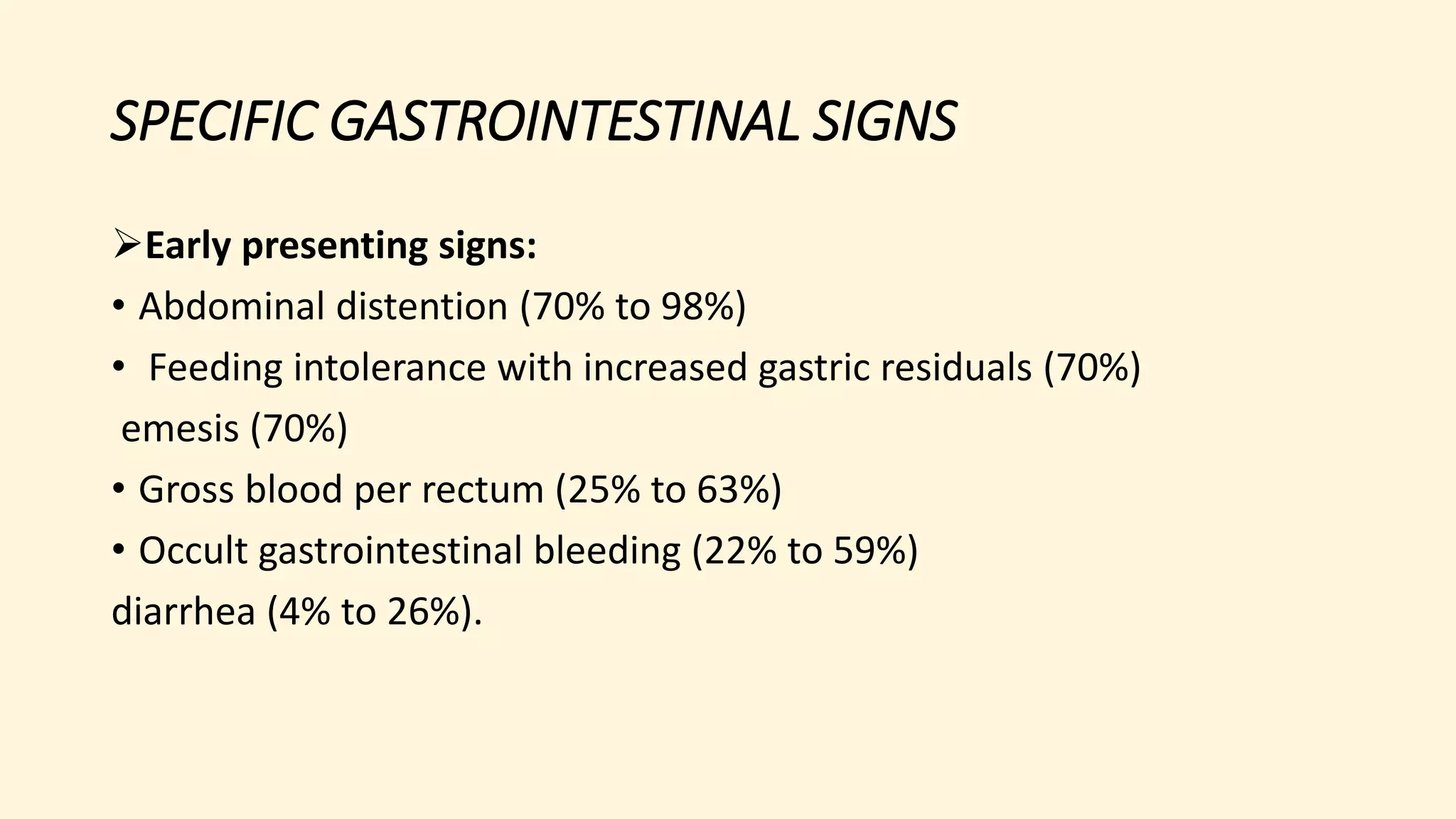
Early presenting signs:
• Abdominal distention (70% to 98%)
• Feeding intolerance with increased gastric residuals (70%)
emesis (70%)
• Gross blood per rectum (25% to 63%)
• Occult gastrointestinal bleeding (22% to 59%)
diarrhea (4% to 26%).
ABDOMINAL ENTERIC SIGNS
• Distension
• Tenderness
• Gastric aspirate,
• vomiting
• Ileus
• Abdominal wall erythema, induration
• Ascites
• Abdominal mass
• Bloody stool
As the disease progresses
abdominal findings become more severe.
marked abdominal distention due to increased intestinal dilation and
ascites.
Abdominal wall erythema may be caused by necrotic bowel loops
abutting the thin abdominal wall.
When the intestine is perforated, the abdomen may develop a bluish
cast as intraperitoneal meconium is seen through the abdominal wall
SYSTEMIC SIGNS:
• Respiratory distress, apnea,
• bradycardia
• Lethargy,
• Irritability
• Bleeding
• Temperature instability
• Poor feeding
• Hypotension
• Acidosis
• Oligurea
• diathesis
Pathology
• Histologically, NEC is characterized by mucosal edema, inflammation,
hemorrhage, coagulation necrosis, and mucosal ulceration.
IMAGING
ABDOMINAL X RAY
• Fixed, dilated loop of bowel
• The characteristic radiologic finding is pneumatosis intestinalis,
which Is believed to be intraluminal gas produced by bacterial
fermentation
• Pneumatosis intestinalis is found in 70% to 80% of confirmed cases of
NEC.
• Pneumoperitoneum: CONFIRM PERFORATION
STAGING: bell’s staging
Stage I – Normal dilatation, mild ileus
Stage II
• Stage II A – Intestinal dilatation, ileus, pneumatosis intestinalis
• Stage II B – Same as II A plus ascites
Stage III
• Stage III A – Same as stage II A plus ascites
• Stage III B – Same as II A plus ascites and pneumoperitoneum
Ddx
• Sepsis with ileus
• Isolated gastric perforation
• Iatrogenic gastric perforation
• Hirschsprung enterocolitis
• Severe gastroenteritis
1. Medical management
Rapid initiation of therapy is required for suspected as well as proven
NEC cases this include:
Supportive care
Empirical antibiotic therapy
 Serial examinations and close laboratory and radiologic monitoring
SUPPORTIVE
Bowel rest: Cessation of feeding (NIL PER OS)
Gastric decompression using intermittent nasogastric suction
Total parenteral nutrition
Assessment and support the cardiovascular system (eg, inotropic support
in addition to fluid replacement)
 Assessment and support respiratory systems (supplemental oxygen and
mechanical ventilation as needed)
Correction of hematologic (eg, DIC) and metabolic abnormalities (eg,
metabolic acidosis).
ANTIBIOTHERAPY
• 20- 30% NEC cases have positive bacteremia
• Empiric antimicrobial regimens are used to provide coverage for
pathogens that cause late-onset bacteremia.
• Anaerobic coverage should be considered when intestinal perforation
is suspected (based on the presence of signs of peritonitis or
radiologic evidence of pneumoperitoneum)
Empirical broad spectrum antibiotics of choice
include:
Ampicillin gentamicin (or amikacin), and metronidazole
• Ampicillin, gentamicin (or amikacin), and clindamycin
• Ampicillin, cefotaxime (if available), and metronidazole (ceftazidime is
an alternative choice for cefotaxime)
 Piperacillin-tazobactam and gentamicin (or amikacin)
 Vancomycin, piperacillin-tazobactam, and gentamicin
Meropenem
2. SURGICAL MANAGEMENT
1. Exploratory laparotomy with resection of the affected
intestinal region(s)
2. Primary peritoneal drainage (PPD)
INDICATIONS
1 Absolute indications:
• Evidence of perforation on abdominal roentgenograms
(pneumoperitoneum)
2 ) Relative indications:
• Failure of medical management,
• Single fixed bowel loop on roentgenograms,
• Abdominal wall erythema,
• A palpable mass.
Prognosis
• Mortality rate 10- 50% in neonates <1500G
• 20% in >2.5 KG
Complications
• There are 2 main complications
• Short bowel syndrome
• Intestinal stricture
REFERENCES
• Nelson textbook of pediatrics 19 edition
• uptodate
• Robinson JR, Rellinger EJ, Hatch LD, et al. Surgical necrotizing
enterocolitis. Semin Perinatol 2017;
• 41:70.
• Kliegman RM, Fanaroff AA. Necrotizing enterocolitis. N Engl J Med
1984; 310:1093.
Thank you

Necrotizing enterocolitis by phocas

  • 1.
    NECTOTIZING ENTEROCOLITIS Presenter: BIMENYIMANAPhocas, Med student, UR Supervisor: Dr. NUBAHUMPATSE Emmanuel
  • 2.
    Case scenario A DOL3, pretern, M neonate born at 32 wks by SVD BW=1.4kg is admitted in NICU for NNI risk. He is on ampicillin and gentamicin and feeding through NGT, infant formula 120ml/kg/day. After 5 days he started to vomit after feed, followed by abdominal distention. But previously was tolerating feeding. FBC: high WBC, thrombocytopenia, AXR: dilated bowels How would you approach the patient? Which investigations will you further require? How would you adjust the treatment?
  • 3.
    Introduction • Is oneof the most common gastrointestinal emergencies in the newborn infant. • It is a disorder characterized by ischemic necrosis of the intestinal mucosa, which is associated with inflammation, invasion of enteric gas forming organisms, transmural involvement and perforation • Necrotizing enterocolitis (NEC) is an inflammatory intestinal disease that affects 5–7% of preterm neonates. • The terminal ileum and proximal colon are the sections of bowel affected most commonly, although more extensive disease is possible from the stomach to the rectum.
  • 4.
  • 5.
    Why the PretermGut is Different? ◦Decreased IgA ◦Decreased Intestinal T lymphocytes ◦Poor Antibody Response ◦Higher Membrane Permeability of GI Epithelial Lining ◦Lower Gastric Motility
  • 6.
    Pathophysiology Is based on3 main problems: 1. immature gut an immune system 2. enteral nutrition and 3. the presence of bacteria
  • 8.
  • 9.
    Pathophysiology • Bacteria reportedto be associated with NEC include Escherichia coli, Klebsiella, Enterobacter, Pseudomonas, Salmonella, Clostridium, coagulase-negative Staphylococcus, and Enterococcus sp. • Gram-positive organisms are more common in stages I and II disease, and enteric organisms predominate in more severe cases.
  • 10.
    Pathophysiology • Viral pathogens,namely, rotavirus, coronavirus, and enteroviruses also have been described in association with NEC. • The type of nutrition that a baby receives appears to have an impact on subsequent colonization patterns, with formula-fed infants showing an early increase in Enterobacteriaceae colonization and the guts of breastfed infants colonized early with Enterobacteriaceae and Bifidobacterium.
  • 11.
    Clinical presentation The majorityof preterm infants who develop NEC are generally healthy, feeding well, and growing prior to developing NEC. The most frequent sign of NEC is a sudden change in feeding tolerance, which can be manifest by numerous clinical signs listed below.
  • 12.
    SPECIFIC GASTROINTESTINAL SIGNS Earlypresenting signs: • Abdominal distention (70% to 98%) • Feeding intolerance with increased gastric residuals (70%) emesis (70%) • Gross blood per rectum (25% to 63%) • Occult gastrointestinal bleeding (22% to 59%) diarrhea (4% to 26%).
  • 13.
    ABDOMINAL ENTERIC SIGNS •Distension • Tenderness • Gastric aspirate, • vomiting • Ileus • Abdominal wall erythema, induration • Ascites • Abdominal mass • Bloody stool
  • 14.
    As the diseaseprogresses abdominal findings become more severe. marked abdominal distention due to increased intestinal dilation and ascites. Abdominal wall erythema may be caused by necrotic bowel loops abutting the thin abdominal wall. When the intestine is perforated, the abdomen may develop a bluish cast as intraperitoneal meconium is seen through the abdominal wall
  • 15.
    SYSTEMIC SIGNS: • Respiratorydistress, apnea, • bradycardia • Lethargy, • Irritability • Bleeding • Temperature instability • Poor feeding • Hypotension • Acidosis • Oligurea • diathesis
  • 18.
    Pathology • Histologically, NECis characterized by mucosal edema, inflammation, hemorrhage, coagulation necrosis, and mucosal ulceration.
  • 19.
    IMAGING ABDOMINAL X RAY •Fixed, dilated loop of bowel • The characteristic radiologic finding is pneumatosis intestinalis, which Is believed to be intraluminal gas produced by bacterial fermentation • Pneumatosis intestinalis is found in 70% to 80% of confirmed cases of NEC. • Pneumoperitoneum: CONFIRM PERFORATION
  • 20.
    STAGING: bell’s staging StageI – Normal dilatation, mild ileus Stage II • Stage II A – Intestinal dilatation, ileus, pneumatosis intestinalis • Stage II B – Same as II A plus ascites Stage III • Stage III A – Same as stage II A plus ascites • Stage III B – Same as II A plus ascites and pneumoperitoneum
  • 21.
    Ddx • Sepsis withileus • Isolated gastric perforation • Iatrogenic gastric perforation • Hirschsprung enterocolitis • Severe gastroenteritis
  • 22.
    1. Medical management Rapidinitiation of therapy is required for suspected as well as proven NEC cases this include: Supportive care Empirical antibiotic therapy  Serial examinations and close laboratory and radiologic monitoring
  • 23.
    SUPPORTIVE Bowel rest: Cessationof feeding (NIL PER OS) Gastric decompression using intermittent nasogastric suction Total parenteral nutrition Assessment and support the cardiovascular system (eg, inotropic support in addition to fluid replacement)  Assessment and support respiratory systems (supplemental oxygen and mechanical ventilation as needed) Correction of hematologic (eg, DIC) and metabolic abnormalities (eg, metabolic acidosis).
  • 24.
    ANTIBIOTHERAPY • 20- 30%NEC cases have positive bacteremia • Empiric antimicrobial regimens are used to provide coverage for pathogens that cause late-onset bacteremia. • Anaerobic coverage should be considered when intestinal perforation is suspected (based on the presence of signs of peritonitis or radiologic evidence of pneumoperitoneum)
  • 25.
    Empirical broad spectrumantibiotics of choice include: Ampicillin gentamicin (or amikacin), and metronidazole • Ampicillin, gentamicin (or amikacin), and clindamycin • Ampicillin, cefotaxime (if available), and metronidazole (ceftazidime is an alternative choice for cefotaxime)  Piperacillin-tazobactam and gentamicin (or amikacin)  Vancomycin, piperacillin-tazobactam, and gentamicin Meropenem
  • 26.
    2. SURGICAL MANAGEMENT 1.Exploratory laparotomy with resection of the affected intestinal region(s) 2. Primary peritoneal drainage (PPD)
  • 27.
    INDICATIONS 1 Absolute indications: •Evidence of perforation on abdominal roentgenograms (pneumoperitoneum) 2 ) Relative indications: • Failure of medical management, • Single fixed bowel loop on roentgenograms, • Abdominal wall erythema, • A palpable mass.
  • 28.
    Prognosis • Mortality rate10- 50% in neonates <1500G • 20% in >2.5 KG
  • 29.
    Complications • There are2 main complications • Short bowel syndrome • Intestinal stricture
  • 30.
    REFERENCES • Nelson textbookof pediatrics 19 edition • uptodate • Robinson JR, Rellinger EJ, Hatch LD, et al. Surgical necrotizing enterocolitis. Semin Perinatol 2017; • 41:70. • Kliegman RM, Fanaroff AA. Necrotizing enterocolitis. N Engl J Med 1984; 310:1093.
  • 31.