Acne Vulgaris


                TSMU
Definition


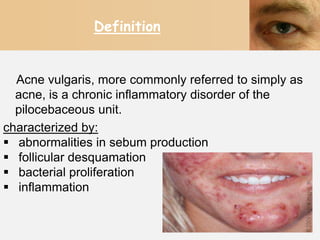
  Acne vulgaris, more commonly referred to simply as
  acne, is a chronic inflammatory disorder of the
  pilocebaceous unit.
characterized by:
 abnormalities in sebum production
 follicular desquamation
 bacterial proliferation
 inflammation
Overview


 Acne vulgaris is the most common cutaneous disorder.
 It affects more than 17 million Americans.
 Patients can experience significant psychological morbidity
  and, rarely, mortality due to suicide.
 Important that physicians are familiar with Acne Vulgaris and
  its treatment.
 affects all races and ethnicities with equal significance.
 Darker skinned patients at increased risk for developing
  post-inflammatory hyper-pigmentation and keloids.
Etiology

    Acne is polygenic and multi-factorial. Four main pathogenetic
    factors contribute to the disease:
•   Propionibacterium acnes and Staphylococcus epidermidis
    colonisation. :
    bacteria found deep in follicles and stimulate the production
    of pro-inflammatory mediators and lipases.
•   Inflammation and immune response. Inflammatory cells and
    mediators efflux into the disrupted follicle, leading to the
    development of papules, pustules, nodules, and cysts.
•   Sebaceous gland hyperplasia and excess sebum production.
•   Abnormal follicular differentiation.
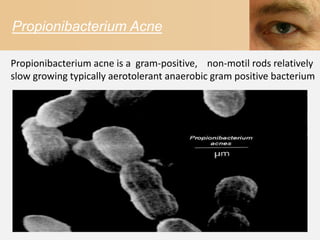
Propionibacterium Acne

Propionibacterium acne is a gram-positive, non-motil rods relatively
slow growing typically aerotolerant anaerobic gram positive bacterium
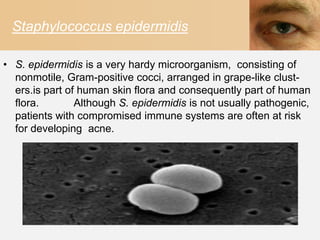
Staphylococcus epidermidis

• S. epidermidis is a very hardy microorganism, consisting of
  nonmotile, Gram-positive cocci, arranged in grape-like clust-
  ers.is part of human skin flora and consequently part of human
  flora.        Although S. epidermidis is not usually pathogenic,
  patients with compromised immune systems are often at risk
  for developing acne.
Pathophysiology


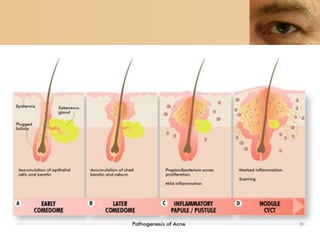
• The initial step in the development of acne is the formation of
  the microcomedo.Follicular keratinocytes that exhibit increas-
  ed cohesiveness do not shed normally, leading to retention
  and accumulation.
• Androgens stimulate enlargement of sebaceous glands and
  increased sebum production, and the abnormal keratinaceo-
  us material and sebum collect in the microcomedo.
• This leads to a build-up of pressure, and whorled lamellar
  concretions develop. At this stage, a non-inflammatory
  comedo may be seen clinically.
• This micro-environment allows the proliferation of bacterium,
  which is part of the normal flora of follicles. This gram-positive
  rod has low virulence but is capable of metabolising
  triglycerides and releasing free fatty acids.This metabolism,
  as well as its ability to activate complement, produces pro-
  inflammatory mediators, including neutrophil chemo-
  attractants.
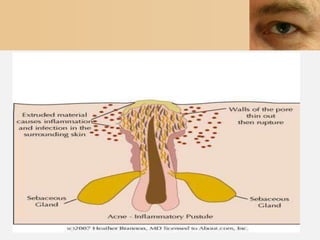
• With increased pressure and recruitment of inflammatory
  mediators, the microcomedo may rupture and release
  immunogenic keratin and sebum, thus stimulating an even
  greater inflammatory response
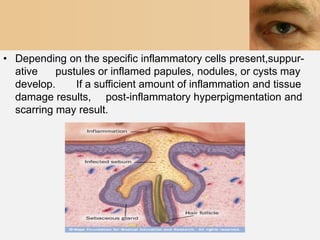
• Depending on the specific inflammatory cells present,suppur-
  ative    pustules or inflamed papules, nodules, or cysts may
  develop.     If a sufficient amount of inflammation and tissue
  damage results, post-inflammatory hyperpigmentation and
  scarring may result.
Clinical Manifestations:

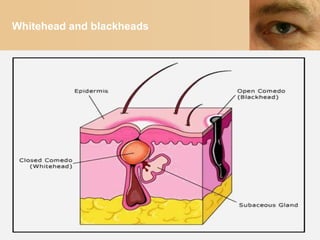
• Closed comedone (whitehead) - a clogged follicle.
  Whiteheads usually appear on the skin as small, round, white
  bumps.
• Open comedone (blackhead) - a plugged follicle that opens
  and turns dark at the surface of the skin. Blackheads do not
  indicate the presence of dirt.
• Papules - inflamed lesions that appear as small, pink bumps
  on the skin.
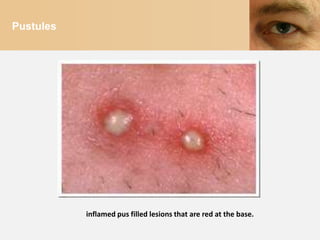
• Pustules (pimples) - inflamed pus filled lesions that are red at
  the base.
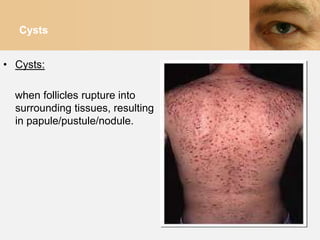
• Cysts and nodules - large, inflamed, pus filled lesions deep
  under the skin that can cause pain and scarring.
• Local symptoms :
                        include pain
                        tenderness.
• Systemic symptoms :

  most often absent
  Severe acne with associated systemic signs and symptoms
  such as Fever, Psychological impact on any patient
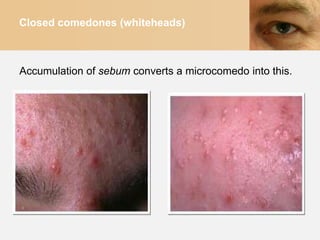
Closed comedones (whiteheads)


Accumulation of sebum converts a microcomedo into this.
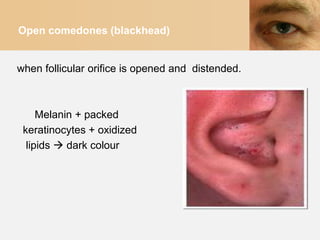
Open comedones (blackhead)


when follicular orifice is opened and distended.


     Melanin + packed
 keratinocytes + oxidized
  lipids  dark colour
Whitehead and blackheads
Pustules


           inflamed pus filled lesions that are red at the base.
Cysts


• Cysts:

  when follicles rupture into
  surrounding tissues, resulting
  in papule/pustule/nodule.
Classification

• Classification system generally as follows

• Type 1 — Mainly comedones with an occasional small inflamed
  papule or pustule; no scarring present

•    Type 2 — Comedones and more numerous papules and pustules
    (mainly facial); mild scarring

•    Type 3 — Numerous comedones, papules, and pustules, spreading
    to the back, chest, and shoulders, with an occasional cyst or nodule;
    moderate scarring
     Type 4 — Numerous large cysts on the face, neck, and upper trunk;
    severe scarring
Diagnosis

•   Complete history
•   Pay attention to endocrine function
-   Rapid appearance with virilization/menstrual irregularity
•   Complete medication list

•   Physical exam:
-   Location          - scarring
-   Lesion type       - keloid
-   pigmentation
LABORATORY EXAMINATION


No laboratory examinations required. If there is suspicion of
an endocrine disorder, free testosterone, follicle-stimulating
hormone, luteinizing hormone, and DHEAS should be deter-
mined to exclude hyperandrogenism and polycystic ovary
syndrome.
majority of acne patients, hormone levels are normal.

Laboratory examinations
transaminases(ALT, AST), triglycerides, and cholesterol
levels may be required if systemic isotretinoin treatment is
planned
                             DHEAS - Dehydroepiandrosterone
DIFFERENTIAL DIAGNOSIS


• Comedones are required for diagnosis of any type of acne.
  Comedones are not a feature of acne-like conditions and of the
  conditions listed below.

• Face - S. aureus folliculitis, pseudofolliculitis barbae, rosacea,
  perioral dermatitis.
• Trunk -Malassezia folliculitis, “hot-tub” pseudomonas folliculitis,
  S. aureus folliculitis, and
Treatment

The goals of pharmacotherapy for acne vulgaris are to reduce
morbidity and to prevent complications.
Medication: Benzoyl Peroxide Antibiotics,Topical and Oral
retinoids
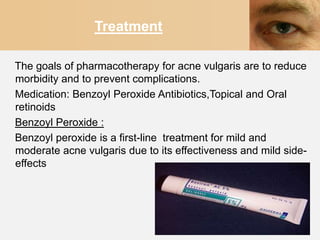
Benzoyl Peroxide :
Benzoyl peroxide is a first-line treatment for mild and
moderate acne vulgaris due to its effectiveness and mild side-
effects
Antibiotics:

• Topical and systemic antibiotics used in the treatment of
  acne vulgaris are directed at Propionibacterium acnes.
  They also have anti-inflammatory properties.

    Minocycline
    Doxycycline
    Tetracycline
Retinoids:

• These agents decrease the cohesiveness of abnormal hyperproliferative
  keratinocytes, and they may reduce the potential for malignant degene-
  ration. They also modulate keratinocyte differentiation.

    isotretinoin
    Tretinoin topical
    Adapalene
    Tazarotene
Alternative treatments


• Phototherapy with blue and red light emitted from special
  fluorescent lights, LEDs, lasers, or dichroic bulbs.
• Photodynamic therapy involving intense blue or violet light,
• zinc, teat tree oil, heat therapy, salt water therapy are all
  used for treating acne.
Prognosis


Acne of any severity usually remits spontaneously by the
early to mid-20s,but a substantial minority of patients,
usually women, may have acne into their 40s.
acne vulgaris

acne vulgaris

  • 1.
  • 2.
    Definition Acnevulgaris, more commonly referred to simply as acne, is a chronic inflammatory disorder of the pilocebaceous unit. characterized by:  abnormalities in sebum production  follicular desquamation  bacterial proliferation  inflammation
  • 3.
    Overview  Acne vulgarisis the most common cutaneous disorder.  It affects more than 17 million Americans.  Patients can experience significant psychological morbidity and, rarely, mortality due to suicide.  Important that physicians are familiar with Acne Vulgaris and its treatment.  affects all races and ethnicities with equal significance.  Darker skinned patients at increased risk for developing post-inflammatory hyper-pigmentation and keloids.
  • 4.
    Etiology Acne is polygenic and multi-factorial. Four main pathogenetic factors contribute to the disease: • Propionibacterium acnes and Staphylococcus epidermidis colonisation. : bacteria found deep in follicles and stimulate the production of pro-inflammatory mediators and lipases. • Inflammation and immune response. Inflammatory cells and mediators efflux into the disrupted follicle, leading to the development of papules, pustules, nodules, and cysts. • Sebaceous gland hyperplasia and excess sebum production. • Abnormal follicular differentiation.
  • 5.
    Propionibacterium Acne Propionibacterium acneis a gram-positive, non-motil rods relatively slow growing typically aerotolerant anaerobic gram positive bacterium
  • 6.
    Staphylococcus epidermidis • S.epidermidis is a very hardy microorganism, consisting of nonmotile, Gram-positive cocci, arranged in grape-like clust- ers.is part of human skin flora and consequently part of human flora. Although S. epidermidis is not usually pathogenic, patients with compromised immune systems are often at risk for developing acne.
  • 7.
    Pathophysiology • The initialstep in the development of acne is the formation of the microcomedo.Follicular keratinocytes that exhibit increas- ed cohesiveness do not shed normally, leading to retention and accumulation. • Androgens stimulate enlargement of sebaceous glands and increased sebum production, and the abnormal keratinaceo- us material and sebum collect in the microcomedo. • This leads to a build-up of pressure, and whorled lamellar concretions develop. At this stage, a non-inflammatory comedo may be seen clinically.
  • 9.
    • This micro-environmentallows the proliferation of bacterium, which is part of the normal flora of follicles. This gram-positive rod has low virulence but is capable of metabolising triglycerides and releasing free fatty acids.This metabolism, as well as its ability to activate complement, produces pro- inflammatory mediators, including neutrophil chemo- attractants. • With increased pressure and recruitment of inflammatory mediators, the microcomedo may rupture and release immunogenic keratin and sebum, thus stimulating an even greater inflammatory response
  • 10.
    • Depending onthe specific inflammatory cells present,suppur- ative pustules or inflamed papules, nodules, or cysts may develop. If a sufficient amount of inflammation and tissue damage results, post-inflammatory hyperpigmentation and scarring may result.
  • 12.
    Clinical Manifestations: • Closedcomedone (whitehead) - a clogged follicle. Whiteheads usually appear on the skin as small, round, white bumps. • Open comedone (blackhead) - a plugged follicle that opens and turns dark at the surface of the skin. Blackheads do not indicate the presence of dirt. • Papules - inflamed lesions that appear as small, pink bumps on the skin. • Pustules (pimples) - inflamed pus filled lesions that are red at the base. • Cysts and nodules - large, inflamed, pus filled lesions deep under the skin that can cause pain and scarring.
  • 13.
    • Local symptoms: include pain tenderness. • Systemic symptoms : most often absent Severe acne with associated systemic signs and symptoms such as Fever, Psychological impact on any patient
  • 14.
    Closed comedones (whiteheads) Accumulationof sebum converts a microcomedo into this.
  • 15.
    Open comedones (blackhead) whenfollicular orifice is opened and distended. Melanin + packed keratinocytes + oxidized lipids  dark colour
  • 16.
  • 17.
    Pustules inflamed pus filled lesions that are red at the base.
  • 18.
    Cysts • Cysts: when follicles rupture into surrounding tissues, resulting in papule/pustule/nodule.
  • 19.
    Classification • Classification systemgenerally as follows • Type 1 — Mainly comedones with an occasional small inflamed papule or pustule; no scarring present • Type 2 — Comedones and more numerous papules and pustules (mainly facial); mild scarring • Type 3 — Numerous comedones, papules, and pustules, spreading to the back, chest, and shoulders, with an occasional cyst or nodule; moderate scarring Type 4 — Numerous large cysts on the face, neck, and upper trunk; severe scarring
  • 20.
    Diagnosis • Complete history • Pay attention to endocrine function - Rapid appearance with virilization/menstrual irregularity • Complete medication list • Physical exam: - Location - scarring - Lesion type - keloid - pigmentation
  • 21.
    LABORATORY EXAMINATION No laboratoryexaminations required. If there is suspicion of an endocrine disorder, free testosterone, follicle-stimulating hormone, luteinizing hormone, and DHEAS should be deter- mined to exclude hyperandrogenism and polycystic ovary syndrome. majority of acne patients, hormone levels are normal. Laboratory examinations transaminases(ALT, AST), triglycerides, and cholesterol levels may be required if systemic isotretinoin treatment is planned DHEAS - Dehydroepiandrosterone
  • 22.
    DIFFERENTIAL DIAGNOSIS • Comedonesare required for diagnosis of any type of acne. Comedones are not a feature of acne-like conditions and of the conditions listed below. • Face - S. aureus folliculitis, pseudofolliculitis barbae, rosacea, perioral dermatitis. • Trunk -Malassezia folliculitis, “hot-tub” pseudomonas folliculitis, S. aureus folliculitis, and
  • 23.
    Treatment The goals ofpharmacotherapy for acne vulgaris are to reduce morbidity and to prevent complications. Medication: Benzoyl Peroxide Antibiotics,Topical and Oral retinoids Benzoyl Peroxide : Benzoyl peroxide is a first-line treatment for mild and moderate acne vulgaris due to its effectiveness and mild side- effects
  • 24.
    Antibiotics: • Topical andsystemic antibiotics used in the treatment of acne vulgaris are directed at Propionibacterium acnes. They also have anti-inflammatory properties.  Minocycline  Doxycycline  Tetracycline
  • 25.
    Retinoids: • These agentsdecrease the cohesiveness of abnormal hyperproliferative keratinocytes, and they may reduce the potential for malignant degene- ration. They also modulate keratinocyte differentiation.  isotretinoin  Tretinoin topical  Adapalene  Tazarotene
  • 26.
    Alternative treatments • Phototherapywith blue and red light emitted from special fluorescent lights, LEDs, lasers, or dichroic bulbs. • Photodynamic therapy involving intense blue or violet light, • zinc, teat tree oil, heat therapy, salt water therapy are all used for treating acne.
  • 27.
    Prognosis Acne of anyseverity usually remits spontaneously by the early to mid-20s,but a substantial minority of patients, usually women, may have acne into their 40s.