PAEDIATRICS AND CHILD HEALTH
• NEONATOLOGY
• Neonatal Necrotizing Enterocolitis (NEC)
Dr. Chongo Timothy Shapi (BSc.HB, MBChB)
- Medical Doctor.
3/20/2022
Dr. Chongo Shapi, BSc.HB, MBChB, CUZ.
.
1
Introduction
• NEC is the most common life-threatening
emergency of the GIT in the newborn period
• The disease is characterized by various degrees of
mucosal or transmural necrosis of the intestine
• The cause of NEC remains unclear but is most
likely multifactorial
• The incidence of NEC is 1–5% of infants in NICU
• Preterm babies and SGA are susceptible to NEC
• Rare in term babies
3/20/2022
Dr. Chongo Shapi, BSc.HB, MBChB, CUZ.
.
2
Pathology and Pathogenesis
• Multifactorial
• There is :
1. Development of a necrotic segment of intestine
2. Gas accumulation in the submucosa of the bowel
wall (pneumatosis intestinalis)
3. Progression of the necrosis to perforation,
peritonitis, sepsis, and death
• NEC affects mostly the terminal ileum and the
proximal segment of colon
• In fatal cases, gangrene may extend from the
stomach to the rectum
3/20/2022 Dr. Chongo Shapi, BSc.HB, MBChB, CUZ. 3
Pathology and Pathogenesis
• Though a multifactorial disease primarily
associated with intestinal immaturity, the
concept of “risk factors” for NEC is controversial
• The following triad is classically been linked to
NEC:
1. Intestinal ischemia (injury)
2. Enteral nutrition (metabolic substrate)
3. Pathogenic micro-organisms
3/20/2022 Dr. Chongo Shapi, BSc.HB, MBChB, CUZ. 4
Risk factors for NEC
1. Prematurity (greatest risk factor)
2. SGA
3. Polycythaemia
4. Too rapid feeding protocols (aggressive enteral
feeding)
5. Hypertonic milk
6. Perinatal asphyxia
7. Sepsis
8. Excessive fluids
3/20/2022
Dr. Chongo Shapi, BSc.HB, MBChB, CUZ.
.
5
Pathology and Pathogenesis
• NEC probably results from an interaction
between:
1. Loss of mucosal integrity due to a variety of
factors (ischemia, infection, inflammation) and
2. The host's response to that injury (circulatory,
immunologic, inflammatory)
• Coagulation necrosis is the characteristic
histologic finding of intestinal specimens
3/20/2022 Dr. Chongo Shapi, BSc.HB, MBChB, CUZ. 6
Pathology and Pathogenesis
• Clustering of cases suggests a primary role for an infectious
agent
• Pathogenic agents include:
1. Escherichia coli
2. Klebsiella
3. Clostridium perfringens
4. Staphylococcus epidermidis
5. Rotavirus
• Nonetheless, in most situations, no pathogen is identified
• NEC rarely occurs before the initiation of enteral feeding
and is much less common in infants fed human milk
3/20/2022 Dr. Chongo Shapi, BSc.HB, MBChB, CUZ. 7
Clinical Manifestations
• Onset
- Usually occurs in the 1st 2 wk of life
- But can be as late as 3 mo of age in VLBW infants
• Age of onset is inversely related to gestational age
• Initial symptoms:
Mainly GIT:
- Feeding intolerance (unable to breastfeed)
- Temperature instability
- Delayed gastric emptying
- Vomiting
- Abdominal distension
- Abdominal tenderness
- Ileus/decreased bowel sounds
- Abdominal wall erythema
- Bloody stools
3/20/2022
Dr. Chongo Shapi, BSc.HB, MBChB, CUZ.
.
8
Non-specific systemic signs
• Lethargy
• Apnea/respiratory distress
• Temperature instability
• Acidosis (metabolic and/or respiratory)
• Glucose instability
• Poor perfusion/shock
• DIC
• Positive results of blood cultures
3/20/2022 Dr. Chongo Shapi, BSc.HB, MBChB, CUZ. 9
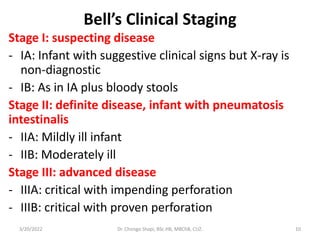
Bell’s Clinical Staging
Stage I: suspecting disease
- IA: Infant with suggestive clinical signs but X-ray is
non-diagnostic
- IB: As in IA plus bloody stools
Stage II: definite disease, infant with pneumatosis
intestinalis
- IIA: Mildly ill infant
- IIB: Moderately ill
Stage III: advanced disease
- IIIA: critical with impending perforation
- IIIB: critical with proven perforation
3/20/2022 Dr. Chongo Shapi, BSc.HB, MBChB, CUZ. 10
• Because of nonspecific signs, sepsis may be
suspected before NEC
• NEC can progress rapidly from mild abdominal
to fullness to septic shock and necrosis of the
entire intestine
• Management requires a high index of
suspicion
3/20/2022 Dr. Chongo Shapi, BSc.HB, MBChB, CUZ. 11
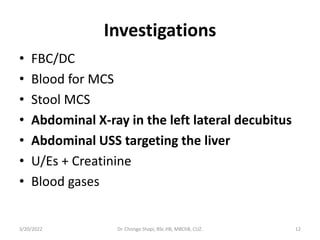
Investigations
• FBC/DC
• Blood for MCS
• Stool MCS
• Abdominal X-ray in the left lateral decubitus
• Abdominal USS targeting the liver
• U/Es + Creatinine
• Blood gases
3/20/2022 Dr. Chongo Shapi, BSc.HB, MBChB, CUZ. 12
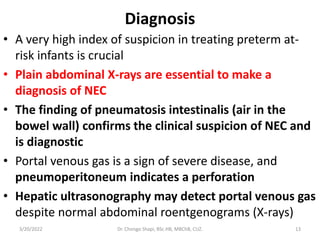
Diagnosis
• A very high index of suspicion in treating preterm at-
risk infants is crucial
• Plain abdominal X-rays are essential to make a
diagnosis of NEC
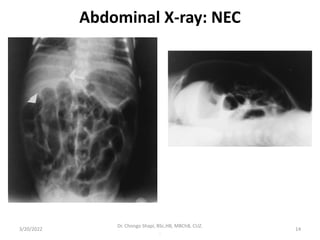
• The finding of pneumatosis intestinalis (air in the
bowel wall) confirms the clinical suspicion of NEC and
is diagnostic
• Portal venous gas is a sign of severe disease, and
pneumoperitoneum indicates a perforation
• Hepatic ultrasonography may detect portal venous gas
despite normal abdominal roentgenograms (X-rays)
3/20/2022 Dr. Chongo Shapi, BSc.HB, MBChB, CUZ. 13
Abdominal X-ray: NEC
3/20/2022
Dr. Chongo Shapi, BSc.HB, MBChB, CUZ.
.
14
X-ray Findings
• Grade I: thickening of the bowel wall +/- dilatation
of the gut
• Grade II: bowel wall gas (pneumatosis intestinalis)
• Grade III: gas in the liver and biliary tree
• Grade IV: gas within the peritoneum
3/20/2022 Dr. Chongo Shapi, BSc.HB, MBChB, CUZ. 15
Differential Diagnosis
- Neonatal Sepsis
- GIT obstruction
- Volvulus
- Isolated intestinal perforation
3/20/2022 Dr. Chongo Shapi, BSc.HB, MBChB, CUZ. 16
Treatment
• Rapid initiation of therapy is required for
suspected as well as proven NEC cases
• There is no definitive treatment for established
NEC
• Therapy is directed at supportive care and
preventing further injury with:
- Stopping feeding
- Nasogastric decompression
- Administration of IVFs (crystalloids e.g. ¼ SD in
10% dextrose or blood products)
3/20/2022
Dr. Chongo Shapi, BSc.HB, MBChB, CUZ.
.
17
Treatment
- Poor perfusion with HCT > 40% give ordinary plasma
at 20 ml/kg, if HCT < 40% give packed RBCs 10-15
ml/kg
- Give antibiotics as soon as the blood for
investigations has been collected
- Initially, give BSA (cefotaxime plus metronidazole)
and then change to drugs that are sensitive
according to the lab results
- Correct haematologic, metabolic and electrolyte
abnormalities
- Intubate when in respiratory failure or worsening
acidosis
- Surgery when indicated
3/20/2022 Dr. Chongo Shapi, BSc.HB, MBChB, CUZ. 18
Treatment
• Monitor the patient's course closely by:
- Performing frequent physical assessments
- Sequential AP and cross-table lateral or lateral
decubitus abdominal x-rays to detect intestinal
perforation
- Serial determination of hematologic, electrolyte,
and acid-base status
3/20/2022 Dr. Chongo Shapi, BSc.HB, MBChB, CUZ. 19
Treatment
• Indications for surgery include:
- Evidence of perforation on abdominal roentgenograms
(pneumoperitoneum)
- Positive abdominal paracentesis (stool or organism on
Gram stain from peritoneal fluid)
- Failure of medical management, a single fixed bowel
loop on roentgenograms, abdominal wall erythema, or
a palpable mass are relative indications for exploratory
laparotomy
NB: Surgery should be performed after intestinal
necrosis develops, but before perforation and peritonitis
occurs
3/20/2022 Dr. Chongo Shapi, BSc.HB, MBChB, CUZ. 20
Prognosis
• Medical management fails in about 20–40%
Early postoperative complications include:
- Wound infection
- Wound dehiscence
- Stomal problems (prolapse, necrosis)
Late complications include:
- Intestinal strictures
- Short-bowel syndrome (malabsorption, growth failure,
malnutrition)
- Complications related to central venous catheters (sepsis,
thrombosis), and cholestatic jaundice
3/20/2022 Dr. Chongo Shapi, BSc.HB, MBChB, CUZ. 21
Prevention
• Exclusive breast-feeding has a reduced risk of NEC
• Minimal enteral feeds followed by judicious
volume advancement
- Remember, early initiation of aggressive feeding
protocols increases the risk of NEC in VLBW infants
• Probiotic preparations (a probiotic is a substance
that stimulates the growth of micro-organisms
especially beneficial ones = normal flora)
3/20/2022 Dr. Chongo Shapi, BSc.HB, MBChB, CUZ. 22
Thanks
3/20/2022 Dr. Chongo Shapi, BSc.HB, MBChB, CUZ. 23

Neonatal Necrotizing Enterocolitis (NEC).pdf

  • 1.
    PAEDIATRICS AND CHILDHEALTH • NEONATOLOGY • Neonatal Necrotizing Enterocolitis (NEC) Dr. Chongo Timothy Shapi (BSc.HB, MBChB) - Medical Doctor. 3/20/2022 Dr. Chongo Shapi, BSc.HB, MBChB, CUZ. . 1
  • 2.
    Introduction • NEC isthe most common life-threatening emergency of the GIT in the newborn period • The disease is characterized by various degrees of mucosal or transmural necrosis of the intestine • The cause of NEC remains unclear but is most likely multifactorial • The incidence of NEC is 1–5% of infants in NICU • Preterm babies and SGA are susceptible to NEC • Rare in term babies 3/20/2022 Dr. Chongo Shapi, BSc.HB, MBChB, CUZ. . 2
  • 3.
    Pathology and Pathogenesis •Multifactorial • There is : 1. Development of a necrotic segment of intestine 2. Gas accumulation in the submucosa of the bowel wall (pneumatosis intestinalis) 3. Progression of the necrosis to perforation, peritonitis, sepsis, and death • NEC affects mostly the terminal ileum and the proximal segment of colon • In fatal cases, gangrene may extend from the stomach to the rectum 3/20/2022 Dr. Chongo Shapi, BSc.HB, MBChB, CUZ. 3
  • 4.
    Pathology and Pathogenesis •Though a multifactorial disease primarily associated with intestinal immaturity, the concept of “risk factors” for NEC is controversial • The following triad is classically been linked to NEC: 1. Intestinal ischemia (injury) 2. Enteral nutrition (metabolic substrate) 3. Pathogenic micro-organisms 3/20/2022 Dr. Chongo Shapi, BSc.HB, MBChB, CUZ. 4
  • 5.
    Risk factors forNEC 1. Prematurity (greatest risk factor) 2. SGA 3. Polycythaemia 4. Too rapid feeding protocols (aggressive enteral feeding) 5. Hypertonic milk 6. Perinatal asphyxia 7. Sepsis 8. Excessive fluids 3/20/2022 Dr. Chongo Shapi, BSc.HB, MBChB, CUZ. . 5
  • 6.
    Pathology and Pathogenesis •NEC probably results from an interaction between: 1. Loss of mucosal integrity due to a variety of factors (ischemia, infection, inflammation) and 2. The host's response to that injury (circulatory, immunologic, inflammatory) • Coagulation necrosis is the characteristic histologic finding of intestinal specimens 3/20/2022 Dr. Chongo Shapi, BSc.HB, MBChB, CUZ. 6
  • 7.
    Pathology and Pathogenesis •Clustering of cases suggests a primary role for an infectious agent • Pathogenic agents include: 1. Escherichia coli 2. Klebsiella 3. Clostridium perfringens 4. Staphylococcus epidermidis 5. Rotavirus • Nonetheless, in most situations, no pathogen is identified • NEC rarely occurs before the initiation of enteral feeding and is much less common in infants fed human milk 3/20/2022 Dr. Chongo Shapi, BSc.HB, MBChB, CUZ. 7
  • 8.
    Clinical Manifestations • Onset -Usually occurs in the 1st 2 wk of life - But can be as late as 3 mo of age in VLBW infants • Age of onset is inversely related to gestational age • Initial symptoms: Mainly GIT: - Feeding intolerance (unable to breastfeed) - Temperature instability - Delayed gastric emptying - Vomiting - Abdominal distension - Abdominal tenderness - Ileus/decreased bowel sounds - Abdominal wall erythema - Bloody stools 3/20/2022 Dr. Chongo Shapi, BSc.HB, MBChB, CUZ. . 8
  • 9.
    Non-specific systemic signs •Lethargy • Apnea/respiratory distress • Temperature instability • Acidosis (metabolic and/or respiratory) • Glucose instability • Poor perfusion/shock • DIC • Positive results of blood cultures 3/20/2022 Dr. Chongo Shapi, BSc.HB, MBChB, CUZ. 9
  • 10.
    Bell’s Clinical Staging StageI: suspecting disease - IA: Infant with suggestive clinical signs but X-ray is non-diagnostic - IB: As in IA plus bloody stools Stage II: definite disease, infant with pneumatosis intestinalis - IIA: Mildly ill infant - IIB: Moderately ill Stage III: advanced disease - IIIA: critical with impending perforation - IIIB: critical with proven perforation 3/20/2022 Dr. Chongo Shapi, BSc.HB, MBChB, CUZ. 10
  • 11.
    • Because ofnonspecific signs, sepsis may be suspected before NEC • NEC can progress rapidly from mild abdominal to fullness to septic shock and necrosis of the entire intestine • Management requires a high index of suspicion 3/20/2022 Dr. Chongo Shapi, BSc.HB, MBChB, CUZ. 11
  • 12.
    Investigations • FBC/DC • Bloodfor MCS • Stool MCS • Abdominal X-ray in the left lateral decubitus • Abdominal USS targeting the liver • U/Es + Creatinine • Blood gases 3/20/2022 Dr. Chongo Shapi, BSc.HB, MBChB, CUZ. 12
  • 13.
    Diagnosis • A veryhigh index of suspicion in treating preterm at- risk infants is crucial • Plain abdominal X-rays are essential to make a diagnosis of NEC • The finding of pneumatosis intestinalis (air in the bowel wall) confirms the clinical suspicion of NEC and is diagnostic • Portal venous gas is a sign of severe disease, and pneumoperitoneum indicates a perforation • Hepatic ultrasonography may detect portal venous gas despite normal abdominal roentgenograms (X-rays) 3/20/2022 Dr. Chongo Shapi, BSc.HB, MBChB, CUZ. 13
  • 14.
    Abdominal X-ray: NEC 3/20/2022 Dr.Chongo Shapi, BSc.HB, MBChB, CUZ. . 14
  • 15.
    X-ray Findings • GradeI: thickening of the bowel wall +/- dilatation of the gut • Grade II: bowel wall gas (pneumatosis intestinalis) • Grade III: gas in the liver and biliary tree • Grade IV: gas within the peritoneum 3/20/2022 Dr. Chongo Shapi, BSc.HB, MBChB, CUZ. 15
  • 16.
    Differential Diagnosis - NeonatalSepsis - GIT obstruction - Volvulus - Isolated intestinal perforation 3/20/2022 Dr. Chongo Shapi, BSc.HB, MBChB, CUZ. 16
  • 17.
    Treatment • Rapid initiationof therapy is required for suspected as well as proven NEC cases • There is no definitive treatment for established NEC • Therapy is directed at supportive care and preventing further injury with: - Stopping feeding - Nasogastric decompression - Administration of IVFs (crystalloids e.g. ¼ SD in 10% dextrose or blood products) 3/20/2022 Dr. Chongo Shapi, BSc.HB, MBChB, CUZ. . 17
  • 18.
    Treatment - Poor perfusionwith HCT > 40% give ordinary plasma at 20 ml/kg, if HCT < 40% give packed RBCs 10-15 ml/kg - Give antibiotics as soon as the blood for investigations has been collected - Initially, give BSA (cefotaxime plus metronidazole) and then change to drugs that are sensitive according to the lab results - Correct haematologic, metabolic and electrolyte abnormalities - Intubate when in respiratory failure or worsening acidosis - Surgery when indicated 3/20/2022 Dr. Chongo Shapi, BSc.HB, MBChB, CUZ. 18
  • 19.
    Treatment • Monitor thepatient's course closely by: - Performing frequent physical assessments - Sequential AP and cross-table lateral or lateral decubitus abdominal x-rays to detect intestinal perforation - Serial determination of hematologic, electrolyte, and acid-base status 3/20/2022 Dr. Chongo Shapi, BSc.HB, MBChB, CUZ. 19
  • 20.
    Treatment • Indications forsurgery include: - Evidence of perforation on abdominal roentgenograms (pneumoperitoneum) - Positive abdominal paracentesis (stool or organism on Gram stain from peritoneal fluid) - Failure of medical management, a single fixed bowel loop on roentgenograms, abdominal wall erythema, or a palpable mass are relative indications for exploratory laparotomy NB: Surgery should be performed after intestinal necrosis develops, but before perforation and peritonitis occurs 3/20/2022 Dr. Chongo Shapi, BSc.HB, MBChB, CUZ. 20
  • 21.
    Prognosis • Medical managementfails in about 20–40% Early postoperative complications include: - Wound infection - Wound dehiscence - Stomal problems (prolapse, necrosis) Late complications include: - Intestinal strictures - Short-bowel syndrome (malabsorption, growth failure, malnutrition) - Complications related to central venous catheters (sepsis, thrombosis), and cholestatic jaundice 3/20/2022 Dr. Chongo Shapi, BSc.HB, MBChB, CUZ. 21
  • 22.
    Prevention • Exclusive breast-feedinghas a reduced risk of NEC • Minimal enteral feeds followed by judicious volume advancement - Remember, early initiation of aggressive feeding protocols increases the risk of NEC in VLBW infants • Probiotic preparations (a probiotic is a substance that stimulates the growth of micro-organisms especially beneficial ones = normal flora) 3/20/2022 Dr. Chongo Shapi, BSc.HB, MBChB, CUZ. 22
  • 23.
    Thanks 3/20/2022 Dr. ChongoShapi, BSc.HB, MBChB, CUZ. 23