Gastrointestinal Bleeding
in
Children
• Dr. C.S.N.Vittal
Epidemiology
• GI bleeding – one of the commonest emergencies in pediatrics
• Account for 10%-20% of referrals to pediatric gastroenterologists.
• 6.4% of PICU admissions of which 0.4% is life threatening (Lacroix)
• Mortality : 4 – 9% in best centers
Presentation of GI Bleeding
Term Definition
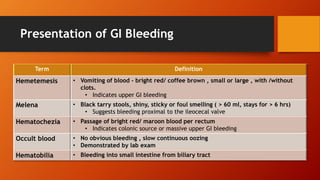
Hemetemesis • Vomiting of blood – bright red/ coffee brown , small or large , with /without
clots.
• Indicates upper GI bleeding
Melena • Black tarry stools, shiny, sticky or foul smelling ( > 60 ml, stays for > 6 hrs)
• Suggests bleeding proximal to the ileocecal valve
Hematochezia • Passage of bright red/ maroon blood per rectum
• Indicates colonic source or massive upper GI bleeding
Occult blood • No obvious bleeding , slow continuous oozing
• Demonstrated by lab exam
Hematobilia • Bleeding into small intestine from biliary tract
Classification of GI Bleeds
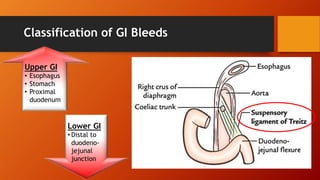
Upper GI
• Esophagus
• Stomach
• Proximal
duodenum
Lower GI
• Distal to
duodeno-
jejunal
junction
Upper GI Bleeding
•Causes
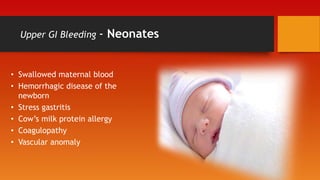
Upper GI Bleeding - Neonates
• Swallowed maternal blood
• Hemorrhagic disease of the
newborn
• Stress gastritis
• Cow’s milk protein allergy
• Coagulopathy
• Vascular anomaly
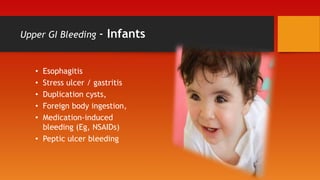
Upper GI Bleeding - Infants
• Esophagitis
• Stress ulcer / gastritis
• Duplication cysts,
• Foreign body ingestion,
• Medication-induced
bleeding (Eg, NSAIDs)
• Peptic ulcer bleeding
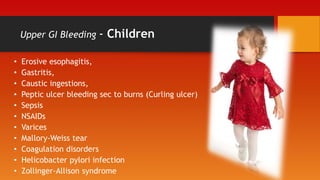
Upper GI Bleeding - Children
• Erosive esophagitis,
• Gastritis,
• Caustic ingestions,
• Peptic ulcer bleeding sec to burns (Curling ulcer)
• Sepsis
• NSAIDs
• Varices
• Mallory-Weiss tear
• Coagulation disorders
• Helicobacter pylori infection
• Zollinger-Allison syndrome
The Forrest Classification of Upper GI Bleeds
Endoscopic findings into the following 3 categories:
I - Active hemorrhage
• Ia = bright-red bleeding,
• Ib = slow bleeding
II - Recent hemorrhage
• IIa = nonbleeding visible vessel,
• IIb = adherent clot on base of lesion,
• IIc = flat pigmented spot
III - No evidence of bleeding.
Lower GI Bleeding
•Causes
Lower GI Bleeding - Neonates
• Anal fissure
• Necrotizing enterocolitis
• Malrotation with volvulus
• Hirschsprung enterocolitis
• Systemic vasculitis
Lower GI Bleeding - Infants
• Anal fissure
• Infectious colitis
• Intussusception
• TB abdomen
• Gangrenous bowel
• Cow’s milk protein allergy
• Meckel’s diverticulum
• Pseudomembranous enterocolitis
Lower GI Bleeding - Children
• Polyps
• Meckel’s diverticulum
• Anorectal fissure
• Intussusception
• Juvenile Polyps
• Inflammatory bowel disease
• Infectious diarrhea (Esch coli and Shigella)
• Vascular lesions / malformations
• HS Purpura
• Hemorrhoids
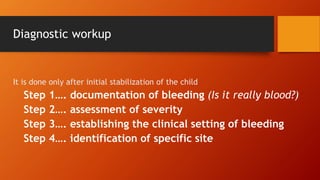
Diagnostic workup
It is done only after initial stabilization of the child
Step 1…. documentation of bleeding (Is it really blood?)
Step 2…. assessment of severity
Step 3…. establishing the clinical setting of bleeding
Step 4…. identification of specific site
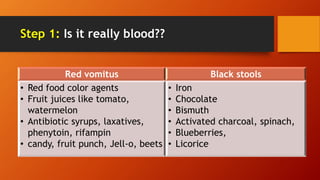
Step 1: Is it really blood??
Red vomitus Black stools
• Red food color agents
• Fruit juices like tomato,
watermelon
• Antibiotic syrups, laxatives,
phenytoin, rifampin
• candy, fruit punch, Jell-o, beets
• Iron
• Chocolate
• Bismuth
• Activated charcoal, spinach,
• Blueberries,
• Licorice
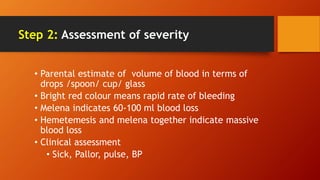
Step 2: Assessment of severity
• Parental estimate of volume of blood in terms of
drops /spoon/ cup/ glass
• Bright red colour means rapid rate of bleeding
• Melena indicates 60-100 ml blood loss
• Hemetemesis and melena together indicate massive
blood loss
• Clinical assessment
• Sick, Pallor, pulse, BP
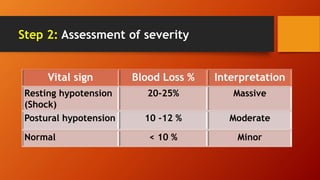
Step 2: Assessment of severity
Vital sign Blood Loss % Interpretation
Resting hypotension
(Shock)
20-25% Massive
Postural hypotension 10 -12 % Moderate
Normal < 10 % Minor
Step 3: Establishing the clinical setting of
bleeding
History:
- Drug ingestion (NSAID)
- Child in ICU setting – Stress ulcer
- Pain abdomen preceding the h/o bleeding - Gastritis
- Preceding h/o vomiting & retching - Mallory Weiss
- Present/past history suggestive of liver disease – Variceal bleed
Step 4: Establishing the site of bleeding
Physical examination
- Cutaneous stigmata of CLD
- Bleeding from other sites (muco-cutaneous). - Bleeding diathesis
- Cutaneous hemangioma - Malformations
- Splenomegaly (95% PHT vs 5% non-PHT) – Liver disease
- Liver: s/o CLD
- Ascites – Portal hypertension
Investigations for upper GI bleed
• Lab studies
• leucopenia, thrombocytopenia, abnormal liver enzymes, bilirubin and
albumin
• USG abdomen
• for portal hypertension
• Doppler USG
• accurate portal and venous blood flow, obstruction
• CT scan
• better delineate the portal vein and liver parenchyma change
• Upper GI Endoscopy
• Radionuclide study
• non invasive method of determining site
Apt Downy Test in Neonates
• Purpose:
• To differentiate between maternal and fetal blood.
• Procedure:
• The blood is placed in a test tube; sterile water is added to hemolyze the RBCs,
yielding free hemoglobin. This solution then is mixed with 1% sodium hydroxide.
• Interpretation:
• If the solution turns yellow-brown, the hemoglobin is maternal or adult
hemoglobin, which is less stable than fetal hemoglobin.
• If the solution remains the same color, it is the more stable fetal hemoglobin;
therefore, the newborn is the source of the bleeding.
Treatment - General
• Supportive care- Colloids with wide bore cannula
• Ryle’s tube lavage (wide bore tube): ongoing bleeding
• Blood transfusion:
1. Continued hemodynamic instability despite colloid infusion
2. Continuous bleeding
3. Persistently low hematocrit (<20%, target 30%)
Treatment - Specific
• Variceal bleeding
• Drugs to reduce bleeding. Eg. Vasopressin, telepressin, somatostatin,
Octreotride
• Balloon tamponade
• Endoscopic variceal ligation (EVL)
• Transjugular intrahepatic portosystemic shunt (TRIPS)
• Surgery
• Shunt surgery
• Non-shunt surgeries (Sugiura procedure)
• Esophageal transaction & devascularization of gastroesophageal varices
Treatment - Specific
• Non-Variceal bleeding
• H2 receptor antagonists
• Protein Pump Inhibitors
• Vasoactive agents Eg. Stomatostatin, Octreotide
• Endotherapy
• Eg. Electrothermal agents, endoclips and argon plasma coagulation
Treatment - Specific
• Anal fissures
• Laxatives, sitz bath, topical 0.2% glyceryl nitrate
• Solitary rectal ulcer
• Sucralfate enema
• Hemorrhagic infective colitis
• Antimicrobials
• Polyps
• Colonoscopic snare polypectomy
• Crohn’s disease
• Steroids, azathioprine, infliximab, metronidazole, cyclosporine
• Dr.C.S.N.Vittal

Approach to GI Bleeding in Children

  • 1.
  • 2.
    Epidemiology • GI bleeding– one of the commonest emergencies in pediatrics • Account for 10%-20% of referrals to pediatric gastroenterologists. • 6.4% of PICU admissions of which 0.4% is life threatening (Lacroix) • Mortality : 4 – 9% in best centers
  • 3.
    Presentation of GIBleeding Term Definition Hemetemesis • Vomiting of blood – bright red/ coffee brown , small or large , with /without clots. • Indicates upper GI bleeding Melena • Black tarry stools, shiny, sticky or foul smelling ( > 60 ml, stays for > 6 hrs) • Suggests bleeding proximal to the ileocecal valve Hematochezia • Passage of bright red/ maroon blood per rectum • Indicates colonic source or massive upper GI bleeding Occult blood • No obvious bleeding , slow continuous oozing • Demonstrated by lab exam Hematobilia • Bleeding into small intestine from biliary tract
  • 4.
    Classification of GIBleeds Upper GI • Esophagus • Stomach • Proximal duodenum Lower GI • Distal to duodeno- jejunal junction
  • 5.
  • 6.
    Upper GI Bleeding- Neonates • Swallowed maternal blood • Hemorrhagic disease of the newborn • Stress gastritis • Cow’s milk protein allergy • Coagulopathy • Vascular anomaly
  • 7.
    Upper GI Bleeding- Infants • Esophagitis • Stress ulcer / gastritis • Duplication cysts, • Foreign body ingestion, • Medication-induced bleeding (Eg, NSAIDs) • Peptic ulcer bleeding
  • 8.
    Upper GI Bleeding- Children • Erosive esophagitis, • Gastritis, • Caustic ingestions, • Peptic ulcer bleeding sec to burns (Curling ulcer) • Sepsis • NSAIDs • Varices • Mallory-Weiss tear • Coagulation disorders • Helicobacter pylori infection • Zollinger-Allison syndrome
  • 9.
    The Forrest Classificationof Upper GI Bleeds Endoscopic findings into the following 3 categories: I - Active hemorrhage • Ia = bright-red bleeding, • Ib = slow bleeding II - Recent hemorrhage • IIa = nonbleeding visible vessel, • IIb = adherent clot on base of lesion, • IIc = flat pigmented spot III - No evidence of bleeding.
  • 10.
  • 11.
    Lower GI Bleeding- Neonates • Anal fissure • Necrotizing enterocolitis • Malrotation with volvulus • Hirschsprung enterocolitis • Systemic vasculitis
  • 12.
    Lower GI Bleeding- Infants • Anal fissure • Infectious colitis • Intussusception • TB abdomen • Gangrenous bowel • Cow’s milk protein allergy • Meckel’s diverticulum • Pseudomembranous enterocolitis
  • 13.
    Lower GI Bleeding- Children • Polyps • Meckel’s diverticulum • Anorectal fissure • Intussusception • Juvenile Polyps • Inflammatory bowel disease • Infectious diarrhea (Esch coli and Shigella) • Vascular lesions / malformations • HS Purpura • Hemorrhoids
  • 14.
    Diagnostic workup It isdone only after initial stabilization of the child Step 1…. documentation of bleeding (Is it really blood?) Step 2…. assessment of severity Step 3…. establishing the clinical setting of bleeding Step 4…. identification of specific site
  • 15.
    Step 1: Isit really blood?? Red vomitus Black stools • Red food color agents • Fruit juices like tomato, watermelon • Antibiotic syrups, laxatives, phenytoin, rifampin • candy, fruit punch, Jell-o, beets • Iron • Chocolate • Bismuth • Activated charcoal, spinach, • Blueberries, • Licorice
  • 16.
    Step 2: Assessmentof severity • Parental estimate of volume of blood in terms of drops /spoon/ cup/ glass • Bright red colour means rapid rate of bleeding • Melena indicates 60-100 ml blood loss • Hemetemesis and melena together indicate massive blood loss • Clinical assessment • Sick, Pallor, pulse, BP
  • 17.
    Step 2: Assessmentof severity Vital sign Blood Loss % Interpretation Resting hypotension (Shock) 20-25% Massive Postural hypotension 10 -12 % Moderate Normal < 10 % Minor
  • 18.
    Step 3: Establishingthe clinical setting of bleeding History: - Drug ingestion (NSAID) - Child in ICU setting – Stress ulcer - Pain abdomen preceding the h/o bleeding - Gastritis - Preceding h/o vomiting & retching - Mallory Weiss - Present/past history suggestive of liver disease – Variceal bleed
  • 19.
    Step 4: Establishingthe site of bleeding Physical examination - Cutaneous stigmata of CLD - Bleeding from other sites (muco-cutaneous). - Bleeding diathesis - Cutaneous hemangioma - Malformations - Splenomegaly (95% PHT vs 5% non-PHT) – Liver disease - Liver: s/o CLD - Ascites – Portal hypertension
  • 20.
    Investigations for upperGI bleed • Lab studies • leucopenia, thrombocytopenia, abnormal liver enzymes, bilirubin and albumin • USG abdomen • for portal hypertension • Doppler USG • accurate portal and venous blood flow, obstruction • CT scan • better delineate the portal vein and liver parenchyma change • Upper GI Endoscopy • Radionuclide study • non invasive method of determining site
  • 21.
    Apt Downy Testin Neonates • Purpose: • To differentiate between maternal and fetal blood. • Procedure: • The blood is placed in a test tube; sterile water is added to hemolyze the RBCs, yielding free hemoglobin. This solution then is mixed with 1% sodium hydroxide. • Interpretation: • If the solution turns yellow-brown, the hemoglobin is maternal or adult hemoglobin, which is less stable than fetal hemoglobin. • If the solution remains the same color, it is the more stable fetal hemoglobin; therefore, the newborn is the source of the bleeding.
  • 22.
    Treatment - General •Supportive care- Colloids with wide bore cannula • Ryle’s tube lavage (wide bore tube): ongoing bleeding • Blood transfusion: 1. Continued hemodynamic instability despite colloid infusion 2. Continuous bleeding 3. Persistently low hematocrit (<20%, target 30%)
  • 23.
    Treatment - Specific •Variceal bleeding • Drugs to reduce bleeding. Eg. Vasopressin, telepressin, somatostatin, Octreotride • Balloon tamponade • Endoscopic variceal ligation (EVL) • Transjugular intrahepatic portosystemic shunt (TRIPS) • Surgery • Shunt surgery • Non-shunt surgeries (Sugiura procedure) • Esophageal transaction & devascularization of gastroesophageal varices
  • 24.
    Treatment - Specific •Non-Variceal bleeding • H2 receptor antagonists • Protein Pump Inhibitors • Vasoactive agents Eg. Stomatostatin, Octreotide • Endotherapy • Eg. Electrothermal agents, endoclips and argon plasma coagulation
  • 25.
    Treatment - Specific •Anal fissures • Laxatives, sitz bath, topical 0.2% glyceryl nitrate • Solitary rectal ulcer • Sucralfate enema • Hemorrhagic infective colitis • Antimicrobials • Polyps • Colonoscopic snare polypectomy • Crohn’s disease • Steroids, azathioprine, infliximab, metronidazole, cyclosporine
  • 26.