Hypospadias Dr.Anil Haripriya
Introduction  Congenital anomaly Incidence  is 1 in 125 live male birth Defined as  “An arrest in normal development of the urethra ,foreskin & ventral aspect of penis which result in wide range of abnormalities”
Embryology Formation of male external genitalia  - Genetic programming - Cell differentiation - Hormonal signaling  - Enzymatic activity & tissue remodeling
Aetiology  Aberrant signaling between epithelium & mesenchyma Environmental factors  - Maternal vegetarian diet & estrogen progesterone exposure during pregnancy
Risk factors Maternal - Maternal age  - Primiparity Paternal - Abnormality of testes & scrotum - Low spermatozoa motility  - Abnormal sperm morphology Fetal - Low birth Wt baby
Hypospadiac penile anatomy Abnormal urethral spongiosum & glans Spared of neuronal structures at 12 o’ clock Vascularity  - Huge endothelium lined vascular channels filled with RBC Urethral plate is well vascularized ,rich nerve supply & extensive muscular with connective tissue backup
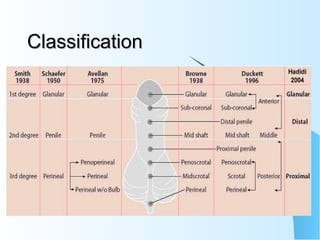
Classification
Clinical Features Meatal dystopia  - Various configurations in terms of form, diameter, elasticity,rigidity,can be fissural in both direction  Dermal defects – frenulum is always –nt, dorsal hood Penile curvature – due to deficient normal ventral penile structures  Penoscrotal transposition & bifid scrotum
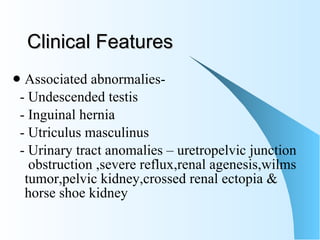
Clinical Features Associated abnormalies- - Undescended testis  - Inguinal hernia - Utriculus masculinus - Urinary tract anomalies – uretropelvic junction  obstruction ,severe reflux,renal agenesis,wilms tumor,pelvic kidney,crossed renal ectopia & horse shoe kidney
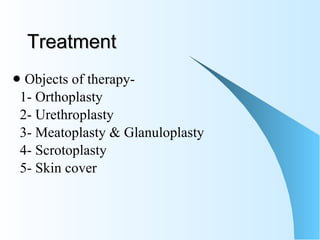
Treatment Objects of therapy- 1- Orthoplasty 2- Urethroplasty 3- Meatoplasty & Glanuloplasty 4- Scrotoplasty 5- Skin cover
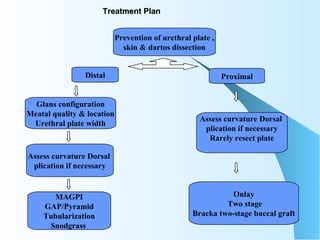
Treatment Plan Prevention of urethral plate , skin & dartos dissection Distal Proximal Glans configuration Meatal quality & location Urethral plate width Assess curvature Dorsal  plication if necessary MAGPI GAP/Pyramid Tubularization Snodgrass  Assess curvature Dorsal  plication if necessary Rarely resect plate Onlay Two stage Bracka two-stage buccal graft
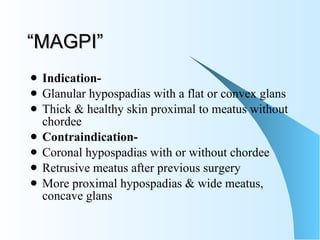
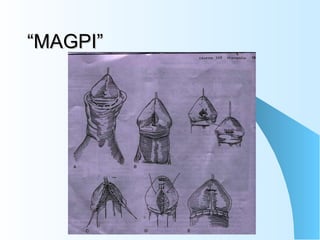
“MAGPI” Indication- Glanular hypospadias with a flat or convex glans Thick & healthy skin proximal to meatus without chordee Contraindication- Coronal hypospadias with or without chordee Retrusive meatus after previous surgery More proximal hypospadias & wide meatus, concave glans
“MAGPI”
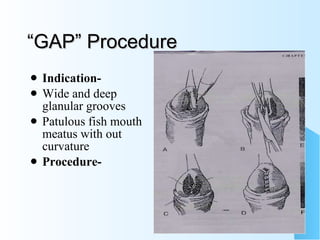
“GAP” Procedure Indication- Wide and deep glanular grooves Patulous fish mouth meatus with out curvature Procedure-
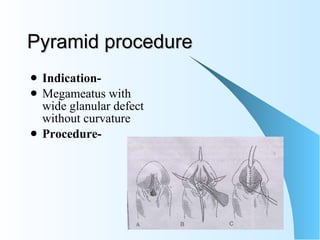
Pyramid procedure Indication- Megameatus with wide glanular defect without curvature Procedure-
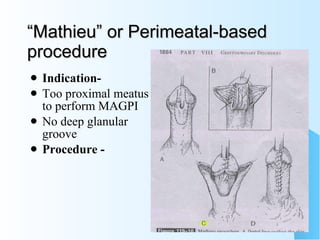
“ Mathieu” or Perimeatal-based procedure Indication-  Too proximal meatus to perform MAGPI No deep glanular groove  Procedure -
“ Snodgrass” Tubularized incised plate urethroplasty Indication-  Urethral groove is not wide enough for tubularization in situ Contraindication- Pt with significant curvature Flat glans ,narrow urethral plate,narrow meatus  Moderate chordee  Skin proximal to meatus is thin & attenuated
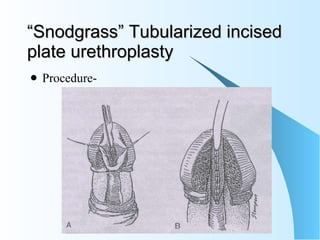
“ Snodgrass” Tubularized incised plate urethroplasty Procedure-
Posterior hypospadias Onlay island flap Transverse tubularized island flap  Two-stage hypospadias repair Bracka two-stage buccal graft repair
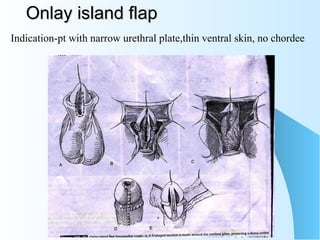
Onlay island flap Indication-pt with narrow urethral plate,thin ventral skin, no chordee
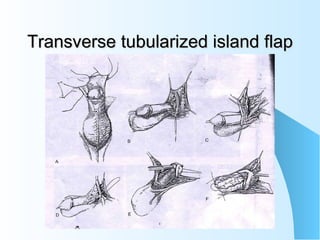
Transverse tubularized island flap
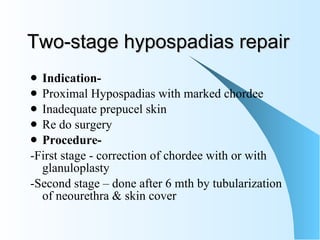
Two-stage hypospadias repair Indication- Proximal Hypospadias with marked chordee Inadequate prepucel skin  Re do surgery Procedure- -First stage - correction of chordee with or with glanuloplasty  -Second stage – done after 6 mth by tubularization of neourethra & skin cover
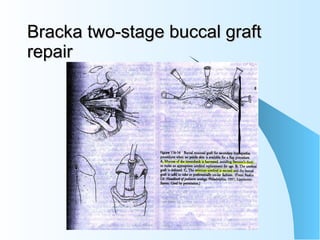
Bracka two-stage buccal graft repair
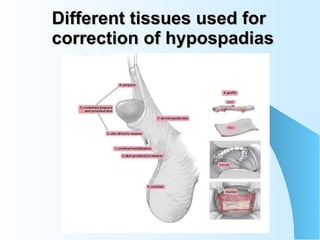
Different tissues used for correction of hypospadias
Complications Meatal stenosis Fistula Infection Diverticulum Stricture Penile torsion Procedure failure
General considerations Testosterone stimulation- im 2mg/kg 3 dose /3wks Vascularity Minimal tissue damage & correct tissue planes Suture material & suture technique  Antibiotics Analgesia – Caudal block Haemorrhage – 1:100000 epinephrine in 1% xylocaine Catheter  Magnification
Summary Selection of patient & appropriate procedure  Appropriate time 6 to 18 mth of life A terminal slit like meatus should be the goal with or without preservation of foreskin depending on parental preference Mid line dorsal plication is safe for correction of curvature Deepithelialized vascular flap should be use as a second layer for all urethroplasties  Follow up at 6mth,1year,after toilet training & after puberty

Hypospadias

  • 1.
  • 2.
    Introduction Congenitalanomaly Incidence is 1 in 125 live male birth Defined as “An arrest in normal development of the urethra ,foreskin & ventral aspect of penis which result in wide range of abnormalities”
  • 3.
    Embryology Formation ofmale external genitalia - Genetic programming - Cell differentiation - Hormonal signaling - Enzymatic activity & tissue remodeling
  • 4.
    Aetiology Aberrantsignaling between epithelium & mesenchyma Environmental factors - Maternal vegetarian diet & estrogen progesterone exposure during pregnancy
  • 5.
    Risk factors Maternal- Maternal age - Primiparity Paternal - Abnormality of testes & scrotum - Low spermatozoa motility - Abnormal sperm morphology Fetal - Low birth Wt baby
  • 6.
    Hypospadiac penile anatomyAbnormal urethral spongiosum & glans Spared of neuronal structures at 12 o’ clock Vascularity - Huge endothelium lined vascular channels filled with RBC Urethral plate is well vascularized ,rich nerve supply & extensive muscular with connective tissue backup
  • 7.
  • 8.
    Clinical Features Meataldystopia - Various configurations in terms of form, diameter, elasticity,rigidity,can be fissural in both direction Dermal defects – frenulum is always –nt, dorsal hood Penile curvature – due to deficient normal ventral penile structures Penoscrotal transposition & bifid scrotum
  • 9.
    Clinical Features Associatedabnormalies- - Undescended testis - Inguinal hernia - Utriculus masculinus - Urinary tract anomalies – uretropelvic junction obstruction ,severe reflux,renal agenesis,wilms tumor,pelvic kidney,crossed renal ectopia & horse shoe kidney
  • 10.
    Treatment Objects oftherapy- 1- Orthoplasty 2- Urethroplasty 3- Meatoplasty & Glanuloplasty 4- Scrotoplasty 5- Skin cover
  • 11.
    Treatment Plan Preventionof urethral plate , skin & dartos dissection Distal Proximal Glans configuration Meatal quality & location Urethral plate width Assess curvature Dorsal plication if necessary MAGPI GAP/Pyramid Tubularization Snodgrass Assess curvature Dorsal plication if necessary Rarely resect plate Onlay Two stage Bracka two-stage buccal graft
  • 12.
    “MAGPI” Indication- Glanularhypospadias with a flat or convex glans Thick & healthy skin proximal to meatus without chordee Contraindication- Coronal hypospadias with or without chordee Retrusive meatus after previous surgery More proximal hypospadias & wide meatus, concave glans
  • 13.
  • 14.
    “GAP” Procedure Indication-Wide and deep glanular grooves Patulous fish mouth meatus with out curvature Procedure-
  • 15.
    Pyramid procedure Indication-Megameatus with wide glanular defect without curvature Procedure-
  • 16.
    “ Mathieu” orPerimeatal-based procedure Indication- Too proximal meatus to perform MAGPI No deep glanular groove Procedure -
  • 17.
    “ Snodgrass” Tubularizedincised plate urethroplasty Indication- Urethral groove is not wide enough for tubularization in situ Contraindication- Pt with significant curvature Flat glans ,narrow urethral plate,narrow meatus Moderate chordee Skin proximal to meatus is thin & attenuated
  • 18.
    “ Snodgrass” Tubularizedincised plate urethroplasty Procedure-
  • 19.
    Posterior hypospadias Onlayisland flap Transverse tubularized island flap Two-stage hypospadias repair Bracka two-stage buccal graft repair
  • 20.
    Onlay island flapIndication-pt with narrow urethral plate,thin ventral skin, no chordee
  • 21.
  • 22.
    Two-stage hypospadias repairIndication- Proximal Hypospadias with marked chordee Inadequate prepucel skin Re do surgery Procedure- -First stage - correction of chordee with or with glanuloplasty -Second stage – done after 6 mth by tubularization of neourethra & skin cover
  • 23.
  • 24.
    Different tissues usedfor correction of hypospadias
  • 25.
    Complications Meatal stenosisFistula Infection Diverticulum Stricture Penile torsion Procedure failure
  • 26.
    General considerations Testosteronestimulation- im 2mg/kg 3 dose /3wks Vascularity Minimal tissue damage & correct tissue planes Suture material & suture technique Antibiotics Analgesia – Caudal block Haemorrhage – 1:100000 epinephrine in 1% xylocaine Catheter Magnification
  • 27.
    Summary Selection ofpatient & appropriate procedure Appropriate time 6 to 18 mth of life A terminal slit like meatus should be the goal with or without preservation of foreskin depending on parental preference Mid line dorsal plication is safe for correction of curvature Deepithelialized vascular flap should be use as a second layer for all urethroplasties Follow up at 6mth,1year,after toilet training & after puberty