National Center for
Biotechnology Information
NCBI
Amandeep Singh
Assistant Professor
Department of Biotechnology
GSSDGS Khalsa College Patiala
Introduction
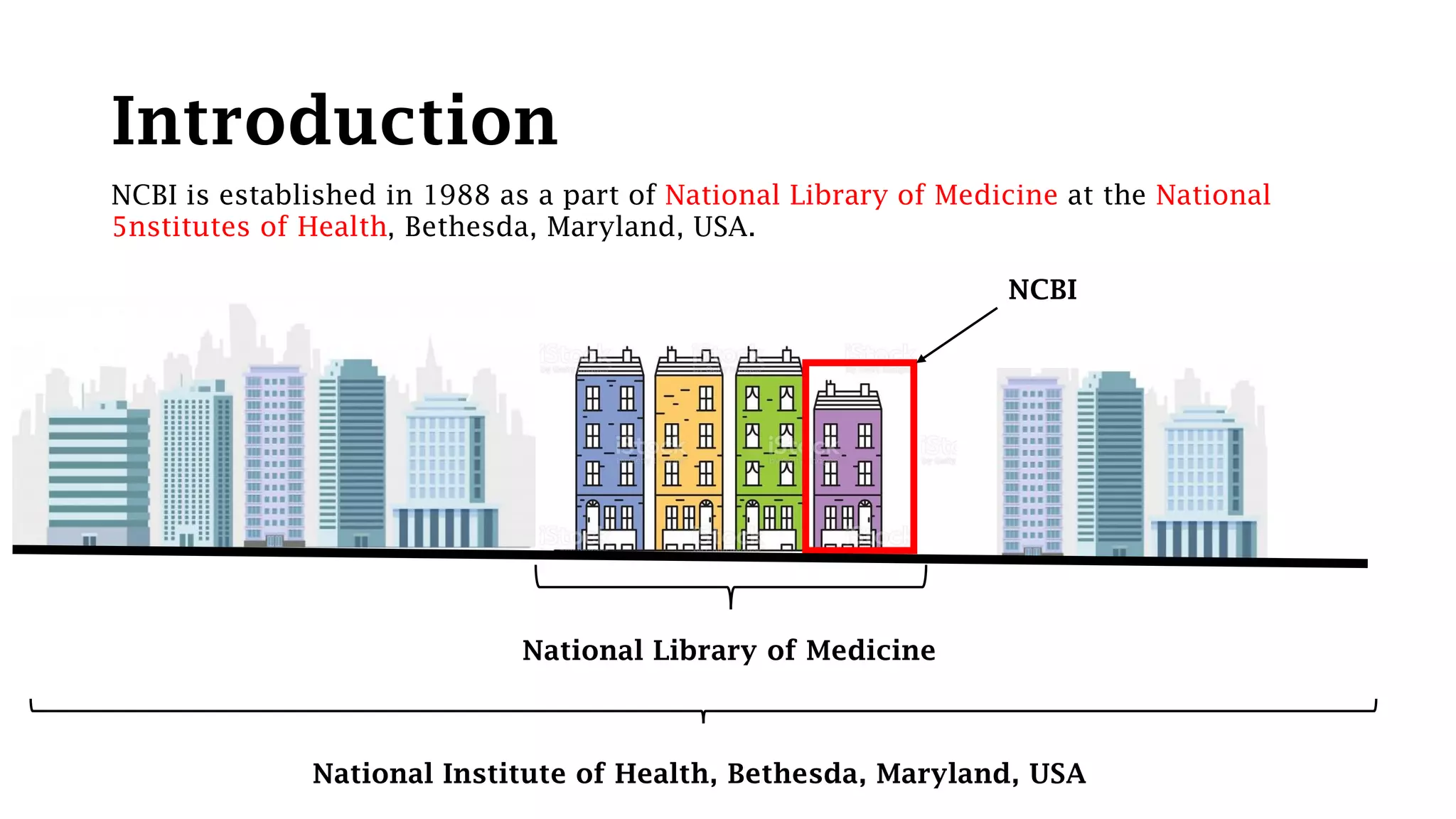
National Library of Medicine
NCBI
National Institute of Health, Bethesda, Maryland, USA
NCBI is established in 1988 as a part of National Library of Medicine at the National
5nstitutes of Health, Bethesda, Maryland, USA.
Aim of NCBI
Develop
Public Databases
Software Tools Spread Biomedical
Information
Roles of NCBI
1. Maintenance of Biological Databases. e.g. GenBank
Primary Secondary/Derivative
1. Original submission by experimentalists. 1. Built up from primary database
2. Content controlled by submitter. 2. Content controlled by third body (NCBI)
2. Provide data retrieval system. e.g. Entrez
3. Provide computational resources for the analysis of GenBank data.
NCBI Database & Resources
DATABASE RETRIEVAL SYSTEM
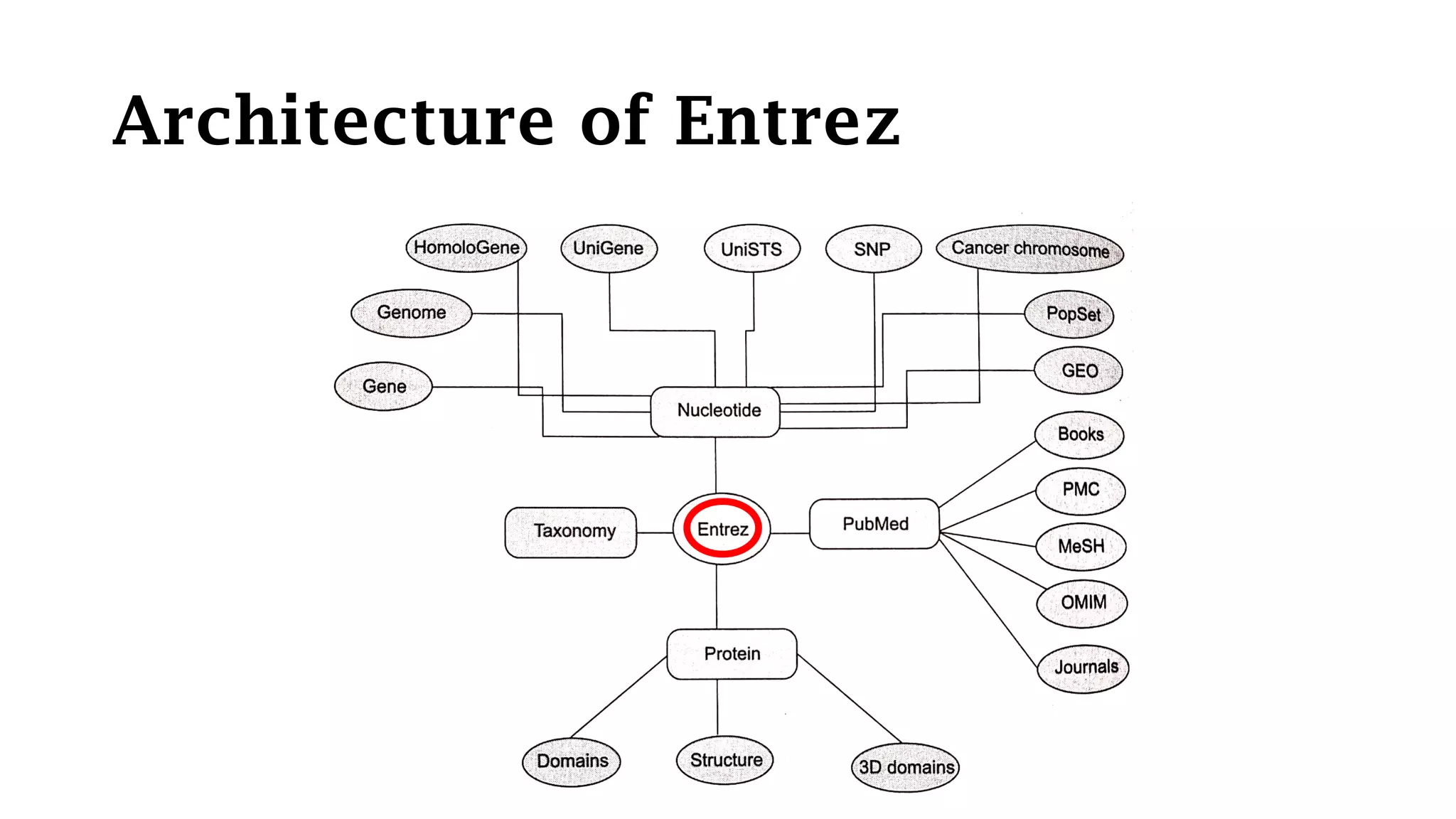
Entrez: Integrated database search and retrieval system.
Extract information from DNA sequence data, protein
sequence data, population set, whole genome,
macromolecular structures, biomedical literature like
PubMed.
Sequence sources: PIR, SWISS-PROT, PDB, GenBank,
RefSeq.
NCBI
Link
Cross-references
Sequence
Abstract of
Paper
Protein
sequence
Coding DNA
Sequence
Protein
Sequence
3D structures
Architecture of Entrez
Sequence Submission to NCBI
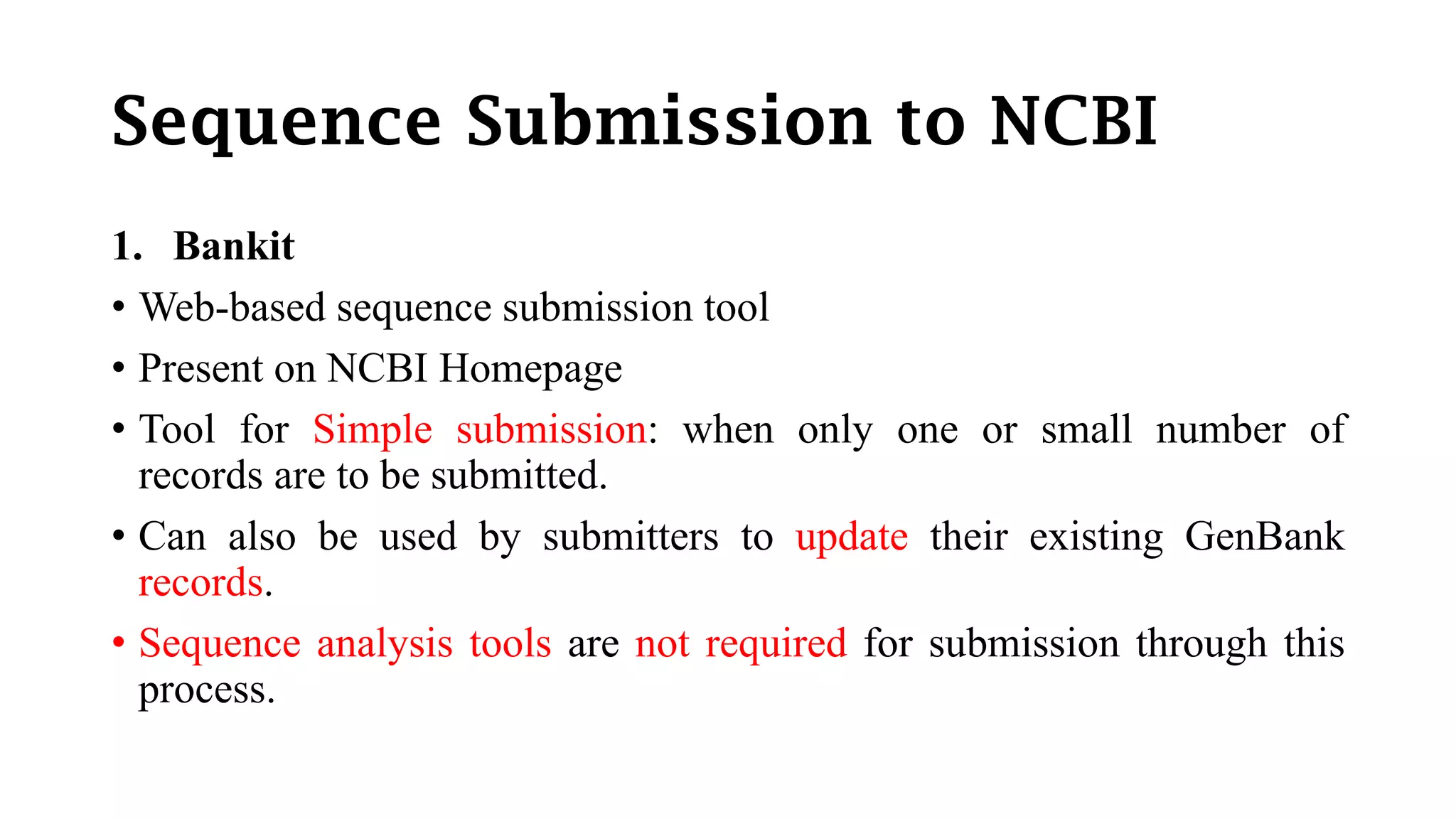
1. Bankit
• Web-based sequence submission tool
• Present on NCBI Homepage
• Tool for Simple submission: when only one or small number of
records are to be submitted.
• Can also be used by submitters to update their existing GenBank
records.
• Sequence analysis tools are not required for submission through this
process.
Sequence Submission to NCBI
2. Sequin
• NCBI tool for sequence submission and update.
• Can handle multiple sequence submissions; that includes long
sequences, multiple annotations, segment sets of DNA, population
studies
• Provide graphical viewing and editing options.
Specialized tools
1. ORF Finder
Graphic analysis tool to detect open reading frame (ORF) of a seectable
minimum size.
ORF Finder
Detection of ORF
In User’s sequence In a sequence already in
the database
Specialized tools
2. e-PCR
Computation procedure that is used to identify sequence-tag-sites
(STSs) with in DNA sequence.
STS is a short (200 to 500 base pair) DNA sequence that has a
single occurrence in the genome and whose location and base
sequence are known.
Search for STS subsequences to match with PCR primer which
have correct order, orientation, spacing to generate known STSs.
Specialized tools
3. Spidey/Splign
• mRNA to Genomic alignment program, which use the local alignment
tools- BLAST & Dot view to find it’s alignment.
• For identification of exons and introns and link between them.
• For tracking splice junction.
• For identification of frameshift sequences.
• For identification of changes in sequences.

NCBI

  • 1.
    National Center for BiotechnologyInformation NCBI Amandeep Singh Assistant Professor Department of Biotechnology GSSDGS Khalsa College Patiala
  • 2.
    Introduction National Library ofMedicine NCBI National Institute of Health, Bethesda, Maryland, USA NCBI is established in 1988 as a part of National Library of Medicine at the National 5nstitutes of Health, Bethesda, Maryland, USA.
  • 3.
    Aim of NCBI Develop PublicDatabases Software Tools Spread Biomedical Information
  • 4.
    Roles of NCBI 1.Maintenance of Biological Databases. e.g. GenBank Primary Secondary/Derivative 1. Original submission by experimentalists. 1. Built up from primary database 2. Content controlled by submitter. 2. Content controlled by third body (NCBI) 2. Provide data retrieval system. e.g. Entrez 3. Provide computational resources for the analysis of GenBank data.
  • 5.
    NCBI Database &Resources
  • 6.
    DATABASE RETRIEVAL SYSTEM Entrez:Integrated database search and retrieval system. Extract information from DNA sequence data, protein sequence data, population set, whole genome, macromolecular structures, biomedical literature like PubMed. Sequence sources: PIR, SWISS-PROT, PDB, GenBank, RefSeq.
  • 7.
  • 8.
  • 9.
    Sequence Submission toNCBI 1. Bankit • Web-based sequence submission tool • Present on NCBI Homepage • Tool for Simple submission: when only one or small number of records are to be submitted. • Can also be used by submitters to update their existing GenBank records. • Sequence analysis tools are not required for submission through this process.
  • 10.
    Sequence Submission toNCBI 2. Sequin • NCBI tool for sequence submission and update. • Can handle multiple sequence submissions; that includes long sequences, multiple annotations, segment sets of DNA, population studies • Provide graphical viewing and editing options.
  • 11.
    Specialized tools 1. ORFFinder Graphic analysis tool to detect open reading frame (ORF) of a seectable minimum size. ORF Finder Detection of ORF In User’s sequence In a sequence already in the database
  • 12.
    Specialized tools 2. e-PCR Computationprocedure that is used to identify sequence-tag-sites (STSs) with in DNA sequence. STS is a short (200 to 500 base pair) DNA sequence that has a single occurrence in the genome and whose location and base sequence are known. Search for STS subsequences to match with PCR primer which have correct order, orientation, spacing to generate known STSs.
  • 13.
    Specialized tools 3. Spidey/Splign •mRNA to Genomic alignment program, which use the local alignment tools- BLAST & Dot view to find it’s alignment. • For identification of exons and introns and link between them. • For tracking splice junction. • For identification of frameshift sequences. • For identification of changes in sequences.