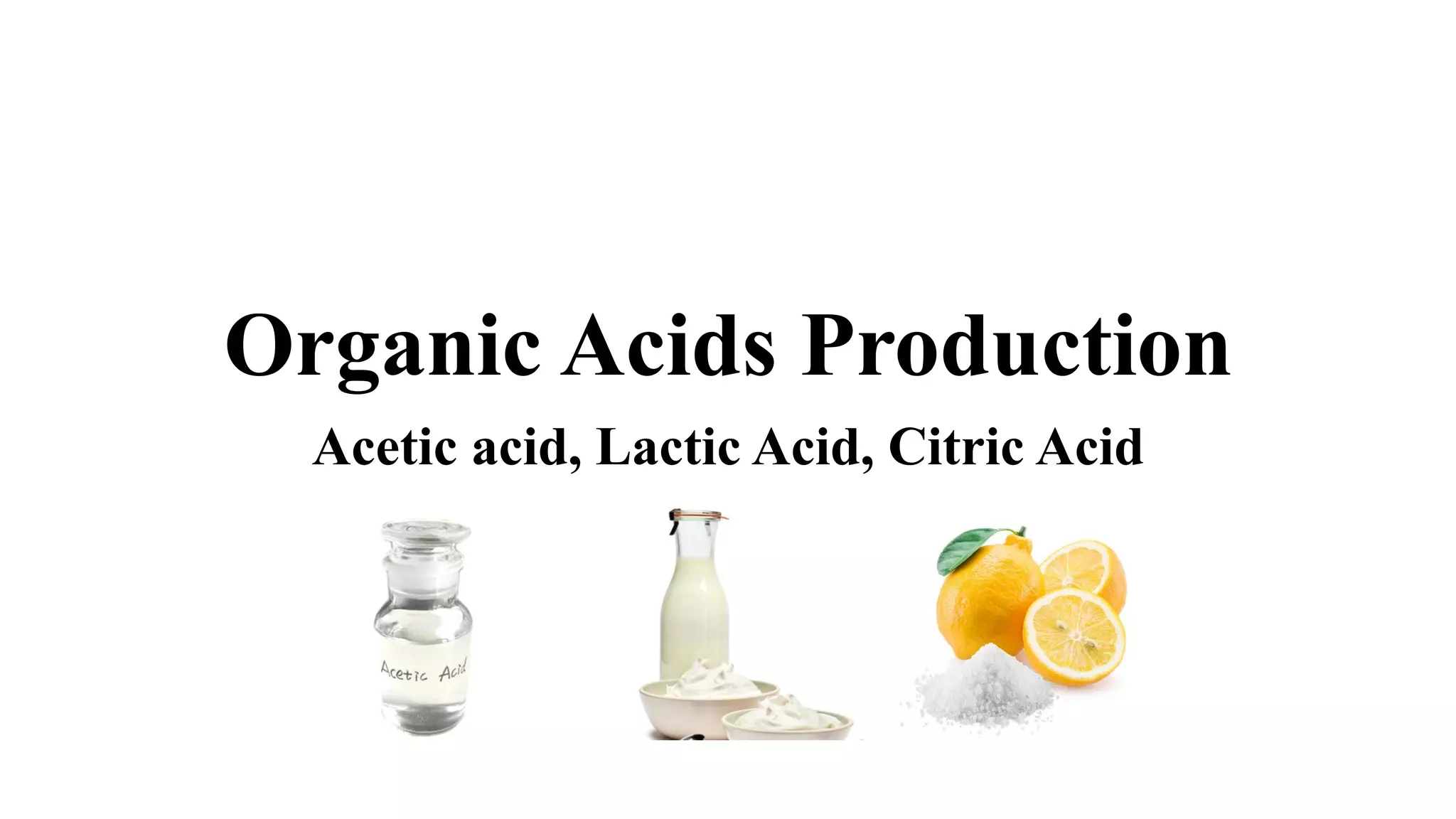
Organic Acids Production
Acetic acid, Lactic Acid, Citric Acid
Acetic Acid
Production
Introduction
• Acetic acid is one of the most important organic acids.
• Dilute acetic acid (~4%) is known as vinegar (vin (wine) aigre (sour)=
sour wine).
• Microorganisms used: Acetobacter aceti or Gluconobacter oxydans,
which belong to the Family Acetobacteriaceae.
Mechanism of formation
• Raw material: Glucose or Ethanol
• Conversion of ethanol to acetic acid is oxygen requiring process and
hence known as Oxidative fermentation.
• Conversion of ethanol to acetic acid is an exothermic reaction.
• Acetic acid bacteria genera: Gluconobacter and Acetobacter.
• Gluconobacter oxidises ethanol to acetic acid whereas Acetobacter
oxidizes ethanol to acetic acid and then finally to CO2 and H2O.
• Strains of Acetobacter are generally involved in vinegar production.
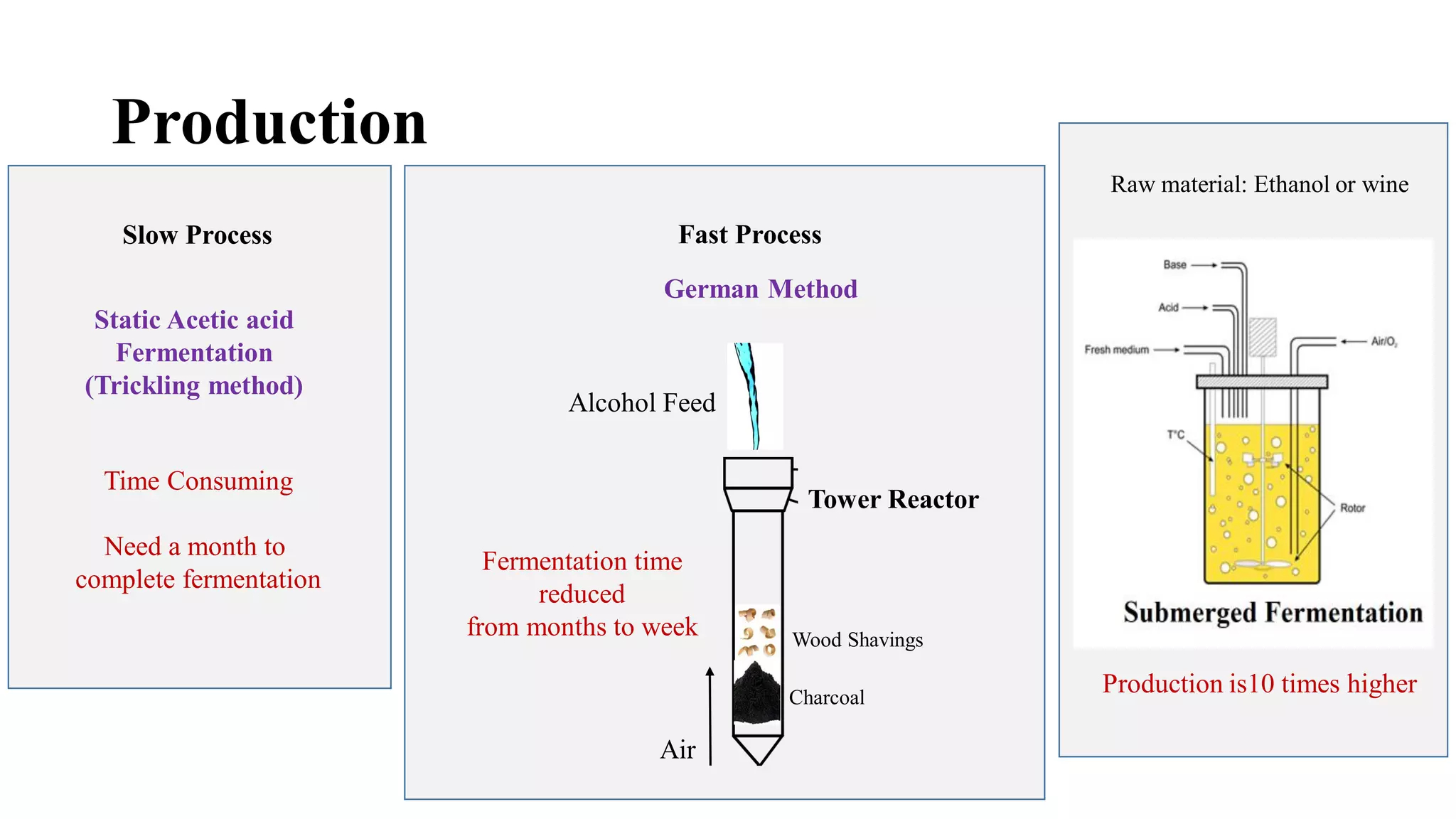
Production
Slow Process Fast Process
Static Acetic acid
Fermentation
(Trickling method)
Tower Reactor
German Method
Wood Shavings
Charcoal
Alcohol Feed
Air
Time Consuming
Need a month to
complete fermentation
Fermentation time
reduced
from months to week
Production is10 times higher
Raw material: Ethanol or wine
Recovery
Filtration Decolourization
Types of Vinegar
1. Distilled White Vinegar
Made from high quality ethanol, does not have any aroma.
2. Apple Cider Vinegar
Made from fermented apple juice or apple juice concentrates.
3. Wine Vinegar
Made from low quality wines (Red and white) by oxidative fermentation.
4. Malt Vinegar
Made from alcoholic and acetous fermentation of malt starch or corn starch.
Malt starch or Corn starch s first treated with enzymes to release sugars.
Sugar is then fermented by yeast to ethanol. This ethanol is then converted to
acetic acid.
Chemical Synthesis
Vinegar is produced by Carbonylation of methanol by Monsanto process
CH3OH + CO CH3COOH
D-Rhodium complex
180°C, 30-40 atm pressure
Lactic acid
Production
Introduction
• Lactic acid fermentation was discovered as early as 1780 by Scheele, who
found that souring of milk is due to formation of lactic acid by group of
bacteria called Lactobacilli.
• Lactic acid producing bacteria are broadly classified into two groups, based
on products formed from glucose.
1. Homolactic fermenters
2. Heterolactic fermenters
Homolactic fermenters dissimilate glucose by EMP pathway to lactic acid.
Two moles of ATPs are produced per mole of glucose utilized.
Heterolactic fermenters dissimilate glucose by Pentose Phosphate Pathway to
equimolar concentration of three end products viz. lactic acid, ethanol and
CO2. Only one mole of ATP is produced per mole of glucose utilized.
Microorganisms used
• For industrial production: Lactobacillus delbrueckii which utilize
glucose
• Lactobacillus bulgaricus which utilize lactose
• Lactobacillus pentosus which utilize pentose of sulfite waste liquor
Production and Recovery
Production Media
• 10-15% glucose
• 10% Calcium Carbonate
• Nitrogenous salts
• Calcium salt converts the lactic acid produced during fermentation to calcium lactate.
• High sugar concentration not used as it crystallize calcium lactate and slow down the fermentation process.
Fermenter
• 20,000-100,000 Liters
• Anaerobically
• pH 5-6
• Lactobacillus delbrueckii
• 5-6 days
• At the end of fermentation, fermentation broth is heated.
• Calcium lactate produced during fermentation is filtered and
concentrated to allow the calcium lactate to crystalize.
• Calcium is finally removed as calcium sulphate by addition of
sulphuric acid.
• Lactic acid is then recrystallized and used.
• Streptococcus lactis: produce only lactic acid.
• Leuconostoc mesenteroides: produce lactic acid, ethanol, CO2
Citric Acid
Production
Introduction
• Citric acid is weak organic acid also known as lemon salt, founds in
fruits and berries.
• IN 1922 Molliard discovered that citric acid accumulates in cultures of
Aspergillus Niger under submerged fermentation process and under
conditions of nutrient deficiency.
Commercial Production of Citric Acid
• Aspergillus Niger most commonly used.
• Yeast strains such as Candida guilliermondii and C. lipolytica are also used
for production of citric acid in smaller quantities.
• There are three well known methods for commercial production of citric
acid:
1. The Japanese kojic acid process, in which special strains of A. niger are
used.
2. The liquid surface culture fermentation, in which A. niger floats on the
surface of culture medium.
3. The submerged fermentation process, in which fungal mycelium grows
throughout the medium in a deep tank.
• A. Niger is used
• In Wheat bran medium, pH 4-5
• After 5-8 days of fermentation,
koji is harvested and placed on
percolators and citric acid is
harvested using water
Spread in tray Windrows on floor
Wheat bran medium
1. Japanese kojic acid process
Percolator
2. Liquid surface culture fermentation
Spores germinate within 24 hours
White mycelium cover the surface of medium
Inoculated medium
pH 5-6
Dispersed in Shallow pans of
Aluminum or Stainless steel
• Humidified Air then dry air
• 5-6 days
• After 9 days of inoculation, sugar concentration reduced from 20% to 2%
• At the end of fermentation, spent medium is drained off and used for citric acid recovery.
Raw material: Sugar beet molasses
3. Submerged fermentation process
• Low investment and operating cost
• 80% of world production of citric
acid
• Less sensitive to changes in
composition of media
• Copper and Iron play important
role
• Copper ion inhibit citric acid
enzyme aconitase (convert citrate
to isocitrate)
• Yield is 84%-85% when beet
molasses is used, 82% when n-
alkane is used as substrate.
• Invert molasses
• Copper & Iron
• 0.01-0.3% KH2PO4
• 0.25% MgSO4.2H2O
• pH 3.5
• Aeration 0.5-1.5 v/v per minute
Citric acid production by A. Niger
Recovery
• Precipitation of oxalic acid (antifoam agent used) in the form of calcium oxalate at
low pH.
• Citrate is precipitated as Calcium citrate by addition of hot neutral (pH 7.2, 70-
90°C temperature) aqueous solution of Ca(OH)2 (the process known as liming).
• Calcium citrate is then filtered using rotary filter to form filter cake.
• Filter cake is treated with dilute sulphuric acid to precipitate calcium as calcium
sulphate leaving the citric acid in the solution.
• Further purified using carbon granule column.
• Demineralized by ion exchange column.
• Purified solution is evaporated in circulating evaporator and crystalized.
• Crystals are collected by centrifugation, marked either anhydrous or in its
monohydrate form or sodium salt.
Recovery
Precipitation of oxalic acid
Calcium citrate (Liming)
Calcium sulphate
Purification
Demineralization
Evaporation
Centrifugation
Ca(OH)2
Filtration, H2SO4
Carbon granule column
Ion exchange column
Circulating evaporator
Anhydrous or monohydrate or sodium salt of citric acid

Organic acids production copy

  • 1.
    Organic Acids Production Aceticacid, Lactic Acid, Citric Acid
  • 2.
  • 3.
    Introduction • Acetic acidis one of the most important organic acids. • Dilute acetic acid (~4%) is known as vinegar (vin (wine) aigre (sour)= sour wine). • Microorganisms used: Acetobacter aceti or Gluconobacter oxydans, which belong to the Family Acetobacteriaceae.
  • 4.
    Mechanism of formation •Raw material: Glucose or Ethanol • Conversion of ethanol to acetic acid is oxygen requiring process and hence known as Oxidative fermentation. • Conversion of ethanol to acetic acid is an exothermic reaction. • Acetic acid bacteria genera: Gluconobacter and Acetobacter. • Gluconobacter oxidises ethanol to acetic acid whereas Acetobacter oxidizes ethanol to acetic acid and then finally to CO2 and H2O. • Strains of Acetobacter are generally involved in vinegar production.
  • 5.
    Production Slow Process FastProcess Static Acetic acid Fermentation (Trickling method) Tower Reactor German Method Wood Shavings Charcoal Alcohol Feed Air Time Consuming Need a month to complete fermentation Fermentation time reduced from months to week Production is10 times higher Raw material: Ethanol or wine
  • 6.
  • 7.
    Types of Vinegar 1.Distilled White Vinegar Made from high quality ethanol, does not have any aroma. 2. Apple Cider Vinegar Made from fermented apple juice or apple juice concentrates. 3. Wine Vinegar Made from low quality wines (Red and white) by oxidative fermentation. 4. Malt Vinegar Made from alcoholic and acetous fermentation of malt starch or corn starch. Malt starch or Corn starch s first treated with enzymes to release sugars. Sugar is then fermented by yeast to ethanol. This ethanol is then converted to acetic acid.
  • 8.
    Chemical Synthesis Vinegar isproduced by Carbonylation of methanol by Monsanto process CH3OH + CO CH3COOH D-Rhodium complex 180°C, 30-40 atm pressure
  • 9.
  • 10.
    Introduction • Lactic acidfermentation was discovered as early as 1780 by Scheele, who found that souring of milk is due to formation of lactic acid by group of bacteria called Lactobacilli. • Lactic acid producing bacteria are broadly classified into two groups, based on products formed from glucose. 1. Homolactic fermenters 2. Heterolactic fermenters Homolactic fermenters dissimilate glucose by EMP pathway to lactic acid. Two moles of ATPs are produced per mole of glucose utilized. Heterolactic fermenters dissimilate glucose by Pentose Phosphate Pathway to equimolar concentration of three end products viz. lactic acid, ethanol and CO2. Only one mole of ATP is produced per mole of glucose utilized.
  • 12.
    Microorganisms used • Forindustrial production: Lactobacillus delbrueckii which utilize glucose • Lactobacillus bulgaricus which utilize lactose • Lactobacillus pentosus which utilize pentose of sulfite waste liquor
  • 13.
    Production and Recovery ProductionMedia • 10-15% glucose • 10% Calcium Carbonate • Nitrogenous salts • Calcium salt converts the lactic acid produced during fermentation to calcium lactate. • High sugar concentration not used as it crystallize calcium lactate and slow down the fermentation process. Fermenter • 20,000-100,000 Liters • Anaerobically • pH 5-6 • Lactobacillus delbrueckii • 5-6 days
  • 14.
    • At theend of fermentation, fermentation broth is heated. • Calcium lactate produced during fermentation is filtered and concentrated to allow the calcium lactate to crystalize. • Calcium is finally removed as calcium sulphate by addition of sulphuric acid. • Lactic acid is then recrystallized and used. • Streptococcus lactis: produce only lactic acid. • Leuconostoc mesenteroides: produce lactic acid, ethanol, CO2
  • 15.
  • 16.
    Introduction • Citric acidis weak organic acid also known as lemon salt, founds in fruits and berries. • IN 1922 Molliard discovered that citric acid accumulates in cultures of Aspergillus Niger under submerged fermentation process and under conditions of nutrient deficiency.
  • 17.
    Commercial Production ofCitric Acid • Aspergillus Niger most commonly used. • Yeast strains such as Candida guilliermondii and C. lipolytica are also used for production of citric acid in smaller quantities. • There are three well known methods for commercial production of citric acid: 1. The Japanese kojic acid process, in which special strains of A. niger are used. 2. The liquid surface culture fermentation, in which A. niger floats on the surface of culture medium. 3. The submerged fermentation process, in which fungal mycelium grows throughout the medium in a deep tank.
  • 18.
    • A. Nigeris used • In Wheat bran medium, pH 4-5 • After 5-8 days of fermentation, koji is harvested and placed on percolators and citric acid is harvested using water Spread in tray Windrows on floor Wheat bran medium 1. Japanese kojic acid process Percolator
  • 19.
    2. Liquid surfaceculture fermentation Spores germinate within 24 hours White mycelium cover the surface of medium Inoculated medium pH 5-6 Dispersed in Shallow pans of Aluminum or Stainless steel • Humidified Air then dry air • 5-6 days • After 9 days of inoculation, sugar concentration reduced from 20% to 2% • At the end of fermentation, spent medium is drained off and used for citric acid recovery. Raw material: Sugar beet molasses
  • 20.
    3. Submerged fermentationprocess • Low investment and operating cost • 80% of world production of citric acid • Less sensitive to changes in composition of media • Copper and Iron play important role • Copper ion inhibit citric acid enzyme aconitase (convert citrate to isocitrate) • Yield is 84%-85% when beet molasses is used, 82% when n- alkane is used as substrate. • Invert molasses • Copper & Iron • 0.01-0.3% KH2PO4 • 0.25% MgSO4.2H2O • pH 3.5 • Aeration 0.5-1.5 v/v per minute
  • 21.
  • 22.
    Recovery • Precipitation ofoxalic acid (antifoam agent used) in the form of calcium oxalate at low pH. • Citrate is precipitated as Calcium citrate by addition of hot neutral (pH 7.2, 70- 90°C temperature) aqueous solution of Ca(OH)2 (the process known as liming). • Calcium citrate is then filtered using rotary filter to form filter cake. • Filter cake is treated with dilute sulphuric acid to precipitate calcium as calcium sulphate leaving the citric acid in the solution. • Further purified using carbon granule column. • Demineralized by ion exchange column. • Purified solution is evaporated in circulating evaporator and crystalized. • Crystals are collected by centrifugation, marked either anhydrous or in its monohydrate form or sodium salt.
  • 23.
    Recovery Precipitation of oxalicacid Calcium citrate (Liming) Calcium sulphate Purification Demineralization Evaporation Centrifugation Ca(OH)2 Filtration, H2SO4 Carbon granule column Ion exchange column Circulating evaporator Anhydrous or monohydrate or sodium salt of citric acid