Methods of Strain Improvement
Genetic improvement of Strains
• Strain: It is a genetic variant or sub-type of a microorganism.
• Wild strains of microorganisms produce low quantities of
commercially important metabolites.
• Therefore we need genetic improvement to produce high quantities of
metabolites/products.
Wild strains: low yield of products
Mutant strains: high yield of products
Characteristics of improved strains
1. Shorter time of fermentation
2. Capable of metabolizing low cost substrates
3. Reduced oxygen demand
4. Decreased foam formation
5. Non-production of undesirable compounds
6. Tolerance to high concentrations of carbon or nitrogen sources
7. Resistance to infections of bacteriophages
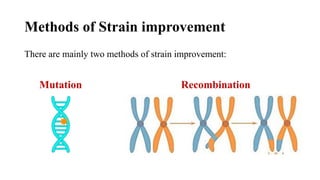
Methods of Strain improvement
There are mainly two methods of strain improvement:
Mutation Recombination
Mutation
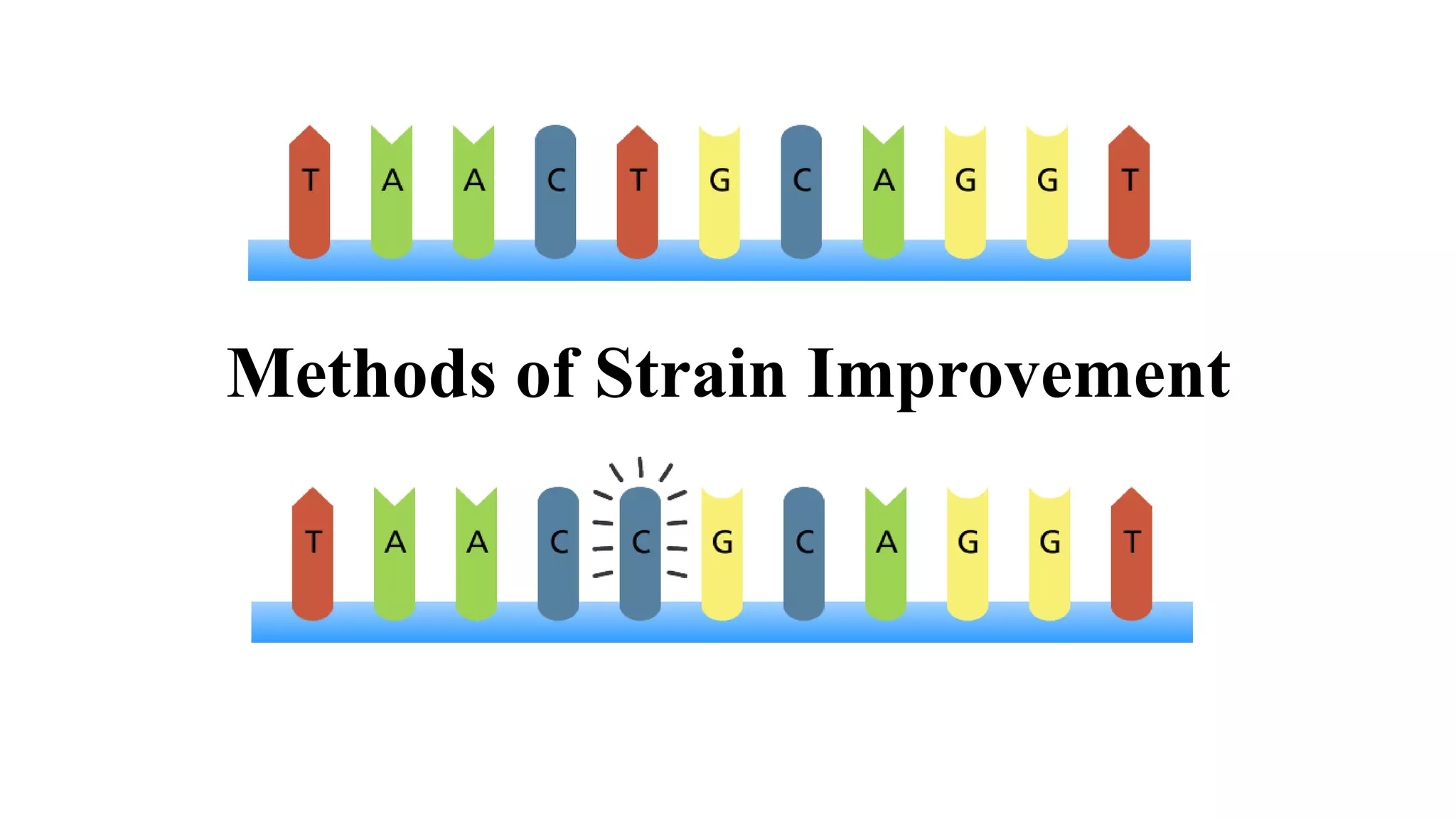
• Any change that occur in the DNA of a gene is referred to as mutation.
This mutation result in structural change in the genome.
• Mutations may be spontaneous or induced.
• Spontaneous mutations occur at a very slow frequency and are not
suitable for industrial purposes.
• Mutations can be induced by mutagenic agents like UV light,
chemicals (nitrous oxide, nitrosoguanidine, hydroxylamine).
Selection of mutants
• Random screening: strain with maximum yield can be selected.
• Selective isolation of mutants:
There are 3 methods for selective isolation of improved strains:
1. Isolation of antibiotic resistant strain
2. Isolation of antimetabolite resistant strain
3. Isolation of auxotrophic mutants
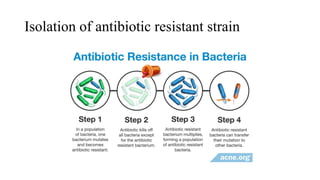
Isolation of antibiotic resistant strain
Isolation of antimetabolite resistant strain
• Antimetabolite which have structural similarities with normal
metabolites can block the normal metabolic pathways and kill the
cells.
• Mutant strains resistant to antimetabolites can be selected for
industrial purposes.
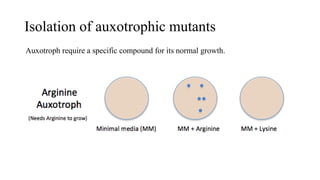
Isolation of auxotrophic mutants
Auxotroph require a specific compound for its normal growth.
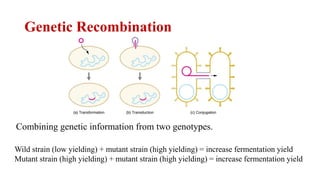
Genetic Recombination
Combining genetic information from two genotypes.
Wild strain (low yielding) + mutant strain (high yielding) = increase fermentation yield
Mutant strain (high yielding) + mutant strain (high yielding) = increase fermentation yield

Methods of strain improvement

  • 1.
    Methods of StrainImprovement
  • 3.
    Genetic improvement ofStrains • Strain: It is a genetic variant or sub-type of a microorganism. • Wild strains of microorganisms produce low quantities of commercially important metabolites. • Therefore we need genetic improvement to produce high quantities of metabolites/products. Wild strains: low yield of products Mutant strains: high yield of products
  • 4.
    Characteristics of improvedstrains 1. Shorter time of fermentation 2. Capable of metabolizing low cost substrates 3. Reduced oxygen demand 4. Decreased foam formation 5. Non-production of undesirable compounds 6. Tolerance to high concentrations of carbon or nitrogen sources 7. Resistance to infections of bacteriophages
  • 5.
    Methods of Strainimprovement There are mainly two methods of strain improvement: Mutation Recombination
  • 6.
    Mutation • Any changethat occur in the DNA of a gene is referred to as mutation. This mutation result in structural change in the genome. • Mutations may be spontaneous or induced. • Spontaneous mutations occur at a very slow frequency and are not suitable for industrial purposes. • Mutations can be induced by mutagenic agents like UV light, chemicals (nitrous oxide, nitrosoguanidine, hydroxylamine).
  • 7.
    Selection of mutants •Random screening: strain with maximum yield can be selected. • Selective isolation of mutants: There are 3 methods for selective isolation of improved strains: 1. Isolation of antibiotic resistant strain 2. Isolation of antimetabolite resistant strain 3. Isolation of auxotrophic mutants
  • 8.
    Isolation of antibioticresistant strain
  • 9.
    Isolation of antimetaboliteresistant strain • Antimetabolite which have structural similarities with normal metabolites can block the normal metabolic pathways and kill the cells. • Mutant strains resistant to antimetabolites can be selected for industrial purposes.
  • 10.
    Isolation of auxotrophicmutants Auxotroph require a specific compound for its normal growth.
  • 11.
    Genetic Recombination Combining geneticinformation from two genotypes. Wild strain (low yielding) + mutant strain (high yielding) = increase fermentation yield Mutant strain (high yielding) + mutant strain (high yielding) = increase fermentation yield