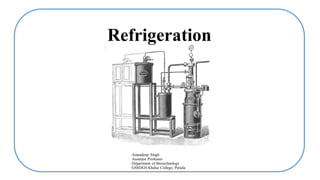
Refrigeration
Amandeep Singh
Assistant Professor
Department of Biotechnology
GSSDGS Khalsa College, Patiala
Content
• Important terminologies in refrigeration
• Importance of refrigeration and factors for spoilage
• Factors affecting cold storage (controlled atmosphere)
• Principle of refrigeration and working of refrigeration system
• Applications of refrigeration in the preservation of various foods
Important terminologies in refrigeration
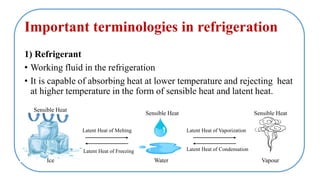
1) Refrigerant
• Working fluid in the refrigeration
• It is capable of absorbing heat at lower temperature and rejecting heat
at higher temperature in the form of sensible heat and latent heat.
Ice Water Vapour
Latent Heat of Melting
Latent Heat of Freezing
Latent Heat of Vaporization
Latent Heat of Condensation
Sensible Heat
Sensible Heat Sensible Heat
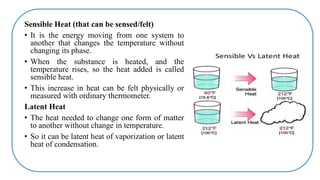
Sensible Heat (that can be sensed/felt)
• It is the energy moving from one system to
another that changes the temperature without
changing its phase.
• When the substance is heated, and the
temperature rises, so the heat added is called
sensible heat.
• This increase in heat can be felt physically or
measured with ordinary thermometer.
Latent Heat
• The heat needed to change one form of matter
to another without change in temperature.
• So it can be latent heat of vaporization or latent
heat of condensation.
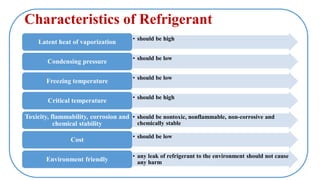
Characteristics of Refrigerant
• should be high
Latent heat of vaporization
• should be low
Condensing pressure
• should be low
Freezing temperature
• should be high
Critical temperature
• should be nontoxic, nonflammable, non-corrosive and
chemically stable
Toxicity, flammability, corrosion and
chemical stability
• should be low
Cost
• any leak of refrigerant to the environment should not cause
any harm
Environment friendly
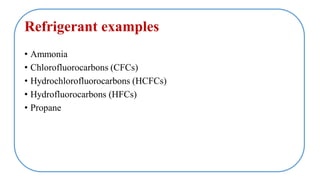
Refrigerant examples
• Ammonia
• Chlorofluorocarbons (CFCs)
• Hydrochlorofluorocarbons (HCFCs)
• Hydrofluorocarbons (HFCs)
• Propane
2) Cooling load
Cooling load is the rate of removal of heat from a defined space in order
to lower the temperature of that space to a desired level.
The cooling loads of refrigeration systems are designated with a
common unit called ton of refrigeration (TR).
3) Ton of refrigeration (TR)
Amount of heat required to be removed from one ton of water at 0°C in
order to convert it into ice at 0°C in one day (24 hours).
1TR= 12600 KJ/h or 210 KJ/min or 3.5 KW
4) Coefficient of Performance (COP)
The efficiency of the refrigeration system is also indicated as
Coefficient of Performance of the system.
It is the ratio of the heat extracted in the refrigerator to the work done on
the refrigerant.
COP = Amount of heat extracted in the refrigerator (Q)
Amount of work done (W)
COP = Q
W
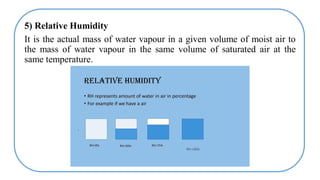
5) Relative Humidity
It is the actual mass of water vapour in a given volume of moist air to
the mass of water vapour in the same volume of saturated air at the
same temperature.
Importance of refrigeration and factors for
spoilage
• Foods can become spoiled due to chemical reaction, physical reaction or action of
microbes. Microbes are present in air, water, soil and also in the food we consume.
• Lowering the temperature slows down the rapid rate of these bacterial growth in
foods. Most bacteria grow at a temperature of 4°C (40°F) to 60°C (140°F).
• This is the basic principle behind prolonging shelf life of the foods we consume
through refrigerated storage.
Importance of refrigeration
• Refrigerated temperatures do not slow the reaction rates as much as
freezing temperatures so they are not used for long term storage.
• However refrigerated foods do not suffer from ice crystal damage and
they do not have to go through a thawing time before preparation as do
many of their frozen counter parts.
• For this reason refrigeration is a storage method of choice in many
situations.
Microbial Growth
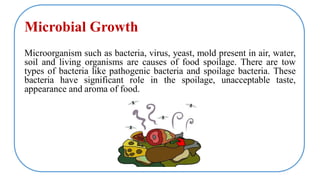
Microorganism such as bacteria, virus, yeast, mold present in air, water,
soil and living organisms are causes of food spoilage. There are tow
types of bacteria like pathogenic bacteria and spoilage bacteria. These
bacteria have significant role in the spoilage, unacceptable taste,
appearance and aroma of food.
Microbial Growth
• Pathogenic bacteria are the root cause of food borne illness, can grow
rapidly in the temperature range of 4°C (40°F) to 60°C (140°F)
generally referred as danger zone.
• The presence of these bacteria will not have the impact on general
appearance, taste and odor of the food.
• Whereas spoilage bacteria that grow at low temperatures may affect
the colour, smell, taste and texture of the foods. For any good
refrigeration, the temperature should be lower than 7.5°C.
Microbial Growth
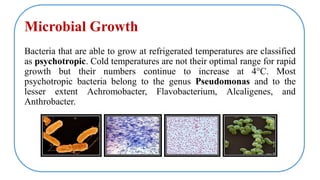
Bacteria that are able to grow at refrigerated temperatures are classified
as psychotropic. Cold temperatures are not their optimal range for rapid
growth but their numbers continue to increase at 4°C. Most
psychotropic bacteria belong to the genus Pseudomonas and to the
lesser extent Achromobacter, Flavobacterium, Alcaligenes, and
Anthrobacter.
Factors affecting cold storage
(Controlled Atmosphere)
• A special commercial refrigeration technique is controlled atmosphere in which
the atmosphere of the refrigerated space is altered.
• The oxygen content is remarkably reduced and carbon-dioxide content is
increased and humidity is controlled.
• Food preservation by refrigeration should start very soon after harvesting and
must be continuous until the food is consumed. Handling of large volume of food
requires expensive and bulky equipments which is both inconvenient and
uneconomical.
• Food preservation also depends on the following factors such as the type of the
product, the length of time the product has to be preserved, the purpose for which
product is to be used, the availability of transportation and storage equipment.
• The preservation of perishable by refrigeration involves the use of low temperature
as a mean of eliminating or retarding the activity of spoilage agents.
Principle of Refrigeration
• It is based on the principle that absorption of heat by a fluid
(refrigerant) as it changes from a liquid to a gas, lowers the
temperature of the objects around it.
• The most common type of refrigeration system applying this principle
is Vapour Compression Refrigeration (VCR) System.
• The VCR System is widely used in refrigeration applications like
refrigerator, water cooler, air conditioner and cold storage.
• The refrigeration effect is produced at the evaporator.
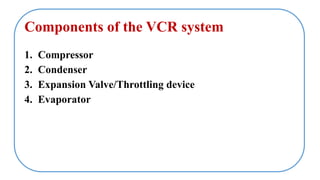
Components of the VCR system
1. Compressor
2. Condenser
3. Expansion Valve/Throttling device
4. Evaporator
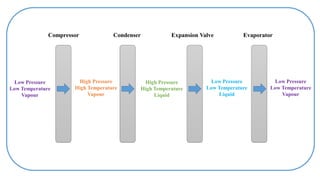
Low Pressure
Low Temperature
Vapour
High Pressure
High Temperature
Vapour
High Pressure
High Temperature
Liquid
Low Pressure
Low Temperature
Liquid
Low Pressure
Low Temperature
Vapour
Compressor Condenser Expansion Valve Evaporator
Working of refrigeration system
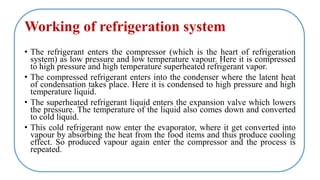
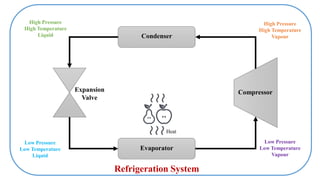
• The refrigerant enters the compressor (which is the heart of refrigeration
system) as low pressure and low temperature vapour. Here it is compressed
to high pressure and high temperature superheated refrigerant vapor.
• The compressed refrigerant enters into the condenser where the latent heat
of condensation takes place. Here it is condensed to high pressure and high
temperature liquid.
• The superheated refrigerant liquid enters the expansion valve which lowers
the pressure. The temperature of the liquid also comes down and converted
to cold liquid.
• This cold refrigerant now enter the evaporator, where it get converted into
vapour by absorbing the heat from the food items and thus produce cooling
effect. So produced vapour again enter the compressor and the process is
repeated.
Low Pressure
Low Temperature
Vapour
High Pressure
High Temperature
Vapour
High Pressure
High Temperature
Liquid
Low Pressure
Low Temperature
Liquid
Compressor
Condenser
Expansion
Valve
Evaporator
Refrigeration System
Heat

Refrigeration

  • 1.
    Refrigeration Amandeep Singh Assistant Professor Departmentof Biotechnology GSSDGS Khalsa College, Patiala
  • 2.
    Content • Important terminologiesin refrigeration • Importance of refrigeration and factors for spoilage • Factors affecting cold storage (controlled atmosphere) • Principle of refrigeration and working of refrigeration system • Applications of refrigeration in the preservation of various foods
  • 3.
    Important terminologies inrefrigeration 1) Refrigerant • Working fluid in the refrigeration • It is capable of absorbing heat at lower temperature and rejecting heat at higher temperature in the form of sensible heat and latent heat. Ice Water Vapour Latent Heat of Melting Latent Heat of Freezing Latent Heat of Vaporization Latent Heat of Condensation Sensible Heat Sensible Heat Sensible Heat
  • 4.
    Sensible Heat (thatcan be sensed/felt) • It is the energy moving from one system to another that changes the temperature without changing its phase. • When the substance is heated, and the temperature rises, so the heat added is called sensible heat. • This increase in heat can be felt physically or measured with ordinary thermometer. Latent Heat • The heat needed to change one form of matter to another without change in temperature. • So it can be latent heat of vaporization or latent heat of condensation.
  • 5.
    Characteristics of Refrigerant •should be high Latent heat of vaporization • should be low Condensing pressure • should be low Freezing temperature • should be high Critical temperature • should be nontoxic, nonflammable, non-corrosive and chemically stable Toxicity, flammability, corrosion and chemical stability • should be low Cost • any leak of refrigerant to the environment should not cause any harm Environment friendly
  • 6.
    Refrigerant examples • Ammonia •Chlorofluorocarbons (CFCs) • Hydrochlorofluorocarbons (HCFCs) • Hydrofluorocarbons (HFCs) • Propane
  • 7.
    2) Cooling load Coolingload is the rate of removal of heat from a defined space in order to lower the temperature of that space to a desired level. The cooling loads of refrigeration systems are designated with a common unit called ton of refrigeration (TR).
  • 8.
    3) Ton ofrefrigeration (TR) Amount of heat required to be removed from one ton of water at 0°C in order to convert it into ice at 0°C in one day (24 hours). 1TR= 12600 KJ/h or 210 KJ/min or 3.5 KW
  • 9.
    4) Coefficient ofPerformance (COP) The efficiency of the refrigeration system is also indicated as Coefficient of Performance of the system. It is the ratio of the heat extracted in the refrigerator to the work done on the refrigerant. COP = Amount of heat extracted in the refrigerator (Q) Amount of work done (W) COP = Q W
  • 10.
    5) Relative Humidity Itis the actual mass of water vapour in a given volume of moist air to the mass of water vapour in the same volume of saturated air at the same temperature.
  • 11.
    Importance of refrigerationand factors for spoilage • Foods can become spoiled due to chemical reaction, physical reaction or action of microbes. Microbes are present in air, water, soil and also in the food we consume. • Lowering the temperature slows down the rapid rate of these bacterial growth in foods. Most bacteria grow at a temperature of 4°C (40°F) to 60°C (140°F). • This is the basic principle behind prolonging shelf life of the foods we consume through refrigerated storage.
  • 12.
    Importance of refrigeration •Refrigerated temperatures do not slow the reaction rates as much as freezing temperatures so they are not used for long term storage. • However refrigerated foods do not suffer from ice crystal damage and they do not have to go through a thawing time before preparation as do many of their frozen counter parts. • For this reason refrigeration is a storage method of choice in many situations.
  • 13.
    Microbial Growth Microorganism suchas bacteria, virus, yeast, mold present in air, water, soil and living organisms are causes of food spoilage. There are tow types of bacteria like pathogenic bacteria and spoilage bacteria. These bacteria have significant role in the spoilage, unacceptable taste, appearance and aroma of food.
  • 14.
    Microbial Growth • Pathogenicbacteria are the root cause of food borne illness, can grow rapidly in the temperature range of 4°C (40°F) to 60°C (140°F) generally referred as danger zone. • The presence of these bacteria will not have the impact on general appearance, taste and odor of the food. • Whereas spoilage bacteria that grow at low temperatures may affect the colour, smell, taste and texture of the foods. For any good refrigeration, the temperature should be lower than 7.5°C.
  • 15.
    Microbial Growth Bacteria thatare able to grow at refrigerated temperatures are classified as psychotropic. Cold temperatures are not their optimal range for rapid growth but their numbers continue to increase at 4°C. Most psychotropic bacteria belong to the genus Pseudomonas and to the lesser extent Achromobacter, Flavobacterium, Alcaligenes, and Anthrobacter.
  • 16.
    Factors affecting coldstorage (Controlled Atmosphere) • A special commercial refrigeration technique is controlled atmosphere in which the atmosphere of the refrigerated space is altered. • The oxygen content is remarkably reduced and carbon-dioxide content is increased and humidity is controlled. • Food preservation by refrigeration should start very soon after harvesting and must be continuous until the food is consumed. Handling of large volume of food requires expensive and bulky equipments which is both inconvenient and uneconomical. • Food preservation also depends on the following factors such as the type of the product, the length of time the product has to be preserved, the purpose for which product is to be used, the availability of transportation and storage equipment. • The preservation of perishable by refrigeration involves the use of low temperature as a mean of eliminating or retarding the activity of spoilage agents.
  • 17.
    Principle of Refrigeration •It is based on the principle that absorption of heat by a fluid (refrigerant) as it changes from a liquid to a gas, lowers the temperature of the objects around it. • The most common type of refrigeration system applying this principle is Vapour Compression Refrigeration (VCR) System. • The VCR System is widely used in refrigeration applications like refrigerator, water cooler, air conditioner and cold storage. • The refrigeration effect is produced at the evaporator.
  • 18.
    Components of theVCR system 1. Compressor 2. Condenser 3. Expansion Valve/Throttling device 4. Evaporator
  • 19.
    Low Pressure Low Temperature Vapour HighPressure High Temperature Vapour High Pressure High Temperature Liquid Low Pressure Low Temperature Liquid Low Pressure Low Temperature Vapour Compressor Condenser Expansion Valve Evaporator
  • 20.
    Working of refrigerationsystem • The refrigerant enters the compressor (which is the heart of refrigeration system) as low pressure and low temperature vapour. Here it is compressed to high pressure and high temperature superheated refrigerant vapor. • The compressed refrigerant enters into the condenser where the latent heat of condensation takes place. Here it is condensed to high pressure and high temperature liquid. • The superheated refrigerant liquid enters the expansion valve which lowers the pressure. The temperature of the liquid also comes down and converted to cold liquid. • This cold refrigerant now enter the evaporator, where it get converted into vapour by absorbing the heat from the food items and thus produce cooling effect. So produced vapour again enter the compressor and the process is repeated.
  • 21.
    Low Pressure Low Temperature Vapour HighPressure High Temperature Vapour High Pressure High Temperature Liquid Low Pressure Low Temperature Liquid Compressor Condenser Expansion Valve Evaporator Refrigeration System Heat